
Understanding Ecommerce Conversion Benchmarks That Matter
Before you start optimizing your online store, it's essential to understand what success truly looks like. What exactly is a "good" ecommerce conversion rate? The truth is, there's no single answer. Comparing your performance against irrelevant benchmarks can actually harm your ecommerce conversion rate optimization (CRO) strategy. Instead, concentrate on benchmarks relevant to your specific business model and target audience.
Industry Benchmarks: A Starting Point
Consider your industry. A luxury watch retailer will likely have a lower conversion rate than a seller of everyday household goods. This difference stems from factors like price point, purchase frequency, and the length of the sales cycle. You might find this resource helpful: How to master a marketing strategy for small businesses.
For example, fashion retailers often see higher conversion rates than businesses selling high-ticket items like furniture. This is because clothing tends to be less expensive and purchased more regularly. However, even within the fashion industry, conversion rates can vary significantly depending on the specific niche.
As a UK-based ecommerce business, understanding the national context is critical for effective CRO. For instance, the average ecommerce conversion rate in the UK in 2025 is around 3.4%, slightly above the global average. The average Shopify store in the UK converts at approximately 1.4%, while those exceeding 3.2% are in the top 20% nationally. For more detailed information, see: What is a good ecommerce conversion rate 2025?
Beyond the Average: Your Specific Business
While industry averages offer a general guideline, relying solely on them can be misleading. Your specific business model, target audience, and product offerings will all influence your ideal conversion rate. A niche retailer with a loyal customer base may achieve higher conversions than a larger, more general ecommerce store.
Understanding the core principles of CRO is vital. Here are some helpful conversion rate optimization techniques to explore.
Identifying Key Metrics: Beyond Sales
While sales are the ultimate objective, other metrics offer valuable insights into customer behavior and areas for improvement. Cart abandonment rate, for example, reveals how many potential customers add items to their cart but don't complete the purchase. A high abandonment rate might indicate issues with the checkout process, shipping costs, or payment options. Average order value (AOV) shows how much customers typically spend per transaction. Increasing AOV can significantly boost revenue even if the number of sales remains constant.
| Metric | Description | Importance |
|---|---|---|
| Conversion Rate | Percentage of visitors who complete a purchase | Measures overall effectiveness |
| Cart Abandonment Rate | Percentage of visitors who add items to their cart but don't purchase | Identifies friction points in checkout |
| Average Order Value (AOV) | Average amount spent per transaction | Indicates customer spending habits and potential for upselling/cross-selling |
By analyzing these metrics alongside your conversion rate, you can gain a comprehensive understanding of your ecommerce performance and pinpoint areas for targeted CRO. This data-driven approach focuses on metrics that genuinely matter for your business, driving sustainable growth instead of chasing superficial numbers. Remember, optimization is a continuous process.
Transforming Product Pages Into Conversion Powerhouses
Product pages are the core of ecommerce, the vital space where casual browsing transforms into purchasing decisions. This is where ecommerce conversion rate optimization (CRO) takes center stage. Leading ecommerce brands consistently refine their product pages, striving to create truly compelling experiences that ultimately drive sales.
Crafting Compelling Product Descriptions
Move beyond dry, technical specifications. Modern product descriptions should tell a story. Focus not just on what a product is, but what it does for the customer. Anticipate and address potential objections directly.
For example, if a garment is crafted from a unique material, explain its advantages in terms of comfort, durability, or care instructions. This proactive approach cultivates trust and minimizes purchase hesitation.
Visual Storytelling That Sells
High-quality product images are essential, but consider going beyond static shots. Lifestyle imagery, showing the product in use, can forge a stronger emotional connection with potential buyers.
Think about incorporating video demonstrations or 360-degree views for a more immersive experience. This helps customers envision themselves using the product, significantly boosting conversions.
The Power of User Behavior Analysis
Understanding user interaction with your product pages is critical. Visualizing user path flows can unlock valuable insights. The infographic below, showing an analytics dashboard on a laptop with a 'User Behavior' text block, illustrates this concept.
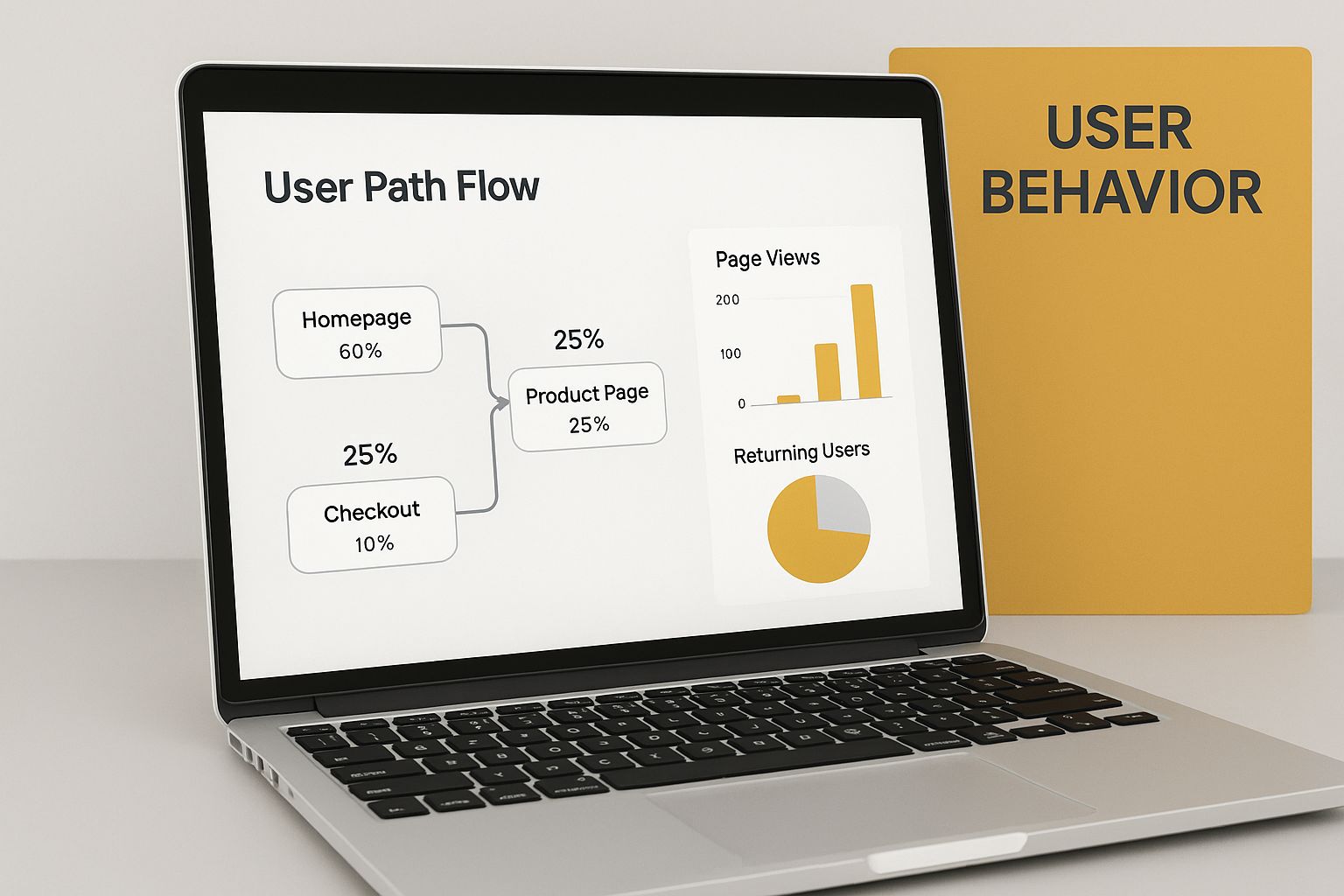
This visualization highlights common drop-off points and areas of high engagement, pinpointing areas for improvement. By identifying where users hesitate or lose interest, you can implement targeted changes to optimize flow and guide customers toward purchase. This data-driven approach maximizes the impact of your optimization efforts on conversion rates.
Mobile-First Experiences That Convert
With the increasing number of UK shoppers using smartphones for online purchases, a seamless mobile experience is non-negotiable. Ensure your product pages are fully responsive, loading quickly and efficiently on any device.
Simplify navigation and prioritize key information for smaller screens and shorter attention spans. Larger buttons and streamlined forms can significantly enhance the mobile checkout process.
Benchmarking Your Ecommerce Conversion Rate
Understanding what constitutes a good conversion rate within the UK market is crucial. A strong ecommerce conversion rate typically falls between 2.5% and 3.5%, with top performers achieving 5% or higher. These figures highlight the importance of website design, user experience, and the customer journey.
For instance, a site with 500 visitors and 15 purchases has a 3% conversion rate, indicative of a well-optimized platform. Find more detailed statistics here.
The Importance of Testing and Iteration
CRO is a continuous process. Constantly testing different product page elements, from headlines to calls to action, is crucial for understanding what resonates with your target audience.
A/B testing, comparing two versions of a page to determine which performs better, is a powerful tool for data-driven optimization. Even minor adjustments can significantly impact your bottom line.
The following table provides a breakdown of how different product page elements can impact conversion rates, based on typical A/B testing results.
Product Page Elements: Conversion Impact Analysis
This table shows how different product page elements influence conversion rates based on A/B testing data
| Page Element | Average Conversion Impact | Implementation Difficulty | Best Practices |
|---|---|---|---|
| High-Quality Product Images | +10-30% | Low | Use professional photography, showcase product in use |
| Compelling Product Descriptions | +5-20% | Medium | Focus on benefits, address customer needs |
| User-Friendly Mobile Design | +10-25% | Medium | Responsive design, streamlined checkout |
| Clear Call to Actions | +5-15% | Low | Use strong verbs, create visual hierarchy |
| Customer Reviews and Testimonials | +10-25% | Medium | Display prominently, encourage reviews |
| Streamlined Checkout Process | +5-15% | High | Minimize steps, offer multiple payment options |
This table highlights the significant impact various elements can have on conversions. While high-quality images and compelling descriptions are relatively easy to implement and offer substantial gains, optimizing the checkout process, although more complex, can significantly reduce cart abandonment. Focusing on these elements can help you transform your product pages into conversion powerhouses.
Mastering Checkout Flow to Capture Abandoned Revenue
Cart abandonment represents a significant challenge for UK ecommerce businesses, leading to substantial revenue loss. By carefully examining successful checkout processes, we can pinpoint the friction points that cause customers to abandon their purchases. This section explores how to optimize your checkout flow for increased conversions.
Streamlining the Checkout Experience for UK Shoppers
A seamless checkout experience is essential for minimizing cart abandonment. Every step in the process should be as smooth and efficient as possible. This starts with reducing the number of steps required to complete a purchase.
- Reduce Form Fields: Request only essential customer information. Excessively long or complex forms can discourage customers from completing the purchase.
- Guest Checkout Option: Offer a guest checkout option, allowing customers to purchase without creating an account. This expedites the process, particularly for first-time buyers.
- Clear Progress Indicators: Provide clear progress indicators to show customers their current stage in the checkout process. This helps manage expectations and encourages completion.
Building Trust and Confidence During Checkout
Trust is paramount in ecommerce, especially during the checkout process. Customers need assurance that their personal and financial information is secure.
- Display Security Badges: Prominently display recognizable security badges from reputable providers like Norton or McAfee to build trust and demonstrate your commitment to security.
- Secure Payment Gateways: Offer a variety of secure payment options, including widely used choices like PayPal and Apple Pay. Catering to diverse payment preferences strengthens the perception of security.
- Transparent Return Policies: Clearly articulate your return policy. A straightforward and customer-friendly return policy can alleviate purchase anxieties.
Payment Method Optimization for the UK Market
Offering the right payment methods is crucial for maximizing conversions. UK consumers have distinct preferences, and accommodating these can significantly impact your bottom line.
- Credit and Debit Cards: Ensure acceptance of major credit and debit cards like Visa, Mastercard, and Maestro, which are standard in the UK.
- Digital Wallets: Include popular digital wallets like Apple Pay, Google Pay, and PayPal, which are increasingly favored by consumers.
- Buy Now, Pay Later: Consider integrating Buy Now, Pay Later options like Klarna and Clearpay to provide flexible payment options and attract a broader customer base.
Optimizing payment methods goes beyond simply offering various choices; it's about presenting them clearly and logically within the checkout flow. A cluttered or confusing payment section can lead to cart abandonment.
The UK boasts a robust ecommerce conversion rate, averaging around 4.1% across various industries. This high rate is attributed in part to well-developed digital infrastructure and widespread adoption of online shopping. Learn more about UK ecommerce conversion rates.
Recovering Abandoned Carts: A Second Chance at Conversion
Even with the most optimized checkout process, some cart abandonment is inevitable. However, this doesn't equate to lost revenue. Implement a cart recovery strategy to re-engage these customers.
- Abandoned Cart Emails: Send automated emails reminding customers about the items left in their carts. Sweeten the deal with incentives like free shipping or discounts.
- Retargeting Ads: Utilize retargeting ads on platforms like Google and Facebook to reconnect with customers who abandoned their carts. Showcase the specific products they left behind.
- Personalized Messages: Personalize your abandoned cart messages by referencing the specific products and offering relevant recommendations.
By implementing these checkout optimization strategies, you can effectively recapture abandoned revenue and significantly boost your ecommerce conversion rate optimization. A smooth, trustworthy, and convenient checkout experience is essential for turning potential customers into paying customers.
Harnessing Social Proof That Actually Converts Customers

Customer testimonials, expert endorsements, and user-generated content are all powerful tools in ecommerce conversion rate optimization. However, simply adding reviews to your website isn't enough. This section explores how to strategically use social proof to overcome purchase hesitation and improve sales.
Understanding The Psychology of Social Proof
Social proof leverages our natural inclination to follow others' examples. When we're unsure, we seek guidance, particularly when shopping online where we can't physically interact with products.
Imagine browsing two similar products on different sites. One has numerous positive reviews; the other has none. Which inspires more trust? The presence of reviews, even imperfect ones, builds confidence and minimizes perceived risk.
Types of Social Proof and Their Impact
Different types of social proof connect with various audiences. Consider your target market when deciding which to emphasize.
-
Customer Testimonials: Authentic stories from happy customers build trust and showcase product value. Prioritize testimonials addressing specific concerns or highlighting key advantages.
-
Expert Endorsements: Recommendations from recognized figures in your industry add credibility and reassure potential buyers. This is particularly effective for specialized products.
-
Usage Statistics: Data like "90% of customers reported improved results" or "Trusted by over 1 million users" creates a sense of popularity and reinforces product effectiveness.
-
User-Generated Content (UGC): Real customer photos and videos using your products fosters community and shows real-world applications. Encourage UGC with contests or incentives.
Strategically Positioning Social Proof Throughout The Customer Journey
Social proof isn't limited to product pages. Integrate it throughout the customer journey to address conversion barriers at every touchpoint.
-
Homepage: Feature key statistics or testimonials to build initial trust and encourage site exploration.
-
Product Pages: Display relevant reviews and ratings to answer product-specific questions and overcome purchase hesitation.
-
Checkout Page: Reinforce trust with security badges and guarantees to alleviate payment and shipping concerns. Consider resources like: How to master the advantages of email marketing.
-
Post-Purchase: Encourage reviews and UGC to build community and generate more social proof.
Generating High-Quality Reviews That Influence
Actively solicit reviews from satisfied customers. Don't just request a star rating; encourage detailed feedback.
-
Automated Email Requests: Send personalized emails after purchase, thanking customers and requesting a review.
-
Incentives: Offer discounts or loyalty points for submitting reviews.
-
Make it Easy: Provide clear instructions and streamline the feedback process.
Implementing Trust Signals That Reinforce Customer Confidence
Beyond reviews, incorporate other trust signals to build credibility.
-
Security Badges: Display recognizable badges from trusted security providers.
-
Money-Back Guarantees: Offer a clear and straightforward guarantee to reduce perceived risk.
-
Contact Information: Make it easy for customers to contact you with questions or concerns.
By strategically implementing these tactics, you can cultivate a robust social proof ecosystem that converts browsers into buyers and builds lasting customer loyalty. Effective ecommerce conversion rate optimization depends on fostering trust and addressing customer concerns at every stage of the buying process.
Personalization Strategies That Drive Purchase Decisions
Personalization in e-commerce has evolved. Instead of simply offering basic product recommendations, sophisticated UK brands are now using behavioral data, purchase history, and even real-time information like the weather or local events to create truly relevant shopping experiences. This detailed approach to e-commerce conversion rate optimization can significantly impact your profits.
Segmentation: The Foundation of Effective Personalization
Effective personalization begins with segmentation. Instead of a one-size-fits-all approach to customers, segmentation divides your audience into smaller groups with shared characteristics. These characteristics could include demographics, buying behavior, browsing history, or even how they interact with your marketing emails.
For instance, segmenting customers by preferred product categories allows you to showcase new arrivals and special offers relevant to their interests, increasing the chance of a sale. Think of it as tailoring a storefront window display to attract specific shoppers. You wouldn't display winter coats to someone looking for summer attire.
Personalized Product Recommendations and Targeted Messaging
After segmenting your audience, you can start creating personalized experiences. This could include personalized product recommendations on your homepage or category pages. Rather than displaying generic bestsellers, you can highlight items based on each segment’s preferences.
You can also use targeted messaging in email marketing and on-site notifications. For example, a customer who recently viewed a product could receive a follow-up email with a discount code, encouraging them to complete the purchase.
Customized Promotions That Reflect Individual Needs
Discounts and promotions drive conversions, but generic offers are often ineffective. Customized promotions, however, show that you understand your customers’ individual needs. For example, consider offering a discount on a customer’s previously browsed product category, or free shipping on orders above a certain amount based on their average order value. These personalized incentives are much more appealing than general discounts. For businesses wanting to add social proof, consider adding Google reviews to your website.
Real-World Examples and Measurable Results
Many UK retailers have seen significant conversion improvements through personalization. One major fashion retailer saw a 25% increase in conversion rates after implementing personalized product recommendations on its homepage. Another UK electronics store achieved a 15% increase in average order value by offering customized discounts based on purchase history.
These real-world results demonstrate that personalization is a highly effective strategy for e-commerce conversion rate optimization. You might also be interested in learning how to master digital marketing.
Balancing Personalization with Practicality and Resources
While the benefits of personalization are clear, implementing these strategies can be challenging, especially for smaller businesses. It's important to balance the desire for specific personalization with practical implementation.
The following table compares different personalization strategies, their complexity, impact on conversion rates, ideal business size, and customer privacy considerations.
Personalization Strategy Comparison: Comparing different personalization approaches and their impact on conversion rates
| Personalization Strategy | Implementation Complexity | Conversion Rate Impact | Best For | Customer Privacy Considerations |
|---|---|---|---|---|
| Personalized Product Recommendations | Low | Medium | All Businesses | Data usage transparency |
| Targeted Email Marketing | Medium | High | Growing Businesses | Opt-in and data security |
| Customized Offers & Discounts | Medium | High | Established Businesses | Clear communication of offer terms |
| On-Site Behavioral Personalization | High | High | Large Businesses | Data minimization and user control |
This table shows that different personalization approaches have varying levels of complexity and potential impact. By starting with strategies that align with your resources, you can harness the power of personalization and significantly improve your e-commerce conversion rate optimization efforts. Even small steps toward personalization can deliver impressive results.
Speed Optimization Techniques That Prevent Abandonment

Site speed is paramount for ecommerce conversion rate optimization. A slow website can frustrate UK shoppers, leading to higher bounce rates and lost sales. This section explores how to transform your site's speed into a conversion advantage. Think of it like this: would you wait in a long queue at a shop with slow service, or simply move on to a quicker alternative?
Identifying Performance Bottlenecks That Impact Sales
Don't rely on generic advice. Identify the specific bottlenecks impacting your sales. Use tools like Google PageSpeed Insights to analyze your site's performance and pinpoint areas for improvement.
Large image files, for example, can significantly slow down loading times. Unoptimized images are like carrying extra weight; they hinder your website's progress. Identifying and optimizing these elements can have a dramatic impact.
Implementing Core Web Vitals for Better Conversions
Core Web Vitals, a set of metrics focusing on user experience, are crucial for both SEO and conversions. These metrics quantify aspects of the user experience such as page load speed, interactivity, and visual stability.
-
Largest Contentful Paint (LCP): Measures how quickly the main content of a page loads. Aim for an LCP of 2.5 seconds or less. This gives users the impression of a responsive and efficient site.
-
First Input Delay (FID): Measures the time it takes for a page to become interactive. A low FID, ideally 100 milliseconds or less, ensures users can quickly engage with your site.
-
Cumulative Layout Shift (CLS): Measures visual stability. A low CLS, 0.1 or less, prevents annoying shifts in layout as a page loads. This creates a smoother, more professional experience.
Addressing these vitals ensures a smooth and responsive experience, encouraging users to stay engaged and complete their purchases.
Mobile-Specific Performance Enhancements for UK Shoppers
With the majority of UK shoppers browsing on mobile, optimizing for different connection speeds is essential. This is especially important for areas with less reliable mobile data coverage.
-
Optimize Images: Compress images specifically for mobile devices. Using appropriate image formats like WebP can also significantly decrease file size without sacrificing quality.
-
Minimize HTTP Requests: Each request adds to loading time. Reducing these requests streamlines the loading process. Combining CSS and JavaScript files is one way to minimize these requests.
-
Leveraging Browser Caching: Storing frequently accessed files locally on a user’s device speeds up subsequent page loads. This improves the user experience, especially for returning visitors.
Prioritizing Speed Improvements Based on Customer Needs
Focus on the speed issues that matter most to your customers. If most of your traffic comes from mobile devices, for instance, prioritize mobile optimization. Consider the specific pages that have the biggest impact on conversions.
-
Product Pages: Prioritize the speed of product pages, where purchase decisions are made. Fast-loading product pages are essential for capturing and holding attention.
-
Checkout Flow: A quick and seamless checkout process is vital. Any delay during checkout can lead to cart abandonment. This includes speed improvements in payment processing.
-
Homepage: First impressions are crucial. Your homepage should load quickly to engage visitors and encourage them to explore further. Slow homepages can lead to immediate bounces.
By implementing these speed optimization techniques, you can create a positive user experience that encourages conversions. This contributes to a stronger ecommerce conversion rate optimization strategy. Remember, a faster website leads to happier customers and higher sales.
Building a Conversion Testing Program That Delivers Results
A/B testing is a valuable tool, but it’s only one component of a successful strategy. To truly optimize your ecommerce conversion rate, you need a comprehensive conversion testing program. This involves moving beyond individual tests and establishing a system for continuous improvement. It's about cultivating a culture of testing and learning within your organization.
Identifying High-Impact Testing Opportunities
Not all tests are created equal. Focusing on key areas can yield significant results, even with small improvements. Optimizing your checkout process, where purchasing decisions are finalized, often has a greater impact than less critical changes, such as altering a button color on your homepage.
-
Checkout Process: Streamline the buying experience by testing different checkout flows, payment options, and form field layouts.
-
Product Pages: Experiment with product descriptions, images, and calls to action to determine what resonates most with your audience.
-
Pricing and Promotions: Test different pricing strategies, discounts, and promotional offers to identify the optimal balance for maximizing revenue.
Developing Hypotheses Based on Customer Behavior
Instead of relying on guesswork, base your tests on real customer data. Utilize analytics platforms like Google Analytics to understand user behavior on your site. Identify areas where users are dropping off or spending the most time. These insights can inform your testing hypotheses. For instance, a high abandonment rate on a specific product page might suggest that unclear product information is causing hesitation.
Implementing Statistically Significant Experiments
To avoid inaccurate conclusions, ensure your tests are statistically significant. A/B testing tools often calculate statistical significance automatically, confirming that the results are due to the changes you’ve implemented, not random chance. These tools not only facilitate the experiments but also analyze the results with increased accuracy.
Building a Testing Culture
Integrate testing into your company culture. Encourage participation from all teams, from marketing to product development. This fosters a culture of continuous improvement focused on optimizing the customer experience. Regularly share test results and insights within the organization to promote knowledge sharing and drive further optimization.
Combining Quantitative and Qualitative Insights
While A/B testing provides valuable quantitative data, qualitative insights are equally important. User testing, customer surveys, and feedback forms can provide valuable context for why users behave in certain ways. This deeper understanding leads to more effective testing hypotheses. Quantitative data might reveal that a particular call to action is underperforming, while qualitative feedback could explain that users find the wording confusing.
Prioritizing Optimization Opportunities
Develop a framework for prioritizing testing opportunities based on potential impact and ease of implementation. A prioritization matrix can help you weigh these factors, ensuring that your efforts are focused on the most effective optimization strategies.
Measuring the True Business Impact
Go beyond simply tracking conversion rates. Measure the impact of your testing program on your bottom line. Analyze how your optimization efforts have affected revenue and customer lifetime value. These metrics provide a clearer picture of your program's overall success and justify continued investment in ecommerce conversion rate optimization.
Looking for tools to enhance your ecommerce marketing? Explore The Digital Marketing Toolbox at https://grow-your-biz.com. Discover a wide range of resources, from AI-powered content creation tools to advanced analytics platforms. The Toolbox offers curated recommendations to help you streamline workflows, automate tasks, and achieve measurable results. Whether you're a small business owner or an experienced ecommerce manager, the Toolbox provides the essential tools for success in today's competitive market.


