
Why Your Abandoned Cart Strategy Needs More Than Just a Reminder
Lost sales from abandoned carts represent one of the most significant and persistent challenges for any e-commerce business. While a basic ‘You left something behind' email is a start, it's rarely enough to stand out in a crowded inbox or convince a hesitant buyer. Modern customers expect personalised, timely, and genuinely helpful communication that directly addresses their reasons for pausing, whether it's related to price, product uncertainty, or a simple, everyday distraction. An expertly optimised abandoned cart sequence isn't just a courtesy; it's a powerful tool that can recover a substantial percentage of this otherwise lost revenue, turning a moment of indecision into a confirmed sale.
This article moves beyond generic advice to provide a deep, strategic breakdown of what makes a recovery campaign truly effective. We will dissect six sophisticated abandoned cart email examples, analysing the psychology, design choices, and copywriting that drive their success. You won't find surface-level descriptions here. Instead, you'll get actionable insights and replicable strategies you can implement immediately to improve your own results.
We will explore a range of proven tactics, including:
- The Simple Reminder with Product Images: Mastering the fundamentals.
- The Urgency and Scarcity Strategy: Creating a compelling reason to act now.
- The Incentive-Based Recovery Email: Using discounts and offers intelligently.
- The Social Proof and Review Integration: Building trust with user-generated content.
- The Personalised Recommendation Sequence: Cross-selling and upselling effectively.
- The Multi-Touch Sequential Campaign: Nurturing hesitant buyers over time.
By examining these real-world examples, you'll learn how to transform your abandoned cart emails from a simple reminder into a high-performing revenue recovery engine.
1. The Simple Reminder with Product Images
The most effective abandoned cart recovery often starts with the simplest approach: a direct, visually-driven reminder. This foundational strategy strips away complexity, focusing on the core elements that matter most to a customer who has just left your site. It leverages high-quality product imagery, essential cart details, and a clear, unmissable call-to-action (CTA). This method is one of the most powerful abandoned cart email examples because its simplicity cuts through inbox clutter, reminding shoppers precisely what caught their eye.
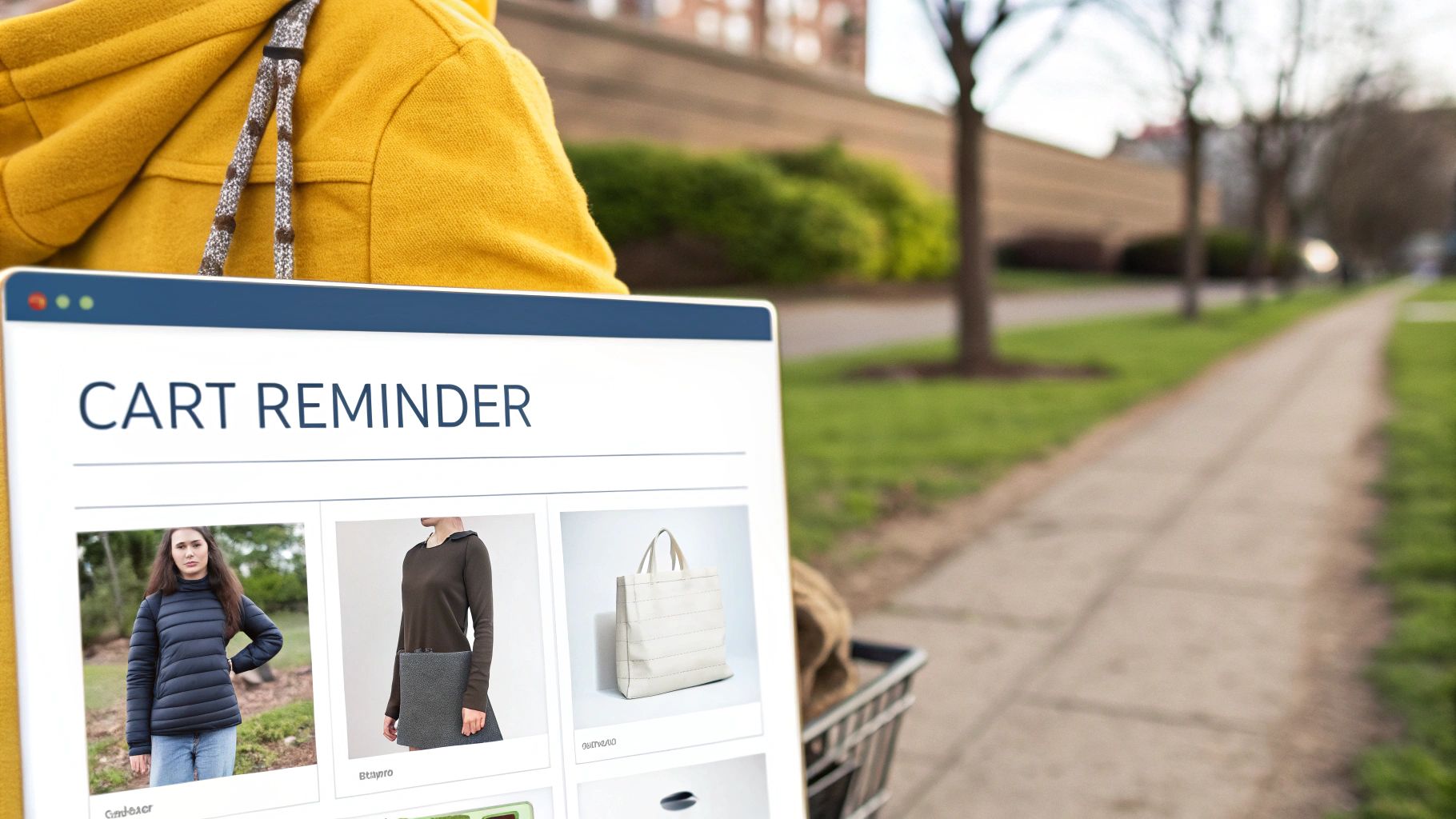
This email isn’t about introducing new products or complex narratives; it’s a gentle nudge designed to reignite the initial purchase intent. The visual cue of the abandoned item is the star of the show, acting as an instant memory jogger. By presenting the product clearly, you help the customer recall the moment they added it to their cart, making the decision to return and complete the purchase feel seamless and intuitive.
Strategic Breakdown
The power of this email lies in its psychological directness. Instead of asking the customer to remember what they were looking at, you show them. This visual-first approach is highly effective for brands with visually appealing products, such as fashion, home decor, and electronics.
- ASOS, the online fashion giant, excels at this. Their abandoned cart emails feature clean, studio-shot images of the exact garments left behind. Crucially, they include the selected size and colour, removing a potential friction point and making the path back to purchase as smooth as possible.
- Wayfair uses a similar tactic but often enhances it with lifestyle or room-setting images. Seeing a piece of furniture in a beautifully styled room, rather than just on a white background, helps the customer visualise it in their own home, reinforcing the emotional connection and desire to buy.
- Target provides a masterclass in clarity. Their emails showcase the product image alongside the price and a bold red “Finish your order” button, creating a simple, scannable, and highly actionable message.
Actionable Takeaways for Your Business
To implement this strategy effectively, focus on precision and clarity. Your goal is to make it incredibly easy for the customer to pick up exactly where they left off.
- Prioritise High-Resolution Imagery: Use the same professional-quality, high-resolution product photos from your website. Consistency builds trust and ensures the product looks as appealing in the email as it did on the product page.
- Include Specific Product Details: Don't just show the product; specify the size, colour, or model the customer selected. This personalisation shows you're paying attention and simplifies their decision-making process upon returning to the cart.
- Craft a Simple, Urgent Subject Line: Subject lines like “Did you forget something?” or “Your items are waiting” are direct and effective. There’s no need for clever wordplay; clarity is key.
- Optimise Sending Time: Send this first reminder email within 1 to 3 hours of abandonment. This window is the sweet spot where the purchase is still top-of-mind, dramatically increasing the likelihood of recovery.
- Design a Prominent CTA: Your “Return to Cart” or “Complete Your Purchase” button should be the most prominent element in the email. Use a contrasting colour that stands out from the background and make it large enough to be easily tapped on mobile devices.
This simple reminder is the workhorse of any abandoned cart sequence. It’s low-effort to create, highly effective, and serves as the perfect first touchpoint to bring distracted shoppers back to finalise their purchase.
2. The Urgency and Scarcity Strategy
This email type moves beyond a simple reminder and introduces powerful psychological triggers: urgency and scarcity. The goal is to create a compelling reason for the customer to act now rather than later. By highlighting limited-time offers, low stock levels, or the risk of an item selling out, this strategy taps into the potent human emotion of FOMO (Fear of Missing Out), transforming passive consideration into decisive action. This makes it one of the most persuasive abandoned cart email examples for driving immediate conversions.
Unlike a gentle nudge, this email adds a time-sensitive or quantity-based constraint to the abandoned items. The message shifts from “Here's what you left” to “Here's what you might lose if you don't act quickly”. This approach is particularly effective for shoppers who were on the fence, as the potential loss of the item or a special deal can be the final push they need to complete their purchase.
Strategic Breakdown
The effectiveness of this strategy is rooted in behavioural economics principles, specifically loss aversion, the idea that people are more motivated by the fear of losing something than by the prospect of gaining something of equal value. Brands across various sectors have perfected this tactic by integrating it seamlessly into their customer journey.
- Booking.com is a master of scarcity. Their emails and on-site notifications frequently feature messages like, “Only 2 rooms left at this price” or “In high demand – 15 other people are looking at this”. This creates social proof and a powerful sense of scarcity, encouraging users to book immediately.
- Nike expertly uses this for limited-edition sneaker releases. Their abandoned cart emails for these items often emphasise the “limited stock” and the high probability of them selling out, turning a simple purchase into an exclusive opportunity.
- Sephora often ties urgency to its sales events. An abandoned cart email sent during a sale might have a subject line like “Last chance: Your 20% off ends tonight,” accompanied by a countdown timer within the email body to visually reinforce the deadline. This is a core part of a wider marketing strategy for small business that can be adapted by retailers of any size.
Actionable Takeaways for Your Business
To leverage urgency and scarcity without appearing manipulative, authenticity and timing are crucial. The pressure you apply must be genuine and add real value to the customer's decision-making process.
- Use Genuine Scarcity Only: Credibility is paramount. Only use “low stock” alerts if the stock is genuinely low. Faking scarcity can erode customer trust if they discover the claim was false. Connect your email platform to your inventory management system for real-time accuracy.
- Craft Urgent Subject Lines: Your subject line needs to communicate the time-sensitive nature of the email immediately. Use phrases like “Last Chance,” “Ends Tonight,” “Your Cart Expires Soon,” or “Don't Miss Out” to grab attention in a crowded inbox.
- Incorporate Countdown Timers: A visual countdown timer ticking down in the email is a highly effective tool. It creates a dynamic and tangible sense of urgency that static text cannot replicate, prompting immediate clicks.
- Clearly State the Consequence: Be explicit about what the customer will lose. Is it a discount? Free shipping? Or the item itself? For example, “Your 15% discount expires in 3 hours” is more powerful than a generic “Hurry back”.
- Time It as a Second or Third Email: While the simple reminder is great for the first hour, the urgency email is often best sent 24 to 48 hours after abandonment. This gives the customer time to consider, making the final push to action more effective.
3. The Incentive-Based Recovery Email
When a simple reminder isn't enough to bring a customer back, introducing a financial incentive can be the decisive push they need. This strategy directly addresses one of the most common reasons for cart abandonment: price sensitivity. By offering a discount, free shipping, or a small bonus item, you tackle the cost barrier head-on. This makes it one of the most compelling abandoned cart email examples because it transforms the email from a simple reminder into a valuable, time-sensitive offer.

This email acknowledges that the customer’s hesitation might be linked to the final cost. Instead of just asking them to return, it sweetens the deal, making the decision to complete the purchase feel not only easier but also smarter. This approach is particularly effective for turning price-conscious shoppers into first-time buyers and can significantly boost conversion rates, especially when deployed strategically within a broader email sequence. Exploring the various advantages of email marketing on grow-your-biz.com can provide deeper insights into how these targeted incentives fit into a larger customer relationship strategy.
Strategic Breakdown
The effectiveness of an incentive-based email hinges on its perceived value and the sense of urgency it creates. It’s a powerful psychological tool that frames the completion of the purchase as a smart financial move. This tactic works exceptionally well in competitive markets where consumers are actively comparing prices.
- J.Crew frequently uses a tasteful “15% off your order” incentive in its abandoned cart emails. The offer is presented cleanly alongside images of the abandoned items, with a clear expiration date to prompt immediate action. This feels like a personal, exclusive offer rather than a mass-market promotion.
- ASOS often leverages free shipping as its primary incentive, especially for orders that are just below their free shipping threshold. Their email might say, “Good news! We'll ship your items for free,” effectively removing the final cost barrier that may have caused the initial abandonment.
- Best Buy sometimes targets its loyalty programme members with exclusive discounts on abandoned items. This not only encourages the sale but also reinforces the value of being part of their member community, fostering long-term loyalty.
Actionable Takeaways for Your Business
To implement an incentive strategy without eroding your profit margins, you need to be tactical and data-driven. The goal is to motivate, not to train customers to expect discounts.
- Test Different Incentives: Don't default to a percentage discount. Test free shipping, a fixed amount off (e.g., £5 off), or a free gift. A/B testing will reveal what your audience values most and the minimum effective incentive needed for conversion.
- Create Genuine Urgency: Always include an expiration date for your offer (e.g., “valid for the next 48 hours”). This scarcity principle is a powerful motivator that prevents procrastination and encourages immediate action.
- Segment Your Audience: Avoid sending discounts to everyone. Create segments to exclude repeat buyers who purchase at full price or customers who abandon high-demand items. Reserve your best offers for new customers or those who have shown significant price sensitivity.
- Position It Strategically: An incentive should not be your first move. Send it as the second or third email in your abandoned cart sequence, after a simple reminder has failed to convert. This ensures you only offer a discount when it’s truly necessary.
- Track Customer Behaviour: Monitor if certain customers repeatedly abandon carts to trigger a discount. If you identify this pattern, you can exclude them from future incentive-based campaigns to protect your profitability.
4. The Social Proof and Review Integration
When a customer hesitates, it is often due to uncertainty. The social proof and review integration email tackles this head-on by leveraging the power of community validation. This strategy moves beyond a simple reminder by incorporating customer reviews, star ratings, and user-generated content directly into the email. It works by alleviating purchase anxiety and building the trust needed to convert a hesitant shopper into a confident buyer. This is one of the most persuasive abandoned cart email examples because it answers the unspoken question: “Is this product actually any good?”
This email transforms a standard marketing message into a trusted recommendation from fellow consumers. By showcasing positive feedback from real people who have already purchased and enjoyed the item, you provide powerful third-party validation. This approach is not just about reminding; it’s about reassuring. It builds a bridge of credibility, making the decision to return and complete the purchase feel less like a risk and more like a wise choice endorsed by others.
Strategic Breakdown
The psychological principle behind this email is social influence. People are more likely to do something if they see others doing it. By integrating social proof, you tap into this innate human tendency, creating a powerful sense of FOMO (Fear of Missing Out) and confidence in the product's quality. This is especially effective for products where quality or fit is a major consideration.
- Amazon is the undisputed master of this technique. Their abandoned cart emails often feature the product's average star rating directly beneath the item image, along with a snippet from a top customer review. This immediately addresses potential quality concerns and leverages the massive volume of user feedback on their platform.
- Glossier, a beauty brand built on community, takes this a step further. Their emails frequently include user-generated content, such as Instagram photos of real customers using the abandoned product. Seeing the product on different people in real-life settings provides authentic, relatable proof of its value.
- Warby Parker brilliantly uses this for their eyewear. An email for an abandoned pair of glasses might showcase photos submitted by other customers wearing that exact style. This helps potential buyers visualise how the frames will look on a real face, not just a model, directly tackling a key barrier to buying glasses online.
Actionable Takeaways for Your Business
To successfully implement this strategy, you must curate and present social proof in a way that feels authentic and compelling. Your goal is to build a fortress of trust around the abandoned items.
- Curate Only High-Star Reviews: Cherry-pick genuine 4 and 5-star reviews to feature. Displaying anything lower can backfire and introduce doubt. The goal here is reassurance, not a balanced debate on the product’s merits.
- Showcase Authenticity with Details: Include the reviewer's first name, and if possible, a “Verified Purchase” badge. This small detail significantly boosts the credibility of the testimonial, assuring shoppers it comes from a real customer.
- Combine Ratings with Product Imagery: Place the star rating (e.g., “★★★★☆ 4.8/5”) directly below or next to the product image. This visual pairing creates an instant connection between the item and its positive reception.
- Keep Reviews Fresh and Relevant: Use recent reviews to show that the product is still popular and well-loved. A review from two years ago is far less impactful than one from last week.
- Optimise Your Sending Cadence: This email works best as the second or third message in your abandoned cart sequence, typically sent 24 to 48 hours after abandonment. This gives the customer time to have second thoughts, making the introduction of social proof a timely and effective persuasion tool.
By integrating social proof, you transform a standard reminder into a powerful, trust-building asset that validates the customer’s initial interest and gives them the final nudge they need to click “buy”.
5. The Personalized Recommendation Sequence
This advanced strategy elevates the abandoned cart email from a simple reminder into a personalised shopping experience. Instead of just showing the items left behind, this approach includes a curated selection of product recommendations based on the customer’s browsing history, past purchases, and the behaviour of similar shoppers. It treats the moment of cart abandonment not as a failure, but as an opportunity to demonstrate a deeper understanding of the customer's tastes and needs, potentially cross-selling or upselling in the process. This is one of the most sophisticated abandoned cart email examples as it transforms a transactional message into a relational one.
This email still leads with the abandoned items, but it supplements them with a ‘You might also like' section. This intelligent addition can recapture a sale even if the customer has changed their mind about the original items. It shows you're a helpful, clued-in retailer, which can significantly strengthen brand loyalty and encourage a return visit, even if it's just to browse the new suggestions.
The following diagram illustrates the automated process that powers these highly personalised recommendation emails.
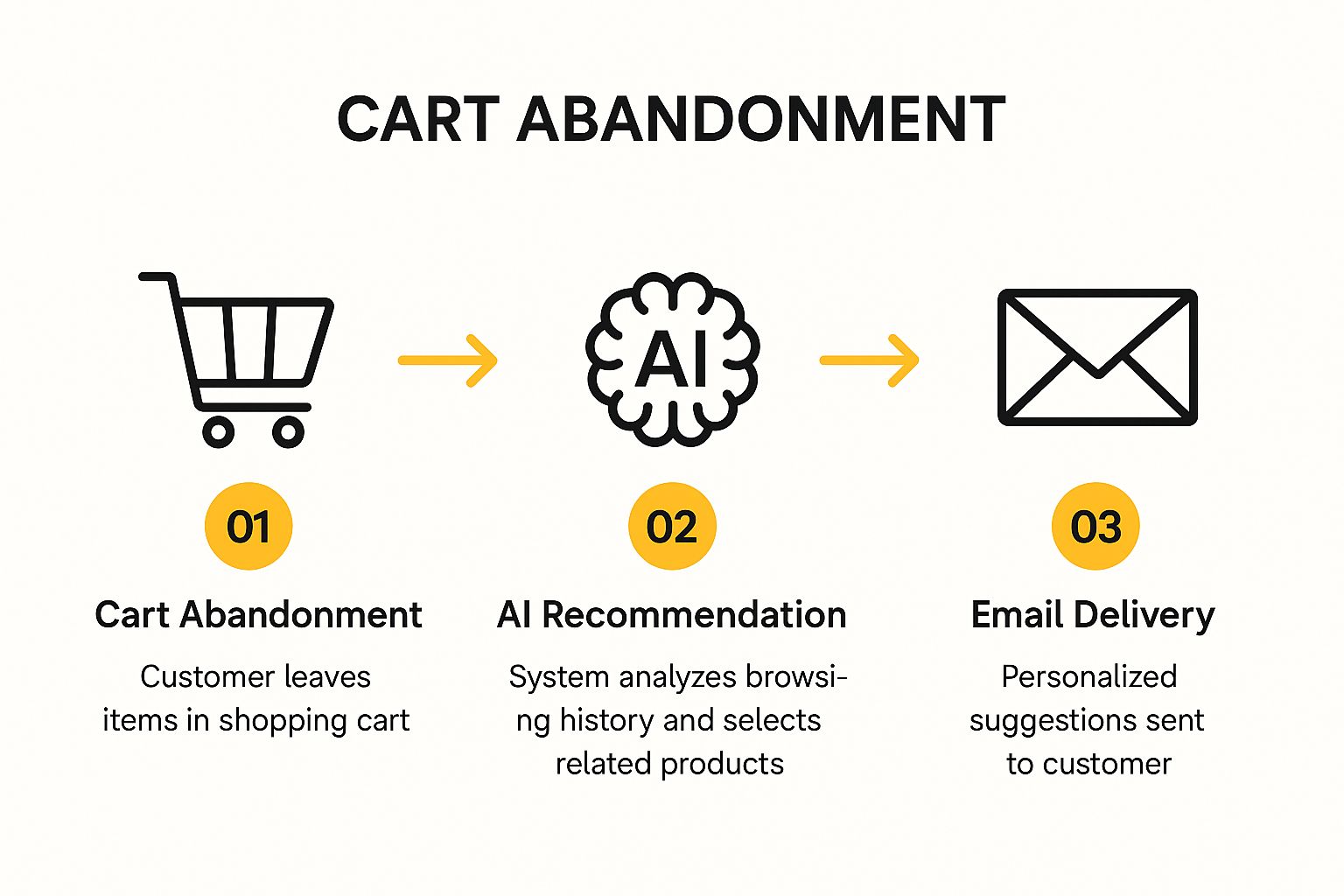
This automated flow ensures that the recommendations sent are timely, relevant, and directly linked to the customer's recent on-site activity, making the suggestions feel genuinely helpful rather than random.
Strategic Breakdown
The power of this email lies in its intelligent use of data to solve a customer's problem. Perhaps the original item wasn't quite right, a bit too expensive, or the wrong colour. By offering alternatives, you increase the chances of presenting the perfect product. This method is particularly effective for large-catalogue retailers where discovery is part of the shopping experience.
- Amazon is the undisputed master of this technique. Their emails often feature the abandoned item followed by rows of algorithmically generated recommendations under headings like “Inspired by your shopping trends” or “Customers who viewed this item also viewed”.
- Netflix, while not a traditional e-commerce brand, popularised the “Because you watched…” model that retailers now adopt. An e-commerce equivalent would be suggesting a different pair of trainers because a customer browsed a specific brand, perfectly mirroring this content discovery logic.
- Stitch Fix builds its entire business model on this principle. While their core service is subscription-based, their marketing emails often use this tactic, suggesting items to “Complete your look” based on past purchases, providing a highly personalised and compelling reason to re-engage.
Actionable Takeaways for Your Business
To execute this strategy, you need a system that can track customer behaviour and generate relevant product suggestions. This requires a more sophisticated setup but can yield significant returns.
- Lead with the Abandoned Items: Always display the original cart contents prominently at the top of the email. The recommendations should be a secondary, supplementary section, not the main focus.
- Use Clear, Enticing Headers: Label your recommendation section clearly with headers like “You might also like”, “Complete the look”, or “Recommended for you”. This frames the suggestions as helpful advice, not a hard sell.
- Limit the Choices: Avoid overwhelming the customer with too many options. A curated list of 3 to 4 relevant recommendations is ideal. Any more can lead to choice paralysis and dilute the email's impact.
- Leverage Customer Data Intelligently: Use a robust e-commerce platform or a dedicated personalisation tool to analyse browsing history, previous purchases, and items frequently bought together to generate your recommendations.
- Segment Your Audience: Test different recommendation strategies. For high-value customers, you might suggest premium alternatives (upselling). For new customers, you might show bestsellers or related items that are slightly cheaper to secure a first-time purchase.
6. The Multi-Touch Sequential Campaign
While a single reminder can be effective, a more sophisticated approach involves a series of strategically timed emails, each with a different purpose. The multi-touch sequential campaign moves beyond a simple nudge, building a narrative over several days to overcome different types of customer hesitation. This method is one of the most powerful abandoned cart email examples because it systematically addresses potential barriers, from simple distraction to price sensitivity, creating multiple opportunities for recovery.
This automated sequence is designed to feel like a personalised journey. The first email is a gentle reminder, the second might offer help or build value, and a third could present a final, compelling incentive. By varying the message, you avoid sounding repetitive and can cater to different psychological triggers, significantly boosting your chances of bringing the customer back to complete their purchase. This approach is a cornerstone of a well-developed digital marketing strategy. You can learn more about how it fits into a broader plan in this Beginner's Guide to Digital Marketing.
Strategic Breakdown
The power of a sequence lies in its escalating persuasion. It acknowledges that not all cart abandonment happens for the same reason. By layering messages, you can address multiple potential issues without overwhelming the customer in a single email. This tactic is particularly effective for considered purchases, where customers may need more information or a stronger push.
- Casper, the mattress brand, implements a classic three-part sequence. The first email is a simple reminder. The second, sent a day later, focuses on educational content, often linking to reviews or explaining the benefits of their mattress technology. The final email, sent a few days later, typically includes a modest discount as a final nudge to seal the deal.
- Glossier uses a sequence that leans heavily on brand identity and community. After the initial reminder, their follow-up email often incorporates user-generated content or social proof, showing real people enjoying the products. A final email might create urgency with a limited-time offer, aligning with their cult-favourite status.
- Bonobos excels at adding value. Their sequence often follows a cart reminder with an email offering styling tips related to the abandoned items. This positions them as a helpful expert, not just a retailer. A final offer of free shipping can then remove the last barrier to purchase.
Actionable Takeaways for Your Business
Building an effective sequence requires careful planning and timing. Your goal is to be persistent without being annoying.
- Map Out a Logical Flow: Define the purpose of each email. A common flow is: 1) Gentle Reminder (1-3 hours), 2) Value Add/Social Proof (24 hours), 3) Final Incentive/Urgency (48-72 hours).
- Vary Your Subject Lines and Content: Each email needs a distinct angle. Use subject lines like “Still thinking it over?” for the second email and “A special offer just for you” for the third to differentiate them from the initial reminder.
- Space Emails Appropriately: Leave at least 24 hours between each email in the sequence. Sending them too close together can feel aggressive and lead to unsubscribes.
- Implement Smart Segmentation: Ensure the sequence automatically stops the moment a customer makes a purchase or clicks the unsubscribe link. Sending a discount to someone who has already bought the item at full price is a poor user experience.
- A/B Test Your Sequence: Don't assume a three-email sequence is optimal. Test two-email versus four-email flows to see what works best for your audience. Measure open rates, click-through rates, and conversion rates for each step.
Abandoned Cart Email Strategy Comparison
| Strategy | Implementation Complexity 🔄 | Resource Requirements 💡 | Expected Outcomes 📊 | Ideal Use Cases 💡 | Key Advantages ⭐ |
|---|---|---|---|---|---|
| The Simple Reminder with Product Images | Low 🔄 | Low – basic design & images | Moderate cart recovery 📊 | E-commerce with visually appealing products, beginners | Easy to implement, high visual impact ⭐ |
| The Urgency and Scarcity Strategy | Medium 🔄 | Medium – timers, dynamic content | High conversion boost 📊 | Limited inventory, flash sales, competitive markets | Strong motivation, effective for price-sensitive ⭐ |
| The Incentive-Based Recovery Email | Medium 🔄 | Medium – discount management & tracking | Increased recovered sales 📊 | Price-competitive markets, flexible pricing, new customer acquisition | Addresses price objections directly ⭐ |
| The Social Proof and Review Integration | High 🔄 | High – review systems, data integration | Builds trust, reduces anxiety 📊 | High-consideration products, brands with strong review bases | Adds credibility, third-party validation ⭐ |
| The Personalized Recommendation Sequence | High 🔄 | High – AI, customer data platforms, dynamic content | Increased AOV, personalized engagement 📊 | Large catalogs, subscription services, advanced analytics | Boosts order value, personalized to user ⭐ |
| The Multi-Touch Sequential Campaign | Very High 🔄 | High – marketing automation, multi-email design | Highest overall conversions 📊 | Complex sales cycles, high-value products, advanced marketers | Multiple touchpoints, message testing ⭐ |
From Abandonment to Conversion: Building Your Winning Strategy
We've journeyed through a comprehensive gallery of powerful abandoned cart email examples, moving far beyond simple reminders. It's clear that recovering lost sales isn't about sending a single, hopeful email. Instead, it's about deploying a sophisticated, multi-layered strategy that speaks directly to the varied and complex reasons a customer might hesitate at the checkout.
From the elegant simplicity of a visual reminder to the psychological pull of urgency and the persuasive power of social proof, each example serves as a blueprint. We’ve seen how leading brands don’t just ask customers to come back; they build a compelling case for why they should. They seamlessly blend design, copy, and timing to create a recovery experience that feels helpful, not harassing.
Synthesising the Winning Formula
The core lesson from these diverse approaches is that success lies in customisation and escalation. Your recovery strategy should be a dynamic sequence, not a static message. It should evolve based on how much time has passed and what you know about your customer.
The most effective sequences we analysed share a common DNA:
- They start simple: The initial email is often a gentle, helpful nudge, featuring clear product images and a direct link back to the cart. It assumes the customer was simply distracted.
- They introduce incentives strategically: Discounts aren't thrown around lightly. They are reserved for a second or third email, used as a powerful lever to convert customers who were likely deterred by price.
- They leverage psychology: Tactics like scarcity (“Only 2 left in stock!”) and urgency (“Your cart expires soon”) are deployed to combat procrastination and create a compelling reason to act now.
- They build trust: Integrating customer reviews and testimonials, as seen in the social proof examples, directly counters purchase anxiety and builds confidence in your products and your brand.
- They get smarter over time: Advanced strategies don't stop at recovering the original cart. They use the data to offer intelligent, personalised recommendations, turning a potential lost sale into an opportunity for upselling and cross-selling.
Your Actionable Roadmap to Higher Conversions
Viewing these abandoned cart email examples is one thing; implementing a winning strategy is another. The path from insight to revenue requires a structured approach. Here are your next steps, designed to build momentum and deliver measurable results.
- Establish Your Baseline: Before you change anything, understand your current performance. What is your cart abandonment rate? What, if any, is your current recovery rate? You can't improve what you don't measure.
- Implement the Simple Reminder: If you have no sequence in place, start here. Set up a single, automated email to be sent 1-3 hours after a cart is abandoned. Use the tactics from our first example: clear subject line, strong visuals of the cart items, and a prominent call-to-action button.
- Layer in a Second Touchpoint: After your first email has been running for a few weeks, add a second email to your sequence, sent 24 hours after abandonment. This is your opportunity to introduce a new angle. Test urgency-driven copy or integrate a couple of your best product reviews.
- Experiment with an Incentive: For your third email, sent at the 48 or 72-hour mark, consider offering a small incentive. A 10% discount or free shipping can be incredibly effective at converting the most price-sensitive shoppers. Analyse your margins to ensure the offer is sustainable.
- Analyse, Test, and Refine: This is the most crucial step. Relentlessly track your key metrics for each email in the sequence: open rates, click-through rates (CTR), and, most importantly, conversion rates. Is your subject line working? Is the 10% discount more effective than free shipping? Use A/B testing to find definitive answers and continuously optimise your approach.
Mastering your abandoned cart email strategy is one of the highest-return activities you can focus on in e-commerce. It's not just about clawing back lost revenue; it's about understanding customer objections, refining your value proposition, and building stronger, more resilient relationships with your audience. By transforming an abandoned cart from a dead end into a point of re-engagement, you create a powerful engine for sustainable growth.
Ready to move from theory to execution? Building, testing, and optimising these complex email sequences requires a robust platform. The Digital Marketing Toolbox provides the powerful automation and analytics tools you need to implement every strategy discussed in this article, from simple reminders to multi-touch, personalised campaigns. Start recovering more revenue today with The Digital Marketing Toolbox.


