

Why Customer Lifetime Value Changes Everything
What's the real difference between businesses that thrive and those that just about get by? The successful ones understand what their customers are truly worth beyond a single purchase. Customer lifetime value (CLV) isn't just another bit of jargon to throw around; it's a completely different way of looking at your business. When you get your head around CLV, you stop chasing quick, one-off sales and start building profitable relationships that grow over time. This shift in mindset is the key to long-term, sustainable growth.
Uncovering Your True Most Valuable Customers
It's a common mistake to think your highest-spending customers are your best ones. But think about it: is a customer who makes one big purchase and then disappears really more valuable than someone who buys from you consistently for years? It's often not the case.
Imagine a local coffee shop. They might get a one-time catering order for an office meeting worth £200. That seems great. But what about the freelancer who comes in every weekday and spends £7? Over three years, that freelancer will have spent over £5,400. Now who's the more valuable customer?
When you learn how to calculate customer lifetime value, you start to see these hidden gems. It makes you look at the whole customer story, not just a single transaction. This gives you the insight to spot and look after your actual best customers—the ones who bring in reliable, long-term revenue.
Strategic Decisions Backed by Data
Once you have a clear picture of CLV, your business strategy becomes much sharper and more effective. Instead of taking a guess at where to put your money and effort, you can make decisions based on solid data that directly affects your profits.
Think about these real-world situations:
- Marketing Budgets: Does it make sense to spend £50 to acquire a customer who will only ever spend £40? Or would you be better off investing £100 to bring in a customer you project will have a lifetime value of £1,000? CLV gives you the clarity to make the right call.
- Customer Service: Knowing a customer's potential lifetime value helps you decide how to handle support issues. A high-CLV customer with a problem probably deserves an immediate, personal resolution to stop them from leaving and to protect all that future income.
- Product Development: By looking at the CLV of customers who use certain features, you can get clues for your product roadmap. This helps you invest in the updates that really build loyalty and increase the value you offer.
This strategic approach has become essential for UK businesses. Customer Lifetime Value is now a key metric, especially in the competitive e-commerce world. Thanks to better data analytics and AI-powered tools, it’s easier than ever to analyse the long-term profitability of customer relationships. You can read more about this trend in the latest UK State of Commerce report. It’s this insight that helps companies who master CLV to pull ahead of the competition, particularly when tight budgets mean every pound has to count.
The Core Formula That Actually Works
Let's cut through the noise. While there are some seriously complex, predictive models out there, figuring out how to calculate customer lifetime value really begins with a simple, foundational formula. This approach gives you actionable insights straight away because it's built on three core parts of customer behaviour: how much they spend, how often they come back, and how long they stick with you.
The classic formula multiplies the average amount a customer spends per purchase by how many times they buy from you, and then by how long you manage to keep them as a customer. For example, a UK-based clothing shop might find its average customer spends £40 per transaction, makes three purchases a year, and stays loyal for five years. This gives a CLV of £600 (£40 x 3 x 5). You can see how UK commerce trends are shaping these kinds of numbers in recent Signifyd reports on the state of commerce.
This basic calculation provides a solid baseline, but its real power is how it can be adapted to fit different business models.
How The Formula Changes for Your Business
The key is realising this isn't a one-size-fits-all equation. The variables need to reflect how your specific business actually makes money.
- For Subscription Models: If you run a SaaS company or a monthly subscription box service, your calculation will look different. Here, you’ll focus on the Average Monthly Recurring Revenue (MRR) per customer and the Average Customer Lifespan in months. A customer paying £25/month for 18 months has a CLV of £450.
- For Seasonal Retailers: A garden centre or a Christmas shop naturally has big swings in purchase frequency. For these businesses, it's much better to calculate CLV over a longer period, maybe two or three years. This helps to smooth out the seasonal peaks and troughs, giving you a more accurate picture of a customer's true long-term worth.
To help you see how these different approaches work for various businesses, I've put together a table comparing the formula variations.
| Business Type | Formula Variation | Key Metrics | Example Calculation |
|---|---|---|---|
| E-commerce Retail | (Average Order Value) x (Purchase Frequency) x (Customer Lifespan) | Average Order Value, Purchases per year, Years as a customer | £40 AOV x 3 purchases/year x 5 years = £600 CLV |
| Subscription (SaaS) | (Average Revenue Per Account) x (Customer Lifespan) | Monthly Recurring Revenue (MRR), Lifespan in months | £25 MRR/month x 18 months = £450 CLV |
| Service-Based | (Average Project/Service Cost) x (Number of Projects/Year) x (Client Lifespan) | Average project fee, Projects per year, Years as a client | £1,500/project x 2 projects/year x 3 years = £9,000 CLV |
| Seasonal Business | (Average Annual Spend) x (Customer Lifespan) | Total spend per year, Years as a customer | £120 annual spend x 4 years = £480 CLV |
As you can see, the core idea of value over time remains, but the specific metrics you use will change based on how your customers interact with you. Tailoring the formula this way ensures you're getting a figure that's actually relevant to your operations.
This infographic shows just how small changes in customer loyalty and spending habits can lead to massive differences in their lifetime value.
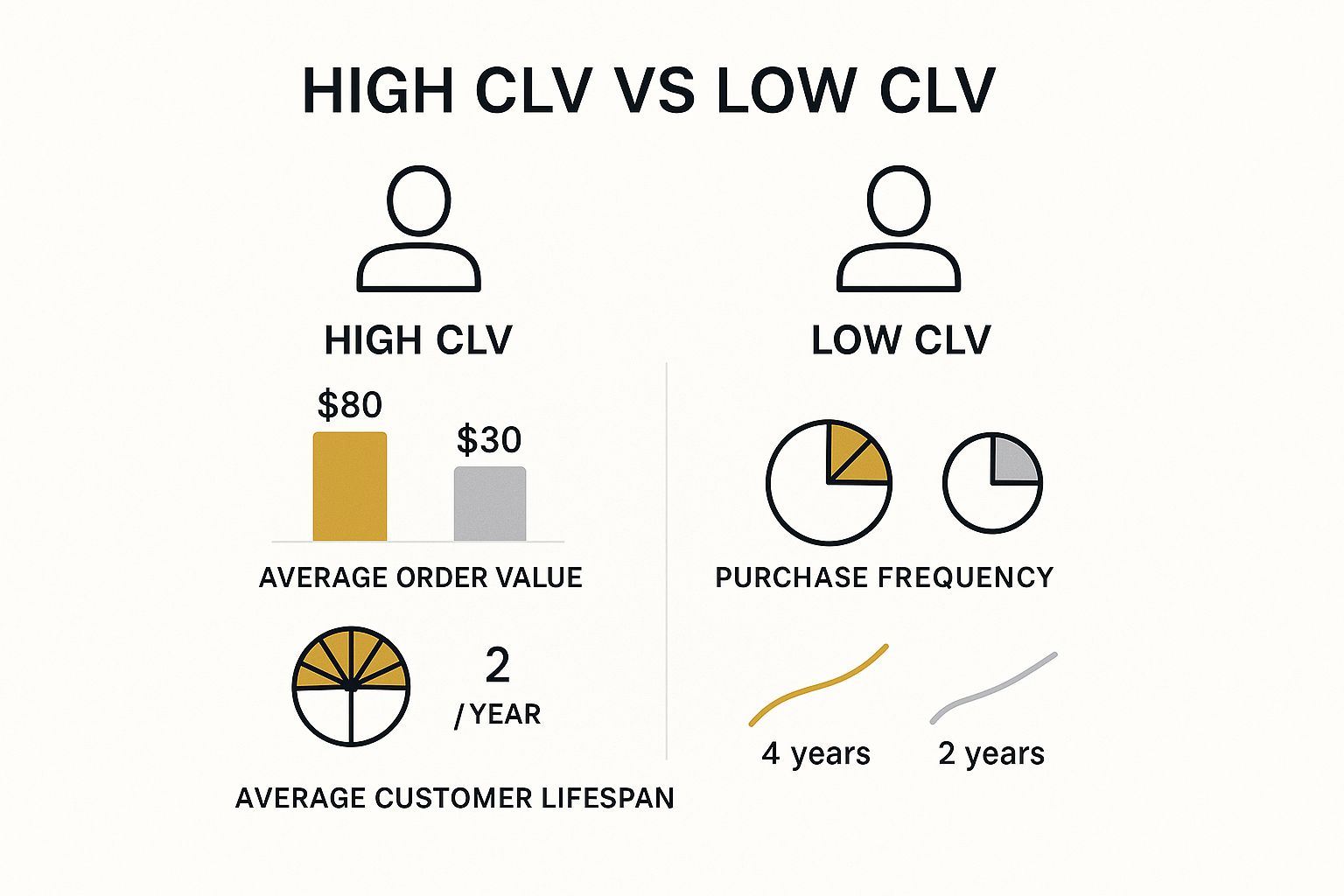
The image makes it clear that the ‘High CLV' customer isn't just spending a bit more per order; their consistent loyalty and repeat business dramatically multiply their overall value. This is where the magic happens. By understanding which version of the formula best fits your revenue model, you can start making smarter decisions that are perfectly suited to your unique customer base.
Finding the Numbers That Matter
Your journey into understanding how to calculate customer lifetime value really comes down to the quality of your data. The formulas themselves are pretty straightforward, but they're only as good as the numbers you put into them. This is often where the real work starts. To get an accurate picture, you need to gather specific metrics like average purchase values, how often customers buy, and how long they stick around. For many businesses, especially smaller ones, this information can be scattered across a few messy spreadsheets that feel a bit precarious.
This is where you'll need to roll up your sleeves. Whether you're using a fancy CRM system or manually digging through old sales records, the aim is to pull together a clean, organised dataset. The good news is that even basic tools can give you powerful insights once you know what to look for and how to handle common data headaches.
Sourcing Your Key Metrics
Before you can do any calculations, you need your raw materials. Your main sources of truth will usually be your sales platform, accounting software, or a CRM if you have one. Don't worry if your records aren't perfect; you can still find what you need.
Focus on pulling these core pieces of information for each customer:
- Customer Acquisition Date: When did they make their first purchase? This is your starting point.
- Total Revenue: The total amount this customer has spent with you to date.
- Total Number of Orders: How many separate transactions have they made?
Here’s an example of how you can find audience data in a tool like Google Analytics, which helps you understand user behaviour over time.
This screenshot shows user retention charts, giving you a visual idea of how long different groups of users stay active. This is a crucial component for estimating the customer lifespan part of the CLV formula.
Dealing with Data Gaps and Inconsistencies
It’s almost a given that you'll run into some frustrating data problems. A customer might use different email addresses, making it tough to track their complete purchase history. Or you might have gaps in your records from before you started tracking everything properly. Don't let this stop you.
For customers with a limited history, you might need to make some conservative estimates based on similar customer profiles. The important thing is to be consistent in how you approach it. It’s better to have a slightly imperfect but consistently calculated CLV than to be paralysed by messy data. As you gather more data over time, your calculations will naturally get more accurate. For many UK businesses, communicating with these customers can also help fill in the gaps, and you can learn more about the advantages of email marketing as a way to maintain contact and unify customer profiles.
Beyond Averages: Individual Customer Insights
Calculating your average Customer Lifetime Value (CLV) is a brilliant starting point, but the real magic happens when you move beyond broad generalisations. Think of it like this: knowing the average temperature in London for the year is useful, but it won’t help you decide whether to wear a coat today. To make smart, immediate decisions, you need specific, individual-level insights. This is where calculating CLV for each customer can shift your business strategy from reactive to proactive.

Drilling down to this granular level reveals the hidden opportunities and risks within your customer base. You start to see who your true VIPs are—not just the one-off big spenders, but the steady, loyal customers who consistently contribute to your bottom line. You can also identify customers who might be at risk of churning or those who have the potential to become much more valuable with a bit of extra attention.
Segmenting for Smarter Decisions
Once you understand how to calculate customer lifetime value on an individual basis, you can begin segmenting your audience in a much more meaningful way. This isn't about generic demographics; it's about grouping customers based on their actual value and behaviour.
Here are a few practical examples of how this plays out:
- High-Value Champions: These are your top-tier customers with the highest CLV. They deserve premium treatment. You might offer them exclusive early access to new products, a dedicated support contact, or surprise loyalty rewards. The goal is to make them feel indispensable because, to your business, they are.
- Potential High-Value Customers: This group has a moderate CLV but shows signs of high potential, like increasing purchase frequency. A targeted email campaign showcasing complementary products or a personalised discount could be the nudge they need to become a champion.
- At-Risk Customers: These customers have a low or declining CLV. Instead of ignoring them, you can create specific retention campaigns. A simple “we miss you” offer or a feedback survey to understand their dissatisfaction can sometimes be enough to win them back.
This personalised approach is a game-changer for resource allocation. Savvy UK retailers now calculate CLV for each customer, adjusting service levels and retention efforts based on whether that person’s estimated lifetime value is high or low. This is increasingly powered by AI solutions that dynamically analyse customer behaviour to refine CLV estimates and improve the customer experience in real-time. You can explore more about how modern commerce is adapting by reading the full report on commerce trends from Signifyd. By moving past averages, you ensure your time, budget, and best efforts are spent where they'll have the greatest impact on your profitability.
When Customer Loyalty Becomes Survival
The conversation around how to calculate customer lifetime value has changed in a big way. It’s no longer just an interesting task for marketing departments with a bit of spare time; it’s become a critical tool for staying afloat. In the current economic climate, with consumer budgets stretched thinner than ever, blind loyalty is a thing of the past. Businesses that only see the value of a single transaction are dangerously short-sighted, missing out on what makes a customer genuinely profitable over time.
The New Reality of Customer Relationships
Recent economic pressures are completely changing how people in the UK spend their money. This isn't just a small shift; it's a deep-rooted change in consumer behaviour. The data is clear: 37% of UK consumers have switched away from brands they were loyal to in the past year, mainly because they were hunting for better value. You can dig deeper into this trend by checking out the latest consumer expectations data from the DMA. This figure is a massive wake-up call: if your business strategy isn’t built on understanding and growing long-term value, you’re putting yourself at risk.
This change means the old ways of doing business are no longer effective. During economic downturns, companies that ignore CLV are often the first to feel the pinch. They watch sales drop and react by slashing costs everywhere, which can harm the customer experience and drive even more people away. On the other hand, businesses with a solid grip on their CLV can make smarter, more precise decisions. They know exactly which customer groups are their most valuable and can channel their resources into keeping those relationships strong.
Building Resilience with CLV Insights
So, what does this actually look like day-to-day? Let's take a subscription box company that’s seeing more cancellations. A business without CLV insights might panic and roll out a blanket discount for everyone, which would eat into their profit margins. But a company that understands its customer value knows that customers who’ve been subscribed for over a year and have a high CLV are worth fighting to keep. They can offer these specific customers a personalised incentive to stay, while perhaps accepting that lower-value, short-term subscribers might leave.
This isn’t about giving up on customers; it’s about investing your limited resources where they’ll make the biggest difference. It’s about creating relationships founded on trust and convenience—the very qualities today’s price-conscious consumers are searching for. By adopting a long-term view, you can adapt more effectively to whatever challenges the market presents. This makes CLV more than just a calculation; it becomes a cornerstone of a resilient business strategy.
Tools That Make CLV Calculation Manageable
Moving on from the theory, it's time to get practical. Actually figuring out how to calculate customer lifetime value means you need the right tools for the job. While plugging numbers into a spreadsheet can work when you're just starting out, it quickly becomes a time-consuming and error-prone task as your business scales.
Fortunately, there’s a whole host of solutions out there to automate this process, serving up actionable insights without the headache. Whether you're a small UK business after a straightforward template or a larger company needing a powerful analytics platform, there's something that will fit your budget and requirements. The real trick is finding a system that not only crunches the numbers but also plays nicely with your existing sales and marketing platforms. This integration is what stops your CLV data from living in a silo and ensures it actively guides your day-to-day decisions.
From Spreadsheets to Sophisticated Software
For many small businesses, a well-organised spreadsheet is a perfectly fine starting point. You can build your own simple models or find templates online to track essentials like average purchase value and frequency. However, as your customer base grows, dedicated software becomes a necessity.
Platforms like HubSpot offer built-in reporting that can give you a solid overview of your CLV. For businesses that need to dig deeper, more advanced tools like Salesforce provide extensive analytics capabilities. These systems are built to handle complex calculations, segment your customers automatically, and even use predictive models to forecast future value.
Visual dashboards are a huge help here. They can pull data from multiple sources to give you a clear, at-a-glance picture of customer trends and profitability.
A dashboard like this allows you to see how your CLV is changing over time and pinpoint exactly which customer segments are bringing in the most value. It transforms raw data into a story you can actually use.
Choosing the right tool is a big decision, so to help you compare your options, we've put together a handy table. It breaks down some popular choices by price, features, and who they're best suited for.
| Tool Name | Price Range | Key Features | Best For | Integration Options |
|---|---|---|---|---|
| Google Analytics | Free | Cohort analysis, user lifetime reports, audience segmentation. | Start-ups and small businesses needing foundational CLV insights without a budget. | Google Ads, Google Search Console, various third-party connectors. |
| HubSpot | £15/month – £4,970+/month | Built-in CLV reporting, marketing automation, CRM integration. | Small to medium-sized businesses looking for an all-in-one marketing and sales platform. | Salesforce, Shopify, Zapier, and a large app marketplace. |
| Baremetrics | £24/month – £410+/month | Subscription analytics, CLV forecasting, churn tracking, segmentation. | Subscription-based businesses (SaaS, subscription boxes) that need detailed revenue metrics. | Stripe, Braintree, Shopify, Recurly. |
| ChartMogul | Free – Custom Pricing | Real-time subscription metrics, CLV calculation, churn analysis, MRR movements. | SaaS and subscription companies of all sizes, with a generous free plan for start-ups. | Stripe, Braintree, PayPal, Zapier, GoCardless. |
| Salesforce | £20/user/month – £400/user/month | Advanced predictive CLV, AI-powered insights (Einstein), deep customisation. | Large enterprises and businesses with complex sales cycles needing a powerful, customisable CRM. | Extensive AppExchange with thousands of integrations for virtually any business system. |
This comparison should give you a good idea of what's available. The key takeaway is that free tools like Google Analytics are great for getting your feet wet, while specialised platforms like Baremetrics or ChartMogul offer incredible depth for subscription models. All-in-one solutions like HubSpot and Salesforce provide CLV as part of a much broader business ecosystem.
Integrating CLV into Your Business Systems
Picking a tool is only the first step; making it a core part of your operations is where the magic really happens. The aim is to create a seamless flow of information where CLV insights influence everything from your marketing campaigns to your customer service approach. This could mean setting up automated weekly reports for your marketing team to help them fine-tune their ad spend or customer retention strategies.
By making CLV a visible and accessible metric across your entire organisation, it stops being just another number on a report. Instead, it becomes a powerful guide for achieving sustainable, long-term growth. For more ideas on connecting these dots, our beginner's guide to digital marketing offers some practical advice.
Turning CLV Knowledge Into Revenue Growth
Figuring out your Customer Lifetime Value is a brilliant start, but that's really only half the job. The real magic happens when you use those numbers to actually increase what each customer is worth to your business over time. It’s about taking data from a spreadsheet and turning it into real revenue by sharpening your marketing based on who your best customers are and what they care about. This is the shift from just measuring CLV to actively managing it for growth.
Personalising Your Marketing Approach
Your CLV data is a goldmine for making your marketing more personal and, ultimately, more effective. Instead of blasting out a generic “20% off” voucher to your entire list, you can get much smarter with your offers. For instance, a high-value customer who reliably buys from you every three months might get an exclusive early look at a new collection. Meanwhile, a customer with a lower CLV could receive a special offer designed to tempt them into making a second purchase sooner than they otherwise might. This kind of targeted approach shows you understand and value each customer's unique relationship with your brand.
The channel you use to deliver your message is just as important as the message itself. For UK businesses, direct and personal marketing tactics consistently bring in higher lifetime revenue. Research shows that SMS marketing is particularly powerful for driving repeat purchases and keeping customers loyal, as people respond well to timely, personal offers sent straight to their phones. You can dive deeper into these findings by exploring these SMS marketing insights for 2025 success on MovableInk.com.
These direct methods work so well because they give customers what they want in the current economic climate: convenience and genuine value. By applying what you know from your CLV calculations, you can build a more resilient and profitable marketing machine. To see how this fits into your overall plan, have a look at our guide on creating a marketing strategy for small business.
Ready to turn your data into growth? Explore The Digital Marketing Toolbox at grow-your-biz.com to find the perfect tools to automate your marketing, personalise communication, and increase your customer lifetime value.


