
In today's competitive market, standing out is non-negotiable for small businesses. While traditional advertising methods still have their place, the modern marketplace offers a wealth of powerful, cost-effective opportunities to connect with your target audience. The challenge isn't a lack of options, but choosing the right ones that deliver tangible results without draining your budget.
This guide moves beyond generic advice to provide a curated list of proven small business advertising ideas designed for the realities of modern commerce. We've organised a collection of actionable steps, real-world examples, and specific tool suggestions to help you build a robust and effective strategy.
Whether you're a local shop aiming to dominate your neighbourhood or a growing online brand seeking national reach, these insights will equip you to attract new customers, build lasting loyalty, and achieve sustainable growth. Forget vague theories; this is a practical playbook for getting noticed and driving sales. We will explore everything from mastering Local SEO and Google My Business to launching effective influencer partnerships and referral programmes.
1. Master Social Media Marketing
In today's digital landscape, mastering social media is one of the most cost-effective and powerful small business advertising ideas available. It involves using platforms like Facebook, Instagram, and LinkedIn to build a community, engage directly with customers, and drive sales through both organic content and targeted paid campaigns.
Unlike traditional advertising, social media allows for a two-way conversation. A local bakery, for instance, can post daily specials on Instagram Stories to create urgency, while a B2B consultancy can share insightful articles on LinkedIn to establish industry authority. This direct line to your audience builds trust and loyalty that passive advertising simply cannot replicate.
Key Benefits of Social Media Marketing
Social media offers distinct advantages, particularly for businesses with limited budgets. The barrier to entry is low, targeting capabilities are incredibly sophisticated, and the return on investment is highly measurable. This unique combination makes it an indispensable tool for growth.
The infographic below summarises the core benefits for your small business.
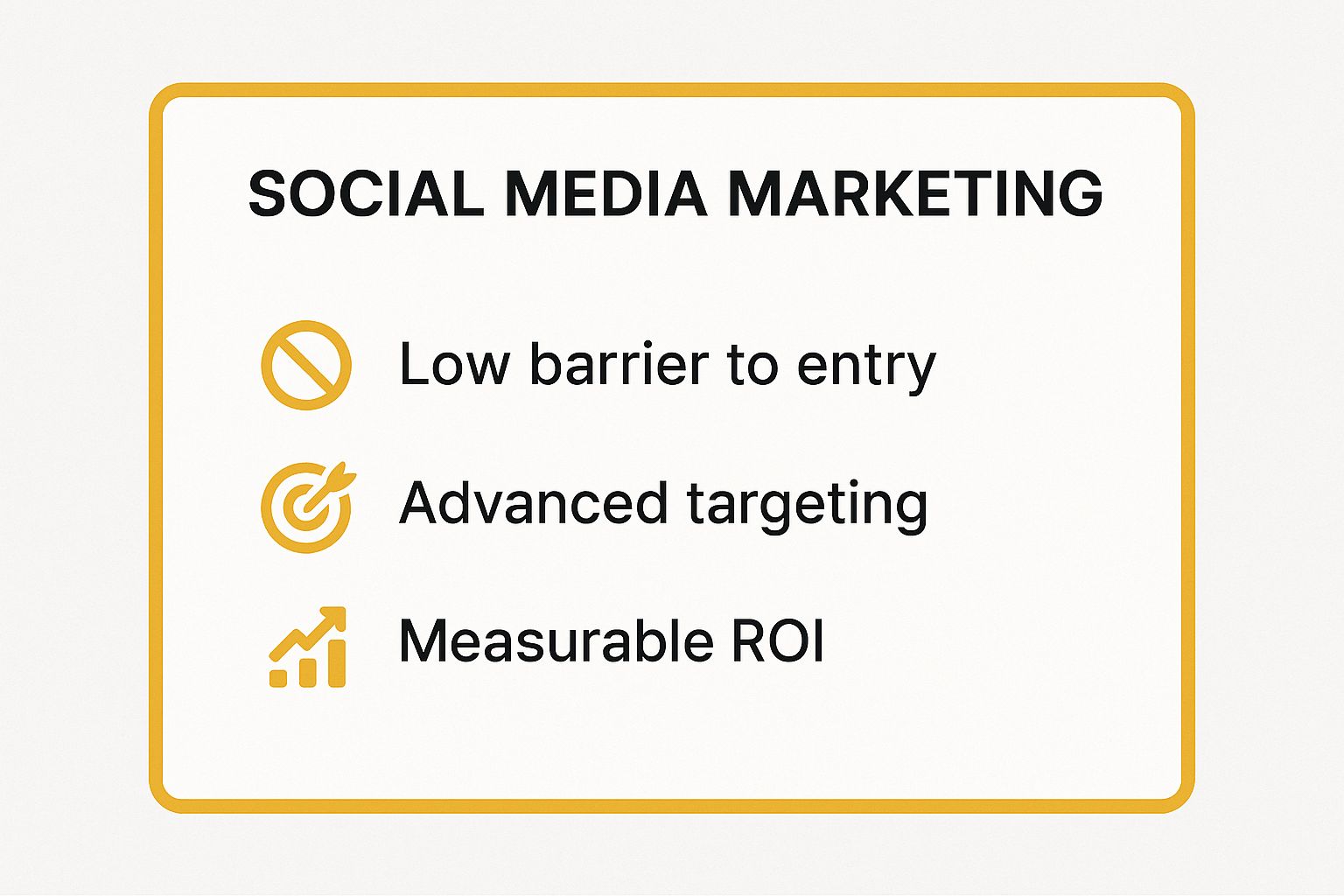
As highlighted, the ability to launch campaigns with minimal initial cost, precisely target users based on demographics and interests, and track every pound spent makes social media a financially sound advertising strategy.
How to Get Started
- Platform Selection: Focus on 2-3 platforms where your target audience is most active. Don't spread yourself too thin.
- Consistent Content: Use a content calendar to plan and post consistently. Quality and regularity are more important than quantity.
- Authentic Engagement: Respond to comments and messages promptly. Show the human side of your brand.
- Visual Appeal: Invest in high-quality photos and videos. Visual content consistently drives higher engagement.
For a deeper dive into integrating this into your overall plan, you can explore this detailed guide on developing a marketing strategy for small business.
2. Run Targeted Google Ads (Pay-Per-Click)
Leveraging Google Ads is a powerful way to place your business directly in front of customers actively searching for your products or services. This pay-per-click (PPC) model means you only pay when someone clicks your ad, making it one of the most direct and measurable small business advertising ideas for generating immediate traffic and leads.
Unlike organic SEO which takes time, PPC offers instant visibility. A local plumber can bid on “emergency plumber near me” to appear at the very top of search results, capturing urgent customer needs. Similarly, an e-commerce shop can use visual Shopping ads to showcase products directly to buyers, shortening the path to purchase and maximising ROI. This strategy is about being in the right place at the exact moment a customer needs you.
Key Benefits of Google Ads
Google Ads provides unmatched control, speed, and precision. You can set specific daily budgets, target users by location, and track every pound spent, ensuring your advertising budget is allocated effectively. For businesses needing quick results, it is an indispensable tool.
The platform allows you to compete with larger companies by focusing on niche keywords and specific geographic areas. A well-optimised campaign can generate high-quality leads from day one, providing a clear and immediate return on your investment and valuable data to refine your broader marketing strategy.
How to Get Started
- Keyword Strategy: Start with long-tail keywords (e.g., “handmade leather wallets for men”) to face less competition and attract highly qualified traffic.
- Use Negative Keywords: Actively add negative keywords (e.g., “free,” “jobs”) to prevent your ads from showing for irrelevant searches and wasting your budget.
- Compelling Ad Copy: Write clear, concise ads with a strong call-to-action (CTA) like “Shop Now” or “Get a Free Quote” to encourage clicks.
- Optimise Landing Pages: Ensure the page users land on after clicking your ad is relevant, fast-loading, and designed to convert visitors into customers.
- Track Everything: Set up conversion tracking immediately to measure which keywords and ads are driving valuable actions, such as sales or form submissions.
3. Leverage Content Marketing
Content marketing is a strategic approach focused on creating and distributing valuable, relevant, and consistent content to attract and retain a clearly defined audience. Unlike direct advertising that sells, this method provides information and solves problems, establishing your business as a trusted authority and ultimately driving profitable customer action.
This is one of the most powerful small business advertising ideas because it builds a long-term asset for your brand. A local accounting firm, for example, could create blog posts about navigating tax season for freelancers, while a fitness studio could produce short workout videos on YouTube. This valuable content builds trust and keeps your business top-of-mind when a potential customer is ready to buy.
Key Benefits of Content Marketing
Content marketing offers compounding returns; a blog post written today can attract customers for years to come. It improves SEO, educates your audience, and generates leads without the recurring cost of paid ads. This makes it an incredibly sustainable growth strategy for businesses aiming to build a loyal customer base.
The core of this strategy, popularised by experts like Joe Pulizzi and Marcus Sheridan, is to answer your customers' most pressing questions. By becoming the go-to resource in your niche, you organically draw in qualified leads who are already looking for the solutions you provide.
How to Get Started
- Solve Problems: Focus your content on answering the specific questions and solving the pain points of your ideal customer.
- Maintain a Schedule: Use a content calendar to publish consistently. This builds audience expectation and rewards you with search engine visibility.
- Repurpose Your Work: Turn a single blog post into social media snippets, an infographic, or a video script to maximise its reach.
- Include a Call-to-Action (CTA): Guide your audience on what to do next, whether it’s subscribing to a newsletter or scheduling a consultation.
To understand how content fits into a broader promotional framework, you can explore this beginner’s guide to digital marketing.
4. Email Marketing
Email marketing is a powerful and direct digital communication channel. It involves sending targeted messages to a list of subscribers to nurture leads, promote products, and drive sales. Unlike many other advertising platforms, you own your email list, giving you a direct line to your audience without algorithm changes getting in the way.
This method remains one of the highest ROI small business advertising ideas because it focuses on building long-term relationships. For example, a local restaurant can send weekly menu updates to keep customers coming back, while a software company might use an automated onboarding sequence to help new users get the most value from their product, reducing churn and building loyalty.
Key Benefits of Email Marketing
Email marketing offers a unique blend of personalisation, automation, and cost-effectiveness. The ability to segment your audience and tailor messages based on their behaviour or interests allows for highly relevant communication that drives higher engagement and conversion rates. It is an asset that you control and can leverage repeatedly.
“Email marketing is the only channel that lets you build a direct, personal connection with your customers at scale. It’s your most valuable digital asset.”
This direct ownership and control make it a stable and reliable foundation for any digital marketing strategy, insulated from the volatility of third-party platforms.
How to Get Started
- Build Your List Organically: Offer something of value, like a discount, a free guide, or exclusive content, in exchange for an email address. Never buy lists.
- Segment Your Audience: Group subscribers based on their purchase history, interests, or engagement level to send more relevant and effective campaigns.
- Craft Compelling Subject Lines: Your subject line is crucial for getting your email opened. Keep it short, intriguing, and honest.
- Optimise for Mobile: The majority of emails are opened on mobile devices. Ensure your templates are responsive and easy to read on a small screen.
To fully understand how this can benefit your operations, you can explore the advantages of email marketing for small businesses.
5. Local SEO and Google My Business
For businesses with a physical location or service area, mastering local search engine optimisation (SEO) is a fundamental advertising idea. This strategy focuses on increasing your visibility in local search results, primarily through a well-optimised Google My Business (GMB) profile, which allows you to appear in “near me” searches and on Google Maps.
When a potential customer searches for “dentist in Manchester” or “plumber near me,” local SEO ensures your business is among the top results. It connects you with high-intent customers who are actively seeking the products or services you offer in your immediate area. This direct connection makes it one of the most powerful and cost-effective small business advertising ideas for generating qualified leads.
Key Benefits of Local SEO
Local SEO provides a direct pathway to customers in your community. The primary advantage is its ability to attract highly relevant traffic at the exact moment a user needs your services, leading to higher conversion rates than broader advertising efforts. It levels the playing field, allowing small local businesses to compete with larger chains.
By optimising for local search, you build authority and trust within your specific geographical area. A complete and active GMB profile, full of positive reviews and helpful information, serves as a powerful digital storefront that encourages local customers to choose you over a competitor.
How to Get Started
- Claim and Complete Your GMB Profile: Fill out every section of your Google My Business profile. This includes services, opening hours, photos, and a detailed business description.
- Encourage Customer Reviews: Actively ask satisfied customers to leave honest reviews on Google. Positive reviews significantly boost your local ranking and build social proof.
- Ensure NAP Consistency: Your Name, Address, and Phone number (NAP) must be identical across your website and all online directories like Yelp and Thomson Local.
- Post Regular GMB Updates: Use Google Posts to share updates, offers, and news. This signals to Google that your business is active and relevant.
- Respond to All Reviews: Engage with both positive and negative reviews professionally. This shows potential customers that you value feedback and are committed to customer service.
6. Referral and Word-of-Mouth Programs
Capitalising on your existing customer base is one of the most authentic and effective small business advertising ideas you can implement. A formal referral programme encourages satisfied customers to become brand advocates, rewarding them for recommending your business to their network and creating a powerful, trust-based acquisition channel.
Word-of-mouth is potent because it comes from a trusted source. When a friend recommends a local tradesperson or a family member suggests a new café, that endorsement carries more weight than a traditional advertisement. A structured programme simply amplifies this natural behaviour, turning passive satisfaction into active promotion. For example, a local hair salon could offer a 20% discount to both the referrer and the new client, creating a win-win scenario that drives new business.
Key Benefits of Referral Programmes
Referral marketing leverages trust to acquire high-value customers at a lower cost. Customers acquired through referrals often have a higher lifetime value and greater loyalty, as they arrive with pre-established trust in your brand. This makes it an exceptionally efficient use of your marketing budget.
A study by Nielsen found that 92% of consumers trust recommendations from people they know, making word-of-mouth the most trusted form of advertising.
This high level of trust translates directly into higher conversion rates, making a well-organised referral programme a cornerstone of sustainable growth.
How to Get Started
- Make it Simple: The referral process must be effortless. Use simple forms, unique codes, or shareable links that customers can use in seconds.
- Offer Dual-Sided Value: Reward both the person referring and the new customer. This incentivises both parties to participate.
- Time Your Request: Ask for a referral immediately following a positive experience, such as after a five-star review or a repeat purchase.
- Promote the Programme: Don't hide it. Advertise your referral programme on your website, in email signatures, and on social media to ensure customers know it exists.
- Show Gratitude: Personally thank every customer who successfully refers someone. A little appreciation goes a long way in fostering loyalty.
7. Influencer and Micro-Influencer Partnerships
Tapping into the power of influencer marketing is one of the most effective small business advertising ideas for building trust and reaching niche audiences. This strategy involves partnering with individuals who have an established and engaged following on social media to promote your products or services through authentic, relatable content.

Unlike traditional celebrity endorsements, this approach relies on the genuine connection an influencer has with their community. A local restaurant could collaborate with a food blogger to review a new menu, or a fitness brand could work with a workout enthusiast to showcase a product in action. This authentic recommendation from a trusted voice often drives more powerful results than a direct brand advertisement.
Key Benefits of Influencer Partnerships
Collaborating with influencers, especially micro-influencers (1,000 to 100,000 followers), offers significant advantages for small businesses. These partnerships are often more affordable, yield higher engagement rates, and provide access to a highly targeted and loyal audience that trusts the creator's recommendations implicitly.
The infographic below highlights the compelling reasons to integrate this into your advertising efforts.
As shown, the focus on authentic engagement and access to niche markets makes influencer marketing a cost-effective strategy. It allows your brand to borrow credibility and connect with potential customers in a way that feels organic rather than disruptive.
How to Get Started
- Find the Right Fit: Prioritise an influencer whose audience aligns perfectly with your target customer. Look at their engagement rate, not just their follower count.
- Start with Micro-Influencers: These creators often have more dedicated communities and offer a better return on investment for small businesses.
- Grant Creative Freedom: Provide clear guidelines and campaign goals but allow the influencer creative control to ensure the content feels authentic to their audience.
- Measure Your ROI: Use unique, trackable discount codes or affiliate links to measure the direct impact of the collaboration on your sales.
For a comprehensive guide on building a successful programme, you can get more expert advice on influencer marketing strategy.
8. Community Event Marketing and Sponsorships
Engaging directly with your local community is a powerful and often overlooked advertising idea for small businesses. Community event marketing involves participating in, sponsoring, or hosting local events to build brand visibility, foster goodwill, and connect with potential customers on a personal level.
This strategy moves beyond digital screens and puts a human face to your brand. For instance, a local bank sponsoring a town festival or a fitness studio offering a free yoga class at a community health fair creates authentic connections. This type of involvement demonstrates that your business is invested in the well-being of the community, building a level of trust and loyalty that digital ads struggle to achieve.
Key Benefits of Community Event Marketing
The primary advantage of this approach lies in its ability to generate high-quality, local leads and build lasting brand affinity. It allows you to interact with your target audience in a relaxed, positive environment, making them more receptive to your message. Sponsoring an event can also provide significant brand exposure through event promotional materials.
This hands-on approach is one of the most effective small business advertising ideas for creating memorable experiences. When a potential customer meets you in person and has a positive interaction, your business becomes more than just a name; it becomes a trusted part of their community.
How to Get Started
- Choose Relevant Events: Select events or sponsorships that align with your brand’s values and attract your target demographic. A home improvement store would benefit from sponsoring a charity home-building event, for example.
- Create an Engaging Presence: Go beyond simply handing out leaflets. Organise an interactive activity, a prize draw, or a demonstration to attract people to your stand.
- Train Your Team: Ensure any staff at the event are friendly, knowledgeable, and well-prepared to act as brand ambassadors. Their enthusiasm is infectious.
- Leverage Branded Giveaways: Offer useful, branded items that people will keep and use, like tote bags, water bottles, or high-quality pens. This ensures your brand stays visible long after the event ends.
9. Direct Mail and Print Advertising
In an era dominated by digital noise, direct mail and print advertising offer a tangible way to cut through the clutter. This traditional method involves sending physical materials like postcards, flyers, catalogues, or placing adverts in local newspapers and magazines to reach a specific audience. It provides a tactile experience that digital ads cannot replicate.
Unlike fleeting digital impressions, a well-designed piece of mail can stay in a home or office for days, serving as a constant reminder of your brand. For example, a local restaurant can mail discount coupons to nearby postcodes, encouraging immediate visits, while a real estate agent might send a neighbourhood market report to establish local authority. This physical presence builds credibility and a sense of permanence.
Key Benefits of Direct Mail and Print Advertising
Direct mail offers unique advantages, particularly for local businesses aiming to target specific geographic areas. The ability to physically place your message in a potential customer's hands can lead to higher recall and a more personal connection, especially when integrated with digital follow-ups.
This method is highly trusted by consumers and can be precisely targeted. A local service business, for instance, can use ‘just moved' mailing lists to reach new residents at the exact moment they need services like plumbing, decorating, or landscaping. This precision makes it a powerful component of a local marketing strategy.
How to Get Started
- Professional Design: Invest in high-quality imagery and professional design. The look and feel of your print material directly reflect your brand's quality.
- Compelling Call-to-Action (CTA): Your CTA must be clear and persuasive. Tell recipients exactly what you want them to do next, whether it's visiting your website, calling for a quote, or bringing in a coupon.
- Targeted Lists: Test different mailing lists and demographics to refine your audience. Services like the Royal Mail's ‘partially addressed mail' can help you reach relevant households without needing personal data.
- Trackable Elements: Include trackable components like QR codes, unique promo codes, or specific landing page URLs. This allows you to measure the campaign's return on investment effectively.
Advertising Strategy Comparison for 9 Small Business Ideas
| Marketing Strategy | Implementation Complexity 🔄 | Resource Requirements ⚡ | Expected Outcomes 📊 | Ideal Use Cases 💡 | Key Advantages ⭐ |
|---|---|---|---|---|---|
| Social Media Marketing | Moderate 🔄 | Moderate ⚡ | 3-6 months for organic growth 📊 | Brands targeting active social users | Low barrier to entry, advanced targeting ⭐ |
| Google Ads (Pay-Per-Click) | High 🔄 | High ⚡ | Immediate traffic, 1-3 months optimization 📊 | Intent-driven campaigns and fast traffic | Immediate visibility, full budget control ⭐ |
| Content Marketing | High 🔄 | Moderate ⚡ | 6-12 months for organic traffic growth 📊 | Building brand authority and long-term leads | Builds trust and lasting value ⭐ |
| Email Marketing | Low to Moderate 🔄 | Low ⚡ | Immediate for existing list, 3-6 months list growth 📊 | Direct, personal communication with customers | Highest ROI, automation saves time ⭐ |
| Local SEO and Google My Business | Moderate 🔄 | Moderate ⚡ | 3-6 months for local ranking improvements 📊 | Location-based businesses with physical stores | Targets local high-intent customers ⭐ |
| Referral and Word-of-Mouth Programs | Moderate 🔄 | Low to Moderate ⚡ | 1-3 months to establish, ongoing benefits 📊 | Businesses with strong customer advocacy | Highest conversion rates, scalable growth ⭐ |
| Influencer and Micro-Influencer Partnerships | Moderate 🔄 | Moderate to High ⚡ | Immediate exposure, 1-2 months for relationships 📊 | Brands seeking authentic endorsements | Access to engaged audiences, credible ⭐ |
| Community Event Marketing and Sponsorships | Moderate 🔄 | Moderate ⚡ | Immediate brand exposure, 1-3 months relationship building 📊 | Local businesses building community presence | Direct local engagement, strong brand loyalty ⭐ |
| Direct Mail and Print Advertising | Moderate 🔄 | Moderate ⚡ | 2-4 weeks from mailing to peak response 📊 | Targeting offline or older demographics | Tangible format, high trust and targeting ⭐ |
Choosing Your Next Move: Creating a Cohesive Advertising Strategy
We have journeyed through a comprehensive array of powerful small business advertising ideas, from the digital dominance of Google Ads and Social Media Marketing to the tangible connections forged through Community Events and Direct Mail. Each strategy presented offers a unique pathway to connect with your target audience, build brand recognition, and drive sustainable growth. The key takeaway, however, isn't to implement every single one simultaneously. Instead, true advertising mastery lies in strategic selection and integration.
The most potent marketing efforts arise not from a single, isolated tactic but from a cohesive, synergistic mix. Think of these ideas as ingredients for your unique growth recipe. The secret is to combine them in a way that amplifies their individual strengths, creating a whole that is far greater than the sum of its parts. This prevents wasted effort and ensures your marketing budget works as hard as possible for your business.
From Ideas to Action: Your Strategic Starting Point
Feeling overwhelmed by the options? That's a normal reaction. The path forward is to start small, be deliberate, and build momentum. Don't try to master nine different platforms overnight. Instead, focus your energy on creating powerful combinations that align directly with your immediate business goals.
Consider these strategic pairings as starting points:
- For Local Dominance: Combine a meticulously optimised Local SEO and Google Business Profile with Community Event Sponsorships. This dual approach ensures you are highly visible in local online searches while simultaneously building a strong, trustworthy presence within your physical community.
- For Building a Loyal Online Tribe: Pair in-depth Content Marketing, such as insightful blog posts or helpful video tutorials, with a robust Email Marketing programme. Use your content to attract and engage your audience, then use email to nurture those relationships, turning casual visitors into loyal customers.
- For Rapid Brand Awareness: Integrate targeted Google Ads with Influencer and Micro-Influencer Partnerships. The PPC ads can capture immediate, high-intent search traffic, while influencers introduce your brand to new, relevant audiences in an authentic and trusted manner.
The Power of Testing, Tracking, and Refining
Once you've chosen your initial strategy, the work isn't over; it's just beginning. The most crucial element for turning these small business advertising ideas from theory into a reliable engine for growth is measurement. You must track your results diligently to understand what is resonating with your audience and what isn't.
Key Insight: Effective advertising is a continuous loop of implementation, measurement, and optimisation. Without clear data on what works, your marketing efforts are based on guesswork, not strategy.
By consistently analysing your key performance indicators (KPIs), whether it's click-through rates, conversion costs, or referral traffic, you can make informed decisions. This allows you to double down on successful tactics and refine or replace those that fail to deliver a return on investment. This iterative process is what separates thriving businesses from those that stagnate. It empowers you to build a predictable, scalable system that consistently drives your business forward, transforming your marketing spend from an expense into a strategic investment in your future.
Ready to turn these ideas into a streamlined action plan? Discover, compare, and manage the essential tools for every strategy mentioned in this article with The Digital Marketing Toolbox. Our platform helps you find the right software for your needs, so you can execute your advertising strategy with confidence and precision. Explore The Digital Marketing Toolbox today and start building your growth engine.


