
In today's fast-paced digital environment, managing multi-channel marketing campaigns can feel like orchestrating a complex symphony. From social media and email to content and advertising, keeping every element aligned, on schedule, and within budget is a monumental task. Without the right systems, teams face fragmented workflows, missed deadlines, and an inability to accurately measure return on investment. This is where dedicated campaign management tools become essential. They don't just organise tasks; they provide the central nervous system for your entire marketing strategy, enabling seamless collaboration, data-driven decisions, and optimised performance.
This comprehensive guide is designed to cut through the noise and help you select the ideal platform for your specific needs. We'll move beyond generic feature lists and marketing jargon to provide a practical, in-depth analysis of the top solutions available. Whether you're a small business owner, part of a digital marketing agency, or an e-commerce manager, you'll find the insights needed to make an informed choice.
We have evaluated a wide range of platforms, from all-in-one suites like HubSpot and Marketo Engage to specialised tools such as Hootsuite for social media and Klaviyo for e-commerce. Each review offers an honest assessment of its strengths, weaknesses, and ideal use cases. You will discover which platforms excel at automation, which are best for content organisation, and which offer the most robust analytics.
To make your evaluation process as straightforward as possible, every entry includes:
- A detailed breakdown of core features and capabilities.
- Practical implementation advice and potential challenges.
- Clear pricing information to match your budget.
- Honest pros and cons based on real-world usage.
- Screenshots and direct links to help you explore further.
Let's dive into the campaign management tools that can transform your chaotic processes into a well-oiled marketing machine.
1. HubSpot
HubSpot stands out as an all-in-one marketing powerhouse, uniquely integrating a powerful CRM at its core with a suite of sophisticated campaign management tools. This tight integration allows marketing teams to track a lead's entire journey, from their first interaction with a campaign asset-like an email or a social media post-to the final conversion, providing unparalleled insight into what truly drives results.
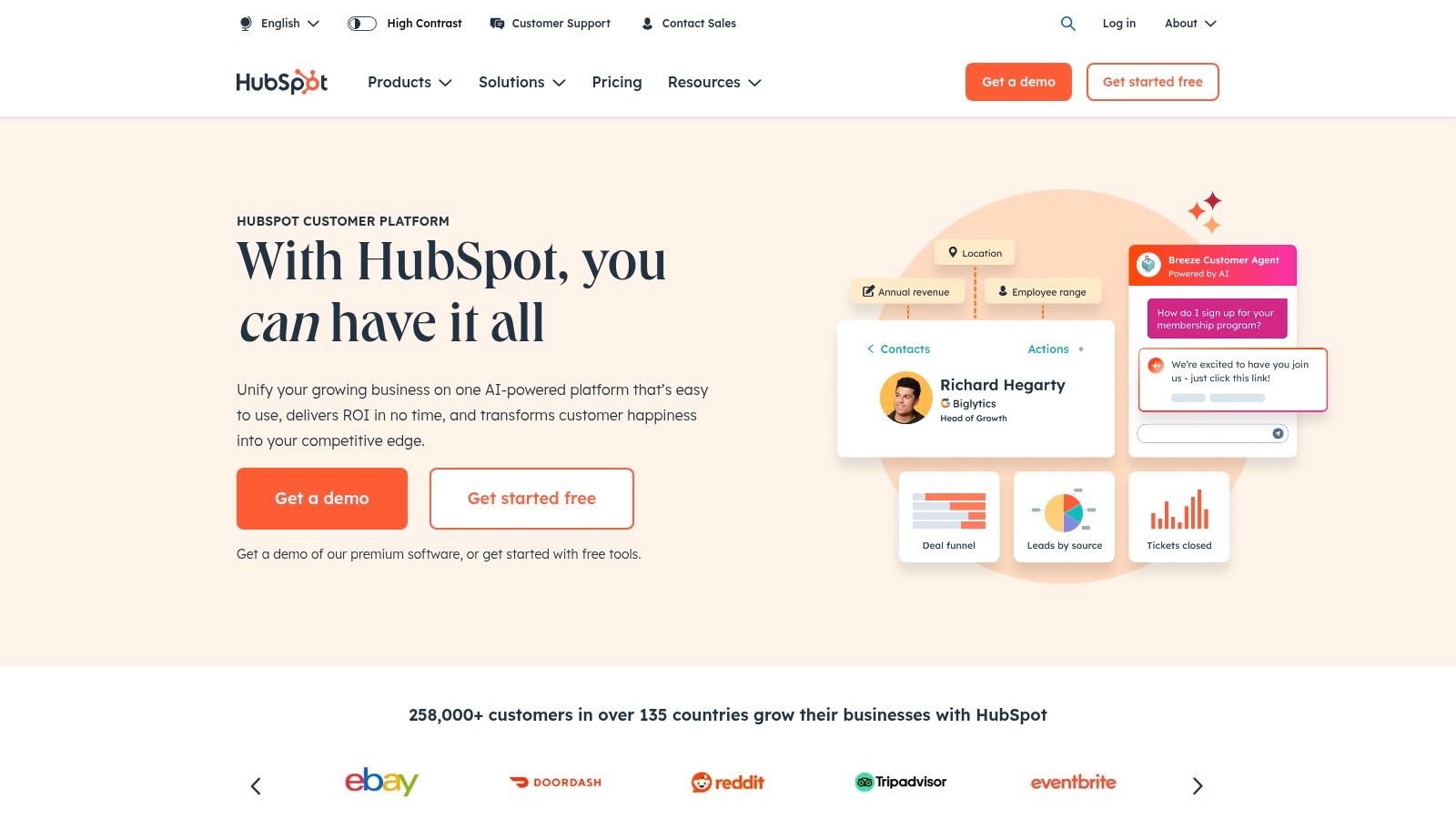
Unlike many platforms that bolt on CRM functionality, HubSpot’s campaign features are built around it. This means you can create highly personalised, multi-channel campaigns that are automatically informed by customer data. For businesses focused on lead generation and nurturing, this centralised approach simplifies what could otherwise be a fragmented process, making it one of the best campaign management tools for achieving scalable growth. For small businesses looking to get started, you can learn more about developing an effective marketing strategy on grow-your-biz.com.
Key Considerations
- Best For: Businesses seeking a unified platform to manage marketing, sales, and customer service with a focus on inbound strategy.
- Pricing: Offers a free tier with basic tools. Paid plans (Marketing Hub) start at around £15/month (Starter), scaling to £655/month (Professional) and up, making premium features a significant investment.
- Implementation: The platform is user-friendly, but fully leveraging its advanced features, like complex workflows and custom reporting, involves a learning curve. Extensive documentation and support are available.
Pros:
- Comprehensive, all-in-one suite of tools.
- User-friendly interface with excellent support.
- Highly scalable for growing businesses.
Cons:
- Premium plans can be costly.
- Advanced features may require training.
Website: https://www.hubspot.com/
2. Mailchimp
Mailchimp is renowned for making sophisticated email marketing accessible to everyone, from solo entrepreneurs to growing businesses. While it started as a simple email newsletter service, it has evolved into a comprehensive marketing platform, offering tools for automation, audience management, and multi-channel campaigns. Its primary strength lies in its user-friendly interface and powerful email-centric features.
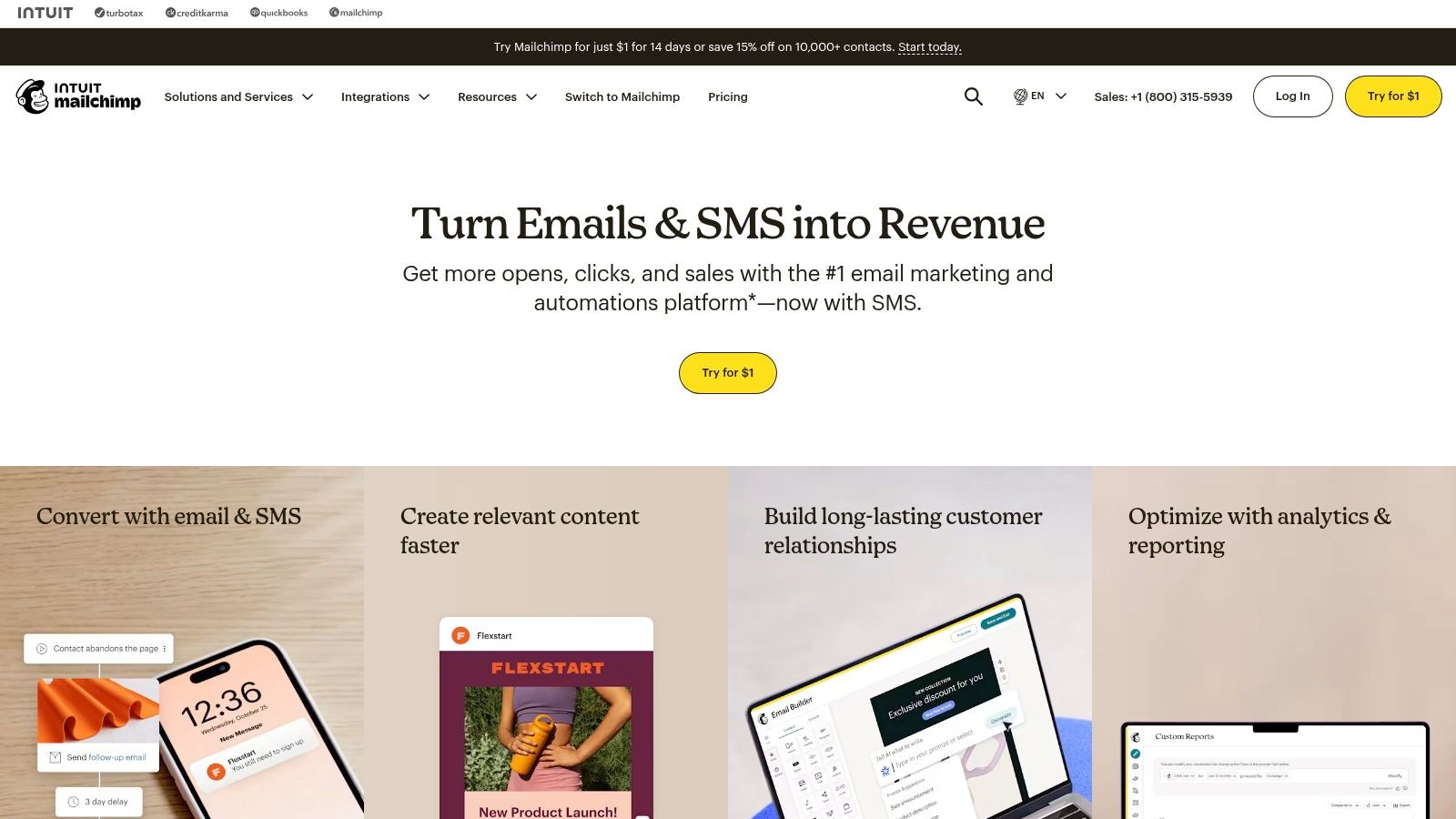
Unlike more complex, all-in-one solutions, Mailchimp excels by focusing on its core competency: email. It provides an intuitive drag-and-drop builder, robust segmentation capabilities, and clear performance analytics. For businesses where email is a central pillar of their strategy, Mailchimp offers a streamlined and effective set of campaign management tools without the overwhelming complexity of enterprise-level systems. If you're looking to maximise your ROI, it's worth understanding the advantages of email marketing on grow-your-biz.com.
Key Considerations
- Best For: Small to medium-sized businesses, e-commerce stores, and content creators who prioritise email marketing as their main communication channel.
- Pricing: A generous free plan is available for up to 500 contacts. Paid plans start at around £11/month (Essentials), increasing with contact list size and feature requirements to £250/month (Premium) and beyond.
- Implementation: Extremely easy to set up, especially for basic email campaigns. Learning to use advanced features like multi-step automations and predictive segmentation requires some exploration but is well-supported by guides.
Pros:
- Highly intuitive and user-friendly interface.
- Excellent free plan for new businesses.
- Strong e-commerce and app integrations.
Cons:
- Pricing can become expensive as your audience grows.
- Advanced automation features are less robust than competitors.
Website: https://mailchimp.com/
3. Hootsuite
Hootsuite has carved out its niche as a specialist in social media management, evolving into a robust platform for executing social-first marketing campaigns. It allows teams to manage all their social channels from a single, unified dashboard, streamlining the process of scheduling, publishing, and monitoring content. This centralisation is key for maintaining a consistent brand voice and strategy across diverse platforms like Instagram, X (formerly Twitter), Facebook, and LinkedIn.
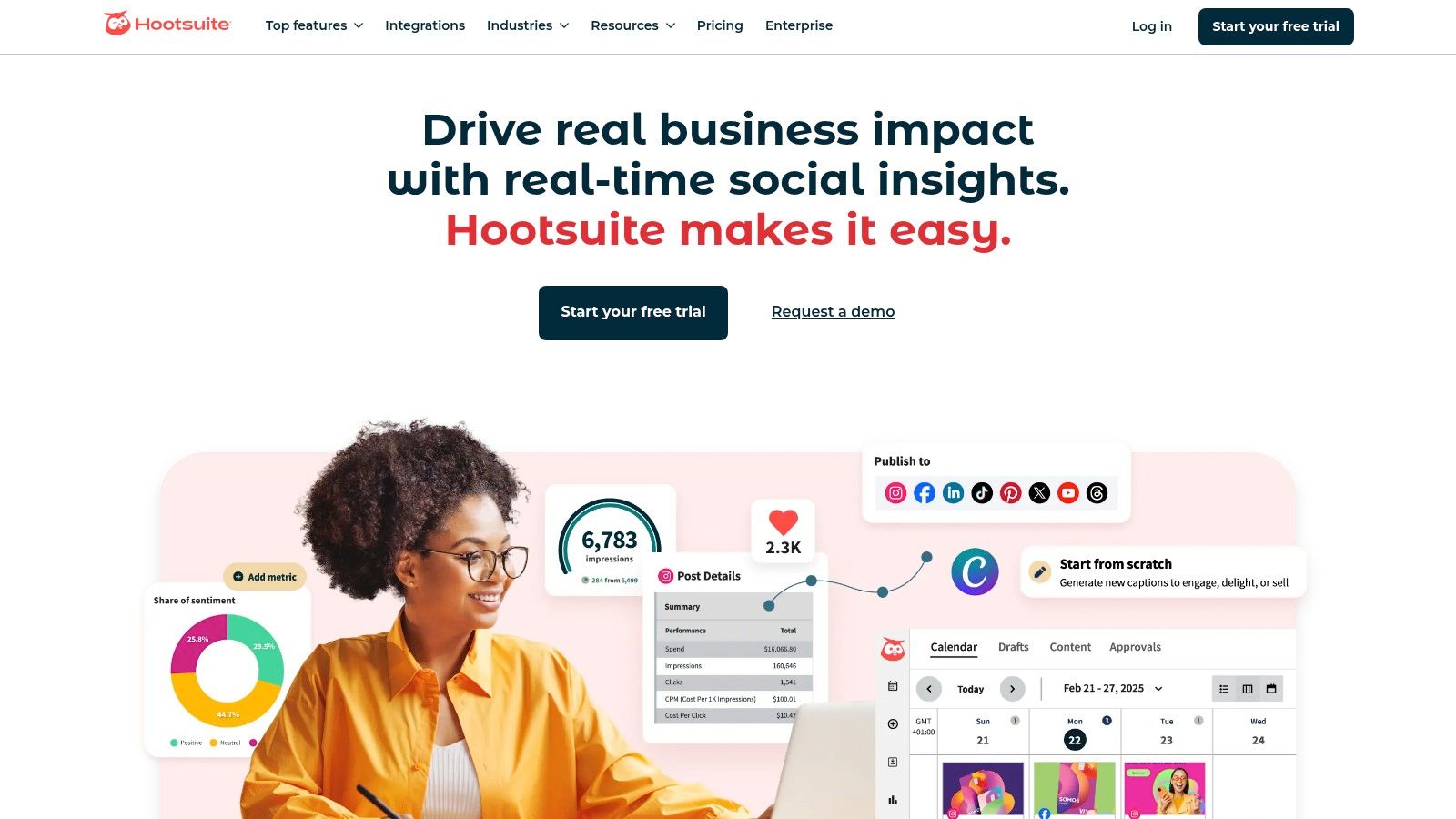
Where Hootsuite truly shines as one of the essential campaign management tools is in its ability to facilitate real-time engagement and listening. Teams can track brand mentions, keywords, and hashtags, allowing them to tap into relevant conversations and manage their online reputation proactively. For businesses where social media is the primary channel for customer interaction and brand building, Hootsuite provides the specialised tools needed to measure social ROI and turn audience engagement into tangible business outcomes.
Key Considerations
- Best For: Businesses and agencies focused on executing and analysing social media-centric campaigns.
- Pricing: Offers a limited free plan. Paid plans begin with the Professional tier at around £89/month, with Team and Enterprise plans scaling significantly higher.
- Implementation: The platform is largely intuitive for core scheduling functions. However, mastering its advanced analytics, social listening, and team collaboration features can involve a learning curve, though extensive support resources are provided.
Pros:
- Excellent support for a wide range of social media platforms.
- User-friendly interface with powerful collaboration features.
- Strong social listening and analytics capabilities.
Cons:
- Can become expensive, particularly for smaller teams or businesses.
- Some advanced features are only available on higher-tier plans.
Website: https://www.hootsuite.com/
4. ActiveCampaign
ActiveCampaign excels by deeply integrating sophisticated email marketing automation with a user-centric CRM. This combination allows businesses to create highly dynamic and personalised customer journeys, moving beyond simple broadcasts to build complex, trigger-based workflows. It stands out by enabling marketers to track engagement with precision and automatically adjust communications based on user behaviour, purchases, or site visits.
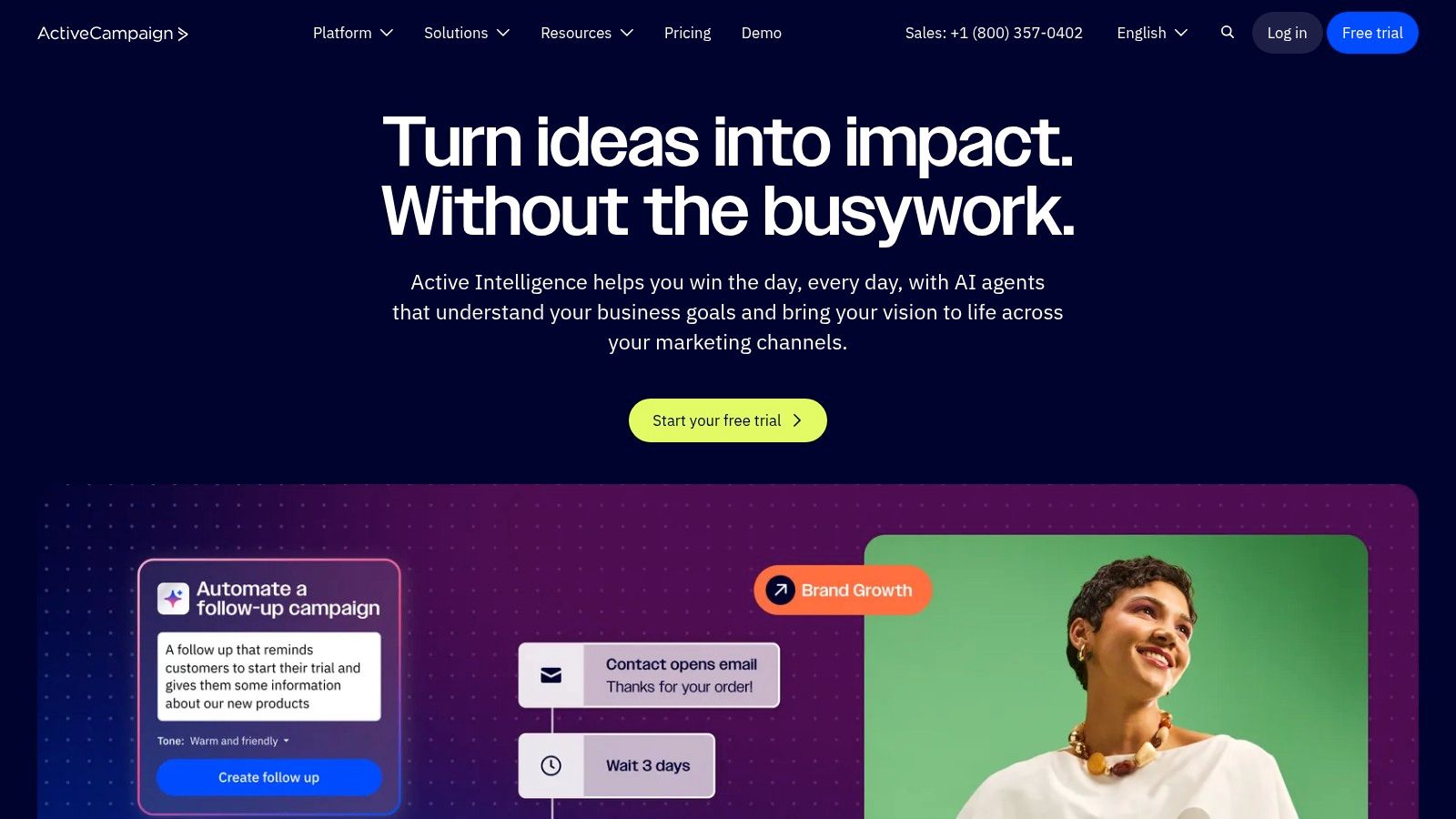
Unlike platforms that keep CRM and email marketing separate, ActiveCampaign's power lies in its unified approach. Features like contact and lead scoring are built-in, helping sales and marketing teams prioritise their efforts on the most engaged prospects. Its robust e-commerce integrations allow for tailored campaigns, such as abandoned cart reminders or post-purchase follow-ups, making it one of the premier campaign management tools for businesses focused on conversion. For those just starting, you can find a helpful beginner's guide to digital marketing on grow-your-biz.com to build a solid foundation.
Key Considerations
- Best For: Small to medium-sized businesses, particularly in e-commerce, that need powerful automation and CRM without the enterprise-level price tag.
- Pricing: Plans are based on contact numbers. The Lite plan starts around £29/month, with Plus (from £49/month) and Professional (from £149/month) adding more advanced CRM and automation features.
- Implementation: While the core features are accessible, mastering the advanced automation builder can present a steep learning curve for new users. The platform’s extensive knowledge base is a valuable resource.
Pros:
- Exceptional automation flexibility and powerful workflows.
- Deep integration between CRM and email marketing.
- Advanced segmentation and personalisation capabilities.
Cons:
- The interface can feel overwhelming for complete beginners.
- Costs escalate significantly as your contact list grows.
Website: https://www.activecampaign.com/
5. Brevo (formerly Sendinblue)
Brevo, formerly known as Sendinblue, has established itself as a versatile all-in-one marketing platform, excelling in providing multi-channel communication tools on a single interface. It uniquely combines email marketing, SMS campaigns, WhatsApp messaging, and live chat, allowing businesses to engage with customers across their preferred channels without juggling multiple subscriptions. This consolidation is its key differentiator in the crowded market of campaign management tools.
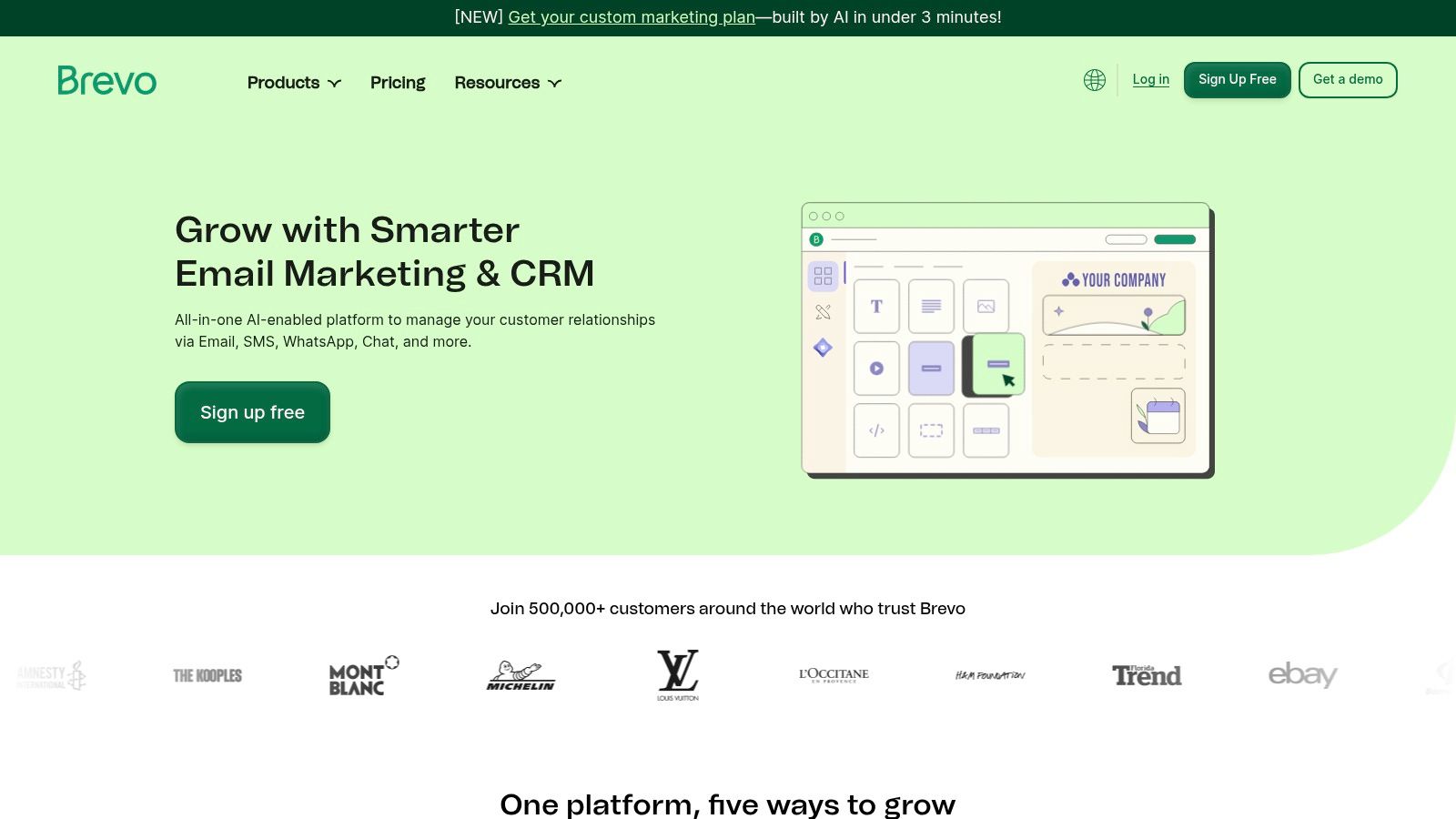
The platform is designed for accessibility, featuring a user-friendly drag-and-drop editor and marketing automation workflows that are simple to set up. Unlike more complex systems, Brevo focuses on delivering core functionalities exceptionally well, making it ideal for small to medium-sized businesses that need powerful, straightforward tools for creating personalised customer journeys. Its impressive deliverability rates ensure that marketing messages consistently reach their intended audience.
Key Considerations
- Best For: Small and medium-sized businesses looking for an affordable, all-in-one platform to manage email, SMS, and chat campaigns.
- Pricing: Offers a generous free plan with up to 300 emails per day. Paid plans start at a competitive £15/month (Starter) and scale to £42/month (Business), with custom pricing for enterprise needs.
- Implementation: Extremely beginner-friendly with a clean interface and intuitive setup. Most users can launch their first campaign within an hour, with minimal need for technical support or extensive training.
Pros:
- Affordable pricing with a comprehensive free tier.
- Excellent multi-channel capabilities (email, SMS, chat).
- User-friendly interface suitable for beginners.
Cons:
- Reporting features on lower-tier plans are limited.
- Lacks some of the advanced enterprise-level features of competitors.
Website: https://www.brevo.com/
6. Zoho Campaigns
Zoho Campaigns positions itself as a powerful, yet remarkably accessible, email marketing automation tool, especially for businesses already invested in the broader Zoho ecosystem. Its key strength lies in its seamless integration with other Zoho products like Zoho CRM, allowing for sophisticated campaign management where marketing and sales data flow effortlessly between platforms. This creates a unified customer view, enabling highly targeted and personalised email communications based on real-time customer behaviour and sales pipeline status.
Unlike standalone email platforms, Zoho Campaigns leverages its native connections to offer advanced automation and segmentation without a hefty price tag. For small to medium-sized businesses, this means you can implement complex, trigger-based workflows-such as nurturing leads who interact with a quote in Zoho CRM or re-engaging customers after a purchase-with relative ease. This focus on integrated automation makes it one of the most effective campaign management tools for organisations looking to maximise the value of their existing customer data.
Key Considerations
- Best For: Small and medium-sized businesses, particularly those already using or planning to use the Zoho suite of business applications.
- Pricing: A 'Forever Free' plan is available for up to 2,000 contacts. Paid plans start at a very competitive £2.50/month (Standard), scaling to £4/month (Professional), with pricing based on email credits or subscriber count.
- Implementation: The platform is user-friendly with an intuitive drag-and-drop editor. Fully utilising the advanced automation and integration with Zoho CRM may involve a slight learning curve, but it is well-supported with documentation.
Pros:
- Seamless integration with Zoho’s suite of products.
- Extremely affordable and transparent pricing plans.
- Comprehensive analytics and reporting capabilities.
Cons:
- The free plan has significant feature limitations.
- The free trial period for paid features is only 14 days.
Website: https://www.zoho.com/campaigns/
7. Klaviyo
Klaviyo has carved out a distinct niche as a premier campaign management tool specifically engineered for e-commerce brands. Its core strength lies in its profound, data-centric integration with platforms like Shopify, Magento, and BigCommerce, enabling businesses to leverage customer data for hyper-personalised marketing. This focus allows for the creation of sophisticated, automated campaigns that directly link marketing actions to sales outcomes.
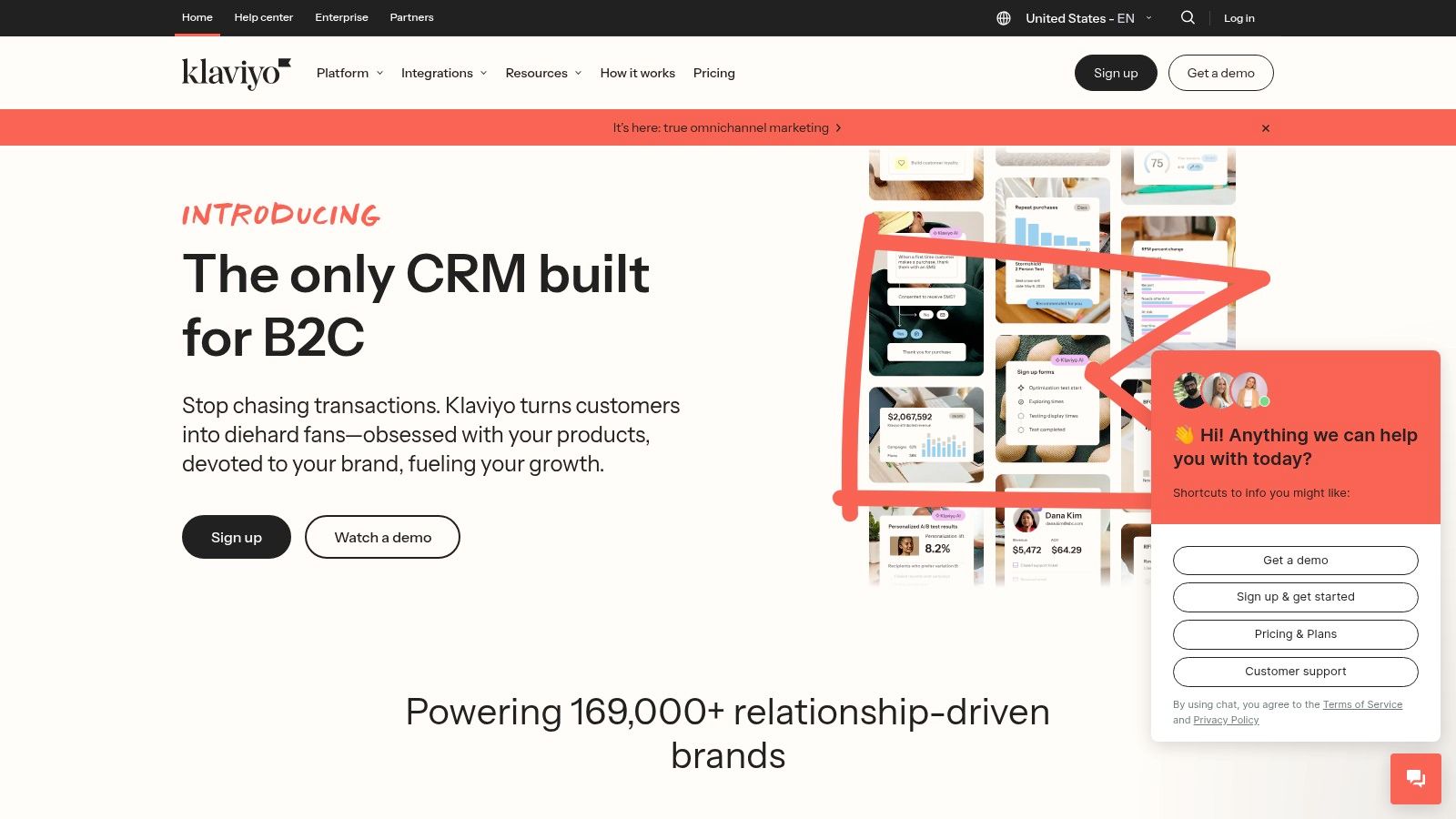
Where other platforms offer broad marketing features, Klaviyo excels in unifying email and SMS marketing under one roof, guided by e-commerce analytics. It moves beyond simple opens and clicks, providing ROI-based reporting that shows exactly how much revenue each campaign generates. For online retailers aiming to boost customer lifetime value through targeted communication, such as abandoned cart reminders or personalised product recommendations, Klaviyo’s specialised toolset is exceptionally powerful.
Key Considerations
- Best For: E-commerce businesses of all sizes that want to drive sales through highly targeted, data-driven email and SMS marketing.
- Pricing: Offers a free plan for up to 250 contacts. Paid plans scale based on the number of contacts and email/SMS volume, starting around £25/month for email and an additional cost for SMS credits.
- Implementation: While direct integration is straightforward, mastering its advanced segmentation and flow-building features can involve a steeper learning curve for beginners. The platform provides extensive educational resources.
Pros:
- Deep, seamless integration with major e-commerce platforms.
- Powerful and granular segmentation capabilities.
- Comprehensive, revenue-focused analytics and reporting.
Cons:
- Pricing can become expensive as contact lists grow.
- The advanced feature set may be overwhelming for novices.
Website: https://www.klaviyo.com/
8. Marketo Engage
Marketo Engage, now part of the Adobe Experience Cloud, is an enterprise-grade marketing automation platform designed for managing complex, large-scale campaigns. It excels in account-based marketing (ABM) and lead management, enabling organisations to orchestrate sophisticated customer journeys across multiple touchpoints, including email, web, mobile, and social media. Its core strength lies in its ability to handle intricate nurturing sequences and scoring models, making it a powerful choice for B2B companies with long sales cycles.
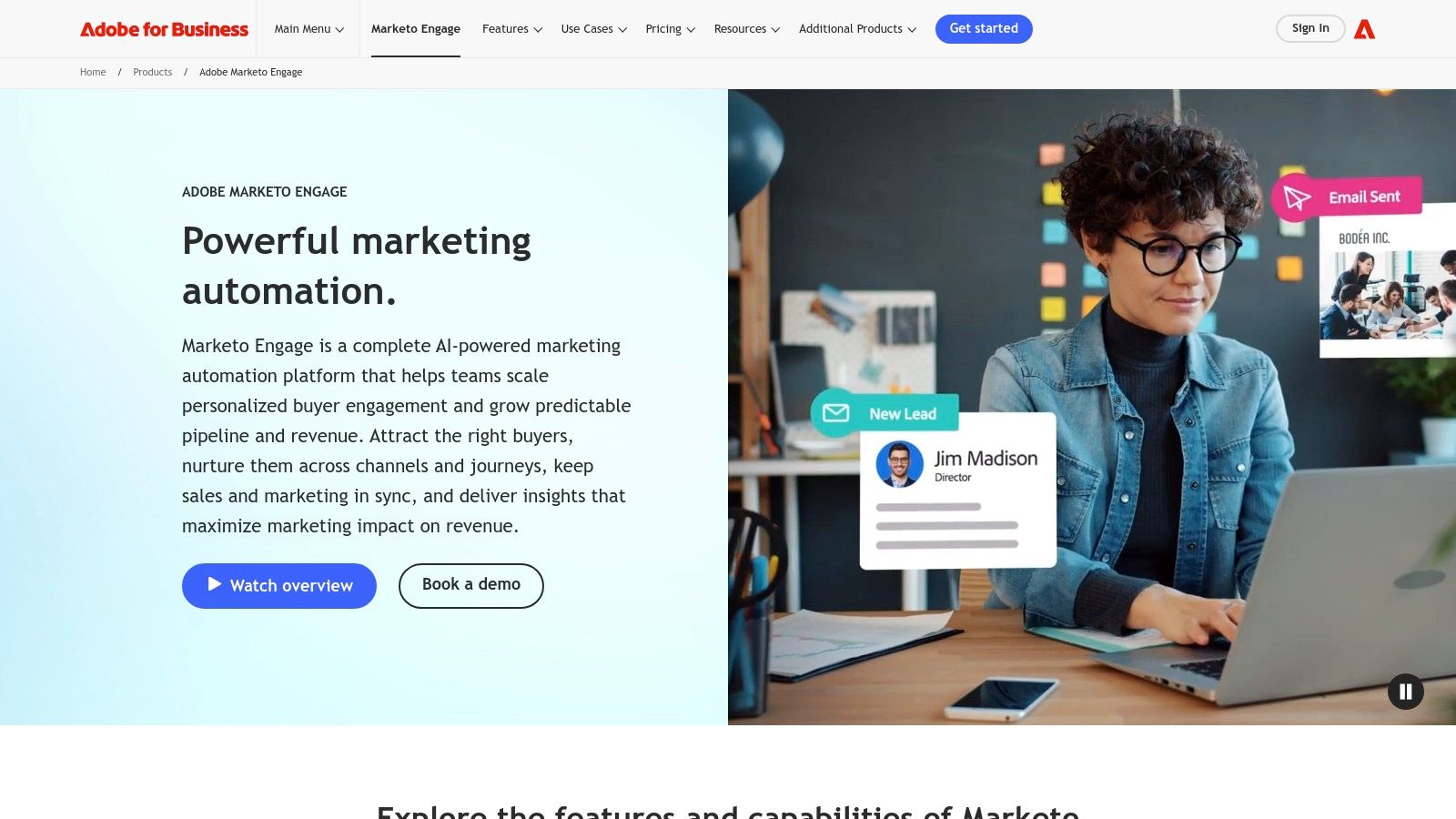
Unlike more generalised platforms, Marketo is built for deep data analysis and personalisation at scale. This focus allows marketing teams to execute highly targeted strategies and gain granular insights into campaign performance and ROI. For large enterprises seeking one of the most robust campaign management tools that can integrate deeply with CRM systems and other elements of the Adobe ecosystem, Marketo provides a comprehensive, if complex, solution for driving measurable revenue growth.
Key Considerations
- Best For: Large enterprises and B2B organisations that require advanced automation, lead nurturing, and detailed analytics for complex marketing funnels.
- Pricing: Custom pricing based on database size and features. It is a premium-priced solution, with costs typically starting in the thousands of pounds per month, making it inaccessible for most small businesses.
- Implementation: The platform is notoriously complex and powerful, often requiring dedicated administrators, extensive training, or implementation partners to fully leverage its capabilities.
Pros:
- Highly powerful and comprehensive for complex marketing needs.
- Excellent scalability for large, growing organisations.
- Deep integration with Salesforce and the Adobe Experience Cloud.
Cons:
- Significant cost can be a barrier for smaller companies.
- Steep learning curve requires specialised expertise.
Website: https://business.adobe.com/products/marketo/adobe-marketo.html
9. Sprout Social
Sprout Social carves out its niche as a specialist social media management platform, offering powerful tools that double as a focused campaign management solution for social-first strategies. It excels at helping businesses organise, schedule, and analyse their social media presence, providing a granular view of campaign performance across various networks. By centralising social publishing and engagement, it ensures a consistent brand voice and streamlined workflow.
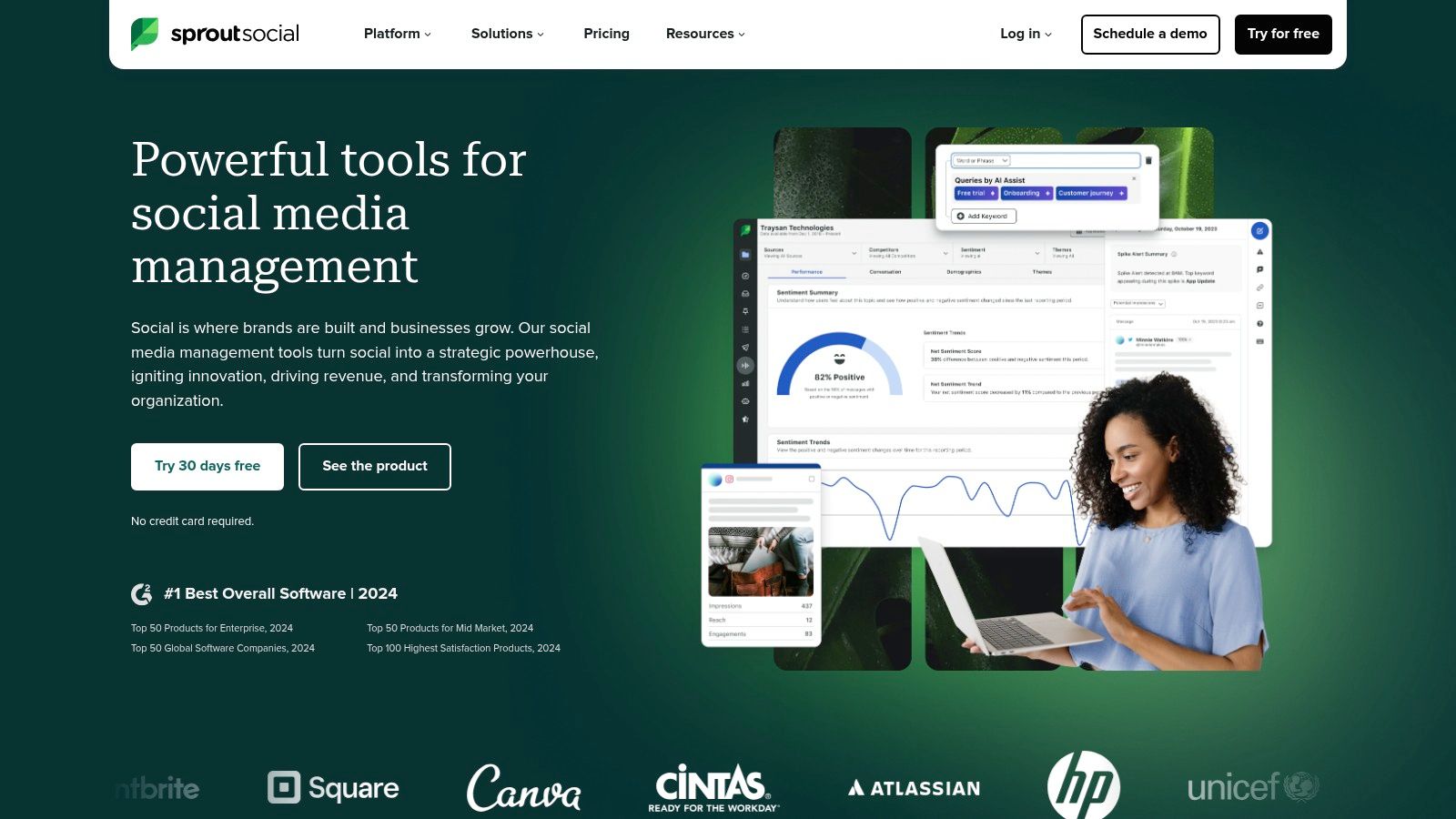
Unlike all-in-one marketing suites, Sprout Social’s strength lies in its depth of social-specific features. Its campaign link and tag tracking allow marketers to precisely measure ROI from social efforts, while advanced social listening capabilities uncover valuable consumer insights and trends. For teams where social media is the primary channel for engagement and lead generation, Sprout Social provides one of the most sophisticated campaign management tools available, transforming social data into actionable business intelligence.
Key Considerations
- Best For: Businesses and agencies that rely heavily on social media marketing and require deep analytics and engagement tools.
- Pricing: Plans start at approximately £199 per user/month (Standard), scaling to £299 per user/month (Professional) and higher for the Advanced plan, positioning it as a premium tool.
- Implementation: The platform is known for its intuitive, user-friendly interface. However, mastering its advanced reporting and listening features may require some initial training to maximise its value.
Pros:
- Comprehensive social media management features.
- User-friendly interface with robust support.
- Advanced analytics and reporting capabilities.
Cons:
- Pricing may be high for small businesses.
- Some advanced features may require additional training.
Website: https://sproutsocial.com/
10. CoSchedule
CoSchedule excels by placing a master content calendar at the heart of its campaign management framework. It is specifically designed for content-heavy marketing teams that need to visualise, schedule, and execute their entire strategy in one place. Its standout feature is the Marketing Calendar, which provides a unified view of every project, from blog posts and email newsletters to social media updates, preventing scheduling conflicts and ensuring message consistency.
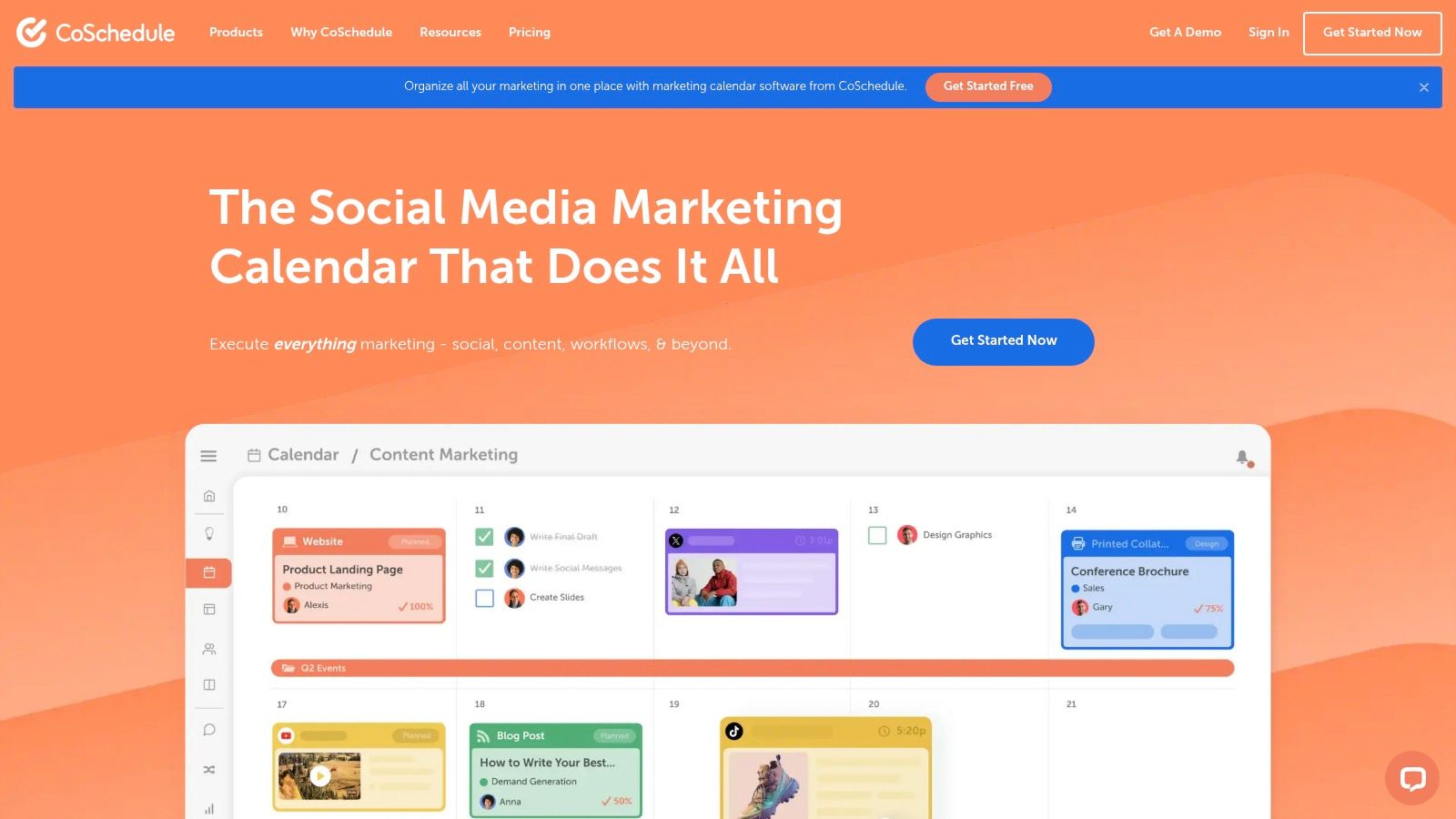
Unlike more generalist project management tools, CoSchedule is built from the ground up for marketers. Features like its AI-powered social media optimisation and ReQueue function, which intelligently recycles evergreen content, are tailored to maximise engagement with minimal effort. This makes it one of the most effective campaign management tools for organisations looking to streamline their content production and distribution workflows, ensuring every piece of content serves a strategic purpose.
Key Considerations
- Best For: Content-driven marketing teams and agencies needing to organise and automate their editorial and social media calendars.
- Pricing: Offers a free calendar tool. Paid plans start at around £15/month per user for the Social Calendar, with the comprehensive Marketing Suite requiring a custom quote.
- Implementation: The interface is intuitive and easy to adopt for basic scheduling. Unlocking the full potential of its automation and team collaboration features may involve a slight learning curve, but is supported by extensive help resources.
Pros:
- Comprehensive and visual content calendar management.
- User-friendly interface with excellent support.
- Powerful AI and automation features for social media.
Cons:
- Pricing for the full suite can be a significant investment.
- Advanced features may require some initial training to master.
Website: https://coschedule.com/
11. Trello
While not a dedicated campaign management tool in the traditional sense, Trello offers unparalleled visual project management that excels in organising the moving parts of any marketing campaign. Its core strength lies in its Kanban-style board, which allows teams to map out workflows from "Idea" to "Launched" and beyond. This visual approach makes it incredibly intuitive to track the status of every campaign asset, from blog posts and social media updates to ad creatives and email newsletters.
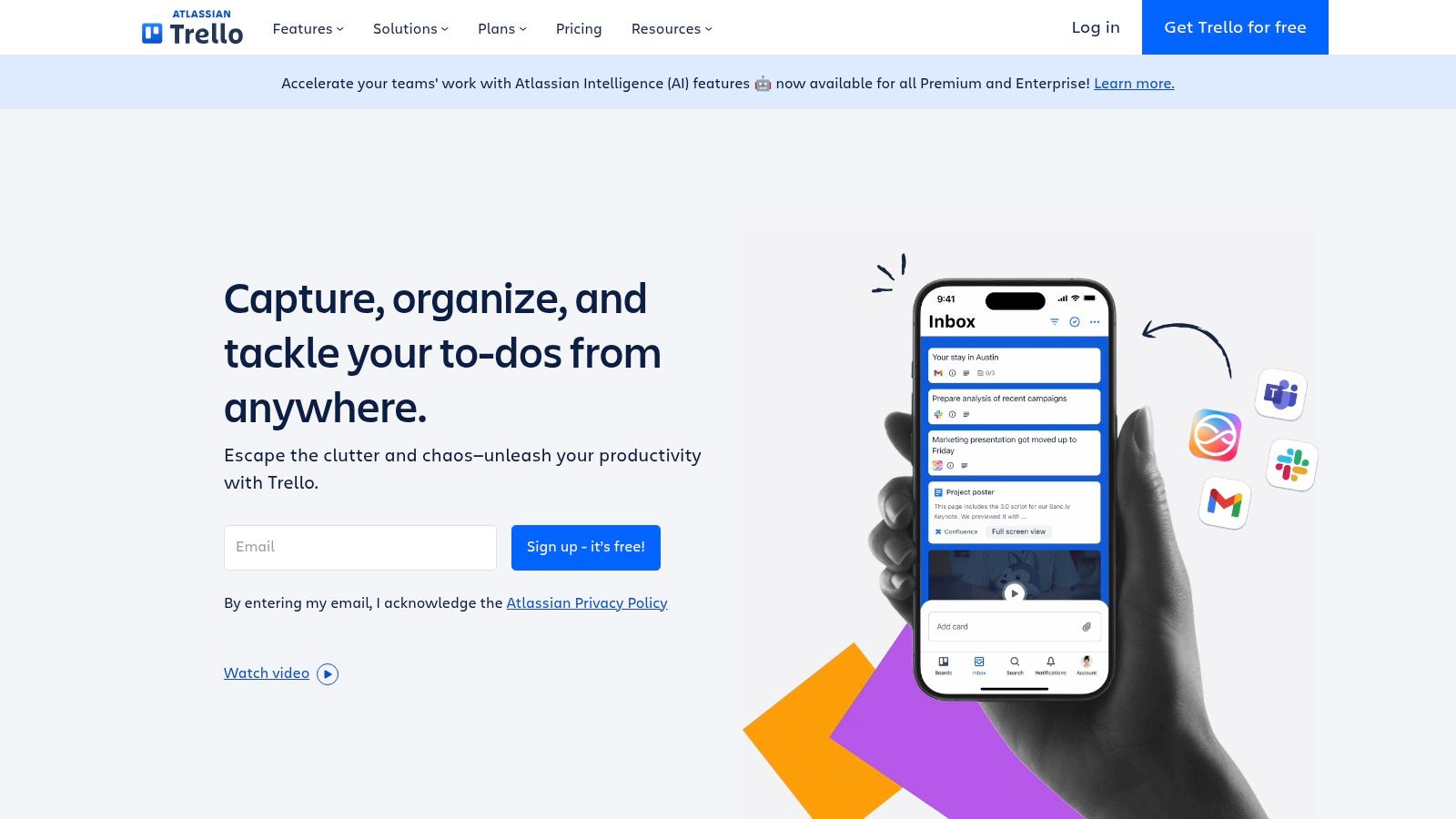
Unlike complex, feature-heavy platforms, Trello's simplicity is its advantage. Each task is a "card" that can be moved across lists, assigned to team members, and filled with checklists, attachments, and due dates. This flexibility makes it an excellent choice for teams that need a centralised, easy-to-understand hub for collaboration and task management without the steep learning curve of more specialised campaign management tools. For many small businesses and agile teams, its straightforward system is all that is needed to keep campaigns organised and on schedule.
Key Considerations
- Best For: Agile marketing teams, content creators, and small businesses needing a flexible, visual way to organise tasks and collaborate on campaign execution.
- Pricing: A generous free plan is available for individuals and small teams. Paid plans start at around £4/month per user (Standard) and scale up to £14/month per user (Enterprise) for advanced features and automation.
- Implementation: Extremely user-friendly with a minimal learning curve. New users can set up a campaign board and start collaborating within minutes. Integrations (Power-Ups) can add more complex functionality.
Pros:
- Highly intuitive and visual Kanban board interface.
- Extremely flexible and customisable for various workflows.
- Excellent free plan for getting started.
Cons:
- Lacks in-depth analytics and reporting features.
- Relies on integrations (Power-Ups) for advanced functionality.
Website: https://trello.com/
12. Asana
While primarily known as a project management tool, Asana excels at bringing structure and clarity to the operational side of marketing campaigns. It allows teams to meticulously plan, organise, and track every task involved in a campaign's lifecycle, from initial brief to final report. Its strength lies in transforming complex campaign strategies into actionable, step-by-step plans that keep every team member aligned and accountable.
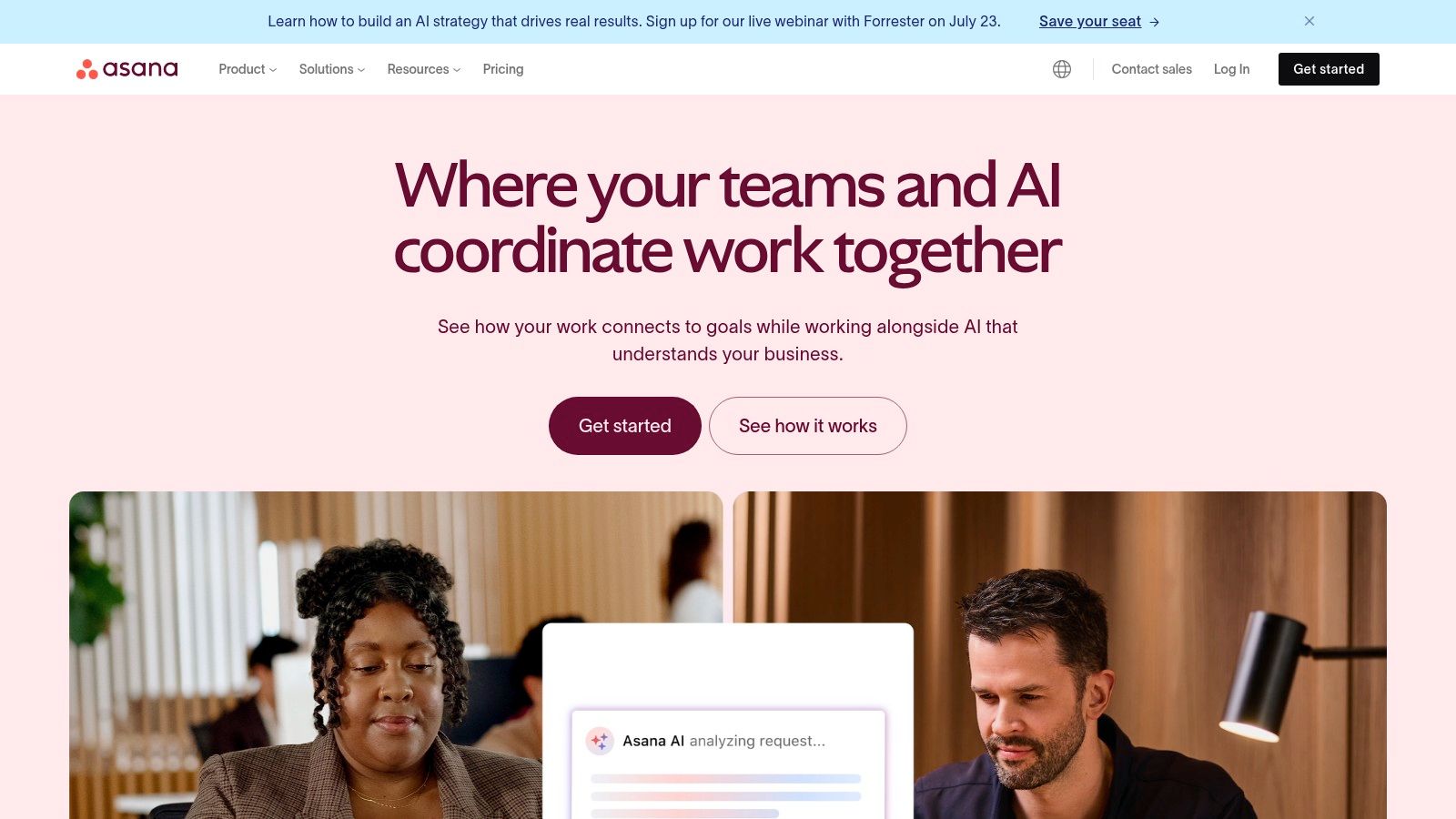
Unlike dedicated marketing automation platforms, Asana focuses on the 'who, what, and when' of campaign execution. With customisable project views like lists, timelines, and Kanban boards, it provides unparalleled flexibility for managing creative production, content calendars, and launch schedules. This makes it one of the best campaign management tools for teams that need a central hub to coordinate cross-functional efforts and maintain visibility over all moving parts. For those needing comprehensive marketing automation, Asana integrates smoothly with tools like HubSpot and Mailchimp.
Key Considerations
- Best For: Marketing teams needing a powerful system to manage tasks, workflows, and collaboration across complex campaigns.
- Pricing: A robust free "Basic" plan is available for individuals or small teams. Paid plans start from £9.49 per user/month (Premium) and £20.99 per user/month (Business) for more advanced features.
- Implementation: Highly intuitive and easy to adopt for basic task management. Leveraging its full potential with custom fields, rules, and integrations requires a more strategic setup.
Pros:
- Extremely flexible and customisable for various campaign types.
- Excellent collaboration features keep teams in sync.
- Generous free plan for getting started.
Cons:
- Lacks built-in marketing automation and analytics.
- Can become cluttered if not organised properly.
Website: https://asana.com/
Campaign Management Tools Feature Comparison
| Tool | Core Features✨ | User Experience ★★★★☆ | Value Proposition 💰 | Target Audience 👥 | Unique Selling Points 🏆 |
|---|---|---|---|---|---|
| HubSpot | CRM, multi-channel campaigns, analytics | Scalable, user-friendly | Premium pricing, all-in-one solution | Businesses of all sizes | Integrated CRM, collaboration tools |
| Mailchimp | Email builder, segmentation, performance | Intuitive, beginner-friendly | Free plan available, scalable pricing | Small to mid-sized businesses | Extensive integrations, ease of use |
| Hootsuite | Social scheduling, social listening, analytics | User-friendly with collaboration | Higher-tier costly | Social media managers | Multi-platform support, team features |
| ActiveCampaign | Marketing automation, CRM, lead scoring | Powerful but complex for beginners | Pricing scales with contacts | Businesses needing advanced automation | Deep CRM integration, flexible workflows |
| Brevo | Email/SMS marketing, automation workflows | Beginner-friendly, simple UI | Affordable plans | Small businesses & multichannel users | High deliverability, multi-channel send |
| Zoho Campaigns | Email templates, automation, reporting | Integrated in Zoho suite | Affordable, limited free plan | SMBs in Zoho ecosystem | Zoho integration, analytics focus |
| Klaviyo | Email/SMS, segmentation, ROI reporting | Powerful, steeper learning curve | Expensive for large lists | E-commerce businesses | Deep Shopify integration, ROI tracking |
| Marketo Engage | Lead nurturing, cross-channel marketing | Complex, requires training | High cost, enterprise focus | Large enterprises | Adobe ecosystem, robust automation |
| Sprout Social | Social management, social listening, analytics | User-friendly, strong support | Premium pricing | Social media teams | Advanced social analytics, engagement |
| CoSchedule | Content calendar, AI scheduling, collaboration | Easy to use, good support | Higher cost for small teams | Marketing teams | AI content tools, content calendar |
| Trello | Kanban boards, customizable tasks, collaboration | Minimal learning curve, flexible | Free plan available | Teams needing visual workflow | Visual task management, simplicity |
| Asana | Task tracking, scheduling, collaboration | Robust, user-friendly | Free plan with limitations | Teams of all sizes | Flexible task views, strong integrations |
Choosing the Right Tool to Amplify Your Marketing Efforts
Navigating the expansive landscape of campaign management tools can feel overwhelming. We have explored a diverse range of platforms, from comprehensive, all-in-one systems like HubSpot and Marketo Engage to specialised powerhouses such as Klaviyo for e-commerce and Hootsuite for social media mastery. We also considered flexible project management aids like Trello and Asana, which prove that effective campaign organisation doesn't always require a dedicated marketing suite. The core takeaway is this: the "best" tool is not a universal title but a subjective one, defined entirely by your unique business requirements, team structure, and strategic objectives.
The journey from planning a campaign to analysing its results is complex, filled with countless tasks, data points, and creative assets. The right software doesn't just automate tasks; it centralises your efforts, provides clarity amidst the chaos, and empowers you to make data-driven decisions. It transforms disparate activities into a cohesive, measurable, and optimised marketing strategy.
How to Make Your Final Decision
To move from this resource list to a final selection, you must first look inward at your organisation's specific needs. A self-assessment is the most critical step in this process. Consider the following framework to guide your choice:
- Primary Goal: What is the main problem you need to solve? Are you struggling with lead nurturing (look at ActiveCampaign), social media scheduling (consider Sprout Social or CoSchedule), or building sophisticated, multi-channel customer journeys (HubSpot might be your answer)? Pinpoint your most significant pain point first.
- Team Size and Expertise: Are you a solo entrepreneur needing a simple, intuitive interface like Mailchimp or Brevo? Or are you part of a larger marketing team that can leverage the advanced features and complexity of a platform like Marketo Engage? Be realistic about the time and resources available for training and implementation.
- Budgetary Constraints: Your financial reality is a non-negotiable factor. Tools like Zoho Campaigns and the free tiers of many platforms offer a fantastic starting point for small businesses. Conversely, larger enterprises with a dedicated marketing budget can justify the significant investment required for more robust solutions. Always factor in the cost of scaling as your business grows.
- Integration Capabilities: No tool exists in a vacuum. Your chosen campaign management tool must seamlessly connect with your existing tech stack, such as your CRM, e-commerce platform, or analytics software. Poor integration creates data silos and manual work, defeating the purpose of adopting a new tool in the first place.
Your Actionable Next Steps
Theory and reviews can only take you so far. The most crucial phase of your evaluation process is hands-on testing. Nearly every tool on our list, from Asana to ActiveCampaign, offers a free trial or a freemium plan. Use this opportunity to your advantage:
- Shortlist Your Top 3: Based on your self-assessment, select the three most promising candidates.
- Sign Up for Trials: Dedicate time to exploring each platform. Don't just browse the features; try to execute a small, real-world task.
- Evaluate User Experience: How intuitive is the dashboard? Can you find what you need without constantly consulting help documents? Involve your team members in this evaluation, as they will be the daily users.
- Test Customer Support: A platform is only as good as the support behind it. Reach out with a question during your trial period to gauge the responsiveness and helpfulness of their team.
Choosing the right campaign management tools is a foundational decision that will directly impact your marketing efficiency and success. By taking a methodical, needs-based approach, you can confidently select a platform that not only simplifies your workflow but also acts as a powerful catalyst for growth, turning your strategic vision into measurable results.
Building the perfect marketing tech stack is an ongoing journey. For more curated comparisons, in-depth guides, and resources designed to simplify your search, visit The Digital Marketing Toolbox. We help you cut through the noise and find the best digital marketing solutions to build a powerful and efficient growth engine. Explore The Digital Marketing Toolbox to continue optimising your strategy today.


