
A competitor analysis framework is simply a structured way of looking at what your rivals are up to—their strengths, their weaknesses, and their game plan. Think of it less as a rigid set of rules and more like a strategic map. It helps you cut through the noise, turning a mountain of raw data into insights you can actually use to make smarter, faster decisions for your business.
Why You Can't Afford to Skip a Competitor Analysis Framework
Let's be honest. Staring at a spreadsheet full of competitor data without a clear plan is a fast track to getting absolutely nowhere. You end up with a jumble of facts, figures, and a whole lot of confusion. This is exactly why a framework isn't just a nice-to-have; it's essential.
A structured approach transforms those random data points into a coherent picture of your competitive world. It helps you understand what your rival might do next and, more importantly, figure out your own best move. Instead of just listing their prices or features, a framework pushes you to ask the right questions.
From Piles of Data to a Real Strategy
A solid framework makes sure the intelligence you gather actually connects back to your business goals. It's the foundation that turns information into a genuine advantage.
This systematic process helps you:
- Spot Gaps in the Market: You can uncover customer needs that are being ignored or find weak spots in a competitor's offerings that you’re perfectly positioned to fill.
- Sharpen Your Value Proposition: When you know exactly how you stack up against the competition, you can clearly explain what makes your product or service the better choice.
- Anticipate What's Coming: By recognising trends and predicting competitor moves before they happen, you can be proactive instead of constantly playing catch-up.
- Benchmark Your Performance: See how you measure up against the established players in your industry. This helps you set realistic goals for growth and define what success really looks like.
A proper analysis isn’t just about listing strengths and weaknesses—it’s about finding actionable insights. The goal is to see what competitors are doing well, where they’re falling short, and what opportunities that creates for you. This perspective helps businesses not only compete but truly stand out.
Building Your Own Strategic Map
Without a framework, it's easy to fall into the trap of "analysis paralysis," where you're so buried in data that you never actually do anything with it. The structure is what saves you from this, forcing you to channel your research toward a clear objective. It shifts your focus from just knowing what your competitors are doing to understanding why they're doing it—and what that means for your strategy.
To get started, it’s worth exploring the different models out there and figuring out which ones apply to your specific business questions. For anyone ready to dive into the practical side of things, it's incredibly useful to learn how to build a powerful competitor analysis framework tailored to your goals. This is your first step in turning competitive intelligence from a defensive chore into an offensive weapon for growth.
Exploring the Core Analysis Frameworks

When it comes to competitor analysis, there’s no such thing as a one-size-fits-all solution. Each framework is a specialised tool designed for a specific job. Think of it like a mechanic's workshop – you wouldn't use a sledgehammer to tighten a tiny screw, nor would you grab a delicate screwdriver to change a tyre. The key is knowing which competitor analysis framework to pull out of the toolbox for the question you need to answer.
To build a strategy that actually works, you need to get to grips with the essential models. Let's unpack the core frameworks that form the bedrock of any solid competitive analysis. We’ll look at what they do, when to use them, and how they can give you the clarity you need to make your next move.
SWOT Analysis: The All-Rounder
If you’ve heard of any framework, it’s probably SWOT. It stands for Strengths, Weaknesses, Opportunities, and Threats, and it’s the versatile multi-tool of the strategy world. It’s perfect for getting a quick, high-level snapshot of both your business and your competitors.
Its popularity comes from its simplicity. SWOT gives you a clear, four-quadrant view of where a company stands. Strengths and Weaknesses are internal factors – things you can control, like your team’s unique skills or your product features. Opportunities and Threats are external factors beyond your direct control, such as shifting market trends or a new rival bursting onto the scene.
This model is especially powerful for small businesses. Running a SWOT is a fundamental step in any good https://grow-your-biz.com/marketing-strategy-for-small-business/ because it instantly highlights where you have an edge and what outside risks you need to watch out for.
SWOT analysis is far from outdated; it remains a foundational model used by approximately 70% of UK SMEs. This method helps firms categorise internal and external factors to better understand their market position.
Porter’s Five Forces: Gauging Industry Health
While a SWOT analysis zooms in on a single company, Porter’s Five Forces pulls back to give you a panoramic view of an entire industry. Developed by the legendary Michael E. Porter, this framework is all about assessing an industry's long-term attractiveness and competitive intensity. It’s less about one specific rival and more about the fundamental dynamics that dictate profitability for everyone.
The Five Forces are:
- Threat of New Entrants: How easy is it for a newcomer to set up shop and start stealing market share?
- Bargaining Power of Buyers: How much leverage do customers have to push your prices down?
- Bargaining Power of Suppliers: On the flip side, how much power do your suppliers have to raise their costs?
- Threat of Substitute Products: How likely is it that customers will find a completely different way to solve the problem your product addresses?
- Rivalry Among Existing Competitors: Just how fierce is the dogfight between the current players in the market?
This framework is your go-to when you’re thinking about entering a new market or trying to figure out why your current one is becoming more or less profitable. It answers the crucial question: "Is this industry a good place to be?"
Perceptual Mapping: Visualising the Battlefield
Finally, we have Perceptual Mapping, sometimes called a Positioning Map. This is a visual tool for understanding exactly how customers see your brand in relation to your competitors. It works by plotting brands on a simple two-axis map, where each axis represents a key purchasing attribute like price vs. quality, or traditional vs. modern.
This tool is brilliant for spotting gaps in the market. By mapping out where every competitor lives in the customer's mind, you can literally see the unoccupied territory – those sweet spots where a new brand or product could thrive. It helps you answer the vital question: "Where do we fit, and where can we be different?"
Each of these frameworks offers a unique lens for viewing your competitive landscape. For a deeper dive into these and other strategic models, exploring a complete competitor analysis framework can broaden your perspective. Ultimately, choosing the right one—or even combining them—is what unlocks truly actionable insights.
How to Choose the Right Framework for Your Business
Picking the right competitor analysis framework isn't just a box-ticking exercise; it's a crucial strategic decision. Think of it like choosing a tool from a toolbox. You wouldn't use a sledgehammer to hang a picture, and you shouldn't use a complex industry-wide analysis when you just need a quick snapshot of your own business.
The framework you choose shapes everything that follows, so your main business goal should always be the starting point.
Aligning Frameworks with Your Goals
Let's say you're a startup just getting its feet wet. You're trying to figure out where you fit in and what your immediate priorities should be. A straightforward SWOT analysis is your best friend here. It gives you a clear, high-level picture of your internal strengths and weaknesses against the external opportunities and threats. It’s perfect for getting your team aligned and building a foundational strategy without getting bogged down in endless data.
But what if you're an established player eyeing a completely new market? Your needs are totally different. You need to understand the structural forces at play—the real intensity of the competition and whether the market is even worth entering. This is where Porter's Five Forces shines. It helps you look beyond individual competitors to see the bigger picture, answering the critical question: "Can we actually win here in the long run?"
The whole point is to match the tool to the task. Using a detailed Perceptual Map when all you really need to know is if you have the resources to launch a new feature is overkill. On the flip side, relying on a basic SWOT when you're getting crushed by industry-wide price wars is like bringing a knife to a gunfight—it just won't give you the strategic depth you need.
To make it simple, think about what you're trying to achieve:
- SWOT Analysis: Best for looking inward and understanding your immediate competitive position.
- Porter's Five Forces: Ideal for sizing up an entire industry's attractiveness and potential for profit.
- Perceptual Mapping: Perfect for seeing your brand through your customers' eyes and finding gaps in the market.
This decision tree gives you a visual guide for the first step of any analysis: defining what you need to find out.
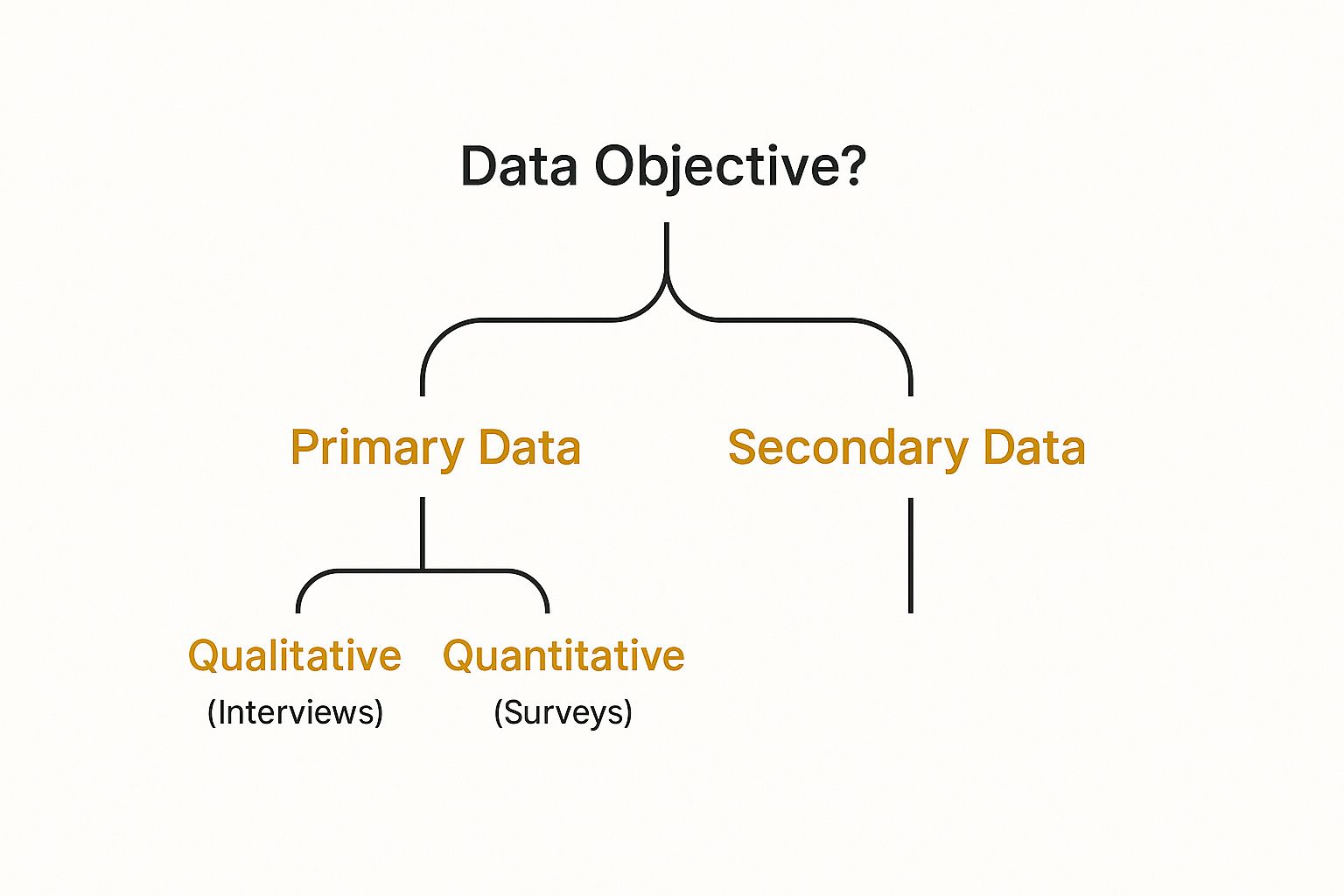
As the chart shows, your path splits depending on whether you're gathering new, firsthand information (primary research) or analysing existing data (secondary research). This initial choice points you toward the right methods for the job.
Making the Right Choice
When you choose with a clear purpose, you get sharp, actionable insights instead of a mountain of useless data. So, before you dive in, ask yourself one simple question: "What is the single most important thing I need to know about my competition right now?" Your answer will lead you straight to the best competitor analysis framework.
To help you decide, here’s a quick comparison table breaking down the most common frameworks and what they're best used for.
Choosing Your Competitor Analysis Framework
This table compares popular frameworks to help you select the best one based on your primary business objective.
| Framework | Primary Goal | Best For | Focus |
|---|---|---|---|
| SWOT Analysis | Assess current standing | Internal strategic planning, quick business health checks | Company-specific |
| Porter's Five Forces | Gauge industry profitability | Market entry decisions, long-term strategic forecasts | Industry-wide |
| Perceptual Mapping | Understand brand positioning | Marketing campaigns, identifying market gaps, product development | Customer perception |
By taking this structured approach, you're not just doing research for the sake of it. You're ensuring that every minute you spend is a direct investment in building a smarter, stronger business strategy.
Putting Your Chosen Framework into Action
A competitor analysis framework is just a theoretical tool until you actually put it to work. You can pick the perfect model, but without a clear, repeatable process for using it, you won't get very far. Let's walk through how to take your chosen framework off the page and turn it into a genuine strategic advantage.
The whole process starts with a simple question: “What do we really need to know?” Your answer sets the direction for everything that follows. Are you trying to figure out a competitor's pricing model, gauge their customer service quality, or map out their online sales funnel? Defining this goal first keeps you from getting lost in a sea of data.
Once you know what you're looking for, the next step is to pinpoint who you're actually up against. It sounds obvious, but it’s a step where many businesses stumble.
Step 1: Define Your Goals and Identify Competitors
Before you start digging for information, you need a clear list of who to investigate. It helps to break them down into a few categories so you get a complete view of the competitive landscape.
- Direct Competitors: These are the ones everyone thinks of first. They offer a very similar product to the same audience you are. Think McDonald's vs. Burger King.
- Indirect Competitors: These businesses solve the same problem for your customer, but with a different solution. A local coffee shop and an energy drink brand are both competing for the morning "pick-me-up" market.
- Emerging Competitors: Keep an eye out for the newcomers. These are the start-ups or new market entrants who could shake things up with a fresh idea or technology.
With your list of rivals ready, it's time to start gathering intelligence.
Step 2: Gather and Process Your Data
This is where you put on your detective hat. The aim is to collect a healthy mix of hard numbers and qualitative feedback to build a three-dimensional picture of each competitor.
Start with the easy-to-find stuff: their annual reports, press releases, and the marketing copy on their website. Then, dig deeper into their digital footprint. Social media, for instance, is an absolute goldmine for understanding how customers feel about them and the tone of voice they use. What do people praise? And more importantly, what do they complain about?
A common mistake is to get bogged down in surface-level metrics. The real magic happens when you understand the 'why' behind the data—why their marketing message connects with people, or why a specific feature is getting terrible reviews.
For a more structured approach, many companies are now monitoring brand performance with specialised tools to get a clearer, data-backed view of how they're perceived in the market.
Step 3: Turn Information into Actionable Insights
This is the most important part of the process: turning all that raw data into a strategic plan. This is where your framework comes in handy. Organise your findings using your SWOT matrix, feature comparison chart, or whatever model you chose. Your job is to spot the patterns, find the gaps, and identify the opportunities.
For instance, your analysis might show a competitor rarely sends out email newsletters. That’s not just a random fact; it’s an opportunity. You could decide to strengthen your own email strategy to fill that gap. To get started, you could explore the https://grow-your-biz.com/advantages-of-email-marketing/ and build a more consistent and engaging campaign.
Ultimately, every piece of data you collect should lead to a tangible action that gives your business a competitive edge.
How Winning Companies Use These Frameworks
A competitor analysis framework is only useful when you actually put it to work. The smartest companies don't just fill out charts and forget about them; they use these insights to make decisions that give them a real edge. Think of these frameworks as the strategic blueprints behind some of the most successful moves in business.
Take the retail world, for example. It's a battlefield. A major clothing brand might use a feature comparison framework to pick apart a rival’s new loyalty programme. By mapping out the rewards, the user experience, and how it's being advertised, they can spot the weak points. Maybe the competitor’s points system is too confusing, or the rewards just aren't that exciting. That's their chance to launch a simpler, more appealing programme that wins over customers.
This thinking works just as well in the B2B space. A software company could use perceptual mapping to see how clients view them compared to the big market leader. What if they find out they're seen as powerful but too complicated to use? The framework tells them what to do next. They can simplify their sign-up process and tweak their marketing to shout about how easy their software is to use, hitting their competitor right where it hurts.
From Data Points to Digital Dominance
Thanks to the sheer amount of customer data available today, these frameworks have gone from static, yearly reports to a live, ongoing process. For any business operating now, applying these ideas is a fundamental part of their strategy, which you can learn more about in our beginner's guide to digital marketing. This constant pulse-check allows them to make sharp, well-informed adjustments on the fly.
We're seeing these frameworks become deeply woven into digital metrics. For instance, a recent survey found that 60% of companies now use perceptual mapping to visualise their brand's position in the market. Another fascinating find was that 72% of retailers adjusted their prices at least quarterly based on what their competitors were doing, which led to an average revenue bump of 5-8% a year. You can discover more insights about these findings on Asana.com.
The true power of a competitor analysis framework isn’t just in the data it helps you gather. It’s in the clarity it brings. It shows you exactly where there’s a gap in the market and gives you the confidence to fill it with a better product, message, or experience.
Real-World Applications
Winning companies treat their competitor analysis as a living, breathing part of their strategy, always feeding it new information. This organised approach is what turns simple observations into meaningful action.
- Refining Ad Campaigns: By looking at a rival’s social media ads, a business might notice their videos are getting way more engagement. That's a clear signal to shift their own ad budget towards producing more video content and ride that wave.
- Improving Customer Support: Reading through a competitor's online reviews might uncover a pattern of complaints about slow response times. This is a golden opportunity to make your own company's fast, 24/7 customer service a key selling point.
These examples show that a framework isn't just some academic task. When used right, it’s a powerful engine for boosting revenue, sharpening your position in the market, and building an advantage that lasts.
The Future of Competitive Analysis

If you still think of competitor analysis as a dusty report you compile once a quarter, it's time for a rethink. That old-school approach is becoming a relic. We're moving away from historical snapshots and into a world where your competitor analysis framework is a live, breathing part of your day-to-day strategy.
This isn't just a minor tweak; it's a fundamental change driven by two powerful forces: artificial intelligence (AI) and real-time data analytics. Imagine getting an alert the second a rival adjusts their prices, launches a new ad campaign, or starts getting slammed in customer reviews. This level of awareness is the new baseline for staying competitive. You stop reacting to yesterday's news and start anticipating next week's challenges.
The market data backs this up. The global competitor analysis evaluation market is on track to hit USD 15.4 billion by 2033, growing at a compound annual growth rate of 11.2%. Here in the UK, the demand for advanced evaluation software has shot up by 18% year-over-year. In fact, over 55% of mid-sized corporations are already putting their money into tools that monitor competitors' digital footprints in real-time. You can dive deeper into the full research on this growing market on cognitivemarketresearch.com.
Embracing Continuous Intelligence
The single biggest trend shaping the future of this field is the move from periodic check-ins to continuous intelligence. It’s like trading an old paper map for a live GPS. The map gives you a general idea of the terrain, but the GPS actively reroutes you around traffic jams and unforeseen road closures as they happen.
This constant vigilance gives you a massive edge, allowing you to:
- Identify threats instantly: You'll know immediately when a new player enters the market with a disruptive feature or a price war kicks off.
- Spot opportunities faster: You can quickly pick up on a weakness in a competitor's messaging or jump on a wave of negative reviews they’re receiving.
- Adapt with agility: Instead of making huge, risky strategic shifts every few months, you can make small, informed tweaks every single day.
Democratising Advanced Analysis
Maybe the best part of all this is that these powerful techniques are no longer just for the giants with bottomless budgets. Thanks to a new generation of accessible, AI-powered platforms, even small businesses and start-ups can build and maintain a sophisticated competitor analysis framework.
The key takeaway is simple: staying ahead now means adopting a dynamic, always-on approach. Your ability to constantly learn from the competitive environment and adapt your strategy is your new secret weapon.
This new era isn't about drowning in more data; it's about getting the right insights to the right people, faster. By building these forward-thinking principles into your analysis, you’ll shift from simply watching your competitors to actively outmanoeuvring them. The future belongs to businesses that are always listening and always learning.
Frequently Asked Questions About Competitor Analysis
Even with a solid plan, digging into a competitor analysis framework can raise more than a few questions. Let's tackle some of the most common ones I hear from businesses, so you can make sure your hard work translates into real-world strategic wins, not just a spreadsheet gathering digital dust.
How Often Should I Run an Analysis?
If you're thinking of competitor analysis as a once-a-year event, you're already behind. The market just moves too fast for that. For most businesses, I recommend a deep-dive analysis using a framework like SWOT or Porter's Five Forces at least quarterly. This gives you a regular, structured pulse check on the big picture.
But that’s just the foundation. You should be keeping a much closer eye on the day-to-day stuff. Things like competitor price changes, new social media campaigns, or a sudden ad blitz need constant, real-time monitoring. The right frequency really boils down to your industry's pace—a fast-moving tech startup needs to check in far more often than a business in a more traditional, stable sector.
Can I Use More Than One Framework at a Time?
Not only can you, but you absolutely should. The richest insights often come from layering different frameworks to see your competitive world from multiple angles. It's like using both a map and a compass; one tells you about the terrain, the other tells you your specific direction.
For instance, you could start with Porter's Five Forces to get that high-level, 30,000-foot view of your industry's overall competitiveness. Once you understand the landscape, you can zoom in with a SWOT analysis on your own business to figure out your specific strengths and weaknesses within that environment. This approach gives you both the 'what' and the 'so what'.
What Is the Biggest Mistake to Avoid?
By far, the most common pitfall is 'analysis paralysis'. This is when you get so caught up in gathering every last scrap of data that you never actually do anything with it. The whole point of this exercise isn't to create a perfect report; it's to uncover insights that help you make smarter decisions.
Always circle back to two key questions: "What does this information actually mean for our strategy?" and "What specific actions can we take right now because of it?" Force yourself to turn your findings into a tangible to-do list. Otherwise, all that great analysis is just an interesting but useless academic project.
Ready to turn insights into action? The Digital Marketing Toolbox offers curated recommendations for the best SEO, analytics, and automation tools to drive real marketing results. Discover the right solutions to outmanoeuvre the competition.


