
To really get a grip on your brand's presence, you need to look at both the numbers and the nuance. That means blending quantitative data, like your website traffic and social media reach, with qualitative insights from things like customer surveys and feedback. This is the only way to get the full story – not just how many people know your brand, but how they actually feel about it.
Why You Can't Afford to Ignore Brand Awareness
Before we jump into the how, let's talk about the why. Strong brand awareness isn't some fluffy vanity metric; it's a hard-hitting business asset that directly fuels growth. When your ideal customers recognise and trust your brand, everything from landing new clients to keeping existing ones becomes simpler and cheaper.
Think of it as the bedrock of your marketing. Without that foundation of awareness, even the most creative campaigns will fall flat. In a noisy marketplace, a familiar name has a massive head start. It builds the trust that often becomes the tipping point when a customer is deciding between you and a competitor.
The Real-World Impact on Your Business
In a competitive field, awareness acts as a powerful defence. A customer who already knows and likes your brand is far less likely to be tempted by a competitor's shiny introductory offer. This stability leads to a more reliable customer base and more predictable revenue.
Imagine a new fintech company launching here in the UK. By running a smart awareness campaign on social media and relevant industry podcasts, they can build credibility before they start pushing hard for sign-ups.
This kind of visibility has a direct effect on your bottom line:
- Lower Customer Acquisition Costs (CAC): When people already know who you are, there's less friction in the buying journey. You simply spend less to bring each new customer on board.
- Improved Customer Loyalty: The trust built through awareness nurtures stronger relationships, encouraging repeat business.
- Increased Market Share: As more people become aware of your brand, you naturally carve out a bigger piece of the industry pie.
A well-known brand is a trusted brand. You're essentially shifting from being just another option to becoming the go-to choice for your audience. That’s where real, sustainable growth ignites.
What This Means in the UK Market
Keeping track of how well-known you are within your target audience is crucial. In the UK, this is often done through large-scale surveys and market research. For instance, a 2025 study involving over 25,000 UK respondents offered incredible insights into brand awareness across various sectors. This kind of data helps businesses see where they stand and tweak their marketing accordingly.
With over 40% of the UK population active on social media, these platforms are indispensable for boosting visibility and connecting with potential customers. You can explore how UK brands are using this data over on Statista.com.
Using Hard Data to Track Your Brand's Footprint
While customer sentiment is vital, you can't beat hard numbers for undeniable proof of your brand's presence in the market. Quantitative metrics are the backbone of any serious attempt to measure brand awareness. They give you a clear, objective baseline to track growth over time and, frankly, to justify your marketing spend.
One of the cleanest indicators is direct traffic to your website. When someone takes the time to type your URL directly into their browser, it’s a powerful signal. They didn't just stumble upon you; they actively sought you out. It's a sure sign your brand name has stuck in their mind.
Another crucial area to watch is your branded search volume. This simply means tracking how often people are plugging your company name, specific products, or even your taglines into search engines. Seeing this number trend upwards is a direct reflection of growing recognition and curiosity.
Digging into Search Volume Trends
Tools like Google Trends are fantastic for getting a visual handle on this growth. You can literally watch how search interest for your brand shifts over time, stack it up against your competitors, and even spot where you’re most popular geographically. This isn't just a vanity check; it’s about confirming if your marketing campaigns are actually making an impact on public awareness.
A great practical exercise is to plot your brand name against your top three competitors over the past 12 months.
This kind of comparison instantly tells a story. You can see if your visibility is climbing, hitting a plateau, or worse, losing ground in your sector. It’s incredibly useful for connecting the dots between a specific activity, like a new product launch, and a tangible shift in public interest.
Making Sense of Social Media Metrics
Social media platforms are a goldmine of quantitative data for measuring brand awareness. But it’s easy to get lost in the numbers. My advice? Look beyond simple follower counts and dig into the metrics that show how far your message is truly travelling.
- Reach: Think of this as the total number of unique people who laid eyes on your content. It’s a primary indicator of how wide your audience is.
- Impressions: This is the total number of times your content was displayed on a screen. High impressions mean your brand is frequently appearing in people's feeds.
It's crucial to understand the difference. High reach with low engagement can mean people are seeing your content, but it isn't compelling enough to make them act. On the other hand, high impressions with lower reach could suggest your existing followers are seeing your posts multiple times, which isn't necessarily a bad thing but doesn't expand your awareness.
When you’re mapping out your brand’s footprint, your share of voice is a non-negotiable metric. It benchmarks your presence against competitors in the ongoing online conversation. You can calculate your brand's share of voice to see exactly what percentage of the chatter you own.
If this is all new territory, our beginner's guide to digital marketing provides a great foundation for these concepts. By pulling together your website analytics, search trends, and social data, you start to build a really robust, data-backed picture of your brand's actual footprint.
Uncovering How People Truly Feel About Your Brand
Numbers and analytics give you a fantastic skeleton, showing you the scale of your brand's reach. But if you want to measure brand awareness in a way that really matters, you need to flesh that out with the human element. This is where qualitative insights come in, revealing the why behind the numbers—how people genuinely feel about your brand, what they associate with it, and the stories they tell.
These emotional and perceptual metrics are every bit as important as your traffic figures. They represent the gap between a brand that's merely recognised and one that's genuinely respected and chosen over others. It's how you move from just tracking visibility to truly understanding your brand's reputation in the real world.
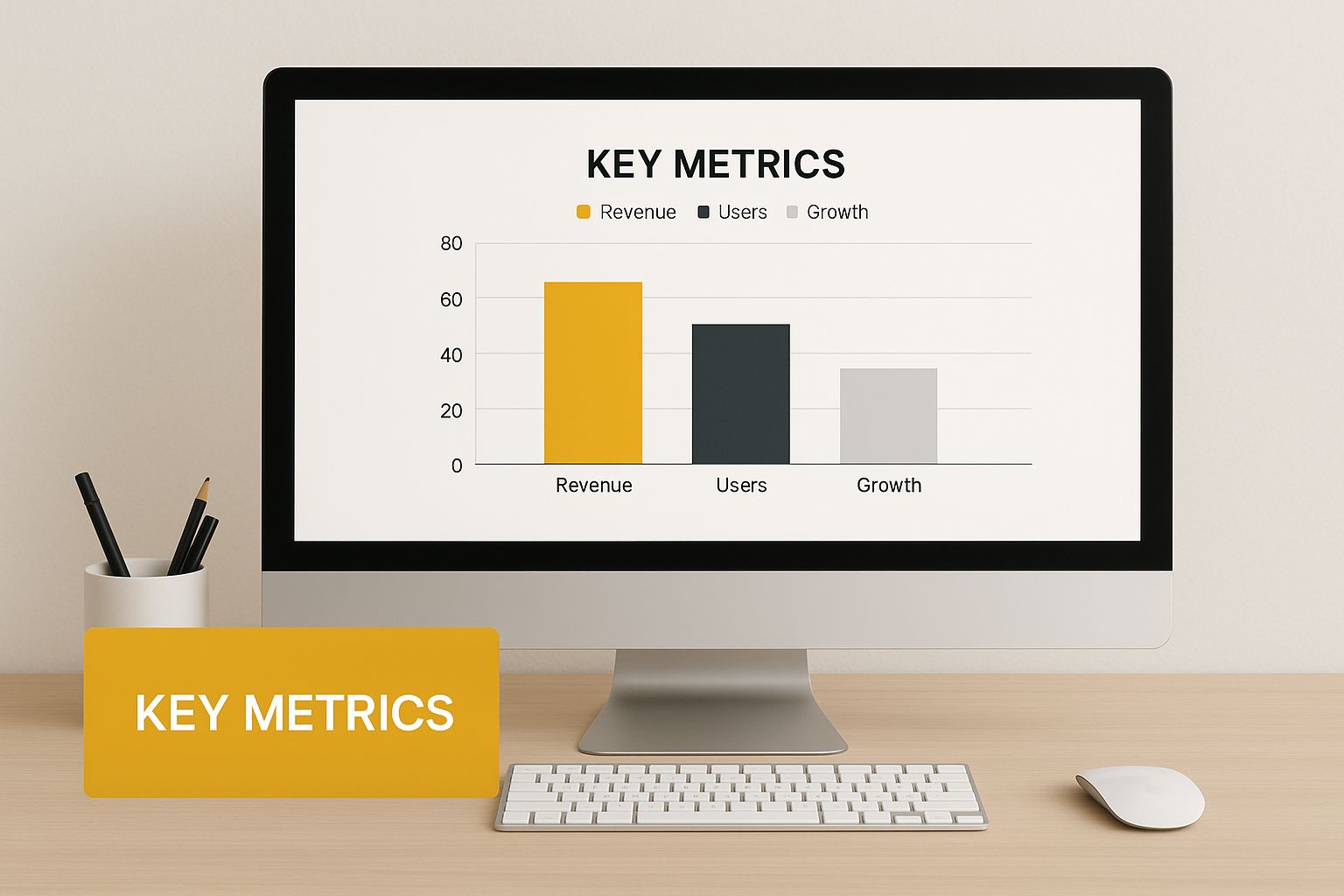
As you can see, it's vital to look past simple reach to get a handle on deeper metrics like sentiment and brand recall.
Designing Surveys That Dig Deeper
Surveys are one of the most direct ways to get inside your audience's head. The trick, though, is to design them carefully to measure different layers of awareness. You’re mainly looking at two types of brand recall: unaided and aided.
Unaided awareness is what I’d call the gold standard of brand recall. It’s when a customer can name your brand without any prompting whatsoever. To measure this, you’d ask something like:
- "When you think of 'energy drinks' or 'accounting software', which brands come to mind first?"
If your name comes up, you know you have strong top-of-mind awareness. It’s a powerful position to be in.
Then you have aided awareness, which measures recognition when you give someone a nudge. Here, you might ask a question like, "Which of the following accounting software brands have you heard of?" and then include your brand in a list with a few competitors. This helps you gauge your brand's general familiarity, even if it isn't the first one people think of.
To really get the full picture, it’s helpful to understand the difference in how you frame these questions.
Aided vs Unaided Brand Awareness Survey Questions
| Question Type | Example Question | What It Measures |
|---|---|---|
| Unaided Awareness | "When you think of electric cars, which brands come to mind?" | Top-of-mind recall and spontaneous brand association. |
| Aided Awareness | "Which of the following car brands have you heard of? (List includes your brand)" | Brand recognition and familiarity within a competitive set. |
The key is to use both types of questions to build a complete profile of your brand's standing in the market.
Expert Tip: Don't just stop at recognition questions. I always recommend following up with open-ended questions like, "What words or feelings come to mind when you think of [Our Brand]?" The answers you get are pure gold for understanding brand perception.
Running these surveys periodically—especially after a big marketing campaign—helps you track how perceptions are shifting over time. While measuring brand awareness directly is one piece of the puzzle, understanding related metrics is just as crucial. For a deeper dive, check out this a practical guide to measuring customer satisfaction to see how these insights feed into your brand's overall health.
Listening to the Digital Conversation
Whether you’re tuned in or not, people are talking about your brand online every single day. Social listening is the practice of actively monitoring social media, forums, and news sites for mentions of your brand, your competitors, and important industry keywords. It's so much more than just keeping an eye on your notifications.
Here’s what you can learn:
- Understand Sentiment: Most listening tools can automatically categorise mentions as positive, negative, or neutral. A sudden spike in negative sentiment is an invaluable early warning system that something’s amiss.
- Identify Themes: What are people actually talking about in relation to your brand? Is it your top-notch customer service? Your pricing? A specific product feature? This tells you which parts of your business are driving the conversation.
- Analyse Media Mentions: Look at where journalists, bloggers, and industry publications are mentioning you. Getting featured in a respected trade journal builds far more authority than a hundred random social media mentions.
Think about it this way: a sudden storm of tweets flagging a bug in your software provides immediate, actionable feedback. That's a lot more useful than waiting for your quarterly sales figures to dip before you realise there's a problem. Direct communication is key, and you can learn more about its power by reading up on the https://grow-your-biz.com/advantages-of-email-marketing/.
Choosing the Right Tools for Brand Tracking
You can’t measure what you don’t monitor. And in today’s world, trying to manually track every mention of your brand online is a recipe for disaster. It's simply too much ground to cover. This is where a good tech stack comes in – automating the heavy lifting so you can focus on strategy, not just data collection.
The "right" tool really depends on your specific situation: your budget, your goals, and how big your business is. You don't always need the most powerful, expensive platform right out of the gate. In fact, starting with a simple, free tool can be a fantastic way to get into the habit of brand monitoring.
Foundational Tools for Getting Started
If you're just dipping your toes into tracking your brand's presence, it’s smart to start with accessible tools. You can pull some surprisingly valuable insights without needing to get budget approval.
A brilliant, no-brainer starting point is Google Alerts. It’s completely free and takes seconds to set up. Just pop in your brand name, key products, or even your competitors' names. Google will then ping you an email whenever it finds new content mentioning your keywords. It’s a basic but reliable way to stay on top of new articles, blog posts, and press mentions.
Another fantastic free resource is Google Trends. As we've mentioned, it’s perfect for seeing how search interest for your brand ebbs and flows over time. This gives you a clear visual on whether you’re gaining mindshare, especially when you plot your brand’s trend line directly against your main rivals.
Sophisticated Platforms for Deeper Insights
Once you're ready to move beyond just counting mentions and need to understand the what and why behind them – things like sentiment, share of voice, and audience demographics – it’s time to look at more advanced platforms. These tools are an investment, but for a growing business, the depth of data they provide is often a game-changer.
A few popular platforms I've seen deliver great results are:
- Brandwatch: A real powerhouse in social listening and consumer intelligence. It provides incredibly granular analytics on brand conversations, sentiment analysis, and spotting emerging trends before they take off.
- Sprout Social: Many know it as a social media management tool, but its listening features are seriously robust for tracking mentions and engagement across all the major social networks.
- Meltwater: This platform is excellent for media monitoring. It goes beyond social media to track your brand’s footprint across millions of global news sources, blogs, and forums.
This screenshot from Brandwatch gives you a feel for a typical dashboard, where you can see mentions, sentiment, and trending topics all in one place.
Platforms like this are designed to turn a mountain of raw data into easy-to-digest visuals, making it much simpler to spot patterns and report on the health of your brand.
It's not just about the volume of mentions; it’s about the context and quality of the conversations. I’ve seen a single positive mention in a major UK publication deliver more value than a hundred automated bot comments on social media.
The UK’s social media advertising market is a key battleground for both building and measuring awareness. With projections showing this market will hit £9.95 billion in 2025 and influencer marketing spend alone forecast at £1.04 billion, the stakes are high. UK brands often pair social listening tools with platforms like YouGov's BrandIndex to get a full picture of consumer perception and measure the real impact of their influencer campaigns. You can find more detail on these social media statistics for the UK over at SproutSocial.com.
Linking Brand Metrics to Bottom-Line Results

Tracking brand metrics is one thing, but the real magic happens when you connect that data to tangible business outcomes. It’s not enough to know your brand is more recognised; you have to show how that recognition directly translates into revenue and growth.
This is your key to shifting the conversation. You can prove that marketing isn't just a cost centre—it's a primary driver of profit. The goal is to draw a clear, undeniable line from a boost in brand awareness to an uptick in your bottom-line results. For example, did that big PR campaign that increased your share of voice also lead to a spike in better-quality leads? Connecting those dots is how you demonstrate real ROI to stakeholders.
Correlating Awareness with Sales Performance
A great way to start is by mapping your brand awareness data against your sales metrics over the same period. Take a look at your sales cycle length. As more prospects come into your funnel already knowing who you are, the time it takes to close a deal should shrink. They simply need less convincing and already have a baseline of trust.
You should also analyse your lead quality. Are the inbound leads you get during periods of high brand visibility converting at a better rate? Making this connection helps justify the budget for top-of-funnel activities, which can sometimes feel a bit removed from direct sales. Any truly effective marketing strategy for small business needs this level of analysis baked in.
The most powerful brand reports don't just show charts on social reach; they show how that reach influenced customer lifetime value and reduced churn. It’s about telling a complete financial story.
Analysing Awareness and Loyalty Together
Think of brand awareness and customer loyalty as two sides of the same coin. A strong brand doesn't just attract new customers; it gives your existing ones a reason to stick around. We see this play out all the time in the fiercely competitive UK sportswear market.
Under Armour, for example, has an 87% brand awareness among sportswear users in the UK, which is a massive market presence. But awareness alone doesn't keep the lights on. The crucial part is that 81% of their users also show loyalty, which is a powerful sign that they've turned simple recognition into genuine retention. As detailed in UK brand profile research, looking at these two metrics together helps brands fine-tune their strategies for both acquisition and retention. You can find more details about Under Armour's performance in the UK on Statista.com.
To get the full picture of how different touchpoints contribute to your results, you need a solid framework for cross-channel attribution. It helps you see exactly how your awareness efforts are contributing to sales across all your channels. When you connect these dots, you can build a powerful case that proves your brand’s direct contribution to the business’s success.
Common Questions About Measuring Brand Awareness
When you first start trying to measure your brand’s footprint, a few questions always seem to come up. It's completely normal. Getting your head around these from the outset will save you a lot of headaches and make your strategy much stronger.
Let's clear the air on some of the most common sticking points.
What's the Real Difference Between Brand Awareness and Brand Equity?
This one trips up a lot of people. The easiest way to think about it is that brand awareness is about recognition. Do people even know you exist? It’s the first, most basic level of connection.
Brand equity, on the other hand, is the real prize. It’s the commercial value that your brand name adds to your products or services. It’s built from customer perception, trust, and loyalty over time. It’s why someone will happily pay more for a name they trust over a generic alternative.
Awareness gets your foot in the door. Equity is why customers invite you to stay. You can’t have equity without awareness first, but awareness alone doesn’t guarantee loyalty.
What Does "Good" Brand Awareness Actually Look Like?
Everyone wants to know the magic number, but honestly, there isn't one. What counts as "good" brand awareness is completely different for a local coffee shop in Bristol versus a nationwide fintech company. It’s all about context.
Instead of chasing some vague, universal benchmark, measure what matters to your business. Focus on these three areas:
- Positive Momentum: Your most important benchmark is your own past performance. Is your share of voice growing? Is direct traffic up? Are more people searching for your brand by name this quarter compared to last? Consistent growth is the goal.
- Your Competitive Edge: How are you performing against your direct rivals? You might not be a household name yet, but if your branded search volume is growing at twice the rate of your main competitor, you're winning the awareness battle where it counts.
- Reaching the Right People: It’s not just about how many people know you, but who knows you. Are you making inroads with your ideal customer profile? If you sell to project managers, strong awareness within that community is far more valuable than broad, generic recognition.
How Often Should I Be Measuring My Brand?
You don't need to run a massive, expensive survey every single month. That’s overkill. But checking in only once a year is like driving with your eyes closed—you'll miss crucial turns in the road.
The smart approach is to use a tiered schedule based on what you’re measuring.
- Check These Weekly or Monthly: Keep a close watch on your digital vitals. This includes things like direct website traffic, social media reach and mentions, and branded search volume. These are your early warning signals and can be tracked easily with tools like Google Analytics and social listening platforms.
- Review These Quarterly: This is the perfect time for a deeper dive. Look at your overall share of voice, analyse the sentiment of media mentions, and see how your numbers stack up against competitors.
- Do This Annually or Bi-Annually: This is when you bring out the big guns—formal brand tracking surveys. Use these to get a solid read on unaided and aided recall. Because they take more time and budget, running them after a major campaign or on an annual basis gives you a fantastic long-term view of your brand’s health and progress.
Ready to discover the perfect tools to automate your marketing, boost your SEO, and engage your audience? At The Digital Marketing Toolbox, we bring together the best solutions in one place, helping you find and compare top-tier software for sustainable growth. Start building your ideal marketing stack today at https://grow-your-biz.com.


