
So, you've decided to create an email newsletter. Fantastic. But before you get lost in picking the perfect template or agonizing over your first subject line, let's take a step back. The newsletters that genuinely succeed—the ones people actually look forward to—all start with a solid foundation.
It all boils down to two simple questions: Why are you sending these emails, and who are you sending them to? Nail this part, and everything else falls into place.
Building Your Newsletter's Foundation
Think of this as the blueprint for your entire email operation. Too many people jump straight into the fun stuff, like design and writing, and wonder why their emails fall flat. A successful newsletter isn’t a lottery; it’s the result of clear thinking and understanding your audience on a real level. This is what separates an email that gets instantly binned from one that becomes a weekly ritual for your readers.
The very first thing you need to pin down is your primary goal. What's the one thing you want a subscriber to do after reading your email? Without a clear destination, your content will wander aimlessly and you'll have no way to measure if it's actually working.
Define Your Primary Goal
Every single decision you make—from the topics you cover to the buttons you ask people to click—should link back to this one core objective. Are you trying to:
- Drive traffic to your blog or newly launched product pages?
- Generate direct sales by showcasing special offers or new stock?
- Build a community around your brand by sharing customer stories and a peek behind the curtain?
- Establish yourself as an expert by sharing exclusive industry insights they can't get elsewhere?
Try to pick just one primary goal to begin with. A small ecommerce shop, for instance, will likely focus on driving sales. A consultant, on the other hand, might prioritise establishing thought leadership. A clear strategy is your starting point. For a really detailed guide on this, check out these resources on building your ecommerce email marketing strategy.
Create a Detailed Reader Persona
Once you know your 'why', it's time to figure out your 'who'. Generic content is the kiss of death. To create something truly valuable, you need to have a crystal-clear picture of the person you're writing for. Don't just stick to basic demographics; build a proper reader persona. If you're targeting a UK audience, for example, what are their specific pain points, their sense of humour, their cultural touchstones?
Ask yourself these questions:
- What are their biggest struggles, either professionally or personally?
- What kind of information would they find genuinely helpful or entertaining?
- What tone of voice will click with them? Are they looking for a formal, professional advisor or a casual, witty friend?
A brilliant newsletter feels like it was written just for you, by someone who genuinely gets it. When you take the time to build a detailed persona, you stop broadcasting generic messages and start having a real conversation.
Putting in this groundwork is incredibly effective. In the UK, email marketing boasts an average return on investment (ROI) of £38 for every £1 spent. That incredible return doesn't come from just flogging products; it comes from delivering genuine value. With your goals and persona locked in, you're ready to start mapping out your first few issues, confident that your content and tone will keep people hooked for the long haul.
Selecting the Right Email Platform
Choosing an email marketing platform is a lot like picking a business partner. It’s a foundational decision that will either make your life easier or cause endless headaches. Get this right from day one, and you’ll save yourself the pain of a complicated and costly migration later on.
It’s easy to get dazzled by a long list of fancy features, but from my experience, what really matters boils down to three core things: an intuitive design interface, powerful automation capabilities, and analytics that actually tell you something useful.
The market is flooded with options, and every single one claims to be the best. For those of us in the UK, it's also crucial to pick a platform that takes GDPR seriously and ideally offers local support. Your goal is to find a tool that not only fits where you are today but also has the legs to grow with you.
Assessing Your Real Needs
Before you even glance at a pricing page, take a moment for an honest self-assessment. What do you really need? A solo blogger sending a weekly digest has completely different requirements than a booming ecommerce business needing sophisticated ways to segment customers and promote different product lines.
Be realistic about your technical comfort level and, of course, your budget. Many platforms offer fantastic free tiers, which are perfect for testing the waters. But always read the small print. A free plan might cap your subscribers at 1,000 or limit your monthly sends to 2,000 emails. Once you outgrow those limits, the price can jump significantly, so it’s good to know what you’re in for.
Think about your main goal. Is it building a tight-knit community? Then a user-friendly editor and simple templates are your priority. Is it driving sales? In that case, powerful automation and A/B testing features are non-negotiable.
The best platform isn't the one with the most features; it's the one with the right features for you. Don't pay for advanced tools you won't touch for at least a year. Focus on getting the fundamentals right with a solid platform you can build on.
The image below shows the basic workflow your chosen platform needs to handle smoothly. It all starts with knowing your audience and ends with delivering content that feels like it was made just for them.
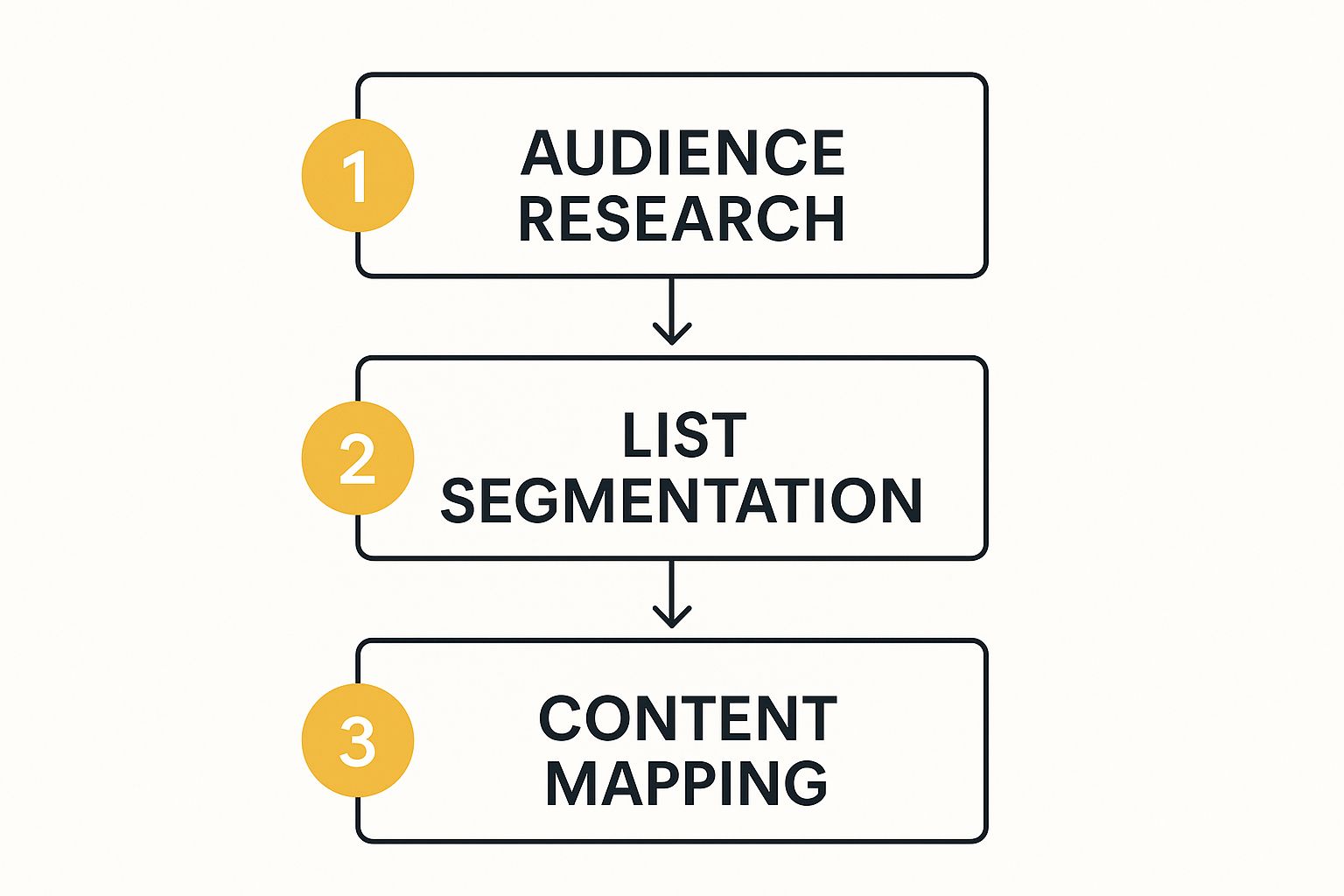
This process really underscores the point: your platform’s main job is to help you understand, group, and serve your audience with precision. That’s the heart of good email marketing.
Comparing Popular Email Marketing Platforms
Now that you have a clearer picture of your needs, you can start weighing up your options. To give you a head start, here’s a look at some of the top contenders and who they’re best suited for. This isn't an exhaustive list, but it covers the main categories you'll encounter.
The table below breaks down a few popular choices, highlighting what they do best. This should help you narrow down the field based on your budget, list size, and must-have features.
| Platform | Best For | Key Features | Starting Price |
|---|---|---|---|
| MailerLite | Beginners & Creators | Very intuitive drag-and-drop editor, great free plan, landing pages. | Free up to 1,000 subs |
| ConvertKit | Bloggers & Solopreneurs | Simple but powerful automations, excellent segmentation, creator-focused tools. | Free up to 1,000 subs |
| ActiveCampaign | SMBs & Agencies | Advanced automation workflows, built-in CRM, strong segmentation. | From ~$29/month |
| Klaviyo | Ecommerce Businesses | Deep integration with Shopify & others, revenue-based reporting, pre-built e-comm flows. | Free up to 250 contacts |
Ultimately, the best way to choose is to get your hands dirty. Sign up for a few free trials. Build a quick email, set up a simple automation, and see how each platform feels. The right choice will feel natural and empower you to spend less time wrestling with software and more time connecting with your audience.
Designing a Newsletter That Captures Attention
Let’s be honest: in a crowded inbox, your newsletter’s design is doing a lot of heavy lifting. It’s your first handshake, your chance to signal that opening your email was a good decision. A great design doesn't just look pretty; it feels professional, builds trust, and makes your content incredibly easy to digest. You don’t need to be a graphic designer to get this right. It really boils down to a few core principles that guide your reader’s eye and get them to act.
Before anyone even reads your carefully crafted words, they experience the design. That split-second visual impression can mean the difference between a curious click-through and an immediate trip to the bin.
Establishing Your Visual Identity
Think of your newsletter as another room in your brand's house. It should feel familiar and connected to your website, your social media, and everything else you do. This all starts with creating a consistent visual identity.
It’s simpler than it sounds. Just nail down these core elements:
- Colour Palette: Don't go crazy. Stick to two or three primary brand colours. A smart trick is to use one distinct, bold colour just for your calls-to-action (CTAs) to make them pop. For the background, a simple white or light grey is usually best for readability.
- Fonts: Choose one clear font for your headings and a complementary one for your body text. The goal is readability, so stick to web-safe, sans-serif fonts. Think Arial, Helvetica, or Open Sans – they’re popular for a reason.
- Logo Placement: Pop your logo right at the top. Every single time. It’s an instant reminder of who the email is from, reinforcing your brand the moment it's opened.
When you’re consistent, people start to recognise your emails at a glance. It builds familiarity and professionalism, creating a stronger connection over time. It’s a key part of getting your subscribers to know, like, and trust you.
Mastering a Clean and Scannable Layout
Here’s a hard truth: people don't read emails; they scan them. Your job is to make that scanning process as effortless as possible. You need to build a clear visual hierarchy that pulls their attention toward what matters most.
Whitespace is your secret weapon here. Giving your content room to breathe prevents the design from feeling cramped and overwhelming. Break up big walls of text with short paragraphs, bullet points, and clear headings. Your message will be far more digestible. To get them to open the email in the first place, you'll also need to understand effective email subject line best practices.
A winning newsletter design isn’t about flashy graphics. It's about clarity. The real goal is to remove friction and guide the reader seamlessly from the subject line to the call-to-action.
Think of your layout as a path. The most crucial information—your main story, your big offer—should be "above the fold," visible without any scrolling. Use bigger fonts, bold text, and compelling images to draw the eye to these key sections first. This approach respects your reader’s time and massively boosts the odds they’ll engage with your core message.
Prioritising Mobile-First Design
With over 41% of emails now opened on a mobile device, designing for the small screen isn't just a good idea—it's non-negotiable. A newsletter that looks amazing on a desktop but is a jumbled, pinch-and-zoom nightmare on a phone will kill your engagement rates.
Adopting a mobile-first mindset means you design for the phone first, then adapt for bigger screens. Here’s how to do it practically:
- Use a Single-Column Layout: This is the gold standard for mobile. It stacks your content neatly in one vertical column, making for a smooth scrolling experience. No awkward side-to-side panning required.
- Keep CTAs Large and Tappable: Your buttons need to be thumb-friendly. A good rule of thumb is to make them at least 44×44 pixels. Also, leave plenty of empty space around them to prevent frustrating mis-taps.
- Optimise Your Images: High-quality images are great, but they need to be compressed to keep the file size down. Huge images will slow down loading times, especially for someone on mobile data, which is a surefire way to get them to close your email.
Before you ever hit "send," do this one simple thing: send a test email to yourself and open it on your phone. It’s the easiest way to catch glaring formatting problems that could torpedo an otherwise brilliant campaign.
Crafting Content Your Subscribers Actually Want

Alright, you've got a great-looking newsletter template. Now for the most important part: what are you actually going to say? This is where the magic happens. We’re moving beyond just sending updates and into the realm of building real connections with your audience, turning casual readers into genuine fans of your brand.
The secret isn’t some complicated formula. It’s simply about giving your subscribers something valuable every single time you land in their inbox. Each email needs to feel like a fair trade for their attention. That means striking the right balance between talking about your business and offering content that genuinely helps, entertains, or inspires them.
Mastering The Art Of The Subject Line
Let’s be honest—your subject line is the gatekeeper. It doesn't matter how brilliant your email is if nobody ever opens it. The goal here is to be utterly compelling without stooping to cheap clickbait tricks that will only damage your credibility over time.
Think of your subject line as the headline for a tiny article. It needs to be intriguing and clear, giving a little taste of the value waiting inside.
Here are a few approaches I've seen work time and again:
- Be Specific and Benefit-Driven: Ditch the generic "This Week's Newsletter." Instead, try something like, "5 Simple Ways to Improve Your Garden This Weekend." The second option tells the reader exactly what they're getting.
- Create Curiosity: A subject line such as "The One Mistake Everyone Makes with Their Finances" is hard to ignore because it instantly creates a desire to find out the answer.
- Use Personalisation: Even just adding the subscriber's first name can make an email feel more like a personal note and less like a mass broadcast.
This kind of strategic thinking is fundamental to all good marketing. If you want to explore the bigger picture, our beginner's guide to digital marketing is a great place to start.
Finding Your Content Mix
A newsletter that just sells, sells, sells is going to see its unsubscribe rate soar. The most successful newsletters operate on a simple principle: give more than you take. A healthy content mix builds trust and keeps your audience engaged, which makes them far more receptive when you do have an offer.
Try blending these types of content:
- Educational Content: Think "how-to" guides, handy tips, or industry insights. A financial advisor, for instance, could share a simple guide on creating a personal budget.
- Entertaining Content: This could be anything from a behind-the-scenes look at your business to a funny story or a collection of interesting links you’ve found.
- Promotional Content: When you do promote, make it feel special. Offer an exclusive discount, early access to a new product, or a unique bundle just for your subscribers.
If you’re looking for some real-world inspiration, check out these fantastic lead nurturing email examples to see how it’s done.
A good rule of thumb is the 80/20 principle: make 80% of your content genuinely helpful and valuable, and keep promotions to just 20%. This approach positions your emails as a welcome resource, not just another advert.
This balance is what turns your newsletter from an interruption into a welcome arrival. It shows you understand your subscribers' needs go beyond their wallets, which is how you build lasting loyalty and a strong community.
Developing a Unique Voice
Finally, what will make your newsletter truly stand out from the crowd is its voice. Are you witty and informal? Authoritative and professional? Your tone should feel authentic to your brand and connect with the person you’re trying to reach.
Don’t be afraid to let your personality shine through. People connect with other people, not faceless corporations. Sharing your own experiences, opinions, and even your mistakes makes your content far more relatable. This unique voice, combined with consistent value, is what makes a newsletter truly unmissable.
Growing and Managing Your Subscriber List
So you've crafted the perfect newsletter. The problem? A brilliant email is useless if no one sees it. This is where the real work begins: building a community of subscribers who are genuinely eager to hear from you.
Growing your email list isn't just a numbers game. It's about ethically and sustainably connecting with the right people. At its core, list growth is a simple value exchange. People guard their email addresses closely, so you need to give them a compelling reason to hand it over—something far more enticing than a generic "subscribe to our newsletter" plea.
Creating High-Converting Sign-Up Opportunities
Your website is prime real estate for finding new subscribers. The trick is to make it incredibly easy for interested visitors to join your list by placing clear, well-designed sign-up forms in strategic spots.
Think about where your visitors are most engaged. These are your golden opportunities:
- Website Footer: A classic, non-intrusive spot. People often look here for contact details or next steps.
- Within Blog Posts: If someone has just read and enjoyed a 1,500-word article, they're already invested. Placing a form right there, or at the end, is a natural next step.
- A Dedicated Landing Page: This is a page solely focused on selling the benefits of your newsletter. You can drive traffic here from social media, ads, or other marketing channels.
- Pop-up or Slide-in Forms: Use these thoughtfully. When timed correctly, like on exit intent (when a user is about to leave), they can be highly effective without being annoying.
Wherever you place them, keep your forms dead simple. Asking only for an email address removes friction and boosts your sign-up rate. You can always gather more information down the line.
Developing Irresistible Lead Magnets
A lead magnet is a freebie you offer in exchange for an email address. It's your most powerful tool for persuading someone to subscribe because it provides immediate, tangible value.
To create a great lead magnet, you need to solve a specific problem for your ideal reader. What would be exceptionally useful for them?
- A detailed checklist for navigating a complex process.
- An exclusive e-book or guide that dives deep into a topic they care about.
- A ready-to-use template (e.g., for budgeting, content planning, or social media).
- Access to an exclusive webinar or video tutorial.
The goal is to create something so valuable that your audience might have even paid for it. Offering it for free instantly establishes your expertise and builds goodwill. It's clear there are many advantages of email marketing when you kick things off by providing such strong initial value.
A strong subscriber list is built on quality, not just quantity. It’s far better to have 100 engaged subscribers who open every email than 1,000 disengaged contacts who mark you as spam.
This focus on quality leads us to a crucial, and often overlooked, practice: ongoing list management.
The Importance of List Hygiene and Segmentation
A healthy email list is a clean and organised one. You have to regularly "clean" your list by removing inactive subscribers—people who haven't opened your emails in months. This practice, known as list hygiene, is non-negotiable. It protects your sender reputation with email providers and ensures your messages land in the inboxes of people who actually want them.
Beyond cleaning, segmentation is your secret weapon for higher engagement. This is where you group subscribers based on their interests, behaviour, or how they joined your list. For instance, you could create segments for new customers, repeat buyers, or people who downloaded a specific lead magnet.
This allows you to send highly relevant, personalised content that speaks directly to their needs, which can dramatically increase your open and click-through rates. In the UK, this targeted approach is particularly effective. Approximately 92% of online adults use email, with 60% preferring it for business communication, highlighting its central role in customer engagement. Learn more about these email marketing statistics on optinmonster.com.
Measuring Success and Optimising for Growth

Hitting ‘send’ on your newsletter is a great feeling, but your work isn’t done. Far from it. To figure out what’s actually connecting with your audience, you need to get comfortable with your email analytics. This isn’t just about stroking your ego; it’s about making smart, data-backed decisions that will genuinely grow your business.
It's easy to get hung up on open rates. While they’re interesting, privacy changes have made them a bit of a vanity metric. What you really need are metrics that show real engagement and tie directly back to your business goals.
Key Metrics That Actually Matter
To get a true read on your newsletter’s performance, you need to shift your focus to more actionable data. In fact, one in three marketers say the click-through rate (CTR) is one of the top two metrics they track for a reason.
Here’s what I recommend keeping a close eye on:
- Click-Through Rate (CTR): This is the gold standard. It tells you what percentage of people actually clicked on a link in your email. A healthy CTR is a clear sign that your content and calls-to-action are hitting the mark.
- Conversion Rate: This is where the magic happens. It tracks how many subscribers followed through on a specific action after clicking, like buying a product or signing up for a webinar. Ultimately, this is the metric that proves your newsletter’s value.
- List Growth Rate: It’s simple maths: are you getting more new subscribers than you're losing? A steady, positive growth rate shows that your newsletter is valuable enough to attract and keep an audience.
- Unsubscribe Rate: Don't panic over a few unsubscribes; it's a natural part of list hygiene. However, a sudden jump can be an early warning sign that something’s off with your content, timing, or frequency.
This kind of data-led thinking is a fundamental part of any solid marketing strategy for small business, because it moves you from guesswork to informed action.
The Power of A/B Testing
Once you have a handle on your core metrics, you can start proactively improving them. This is where A/B testing becomes your best friend. The concept is simple: you send two slightly different versions of your email to small segments of your audience and see which one performs better.
Don’t just send and hope. Test, learn, and iterate. Small, consistent improvements over time lead to massive gains in engagement and ROI. This iterative process is what transforms a good newsletter into a great one.
You can test almost anything in your email, but my advice is to change only one element at a time. Otherwise, you’ll never know what actually made the difference.
Some easy wins to start with:
- Subject Lines: Pit a direct statement against an intriguing question.
- Calls-to-Action (CTAs): See if button colour makes a difference, or test different text like "Shop Now" vs. "Explore the Collection".
- Content Formats: Does your audience prefer a deep-dive story or a quick list of curated links? Test it!
By regularly checking your results and experimenting with new ideas, you build a powerful feedback loop. Your newsletter stops being a one-way broadcast and becomes a dynamic marketing asset that evolves and improves right alongside your business.
Answering Your Lingering Newsletter Questions
Even with the best blueprint in hand, a few questions always seem to surface when you get down to the nitty-gritty of running a newsletter. Let's tackle some of the most common ones I hear, so you can move forward with confidence.
How Often Should I Send My Newsletter?
Honestly, consistency beats frequency every single time. It's far better to send one genuinely valuable newsletter each month than to churn out four rushed, low-impact emails just for the sake of it.
Start with a rhythm you know you can stick to. Whether that's weekly, fortnightly, or monthly, choose a schedule that feels sustainable for you and your team. Once you've found your groove and your list starts to grow, why not ask your audience directly? A simple poll can give you invaluable feedback and makes your subscribers feel heard.
What Is the Best Time to Send an Email?
If anyone tells you there's a single magic time to send an email, they're pulling your leg. The perfect time depends entirely on your audience and their daily routines.
As a rule of thumb, if you're talking to a B2B audience, mid-week during business hours (think 10 AM on a Tuesday) is a solid starting point. For B2C newsletters, you might find more success in the evenings or over the weekend when people are relaxing.
The only way to know for sure is to test. Dive into your email platform's analytics. Experiment with different days and times, and let the data tell you when your audience is most engaged.
How Can I Avoid the Spam Folder?
Landing in the inbox is non-negotiable. The cornerstone of good email deliverability is permission. Always, always get explicit consent before adding someone to your list. Purchased lists are a fast track to the spam folder and a damaged reputation.
Here are a few other critical steps:
- Use a professional email service provider. Platforms like Mailchimp or ConvertKit have established relationships with inbox providers, which helps your cause.
- Dodge spammy language. Avoid over-the-top, salesy phrases in your subject lines, like 'free money' or 'act now!'.
- Keep your list healthy. Regularly removing inactive subscribers shows email clients that you're a legitimate sender whose content people actually want to receive. This is a vital part of creating a newsletter that gets delivered and read.
Ready to discover the perfect tools to build, send, and analyse your newsletters? The Digital Marketing Toolbox offers a curated catalogue of the best email marketing platforms, automation software, and analytics tools to help you grow. Find the right solution for your business at https://grow-your-biz.com.


