

At its heart, what is marketing segmentation? Think of it less as a complex marketing theory and more as a simple, powerful idea. It’s the process of taking a large, general audience and splitting it into smaller, more defined groups based on things they have in common. It's the difference between shouting one message into a crowded stadium and having a real conversation with small groups of people who actually want to listen.
The Foundation of Smarter Marketing

Let's be honest, trying to sell a product to "everyone" is a recipe for disaster. Your message ends up so bland and generic that it fails to connect with anyone on a meaningful level. This old-school, one-size-fits-all approach just doesn't work anymore; it's inefficient, expensive, and frankly, a bit lazy.
Marketing segmentation completely flips that outdated model around. It starts with a fundamental truth: different people have different wants, needs, and reasons for buying.
By segmenting, you can stop blasting out a single, broad campaign and start creating targeted strategies that speak directly to the unique makeup of each group. The result? Marketing that feels more personal, relevant, and far more effective.
Why Is This So Crucial Now?
We live in a world saturated with digital noise. Cutting through it requires one thing above all: relevance. Customers today don’t just appreciate personalisation; they expect it. They want to feel like brands 'get' them.
Segmentation is the bedrock of that understanding. It’s the essential groundwork you need to lay before you can even think about creating those personalised experiences that grab attention, earn trust, and build genuine loyalty.
The financial stakes are high, too. In the UK alone, the social media advertising market is on track to hit £9.95 billion by 2025. With that much money flowing, you can’t afford to guess. Segmentation ensures you’re placing your bets on the right people. If you want to dig deeper, exploring current social media marketing statistics really shows how vital targeted spending has become.
"Segmentation isn't just about dividing people into boxes. It's about understanding the nuances of your audience so you can serve them better, communicate more clearly, and build stronger relationships."
Marketing Segmentation At A Glance
To get a clearer picture, let's quickly break down the core idea into its essential parts. This table offers a snapshot of the who, what, and why behind this foundational strategy.
| Component | Brief Explanation |
|---|---|
| Who | The specific subgroups of your market, like 'young professionals in urban centres' or 'eco-conscious families with young children'. |
| What | The shared traits used for grouping, such as demographics (age, income), behaviours (purchase history), or psychographics (values). |
| Why | To deliver more relevant marketing messages, improve customer happiness, and ultimately, get a much better return on investment. |
By organising your audience into these distinct groups, you’re swapping guesswork for a data-led strategy. It gives you the insight to tailor everything—from your ad copy and special offers to the very platforms you use to reach them. At the end of the day, it's about speaking the right language to the right people at exactly the right time.
The Four Core Types of Marketing Segmentation
Knowing the theory is one thing, but seeing segmentation in action is where it really clicks. To get a proper handle on marketing segmentation, we need to break it down into the four main ways marketers slice up their audiences.
Think of these as different lenses. Each one gives you a unique view of your market, revealing a fresh perspective on who your customers are and what makes them tick.
These four types are Demographic, Geographic, Psychographic, and Behavioural. While each is useful on its own, the real magic happens when you start layering them. Combining them helps you build a rich, detailed picture of your ideal customer, moving from a blurry sketch to a high-definition portrait.
Let's dive into each one.
Demographic Segmentation: The "Who"
This is probably the most familiar and widely used method of the bunch. Demographic segmentation is all about splitting your market based on objective, statistical data. It’s the foundational stuff. It answers the simple but crucial question: "Who is actually buying from me?"
It's popular for a reason—the data is usually straightforward to find and measure, giving you a solid baseline for understanding your audience.
Common demographic variables include:
- Age: Are you talking to Gen Z, Millennials, or Baby Boomers? A skincare brand, for instance, won't use the same message for a teenager worried about acne as they would for an older adult looking for an anti-ageing cream.
- Gender: Though lines are blurring, it’s still relevant for products in fashion, cosmetics, or certain health supplements.
- Income: A luxury car brand isn't targeting the same people as a budget supermarket chain. It’s all about disposable income.
- Occupation: A software company might have one package for freelance designers and a completely different enterprise solution for corporate finance teams.
- Education Level: This often influences communication style, the complexity of information you share, and the channels you use.
While demographic data is a great starting point, relying on it alone can be restrictive. It tells you who your customers are, but it does very little to explain why they buy.
Geographic Segmentation: The "Where"
Next up is geographic segmentation, which, as the name suggests, groups people based on their physical location. This can be as massive as a continent or as granular as a specific postcode. It answers the question: "Where are my customers?"
This is obviously critical for any business with a physical footprint, like a chain of coffee shops or a local gym. But it's just as important for e-commerce businesses that need to consider shipping costs, regional promotions, and even cultural nuances.
Common variables for geographic segmentation include:
- Country or Region: A clothing retailer will be pushing thick winter coats in the UK while its Spanish branches are still stocking swimwear.
- City or Postcode: A food delivery service will concentrate its ad spend on urban areas where it has plenty of partner restaurants, not out in the countryside.
- Climate: A company selling garden furniture knows to ramp up its marketing in sunnier regions as spring approaches.
- Population Density: An e-scooter rental company will thrive in a dense city centre like Manchester but would be pointless in a sleepy village in the Cotswolds.
Psychographic Segmentation: The "Why"
This is where things get really interesting. Psychographic segmentation goes beyond the 'who' and 'where' to dig into the 'why' behind your customers' decisions. It’s about grouping people based on their psychological traits—their lifestyle, values, interests, and personalities.
Getting this data is trickier; it often means using surveys, customer interviews, or analysing social media behaviour. But the insights are gold. This is how you build a genuine, emotional connection with your audience.
Psychographic variables often include:
- Lifestyle: A fitness brand might segment its audience into 'dedicated yoga enthusiasts', 'marathon runners', and 'busy parents needing quick home workouts'. Each group needs a different message.
- Values and Beliefs: An eco-friendly cleaning brand naturally targets consumers who prioritise sustainability and ethical choices.
- Interests and Hobbies: A bookshop can send targeted promotions for new science fiction releases to customers it knows are fans of the genre.
- Personality Traits: An adventure travel company appeals to extroverted thrill-seekers, whereas a spa retreat will resonate with people looking for peace and introspection.
Behavioural Segmentation: The "How"
Finally, we have behavioural segmentation, which is all about how customers interact with your brand. It groups them based on their actions—their buying habits, brand loyalty, and how they use your product. This method is incredibly powerful because it’s based on what people actually do, not just what they say. It answers: "How do my customers behave?"
With modern marketing tools, tracking this data is easier than ever. It allows you to create marketing that feels incredibly relevant and timely.
Key behavioural variables include:
- Purchase History: An online pet shop can send a friendly reminder to a customer who buys the same 12kg bag of dog food every single month.
- Usage Rate: A coffee shop could offer a loyalty card to reward its 'heavy users' (the daily regulars) and run a special discount to tempt 'light users' to come in more often.
- Benefits Sought: Some people buy a smartphone for its amazing camera; others only care about battery life. Your marketing needs to speak to these different priorities.
- Brand Loyalty: You can create VIP programmes for your die-hard fans while running re-engagement campaigns to win back customers who haven't bought from you in a while.
To see how these concepts are applied in the real world, it’s worth checking out some powerful customer segmentation examples to see these principles in action.
Comparing The Four Main Segmentation Types
To pull this all together, here’s a quick comparison of the four types of segmentation. Think of this as a cheat sheet for deciding which approach—or combination of approaches—is right for your next campaign.
| Segmentation Type | What It Measures | Common Variables | Example Use Case |
|---|---|---|---|
| Demographic | The "Who": Objective, statistical attributes of a population. | Age, gender, income, occupation, family size. | A luxury watch brand targeting high-income males aged 40-65. |
| Geographic | The "Where": The physical location of the audience. | Country, city, climate, population density. | A fast-food chain promoting its new spicy burger in regions known for preferring spicier food. |
| Psychographic | The "Why": The internal traits of your audience. | Lifestyle, values, interests, personality. | A travel agency marketing an eco-tour to customers who value sustainability and adventure. |
| Behavioural | The "How": The audience's actions and interactions. | Purchase history, usage rate, brand loyalty. | An e-commerce site sending a "we miss you" discount to customers who haven't purchased in 6 months. |
As you can see, each type offers a different window into your customer's world. The most effective strategies rarely rely on just one; they blend them together to create a full, three-dimensional view of the people they want to reach.
Why Segmentation Is Your Marketing Superpower
Getting to grips with the different types of segmentation is a great start, but what really matters is the 'why'. Why bother putting time and resources into this? The simple answer is that segmentation isn't just another tactic; it's a strategic shift that gives your marketing a genuine superpower. It turns your efforts from a hopeful shout in the dark into a precise, meaningful conversation.
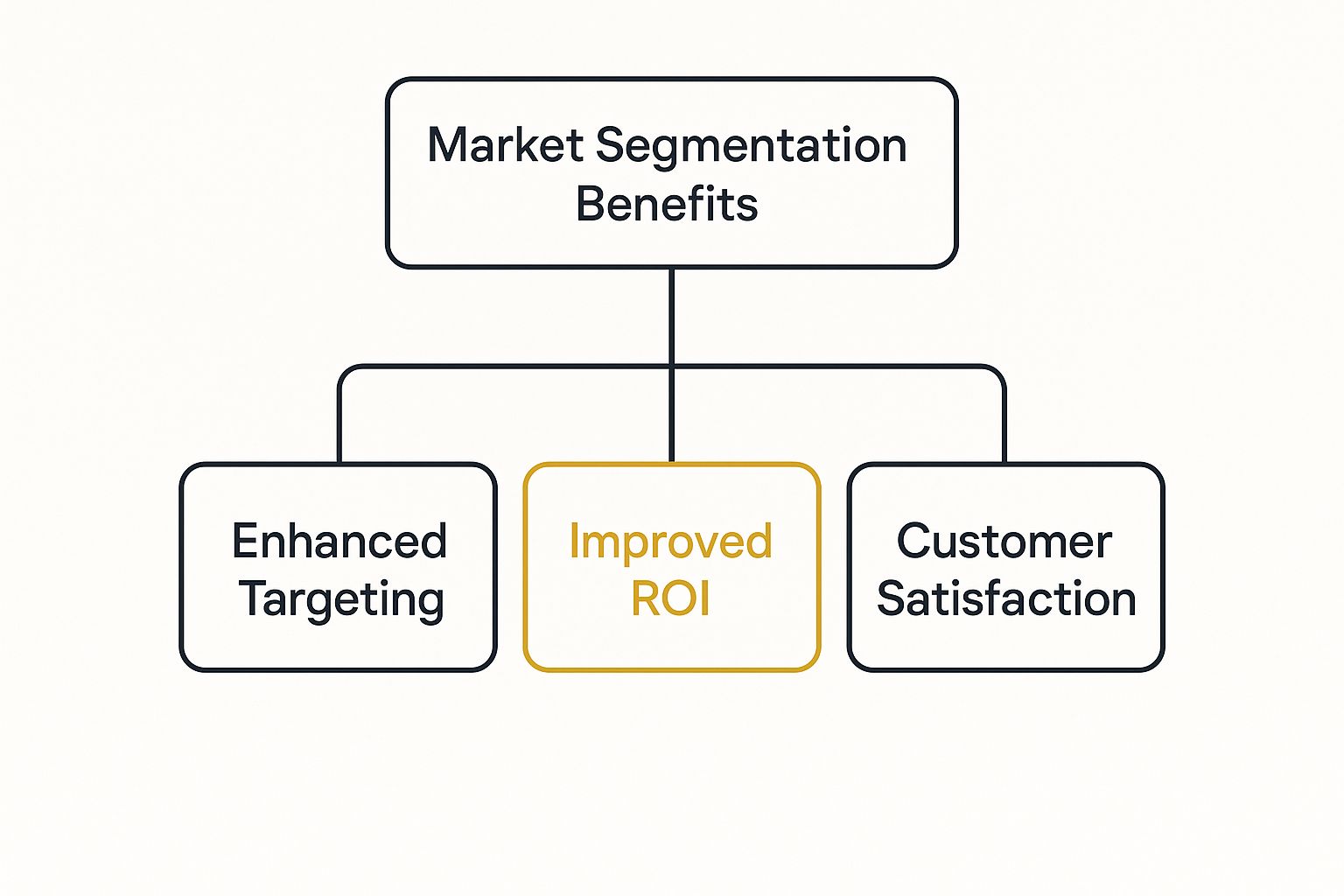
Without it, you’re basically treating every customer as if they’re the same person. That’s a surefire way to waste your budget, water down your message, and fail to build any real connection. With segmentation, you unlock the ability to be more relevant, efficient, and, in the end, far more profitable. Each benefit builds on the last, creating a powerful cycle of growth.
Deliver Messages That Truly Resonate
The most obvious win from marketing segmentation is the power to craft messages that feel personal. Imagine sending a promotion for your new steak pie to a vegan customer—it's not just a miss, it can actively damage their view of your brand.
Now, let's flip that. A sustainable clothing brand knows a group of its customers has previously bought from their eco-friendly collection. Instead of a generic "20% off" blast, they send this group a targeted email about new arrivals made from recycled materials. The message lands because it speaks directly to that group's values and past behaviour. This is what turns a passive browser into an active buyer.
By speaking to the distinct needs and desires of each group, you show your audience you see them as more than just a transaction. You prove that you understand them, which is the foundation of building lasting brand trust.
Achieve a Higher Return On Investment
Every marketing pound counts, especially when you're working with a tight budget. Segmentation makes sure your resources are put to the best possible use. Instead of spreading your budget thinly across a huge, uninterested audience, you can focus your spending on the segments most likely to convert.
This targeted approach delivers a much better return on investment (ROI). Think about it: why spend money advertising winter coats to customers in a warm climate? Or promoting premium services to a segment that only ever buys on price? By zeroing in on your highest-potential groups, you not only improve conversion rates but also cut your customer acquisition costs. A well-defined marketing strategy for small business is often built on this very principle.
Uncover Untapped Market Opportunities
Sometimes, the most valuable insights are hiding in plain sight. When you start analysing your audience and breaking it down into segments, you often uncover underserved niches or emerging trends that your competitors have completely missed.
You might discover a growing segment of customers who consistently buy your gluten-free products, signalling a clear opportunity to expand that product line. Or perhaps you spot a geographic area with high engagement but low sales, which might point to a need for better local shipping options.
This kind of strategic awareness is vital for growth. In fact, a recent survey found that 42% of UK businesses prioritise reaching new customer segments as a top marketing goal. This shows just how important this practice is for staying competitive in today's market.
Cultivate Stronger Customer Loyalty
Finally, when you add up all these benefits, the result is deep, lasting customer loyalty. When customers consistently get offers, content, and messages that are relevant to them, they feel seen and valued. This positive experience builds an emotional connection that goes far beyond a simple price comparison.
Loyal customers are your brand's greatest asset. They don't just buy from you again and again; they become powerful advocates who recommend you to their friends and family. This word-of-mouth marketing is incredibly effective, and it’s a direct result of making each customer feel like an individual. Ultimately, a major driving force behind segmentation is to enable powerful personalization in marketing, transforming how brands connect with their audiences.
Building Your First Segmentation Strategy Step by Step
Alright, so you understand the what and why of marketing segmentation. But moving from theory to practice can feel like a huge jump. The good news is that building a powerful strategy is less about complex data science and more about following a clear, logical process.
Think of the following steps as a practical roadmap. It's not a rigid set of rules, but a framework to guide your thinking. This is how you turn a jumble of audience data into a concrete plan for growth that delivers real results.
Step 1: Define Your Market Goals
Before you dive into a single spreadsheet, you have to ask one simple question: "What are we actually trying to achieve?"
Without a clear goal, your segmentation efforts will be aimless. Are you trying to get existing customers to buy more often? Launch a new product successfully? Maybe you're trying to break into a new city or country?
Your main objective will directly shape how you slice up your audience. For instance, if your goal is to boost repeat purchases, you’ll naturally focus on behavioural data to find your most loyal customers and, just as importantly, those who might be about to leave.
A few common goals might be to:
- Increase customer lifetime value (CLV) by giving your top-spending segments some extra love.
- Improve conversion rates by tailoring landing pages and offers to what specific groups actually want to see.
- Boost brand awareness in a new region or with a particular age group you haven't reached yet.
- Lower your customer acquisition cost (CAC) by stopping wasted ad spend on people who will never buy.
Once you know what you're aiming for, every other step becomes much clearer and more purposeful.
Step 2: Collect and Analyse Customer Data
With your goals in place, it’s time to gather the raw materials: customer data. This is where you’ll start spotting the patterns you need to form meaningful groups. Don’t worry if you don’t have a massive data team; you probably have more useful information at your fingertips than you realise.
Start by looking at what you already own:
- Your CRM System: This is a goldmine. It's packed with demographic info (names, locations) and behavioural history (what they bought, when they last contacted you).
- Website Analytics: Tools like Google Analytics are brilliant for understanding what people do on your site. Which blog posts do they read? How did they find you? Where in the world are they?
- Customer Surveys: Sometimes, the best way to get answers is just to ask. Surveys are perfect for gathering psychographic data—the why behind what people do.
- Social Media Insights: Your social platforms provide great demographic data on your followers and show you exactly what kind of content gets them talking.
After you've pulled this data together, the real work begins. Look for interesting patterns. Are customers from Manchester buying a specific product? Do people who read your blog tend to make bigger purchases? These little observations are the seeds of your future segments.
Step 3: Select Your Segmentation Methods
Now for the fun part. Using the patterns you’ve uncovered, you can decide how you’re going to divide your audience. As we've covered, the four main types are demographic, geographic, psychographic, and behavioural. The best strategies almost always mix and match.
A smart approach is to start broad and then add layers for more detail. For example, you could begin with a simple demographic split by age. Then, you could add a behavioural layer to separate the frequent buyers from the one-off purchasers within each age group. Suddenly, you have a much richer, more useful picture.
Pro Tip: Don't try to create a dozen tiny segments from the get-go. Start with two to four well-defined, distinct groups that represent your most important customer types. You can always get more granular later on.
Step 4: Create Detailed Segment Profiles
This is where your data starts to feel human. A segment profile—often called a customer persona—is a detailed, almost story-like description of the "typical" person in each of your groups. It’s how you turn a list of data points into a relatable character you can actually market to.
A strong persona should include:
- A Name and a Face: Give them a name like "Eco-Conscious Chloe" or "Budget-Minded Brian." Find a stock photo. It makes them feel real and keeps them top-of-mind.
- Demographic Details: Nail down their age, job title, income, and where they live.
- Goals and Motivations: What is this person trying to accomplish in their life or work? What drives their buying decisions?
- Pain Points: What problems or frustrations are they dealing with that you can solve?
- Preferred Channels: Where do they hang out online? Are they scrolling Instagram, networking on LinkedIn, or reading niche blogs?
These profiles become your north star for every marketing decision. Before you write an email or design an ad, you’ll find yourself asking, "Would Chloe actually care about this?" This mindset is central to any good beginners-guide-to-digital-marketing and ensures your messaging always hits the mark.
Step 5: Activate Your Segments with Targeted Campaigns
The final step is to put all your hard work into action. Now that you have clearly defined segments and detailed personas, you can design marketing campaigns that speak directly to each group’s unique world. To see this in action, check out some powerful e-commerce customer segmentation strategies.
In practice, this could look like:
- Sending a targeted email with an exclusive offer to your "High-Value Spenders" segment.
- Running a Facebook ad campaign for your "Young Professionals" segment that highlights a feature you know they'll love.
- Writing blog content that directly solves the biggest problems faced by your "Small Business Owner" segment.
And remember, segmentation isn't a "set it and forget it" task. Markets shift, people change, and new trends emerge. You need to regularly revisit your data, tweak your segments, and refine your campaigns to make sure your strategy stays sharp and effective.
How Technology Is Reshaping Market Segmentation
Market segmentation used to be something you did every quarter, pulling data into a spreadsheet and creating a few broad customer buckets. That old-school approach is becoming a relic. Today, technology—specifically artificial intelligence (AI) and machine learning—has turned segmentation into a living, breathing process that happens in real-time.
We're moving far beyond old, static categories. The real power now lies in predictive segmentation, which is all about using data to anticipate what customers will do next. Think about it: instead of just knowing someone bought running shoes, a smart system can predict they’ll be looking for high-performance socks in three weeks, simply by analysing the browsing patterns of thousands of people just like them.
This isn't just a minor upgrade; it's a fundamental shift that turns segmentation from a simple organisational tool into a powerful engine for growth.
The Power of AI in Modern Segmentation
Artificial intelligence is the secret sauce for getting a truly deep and nuanced understanding of your audience. AI algorithms are brilliant at sifting through mountains of data in the blink of an eye, finding subtle patterns and connections a human marketer could easily miss. This allows us to create incredibly detailed micro-segments—tiny, hyper-specific groups with very particular needs.
For example, a UK-based online furniture shop could use AI to pinpoint a micro-segment like, "apartment renters in London, aged 25-35, who recently searched for space-saving furniture and also showed interest in sustainable materials." That's a universe away from a vague bucket labelled "urban millennials."
This isn't science fiction; it's already standard practice. In fact, 94% of UK marketers are already using AI in their campaigns, according to recent findings. This huge shift shows that segmentation is no longer about basic demographic splits; it's about building complex clusters based on actual behaviour and intent. You can dig into more UK digital marketing trends on searchhog.co.uk.
From Static Lists to Real-Time Personalisation
The biggest game-changer is the ability to personalise experiences in real time. Modern tech allows a website to adapt on the fly based on what a visitor is doing right now. If someone clicks on three different organic skincare products, an AI-powered system can instantly change the homepage to feature more eco-friendly items and even show a timely pop-up offer for a natural face wash.
This dynamic approach means every single interaction feels relevant. You’re not just sending the right message to the right person; you're sending it at the precise moment it will land with the most impact. The results speak for themselves, which is why 51% of UK retail leaders believe AI is the single most important technology for driving growth.
"Technology is turning segmentation from a periodic report into a living, breathing system. It allows brands to respond to customer needs as they happen, not months after the fact."
What's more, this automated intelligence puts sophisticated marketing within reach for more businesses. Strategies that once required a whole team of data analysts can now be managed with smart, intuitive platforms. This levels the playing field, allowing smaller companies to compete on personalisation. For instance, many tools can now automatically segment your email lists to get better results, highlighting the massive advantages of email marketing when it's fuelled by intelligent segmentation.
At the end of the day, technology is making market segmentation faster, smarter, and more powerful than ever before.
Got Questions About Marketing Segmentation?
Even when you've got a good grasp of the theory, putting marketing segmentation into practice can bring up a lot of questions. That’s perfectly normal. This is where the rubber meets the road, and it's where the most common uncertainties tend to pop up.
Think of this final section as your go-to troubleshooting guide. We’re going to tackle the real-world questions marketers ask when they move from planning to doing, so you can start segmenting your audience with confidence.
How Often Should I Update My Segments?
This is a great question, and the honest answer is: it depends. Your segments aren't set in stone. They need to breathe and evolve, just like your customers and the market itself. Sticking with outdated segments is like trying to navigate with an old, crumpled map—it just won’t get you where you need to go today.
As a general rule, a major review of your segmentation strategy once a year is a smart move. But sometimes, you'll need to act faster.
Keep an eye out for these triggers to review your segments more often:
- A big shift in market trends: For instance, if there's a sudden surge in demand for sustainable products, you might have a valuable new psychographic segment on your hands.
- Changes in what you sell: Launching a new premium service or a budget-friendly product line will naturally bring in different types of customers.
- Your campaign performance is dropping: If your once-reliable targeted campaigns are suddenly seeing lower engagement, it’s a huge red flag that your segments are no longer on the money.
The aim isn't constant, chaotic change, but continuous relevance. Your segments should be living, breathing profiles of your current audience, not a dusty snapshot from a few years ago. Regular check-ins keep your marketing sharp.
What Are the Biggest Segmentation Mistakes to Avoid?
Sometimes, knowing what not to do is just as important as knowing the right steps. Many businesses stumble with segmentation, not because it’s too difficult, but because they fall into a few common and completely avoidable traps. Knowing what these are is the first step to sidestepping them.
Here are three major pitfalls to watch out for:
- Creating way too many segments: It’s easy to get carried away and create dozens of tiny micro-segments. The problem? It quickly becomes an unmanageable mess. Start with 3-5 core segments that are distinct and valuable enough to deserve their own marketing focus.
- Relying only on demographic data: Demographics tell you who your customers are, but they don't explain why they buy. A 60-year-old and a 25-year-old might both be avid hikers. If you only look at their age, you'll miss the powerful psychographic connection they share.
- Forgetting to act on the insights: The most detailed, beautifully crafted segments in the world are completely useless if they just sit in a report on a server somewhere. Segmentation is a tool for action. Every segment you define should lead directly to a specific, targeted marketing activity.
Can a Small Business Realistically Do This?
Absolutely. There's a persistent myth that marketing segmentation is a game reserved for massive corporations with huge data teams and eye-wateringly expensive software. The truth is, it's a scalable strategy that can deliver incredible value to businesses of any size.
A small e-commerce shop can start by simply analysing its sales data in a spreadsheet to spot its top-spending customers. A local service business could use customer feedback forms to understand different client needs. The key is to start simple and work with the data you already have.
You don't need a complex AI platform to get started. The analytics from your website, the reports from your email marketing service, and the insights from your social media channels are a goldmine of actionable information. The principles are the same, whether you have 100 customers or a million.
How Do I Know if My Strategy Is Working?
This is the crucial final piece. To know if all this effort is actually paying off, you have to track the right metrics and compare how your different groups are performing.
After you've rolled out your targeted campaigns, you should be looking for clear improvements in key performance indicators (KPIs) for each segment.
Key Metrics to Monitor:
- Conversion Rate: Are your tailored landing pages and offers converting better for specific segments than your old, generic campaigns did?
- Engagement Metrics: Keep an eye on email open rates, click-through rates, and social media engagement. Higher numbers are a great sign that your messaging is hitting the mark.
- Customer Lifetime Value (CLV): A successful strategy should increase the long-term value of your most important customer groups.
- Customer Acquisition Cost (CAC): Effective segmentation should actually lower your CAC, as you'll stop wasting budget on people who aren't interested.
By tracking these metrics, you’ll get a clear, data-backed picture of what’s working, what isn't, and where you need to fine-tune your approach.
Ready to put these strategies into action with the right tools? The Digital Marketing Toolbox offers a curated selection of top-tier solutions for analytics, SEO, email marketing, and more, helping you build and activate your segments with precision. Find the perfect tools to power your growth at https://grow-your-biz.com.


