
Imagine knowing what your customers want, even before they do. That’s the reality that predictive analytics for marketing makes possible. It’s all about using data to get a glimpse into the future, allowing you to shape what happens next instead of just reacting to what already has.
Moving Beyond Guesswork in Marketing
For a long time, marketing felt like navigating with an old compass. You had a general direction, sure, but you were also dealing with a lot of uncertainty. Most decisions were based on intuition, historical reports, and a healthy dose of guesswork. You'd look at last month's numbers to plan this month's campaigns.
Predictive analytics completely changes the game. It’s like swapping that compass for a high-tech GPS. It doesn’t just show you where you've been; it calculates the best route forward by anticipating traffic jams, roadblocks, and hidden opportunities.
The Power of a Proactive Strategy
Instead of constantly looking in the rearview mirror, predictive analytics works like a weather forecast for your business. It helps you see what's coming, so you can anticipate customer needs, spot who is most likely to buy, and figure out which marketing efforts will give you the biggest bang for your buck. This is a fundamental shift from reactive to proactive thinking.
This forward-looking approach is quickly becoming the norm. In the UK, it’s expected that by 2025, an incredible 88% of marketers will rely on AI-powered predictive analytics to guide their campaigns. That huge shift is happening for a good reason: AI models are proving to be 33% more accurate than older forecasting methods.
What Predictive Analytics Unlocks
By digging into the patterns hidden in your existing data, this technology gives you confident answers to some of your most pressing business questions. To really grasp how it all works, this guide on predictive analytics in marketing is a great resource. The focus is no longer on what worked yesterday, but on what will definitely work tomorrow.
Here’s a taste of what it can do:
- Anticipate Customer Needs: Suggest the perfect product at just the right moment.
- Identify High-Value Leads: Point your sales team towards the prospects most likely to convert.
- Reduce Customer Churn: Flag customers who are at risk of leaving so you can step in before they do.
- Optimise Campaign ROI: Put your budget where it will have the greatest impact.
Ultimately, using data to forecast what’s next gives you a serious competitive advantage in a very crowded market.
How Predictive Marketing Actually Works
Predictive marketing might sound like something out of a sci-fi film, but the core idea is pretty straightforward: it uses data from the past to make educated guesses about the future. Forget the complicated jargon for a moment. Just think of it as a collection of specialised tools, each built to answer a specific, crucial question about your customers and campaigns.
At its heart, predictive analytics for marketing is powered by algorithms. These algorithms tirelessly sift through enormous piles of data—everything from purchase histories and website clicks to email open rates—searching for subtle patterns. Once found, these patterns become the blueprint for models that can anticipate what a customer is likely to do next.
Pinpointing Your Hottest Prospects
One of the most valuable tools in the box is predictive lead scoring. Old-school lead scoring was a bit rigid, assigning points for things like job titles or company size. Predictive scoring, on the other hand, is dynamic. It learns and adapts, creating a sort of "heat map" that shows you which prospects are warming up.
It works by analysing the habits of your most successful customers and then looking for those same behaviours in new leads. This allows your sales team to stop chasing dead ends and instead focus their energy on the people who are genuinely close to making a purchase. The impact on efficiency is massive.
Predictive analytics shifts the focus from 'who are our customers?' to 'who will be our next best customers?' It's about prioritising effort where it will generate the highest return.
Keeping Your Customers Close
Another game-changer is churn prediction, which basically works like an early-warning system for your customer base. The model gets really good at spotting the small behavioural changes that suggest a customer is starting to drift away or considering a competitor.
This might be a slight drop in app usage, fewer visits to your website, or a tendency to ignore your latest emails. By flagging these at-risk accounts early, you get a chance to step in with a retention offer, some helpful content, or even a personal phone call before it's too late. To see how this works in practice, you can explore detailed predictive churn modeling strategies that help businesses keep their customers loyal.
Forecasting Future Customer Value
Finally, there’s customer lifetime value (CLV) prediction, a tool that's essential for anyone who wants to allocate their budget wisely. These models forecast the total revenue you can reasonably expect to earn from a single customer over the entire course of your relationship.
When you know which customers are likely to be the most valuable in the long run, you can make much smarter decisions about where to spend your marketing pounds. It helps you justify investing more to acquire and retain those high-CLV segments, ensuring your budget is always aimed at building the most profitable relationships.
The Real-World Benefits for Your Strategy
Knowing the theory behind predictive analytics for marketing is interesting, but seeing the real-world results is what actually matters to your bottom line. Let's move past the concepts and look at how this approach turns raw data into tangible outcomes that fuel growth.
Essentially, predictive analytics lets you switch from a reactive to a proactive mindset. Forget picking apart last quarter's campaign to figure out what went wrong. Now, you can anticipate what customers will do and make smarter decisions right from the very beginning.
Deliver Hyper-Personalised Experiences
Predictive models give you a much deeper understanding of each individual customer. You can finally figure out who is most likely to respond to a particular offer, guess what product they'll want next, and pinpoint the perfect moment to get in touch.
This opens the door to hyper-personalisation on a massive scale—something that used to be a pipe dream. An e-commerce brand, for instance, can stop showing generic recommendations and start suggesting the exact complementary item a specific shopper is almost certain to buy. It creates a connection that feels genuinely helpful. This kind of targeted engagement is crucial for any effective https://grow-your-biz.com/marketing-strategy-for-small-business/ aiming to build lasting loyalty.
By forecasting individual needs, you stop broadcasting messages to a crowd and start having meaningful conversations with each customer, significantly boosting engagement and conversion rates.
The numbers speak for themselves. Early AI-powered simulations can prevent 43% of campaign failures simply by helping marketers get the timing and messaging right. On top of that, lead scoring models have been shown to boost qualified leads by 36%, and predictive churn analysis can drive a 21% increase in customer re-engagement.
Maximise Your Campaign ROI
Every marketing pound has a job to do, and predictive analytics ensures your budget is working as hard as it possibly can. By identifying the customer segments with the highest potential to convert or deliver long-term value, you can put your resources exactly where they’ll generate the best return.
It means you can stop wasting money on audiences who were never going to buy in the first place. Instead, you can focus your ad spend, content creation, and sales efforts on the opportunities that are most likely to pay off. Adopting these tools leads to some undeniable Benefits of Predictive Analytics: Boost Your Business Growth and builds a much stronger, more resilient business.
Seeing Predictive Analytics in Action
Alright, let's move beyond the theory. It's one thing to talk about models and benefits, but it’s seeing how predictive analytics for marketing actually gets results that makes it all click. Let’s look at how UK businesses are putting these tools to work, solving real-world problems and driving genuine growth. These stories draw a straight line from a predictive model to a much healthier bottom line.
Think about a popular UK fashion retailer staring down the barrel of another unpredictable British summer. Traditionally, they’d look at last year's sales figures, add a dash of gut feeling, and place their bets on how many sunglasses and raincoats to order. More often than not, this meant warehouses full of unsold stock or, even worse, empty shelves during a surprise heatwave.
From Reactive Stocking to Predictive Success
By bringing in a predictive analytics model, they completely flipped their strategy on its head. This wasn't just about looking at old sales data anymore. The new system crunched everything from long-range weather forecasts and social media chatter to the schedules of local festivals and events.
What happened next was quite remarkable. The model accurately forecasted a spike in demand for lightweight jackets in the North West two weeks before an unexpected rainy spell hit. At the same time, it flagged a growing interest in festival wear in London. This insight allowed them to:
- Optimise inventory precisely for each location, cutting down on waste.
- Prevent lost sales by making sure the right products were on the shelves at the right time.
- Boost customer satisfaction by simply having what people wanted, right when they wanted it.
Predictive analytics turns inventory management from a guessing game into a precise, data-driven strategy. It connects external signals, like a weather forecast, to internal business decisions, creating a direct impact on profitability.
Identifying High-Value Financial Clients
Now, let's switch gears to a financial services firm in Manchester. They had a new wealth management product to launch but were working with a tight marketing budget. The old scattergun approach just wouldn't cut it—it was far too inefficient and costly. They needed to find the needles in the haystack: the specific clients who were most likely to be interested.
Using a predictive model, the firm sifted through its existing client data, searching for common threads among those who had previously signed up for similar high-value services. The model quickly pinpointed a very specific segment of clients who shared key traits: they fell within a certain income bracket, had a history of reading retirement planning articles, and had recently experienced a major life event, like selling a business.
By concentrating their campaign solely on this hyper-targeted group, the firm saw a conversion rate three times higher than any of their previous efforts. They didn't just save a fortune on marketing spend; they built better relationships by offering a genuinely relevant product to the people who stood to gain the most from it. These examples show that predictive analytics isn't some abstract concept for tech giants; it's a practical, powerful tool for any UK business that wants to market smarter.
Your Roadmap to Getting Started
Thinking about diving into predictive analytics? It can seem like a massive undertaking, but the secret is to break it down. A solid roadmap turns a complex idea into a series of achievable steps. The most important thing is to start with a clear goal, not just with a piece of technology. This way, everything you do is tied directly to real business results.
Before you even think about data models or software, you need to nail down your business objectives. What specific problem are you trying to fix? Is it to stop customers from leaving? To get better quality leads? Or maybe to encourage people to spend more? Pinpointing a clear goal makes your entire strategy focused and, crucially, measurable.
Once you know what you’re aiming for, it’s all about the data.
The Core Implementation Path
Getting from raw data to a genuinely useful insight is a logical process. It starts with collecting the right information, then cleaning it up so it’s accurate, and finally using it to build a predictive model. Following these steps ensures your forecasts are built on a solid foundation, helping you avoid that classic "garbage in, garbage out" trap that catches so many people out.
This flow chart breaks down the essential stages for getting predictive analytics up and running in your marketing.
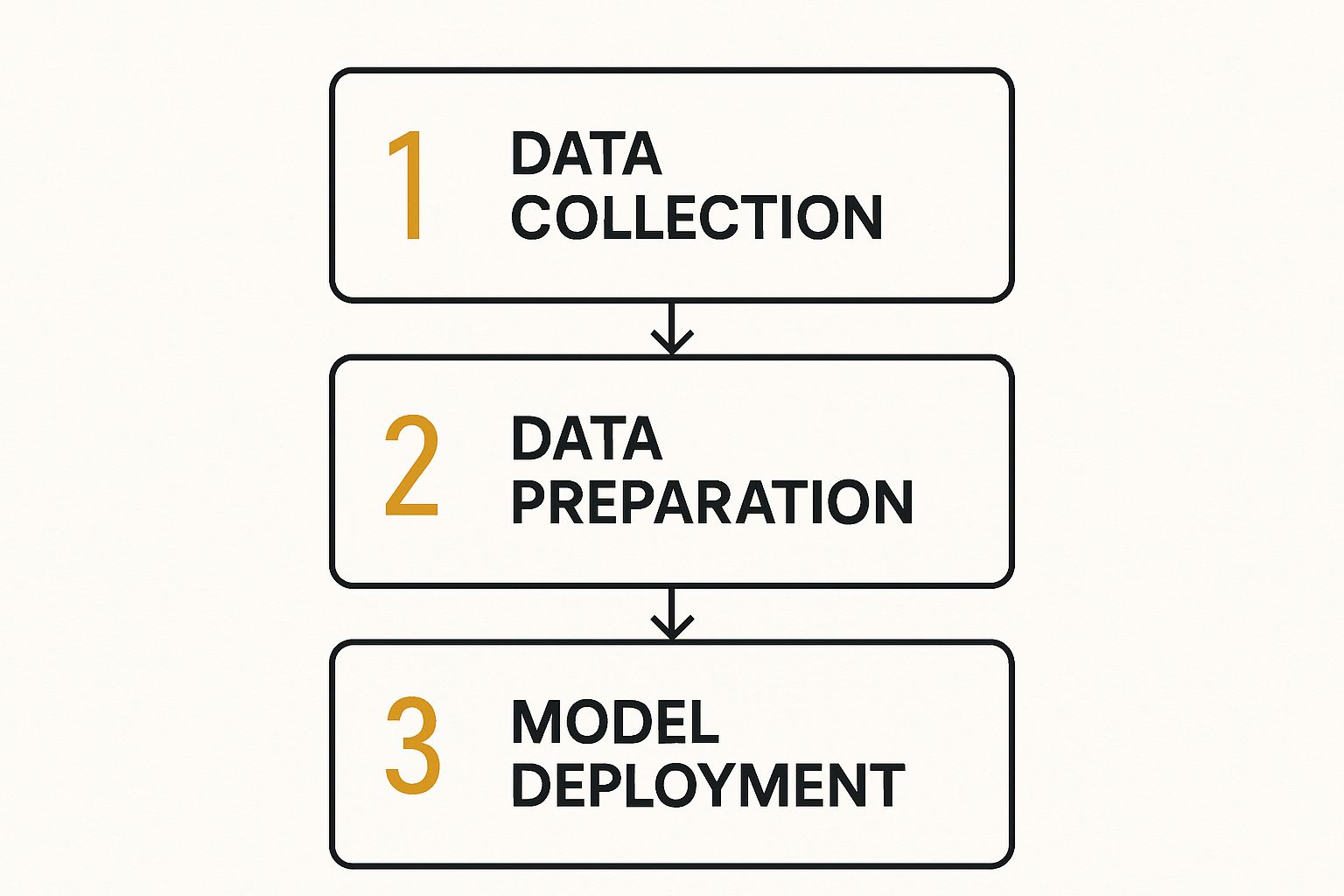
As you can see, a successful model is completely dependent on the quality of the data collection and preparation work that comes first.
Overcoming Common Hurdles
As you progress, the next big step is to weave these new insights into your day-to-day marketing. This could mean automatically sending predictive lead scores into your CRM or using churn risk alerts to kick off a retention campaign. Many of the advantages of email marketing are magnified when you can target the right person with the right message at exactly the right time, all thanks to predictive insights.
But this isn't just about tech; it's about people, too. Getting your team on board is absolutely critical. A great way to start is with a small, manageable pilot project that shows a clear win. Demonstrating value early on is the best way to build momentum and get everyone excited about what’s possible.
Adopting predictive analytics is a strategic investment, not an expense. It requires a clear vision, clean data, and a commitment to integrating insights into daily operations to achieve a significant return.
Despite the obvious benefits, many UK businesses are rightly careful with their spending. For small and midsize UK firms, marketing budgets often average just 2% of total revenue, making every pound count. This financial reality highlights why it's so important to start with a focused, high-impact project to prove its worth. By following a structured roadmap, you can confidently turn this powerful technology into a concrete asset for your business growth.
The Future of Intelligent Marketing
Predictive analytics isn't just a passing phase in marketing; it's a fundamental change in how businesses will build relationships with their customers for the foreseeable future. As we look ahead, this technology is poised to become more deeply embedded, more intuitive, and frankly, essential. The future isn't just about guessing what might happen—it's about actively shaping outcomes as they unfold.
Driving this evolution is the increasing sophistication of artificial intelligence (AI). We're seeing AI take on the heavy lifting of automating and fine-tuning predictive models, allowing them to learn and adapt with less and less human input. In practice, this means marketing systems will get smarter by themselves, constantly tweaking campaigns to squeeze out better results.
The Dawn of Real-Time Personalisation
The next big jump is towards true, instantaneous personalisation. Picture this: a customer lands on your website, and with every single click, a predictive model re-calibrates the offers, content, and product suggestions they see. This isn’t a pre-programmed path; it’s a fluid, deeply relevant experience that adapts to their behaviour in that exact moment, which is a powerful way to lift engagement and sales.
This kind of hyper-responsiveness won't be confined to websites. We're already seeing predictive insights being woven into newer channels, such as:
- Voice Assistants: Serving up personalised recommendations through devices like smart speakers.
- Connected Devices (IoT): Anticipating a customer's needs based on how they interact with their smart home technology.
- Augmented Reality (AR): Creating bespoke virtual try-on or product placement experiences in real time.
Getting to grips with predictive analytics is no longer just about making today’s campaigns a bit better. It’s about building a robust, forward-looking strategy that keeps your business competitive in a world that runs on data.
Ultimately, mastering these tools is becoming a central pillar of modern business. For anyone new to this space, getting the basics right is crucial. You can explore a comprehensive beginner's guide to digital marketing to build a solid foundation before diving into these more advanced methods. Staying relevant tomorrow means embracing the future of intelligent marketing today.
Frequently Asked Questions
It's completely normal to have a few questions as you start to look into predictive analytics for marketing. It’s a big step away from the way things have always been done, and getting your head around the practicalities is the first step towards feeling confident enough to dive in.
We get asked a lot of the same questions by marketing pros, so we’ve put together some straightforward answers to help clear things up. The goal here is to show you how this technology can actually slot into your current strategy and deliver real, tangible results, no matter the size of your business.
What’s the Difference Between Predictive Analytics and BI?
I like to think of traditional business intelligence (BI) as a very detailed report card. It’s fantastic at looking backwards, slicing and dicing historical data to tell you exactly what happened last quarter or during your last big campaign. It answers the critical question, “How did we do?”
Predictive analytics, on the other hand, is your strategic map for what’s ahead. It takes that same historical data and uses clever algorithms to forecast what’s likely to happen next. So, instead of just reporting on the past, it gives you the foresight to make decisions that will actively shape your future.
Do I Need a Data Scientist to Use Predictive Marketing?
Not anymore. While a data scientist is still invaluable for building highly complex, custom models from scratch, the game has changed. Many of today's marketing automation platforms come with user-friendly predictive features baked right in, making them perfectly usable for marketers who don't have a background in statistics.
You can get started right away with tools that handle things like:
- Automated lead scoring to help your sales team focus on the hottest prospects.
- Churn risk detection to give you a heads-up on customers who might be about to leave.
- Product recommendation engines to drive more cross-sells and upsells.
The trick is to start with a clear business problem you want to solve and pick a tool that fits your team's current skill set.
How Much Data Do I Need to Start?
The old saying holds true here: it's all about quality over quantity. You need a solid foundation of clean, consistent, and relevant historical data to build a model you can trust. A big pile of messy, inaccurate data will only ever produce flawed predictions.
As a general rule of thumb, for common tasks like customer segmentation or predicting churn, having several months' to a year's worth of customer interaction and transaction data is a great starting point. The more high-quality information you can feed the model over time, the sharper and more reliable its forecasts will become.
Is Predictive Analytics Only for Large Companies?
Absolutely not. That was certainly the case years ago, but the boom in SaaS (Software as a Service) tools has made predictive analytics much more affordable and accessible for businesses of all shapes and sizes. Many marketing platforms now bundle these features in at different price points, which has really levelled the playing field.
If you’re a smaller business, the best way to start is to pick one specific, high-impact problem. Focus on something like improving the quality of your leads or cutting down customer churn. Choose a solution that gives you a clear, measurable return without needing a huge upfront investment.
Ready to discover the perfect tools to power your marketing strategy? The Digital Marketing Toolbox provides a curated catalogue of the best solutions in analytics, SEO, AI, and more. Stop guessing and start growing with our expert recommendations. Find your next game-changing tool at https://grow-your-biz.com.


