
Let's be honest, the term "marketing automation" can sound a bit intimidating. It often conjures up images of complex software and massive corporate teams. But for a small business, it's something much simpler and far more powerful.
Think of it as your secret weapon for handling repetitive marketing jobs automatically. It's about putting essential tasks—like email follow-ups, social media posts, and lead nurturing—on a smart, reliable autopilot. This frees you up to focus on what really matters: strategy, customer relationships, and growing your business.
What Is Marketing Automation, Really?
Forget the buzzwords for a moment. At its core, marketing automation is a tool built to help you do more with less. That’s a perfect match for the reality of running a small business, where time and money are always tight.
Imagine hiring a new team member who works 24/7. This person never forgets to send a welcome email, always follows up with a promising lead, and gets your new blog post onto social media at the perfect time, every time. That’s exactly what marketing automation does. It becomes your most dependable employee, taking care of the crucial but time-consuming tasks that fuel your growth.
Putting Your Business on Autopilot
Running your marketing can feel like flying a plane. As the pilot (the business owner), you need to keep your eyes on the destination—attracting new customers, launching products, and steering the company forward. Marketing automation is your expert co-pilot. It manages the pre-flight checks, handles the navigation, and watches the instruments, making sure the journey is smooth.
This co-pilot is brilliant at handling predictable but vital tasks, like:
- Sending a welcome email series to new subscribers to make a great first impression.
- Alerting you or your team the moment a lead keeps revisiting your pricing page.
- Scheduling all your social media content weeks ahead of time for a consistent presence.
- Automatically sorting your audience into different groups for targeted, relevant offers.
By setting up these automated workflows, you aren't getting rid of the human touch. You're actually creating more time for it. You can jump in when it counts the most—like closing a big deal or handling a tricky customer question—because all the prep work has already been done for you.
Closing the Resource Gap
One of the biggest hurdles for any small business is trying to compete with the huge marketing departments of bigger companies. This is where marketing automation truly levels the playing field.
It gives a one-person team the power to run a marketing strategy with the polish and consistency of a much larger organisation. You get the benefits of timely, personal communication without needing to hire an entire team to make it happen. To get a deeper look at how this works in practice, check out a comprehensive guide to small business marketing automation. It's all about bridging that gap between having limited resources and building a powerful marketing engine that drives real growth.
How Automation Creates Growth for Small Businesses

For any small business, growth isn’t just a nice-to-have; it's essential for survival. The catch is that the very things that fuel this growth—like consistent marketing, timely lead follow-ups, and customer engagement—are often the most time-consuming. This is where marketing automation truly shines, turning abstract goals into real, measurable results.
Think of it as a force multiplier for your efforts. Instead of you having to send every single follow-up email by hand or remember to post on social media each day, automation software handles these repetitive jobs with perfect precision. This frees you up to focus on the high-impact work that actually needs your brainpower, like refining your marketing strategy for your small business or building relationships with your best customers.
Turning Wasted Time into Valuable Work
Let's be honest: how many hours a week do you lose to routine marketing admin? Manually updating contact lists, sending one-off emails, and posting content across different social channels adds up fast. Every hour spent on those tasks is an hour you could have spent on sales calls, product development, or big-picture planning.
Automation tackles this problem head-on. You set up a workflow once, and it runs for you indefinitely, reclaiming countless hours over the long term. It’s not just about being more efficient; it’s about strategically reallocating your most precious resource—your time—to the activities that directly drive revenue.
This shift is particularly critical for newer businesses. In fact, recent research shows that for UK SMEs operating for five years or less, technology is the backbone of their development. A huge 92% of new SME owners agree that technology has been essential to their growth, proving just how central automation has become.
From Lukewarm Leads to Loyal Customers
One of the biggest wins with automation is how it transforms your lead nurturing. A new subscriber or a casual website visitor is rarely ready to buy on the spot. They need consistent, helpful interaction to build trust in what you do.
Trying to track every lead's journey manually is a recipe for disaster for a small team. Automation, on the other hand, makes it look easy.
- Automated Welcome Emails: A new subscriber instantly gets a series of emails introducing your brand, sharing valuable content, and explaining what makes you different. It’s a perfect, professional first impression, every single time.
- Targeted Content: The system can send highly relevant follow-up information based on what a lead does, like downloading a specific guide or visiting a product page. This makes your communication feel personal and understood.
- Lead Scoring: The software can even track engagement automatically, giving points for actions like opening emails or clicking links. This highlights your most interested prospects, telling your sales team exactly who to call first.
This structured approach means no potential customer ever falls through the cracks. It systematically moves people from mild interest to genuine sales-readiness—a process your bigger competitors have been using for years.
Automation isn’t about replacing your marketing; it's about making your existing marketing smarter and more effective. It takes the solid foundation you've built and adds a layer of intelligent execution that works for you around the clock.
Making Data-Driven Decisions Simple
A gut feeling can only get you so far. True, sustainable growth comes from understanding what’s working, what isn’t, and then doubling down on your wins. Many small businesses struggle with this because they lack the tools to easily track their return on investment (ROI).
Marketing automation platforms change that. They come with built-in analytics and clear dashboards that give you answers at a glance. You can see which email campaigns are getting the most clicks, which landing pages are converting best, and which social channels are bringing in quality leads.
This clarity takes the guesswork out of your marketing. You can confidently put your budget into the channels delivering the best results, ensuring every pound spent is working as hard as possible for your business. This data-backed approach empowers you to make smart, profitable decisions that keep pushing you forward.
The Automation Features You Actually Need

Jumping into marketing automation can feel like being handed the keys to a spaceship. There are thousands of blinking lights and complex controls, and it's easy to feel overwhelmed. Many platforms try to wow you with a dizzying list of features, but the truth is, most growing businesses don't need all of them.
The trick is to ignore the noise and zero in on the core tools that will actually move the needle. By focusing on a solid foundation of marketing automation for small business, you can avoid paying for confusing bells and whistles you'll never use. Let's look at the must-have features that deliver real results from day one.
H3: Email Automation and Sequences
Email is the absolute bedrock of a smart automation strategy. We’re not talking about one-off newsletters here, but rather a series of automated emails—often called drip campaigns—that spring into action based on what a customer does. This is your secret weapon for building relationships on autopilot.
Some classic, high-impact workflows include:
- Welcome Series: When someone new signs up, don't just send a single "hello." A carefully crafted three-part series can introduce your brand story, share your most helpful content, and even offer a small welcome discount. It makes an incredible first impression.
- Abandoned Cart Reminders: If you run an e-commerce shop, this is a non-negotiable. An automated email that gently reminds a shopper about the items they left behind can claw back a huge chunk of potentially lost sales.
- Re-engagement Campaigns: You can set up a simple trigger to send a friendly "we miss you" message to customers who haven't been active for a while, pulling them back into your orbit.
These automated conversations make sure every lead and customer gets the right message at the right time. To get a better sense of its power, it's worth exploring the many advantages of email marketing that automation unlocks.
H3: Lead Management and Segmentation
As your audience grows, your contact list can quickly turn into a digital junk drawer. A good lead management system is the tidy filing cabinet you need, keeping all your contact information organised and easy to find. Think of it as a living, breathing database of your community.
But just storing contacts is only half the story. The real magic is segmentation. This feature lets you automatically group people based on shared traits or actions. You could, for instance, create separate segments for:
- New leads who downloaded your beginner's guide.
- Loyal customers who have bought from you more than three times.
- Prospects who keep visiting your pricing page but haven't bought yet.
Being able to segment your audience like this means you can stop sending generic blasts and start sending highly relevant messages that people actually want to read.
H3: Lead Scoring Your Hottest Prospects
How can you tell which of your leads are just window shopping and which are pulling out their wallets? Lead scoring is your built-in prospect detector. It works by automatically assigning points to your contacts based on the actions they take, helping you spot who’s most interested.
Here's how it might look in practice. A lead could earn:
- +2 points for opening an email
- +5 points for clicking a link to a specific product
- +10 points for downloading a detailed case study
Once a contact hits a certain threshold—say, 25 points—the system can ping your sales team, letting them know it's the perfect time to reach out. This stops your team from wasting time on cold leads and focuses their energy where it counts.
Lead scoring takes the guesswork out of your sales process. Instead of treating every lead the same, it creates a clear priority list, allowing you to focus your energy where it will have the greatest impact.
H3: Social Media Scheduling
Keeping up a consistent presence on social media is vital, but it can be a massive time-drain. Social media scheduling is a beautifully simple automation feature that lets you write, plan, and schedule all your posts weeks or even months in advance.
Instead of scrambling to post something new every day, you can block out a few hours and get all your content lined up in one go. The tool then publishes it for you at the best times for each platform. This frees you from the daily grind and keeps your brand active and engaged, even when you're busy with other things.
Essential vs. Advanced Automation Features for SMEs
When you're just starting out, it's easy to get distracted by advanced features that sound impressive but aren't necessary yet. The key is to master the fundamentals first. This table breaks down the core features you should prioritise versus the more advanced ones you can grow into later.
| Feature | What It Does for Your Business | Priority for Beginners |
|---|---|---|
| Email Sequences | Nurtures new leads and engages existing customers with automated, triggered email series. | High |
| Contact Segmentation | Groups your audience based on behaviour or demographics for more targeted messaging. | High |
| Lead Scoring | Identifies your most engaged, sales-ready leads by assigning points based on their actions. | High |
| Social Media Scheduling | Maintains a consistent online presence by scheduling posts in advance across your platforms. | High |
| Dynamic Content | Personalises website or email content based on who is viewing it. | Medium |
| A/B Testing | Tests different versions of emails or landing pages to see which performs better. | Medium |
| CRM Integration | Syncs marketing data with your sales CRM for a unified view of the customer. | Medium to High |
| Predictive Analytics | Uses AI to forecast customer behaviour and identify future trends. | Low |
Focusing on the "High" priority features will give you the strongest foundation for success without overwhelming your team or your budget. As your confidence and business grow, you can then begin exploring the more advanced capabilities.
Creating Your First Automation Workflows
Theory is great, but putting it into practice is where you'll really see the magic happen. The idea of building a "workflow" might sound a bit technical, but it’s really just a series of automated actions that kick off when something specific happens.
Think of it like a simple recipe for your marketing: when X happens, do Y, then wait a bit, then do Z.
This hands-on approach is the quickest way to get a feel for the power of marketing automation for small businesses. We'll walk through three straightforward workflows that you can set up quickly and that deliver almost immediate results. You don't need a massive, complicated system to make a real difference.
This diagram breaks down the basic logic behind any automation: spot a repetitive task, set a trigger to start the process, and then keep an eye on the results to see what's working.
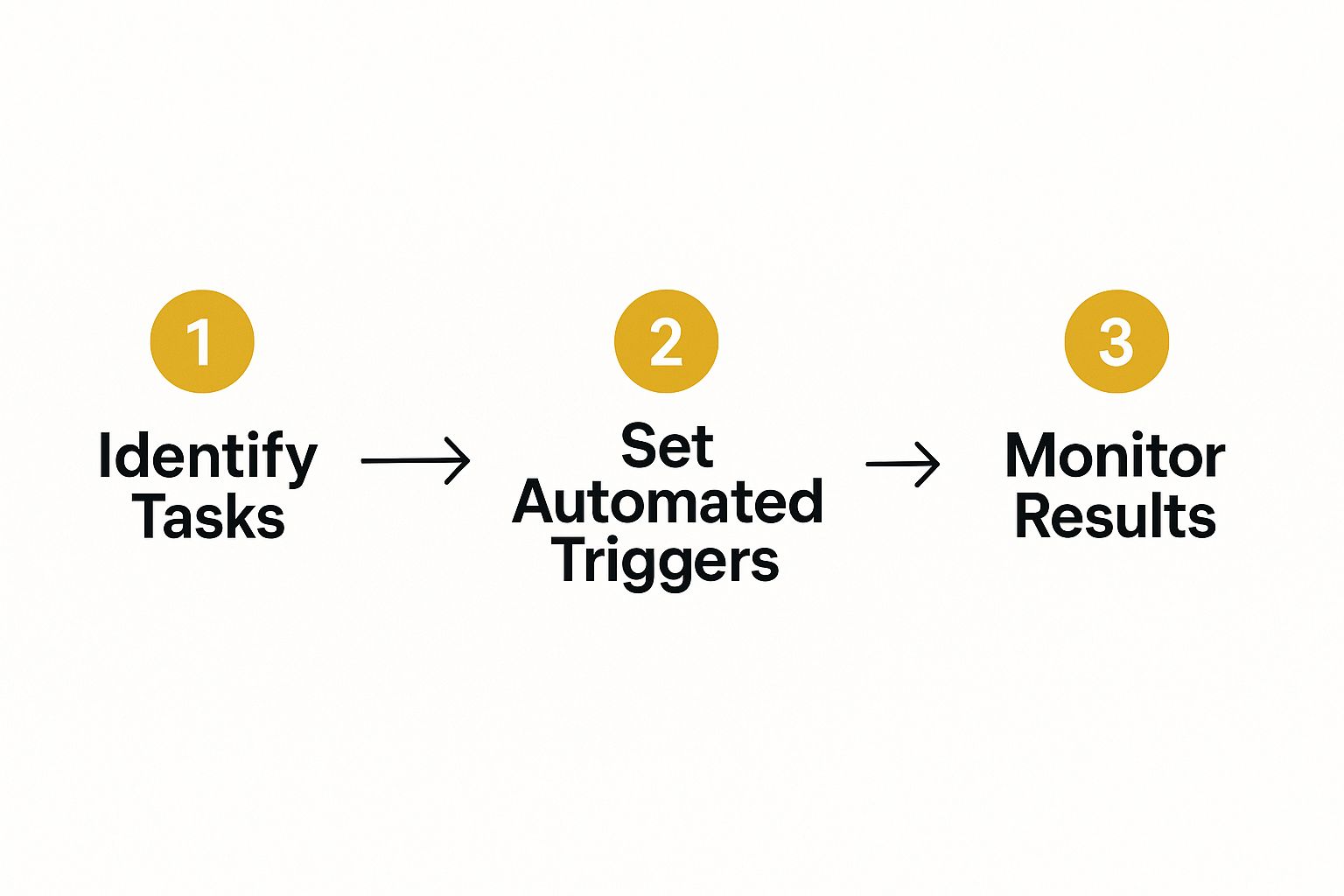
Honestly, every successful workflow follows this simple pattern. It’s all about turning that manual grind into a reliable, automated system that works for you 24/7.
Workflow 1 The Welcome Series
First impressions count, and a welcome series is your chance to make a fantastic one. This is, without a doubt, the most important workflow for any business to have. It engages new subscribers the very moment they show interest, helping you build a solid relationship from day one.
The Goal: To introduce your brand, give new contacts something valuable right away, and gently nudge them towards their next step with you.
Here’s a simple three-part structure to get you started:
- Trigger: A visitor signs up for your newsletter or creates an account on your site.
- Action 1 (Immediate): Send Email #1. This is your warm "hello," confirming they've subscribed and delivering whatever freebie or resource you promised.
- Wait: Give them a couple of days to breathe. Let’s say 2 days.
- Action 2: Send Email #2. Now’s a great time to share your most popular blog post, a genuinely helpful tip, or a short video that tells your brand’s story.
- Wait: Let another 3 days pass.
- Action 3: Send Email #3. This email can introduce a best-selling product, share a glowing customer testimonial, or offer a small, one-time discount to encourage that first purchase.
Once this is set up, every single new lead gets a consistent and professional introduction to your business without you having to lift a finger.
Workflow 2 The Lead Nurturing Campaign
Let's be real: not everyone who shows interest is ready to buy on the spot. A lead nurturing workflow is designed specifically for these people. It educates them, builds trust, and gently guides them toward making a purchase when they're ready.
The Goal: To turn those warm-but-not-hot leads into sales-ready prospects by sending them targeted, valuable content over time.
Imagine a contact downloaded a guide from your website. Here’s what you could do:
- Trigger: A contact downloads your "Beginner's Guide to Landscape Gardening."
- Action 1 (Immediate): An email lands in their inbox with the guide attached, thanking them for their interest.
- Wait: 4 days.
- Action 2: Follow up with a related blog post, something like "5 Common Gardening Mistakes to Avoid." This reinforces your expertise.
- Wait: 5 days.
- Action 3: Send them a case study or a testimonial showing how your service helped someone else create their dream garden.
- Wait: 5 days.
- Action 4: Now you can send a soft-sell email offering a free consultation or a special introductory package.
This methodical approach keeps your business top-of-mind and positions you as the helpful expert, not just another company trying to sell something. By the time you make an offer, the lead is already convinced you know your stuff.
Workflow 3 The Re-engagement Campaign
It happens to everyone. Some customers just go quiet. A re-engagement campaign is your automated way to win them back before they're gone for good. It’s always cheaper and easier to keep a customer than to find a new one.
The Goal: To reactivate dormant contacts and remind them why they liked you in the first place.
Here’s a simple but effective workflow for this:
- Trigger: A contact hasn't opened an email or visited your website in 90 days.
- Action 1: Send an email with a friendly, compelling subject line like "Is this goodbye?" or "We've missed you." Inside, highlight what's new or offer an exclusive discount to tempt them back.
- Wait: 7 days.
- Action 2: If they still haven't engaged, send one final email. You could ask for feedback or give them a simple option to update their preferences or unsubscribe.
This process helps you keep a clean, healthy email list and often brings a good chunk of those inactive subscribers back into the fold, turning a potential loss into a renewed opportunity.
As you start to define your first automation workflows, you might also want to think about how you can automate keyword research to make your SEO efforts more efficient and save even more of your valuable time.
Choosing Your Marketing Automation Platform

Alright, you know what you want to automate and the kind of workflows you need. Now comes the big decision: which platform should you use? It can feel a bit daunting, but really, the choice comes down to what you have more of – time, budget, or technical confidence.
For most small businesses, it’s a fork in the road. You can either roll up your sleeves and manage the software yourself, or you can bring in the experts and partner with a marketing automation agency. Let’s look at what each path actually involves.
The Do-It-Yourself Software Path
Going the DIY route puts you in complete control. You pick the tool, you build the campaigns, and you run the show day-to-day. This is often the most cost-effective way to get started, which is a huge plus for many businesses.
The catch? All that control requires a serious time investment. You’ll need to block out hours to get your head around the platform, piece together your automations, and figure out what the results are actually telling you.
This path makes sense if:
- You're watching every penny. Many tools have affordable starting plans perfect for tight budgets.
- You're comfortable with tech. If you enjoy tinkering with new software, this is for you.
- You have the time to spare. You can realistically dedicate a few hours each week to managing it.
The Marketing Agency Partner Path
Working with an agency is like getting an expert marketing team overnight. They’ve already got the strategic experience, the technical skills, and the knowledge of what works (and what doesn't). An agency will handle the software, design your campaigns, and give you clear reports on how things are going.
This approach saves a phenomenal amount of time and helps you sidestep the frustrating mistakes most people make when they’re just starting out. The trade-off, naturally, is the cost. It's a bigger financial commitment than a simple software subscription.
This "done-for-you" model is really taking off. The UK marketing automation industry is on track to blow past £1.9 billion by 2025, and a big reason for that is small businesses teaming up with agencies. These partnerships give them access to seriously powerful tools like HubSpot or ActiveCampaign without the steep learning curve. If you want to dig deeper, you can find great insights into why UK businesses are partnering with a marketing automation agency.
The right choice isn't about which option is "better" overall, but which is the best fit for your current business reality. An honest assessment of your time, technical skill, and budget will point you to the most sustainable and effective solution for your growth.
Picking the wrong path leads to frustration. You either end up with a powerful tool that just sits there gathering dust, or you’re stuck with a hefty bill and no real results to show for it. Take a moment to weigh these factors honestly. It's the key to making a smart decision that actually helps you grow.
How AI Is Supercharging Modern Automation
Artificial intelligence isn't some futuristic fantasy anymore. It’s here, right now, and it's plugging directly into marketing automation platforms, handing small businesses a serious competitive advantage. Think of your automation platform as the reliable, efficient hands that get things done. AI is the creative brain that tells those hands what to do.
This combination is taking tasks that used to swallow up entire days—like content creation—and shrinking them down to minutes. It’s an incredibly powerful partnership that makes top-tier marketing possible, even when you're juggling a thousand other things.
Your New Creative Assistant
What if you had an on-demand copywriter, strategist, and analyst all rolled into one? That’s exactly what accessible AI tools like ChatGPT have become for small business owners. They aren't here to take over your marketing; they're here to make it better and faster, acting as an assistant that never gets tired or runs out of ideas.
This completely changes the game for your day-to-day marketing grind. For example, you can now use AI to:
- Draft Compelling Emails: Generate an entire welcome series or a campaign to win back old customers in a fraction of the time it would normally take.
- Brainstorm Social Media Content: Simply ask for a week’s worth of post ideas for your industry, and you’ll get captions, hashtags, and all.
- Analyse Customer Feedback: Paste a bunch of customer reviews into an AI tool and ask it to find the common themes, complaints, or most-loved features.
This is why AI is becoming such a big deal in marketing automation for small business. It smashes through the creative roadblocks that so often stop busy owners in their tracks. Before you dive in, getting the fundamentals right is key; our beginner's guide to digital marketing is a great place to build that foundation.
The Human Touch Is Still Your Secret Weapon
AI is an amazing tool for getting things done quickly, but that's what it is—a tool. It’s not a replacement for your own experience and knowledge. Its real magic lies in producing a solid first draft, but it’s your unique brand voice and human touch that will make your marketing feel real and connect with people.
AI is brilliant at creating content that’s grammatically sound and well-structured, but it can’t share your personal stories, your hard-won industry insights, or your genuine passion. Your job is to be the editor-in-chief, taking what the AI gives you and polishing it until it truly sounds like you.
Always, always review and edit AI-generated copy. Does it reflect your personality? Does it speak directly to your customer’s problems? That final human check is absolutely essential for keeping the trust you’ve worked so hard to build.
A Powerful (and Underused) Advantage
For all its power, a surprising number of UK small businesses are still on the sidelines, missing out on what AI can do. The data shows a massive opportunity for those who are ready to jump in.
On average, businesses using AI for marketing see a 73% reduction in content creation time and a 62% decrease in customer service costs. The numbers on growth are just as compelling: conversion rates can improve by around 41%, while customer acquisition costs often drop by an average of 35%. You can discover more insights about AI success in 2025 to get a fuller picture of what’s possible.
Common Questions About Marketing Automation
Thinking about bringing a new tool into your business always raises a few questions. It’s a big decision. So, let's tackle some of the most common worries small business owners have when they first consider marketing automation.
Is Marketing Automation Too Expensive For My Business?
Not like it used to be. A few years ago, this kind of tech was reserved for the big players, but today's tools are built with small businesses in mind. You'll find plenty of platforms with affordable monthly plans, and many even offer free tiers to get you started.
But the real question isn't about cost—it's about value. Think about the hours you'll get back each week and the leads you'll convert that might have otherwise slipped away. When you look at it that way, it’s less of an expense and more of an investment that quickly pays for itself.
Do I Need To Be a Tech Expert To Use It?
Absolutely not. If you can send an email or post on social media, you have the skills you need. The best marketing automation for small business platforms are made for business owners, not coders.
They're packed with user-friendly features like drag-and-drop editors and ready-made templates. You don't need to know a single line of code. Plus, the best providers have a mountain of tutorials and great support teams to help you out if you get stuck.
Will This Make My Marketing Feel Robotic?
This is probably the biggest myth out there. It's a common fear, but the reality is quite the opposite. Good automation actually helps you create more personal, human connections—at a scale you could never manage on your own.
Instead of sending one-size-fits-all blasts, automation lets you send messages based on what people actually do. Someone clicks a specific link? They get a relevant follow-up. It's about using data to be more thoughtful, not less.
By sending targeted, relevant messages triggered by specific actions, you create a much better experience for your customers. As you start using these systems, it’s also smart to keep an eye on how data privacy is changing. Staying informed on topics like the future of data privacy will be key.
Ready to reclaim your time and accelerate your growth? Explore The Digital Marketing Toolbox to discover and compare the best automation tools that fit your small business needs. Find your perfect solution at https://grow-your-biz.com today.


