

Brand positioning is about carving out a specific spot for your brand in a customer's mind. It's more than just a logo or the products you sell; it’s the distinct feeling and value people connect with your business, setting you apart from everyone else. At its core, it's the art of deliberately shaping how people see you.
What Is Brand Positioning Really

Think about walking into a packed, bustling restaurant. There are dozens of tables, but one has your name on it—reserved just for you. Brand positioning is the business version of that. You’re not just hoping customers find you; you're reserving a specific table in their minds. It's about carving out a unique space that belongs only to you, so when they need what you offer, your name is the first one that comes to mind.
This isn’t about flashy advertising slogans or trying to trick people. It's a foundational strategy that should guide every single business decision you make. From your product's features and pricing structure to your marketing messages and customer service, every touchpoint must reinforce your chosen position. Without it, you're just another voice shouting in a crowded market, easily ignored and quickly forgotten.
The Foundation of Customer Perception
Good positioning tells a clear, consistent story about who you are, who you're for, and why you’re the best possible choice for that specific group of people. This clarity is what builds trust and makes a brand truly memorable.
In the UK market, for instance, this focus on genuineness is vital. Over the past decade, authenticity has become a cornerstone of brand positioning, with 88% of UK consumers saying it's important when deciding which brands to support.
This strategic clarity has a ripple effect across your entire business:
- It Guides Your Marketing: It acts as a compass for all your promotional efforts, ensuring every campaign hammers home the same core message.
- It Informs Product Development: Understanding your position helps you design products and services that perfectly solve the problems of your ideal audience.
- It Builds Brand Loyalty: When customers get what you stand for, they're far more likely to form a lasting connection and stick with you.
Brand positioning is not what you do to a product. Positioning is what you do to the mind of the prospect. It's the process of differentiating your brand in the mind of your target audience.
Ultimately, defining your position is the first real step towards building a powerful, enduring brand. It’s what transforms your business from being just another generic option into becoming the only option for a specific group of customers. This deep understanding is also essential when you're looking into how to rebrand your business, as any successful rebrand depends on a deliberate and well-executed shift in how the market perceives you.
Why Effective Positioning Drives Business Growth
Think of strong brand positioning as less of a marketing tactic and more of a powerful engine for long-term business success. When you carve out a distinct space in the market, you gain a strategic edge that ripples through every part of your organisation. It’s not about one-off campaigns; it's about creating a brand experience people can count on.
This clarity becomes your internal compass. It guides everything from product development and customer service scripts to the people you hire. Every decision, every action, should reinforce who you are and what you stand for, ensuring every customer touchpoint tells the same, cohesive story.
Building Trust and Commanding Value
One of the biggest wins from sharp positioning is the ability to build deep, lasting trust with your customers. When your brand consistently delivers on its promise, people know exactly what they’re getting. That kind of reliability turns one-time buyers into loyal advocates who genuinely feel connected to what you do.
This trust is absolutely critical, especially in the UK market. In fact, 81% of consumers say they need to trust a brand before they even think about buying from it, showing a direct line between a clear position and your sales figures. You can discover more branding statistics on Exploding Topics.
A well-defined position also frees you from the race to the bottom on price. Instead of just being the cheapest option, you can charge a premium because you offer something unique and valuable. People are often happy to pay more for a brand that perfectly solves their problem or reflects their own values.
Creating a Competitive Moat
Powerful positioning builds a powerful defence against your competition. When you "own" a specific idea or niche in your customers' minds, it becomes incredibly difficult for anyone else to push you out. Rivals are left scrambling to either compete on your terms or find a completely new angle, which hands you a massive advantage.
This kind of strategic focus is a cornerstone of any effective marketing strategy for small business, as it enables smaller companies to punch well above their weight against bigger, more established players.
Investing in your brand's position isn't an expense; it's a strategic investment in long-term brand equity. It transforms your brand from a simple commodity into a valuable, resilient asset that fuels sustainable growth and profitability for years to come.
The Four Pillars of a Strong Brand Position

To get a real handle on brand positioning, it helps to break it down into four core elements. I like to think of these as the structural pillars holding up your entire brand. If one is shaky, the whole thing risks collapse.
But when all four are solid and work together, you build an unshakeable presence in your market. This framework gives you a practical way to build or sharpen your own brand’s identity with real clarity.
Pillar 1: Your Target Audience
This is always the starting line: who are you actually for? Simply saying "everyone" is a recipe for being for no one. A strong position is carved out for a specific group of people who share similar needs, values, and frustrations. The sharper your focus on this audience, the better you can speak their language.
Think about two online fitness apps. One might target busy working mums who need quick, effective home workouts. The other could go after competitive athletes training for their next marathon. Their entire approach—from the messaging right down to the app's features—would be worlds apart, all because they serve different people. As our beginner's guide to digital marketing explains, this focus is everything.
Pillar 2: Your Market Category
Your market category is the mental shelf your customers place you on. It's the box they instinctively use to understand what you do. Are you a luxury car, a budget-friendly family runabout, or a rugged 4×4? This context immediately sets expectations around price, quality, and the overall experience.
Defining your category helps people "get" you in an instant. Sometimes this means slotting neatly into an existing category. Other times, it means carving out a completely new one. Look at how Tesla didn’t just enter the car market; it created a new mental box for many people by positioning itself as a tech company that happens to make electric vehicles.
Your brand’s position is ultimately decided in the customer's mind, not in your boardroom. These four pillars are your tools for shaping their perception and guiding them to the conclusion you want.
Pillar 3: Your Points of Difference
This pillar answers the most important question of all: why should anyone choose you? This is your unique selling proposition, your secret sauce—the value only you bring to the table. To be effective, your points of difference must be:
- Relevant: They have to solve a real problem or satisfy a genuine desire your target audience has.
- Credible: You have to be able to back up your claims and deliver on your uniqueness, every single time.
- Distinctive: They need to be things your competitors can't easily copy or claim for themselves.
A point of difference could be anything from your proprietary technology or an exceptional service model to your unwavering commitment to sustainable sourcing. Whatever it is, it must be the compelling reason someone picks you out of a line-up.
Pillar 4: Your Brand Promise
Finally, your brand promise is the tangible value you deliver to customers, time and time again. It’s where the other three pillars come together in a single, powerful commitment. It's the promise you make—and keep—with every single interaction.
For Volvo, the promise has always been safety. For Amazon, it’s convenience and an almost infinite selection. This isn't just a clever slogan; it has to be an operational reality, woven into your company's DNA and proven through your actions. When customers believe in your promise, you earn genuine loyalty and build a truly formidable brand position.
Right, you've done the hard work and figured out your brand's strategic pillars. Now it's time to bring it all together into a powerful positioning statement.
This isn't your flashy public tagline. Think of it more as your company's internal North Star—a concise, guiding document that gets everyone, from marketing to product development, rowing in the same direction. It’s the blueprint that ensures every decision, every bit of copy, and every customer interaction tells the same consistent story.
The Classic Positioning Statement Formula
There are plenty of ways to frame a positioning statement, but a classic, time-tested formula is the perfect place to start. It forces you to be ruthlessly clear and cut straight to what matters most.
Here’s the template:
For [Your Target Audience], [Your Brand Name] is the [Your Market Category] that [Your Brand Promise] because only we [Your Points of Difference].
See how it works? It creates a logical thread connecting who you serve, what you do, and—crucially—why you’re the only real choice for them.
Let’s make this real. Imagine a new startup called "Commune" that's launching a project management tool.
Building a Statement Step by Step
To bring this formula to life, the Commune team needs to plug in the strategic pillars they’ve already defined. The key here is specificity; vague statements are useless.
- Target Audience: Not just "small businesses." Let's get specific. How about: "UK-based creative agencies and freelance teams struggling with project overload." This immediately paints a picture of a customer with a genuine problem.
- Brand Name: Commune.
- Market Category: A collaborative project management platform. This helps people instantly categorise the product in their minds.
- Brand Promise: To effortlessly organise client work and communication. This is the core value they deliver.
- Points of Difference: This is their secret sauce. What makes them unique? Let's say it's because they "integrate client feedback directly into task workflows" and "use AI to predict project bottlenecks before they happen." These are concrete, compelling differentiators.
Now, let's put it all together into one coherent statement:
For UK-based creative agencies and freelance teams struggling with project overload, Commune is the collaborative project management platform that effortlessly organises client work and communication because only we integrate client feedback directly into task workflows and use AI to predict project bottlenecks before they happen.
It’s not designed to be a poetic marketing slogan. It’s a strategic tool. It's direct, credible, and gives the Commune team a solid reference point to keep their brand sharp and focused as they grow.
Strategic Frameworks for Finding Your Market Niche
Once you’ve got a handle on the core pillars of your brand, the real work begins: finding your own defensible space in the market. Instead of throwing darts in the dark, you can use established strategic frameworks to map out the competitive landscape and pinpoint exactly where you fit. These models give you a structured path from raw market data to a robust positioning strategy.
A deep understanding of the competitive landscape is the foundation for all of this. Learning what is competitive intelligence and how to apply it is the key to unlocking the power of these frameworks. It's the fuel you need to make smart decisions about where to plant your flag.
One of the most straightforward and visual tools for this job is Perceptual Mapping.
Visualising Market Gaps with Perceptual Mapping
Think of a simple graph with two axes. Each axis represents a key quality that customers in your market care about. For example, you might have price on one axis (from "Value" to "Luxury") and quality on the other (from "Basic" to "Premium"). The magic of perceptual mapping comes when you start plotting your direct competitors on this graph based on how customers see them.
Once you’ve placed everyone, you can literally see the empty spaces. This "unclaimed territory" is your potential market opportunity—a unique position that no one else currently owns. It’s a brilliant, data-backed way to answer the question, “Where can we actually win?”
Take the UK coffee shop market, for instance. You could plot chains based on "Speed of Service" versus "Quality of Experience." You might find a gap for a brand that delivers both a high-quality, artisanal experience and fast, efficient service. That's a position that could immediately attract customers tired of having to choose one or the other.
Building a Holistic Blueprint with the Brand Key Model
While perceptual mapping is fantastic for spotting external gaps, another framework, the Brand Key model, helps you build a more detailed internal blueprint of your brand’s DNA. It organises nine essential components into a keyhole shape, forcing you to take a 360-degree look at what your brand really is.
This model makes you dig deep into everything from your brand's core values and personality to the concrete reasons customers should believe what you say. It prompts you to define things like:
- Root Strength: Your heritage and what you're fundamentally good at.
- Competitive Environment: The market you’re in and who you’re up against.
- Target Audience: A crystal-clear profile of your ideal customer.
- Insight: The genuine human need that your brand answers.
By working through a Brand Key, you end up with a single, unified document that defines every part of your brand. It becomes your North Star, ensuring every marketing message and business decision reinforces the same strong, consistent identity.
This infographic gives a quick snapshot of how these two powerful frameworks stack up.
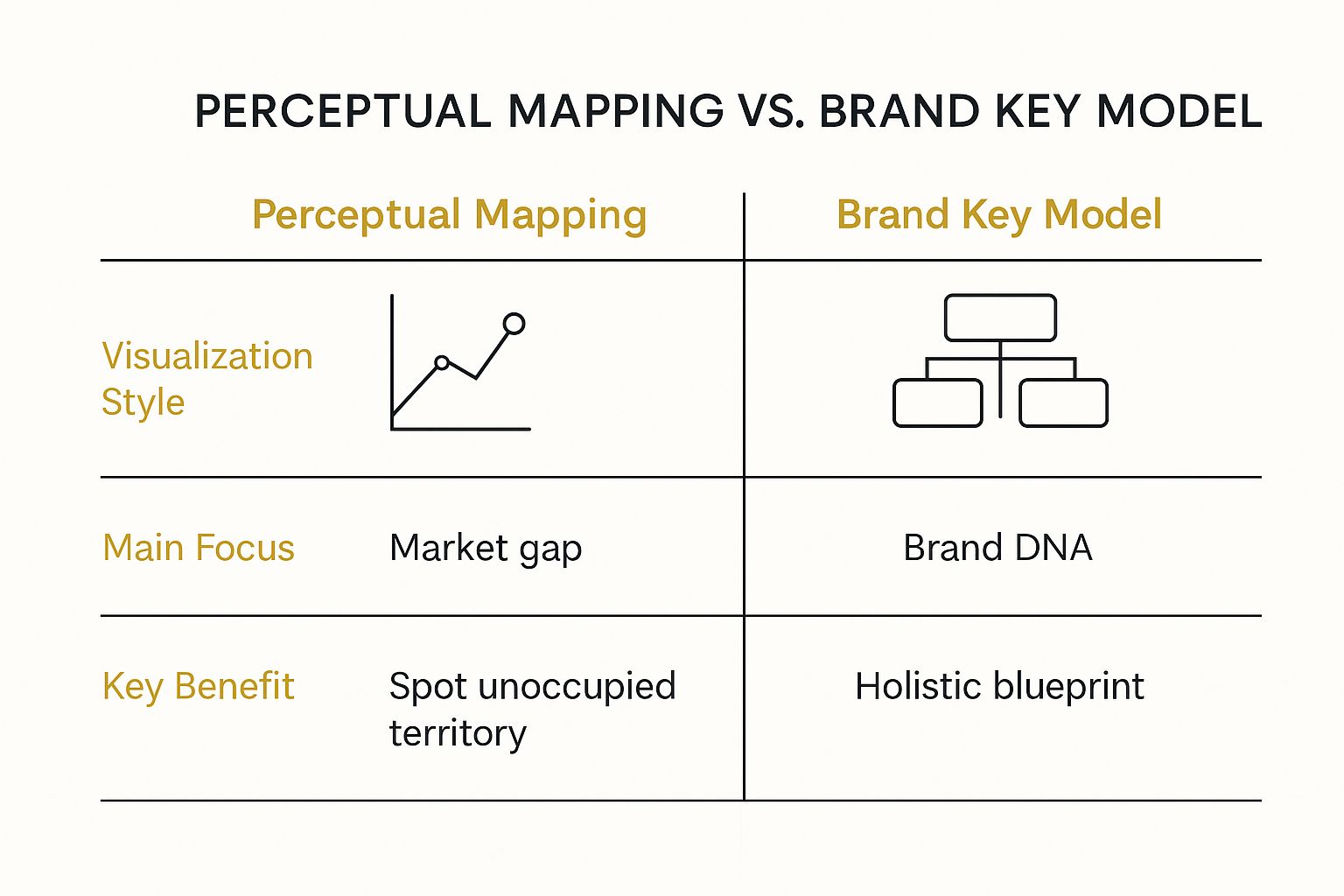
To make the choice clearer, here’s a side-by-side look at what each framework offers.
Comparing Brand Positioning Frameworks
| Framework Feature | Perceptual Mapping | The Brand Key Model |
|---|---|---|
| Primary Goal | Identify gaps in the market | Define the brand's core identity |
| Perspective | Outward-looking (market-focused) | Inward-looking (brand-focused) |
| Output | A visual map of the competitive landscape | A comprehensive brand blueprint |
| Best For | Competitive analysis and opportunity spotting | Internal alignment and brand building |
| Complexity | Relatively simple and visual | More detailed and comprehensive |
Ultimately, these models serve different but complementary purposes. Perceptual mapping is your telescope for spotting opportunities on the horizon, while the Brand Key is your microscope for defining the very soul of your brand. Using them together gives you the complete picture you need to carve out your unique place in the market.
Real-World Examples of Brand Positioning in Action
Theory is one thing, but seeing a great strategy out in the wild is the best way to grasp the power of brand positioning. By looking at how a couple of well-known UK brands have carved out their space, we can turn these abstract ideas into something tangible.
Let's start with Lush. They’ve masterfully positioned themselves in the incredibly crowded cosmetics market, proving that you can thrive by simply refusing to play by the established rules.
Lush: The Ethical Bathing Disruptor
Lush doesn't try to compete on the pseudo-scientific glamour that so many traditional beauty brands lean on. Instead, it built its entire identity around a completely different set of values: freshness, ethics, and a playful, sensory-first experience.
- Target Audience: They speak directly to ethically conscious consumers of all ages who want natural ingredients, refuse to support animal testing, and actually enjoy a fun, hands-on shopping trip.
- Market Category: While it operates within cosmetics, Lush essentially created its own niche: "fresh, handmade cosmetics."
- Points of Difference: Its dedication to minimal or "naked" packaging, vegetarian ingredients, and outspoken campaigns against animal cruelty are what truly set it apart.
- Brand Promise: To deliver effective, fun, and ethically-made beauty products that are as good for the planet as they are for your skin.
This ethical stance isn't just a nice-to-have; it connects deeply with today's UK shoppers. A huge 62% of Gen Z shoppers actively choose brands that focus on sustainability, proving how a values-driven position can build an incredibly loyal community. Find out more about branding trends on huddlecreative.com.
Monzo: The Banking Challenger
Now, let's look at Monzo, the digital bank that completely shook up the UK's stuffy financial sector. It didn't try to be a slicker version of an old bank; it positioned itself as a fundamentally new way to handle your money. You can't miss that "hot coral" card.
Monzo zeroed in on digitally-native millennials and Gen Z, people who were completely fed up with the slow, bureaucratic hassle of high-street banking. Its promise was simple: banking that is transparent, easy, and designed for modern life.
This crystal-clear positioning is backed up at every turn, from its brilliant app to its refreshingly straightforward communication. It's no wonder Monzo has become the default choice for a new generation.
These examples show how a sharp position, supported by a consistent brand experience, builds something powerful and memorable. For many modern brands, this is achieved through a strong online presence, often managed by a dedicated virtual marketing team.
Answering Your Top Brand Positioning Questions
As you start putting these ideas into practice, you’ll probably find a few questions cropping up. It’s completely normal. Let’s walk through some of the most common ones to clear things up and help you feel more confident about carving out your own space in the market.
How Often Should We Revisit Our Positioning?
Think of your brand positioning as a strategic foundation, not something you etch in stone. It needs to be stable, but not so rigid that it can’t adapt.
A yearly health check is a good habit to get into. You should also take a serious look at it whenever the ground shifts beneath your feet—think a major new competitor storming the scene, a fundamental change in what your customers want, or a big technological leap.
A complete repositioning is a massive effort, so don’t take it lightly. Only go down that road if you have clear evidence that your current position just isn't cutting it anymore.
Can Small Businesses Really Compete with Big Brands?
Without a doubt. In fact, smart positioning is arguably a small business’s secret weapon.
Big corporations often have to cast a wide net, trying to be everything to everyone. That’s your opening. As a smaller business, you can zero in on a specific niche and serve that audience better than anyone else. By completely owning a specialised corner of the market, you can build a fiercely loyal community that the big players can only dream of. It’s the classic "big fish in a small pond" strategy, and it works.
Your tagline is what you say; your brand positioning is what you do. The tagline is an external expression, while positioning is the internal strategy that guides every action, ensuring authenticity.
What’s the Difference Between a Tagline and Positioning?
This is a really important one to get right. Your positioning statement is an internal document, your strategic compass that guides every decision you make.
A tagline, however, is the external, catchy phrase your customers see and hear, like Nike's "Just Do It." Your positioning is the why behind the tagline. It’s the substance that makes the slogan ring true. They are two different things, but one flows directly from the other.
Ready to find the perfect tools to bring your brand positioning to life? The Digital Marketing Toolbox offers a curated selection of solutions to help you analyse your market, engage your audience, and build a standout brand. Discover the right tools for your strategy at https://grow-your-biz.com.


