
Let's be honest, the old way of buying ads was a grind. It involved endless phone calls, back-and-forth negotiations, and stacks of paperwork just to get an ad on a website. Programmatic marketing completely flipped that script.
Your Introduction to Programmatic Marketing
Think of it like a lightning-fast auction for digital ad space. Instead of trading stocks, it's trading ad slots on websites, in apps, and even in videos—all happening in the time it takes a webpage to load.
This isn't about just buying ad space blindly. Programmatic technology uses data to find your ideal customer with surgical precision. It answers the crucial questions instantly: who is this person, what are they interested in, and is showing them my ad right now a smart move?
At its heart, programmatic isn't just about automation; it's about making advertising more intelligent. It lets marketers get back to thinking about big-picture strategy and creative ideas, while the algorithms handle the complex, moment-to-moment buying decisions.
To help break it down, here’s a quick overview of the key ideas.
Programmatic Marketing At a Glance
| Concept | Simple Explanation |
|---|---|
| Real-Time Bidding (RTB) | An instant, automated auction to buy and sell ad impressions. |
| Demand-Side Platform (DSP) | The software advertisers use to buy ad space automatically. |
| Supply-Side Platform (SSP) | The software publishers use to sell their ad space automatically. |
| Data Management Platform (DMP) | A platform that collects and organises audience data for better targeting. |
This table just scratches the surface, but it shows how different pieces of technology work together to make the magic happen.
Why Programmatic Dominates Modern Advertising
This shift to automated ad buying isn't just a passing phase; it's how modern advertising works. It has become the go-to method because it’s incredibly efficient and delivers massive reach.
The UK market really drives this point home. Forecasts predict that UK programmatic ad spend will soar to £23.19 billion by 2025—a figure that nearly doubles what Germany and France spend combined. This proves just how central it has become to any serious marketing budget.
This data-first mindset is a core part of effective online campaigns. To get a feel for how it fits into the wider strategy, have a look at our beginner's guide to digital marketing for some broader context.
So, what does this data-driven approach actually deliver?
- Real-Time Optimisation: You can tweak your campaigns on the fly based on what's working and what isn't.
- Enhanced Targeting: Go beyond simple demographics to reach people based on their actual interests and online behaviour.
- Greater Efficiency: It cuts out the tedious manual work, freeing up your team to focus on what matters.
For a deeper dive into how automation drives campaign performance, this resource on how Programmatic Ads Automate Success In One Click is a great read.
How a Programmatic Ad Buy Actually Works
So, how does this digital ad auction actually play out? It all happens in the blink of an eye, a lightning-fast sequence of events kicking off the very moment you land on a webpage. Let's pull back the curtain and walk through what's happening behind the scenes.
Picture this: an avid runner named Sarah clicks on an article on her favourite fitness blog. The second her browser starts loading that page, the programmatic machine whirs into action. It’s not magic, just a series of incredibly quick conversations between different tech platforms.
The fitness blog’s website instantly sends out a signal: "I have ad space available for this specific visitor!" This message goes out through its Supply-Side Platform (SSP). You can think of the SSP as the publisher's auctioneer, working to get the highest price for the ad space.
From there, the SSP connects to an Ad Exchange, which is the central marketplace where everything happens. An ad exchange is basically the London Stock Exchange for digital ad spots, where ad impressions are traded instead of company shares.
The Bidding War Begins
Now, the other side of the market gets involved. Hundreds, maybe thousands, of advertisers want to reach people just like Sarah. They manage their ad buying through a Demand-Side Platform (DSP). A DSP acts as the advertiser’s agent, armed with data and clear instructions on who to target and what they're willing to pay.
The ad exchange officially opens the auction. It shares the key details: the website, the ad’s size and position, and—most importantly—anonymised data about Sarah. This might include her browsing history (which shows her interest in running shoes), her location, and the type of device she’s using.
This is where another critical player, the Data Management Platform (DMP), comes in. A DMP is like a vast data library that helps advertisers get a richer picture of the user. It helps the DSP make a split-second decision on whether Sarah is the right person to see their ad.
The infographic below maps out this entire automated journey, showing how all these platforms interact in real time.
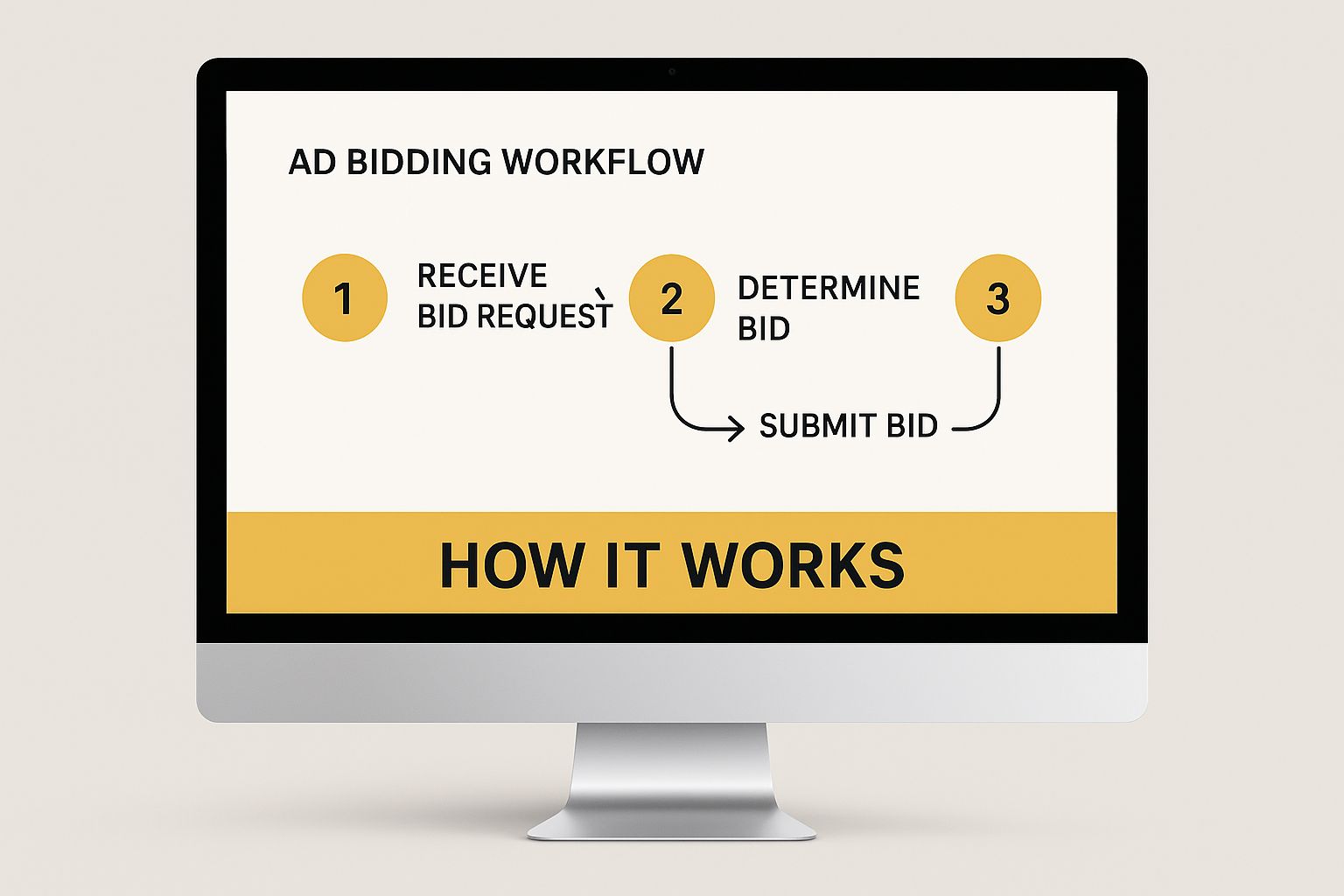
As you can see, it's a clear path from a user visiting a site to the winning ad being served, highlighting how the DSP, SSP, and ad exchange work together.
Selecting the Winning Ad
Armed with all this information, DSPs representing different brands—say, a sportswear company or a local marathon organiser—instantly calculate a bid. This whole process is called Real-Time Bidding (RTB). In a flash, each DSP submits its bid to the ad exchange.
The entire auction, from the initial ad request to picking the winner, happens in about 100 milliseconds. That’s literally faster than you can blink. For the user, it’s just a seamless part of the page loading.
The ad exchange reviews all the bids. The highest one wins. The winning advertiser's DSP gets the notification and immediately sends the ad creative (the image or video) back down the line to the fitness blog. Just like that, the sportswear company’s ad for new running shoes appears on Sarah's screen, perfectly timed and highly relevant.
This intricate process is the engine of modern digital advertising. And if you're getting into the nitty-gritty of how a programmatic ad buy actually works, you'll need to get comfortable with core metrics like understanding how to calculate impressions, which is fundamental to measuring how your campaigns are doing.
Why This Process Matters
This high-speed transaction happens billions of times a day across the internet, and it has completely changed the advertising game. Here’s why it’s so important:
- Precision Targeting: Advertisers aren't just buying space on a website anymore. They're buying the chance to reach a specific person, which makes their ad spend incredibly effective.
- Efficiency: Automating the process gets rid of the old-school manual negotiations. This saves a huge amount of time and resources for both advertisers and publishers.
- Real-Time Optimisation: Because everything is data-driven, advertisers can see what’s working (and what isn't) in real time. They can then tweak their strategies on the fly to get better results.
Ultimately, the system ensures that Sarah sees an ad she might actually be interested in, the fitness blog makes the most money from its content, and the sportswear brand connects with a potential customer at just the right moment. That, in a nutshell, is the power of a programmatic ad buy.
The Different Flavours of Programmatic Deals
Programmatic marketing isn’t just one single thing. It’s better to think of it as a menu of options, with different ways to buy and sell ad space depending on what you’re trying to achieve. Figuring out these deal types is key to running a successful campaign, whether your main goal is getting in front of as many eyes as possible or making sure your brand appears in exactly the right places.
The programmatic world gives you a whole spectrum of choices, from wide-open auctions that anyone can join to exclusive deals arranged in advance. It’s a bit like shopping – you can head to a bustling public market or visit a private, invitation-only boutique. Each has its place and is built for different strategies.
Let's break down the four main ways programmatic deals get done, starting with the most common and working our way up to the most exclusive.
Open Auctions: The Public Marketplace
The most common setup is the Open Auction, which you’ll often hear called Real-Time Bidding (RTB). This is the big, public free-for-all of programmatic advertising. It’s an open environment where pretty much any advertiser can bid on ad space from a massive pool of publishers.
Picture a fast-moving auction house. The auctioneer (the SSP) holds up an item (an ad impression), and a room full of bidders (the DSPs) all shout out their prices at once. The highest bid wins, and the ad shows up on the screen almost instantly.
- Best for: Campaigns where the goal is maximum reach and scale, often at the lowest possible cost per impression.
- Keep in mind: You get huge scale, but you have less say over exactly where your ads end up. This makes brand safety tools, like whitelists and blacklists, absolutely essential.
This approach is fantastic for broad awareness campaigns. But what if you need more control and a bit more predictability? That’s where the other deal types come in.
Private Marketplaces: The Invitation-Only Auction
A Private Marketplace (PMP) is a step up in terms of exclusivity. Think of it as the VIP room at the auction house. It’s an invite-only auction where a publisher, or a group of them, invites a select list of advertisers to bid on their prime ad inventory.
The big win here is transparency. Advertisers know precisely which sites their ads might run on, which gives them far more control over brand safety and the context their ad appears in. For publishers, it’s a way to offer their best spots to trusted buyers, often setting a higher minimum price than they would in the open auction.
A PMP strikes a great balance. It gives you the efficiency of real-time bidding but with the quality control and safety you'd expect from a more direct deal. It's the perfect middle ground.
This model is a great fit for brands that need to be sure their ads are running next to high-quality, relevant content, but still want the competitive pricing of an auction.
Preferred Deals: Getting First Dibs
Moving even further towards exclusivity, we have Preferred Deals. This one isn't an auction at all. Instead, a publisher offers its ad space to a single buyer at a fixed, pre-agreed price before it goes to any auction. The advertiser essentially gets a "first look" and the right of first refusal.
If the advertiser takes the deal at that price, it’s done. If they pass, the ad space usually rolls over into a Private or Open Auction for others to bid on. It's a simple, priority-based transaction.
Programmatic Guaranteed: The Direct Booking, Automated
Finally, we have Programmatic Guaranteed, sometimes called Programmatic Direct. This is the most direct and predictable type of deal, basically taking the old-school way of buying media and giving it a modern, automated upgrade. Here, an advertiser and a publisher agree on everything upfront: a specific number of impressions, a fixed price, and the exact dates the campaign will run.
The ad inventory is completely reserved and guaranteed for that one buyer. There’s no bidding, no uncertainty. It's a direct sale, just handled through programmatic platforms. This gives both sides the ultimate level of control and predictability, making it ideal for high-impact campaigns where premium placement is a must.
Now that we've covered the different deal types, it helps to see how this automated approach stacks up against the old-school way of doing things.
Manual Ad Buying vs Programmatic Ad Buying
Before programmatic technology, media buying was a very manual, relationship-driven process involving countless emails, phone calls, and spreadsheets. Programmatic changed all that.
Here’s a quick comparison to highlight the key differences:
| Feature | Manual Ad Buying | Programmatic Marketing |
|---|---|---|
| Process | Involves direct negotiations, insertion orders (IOs), and manual campaign setup with publishers. | Uses automated platforms (DSPs, SSPs) to buy and sell ad impressions in real-time auctions or direct deals. |
| Speed | Slow and time-consuming. Can take days or weeks to launch a campaign. | Extremely fast. Ad impressions are bought and served in milliseconds. |
| Targeting | Broad targeting based on the publisher's overall audience demographics and content. | Highly granular targeting based on user data, behaviour, context, location, device, and more. |
| Efficiency | Labour-intensive, requiring significant human effort for management and optimisation. | Highly efficient. Algorithms handle bidding and optimisation, freeing up human teams for strategy. |
| Reach & Scale | Limited to the publishers you have direct relationships with. | Access to a massive pool of inventory from thousands of publishers across the web. |
| Optimisation | Relies on manual analysis of post-campaign reports. Changes are slow to implement. | Real-time data allows for on-the-fly campaign adjustments and continuous optimisation. |
In short, programmatic brings a level of speed, precision, and efficiency that was simply impossible to achieve with manual methods. It allows for smarter decisions, better targeting, and ultimately, more effective advertising campaigns.
The Good, The Bad, and The Automated: Weighing Up Programmatic Marketing

Programmatic marketing gives you a powerful way to reach audiences with incredible speed and precision. But let's be honest, this automated world isn't a magic bullet. To get it right, you need to have a clear-eyed view of both the massive advantages it offers and the very real hurdles you'll need to overcome.
Getting this balance right is everything. If you appreciate the upsides and prepare for the pitfalls, you can build a much smarter and more resilient programmatic strategy that actually delivers the goods.
The Clear Advantages of Programmatic Advertising
First off, the biggest win is sheer efficiency. Automating the ad buying process cuts out countless hours once sunk into manual negotiations, phone calls, and paperwork. This frees your team up to stop being administrators and start focusing on what really matters: strategy and creative thinking.
But it’s not just about saving time. Programmatic gives you laser-focused targeting. You can go way beyond broad demographics and connect with people based on what they actually do online, their genuine interests, and what they’re looking to buy right now. This means your ads are far more relevant to the people who see them, and you waste a lot less money.
The ability to tweak campaigns in real-time is a complete game-changer. Forget waiting weeks for a report. You can see what’s working and what isn’t as it happens, making instant adjustments to get a better return on your investment.
This data-first approach makes every pound you spend accountable. You can see precisely which audiences are clicking, which ad creative is hitting the mark, and which channels are driving sales. Insights this deep were just a fantasy in the old world of media buying. Now, every part of your advertising is a chance to learn and improve.
Navigating the Key Challenges
For all its strengths, the programmatic world has its share of tripwires. One of the most stubborn problems is ad fraud. This is where non-human traffic—bots—generate fake clicks and impressions, siphoning off your budget without a single real person ever seeing your ad. It's a multi-billion-pound global issue, so it has to be a top concern.
Another huge one is brand safety. Without the right safeguards, your ads could easily end up next to controversial or downright inappropriate content, which can seriously damage your reputation. You have to be proactive here, using whitelists, blacklists, and third-party verification services to protect where your brand shows up.
Here are a few of the main headaches marketers are dealing with:
- Viewability Concerns: Just because an ad was served doesn’t mean a human actually saw it. Fighting to ensure ads appear "above the fold" and are genuinely viewable is an ongoing battle.
- Transparency Issues: The supply chain can feel like a tangled mess. It’s often difficult to see exactly where your money is going and how much of each pound actually makes it to the publisher.
- The Cookieless Future: The industry-wide shift away from third-party cookies is forcing everyone to rethink how they target and measure campaigns, pushing brands to get serious about their own first-party data.
These challenges are real, but they’re not deal-breakers. They just demand a more strategic approach and a commitment to working with the right tools and partners. A solid marketing strategy for small business can provide the framework needed to tackle these complexities head-on.
The UK Market Paradox
The UK programmatic market shows this two-sided reality perfectly. While spending in the UK saw a 15% growth in 2024 and is set to keep climbing, all that extra investment has just dialled up the competition. Too many advertisers are now paying over the odds to reach the exact same generic audiences, resulting in campaigns that just blend in and don't perform.
This paradox highlights why you need a smarter data strategy to avoid burning through your budget. It’s no longer enough to just buy ads; you have to out-think the competition. Successfully navigating what is programmatic marketing means facing these hurdles to truly unlock what it can do for your brand.
What’s Next for Programmatic Advertising?
The world of programmatic marketing never stands still. New technology and a huge shift in what people expect from privacy are forcing everyone to rethink their approach. To stay ahead, you have to know what trends are just around the corner.
The biggest shake-up by far is the move away from third-party cookies. This isn't a small change; it’s forcing the entire industry to find new ways to target ads and measure whether they’re actually working.
Because of this, first-party data is suddenly front and centre. Brands are now scrambling to build real relationships with their customers to collect their own insights. This data, which comes directly from your own website, app, or CRM system, is the new gold standard for running programmatic campaigns that feel relevant, not creepy.
Programmatic Is Breaking Out of the Browser
For a long time, "programmatic" just meant display ads on websites. Not anymore. The technology is pushing into all sorts of new and interesting places, giving brands fresh ways to reach people where they’re already paying attention.
We’re seeing huge growth in a few key areas:
-
Connected TV (CTV): As more people ditch traditional TV for streaming, programmatic lets you place targeted video ads on smart TVs and platforms like Roku with all the precision of a digital campaign.
-
Digital Audio: Think podcasts and music streaming. Programmatic audio ads can reach listeners when they’re away from their screens, a moment that used to be incredibly difficult to tap into.
-
Digital Out-of-Home (DOOH): Yes, even billboards are going programmatic. Digital screens in airports, shopping centres, and bus stops can now be bought in real-time and even change based on the weather or a local event.
The core idea hasn’t changed: use data and machines to get the right message to the right person. What's different is that the ‘place’ can now be a TV screen, a podcast, or a massive digital billboard in the middle of a city.
This expansion means you can build a single, smart strategy that follows a customer across all these different touchpoints. It’s about creating one seamless advertising experience, which can be managed well even by remote teams—something we cover in our guide to virtual marketing.
Smarter Campaigns with AI and Retail Data
Artificial intelligence is the real engine behind all this. AI and machine learning are making campaigns much more predictive, automatically tweaking bids, creative, and targeting to get better results without someone having to manually pull all the levers.
In the UK, you can really see this happening with the rise of retail media networks. By 2025, platforms from giants like Tesco and Sainsbury’s will soak up a huge chunk of ad spend because they hold incredibly valuable first-party shopper data. Brands that tap into this ecommerce data for their programmatic campaigns are already seeing higher conversion rates and much better returns. You can read more about how retail data is shaping UK advertising on kinesso.co.uk.
By getting ready for these shifts now, you can make sure your programmatic strategy isn't just up to date, but fully prepared for what’s coming next.
Frequently Asked Questions
Even when you've got the basics down, a few practical questions about programmatic marketing always seem to crop up. Let's tackle the most common ones to clear up any confusion and help you get started with confidence.
Is Programmatic Marketing Only for Big Companies?
Not at all. It might have started that way, with only massive companies having the budgets to play, but things have changed dramatically. The game-changer has been the rise of self-serve platforms.
Many Demand-Side Platforms (DSPs) now have flexible pricing, often with low or even no minimum spend. This opens the door for small and medium-sized businesses to run incredibly targeted campaigns without needing a huge upfront investment. The trick is to start small with a clear goal and a laser-focused audience, then test, learn, and scale up as you see what works.
How Do You Keep a Brand Safe in Programmatic Campaigns?
This is a huge deal, and rightly so. Protecting your brand's reputation is paramount, and there are several layers of defence built into any good programmatic strategy.
Think of it as a multi-layered security system:
- Whitelists: This is your VIP list—a hand-picked collection of high-quality websites where you know you want your ads to appear.
- Blacklists: This is the opposite—a list of sites, apps, or content categories you want to avoid at all costs.
- Third-Party Verification: Specialised tools act like real-time security guards, scanning placements for dodgy content and blocking your ad from appearing in an unsafe environment.
For the highest level of control, many advertisers use Private Marketplaces (PMPs) or Programmatic Guaranteed deals. These give you a direct line to premium publishers, ensuring your ads show up exactly where you want them, on sites you already trust.
What's the Difference Between Programmatic and RTB?
This one trips a lot of people up, but the distinction is actually quite simple. The easiest way to think about it is like this: one is the entire system, and the other is just one way of using it.
Programmatic is the whole automated advertising machine. It’s the entire ecosystem of technology and processes used to buy and sell digital ads automatically.
Real-Time Bidding (RTB) is just one specific buying method within that machine. It’s the open auction process where impressions are bought and sold in milliseconds. But programmatic also includes other, non-auction methods like Preferred Deals and Programmatic Guaranteed.
So, just remember this: all RTB is programmatic, but not all programmatic is RTB.
Ready to build a smarter marketing stack? The Digital Marketing Toolbox offers a curated selection of the best tools for SEO, automation, and analytics to drive your growth. Discover your next essential tool at Grow Your Biz.


