
Ever wondered how a complete stranger becomes a loyal customer? It’s not magic; it's a process. That process is what marketers call a sales funnel.
Think of it as the path you design for potential customers to walk, from the moment they first hear about you to the point they decide to buy. It's called a funnel for a simple reason: you'll always have more people at the start than you do at the end. Lots of people will show initial interest, but only a smaller, more committed group will make it all the way through to a purchase.
How Does a Sales Funnel Actually Work?
At its heart, a sales funnel gives structure to your customer acquisition efforts. Instead of throwing random marketing messages out into the world and hoping something sticks, a funnel gives you a clear framework. It’s a way to visualise how someone moves from being a casual browser to a paying customer, step-by-step.
The classic analogy is a real kitchen funnel. You pour a lot of liquid in at the wide top—that's your entire potential audience. As the liquid travels down, the funnel gets narrower, filtering everything until a pure, concentrated stream comes out the bottom. Your sales funnel does the exact same thing: it captures a broad audience and then carefully guides the most promising leads toward the final sale.
The Customer Journey, Made Visible
Every customer goes on a journey. They discover a problem, look for solutions, and eventually choose one. A sales funnel simply maps out this natural journey and aligns your marketing with it.
It's built on the reality that while many people might come across your brand, the number gets smaller at each step. Fewer will click your ad, even fewer will sign up for your newsletter, and a smaller group still will actually buy something. Knowing this helps you spot exactly where people are losing interest or dropping off, so you can fix the leaks.
A well-designed sales funnel doesn’t just sell; it builds relationships. By providing the right information at the right time, you establish trust and demonstrate value long before asking for a sale.
This structured approach means you can stop using a one-size-fits-all sales pitch. Instead, you can talk to people about what matters to them, right when they need to hear it.
Why Every Business Needs a Sales Funnel
Putting a sales funnel in place brings focus and predictability to your marketing. It’s not just a theoretical concept; it delivers real-world results.
Here's a quick look at the main stages of a typical sales funnel, which we'll explore in more detail later.
The Four Core Stages of a Sales Funnel
| Stage | Customer's Question | Business's Goal |
|---|---|---|
| Awareness | "What is this? How can it solve my problem?" | Grab attention and make an introduction. |
| Interest | "This looks interesting. Let me learn more." | Engage and educate with valuable content. |
| Desire | "This seems like the best solution for me." | Nurture trust and showcase unique benefits. |
| Action | "I'm ready to buy this." | Make the purchase process easy and seamless. |
Understanding these stages transforms how you approach your marketing and sales.
The Key Benefits of Using a Funnel
When you get your funnel right, the benefits are huge.
- You'll Nurture Leads Better: A funnel gives you a clear roadmap to guide potential customers, so no one gets forgotten or falls through the cracks.
- Conversion Rates Will Increase: By addressing the specific needs at each stage, you remove roadblocks and make it easier for people to say "yes".
- You Can Forecast with Confidence: Once you know your conversion rates between stages, you can predict future sales with much greater accuracy.
- Your Marketing ROI Improves: It helps you zero in on the channels and tactics that are actually working, so you can double down on what drives results.
Ultimately, getting to grips with the sales funnel is non-negotiable for growing a business today. For anyone just starting out, taking a look at a beginner’s guide to digital marketing can be a great way to see how funnels fit into the bigger picture.
Navigating the Funnel Stages: TOFU, MOFU, and BOFU
To really get to grips with a sales funnel, you need to see it as more than just a model. It’s a journey, a story you tell potential customers. The most effective way to map this out is by breaking it into three distinct phases: TOFU, MOFU, and BOFU.
Think of it like building a relationship. You don’t ask for a huge commitment on the first date. Instead, you start with a friendly introduction, build trust over time, and only then suggest taking the next big step. Each stage of the funnel has a different job to do, speaking to people with different levels of awareness and requiring a completely different marketing approach.
This simple visual breaks it down, showing how you guide someone from being a total stranger to a curious prospect, and finally, a loyal customer.
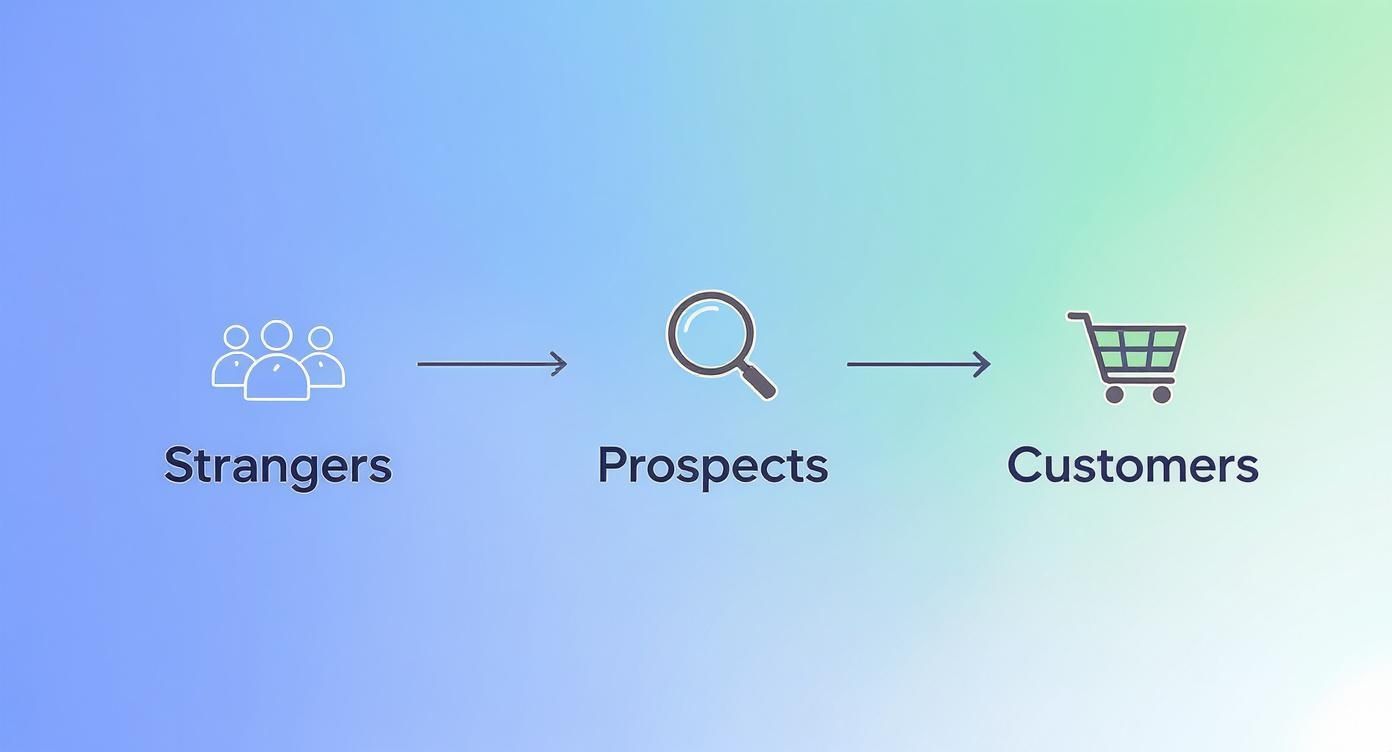
As you can see, the funnel gets narrower at each stage. That’s completely normal. You're filtering for the people who are the very best fit for what you offer. Let's walk through what’s really happening at each of these crucial points.
TOFU: Top of the Funnel
The Top of the Funnel (TOFU) is your first handshake. This is the widest, most open part of your funnel, designed to attract people who are just starting to realise they have a problem or a need. Right now, they probably don't even know your brand exists.
Your goal here isn't to sell. It's to help. You're casting a wide net, offering valuable information that helps your audience understand the challenge they're facing.
The content you create for this stage needs to be genuinely useful, educational, and easy to find. It’s all about answering their early-stage questions and quietly positioning your brand as a trusted expert in the field.
The main thing to remember at TOFU: You’re not selling a product; you’re offering solutions and building awareness. The goal is to establish trust by being genuinely helpful, so they remember you later.
Some of the most effective tools for the TOFU stage include:
- Blog Posts: Think SEO-friendly articles that answer common questions. A company selling smart home tech might write a post like, "5 Simple Ways to Make Your Home Safer."
- Social Media Content: Engaging videos, infographics, and quick tips that grab attention and showcase your expertise without asking for anything in return.
- Educational Videos: Short, helpful videos on platforms like YouTube that explain concepts or solve common headaches in your industry.
- Infographics: These are perfect for making complex information easy to digest and share, getting your content in front of more eyes.
Someone at the TOFU stage is in "discovery mode." They're looking for answers, not products. By offering help without a hard sell, you become a friendly guide they'll turn to as they dig deeper.
MOFU: Middle of the Funnel
Once someone has read your blog post or watched your video, they slide into the Middle of the Funnel (MOFU). They now know they have a problem and are actively looking for the best way to solve it.
They’ve met you, and they’re interested. Your job now is to nurture that spark and show them why you're a serious contender. This is where you can start introducing your business as a brilliant solution to their problem.
Here, the content gets more specific and in-depth. It’s about helping them evaluate their options and demonstrating your unique value.
This is also where you start turning anonymous visitors into actual leads. You might offer a really valuable piece of content—like a detailed guide—in exchange for an email address. For any growing business, understanding the advantages of email marketing is key, as it opens up a direct line to nurture these promising leads.
Great content and tactics for the MOFU stage are:
- Case Studies: Nothing builds trust like showing how you've already helped others succeed. These are powerful stories of transformation.
- Whitepapers and Ebooks: These detailed resources allow you to dive much deeper into a topic than a blog post can, cementing your authority.
- Webinars: Hosting a live training session or an on-demand workshop educates your audience while subtly showing how your solution fits in.
- Email Newsletters: By delivering consistent value straight to their inbox, you stay top-of-mind while they weigh up their choices.
At the MOFU stage, you are building a bridge. You’re connecting the dots between their problem and your solution, proving you have the expertise they need.
BOFU: Bottom of the Funnel
Finally, we hit the Bottom of the Funnel (BOFU). The people here are ready. They've done their homework, they know and trust your brand, and they are on the brink of making a decision. They’re just looking for that final confirmation that you're the right choice.
The goal here is simple: convert. Your communication becomes much more direct and focused on your specific offer. You need to make choosing you an absolute no-brainer.
Everything you offer at the BOFU stage should be designed to tackle last-minute doubts and clearly spell out the value they'll get.
Marketing tactics that close the deal at the bottom of the funnel include:
- Product Demos: Show, don't just tell. A live or recorded demo lets prospects see exactly how your product solves their problem.
- Free Trials: Let them experience the value for themselves. A risk-free trial is one of the most powerful ways to convert someone who is on the fence.
- Consultations: A one-on-one call to discuss their specific needs shows you're invested in their success and can answer any final, detailed questions.
- Customer Testimonials and Reviews: Hearing from happy customers provides the social proof needed to dissolve any lingering uncertainty.
At BOFU, buying intent is at its peak. The big question in your prospect’s mind is, "Is this really the right solution for me?" Your job is to answer with a resounding "yes" and make the final step to purchase as clear and easy as possible.
How Successful UK Brands Use Sales Funnels
Knowing the theory behind TOFU, MOFU, and BOFU is all well and good, but seeing it in action is what makes everything click. UK brands, from high-street names to breakout software companies, are absolute pros at mapping out these customer journeys. By taking a look under the bonnet of their strategies, we can turn these abstract ideas into a practical plan we can actually use.
These businesses get it. They know a sales funnel isn't just a textbook diagram; it's a real conversation with a potential customer. They carefully tailor their message at each stage, building trust and gently guiding people towards a purchase without being pushy.
Let's break down a couple of familiar examples to see exactly how they pull it off.
The E-commerce Retailer Blueprint
Think about a popular UK-based online fashion brand. Their funnel is a well-oiled machine, built to grab attention and turn casual browsers into loyal shoppers. It all starts where their audience lives: social media.
Here’s a typical look at how their funnel works:
- TOFU (Top of Funnel): The whole thing kicks off with a gorgeous Instagram or TikTok video showcasing their new seasonal collection. The ad isn't shouting "buy now!" – it’s all about style inspiration. The goal is pure awareness, getting thousands of potential customers to simply stop scrolling and take notice.
- MOFU (Middle of Funnel): Someone clicks the ad and lands on a beautifully curated collection page. They have a look around, add a jumper to their basket, but then get distracted and leave. This is where the magic happens. An hour later, an automated abandoned cart email lands in their inbox with a friendly nudge and a bit of social proof, like "4.8-star reviews from over 2,000 happy customers."
- BOFU (Bottom of Funnel): If they still haven't bought anything after 24 hours, a final email arrives. This one dials up the urgency with a compelling, time-sensitive offer: "Complete your order in the next 48 hours and get 15% off." This last little push is often all it takes to turn an interested browser into a paying customer.
This simple three-step flow is so effective because it aligns perfectly with where the customer is mentally at each point, delivering the right message at the right time.
The SaaS Company Playbook
Now, let's switch gears and look at a UK-based SaaS (Software as a Service) company selling project management software. Their sales cycle is much longer and more considered, so their funnel is all about education and proving their worth.
Their approach is less about impulse buys and more about methodically building a case for their solution.
A B2B sales funnel has to establish deep trust and authority. The aim isn't just to get a sale, but to prove you're a reliable partner for their business's long-term success.
Here’s how they structure their funnel:
- TOFU – The Helpful Expert: They start by publishing genuinely useful articles on LinkedIn and their blog, with titles like "How to Improve Team Productivity in a Hybrid Workplace." This content naturally attracts managers and team leads who are actively looking for answers, positioning the company as an authority in the space.
- MOFU – The Solution Provider: Within those articles, there’s a clear call-to-action to download a free whitepaper, such as "The Ultimate Guide to Streamlining Project Workflows." To get it, people hand over their email address, officially becoming a lead. They’re then added to a nurture sequence that sends them case studies and testimonials from other UK businesses.
- BOFU – The Trusted Partner: After receiving a few value-packed emails, the lead gets an invitation to book a "free, no-obligation personalised demo." This one-on-one session is the final hurdle, where a sales expert can address their specific pain points and show exactly how the software solves them, leading directly to a trial sign-up or a subscription.
These two funnels, while very different, show how a structured customer journey can work for almost any business model. The secret is to map your tactics to what your audience actually needs, which is a cornerstone of any solid marketing strategy for small businesses.
The Importance of Brand in Conversion
Interestingly, a massive brand name doesn't automatically mean you have an efficient funnel. A YouGov analysis of top UK snack brands revealed that Pringles had a much better conversion rate from the consideration stage to purchase intent than Walkers. Pringles managed a 34% conversion rate at this critical point, a full 13 percentage points higher than its rival, even though Walkers has broader brand appeal.
This just goes to show that a well-optimised funnel can be more powerful than brand recognition alone when it's time to actually drive sales. You can dive deeper into these brand dynamics in the full analysis of top snack brands. It's clear proof that understanding and actively working on your sales funnel is a critical business activity.
Building Your First Sales Funnel From Scratch
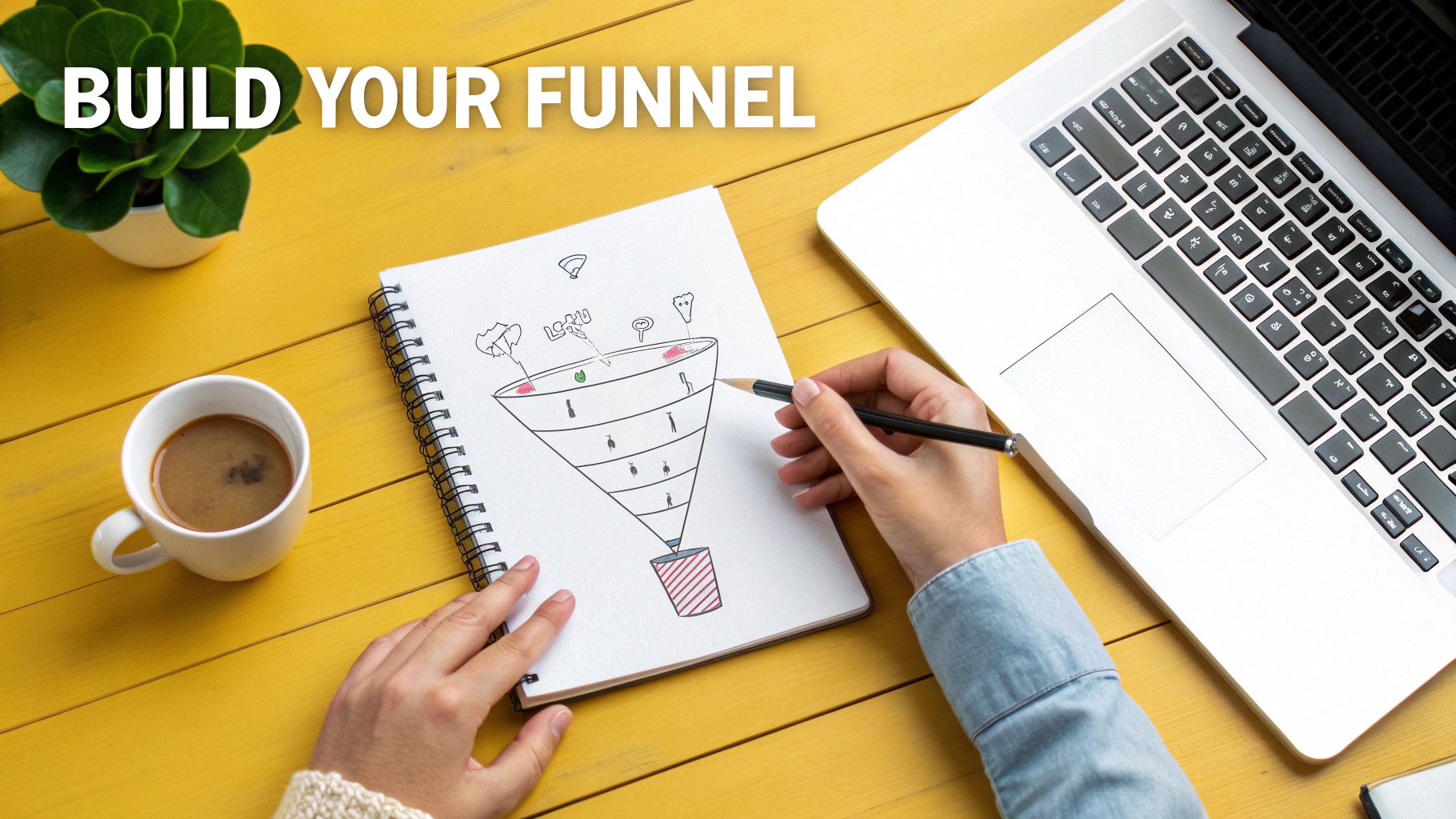
Moving from theory to practice can feel overwhelming, but constructing a sales funnel follows a clear pattern. It all begins with one simple rule: know your customer. Without that insight, every other step feels like guesswork.
This guide breaks the process into five essential stages. Picture it as fitting together the parts of a machine, where each element nudges a potential client closer to a sale.
Step 1: Define Your Ideal Customer Persona
Every funnel starts with a buyer persona. This isn't a rough stereotype; it’s a detailed sketch of the person most likely to buy your product or service. Think of it as the guiding star for every decision you make.
Ask yourself:
- Demographics: What is their age, location and job role?
- Challenges: Which problems keep them awake at night?
- Goals: What do they want to achieve professionally or personally?
- Information Sources: Which blogs, forums or social channels do they trust?
A well-defined persona acts as your North Star, guiding your content, ads and offers with laser focus.
Step 2: Create A High-Converting Landing Page
With your persona in place, build the landing page that welcomes them into your funnel. This page has a single aim: turn visitors into leads.
Focus on these critical elements:
- Compelling Headline: Speak to your persona’s main pain point instantly.
- Persuasive Copy: Highlight benefits, not just features.
- Simple Form: Only request a name and email to maximise conversions.
- Clear Call-To-Action: Use action-oriented language like “Download Your Guide Now.”
Step 3: Craft An Irresistible Lead Magnet
Your lead magnet is the incentive that convinces strangers to hand over their email. It must deliver immediate value and feel almost too good to pass up.
A great lead magnet doesn’t just attract contacts; it filters out unqualified prospects by focusing on a very specific need.
Choose from formats such as:
- Checklists
- Short eBooks
- Video tutorials
- Templates
The format is secondary to the perceived value.
Step 4: Set Up An Automated Email Nurture Sequence
Once someone opts in, the real work begins. An automated email sequence builds rapport, shares helpful tips and eases leads towards your main offer.
A simple, effective sequence might look like this:
- Email 1 (Immediate): Deliver the lead magnet and welcome them.
- Email 2 (2 Days Later): Offer another actionable tip related to the lead magnet.
- Email 3 (4 Days Later): Share a case study or testimonial.
- Email 4 (6 Days Later): Introduce your core product or service.
Each message adds value before any sales pitch. For a smoother setup, explore the best marketing funnel builder tools.
Step 5: Present A Compelling Core Offer
Now it’s time for the main event: your core offer. By this stage, leads understand their problem and trust your expertise. Your offer page must showcase the transformation they’ll experience.
Key components include:
- Benefits-focused copy that explains how life or business improves.
- Strong social proof like testimonials and data-driven results.
- A clear, urgent call-to-action to drive the purchase.
This is the moment every piece of your funnel works together to convert interest into revenue.
Measuring What Matters in Your Funnel
A sales funnel without data is really just a bunch of educated guesses. If you want to build a reliable engine for growth, you have to measure what’s happening at every single stage. Tracking the right metrics is how you spot what's working, what's falling flat, and exactly where your potential customers are dropping off.
It’s all about moving past the ‘vanity metrics’ that look good on paper and digging into the key performance indicators (KPIs) that actually affect your bottom line. These numbers empower you to make smart decisions, patch up the leaks, and get better results.
To truly understand what's going on inside your funnel, you need to track specific metrics at each stage. Think of it as a health check-up for your entire sales process. Here’s a breakdown of the essential KPIs to watch.
Essential Metrics for Each Funnel Stage
| Funnel Stage | Primary KPI | What It Tells You |
|---|---|---|
| Top of Funnel (TOFU) | Website Traffic/Reach | "How many people are we reaching?" This shows the size of your audience and brand visibility. |
| Middle of Funnel (MOFU) | Lead Conversion Rate | "How many visitors are becoming leads?" This measures the effectiveness of your content and offers. |
| Bottom of Funnel (BOFU) | Sales Conversion Rate | "How many leads are becoming customers?" This is the ultimate measure of your funnel's success. |
Each of these metrics tells a different part of the story, helping you pinpoint exactly where to focus your optimisation efforts for the biggest impact. Let's look at each stage in a bit more detail.
Top-of-Funnel Metrics: Awareness
Right at the top of the funnel (TOFU), your main job is to cast a wide net and attract a broad audience. The big question here is, "How many people are we actually reaching?" This is all about measuring the sheer volume of people who are discovering your brand for the first time.
The most important TOFU metrics include:
- Website Traffic: The total number of visitors hitting your website or blog. Keep a close eye on unique visitors to gauge the true size of your audience.
- Social Media Reach: This tells you how many unique users saw your content on platforms like Instagram, LinkedIn, or Facebook.
- Impressions: This is simply the number of times your content, whether it’s an ad or a post, was shown to someone.
These figures give you a solid baseline for your brand's visibility. If your traffic suddenly nosedives, for example, it might signal an issue with your SEO or social media strategy, telling you it’s time to dig deeper.
Middle-of-Funnel Metrics: Engagement
Once you’ve got their attention, it’s time for the middle of the funnel (MOFU). Your focus shifts from broad awareness to genuine interest. The question now becomes, "How many people are engaging with us and becoming leads?" This is where you separate the casual browsers from the real prospects.
Key MOFU metrics to track are:
- Lead Magnet Downloads: How many people are actually downloading your checklists, ebooks, or whitepapers? This is a direct indicator of how valuable your offers are.
- Click-Through Rate (CTR): This measures the percentage of people who click a link in an email, social post, or ad. A consistently low CTR is a huge red flag that your messaging isn't hitting the mark.
- Landing Page Conversion Rate: Of all the people who visit your landing page, what percentage actually fill out the form? This KPI is a direct measure of that page's performance.
For instance, you might see a high number of downloads but a poor email CTR. That’s a classic sign that your lead magnet is great, but your follow-up sequence is failing to keep those new leads hooked.
Bottom-of-Funnel Metrics: Conversion
Finally, we get to the bottom of the funnel (BOFU), where the goal is crystal clear: turn those engaged leads into paying customers. The most important question you can ask is, "How many of our leads are we actually converting into sales?" This is where the rubber meets the road.
Crucial BOFU metrics include:
- Sales Conversion Rate: The percentage of leads that make a purchase. This is the ultimate acid test for your entire funnel.
- Customer Lifetime Value (CLV): This is a forecast of the total revenue you can expect from a single customer over their entire relationship with you. A high CLV shows you’re attracting and keeping the right kind of customers.
- Customer Acquisition Cost (CAC): How much do you have to spend on marketing and sales to win one new customer? You always want your CLV to be significantly higher than your CAC.
Understanding your conversion rate is non-negotiable. It’s the clearest signal of your funnel's health and tells you precisely how well you’re turning interest into income.
For a bit of context, in the UK e-commerce market, the average conversion rate sits around 2.9%. Email marketing tends to convert at 2.6%, and organic search at 2.7%. Comparing your numbers against these benchmarks can reveal a lot about your performance.
To keep pushing your numbers up, you’ll want to get familiar with the principles of Conversion Rate Optimization (CRO). It’s a continuous process, but it’s the key to making your funnel more effective over time.
Got Questions About Sales Funnels? Let's Clear Things Up.
As you start sketching out your customer's journey, you’re bound to have questions. It’s one thing to understand the theory, but putting it into practice is where the real head-scratchers pop up. This section tackles the most common queries we hear about sales funnels, giving you straight, simple answers so you can move forward with confidence.
Think of this as your go-to guide for those nagging uncertainties. We'll demystify confusing jargon, help you set realistic expectations, and point you to the right tools to get started.
Sales Funnel vs. Marketing Funnel: What’s the Real Difference?
This is easily the most common question, and it's a good one. The terms are thrown around so often you'd think they mean the same thing. While they're two sides of the same coin, they actually look at the customer journey from different angles.
- A marketing funnel is all about getting attention and generating leads. Its job is to cast a wide net at the top (TOFU) and draw potential customers in, turning strangers into genuinely interested prospects (MOFU).
- A sales funnel takes the baton from there. It’s laser-focused on turning those interested leads into paying customers, zeroing in on the MOFU and BOFU stages where people make the final decision to buy.
To put it simply, the marketing funnel’s job is lead generation. The sales funnel’s job is revenue generation. They're two halves of the same process that guides someone from "who are you?" to "take my money!".
How Long Until I Actually See Results?
Ah, the classic "how long is a piece of string?" question. The truth is, how quickly you see results from a new sales funnel depends on a whole host of factors.
For a straightforward e-commerce funnel selling a low-cost item, you could see your first sales within days or even hours of switching on your ads. But for a complex B2B funnel selling a high-value service, it could take several months to guide a lead from that first handshake to a signed contract.
A few key things that influence the timeline are:
- Your sales cycle length: An impulse buy is quick. A major business investment is not.
- Your industry: In a crowded market, it can take longer to cut through the noise.
- Your budget: A bigger ad spend means you can test, learn, and optimise much faster.
The most important thing is to start collecting data right away. Even if the sales don't pour in overnight, you’re still learning what your audience responds to, which is pure gold for refining your strategy.
What Are the Best Tools to Start With on a Tight Budget?
You absolutely do not need a massive software budget to build a killer sales funnel. There are plenty of brilliant tools out there with free or low-cost plans that are perfect for startups and small businesses finding their feet.
Here are the three essential, budget-friendly categories you should look at first:
- Landing Page Builders: Tools like MailerLite or Carrd let you create clean, effective landing pages in minutes, no coding required.
- Email Marketing Platforms: Services like AWeber or ConvertKit have free plans for beginners, so you can build automated email sequences to nurture leads without spending a penny.
- Analytics and Tracking: Google Analytics is completely free and gives you a phenomenal amount of insight into who’s visiting your site and what they’re doing. It’s essential for spotting where your funnel is leaking.
Starting with these foundational tools gives you everything you need to build, automate, and measure your first sales funnel without breaking the bank.
Building and optimising your funnel is a journey, not a destination. At The Digital Marketing Toolbox, we’ve hand-picked the best resources to help you at every single stage, from attracting new visitors to keeping your customers happy. Explore our platform to find the perfect tools to fuel your growth. Learn more about our curated tools.


