
Ever wondered what those visual ads are that pop up on websites and apps you visit every day? That's display advertising in a nutshell.
Think of it as the online version of a billboard or a glossy magazine ad. It's all about using eye-catching visuals—like banners, images, and videos—to grab your attention and introduce you to a brand.
Getting to Grips with Display Advertising
Picture yourself scrolling through your favourite news site or playing a game on your phone. Those ads you see tucked into the sidebars, at the top of the page, or even between paragraphs? Those are display ads.
Unlike search ads, which only show up when you're actively looking for something, display ads come to you. They're a "push" form of marketing, designed to put a brand in front of people who might be interested but aren't necessarily searching for it at that exact moment.
The goal is to plant a seed. By placing visually appealing ads on sites your ideal customers already frequent, you build familiarity and create interest long before they even think about making a purchase. It's a fundamental part of a well-rounded strategy, as we cover in our beginner's guide to digital marketing.
The numbers prove its value. In the UK alone, spending on online display advertising recently jumped by 11%, climbing from £11.6 billion to a massive £13 billion. This shows just how much businesses rely on these visual ads to reach their audiences online.
What Really Sets Display Ads Apart?
So, what makes a display ad different from, say, a text ad on Google? It boils down to a few core characteristics that work together to build brand recognition and encourage action.
To give you a quick snapshot, here's a simple breakdown of what display advertising is all about.
Display Advertising at a Glance
| Component | Brief Explanation | Primary Goal |
|---|---|---|
| Visual Format | Uses images, videos, and animations, not just plain text. | Capture attention and make a memorable impression. |
| Placement | Appears on third-party websites, apps, and social media platforms. | Be present where potential customers spend their time. |
| Targeting | Reaches users based on demographics, interests, and browsing history. | Find relevant audiences who aren't actively searching. |
| Strategy | A proactive "push" approach, showing ads to potential customers. | Build brand awareness and create future demand. |
As you can see, the focus is squarely on being seen in the right places by the right people, even before they know they need you.
Key Characteristics of Display Ads
- A Visual-First Medium: They lean heavily on images, videos, and graphics to tell a story and catch the eye.
- Proactive, Not Reactive: Instead of waiting for a search query, display ads target people based on their online behaviour and interests.
- Masters of Brand Awareness: While they can certainly drive conversions, their greatest strength lies in getting your name and message out to a broad yet relevant audience.
Display advertising isn’t about answering a direct question; it’s about starting a conversation. It’s the art of showing up where your audience hangs out online, building that all-important familiarity and trust, one impression at a time.
Exploring the Main Display Ad Formats
Display advertising isn't a one-size-fits-all game. It’s more like a creative toolbox, packed with different ad formats, each with its own unique job to do. Getting to grips with these options is the first step toward building a campaign that actually grabs attention and hits your targets.
Think of it like this: you wouldn't use a sledgehammer to hang a picture frame. In the same way, you don't want to use a simple banner ad when what you really need is to get people properly engaged with your brand. The right format always comes down to what you’re trying to achieve.
For any UK business, matching the ad format to your campaign goal is absolutely essential if you want to see a decent return on your ad spend. So, let’s unpack the main types you'll come across.
The Classic Banner Ad
Banner ads are the old guard of digital advertising, the original billboards of the internet. You’ve seen them a thousand times—they're the static or animated images that sit at the top, bottom, or sides of a webpage. Their greatest strength is their simplicity and the fact they’re supported everywhere, especially across huge platforms like the Google Display Network.
Their main job? To get your brand seen and remembered. By putting your logo and a straightforward message in front of people over and over, they help keep your business at the front of their minds. They’re a solid choice for campaigns where the aim is pure visibility, not complex interaction.
The Storytelling Video Ad
If banner ads are billboards, then video ads are the storytellers. These are the short clips you see before, during (mid-roll), or after the YouTube video you wanted to watch, or as standalone ads on websites and in apps. Nothing beats video for conveying emotion or showing a product in action.
You’ll want to reach for video when your goal is to build a real connection or when you need to explain something that a static image just can’t do justice. They’re brilliant for engagement, holding a viewer's attention for much longer than a simple banner ever could.
Key Insight: While banner ads are fantastic for brand recall, video ads are what you need for deeper engagement. They give you the space to tell a proper story, show off your brand’s personality, and leave a lasting impression.
The Chameleon Native Ad
Ever been reading an article online and come across a piece that looks and feels just like the site's own content, but with a small "Sponsored" or "Promoted" tag? That's a native ad. These ads are specifically designed to match the form and function of the platform they appear on.
They are the chameleons of the ad world, blending seamlessly into the user’s experience so they feel less intrusive. Their secret weapon is their ability to sidestep ‘banner blindness’—that subconscious habit we all have of ignoring anything that remotely looks like a traditional ad.
- Goal: To drive interest and engagement without disrupting what the user is doing.
- Best For: Promoting valuable content, like a new blog post or an in-depth guide, to an audience already looking for that kind of information.
The Interactive Rich Media Ad
Rich media ads are where things get really interesting. These are the interactive powerhouses that go way beyond a static image or a video you just watch. They actively invite people to get involved—maybe by playing a quick game, swiping through a product gallery, or even filling out a form, all without leaving the ad itself.
These ads are built for one thing: action. Because they require someone to physically interact with them, they tend to have much higher engagement rates and provide a goldmine of data on how people are responding. They're perfect for campaigns that need to drive instant conversions or capture user details, offering a memorable experience that really makes you stand out from the crowd.
How Display Ads Actually Reach Your Audience
Ever looked at a pair of shoes online, only to have ads for those exact shoes follow you across the internet for days? It's not magic. It’s a sophisticated system working behind the scenes to get the right ads in front of the right people, at precisely the right moment.
At its heart, delivering an ad is about connecting advertisers who want to show their ads with publishers (websites and apps) who have space to sell. This used to be a painstakingly manual process, but today it’s powered by a few key technologies that make it fast, efficient, and incredibly targeted.
The Marketplace: Ad Networks
Think of an Ad Network as a massive digital marketplace. The biggest player, of course, is the Google Display Network, which connects advertisers to millions of websites, apps, and videos. An advertiser simply tells the network who they want to reach, and the network finds available ad space on publisher sites that fit the bill.
These networks are the essential middleman, simplifying the whole buying and selling dance for everyone involved. Imagine the chaos if an advertiser had to negotiate with every single website individually. It would be impossible to do at any sort of scale.
This is especially true in the UK, where digital formats like display advertising now completely dominate ad spend. In fact, total digital ad expenditure in the UK recently hit a staggering £23.5 billion. This number really highlights the massive shift to digital-first strategies, where these networks are absolutely critical.
The Automated Engine: Programmatic Advertising
If ad networks are the marketplace, then Programmatic Advertising is the automated engine that runs it. This is technology that uses software to buy and sell digital ad space in real-time, completely cutting out the need for human negotiation. The most common method here is Real-Time Bidding (RTB), which is basically a lightning-fast auction.
Here’s a quick breakdown of how it works:
- You visit a website that has ad space.
- The moment the page starts to load, an auction signal is sent to an ad exchange.
- Advertisers instantly bid against each other to show their ad to you.
- The highest bidder wins, and their ad pops up on your screen.
This entire process happens in the milliseconds it takes for the webpage to appear. It's what allows for hyper-targeted advertising, making sure the person seeing the ad is a great match for the advertiser.
Programmatic advertising isn't just about speed; it's about intelligence. It uses data to make split-second decisions, ensuring that an advertiser’s budget is spent showing ads to the most valuable audiences.
The Advertiser's Control Panel: DSPs
So, how does an advertiser actually manage all of this? That's where a Demand-Side Platform (DSP) comes in. A DSP is the advertiser’s command centre—it's a piece of software that lets them buy ad space across multiple ad networks and exchanges all from one central interface.
It’s where they set their budget, define who they want to target, and upload their ad creatives. For a deeper dive into advanced campaign deployment, you can find great insights on using AI to launch ads.
Together, ad networks, programmatic bidding, and DSPs form the technological backbone of modern display advertising. They create the precision and scale that make it such a powerful tool for businesses today.
Finding the Right People with Smart Targeting
Great advertising isn't just about reaching a massive audience; it's about reaching the right one. The real magic of display advertising is its ability to zero in on specific groups of people with incredible accuracy. This ensures your message connects with those most likely to be interested, which means less wasted budget and a much bigger impact.
Think of it this way: instead of shouting your message from a rooftop to anyone who will listen, smart targeting is more like striking up a quiet, relevant conversation with someone who's already keen on what you're offering. There are a few different ways to do this, and they all have their own strengths.
This process shows how an advertiser can tap into an ad network to get their content onto the most relevant websites.
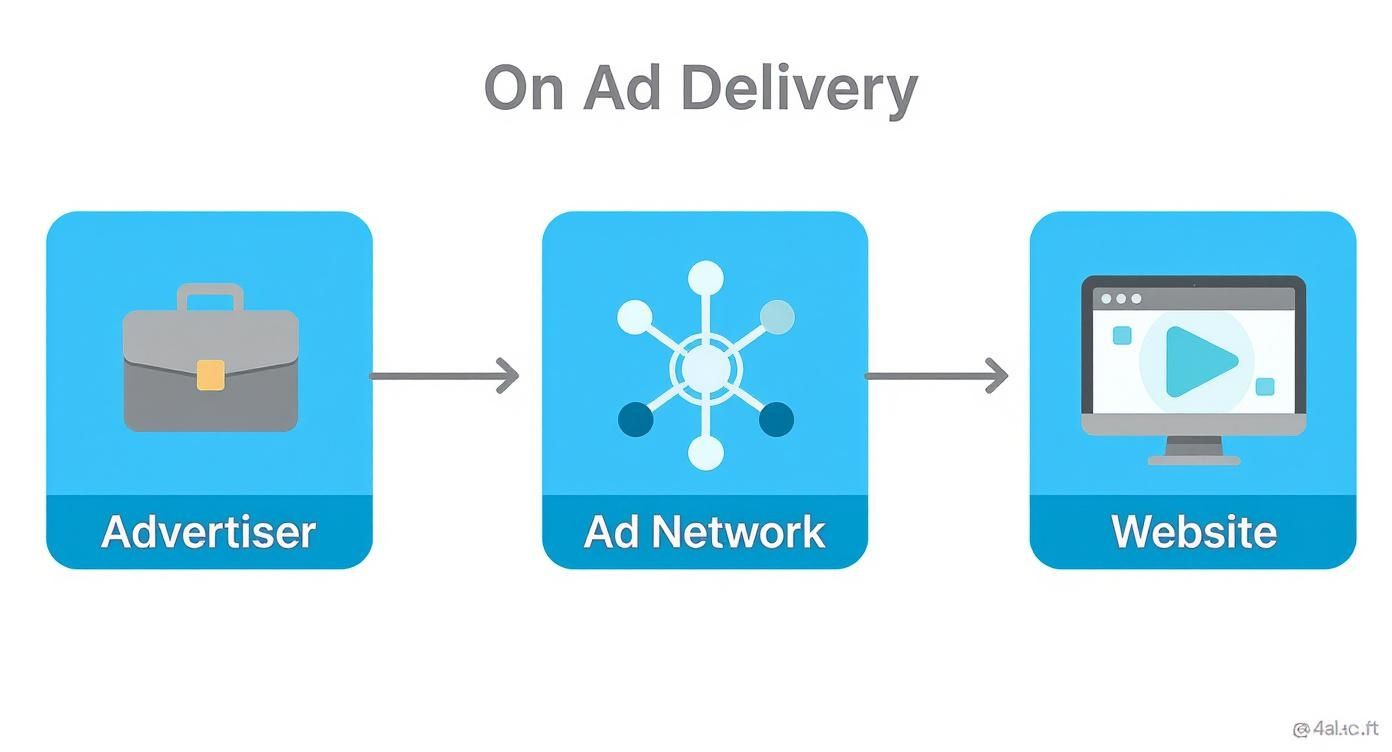
This simple flow is essentially how your ads find their way in front of potential customers across the internet.
Core Targeting Strategies
The most common targeting methods work best when you blend them together into a single, smart approach. Getting these right is a cornerstone of any solid marketing strategy for small business.
-
Contextual Targeting: This is probably the most straightforward method. It’s all about placing your ads on websites where the content is a natural fit for your product. For instance, if you sell hiking boots, you'd want your ads to appear on blogs about outdoor adventures or mountain climbing. It’s a common-sense approach that just works. To dig a little deeper, you can learn more about contextual targeting.
-
Demographic Targeting: Here, you’re narrowing your audience based on key characteristics like age, gender, location, or even income level. A brand selling luxury watches, for example, could choose to show ads only to high-income earners in specific postcodes.
-
Behavioural Targeting: This is where things get really clever. This strategy uses data about what someone has done online in the past—pages they’ve visited, articles they’ve read—to show them relevant ads. If a user has been looking up budget holiday deals, it's a safe bet they'll be receptive to an ad for travel insurance.
Key Takeaway: The whole point of these targeting methods is to stop guessing. By using real data to understand who your audience is and what they care about, you can deliver ads that actually feel helpful instead of annoying.
The Power of the Second Chance with Retargeting
Of all the targeting strategies, retargeting (sometimes called remarketing) might just be the most powerful. It’s basically a friendly digital nudge.
Retargeting is designed to reach people who have already visited your website but left without doing what you wanted them to, like making a purchase. Picture a customer who picks up an item in your shop, thinks about it, and puts it back down. Retargeting is like having a helpful assistant gently remind them about it a few days later.
By showing these potential customers your ads as they browse other sites, you stay fresh in their minds and give them an easy way to come back and finish what they started.
Measuring Success with the Right Ad Metrics
So, you’ve launched your display ads. How do you actually know if they're working? It's one thing to get your ads out there, but proving their value means tracking the right numbers. This isn't about getting lost in jargon; it's about understanding your return on investment and making smarter decisions with your budget.

We start at the top of the marketing funnel with metrics that show us who is seeing our ads. From there, we can follow the trail to see if that initial attention is sparking real business results, like sales or new leads.
Top-of-Funnel Awareness Metrics
Think of these as the first handshake in your customer's journey. They don't track sales directly, but they tell you if your message is even reaching the people you want it to.
-
Impressions: This is simply how many times your ad has been displayed on a screen. One view equals one impression. It’s the foundational number for figuring out the sheer reach of your campaign.
-
Click-Through Rate (CTR): This is the percentage of people who not only saw your ad but were interested enough to actually click it. A healthy CTR is a great sign that your ad creative and targeting are hitting the mark with your audience.
These initial numbers give you a quick health check on your campaign’s visibility. And it’s a big deal—the UK advertising market reached a total spend of £10.6 billion in a recent quarter, with online display advertising growing by 10.1% year-on-year. You can explore the full report on UK ad spend to see the full picture.
Business-Focused Performance Metrics
Getting seen is important, but what really matters is whether those clicks are turning into something valuable for your business. This is where performance metrics come into play.
The ultimate goal of most display advertising is to drive a specific outcome. Connecting your ad metrics directly to your business goals is the only way to prove your campaign’s worth and justify your ad spend.
These key performance indicators (KPIs) show the direct impact your ads have on your bottom line:
-
Conversions: This is the big one. A conversion is the specific, valuable action you want someone to take after clicking your ad. It could be making a purchase, filling out a contact form, or signing up for your newsletter. And given the advantages of email marketing, that newsletter sign-up is a pretty powerful conversion.
-
Cost Per Acquisition (CPA): Sometimes called Cost Per Action, this metric tells you exactly how much it costs, on average, to get one conversion. You calculate CPA by dividing your Total Ad Spend by your Total Conversions. This simple sum is crucial for understanding whether your campaigns are actually profitable.
Common Campaign Pitfalls and How to Avoid Them
It's one thing to know all the right moves, but in display advertising, knowing what not to do is just as critical. Even the best-funded campaigns can burn through cash and achieve very little if they fall into a few all-too-common traps.
Think of this as your pre-launch checklist. A quick run-through to make sure you're not about to stumble at the first hurdle. We'll cover the most frequent mistakes I see and, more importantly, how to sidestep them from day one.
The absolute classic is banner blindness. We’ve all done it. Our brains have become so good at filtering out the noise online that we automatically ignore anything that even remotely looks like a standard banner ad. If your ad is generic, bland, or just fades into the webpage, it's effectively invisible.
The fix isn't to be louder, but smarter. Your creative has to be visually arresting. Think bold colours, striking imagery, and a message so clear and relevant to your audience that it cuts right through the clutter.
Overlooking Key Technical Settings
Beyond the creative, some simple technical oversights can completely derail your efforts. These aren't fancy, high-level strategies; they're the foundational settings that prevent wasted spend and stop you from annoying potential customers.
-
Forgetting Mobile Optimisation: It’s a simple fact: a huge chunk of your audience will see your ads on a phone. If your banner looks squashed, distorted, or has unreadable text on a small screen, it doesn't just fail—it makes your brand look sloppy. Solution: Always, always create and test ad variations designed specifically for mobile.
-
Ignoring Frequency Capping: Ever felt like you're being stalked across the internet by the same pair of shoes? That's what happens when a campaign has no frequency cap. It’s the fastest way to turn interest into irritation. Solution: Be sensible and set a limit. Decide how many times it's reasonable for one person to see your ad in a day or week, and stick to it.
-
Using Overly Broad Targeting: Trying to appeal to everyone is a sure-fire way to connect with no one. Casting the net too wide means your budget gets spread thin, paying for impressions and clicks from people who will never become customers. Solution: Get specific. Layer your targeting by combining demographics with interests, behaviours, and retargeting lists to zero in on your ideal customer profile.
By getting ahead of these issues, you change the game from just spending money to making a genuine investment. A great campaign isn't just about launching ads; it's about launching them with enough foresight to avoid the obvious failures and give yourself the best possible chance of success.
Frequently Asked Questions
Even when you've got the basics down, a few practical questions always pop up. Let's tackle some of the most common ones we hear to clear up any lingering confusion.
Is Display Advertising the Same as Search Advertising?
Not at all. They’re two completely different beasts and play very different roles in your marketing. It’s best to think of them as “push” versus “pull” marketing.
-
Display advertising is a ‘push’ strategy. You’re proactively showing your ads to people as they’re browsing other websites, watching videos, or using apps. The goal is to get on their radar, build brand awareness, and create demand for the future. You’re reaching people who aren't actively looking for you right now, but who fit the profile of a potential customer.
-
Search advertising is a ‘pull’ strategy. This is where you show ads to people who are actively typing related keywords into a search engine like Google. You're capturing existing demand—connecting with someone who has a problem and is looking for a solution at that very moment.
They work brilliantly together. Display ads build that initial recognition, so when someone eventually does search for what you offer, your brand is already a familiar face in the crowd.
Display advertising plants the seed of an idea, while search advertising harvests the interest once it has grown. One builds the audience, the other converts it.
How Much Does Display Advertising Cost in the UK?
This is a classic "how long is a piece of string?" question. The cost of display advertising isn't fixed; it can swing wildly depending on a few key factors.
The price is shaped by your industry, the precision of your audience targeting, and the platform you use. Most campaigns are priced on a Cost Per Mille (CPM) model, meaning you pay a set fee for every one thousand times your ad is shown. In the UK, CPM rates can be anything from under £1 to over £10.
If you're in a competitive B2B sector or trying to reach a very specific, high-value audience, expect to pay more. The smartest way to start is with a modest, controlled budget. See what works, measure everything, and then reinvest in the campaigns that deliver the goods.
Can Small Businesses Benefit from Display Advertising?
Absolutely. The idea that display ads are just for big-name brands with bottomless budgets is a thing of the past. Platforms like the Google Display Network have opened the doors for businesses of any size.
For a small business, display ads can be a powerful tool for achieving specific goals, such as:
- Building local brand awareness: Get your name in front of people in your town or even within specific postcodes.
- Reaching niche audiences: Target potential customers based on their unique interests and online behaviour.
- Retargeting website visitors: Remind people who have already visited your site about what you offer, encouraging them to come back and make a purchase.
Success for a small business isn't about outspending the competition. It’s about having a crystal-clear goal and knowing exactly who you want to talk to.
Finding the right platforms to manage your campaigns is the next step. At The Digital Marketing Toolbox, we’ve gathered the best solutions for analytics, ad creation, and optimisation all in one place. Discover tools to help you succeed.


