
Ever heard the old marketing saying, "Half my advertising spend is wasted; the trouble is I don't know which half"? Performance marketing is the answer to that age-old problem. It’s an advertising model where you pay only when a specific action happens—like a click, a lead, or a sale.
You're not just renting ad space and hoping for the best; you're paying for real, tangible results.
What is Performance Marketing, Really?

Think of it this way: imagine you put up a massive billboard on a busy street. With traditional advertising, you pay a flat fee for that space, whether it brings in one customer or a thousand.
With performance marketing, it's as if you only paid the billboard company each time someone saw the ad, walked into your shop, and actually bought something. It completely flips the script, shifting the risk from you (the advertiser) to the publisher running your ad. Accountability is everything.
This is a world away from traditional brand marketing, which often chases fuzzier goals like "brand awareness" or "sentiment." Performance marketing is all about the numbers and is ruthlessly focused on Return on Investment (ROI). Every single pound is tracked, measured, and optimised to hit a specific goal.
It’s this data-first mindset that makes it such a powerful strategy for businesses needing to prove their marketing spend is delivering concrete value. You can dig deeper into these core ideas in our beginner's guide to digital marketing.
The Key Players in the Ecosystem
So, who's involved in making this all happen? It’s a bit like a theatre production, with a few key roles working together to put on a great show.
- The Advertiser (or The Brand): This is you—the business promoting a product or service. You're the one setting the goals, defining what "action" you'll pay for, and creating the ads.
- The Publisher (or The Partner): This is anyone who promotes your product. It could be an affiliate blogger, a major news website, a social media influencer, or a search engine. They own the "stage" where your ad appears.
- The Network/Platform (The Stage Manager): These are the intermediaries that connect advertisers and publishers. They handle the technical heavy lifting—like tracking, payments, and reporting—to make sure everything runs smoothly for everyone.
This results-driven model ensures that advertisers aren't just paying for potential reach; they're investing directly in tangible outcomes that drive business growth. It’s about paying for action, not just attention.
This setup creates a win-win situation. Publishers are motivated to send high-quality traffic that actually converts, because that’s how they get paid. And advertisers only pay for the outcomes that directly impact their bottom line.
If you're just starting out, getting a handle on Pay-Per-Click (PPC) is a great first step, as it's a cornerstone of this world. This guide on PPC for beginners is an excellent place to build that foundational knowledge.
The Core Channels Driving Performance
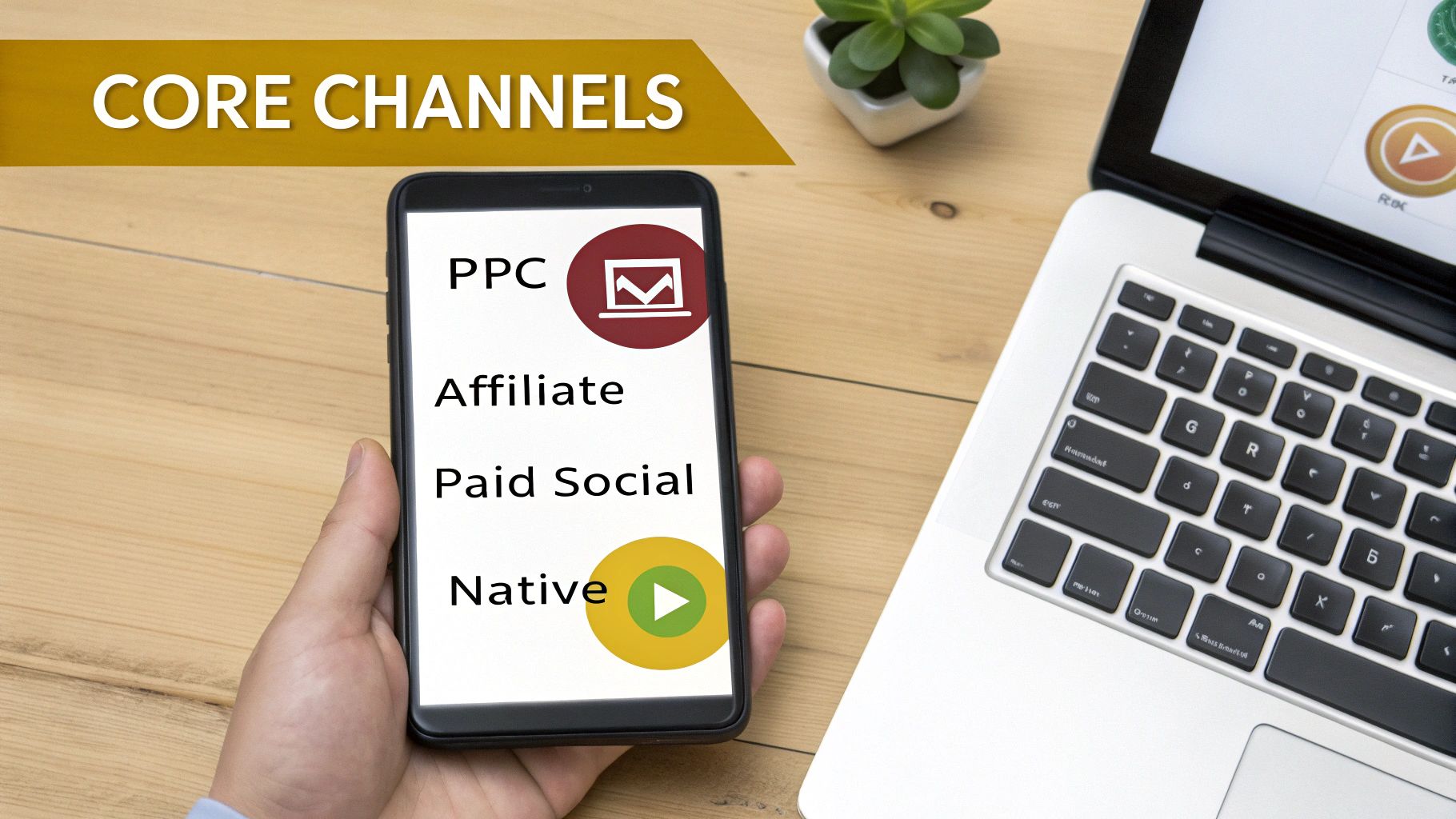
Performance marketing isn’t some monolithic thing; it’s a mindset you apply across different digital channels. Each channel gives you a unique way to reach people, but they all share one crucial characteristic: you only pay for a measurable result. Getting your head around these core channels is the first real step to building a campaign that actually works.
Think of it like a toolbox. You wouldn't use a sledgehammer to hang a picture frame, would you? In the same way, a savvy marketer picks the right channel for the job, depending on who they're trying to reach, what they want to achieve, and how much they have to spend.
Let's break down the most powerful tools in the performance marketing toolbox.
Pay-Per-Click (PPC) Advertising
PPC is probably the most direct form of performance marketing you'll come across. It’s all about placing ads on search engines like Google and Bing, and you bid to show up when someone searches for a specific keyword. The best part? You only pay when someone actually clicks on your ad.
This is so effective because it taps into high-intent customers—people who are actively looking for what you sell. If someone types "emergency plumber near me," they're not just browsing; they have a burst pipe and a problem that needs solving now. Your ad showing up at that exact moment is an incredibly powerful way to win their business.
Affiliate Marketing
Affiliate marketing is basically a commission-based sales force. You team up with partners—bloggers, influencers, or review sites—who promote your products to their own audience using a unique tracking link.
When a sale, lead, or even a click comes through their link, you pay them a pre-agreed commission. It’s a beautifully low-risk, high-reward model. You're building a network of promoters who only get paid when they deliver, tapping into the trust they’ve already built with their followers.
Paid Social Media Advertising
With billions of us scrolling through Facebook, Instagram, TikTok, and LinkedIn every single day, paid social has become a heavyweight in the performance marketing world. These platforms offer unbelievably granular targeting, letting you reach people based on their age, interests, online behaviours, and even previous interactions with your website.
You can run campaigns fine-tuned for specific outcomes, such as:
- Website Clicks: Getting people onto a landing page.
- Lead Generation: Gathering contact details with simple, on-platform forms.
- Conversions: Pushing for that all-important final purchase.
This laser-focused ability to find your ideal customer and pay only for the action you want makes paid social absolutely essential for growth.
Native Advertising
Ever been reading an article on a news site and come across a piece labelled "Sponsored Content"? That's a native ad. They’re designed to look and feel like part of the website's regular content, making them far less jarring than a flashing banner ad.
Because they don't scream "I'm an advert!", native ads cleverly sidestep our natural "ad blindness." By blending in, they capture attention in a more organic way, often leading to better engagement because the user feels like they're discovering something useful or interesting.
The core principle connecting all these channels is accountability. Each one allows you to track spending directly to outcomes, ensuring you know exactly which parts of your marketing strategy are working and which need adjustment.
This shift towards measurable results is huge. In the UK, digital advertising—the engine behind performance marketing—accounted for £35.54 billion of total ad spend in 2024. Digging deeper, 67% of UK B2B marketers say PPC is critical for generating leads, while 68% of B2C marketers are using influencer marketing to drive sales. The trend is crystal clear: if you can't measure it, it's not worth doing.
Email Marketing as a Performance Channel
We often think of email marketing as a nurturing tool, but it can be a straight-up performance powerhouse when done right. By segmenting your email list and sending targeted offers, you can drive direct sales and track every single conversion.
Automation takes this even further, letting you send emails triggered by specific actions, like when a customer abandons their shopping basket. By keeping a close eye on open rates, click-throughs, and—most importantly—conversions, email becomes a fully accountable part of your strategy. To really get the most out of it, it's worth exploring the many advantages of email marketing for your specific business.
How Influencers Became a Serious Performance Channel
Not so long ago, influencer marketing was seen as a bit of a gamble. You’d pay a hefty flat fee for a single post and cross your fingers, hoping it would make a difference. Those days are over. Now, it's a powerful performance marketing channel, turning collaborations into genuine conversion engines with fully trackable, data-backed results.
The real game-changer here is accountability. Modern brands are equipping influencers with tools that directly connect their promotional work to actual sales. This means you can see exactly how much revenue each partnership generates, making it a strategy driven by real outcomes, not just vanity metrics.
This is what we mean by performance-based influencer marketing. It’s no longer about vague ideas like "reach" but about tangible actions that actually grow your bottom line.
Moving Beyond Impressions to Customer Acquisitions
The magic of this channel lies in its ability to blend authentic, trusted recommendations with direct-response marketing. When an influencer your target audience genuinely trusts recommends your product, it carries so much more weight than a standard ad.
We make this happen with a few key tactics:
- Unique Promo Codes: Giving an influencer a custom discount code (like "LAURA15") is one of the simplest and most effective ways to track every single purchase they drive.
- Trackable Affiliate Links: These are specialised URLs with tracking codes that credit the influencer for every click and subsequent sale, leaving no doubt about where the conversion came from.
- Performance-Based Payments: Many collaborations now work on models like Cost Per Acquisition (CPA). Instead of a fixed fee, the influencer earns a commission for each sale they generate.
This shift in approach means your marketing spend is directly tied to revenue. You're not just paying for a shout-out; you're investing in a customer acquisition channel with a clear and measurable return.
The market trends tell the same story. The UK's influencer marketing sector was valued at USD 2.36 billion in 2024, and it's set to grow as more brands demand tangible business outcomes. With around 69% of UK consumers making purchases based on influencer promotions, the channel's power to convert is undeniable. You can dig into more UK influencer marketing statistics at Goviralglobal.com.
Why Audience Alignment is Everything for ROI
For this to work, alignment is everything. The single most important factor is picking creators whose audience is a genuine match for your ideal customer. A fitness influencer promoting a new protein powder to their health-conscious followers just makes sense, and that natural fit is what drives conversions.
Get this wrong, and it can be a costly mistake. Imagine a tech influencer promoting a high-fashion brand. The campaign would almost certainly fall flat because the audience just isn't interested. The result? Poor performance and a wasted budget.
The goal is to find partners who aren't just popular, but who are authentic advocates for the kind of products you sell. That authenticity builds the trust needed to turn a follower into a paying customer, transforming influencer marketing from a speculative bet into a predictable, profitable part of your performance strategy.
Key Metrics That Measure Success
In performance marketing, there's no room for guesswork. You don't just hope your campaigns are working—you measure everything. Success isn't a vague feeling; it's defined by cold, hard data, and you need to speak its language to succeed.
Think of it this way: instead of paying a flat fee for a billboard and crossing your fingers, you're only paying for specific, pre-agreed actions. This sharp focus on tangible results is what makes performance marketing a completely different beast from traditional advertising. Let's break down the essential metrics that drive every campaign.
The Payment Models That Define Performance
At the heart of performance marketing are payment models that are also key performance indicators (KPIs). This creates a direct, unbreakable link between what you spend and what you get. Each model is tailored to a different business objective, whether you’re trying to get more eyes on your website, find potential customers, or directly drive sales.
Here’s a look at the most common models you’ll come across:
Comparing Performance Marketing Payment Models
To really get to grips with this, it's helpful to see the main payment models side-by-side. Each one aligns your costs with a different stage of the customer journey, from initial interest to the final sale. Choosing the right one depends entirely on what you're trying to achieve.
| Model | What You Pay For | Primary Goal | Best Used For |
|---|---|---|---|
| Cost Per Click (CPC) | Every single click on your ad | Driving traffic | Building brand awareness and sending users to a specific landing page or website. |
| Cost Per Lead (CPL) | A user's contact information | Lead generation | Capturing details from interested users (e.g., newsletter sign-ups, ebook downloads). |
| Cost Per Acquisition (CPA) | A completed sale or conversion | Sales/Conversions | Directly linking ad spend to revenue, especially for e-commerce and SaaS businesses. |
As you can see, the model you pick isn't just a financial decision; it's a strategic one. It forces you to be crystal clear about your campaign goals from the very beginning.
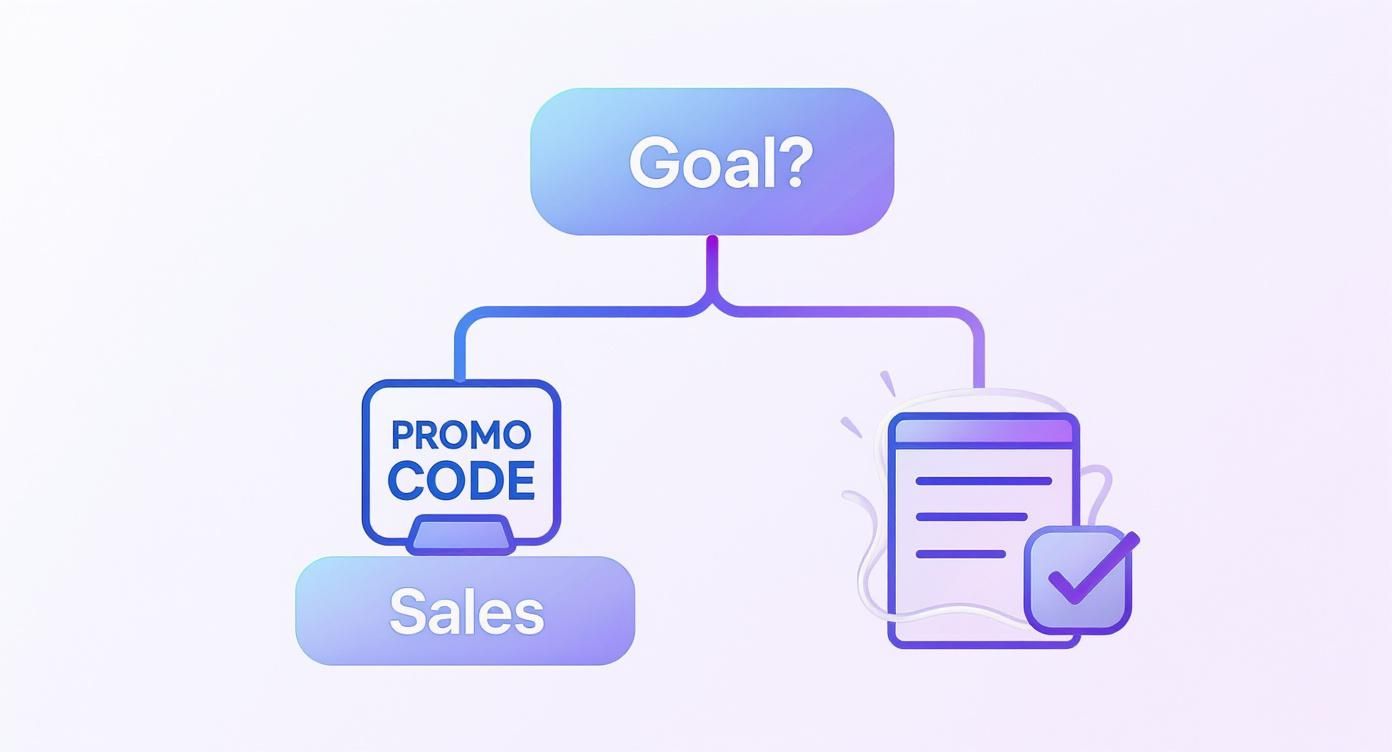
This simple diagram perfectly illustrates the point. If your goal is sales, a trackable promo code is your best friend. If it's lead generation, you need a form to capture user details. The strategy and the metric are two sides of the same coin.
Beyond the Click: Gauging Profitability and Long-Term Value
While models like CPC, CPL, and CPA are fantastic for measuring individual campaign actions, you need to zoom out to see the bigger picture. Two other metrics are absolutely vital for understanding the overall financial health of your marketing efforts.
First up is Return On Ad Spend (ROAS). This is your ultimate profitability gauge. It tells you exactly how much revenue you’re generating for every single pound you put into advertising. For example, a ROAS of 5:1 means you made £5 for every £1 spent—a clear indicator of a successful campaign.
Then there's Customer Lifetime Value (LTV). This metric isn't about a single purchase; it forecasts the total profit a single customer will bring to your business over their entire relationship with you. Knowing your LTV is crucial because it helps you decide how much you can reasonably afford to spend to acquire a new customer and still be profitable down the line.
By keeping one eye on ROAS for short-term campaign success and the other on LTV for long-term, sustainable growth, you can make much smarter decisions about where to allocate your budget for the biggest impact.
Of course, tracking all this across different channels gets complicated fast. To make sure you’re giving credit where it's due and not wasting a penny, mastering cross-channel marketing attribution is non-negotiable. It’s the only way to get a truly clear picture of what’s driving your results.
Getting Your First Performance Campaign Off the Ground

Knowing the theory is one thing, but actually putting it into practice is where the real learning begins. Kicking off your first performance marketing campaign can feel a bit overwhelming, but if you break it down into manageable steps, it’s much less intimidating. This is the moment you stop just reading about performance marketing and start making it work for you.
Think of it like building a piece of flat-pack furniture. If you just tip all the pieces out of the box and hope for the best, you’ll end up with a mess. Follow the instructions step-by-step, though, and you'll build something solid that does exactly what you need it to.
Setting Clear, Measurable Goals
Before a single penny of your budget is spent, you have to define what a "win" looks like. Vague goals like "get more customers" just won't cut it in this world. Performance marketing is all about precision.
Your goal needs to be specific and linked directly to a hard metric. Here are a couple of examples:
- Objective: Generate 50 qualified leads for the sales team in the next 30 days.
- Key Metric: Keep the Cost Per Lead (CPL) under £25.
- Objective: Hit a 4:1 Return On Ad Spend (ROAS) for our new e-commerce product line.
- Key Metric: Track the Cost Per Acquisition (CPA).
These specific targets become your North Star, guiding every decision you make—from who you target to how much you spend and what your ads look like. A clearly defined objective is the best defence against wasting money.
This level of detail is non-negotiable. The UK’s digital ad market pulled in around USD 39.7 billion in 2024 and is on track to hit USD 93 billion by 2030, showing just how much businesses are banking on data-driven results. In an arena that competitive, sharp objectives are what separate the winners from those who just burn through their budget. You can dig deeper into the UK's booming digital ad market over at GrandViewResearch.com.
Nailing Your Target Audience and Budget
Once your goal is set, you need to be crystal clear on who you're talking to. Go deeper than basic demographics like age and location. What keeps them up at night? Where do they hang out online? What sort of language do they use?
Building a detailed customer persona isn't just a box-ticking exercise; it helps you pick the right channels and write copy that actually lands with people. For smaller companies, this is a fundamental piece of any effective marketing strategy for small business.
Your budget should be realistic and flow directly from your goals. For instance, if your target CPA is £50 and you want 100 sales, you’ll need a starting budget of at least £5,000. It's always a good idea to start with a smaller test budget to see what works before you go all in.
Your campaign's success hinges on delivering the right message to the right person at the right time. A deep understanding of your audience is the key to making this happen.
Setting Up Tracking and Creating Your Ads
This is the technical core of any performance campaign. You have to install tracking mechanisms to measure the actions that matter to you. This usually means adding a small bit of code, often called a pixel or a tag, to your website.
- Pixels: Tools like the Meta Pixel or TikTok Pixel follow what users do on your website after seeing one of your ads, directly linking an ad view to a conversion.
- Google Analytics: This is your big-picture tool. It gives you a full view of your website traffic and user behaviour, helping you piece together the entire customer journey.
Without proper tracking, you're flying blind. It’s the engine that powers performance marketing, giving you the data you need to tweak and improve your campaigns.
Finally, it’s time to create your ad assets—the images, videos, and words your audience will actually see. Your creative needs to be eye-catching, communicate your value clearly, and feature a strong call-to-action (CTA) that tells people exactly what you want them to do next. And don't forget to tailor your creative for each platform; what works on Instagram won't necessarily fly on LinkedIn.
Where Accountable Marketing Is Headed Next
Throughout this guide, we've broken down performance marketing into its core parts. It’s a powerful discipline built on a simple, game-changing idea: paying for measurable actions, not just potential eyeballs. Looking forward, this principle of accountability isn't just a fleeting trend—it’s fast becoming the bedrock of all successful marketing.
The ground is always shifting beneath our feet, pushed along by new tech and evolving customer habits. To keep up, let alone get ahead, we have to lean into what's next. This means leaving behind basic click-tracking and embracing a much smarter, more complete view of what drives growth.
AI and Automation Are Taking the Wheel
Artificial intelligence isn't science fiction anymore; it's a very real tool that’s changing how we run campaigns. AI algorithms can now handle bidding strategies, test thousands of ad variations, and shift budgets on the fly with a level of precision that's simply beyond human capability.
This frees up marketers to step away from the tedious, tactical work. Instead, they can focus on the bigger picture—setting strategic goals, interpreting the results, and planning the next big move.
By focusing on measurable outcomes, any business can achieve sustainable growth and a transparent return on its marketing investment, paving the way for a more accountable future.
Smarter Attribution in a Privacy-First World
Think about your own path to making a purchase. It's rarely a straight line. As customer journeys get more complicated, zigzagging across different devices and platforms, old-school attribution models like "last-click" just don't cut it anymore. They're becoming obsolete.
The future is all about more sophisticated, multi-touch attribution that gives credit where it's due, valuing every single touchpoint—from the first blog post a customer reads to the final ad they click.
At the same time, the growing demand for data privacy is completely changing the tracking game. As we move towards a world without third-party cookies, businesses have to adapt. This means getting comfortable with privacy-friendly measurement tools and, most importantly, building trust by being open and honest about how they handle the customer data they collect directly.
These two forces—smarter, AI-driven optimisation and a genuine respect for user privacy—are pushing marketing towards a more effective and ethical future. By embracing these changes, businesses won't just survive; they'll thrive, building lasting growth on a solid foundation of transparent, accountable results.
Your Performance Marketing Questions, Answered
Diving into performance marketing often brings up a few practical questions. Moving from theory to action is a big step, and it’s normal to wonder about the real-world costs, which channels to pick, and what it all means for your brand. Let's clear up some of the most common queries.
How Much Does Performance Marketing Cost?
This is the big one, and the honest answer is: it really depends on your budget. Unlike traditional advertising—where you might be looking at a hefty upfront payment for a billboard or a magazine ad—performance marketing is incredibly flexible.
You could dip your toe in the water with a paid social or search campaign for as little as £5 a day. Because you’re paying for a specific outcome, you’re always in the driver’s seat. For instance, if you set your target Cost Per Acquisition (CPA) at £20, you know exactly what each sale will cost you. It makes budgeting far more predictable.
This scalability is precisely what makes performance marketing so appealing. It gives small businesses a fighting chance to compete, while also letting larger companies manage multi-million-pound budgets with pinpoint accuracy and total accountability.
Which Channel Is Best for My Business?
There’s no magic bullet here. The "best" channel comes down to your industry, who you're trying to reach, and what you want to achieve. That said, there are some solid starting points.
- Got a solution to an urgent problem? If people are actively searching for what you offer (think "emergency plumber" or "buy running shoes"), then Pay-Per-Click (PPC) on search engines is almost always your best bet.
- Selling something visual? For businesses in e-commerce, fashion, or food, visual platforms like Instagram and Pinterest are perfect. Paid Social lets you show off your products to very specific groups of people.
- Need to build trust in a niche market? When credibility is key, Affiliate and Influencer Marketing can be a game-changer. You're tapping into the trust that publishers and creators have already built with their audience.
The real secret is figuring out where your ideal customers hang out online. Start by testing one or two channels, prove they work for you, and then build out from there.
Can Performance Marketing Also Build My Brand?
Without a doubt. While its main job is to drive measurable actions like sales or sign-ups, brand building is a fantastic side effect. Every well-run performance campaign puts your brand in front of thousands—sometimes millions—of carefully chosen potential customers.
Think about it. When people see your ads again and again, it builds familiarity and recognition. They might not click right away, but you’re planting a seed. This means every pound you spend driving a conversion is also chipping in towards your overall brand awareness. It’s a seriously efficient way to hit two crucial marketing goals at once, tying direct results to long-term brand value.
Ready to build a smarter, more efficient marketing strategy? The Digital Marketing Toolbox is your central hub for discovering and comparing the best tools for SEO, email marketing, social media, and more. Stop guessing and start growing with curated solutions that deliver measurable results.
Find the perfect tools for your business at https://grow-your-biz.com.


