
Getting customers to spend a little more on each purchase is the essence of increasing your average order value (AOV). It’s not about finding more customers, but about maximising the value of the ones you already have. This is where tactics like smart upselling, creating irresistible product bundles, and setting a clever free shipping threshold really shine.
Why Average Order Value Is Your Key Growth Metric
Before we jump into the "how," let's talk about the "why." Why should AOV be one of your obsessions as a business owner? In an era of ever-climbing customer acquisition costs (CAC), squeezing more value from each transaction is simply more efficient than pouring money into finding new buyers. Focusing on AOV is a direct route to boosting your profitability without having to inflate your marketing budget.
Think about it. Every single order has fixed costs attached—from marketing spend to payment processing fees. By nudging each customer to spend just a bit more, you dramatically improve the profit margin on that sale. This makes your business far more resilient and frees up cash you can reinvest into growth.
The Real-World Impact of a Higher AOV
Even a small lift in AOV can have a massive impact on your bottom line. Let's say you manage to increase your AOV by just £5. If you're processing 1,000 orders a month, that small change adds up to an extra £60,000 in revenue over the year. That's not just pocket money; it’s a sign of a fundamentally healthier, more efficient business.
Recent data shows this is more important than ever. In the UK e-commerce market, AOV recently jumped by 7% year-over-year, while overall online sales grew by a mere 1%. Shoppers are becoming more considered, buying less often but spending more when they do. Figures from IRP Commerce show AOV creeping up 3.08% from £121.30 to £125.04 in a recent period.
This shift in consumer behaviour makes it crystal clear: you have to capture as much value as possible from every single visit.
By focusing on AOV, you are optimising the moment of highest purchase intent. You’re not trying to convince a cold lead to buy; you’re engaging a customer who is already committed to making a purchase.
Before we dive into the specific tactics, here's a quick look at the core strategies we'll be covering.
Top Strategies to Increase Average Order Value at a Glance
Here's a quick summary of the core tactics this guide will cover, outlining the strategy, its primary benefit, and an example of a tool you can use.
| Strategy | Primary Benefit | Example Tool |
|---|---|---|
| Product Bundling | Increases perceived value and moves more inventory. | Shopify's built-in bundle features or Bold Bundles app. |
| Upselling & Cross-selling | Introduces customers to higher-value or complementary items. | ReConvert for post-purchase upsells. |
| Free Shipping Thresholds | Motivates customers to add more items to meet a spending goal. | Most e-commerce platforms offer this natively. |
| Tiered Loyalty Programmes | Rewards bigger spenders, encouraging them to spend more to unlock perks. | LoyaltyLion or Smile.io. |
Each of these strategies plays a unique role in encouraging customers to increase their spend, turning small wins into significant, long-term growth.
AOV and Your Broader Business Strategy
A healthy AOV isn’t just a sales figure; it’s a vital sign for your entire business. It has a ripple effect across your other key performance indicators (KPIs), helping you make smarter decisions everywhere.
- Improved Return on Ad Spend (ROAS): When each conversion is worth more, your ad campaigns instantly become more profitable. This allows you to bid more competitively for placements, fuelling a powerful growth cycle.
- Enhanced Customer Lifetime Value (CLV): AOV is a direct ingredient in the CLV formula. As customers consistently spend more per order, their total value to your business grows. For a deeper look at this, check out our guide on https://grow-your-biz.com/blog/how-to-calculate-customer-lifetime-value.
- Better Inventory Management: Understanding which products drive a higher AOV through bundles or upsells gives you incredible insight for demand forecasting and making smarter purchasing decisions.
Of course, to improve your AOV, you first need to know where you stand. Learning how to calculate AOV and boost it is the crucial first step. Once you've got that down, you can start turning every transaction into a bigger win and set the stage for sustainable, profitable growth.
Mastering the Art of Upselling and Cross-Selling
Upselling and cross-selling are staples in ecommerce for one simple reason: they work. When you get them right, they don't feel like a hard sell; they come across as a genuinely helpful recommendation from someone who knows their stuff. The real goal is to move past generic "you might also like" suggestions and offer something that truly adds value to what your customer is already buying.
This isn't about being pushy. It’s about being smart. You're presenting thoughtfully chosen options at the exact moment a customer is most receptive, ready to click "buy". A well-timed upsell or a perfectly paired cross-sell can give your average order value a serious boost without ever getting in the way of the shopping journey.
The Nuance Between Upselling and Cross-Selling
People often throw these terms around interchangeably, but they're two distinct tactics. Knowing the difference is crucial if you want to use them effectively and actually see a change in your AOV.
- Upselling is all about encouraging a customer to buy a better, more premium version of the item they're looking at. Think bigger sizes, more advanced features, or a deluxe model.
- Cross-selling is about suggesting related products that go with the item in their basket. It’s like offering a protective case for a new phone or batteries for a kid's toy.
Let's say a customer adds a standard 250ml bottle of shampoo to their basket. An upsell would be a prompt showing them the 500ml "value size" for just a little more money. A cross-sell, on the other hand, might suggest the matching conditioner to complete the set. Both are brilliant for lifting AOV, but they tap into different buying motivations.
The Rule of 25 for Effective Upselling
One of the quickest ways to kill an upsell is by offering an upgrade that’s way too expensive. It can create "sticker shock" and make the customer second-guess their original decision. I’ve always found the Rule of 25 to be a solid guideline here.
The trick is to offer an upsell that costs no more than 25% more than the original product.
If someone's about to spend £100, you can probably nudge them towards a £125 premium version. But trying to jump them to a £200 model? That's a much harder sell. This small price increase keeps the upgrade feeling like a smart, accessible choice rather than a huge financial leap. It respects their initial budget while showing them a bit more value.
You can use tools to embed these offers seamlessly. For example, widgets from a service like Elfsight can display related products or special offers right on your product pages, which is prime real estate for these kinds of suggestions.
By adding a clean product grid or a subtle pop-up, you can introduce these offers without cluttering the page and gently guide your customer towards a bigger basket.
Prime Real Estate for Your Offers
What you offer is only half the battle; where you offer it is just as important. You need to present these suggestions when your customer's intent to buy is at its peak.
Here are the four spots that consistently deliver the best results:
- On Product Pages: This is your first and best shot. Suggest premium versions or complementary items right under the main product details.
- In the Shopping Cart: Just before they head to checkout, show a "Complete the look" or "Don't forget" section with low-cost, relevant add-ons.
- During Checkout: This is the perfect place for last-minute impulse buys. Think gift wrapping, product protection, or express delivery.
- Post-Purchase Emails: Your relationship doesn't end at the checkout. Follow up with an email showing them products that would go perfectly with their recent purchase. It's a great way to plant the seed for their next order.
Getting this right is a huge part of a bigger picture. As you tweak your product pages and checkout flow, you're actively working on your ecommerce conversion rate optimization, making every touchpoint more effective.
The bottom line is relevance. A great cross-sell should feel like a discovery, not a sales pitch. Forget just showing "bestsellers"—take the time to curate products that genuinely make sense with what's already in the cart.
When you master this, you’re not just increasing your AOV. You’re improving the entire customer experience by helping people find more products they’ll actually use and love. It’s a win-win that turns a simple transaction into a much more valuable exchange for everyone.
2. Offer Smart Bundles and a Free Shipping Threshold
Two of the most powerful psychological nudges in e-commerce are the allure of convenience and the deep-seated hatred of paying for shipping. You can tap directly into these motivations by offering smart product bundles and a free shipping threshold. When you get them right, they don't feel like a hard sell; they feel like you're helping the customer make a smarter, more valuable choice.
Product bundling isn't just about throwing a few random items together. It's about curation. A well-thought-out bundle solves a customer's entire problem in one click, making its perceived value much higher than the sum of its parts.
This is how bundling fits in with other classic AOV-boosting tactics like upselling and cross-selling.
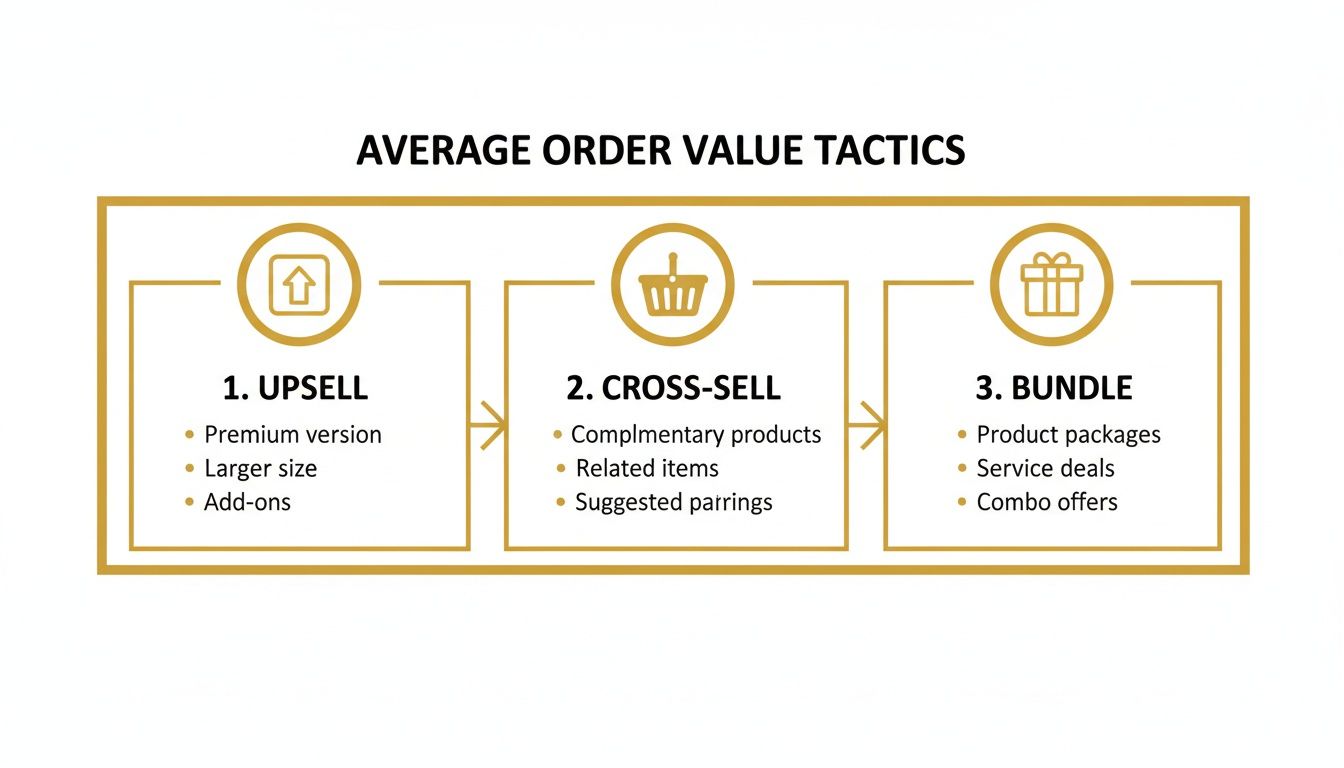
As you can see, they're all related strategies designed to guide customers towards a bigger, better purchase.
Choosing Your AOV Boosting Strategy
Deciding between upselling, cross-selling, and bundling depends on what you sell and what your customers need. Each has its own strengths and level of complexity. This table breaks down the core differences to help you decide where to start.
| Strategy | Best For | Implementation Difficulty | Potential AOV Lift |
|---|---|---|---|
| Upselling | Products with clear 'good, better, best' tiers (e.g., software, electronics). | Low to Medium | Moderate to High |
| Cross-selling | Catalogues with complementary items that enhance the main product. | Low to Medium | Low to Moderate |
| Bundling | Items that are frequently bought together or form a complete 'kit' or 'look'. | Medium | High |
Ultimately, the best approach is often a mix of all three. You might cross-sell an accessory on a product page but offer a complete bundle in the cart. The key is to test what resonates most with your audience.
Create Bundles That Just Make Sense
The best bundles feel intuitive. They take the guesswork out of shopping and usually come with a small discount as a reward for buying everything at once. This strategy is incredibly flexible and works for almost any product catalogue.
Imagine someone just getting into coffee. Instead of just selling them a bag of beans, you could create a "Home Barista Starter Kit" that includes:
- A bag of your best-selling whole-bean coffee
- A quality entry-level grinder
- A pack of paper filters
- A stylish ceramic mug
Suddenly, this is so much more appealing than hunting for each item individually. You're no longer just selling products; you're selling the entire experience of making great coffee at home. For a fashion brand, this might be a "Complete the Look" bundle with a dress, a matching belt, and the perfect earrings. You're simply grouping things people would likely buy together anyway and making it easier and slightly cheaper for them.
Bundling works because it shifts the customer's focus from the cost of individual items to the overall value and convenience of the package. They see it as a curated solution, not just a collection of products.
Find Your Free Shipping Sweet Spot
Let's be honest: shipping costs are a conversion killer. People genuinely hate paying for delivery, so much so that they will often spend more on products just to avoid that fee. This little psychological quirk is one of your best tools for boosting your average order value.
The tactic is simple: offer free shipping on orders over a certain amount. The real art is in picking the right number.
Set it too low, and you'll just be eating shipping costs without seeing a meaningful increase in what people spend. Set it too high, and customers will see it as an impossible goal and might just abandon their cart entirely. You're looking for the sweet spot—a threshold that feels like a gentle nudge, not a giant leap.
How to Calculate Your Ideal Threshold
Start by figuring out your current average order value. A solid rule of thumb is to set your free shipping threshold about 30% higher than your current AOV.
For instance, if your AOV is currently £40, a great starting point for your free shipping threshold would be around £52. This encourages a customer who was about to spend £40 to pop one more small item into their basket. It feels achievable, and more importantly, it feels like a smart move on their part.
Make sure this offer is unmissable. Display it in a banner across the top of your site and use a dynamic message in the shopping cart—something like, "You're only £12 away from free shipping!" This turns the process into a mini-game and makes the target feel tangible.
This approach is especially relevant in the current UK market. Recent data shows a 7% YoY rise in AOV, a trend driven by shoppers spending more per order even as the total number of transactions falls. With retail having contracted for 11 straight months and e-commerce growth at a modest 4.6%, using proven tactics like these is crucial for capturing more revenue from every single customer. You can learn more by reading the full UK State of Commerce report.
Building Loyalty Programmes That Reward Bigger Baskets
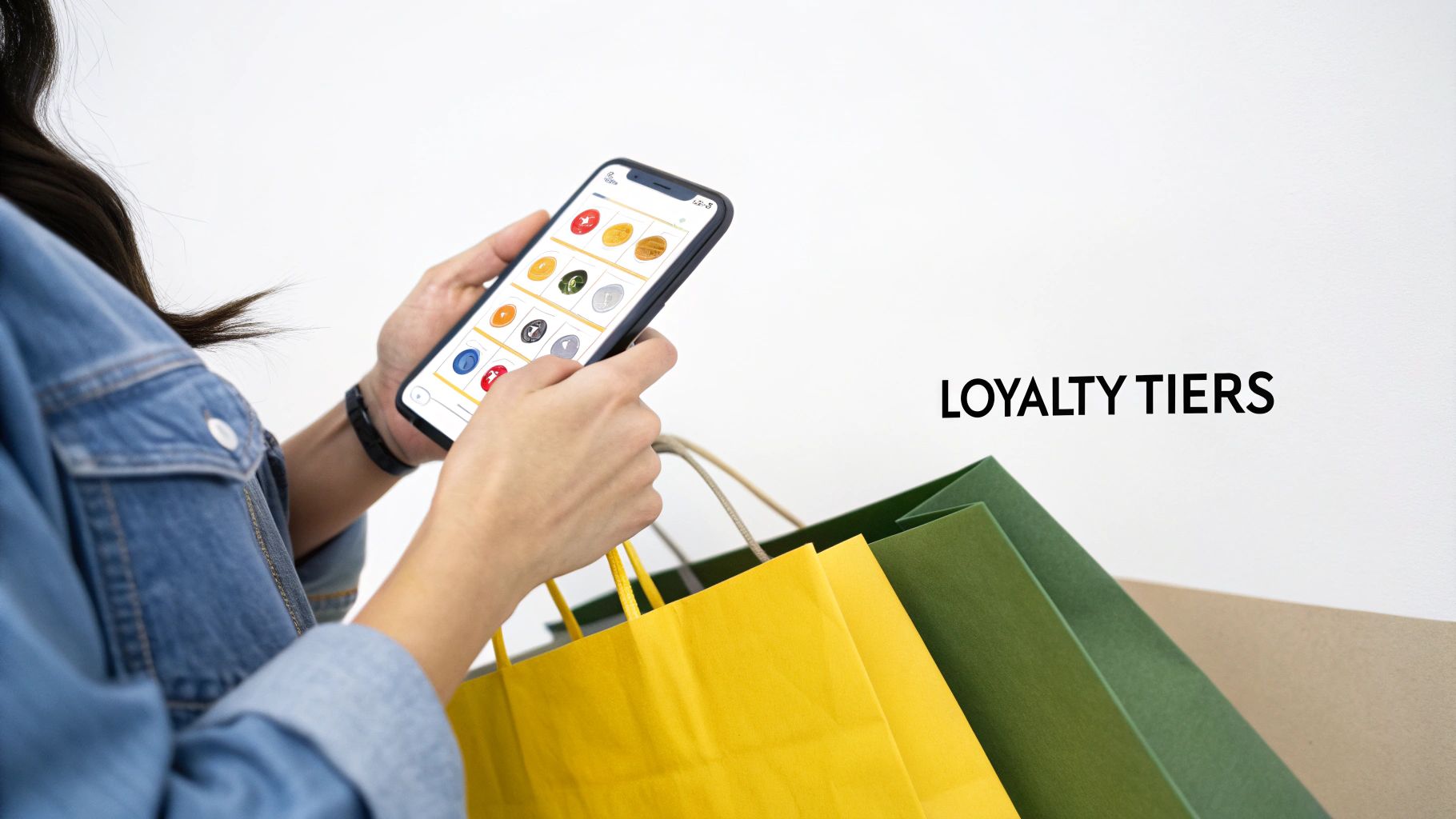
While things like product bundles and free shipping thresholds are great for a quick AOV win on a single sale, a smart loyalty programme plays the long game. It's designed to bring people back again and again, turning casual shoppers into genuine fans of your brand.
But here’s the real secret: you need to structure your programme to specifically reward customers for spending more each time they check out. Moving beyond a simple "one point for every pound spent" model is where you'll see the biggest impact on your AOV.
Designing a Tiered Loyalty System
One of the most powerful ways to get customers spending more is with a tiered loyalty programme. The idea is wonderfully straightforward: the more a customer buys from you over time, the higher up the ladder they climb, unlocking better and better perks along the way.
This creates a clear sense of progression and gives your customers a goal to aim for.
Let's say you run a beauty brand. A three-tier system could look something like this:
- Bronze Tier (Entry Level): Customers get in on their first purchase. They'll earn basic points and maybe get a little something for their birthday.
- Silver Tier (Spend £250): This is where it gets interesting. They unlock free shipping on all orders, get a sneak peek at new product launches, and access to bonus point events.
- Gold Tier (Spend £500): Top-tier treatment. They get all the Silver perks plus access to exclusive limited-edition items, a personal customer service contact, and a really nice annual gift.
This kind of structure gives people a real reason to consolidate their spending with you. Someone who sees they're close to hitting the Silver tier is far more likely to pop one more item into their basket to get over the line. That's a direct, tangible boost to your AOV.
A tiered system turns shopping into a rewarding journey. Customers aren't just buying products; they're investing in a relationship with your brand that offers escalating value and exclusivity.
Introducing Gamification in the Cart
Beyond the long-term appeal of tiers, you can create a bit of excitement right in the shopping cart itself. This is all about using gamification—small, fun challenges that nudge customers to increase their order size for an immediate reward. It’s less about climbing a loyalty ladder and more about capturing that impulse at the moment of purchase.
This technique works because it creates a little bit of urgency and fun. Imagine a dynamic message popping up in the cart that says, "You're only £8 away from unlocking a free mystery gift!" It completely reframes the decision. It's no longer about "spending more money," but about "winning a prize."
Here are a few practical ideas you can try:
- Progress Bars: Show a visual bar that fills up as they add items, clearly marking the goal for free shipping or a gift.
- Mystery Rewards: The allure of the unknown is powerful. Offer a surprise gift for hitting a spending goal—the curiosity alone can be enough to get them to add more.
- Spin-to-Win Pop-ups: As they're about to check out, trigger a pop-up that gives them a chance to spin a wheel for a discount if they add one more suggested item.
These little interactive touches make the checkout feel less like a transaction and more like a game. It's a playful way to encourage a slightly higher spend without being pushy.
Tools to Build Your Loyalty Programme
Thankfully, you don't need a huge development team to build a sophisticated loyalty programme. There are some fantastic tools out there that plug right into major e-commerce platforms, making it easy to manage points, tiers, and rewards.
For businesses looking for a robust solution, platforms from The Digital Marketing Toolbox like LoyaltyLion or Smile.io are my go-to recommendations. They give you all the building blocks you need to create a custom tiered programme, handle the points, and automate rewards.
Better yet, their dashboards let you track how your members are engaging and measure the direct impact your programme is having on key metrics like AOV and customer lifetime value. By getting the right tool in place, you can build a system that not only keeps customers coming back but actively encourages them to spend more every single time.
Make Your Recommendations Smarter with Personalisation and AI
Let's be honest, generic upsells and cross-sells often feel a bit pushy. They're the digital equivalent of a cashier asking, "Would you like to supersize that?" Personalisation is what turns a clumsy sales tactic into a genuinely helpful recommendation.
When you stop showing every visitor the same "bestsellers" list and instead present products that actually fit their interests, you're not just selling anymore—you're helping. This builds a level of trust that makes customers far more likely to add that extra item to their basket. The idea is to make the shopping experience feel like it was designed just for them.
Let AI Do the Heavy Lifting for You
Of course, you can't manually curate product suggestions for hundreds or thousands of visitors. That’s where AI and machine learning come in. Modern recommendation engines are brilliant at crunching huge amounts of data in real-time to predict what a customer might want to buy next.
These systems are a world away from the old "customers who bought this also bought…" logic. They can spot subtle patterns and connections between products that a human would never notice.
For instance, an AI might learn that customers who buy a specific blue yoga mat are also incredibly likely to purchase a certain brand of water bottle, but only during the summer. That's the kind of deep insight that lets you serve up timely, relevant offers that feel like they’ve read your customer’s mind, nudging that average order value upwards.
It's not just a hunch—businesses using highly personalised interactions are outperforming their competitors by 30% in both conversions and revenue. This isn't just a nice-to-have feature; it's a serious lever for growth.
Dynamic Recommendations on Your Site
One of the best places to put this technology to work is with dynamic product recommendation widgets, especially on your product and cart pages. These tools can automatically show a hand-picked selection of items based on what the user is doing right now.
Here are a few ways this plays out in the real world:
- "Complete the Look": If you sell apparel, an AI can see a dress in the cart and instantly suggest the perfect shoes and handbag to go with it.
- "Frequently Bought Together": This is a classic for a reason, but AI makes it smarter. It ensures the bundled products are the ones statistically most likely to be bought together, not just what you think should be.
- "Inspired by Your Browsing History": Has a customer been clicking on hiking boots? The AI can then showcase waterproof socks, backpacks, or walking poles as they continue to browse your site.
Getting started is easier than you might think. You can check out some of the leading website personalization tools which plug straight into major e-commerce platforms like Shopify or BigCommerce. Many are built for marketers, not developers, so you can set up powerful rules without writing any code.
AI-Powered Marketing and Retargeting
This level of personalisation shouldn't stop when a visitor leaves your site. You can also tap into AI to create laser-focused email marketing and ad campaigns that keep the conversation going and encourage a bigger spend later on.
Think about a post-purchase email sequence. It could be automated to suggest the perfect add-on a week after the first order arrives. For someone who just bought a high-end coffee grinder, an email showcasing a subscription for single-origin beans that work perfectly with their new gear is a natural next step.
AI can even write your ad copy for you. Tools like Copy.ai can generate hundreds of variations of ad text, highlighting different product combinations based on what a user looked at on your site.
This allows you to test and refine your messaging on a huge scale. Your retargeting ads will always feature the most compelling offers, giving customers a great reason to come back and complete a higher-value purchase.
Your AOV Optimisation Action Plan
Alright, you've seen the strategies, now it's time to put them to work. Let's translate those ideas into a practical roadmap you can actually follow. Think of this as your cheat sheet for boosting that average order value, starting with the easiest changes that will give you the most immediate results.
We'll break it down into stages, from quick wins to long-term projects. This way, you can prioritise what to tackle now, what to plan for next, and what to build towards for sustainable growth. Each stage builds on the last, creating a solid system for getting more revenue out of every single sale.
Quick Wins for Immediate Impact
Let's start with the low-hanging fruit. These are the kinds of changes you can often knock out in an afternoon with minimal technical headaches. They're brilliant because they give you immediate feedback and can deliver a noticeable lift in AOV almost straight away.
- Set a Free Shipping Threshold: First, figure out your current AOV. Then, set your free shipping minimum about 30% higher. Don't be shy about it – announce it with a site-wide banner and add a dynamic message in the cart that shows customers how close they are. A little nudge goes a long way.
- Add Low-Cost Cross-Sells at Checkout: Think about small, complementary items that are easy impulse buys. We're talking about things like accessories, cleaning kits, or even gift wrapping. Add these as simple one-click options right in the shopping cart or during the final checkout steps.
These tactics work because they tap into basic human psychology. We all love a good deal (hello, free shipping!) and we're suckers for a convenient, small add-on. They're genuinely the simplest way to start seeing an increase in what your customers spend.
Strategic Projects for Solid Growth
Once you've got those quick wins humming along, it's time to dig into some more structured projects. These take a bit more thought and planning, but the payoff is much bigger. You're not just nudging the AOV up; you're fundamentally improving the shopping experience.
- Create Product Bundles: Stop thinking only in terms of individual items. Dive into your sales data and find out what people frequently buy together. Package those products as a "starter kit," a "complete set," or a "pro bundle." Then, shave a little off the total price to make it a no-brainer.
- Implement Post-Purchase Upsells: This is a game-changer. Use an app or tool to offer a relevant, one-click upsell after the customer has already paid. This tactic is brilliant because it completely removes the risk of distracting them from their initial order. It's the perfect, friction-free moment to introduce them to another product they'll love.
By focusing on bundles and smart upsells, you shift the customer's mindset from 'buying a product' to 'solving a problem'. This value-driven approach is key to consistently achieving a higher average order value.
Advanced Levers for Long-Term Value
Now for the big picture. These strategies don't just pump up your AOV; they build real customer relationships and fierce brand loyalty. They're not a "set it and forget it" deal—they require ongoing attention, but they create a powerful competitive advantage that's hard to copy.
- Launch a Tiered Loyalty Programme: Design a points-based system where customers unlock better perks as they spend more. Think exclusive discounts, early access to new products, or even free gifts. It gamifies shopping and gives them a very clear reason to keep coming back to you instead of a competitor. For a holistic approach to boosting your revenue, consider enrolling in a comprehensive revenue optimization course to refine your AOV strategies.
- Deploy AI-Powered Recommendations: It’s time to get personal. Integrate a smart recommendations engine that analyses customer behaviour in real-time. This technology serves up hyper-relevant product suggestions that feel less like a sales pitch and more like a helpful friend pointing out something you might have missed.
Got Questions About AOV? We've Got Answers
Let's dig into some of the most common questions that pop up when businesses start focusing on their average order value. This is where we get into the nitty-gritty of putting these strategies to work.
What’s a Good Average Order Value, Anyway?
Honestly, there’s no single magic number. What's considered a "good" AOV can be wildly different from one industry to the next. A beauty brand might see an AOV hovering between £15 to £90, while a high-end furniture shop could be looking at an average well over £300.
The best benchmark is your own history. Are you seeing steady, month-over-month growth? That's a much healthier sign than trying to measure yourself against a completely different kind of business. Focus on beating your own past performance.
How Can We Raise AOV Without Just Slashing Prices?
Constantly offering discounts is a quick way to erode your margins. The smarter play is to focus on increasing the perceived value of a larger order, making customers want to spend more.
Here are a few proven ways to do that:
- Smart Bundling: Instead of just grouping random products, create bundles that solve a specific problem. Think "The Ultimate Skincare Starter Kit" or "The Complete Coffee Lover's Set." It makes the purchase feel like a thought-out solution, not just a collection of items.
- Exclusive Gifts with Purchase: A well-chosen, exclusive gift for orders over a certain amount can feel far more special than a simple 10% discount. It adds an element of delight and exclusivity.
- Tiered Loyalty Programmes: Make your customers feel like insiders. Reward bigger spenders with perks like early access to new products or exclusive content, not just cashback. It builds a community and encourages higher spending to unlock the next level.
How Often Should We Be Looking at Our AOV Strategy?
You'll want to keep an eye on your AOV metric at least monthly to catch any immediate trends or issues. But for a proper deep dive, a quarterly strategic review is the way to go. This gives you enough time to see the real impact of any changes you've implemented, like a new free shipping threshold or a product bundle.
Don’t think of AOV as a set-it-and-forget-it number. It’s a living, breathing metric that tells you how well your merchandising and marketing efforts are resonating with customers. Regular check-ins and a willingness to test new ideas are key.
By making this a regular part of your routine, you can stay ahead of changing customer habits and consistently find new opportunities to encourage bigger, more valuable orders.
Ready to find the right tech to bring these strategies to life? The Digital Marketing Toolbox is a hand-picked collection of top-tier solutions, from AI recommendation engines to loyalty platforms. It's the perfect place to find the tools you need to start boosting your revenue.
Explore the best tools for the job at The Digital Marketing Toolbox.


