
Figuring out your marketing budget often starts with a simple rule of thumb: set aside between 7% and 12% of your total revenue. If you're a newer business hungry for growth, you might need to push that higher, closer to 12-20%. On the other hand, well-established companies can often keep their momentum with a slightly smaller slice of the pie.
But let's be clear, there's no magic number. A budget is really about creating a smart, deliberate plan to grow your business.
Why Your Marketing Budget Is Your Growth Blueprint

It’s easy for small business owners to see marketing as just another line item on the profit and loss sheet. But thinking of it that way is incredibly limiting. A well-planned budget is actually your strategic roadmap—a blueprint connecting every pound you spend to your most important business goals. It’s what separates a real marketing plan from just randomly boosting posts and hoping for the best.
Without a formal budget, marketing often turns into a series of disconnected, reactive decisions. You might throw some money at a Facebook ad one month, then sponsor a local event the next, all without any real way of knowing what actually worked. That kind of scattergun approach rarely leads to sustainable growth.
A proper budget forces you to be intentional. It makes you ask the tough questions: Where do our ideal customers actually hang out? Which channels give us the best bang for our buck? This process turns your marketing spend from a cost centre into a calculated investment in generating leads and driving sales.
Set SMART Goals as Your Foundation
The best, most effective marketing budgets are always built on a solid foundation of clear objectives. Forget vague ambitions like "increase brand awareness." Your budget needs to be tied to SMART goals—that’s Specific, Measurable, Achievable, Relevant, and Time-bound.
Using this framework changes your entire approach. For instance:
- Instead of: "We need more website traffic."
- A SMART goal sounds like: "Increase organic website traffic by 20% over the next six months by publishing two SEO-optimised blog posts per week."
See the difference? That level of clarity makes budgeting a whole lot easier. Now you can allocate funds specifically for the content creation and SEO tools you need to hit that precise target. Your budget is no longer a wild guess; it's a resource plan designed to deliver a specific outcome. You might also find our guide on creating a comprehensive marketing strategy for your small business helpful here.
From Cost to Investment
Recent data shows UK businesses are getting much more strategic with their marketing funds. While the average spend hovers around 7.7% of total revenue, this number shifts depending on a company's age and goals. New businesses (those under five years old) often allocate a more aggressive 12-20% of their revenue to grab market share and build their brand from the ground up. In contrast, established brands might only need to spend between 6-12% to maintain their position.
By framing your marketing spend as an investment, you link every single activity to a potential return. This changes the conversation from "How much are we spending?" to "What growth are we generating with this investment?"
This simple but powerful mindset shift is the first, and arguably most important, step. It ensures every pound is accountable, purposeful, and dedicated to moving your business forward. A budget built this way isn't a restriction; it's the engine that powers your growth.
Right, let's get down to the brass tacks: how much should you actually be spending on marketing? It's the million-dollar question, isn't it? The good news is you don't need a crystal ball or a complex algorithm. There are a few tried-and-tested ways to land on a number that makes sense for your business.
The most common starting point, especially if you're just getting started, is to base it on a percentage of your revenue. It’s a beautifully simple way to keep your spending realistic and scalable.
As a general rule of thumb, most small businesses allocate somewhere between 7% and 12% of their gross revenue to marketing. But that's just a guideline. A brand-new online shop trying to make a splash will need to shout a lot louder than an established local plumber with a solid reputation. The new shop might need to push that budget up to 15-20% of projected revenue, while our plumber might be perfectly fine with a lean 5-8% to keep the phone ringing.
A Smarter Way: Working Backwards From Your Goals
While the revenue method gives you a safe ballpark, a more strategic approach is to work backwards from what you actually want to achieve. This is what we call the Goal-Driven method. Instead of asking "What can I afford?", you ask "What will it cost to hit my target?".
Let's say your big goal for the next quarter is to land 100 new customers. Here’s how you'd figure out the budget:
- Find Your Cost Per Customer: You first need to know your Customer Acquisition Cost (CAC). If you've run ads before, dig into your data. If not, you might need to run a few small test campaigns to get a baseline. Let's imagine your CAC works out to be £50.
- Do the Maths: Now, it's simple multiplication. 100 customers x £50 per customer = £5,000.
- There's Your Budget: To hit that specific goal, you'll need a marketing budget of £5,000 for the quarter.
This approach is powerful because it ties every pound you spend directly to a concrete outcome. Of course, it relies on knowing your numbers, which is why understanding the customer acquisition cost formula is essential for small businesses.
Taking a Peek at the Competition
Another way to frame your budget is by seeing what your competitors are up to. Now, you’ll never know their exact figures, but you can definitely get a feel for their investment.
Are they all over Google Ads when you search for your key services? Is their Instagram feed full of sponsored content? Tools like Semrush can even give you a rough estimate of what they're spending on digital ads. The point isn't to copy them, but to understand the landscape. If your biggest rival is highly visible, you know you'll need a competitive budget just to be part of the conversation.
My Two Cents: The best strategy is often a blend. Use the Percentage of Revenue method to set a sensible upper limit for your spending. Then, use the Goal-Driven method to allocate that money to specific campaigns that will actually move the needle.
Choosing the right calculation method is a bit like choosing the right tool for a job. Each has its strengths and is suited for different situations.
Comparing Marketing Budget Calculation Methods
| Method | How It Works | Best For | Potential Pitfall |
|---|---|---|---|
| Percentage of Revenue | Allocate a fixed percentage (e.g., 7-12%) of your gross revenue to marketing. | Businesses seeking a simple, scalable, and stable budget that grows with the company. | Can be too restrictive during a growth phase or too generous during a slow period. |
| Goal-Driven | Start with a specific goal (e.g., 100 new customers), calculate the cost to achieve it (CAC x Target), and set that as your budget. | Ambitious start-ups and businesses with very specific, measurable objectives (like a product launch). | Requires accurate data on metrics like CAC, which can be difficult for new businesses to estimate. |
| Competitor-Based | Analyse the marketing activities and estimated spend of your direct competitors to inform your own budget. | Businesses entering a crowded market who need to gauge the investment required to compete. | It’s based on estimates, not hard data, and can lead to reactive rather than proactive spending. |
Ultimately, there's no single "correct" method. The key is to pick the one that gives you the most clarity and confidence for the stage your business is in.
Looking at the wider UK market, spending varies hugely. Recent studies show that 41% of small businesses spend under £500 a month on advertising. Yet, the average annual ad spend for a small business is around £78,000—that's about £6,500 a month. You can see more stats on how much small businesses should spend on advertising to get a better sense of where you fit.
What this data tells us is that your budget is personal. By picking the right calculation method, you can build a financial plan that actively fuels your growth, rather than just being another business expense.
Allocating Your Funds for Maximum Impact
You've done the hard work and figured out how much to spend on marketing. Now for the real question: where does that money actually go? Just sprinkling a little cash across every channel you can think of is a surefire way to see zero results. The trick is to allocate every pound strategically, making sure it’s pulling its weight to bring in a real return.
Think of it like an investor. You wouldn't put all your money into a single, risky stock, nor would you spread it so thin that no single investment could grow. You have to place your funds where they're most likely to deliver results for your business. After all, a B2B software company isn't going to find its customers in the same places as a local high-street boutique. It all comes down to where your ideal customers hang out online.
This chart shows that while many small businesses keep their monthly spend modest, a healthy chunk—over 60%—invest more than £500. This tells us that most serious business owners realise you have to spend money to make money.
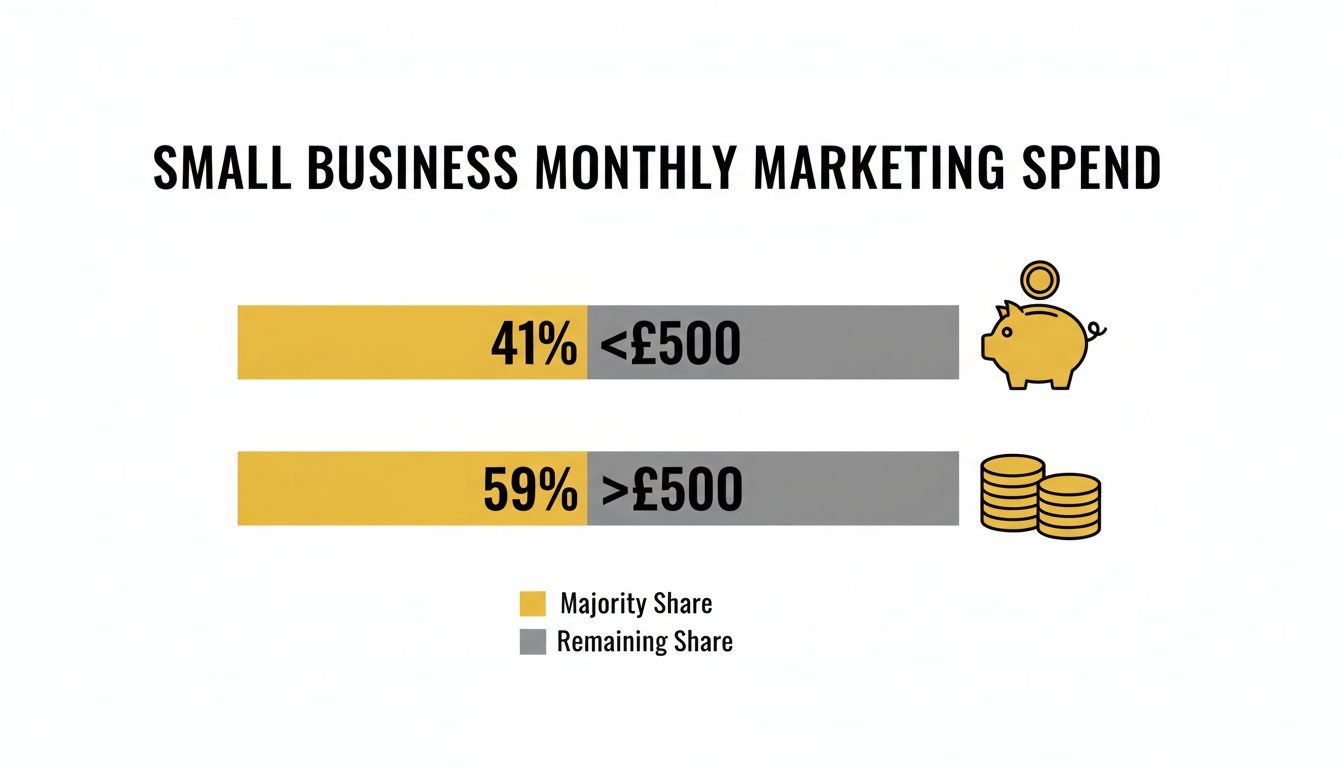
The split in spending habits is quite clear. It suggests that businesses are making a conscious choice: either dip a toe in the water with a smaller budget or commit to a more substantial, ongoing marketing strategy designed for serious growth.
Building Your Core Marketing Mix
Your marketing allocation should be a balanced portfolio. You need a mix of long-term investments that steadily build value and shorter-term tactics designed to get the phone ringing right away.
Here’s a look at the essential channels and what they're good for:
-
Search Engine Optimisation (SEO): This is your long-game asset. Good SEO work gets your website ranking higher in Google, which drives a consistent flow of "free" organic traffic. It’s not a quick fix by any means, but the payoff is huge. You build brand authority and a reliable stream of leads that grows over time.
-
Content Marketing: This and SEO go hand-in-hand. By creating genuinely useful blog posts, guides, and videos, you answer your audience's questions and establish yourself as an expert. A good portion of your budget might go into content creation, and mastering things like video marketing for small business is crucial for getting the most out of that spend.
-
Pay-Per-Click (PPC) Advertising: Need results now? This is your tool. Platforms like Google Ads and Meta (Facebook & Instagram) Ads let you jump in front of a very specific audience almost instantly. You pay for every click, which makes it an incredible way to generate immediate traffic and test new offers. The catch? The traffic vanishes the moment you stop paying.
-
Social Media Marketing: This is where you build a community and actually talk to your audience. It's a blend of organic posting (growing your following for free) and paid social ads (reaching new people). It’s brilliant for building your brand and getting on people's radar.
-
Email Marketing: Often hailed for having the highest ROI, email is your secret weapon for nurturing leads and getting repeat business. It's a direct line to your most engaged customers and incredibly cost-effective.
Sample Budget Allocations For A £2,000 Monthly Spend
To bring this all to life, let’s look at how a few different types of small businesses might carve up a hypothetical £2,000 monthly marketing budget. You’ll see just how much your business model influences your priorities.
| Marketing Channel | Local Service Business (e.g., Plumber) | E-commerce Store (e.g., Handmade Jewellery) | B2B SaaS Startup |
|---|---|---|---|
| PPC (Google Ads/Local Services) | £800 (40%) | £700 (35%) | £600 (30%) |
| SEO & Content Marketing | £500 (25%) | £500 (25%) | £800 (40%) |
| Social Media (Organic & Paid) | £300 (15%) | £600 (30%) | £400 (20%) |
| Email Marketing & Tools | £200 (10%) | £200 (10%) | £200 (10%) |
| Contingency / Testing | £200 (10%) | £0 (0%) | £0 (0%) |
So, what does this table tell us?
The local plumber is pumping 40% of their budget into Google Ads. Why? They need to be there when someone frantically searches "emergency plumber near me." Their entire focus is on capturing customers at the exact moment of need.
Meanwhile, the e-commerce shop is splitting its ad spend between PPC and social media (35% and 30%). They're using visual platforms like Instagram to show off their beautiful jewellery and catch the eye of impulse buyers.
And the B2B SaaS startup? They're investing the most (40%) in SEO and content. Their sales cycle is much longer, so their goal is to build authority and educate potential clients with in-depth articles that attract leads for the sales team to nurture.
Here's the bottom line: Notice how every single one of these budgets puts a solid chunk towards SEO and content. These foundational activities create assets—like high-ranking blog posts—that keep paying you back long after an ad campaign ends. Never, ever neglect the long game.
By allocating your funds this thoughtfully, you build a balanced strategy that drives sales today while securing your growth for tomorrow. It's all about being deliberate and making every single pound count.
Tracking and Proving Your Marketing ROI
Let’s be honest, a marketing budget without tracking is just an expense sheet. To turn that spending into a proper growth engine, you have to measure the impact of every pound. This is the crucial step that takes you from "I think this is working" to "I know this is working."
When you're tracking your performance, you can make smart, data-backed decisions. It gives you the evidence you need to double down on the campaigns that are bringing in customers, and the confidence to cut the ones that are just draining your resources. It’s all about justifying that marketing spend—to yourself, your team, or any stakeholders.
Moving Beyond Vanity Metrics
The first thing to get right is focusing on the numbers that actually matter to your bottom line. It's incredibly easy to get distracted by "vanity metrics" like social media likes, follows, or even page views. They might give you a temporary buzz, but they don't pay the bills.
Instead, you need to track Key Performance Indicators (KPIs) that draw a direct line between your marketing activities and real business growth. These are the numbers that tell the true story.
Here are the essential KPIs I always recommend small businesses keep a close eye on:
-
Customer Acquisition Cost (CAC): Put simply, this is what it costs you to win over a new customer. You calculate it by dividing your total marketing spend over a certain period by the number of new customers you gained in that time. The lower the CAC, the more efficient your marketing is.
-
Customer Lifetime Value (CLV): This is a forecast of the total revenue you can expect from a single customer over the entire time they do business with you. A high CLV is a fantastic sign—it means your customers are loyal and keep coming back for more.
-
Return on Ad Spend (ROAS): This one is vital for any paid advertising. It measures the gross revenue you generate for every pound you put into an ad campaign. If you have a ROAS of 4:1, for example, it means you're making £4 for every £1 you spend.
To really get a grip on this, you need to know how to calculate return on investment for all your different initiatives. Getting these sums right is fundamental to properly managing your marketing budget for a small business.
Setting Up Your Tracking Systems
You don't need a massively complicated or expensive setup to get started. In fact, many of the tools you're probably already using have powerful analytics built right in.
The trick is to get them set up correctly from the very beginning. Take Google Analytics—it’s a completely free tool that can give you a treasure trove of information about your website traffic and what visitors do once they get there. By setting up simple conversion goals, like a contact form submission or a product purchase, you can directly link your marketing channels to valuable outcomes.
It’s the same story with social media platforms like Meta (Facebook and Instagram) and LinkedIn. Their advertising dashboards are incredibly robust, letting you track everything from click-through rates right down to the direct sales your campaigns have generated.
I’ve seen this mistake so many times: people wait too long to implement tracking. You need to set up your analytics and tracking pixels before you spend a single pound on a new campaign. If you don't, you're just flying blind with no real way of knowing what actually brought in the results.
Proving the Value of Your Spend
Tracking your ROI isn't just an internal job; it’s about building genuine confidence in your marketing strategy. This confidence is being reflected in wider UK business trends, too. Optimism around marketing budget growth is on the up, with a net balance of +25.6% of companies planning to increase their total marketing spend in the 2025/26 financial year.
This makes sense when you look at the results. In 2025, when 37% of small businesses increased their budgets, a staggering 88% of them reported that their revenue was either stable or had improved. It’s a clear link between smart investment and tangible returns.
By consistently tracking and reporting on your key metrics, you create a powerful feedback loop. You can clearly show how the marketing budget is contributing to the overall health of the business. This data empowers you to make smarter decisions, prove your department's worth, and confidently ask for more investment in the things you know will drive growth.
For a complete walkthrough, check out our guide on how to calculate your marketing ROI.
How to Adjust and Optimise Your Budget Over Time
Getting your marketing budget down on paper is a great start, but it's certainly not a "set it and forget it" task. The most successful businesses I've seen treat their budgets as living, breathing documents. Your initial plan is really just your best-educated guess; the real magic happens when you start tweaking it based on what the data tells you.
Think of it this way: your budget isn't carved in stone. It’s a dynamic roadmap that needs to bend and flex in response to the market and your customers. This agility is precisely what separates businesses that get a decent return from those that make every single pound work as hard as it possibly can.
The key is to build a rhythm of regular reviews. This simple habit stops you from letting a failing campaign burn through cash or, just as bad, missing a golden opportunity to double down on something that’s taking off.
Establish a Regular Review Cadence
To stay on top of performance without getting lost in the weeds, a two-tiered review schedule is your best bet. This approach lets you make quick, tactical changes while still keeping an eye on the bigger strategic picture.
Here’s a simple but effective schedule to get you started:
- Monthly Check-ins: These are for digging into your channel-specific performance. At the end of each month, sit down and look at the hard numbers. What’s your Google Ads ROAS looking like? Is your social media engagement actually translating into website clicks? This is your chance to make small, immediate adjustments.
- Quarterly Strategy Reviews: Every three months, it’s time to zoom out and look at the whole strategy. Are you still on track to hit your main SMART goals? Has the market shifted? This is where you make bigger calls, like reallocating a significant chunk of cash from one area to another.
This rhythm makes sure you’re both reactive to short-term data and proactive about your long-term goals—the very core of a smart marketing budget for a small business.
A Real-World Scenario: Shifting Funds on the Fly
Let's imagine you run a small e-commerce business selling artisanal coffee beans. You’ve allocated £1,000 for Google Ads and another £1,000 for creating organic content on Instagram.
After your first monthly check-in, the data tells a very clear story.
Your Google Ads campaign targeting "speciality coffee subscription UK" is delivering a fantastic 5:1 Return on Ad Spend (ROAS). For every £1 you put in, you're getting £5 back in sales. Wonderful. Your Instagram content, however, is getting some likes but hasn't driven any direct sales at all.
This is a critical decision point. The data is screaming at you, telling you exactly where your customers are ready to buy. Sticking rigidly to your initial budget would mean wasting money on a channel that isn't performing, while starving one that’s delivering proven results.
The smart move is to be agile. You might decide to shift £500 from your organic content budget straight over to the Google Ads campaign for the next month. You're not abandoning Instagram entirely, but you are redirecting funds to where they’ll have the biggest immediate impact on your bottom line.
Knowing When and How to Pivot
This data-informed agility is the secret to genuine budget optimisation. It’s all about giving yourself permission to change course based on what the numbers are telling you.
Here are the guiding principles of a successful pivot:
- Double Down on Winners: If a campaign or channel is clearly smashing its targets, don't be afraid to feed it more money, even if it's mid-quarter.
- Cut Underperformers Ruthlessly: Emotion has no place here. If a channel isn’t delivering after a fair test, slash its budget and reallocate those funds elsewhere.
- Embrace Experimentation: Always keep a small slice of your budget (around 10% works well) for testing new channels or bold ideas. You never know where the next big win will come from.
By continuously reviewing, analysing, and adjusting, you create a powerful feedback loop. This iterative process ensures your marketing budget for a small business evolves, gets smarter over time, and consistently drives measurable growth.
Got Questions About Your Marketing Budget? You're Not Alone.
Figuring out the money side of marketing can feel like a minefield. It’s one of the areas where small business owners have the most questions, and for good reason—every pound counts. Let’s tackle some of the most common sticking points we see time and time again.
Getting these answers straight will give you the confidence to build a marketing plan that actually works for your business.
How Much Should We Spend on Marketing if We Have No Revenue Yet?
This is the classic chicken-and-egg scenario, isn't it? If you have no sales, basing your budget on a percentage of revenue is impossible. So, you have to flip the script and think about your goals first. Your initial marketing spend isn't an expense; it's an investment to kickstart the whole operation.
Instead of looking at past performance, define what success looks like in the immediate future. What are your non-negotiable launch goals?
- Maybe it's landing your first 50 paying customers.
- Perhaps it's generating 100 qualified leads for your sales team.
- For a service business, it might be booking 20 initial consultations.
Once you have a concrete target, you can work backwards. Do a little research on the typical Customer Acquisition Cost (CAC) for your industry. This will give you a ballpark figure for what it takes to win a single customer, helping you build a realistic starting budget designed to hit those critical early milestones.
What Hidden Marketing Costs Am I Forgetting?
This is a big one. It's so easy to get fixated on the obvious costs, like your ad spend on Google or Facebook, and completely overlook the infrastructure that makes it all run. These "hidden" costs can nibble away at your budget, leaving you with less to put towards actually reaching new customers.
A smart marketing budget covers the entire ecosystem. It's not just the ads—it's the tools, talent, and tech you need to execute your strategy properly.
Make sure you've accounted for these often-forgotten expenses:
- Software & Tools: Think about your email marketing platform (like AWeber), SEO analysis tools, social media schedulers, and any analytics software. These monthly or annual subscriptions add up.
- Content Creation: Are you creating everything yourself? If not, you'll need to budget for freelance writers, graphic designers, or video editors to produce high-quality assets.
- Website Expenses: Don't forget the boring-but-essential costs like web hosting, domain name renewals, and any premium plugins or themes that keep your site running smoothly.
Should I Cut My Marketing Budget When Business is Slow?
It’s a tempting, almost reflexive, reaction. When sales dip, the marketing budget is often the first thing on the chopping block. But this can be a huge mistake.
When you stop marketing, you become invisible. All the momentum you've built vanishes, making it significantly harder (and more expensive) to win back customers' attention when things pick up again.
Instead of cutting your budget to zero, reallocate it. Pivot from expensive, top-of-funnel activities aimed at acquiring brand-new customers. Focus on more cost-effective strategies for retention. This is the perfect time to double down on email marketing to your existing list or invest in long-term organic assets like SEO-focused blog posts. The goal is to stay present and play the long game, not to disappear.
How Long Until I See a Return on My Marketing Spend?
If there’s one thing marketing requires, it's patience. The time it takes to see a return on your investment (ROI) varies dramatically depending on the channel you're using. If you don't set realistic expectations from the outset, you risk giving up on a perfectly good strategy just before it starts to pay off.
For example, Pay-Per-Click (PPC) advertising can bring in data and results almost instantly—sometimes within a few days. On the other end of the spectrum, SEO and content marketing are marathons, not sprints. You could be looking at 6-12 months of consistent work before you see a real, tangible impact on your organic traffic and lead flow. A well-balanced budget acknowledges this, mixing short-term tactics for quick wins with long-term strategies for sustainable growth.
At The Digital Marketing Toolbox, our goal is to make it easier to find the right tools to get the most out of every pound you spend. Take a look at our handpicked selections for SEO, email, social media, and more to build a powerful and cost-effective marketing machine. Discover the perfect tools to grow your business today.


