
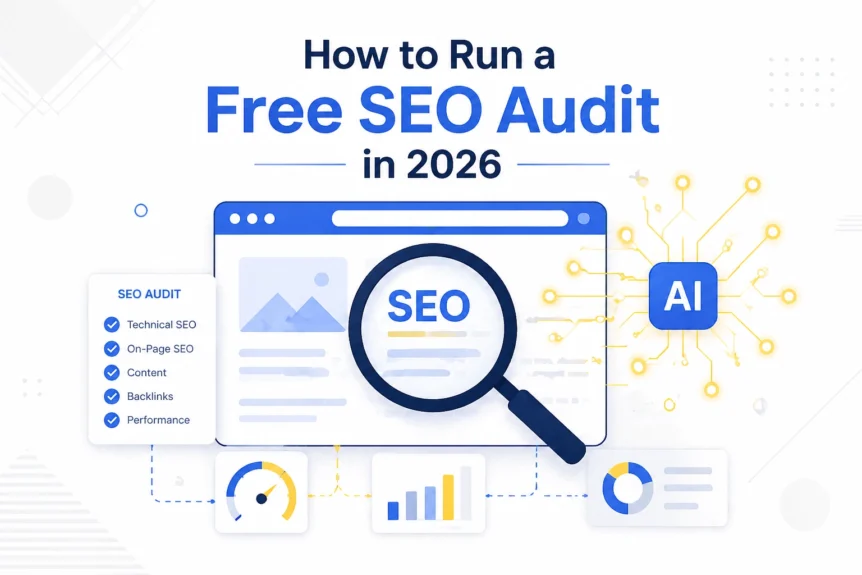
Let’s be blunt: if you’re still auditing your website like it’s 2022, you’re essentially bringing a knife to a laser-tag fight.
The SEO landscape in 2026 isn't just about Google’s blue links anymore. It’s about GEO (Generative Experience Optimization), the art of making sure AI bots like SearchGPT and Perplexity actually mention your brand when someone asks a question.
If you’re a small business owner, you don’t need a $5,000 agency audit to figure out why your traffic is stalling. You need to find the "low-hanging fruit," fix the leaks, and prepare for the AI-first world. I’m going to show you exactly how to run a comprehensive SEO audit for the grand total of zero dollars.
Phase 1: Picking the Low-Hanging Fruit
Before we get fancy with AI, we need to handle the basics. I almost always point people toward the "technical quick-wins" first. Why? Because search engines (and humans) have zero patience for a broken site.

The "Speed and Health" Scan
Your first stop is Google Search Console (GSC). If you don't have this set up, stop reading and go do it. It is the single most important "free" tool in your arsenal.
- Core Web Vitals: Check the "Experience" tab. If your mobile scores are in the red, you're burning cash. Speed is a massive ranking factor for both traditional search and AI retrieval.
- The 404 Hunt: Use a free tool like Screaming Frog (free up to 500 URLs) or the AIOSEO Analyzer to find broken links. A 404 page is a dead end for a customer and a "keep out" sign for a bot.
- Mobile-First or Bust: If your site doesn't look perfect on a smartphone, you're invisible. Use Google’s PageSpeed Insights to see exactly what’s slowing you down.
Golden Nugget: Fix your site speed first. A one-second delay can drop conversions by 7%. In 2026, "fast" is the baseline, not a feature.
Phase 2: The Truth About "Ownership"
I need to get something off my chest. Forget the sticker price for a moment; if you are building your business on a closed-source platform where you don’t own the code, you’re renting your digital future.

The reality of closed systems: Platforms like Wix or Squarespace are great for a "weekend project," but for serious SEO growth, they can feel like a straightjacket. You want the "ownership" that comes with self-hosted platforms like WordPress.
- API Access: Can you connect the latest AI SEO tools?
- Data Portability: Can you move your site if the platform triples its prices?
- Technical Control: Can you edit your
robots.txtto tell AI bots exactly what to crawl?
If you’re feeling stuck in a "locked box," 2026 is the year to consider a move. Ownership is the ultimate SEO strategy.
Phase 3: GEO – Talking to the Robots
So, what exactly is Generative Experience Optimization (GEO)? It’s making your site "readable" for Large Language Models (LLMs). If an AI can’t summarize your business in three sentences, it won't recommend you.

The AI-Ready Checklist
- Schema Markup is King: Use JSON-LD Schema to tell bots exactly what you do. Are you a local plumber? Use "Plumber" schema. Selling a SaaS tool? Use "SoftwareApplication" schema. This isn't optional anymore; it’s the primary way AI understands your "entities."
- The
robots.txtUpdate: Ensure you aren't blocking bots likeGPTBotorClaudeBotunless you have a very good reason. You want these bots to index your helpful content so they can cite you as a source. - Entity Consistency: Is your business name, address, and phone number (NAP) identical across the web? If Google sees one address and Perplexity sees another, they’ll both ignore you out of caution.
Phase 4: Scaling Up – Which Tool Should You Choose?
A free audit is a great start, but if you're serious about scaling, you need a "cockpit" to fly your spaceship. In our Grow Your Biz Toolbox, we have two clear winners for small businesses.
The "Pro's Choice": SE Ranking
SE Ranking is my go-to for anyone who wants enterprise-level data without the enterprise-level price tag. It’s roughly half the cost of the "big name" competitors but packs a serious punch.
- What I love about this: Their new AI Visibility Tracker. It literally tells you how often you’re appearing in AI-generated search results.
- The Sweet Spot: The "Core" plan is perfect for small businesses. Check it out in our SEO tools comparison.
The "Step-by-Step" Mentor: Hike SEO
If you’re a total beginner and SEO feels like a foreign language, Hike SEO is your best friend. It doesn't just give you data; it gives you a "To-Do" list every month.
- Let’s be blunt: Most SEO tools are too complex. Hike simplifies everything for the DIY business owner.
| Feature | SE Ranking | Hike SEO |
|---|---|---|
| Best For | Data-driven growth & agencies | DIY Small Business owners |
| Key AI Feature | AI Visibility & GEO tracking | Simple "Action" recommendations |
| Price Point | Mid-range (Value-packed) | Budget-friendly for starters |
| Learning Curve | Moderate | Very Low |
The 2026 Audit Summary Checklist
Use this table to track your progress as you move through your free audit.
| Step | Task | Why it Matters |
|---|---|---|
| 1 | Google Search Console | Identify 404s and indexing errors. |
| 2 | PageSpeed Insights | High speed = higher rankings & conversions. |
| 3 | Schema Validation | Helps AI bots understand your business "Entity." |
| 4 | NAP Consistency | Essential for Local SEO and AI trust. |
| 5 | Content Freshness | AI favors recent, factual data. |
Moment of Truth
Is a free SEO audit enough? For the first 6 months, yes. It will help you clear the "technical debt" that's holding you back. But the truth is, SEO in 2026 moves fast. While you're manually checking links, your competitors are using AI to optimize 1,000 pages an hour.
If you want to move from "surviving" to "thriving," you eventually need a tool that does the heavy lifting for you. My recommendation? Start with the free audit today, fix your speed and schema, and then jump into a trial of SE Ranking or Hike SEO via our toolbox to start dominating the AI search era.
Stop flying solo( get the data you need to grow.) 🚀


