
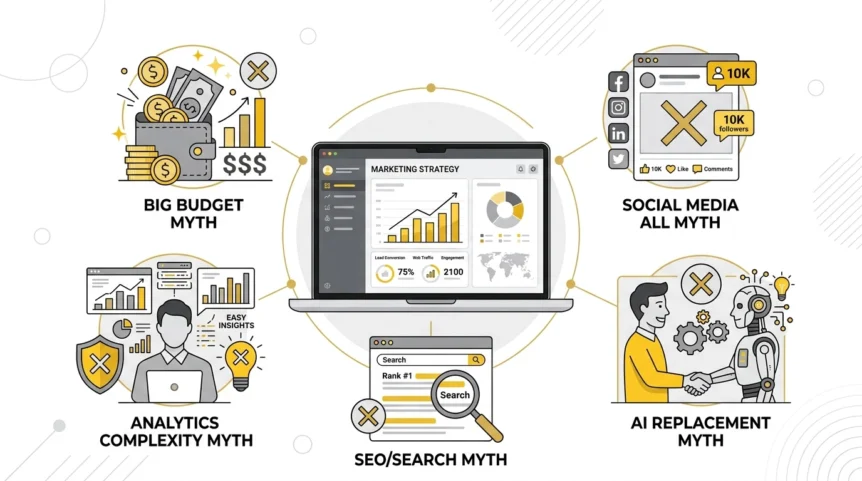
Marketing strategy for small business in 2026 isn't about following the loudest voices—it's about knowing which myths to ignore. Are you still pouring your hard-earned cash into tactics that felt “modern” three years ago? Do you feel like you’re running a race where the finish line keeps moving further away?
Here’s the deal: the digital landscape of 2026 doesn't care how things “used to be done.”
If you’re a small business owner, a freelancer, or running a boutique agency, the noise is louder than ever. The tools are smarter, the algorithms are pickier, and your customers? They’ve seen it all.
At Grow Your Biz, we spend our days looking under the hood of thousands of business growth strategies.
We see what works and, more importantly, we see where people are burning cash on outdated ideas. It’s time to clear the air.
Here are the 5 dangerous myths currently holding your small business back, and exactly how to fix them.
Golden Nugget: A strong marketing strategy for small business is rarely about doing more. It’s about doing the right things, in the right order, without wasting budget.
Myth 1: “The Bigger the Budget, the Bigger the Win”
Forget the sticker price for a moment.
Most small business owners think they’re at a massive disadvantage because they can't drop £10k a month on a fancy Manhattan agency.
The truth is, in 2026, strategy and systems beat raw spending every single time.

We’ve seen “lean” businesses out-maneuver massive corporations by using a targeted digital marketing toolbox rather than a scattergun approach.
Massive budgets often lead to “lazy marketing”: buying traffic instead of earning trust.
If your marketing strategy for small business starts and ends with spend, you’re already on the back foot.
For the Freelancer
Stop trying to buy your way into a crowded market. Your “sweet spot” is personalization. Use automation tools to handle the heavy lifting of lead nurturing so you can focus on high-touch closing. You don't need a million-dollar ad spend; you need a £50/month tool that makes you look like a team of ten.
For the Agency
Your clients don't want to hear about “impressions” anymore. They want to know the ROI. Instead of asking for more ad spend, show them how you can optimize their existing traffic using tools like Hotjar to see why people aren't converting.
Golden Nugget: Efficiency is the new currency. A well-oiled marketing system that costs £200/month in SaaS fees will often outperform a £2,000/month unoptimized ad campaign.
Myth 2: “If You Aren't on Every Platform, You're Invisible”
Is it worth the money and time to be on TikTok, LinkedIn, Instagram, X, Threads, and whatever new platform launched this morning?
The answer is a hard no.
Trying to be everywhere is the fastest way to become “white noise.”
We see businesses “flying solo” trying to manage six different social accounts, only to end up with mediocre content on all of them.

A Marketing Strategy for Small Business Needs Focus, Not Noise
In 2026, the winning marketing strategy for small business is about depth, not breadth.
That lines up with what HubSpot says about small business marketing, too: channel selection matters more than trying to show up everywhere at once.
- Pick two “Power Channels”: Where does your target audience actually hang out when they are in a “buying” mindset?
- Master the content loop: Take one great piece of content and repurpose it, rather than starting from scratch on every app.
- Use the right widgets: If you’re focusing on Instagram, don't just post; bring that feed onto your site with Instagram Feed widgets to build social proof where it counts.
Moment of Truth: A smart marketing strategy for small business doesn't reward you for showing up everywhere. It rewards you for showing up where buyers actually care.
Myth 3: “AI is a ‘Set It and Forget It' Solution”
Let’s talk about the elephant in the room.
By now, everyone is using AI. But there’s a massive myth that you can just plug in a prompt and have a “marketing strategy” by lunchtime.
The truth is, AI is the engine, but you are still the pilot.
If you let AI do everything, your brand will end up sounding like a cardboard box: bland, generic, and easily ignored.
We use AI for “API access” to data, for drafting, and for brainstorming, but the “soul” of the strategy must come from you.
A good marketing strategy for small business uses AI to save time, not to replace judgment.

| Feature | AI's Role | Your Role |
|---|---|---|
| Content Creation | Drafting, formatting, and SEO optimization. | Tone of voice, unique insights, and personal stories. |
| Data Analysis | Crunching numbers from SEO audit tools. | Deciding which metrics actually matter for your goals. |
| Customer Support | Handling FAQs via Chat Bot templates. | Stepping in for complex, high-value human interactions. |
Myth 4: “SEO is Just About Ranking #1 on Google”
Back in the day, SEO was a simple game: pick a keyword, write a post, and hope for the best.
In 2026, the “cockpit of a spaceship” that is the Google SERP (Search Engine Results Page) has changed.
Ranking #1 is great, but being referenced is better.
With AI Overviews and fragmented search, your marketing strategy for small business needs to focus on “Entity Authority.”
It’s not just about “toxic links” and keyword stuffing anymore; it's about being the most helpful resource in your niche.
That broader approach mirrors advice from Forbes on small business marketing strategy, where consistency, positioning, and trust all do the heavy lifting.

We’ve noticed that businesses that focus on Google Maps SEO and local citations are seeing a much higher conversion rate than those chasing national keywords.
Golden Nugget: Don't just build a website; build an ecosystem. Use All-in-One Reviews to show Google (and your customers) that you are a trusted, active business.
Myth 5: “Data is Only for Big Corporations”
“I'm too small for data,” is a phrase that makes us cringe.
You might think you don't need fancy dashboards or “API access” to understand your customers.
But without data, you’re just guessing with your wallet.
The most successful small businesses we work with at Grow Your Biz treat their data like a GPS.
They know exactly where their leads come from, which email marketing tools have the highest open rates, and which pages on their site are “leaking” money.
Any marketing strategy for small business that ignores data will eventually start burning cash.
Real-World Application
If you're using a tool like Dripify for LinkedIn automation, are you actually looking at the response rates? Or are you just hitting “send” and hoping for a miracle?
Small business data isn't about complex spreadsheets; it's about asking three simple questions:
- How much did it cost to get this lead?
- What path did they take to find me?
- Where did they drop off?

The Moment of Truth
The “old ways” of marketing are dying, but that’s actually the best news you’ve heard all year. Why?
Because when the myths are busted, the playing field levels out.
You don't need a massive team. You don't need to be a coding genius. You just need to be pragmatic.
Stop trying to be a “viral sensation” and start building a marketing strategy for small business that focuses on:
- Authenticity over volume.
- Strategic tool selection (Check out our SaaS comparison guides).
- Measurable business outcomes instead of vanity metrics.
So, which myth are you going to stop believing today?
Ready to build a strategy that actually scales? Explore the Grow Your Biz Digital Marketing Toolbox and get the exact tools we use to help small businesses thrive in 2026. Let's get to work.


