
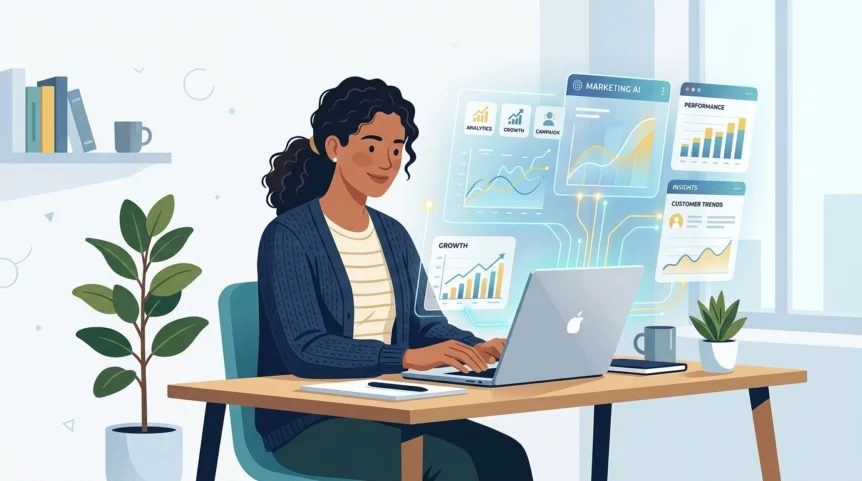
If you’re still guessing your way through marketing in 2026, it’s easy to feel like everyone else got the playbook before you did. The good news? An AI marketing strategy for small business no longer needs a massive budget, a data team, or a technical background to work.
Here’s the real issue: most small businesses are using AI in random bursts. They prompt ChatGPT once, publish a rushed post, and then wonder why leads and sales stay flat. A proper AI marketing strategy for small business works differently. It builds a repeatable system that saves time, scales output, and improves ROI.
We’ve spent years testing practical tools inside our digital marketing toolbox, and we’ve boiled it all down to five actionable steps. Whether you’re flying solo or managing a small team, this guide will help you build an AI marketing strategy for small business that actually works in the real world.
For the Solopreneur: The “Time-is-Money” Persona
If you are a freelancer or a “one-man-band,” your biggest enemy isn't the competition; it’s the clock. You are the CEO, the janitor, and the marketing director.
For this kind of AI marketing strategy for small business, the goal is simple: buy back your time. Use tools that act like a silent partner, handling the grunt work while you focus on the actual craft.
For the Growing Agency: The “Scale-or-Fail” Persona
If you have a small team, you aren't just looking for time; you’re looking for efficiency and ROI. You need AI to handle the volume that would otherwise require hiring three more people.
A smart AI marketing strategy for small business helps you scale without burning cash. You want every £1 spent on ads or content to generate real return, not just more busywork.
Step 1: Define Your Marketing Channels (Don’t Try to Be Everywhere)
So, which channels should you choose? Forget the sticker price for a moment and look at where your customers actually hang out. One of the biggest mistakes in any AI marketing strategy for small business is trying to conquer TikTok, LinkedIn, Instagram, and email all at once.
The smarter move? Pick two or three channels and go deep.
- If you’re B2B: Focus on LinkedIn and Email.
- If you’re Local Retail: Focus on Instagram and Google Maps SEO.
- If you’re E-commerce: Focus on Meta Ads and sophisticated Email funnels.
Once you’ve picked your battles, use AI to map out your customer journey. Use data to find out when customers are online, what problems they are trying to solve, and which message gets them to act.
If you need a benchmark for channel strategy, HubSpot’s marketing guidance is a solid place to start: HubSpot Marketing Hub.
Golden Nugget: AI isn't a strategy; it's the fuel. If your car is pointed in the wrong direction, more fuel just helps you get lost faster. Define your destination first.

Step 2: Build Your AI Content Factory
Let’s face it, staring at a blinking cursor is the fastest way to kill a Monday morning. AI tools like Rytr or the ones integrated into our Grow Your Biz suite have changed the game.
For most teams, this is where an AI marketing strategy for small business starts paying for itself. Content creation speeds up, output becomes more consistent, and your team stops reinventing the wheel every day.
We recommend a “Batch and Blast” approach. Instead of writing one post a day, spend two hours on a Monday morning using AI to generate:
- Weekly Blog Posts: Use AI to outline and draft long-form content.
- Social Snippets: Break that blog post down into 5 LinkedIn posts and 3 Instagram captions.
- Ad Copy: Generate 10 variations of a Facebook ad and let the AI tell you which one will likely perform best.
The secret here is the Human-in-the-loop method. Let AI do 80% of the heavy lifting: research, drafting, and formatting. Then spend the last 20% injecting your brand’s real voice.
Want to understand the tools behind this shift? Read more about business use cases directly from OpenAI.
Step 3: Automate Your Distribution (Set it and Forget it)
Is it worth the money to pay for automation? Absolutely. If you are manually sending every email or posting every tweet, you are burning cash.
A strong AI marketing strategy for small business should reduce repetitive work first. That’s where the quickest ROI usually shows up.
Distribution is where AI truly shines for a small business. You should be using tools that don't just “schedule” posts but “optimise” them. In a practical AI marketing strategy for small business, this is where you stop chasing tasks and start building systems.
We’re talking about:
- Predictive Sending: Platforms like AWeber or GetResponse use AI to see exactly when your specific subscribers are most likely to open their inbox.
- Smart Chatbots: Instead of letting a lead go cold at 10 PM on a Sunday, use AI chat bot templates to qualify leads and answer FAQs instantly.
When you automate, you stop being a “content creator” and start being a “marketing orchestrator.”
Step 4: Scale the Output (Volume + Personalization)
Once you have your workflow and your automation in place, it’s time to turn up the volume. In the old days, “more content” meant “less quality.” Not anymore.
AI allows for Hyper-Personalization. Imagine sending an email where the subject line and the product recommendation are automatically generated based on that specific customer's last three clicks on your site.
That isn't sci-fi anymore. It’s standard practice for a high-performing AI marketing strategy for small business.

Use AI to:
- A/B Test at Scale: Test 50 different headlines simultaneously to find the “sweet spot.”
- Repurpose Video: Take one 10-minute YouTube video and use AI to chop it into 20 viral “Shorts” or “Reels” automatically.
- SEO Optimization: Use AI to scan your pages for “toxic links” and ensure you are hitting the right “SERP features” to stay ahead of the curve.
Step 5: Measure, Optimize, and Pivot Monthly
The truth is, even the best AI needs a nudge. You shouldn't just “set and forget” for the rest of the year. Every 30 days, we need to take a cold, hard look at the numbers.
Are your AI-generated emails actually converting, or are they just sitting in the spam folder? Is your social media engagement rising, or are you just shouting into a void of bots?

Use an AI-powered dashboard to track your ROI. A well-run AI marketing strategy for small business should always tie activity back to results.
Focus on:
- Customer Acquisition Cost (CAC): How much £ are you spending to get one new customer?
- Conversion Rate: Are people actually clicking “buy” after interacting with your AI tools?
- Time Saved: Calculate how many hours AI has saved your team and re-invest that time into high-level strategy.
Golden Nugget: Data is the new oil, but it’s useless if you don't have a refinery. Use AI to distill your metrics into simple “Yes/No” decisions for the following month.
The Moment of Truth
Using AI to supercharge your AI marketing strategy for small business isn't about being “techy.” It’s about being pragmatic. It’s about protecting your time, increasing output, and improving ROI without adding chaos to your day.
Don't try to implement all 5 steps today. Start with Step 1 and 2. Get your channels right, build a simple content factory, and see the results for yourself.
Ready to start building your own AI-powered engine? Explore our full digital marketing toolbox and find the specific tools that will take your business from surviving to thriving in 2026.
Stop flying solo in the cockpit; it’s time to let AI be your co-pilot. Let’s grow your biz.


