

A live chat widget can turn a quiet website into a useful sales channel. It can also become another dashboard nobody checks.
That is the real question behind Tidio vs Melu. Do you want software your team operates, or a managed service where real people handle conversations for you?
There is another question small businesses should ask before comparing monthly prices: what happens to your conversations if you leave?
Both tools are closed-source SaaS. You rent the platform, rather than owning the code, database structure or system organising your customer conversations.
Table of Contents
- Tidio vs Melu: quick comparison
- What are Tidio and Melu?
- Usability and features
- Pricing and ROI
- AI and customer support
- Who owns your customer conversations?
- Which tool suits your business?
- Final verdict
Tidio vs Melu: quick comparison
| Category | Tidio | Melu |
|---|---|---|
| Best for | Businesses wanting self-service chat and AI automation | Businesses wanting fully managed human chat |
| Setup | Quick website installation and no-code configuration | Quick installation, followed by briefing Melu’s team |
| Live chat | Your team handles conversations | Melu’s operators handle conversations |
| AI | Lyro AI Agent, Flows and reply assistance | Primarily human-operated; no clearly advertised customer-configurable AI agent |
| Channels | Website chat, email, Messenger, Instagram and WhatsApp integrations | Website chat, plus managed messaging options |
| Pricing | Free plan; paid plans from roughly £19 per month | 14-day trial, then monthly usage-based pricing |
| Support | Email support; live chat and premium support on higher tiers | Human operators, client portal and managed service support |
| Data access | Conversation history and analytics; export and API options depend on plan | Leads, transcripts and reports in the client portal |
| Ownership model | Closed-source SaaS | Closed-source SaaS and managed service |
| Verdict | Best for control, automation and scalability | Best for convenience and human lead handling |
Prices are approximate GBP conversions and can change with billing terms, exchange rates and usage.
What are Tidio and Melu?
Tidio: the software cockpit
Tidio is a customer service platform built around live chat, ticketing, automation and AI.
Your team installs the widget, writes the rules, monitors the inbox and jumps into conversations when needed.
Its standout feature is Lyro AI Agent. Lyro uses your support content to answer common questions, handle simple requests and hand more complicated conversations to a human.
Tidio also includes Flows, which are no-code automation paths. Use them to collect lead details, promote an offer or nudge a hesitant visitor towards checkout.
It is a capable cockpit. There are plenty of buttons, but most small businesses can get started without needing an engineering degree.
Melu: the outsourced receptionist
Melu takes a different route.
You install the chat service, provide information about your business and let Melu’s trained operators answer visitors on your behalf.
The service focuses on human conversations, lead capture and 24/7 coverage. When a chat produces a lead, Melu sends a notification so your team can follow up.
Melu also provides a secure client portal where businesses can view leads, transcripts and performance reports.
So, Tidio vs Melu is not really software versus software. It is DIY customer communication versus outsourced customer communication.
Golden Nugget: Choose Tidio when you want to operate the machinery. Choose Melu when you want someone else to keep the machinery running.
Usability and features
Which one is easier to use?
Tidio is easier if your team wants immediate control.
You can install the widget, customise the appearance, create canned replies and set operating hours. Paid plans support features such as automatic chat assignment, visitor history, macros and advanced analytics.
The trade-off is obvious: your team still needs to answer the chat.
Melu removes much of that day-to-day work. Its operators are trained using your FAQs, brand information and instructions.
That makes Melu particularly useful for small businesses without the capacity to monitor a chat inbox throughout the day.
Feature comparison
Tidio is stronger for:
- No-code chatbot and automation flows
- Shopify, WordPress and Wix integrations
- Shared inbox management
- Ticketing and email handling
- Visitor tracking and analytics
- Up to 10 seats on several self-service plans
- Custom workflows your team can change instantly
Melu is stronger for:
- Real human replies
- 24/7 coverage
- Lead qualification
- Instant lead notifications
- Managed setup and operator training
- Chat transcripts and reports in a client portal
- Reducing the need to hire or rota chat staff
What is the practical difference?
Tidio gives you more levers. Melu gives you fewer jobs.
Pricing and ROI
How much does Tidio cost?
Tidio has a free plan with limited usage, including up to 50 billable conversations and 10 seats.
The Starter plan works out at roughly £19 per month and includes 100 billable conversations.
The Growth plan starts at approximately £39 per month for 250 billable conversations. Higher usage increases the monthly cost.
Lyro AI is priced separately from around £26 per month, depending on the AI conversation allowance. The Plus plan starts at roughly £236 per month, before additional usage.
Tidio counts a conversation as billable when a human agent replies or proactively starts the conversation. Unanswered spam does not automatically become a chargeable interaction.
That is sensible, but monitor your volume. A successful campaign can also become an unexpectedly busy inbox.
How much does Melu cost?
Melu offers a 14-day free trial and rolling monthly contracts.
Pricing depends on the number of raised conversations and the service required. Public information highlights a standard package covering up to 50 conversations, while exact pricing is provided according to the account.
Melu’s published comparison material gives an equivalent figure of roughly £0.32 per hour for its standard service. Treat that as an indication, not a guaranteed quote.
Which delivers better ROI?
Tidio usually wins on software cost if your team already has spare capacity.
Melu can produce better ROI when the alternative is missed leads, distracted staff or paying employees to cover evenings and weekends.
The right calculation is not simply:
Monthly fee ÷ number of chats
Use this instead:
Cost of tool or service + staff time + missed opportunities + setup effort
That is where the Tidio vs Melu decision gets more interesting.
AI and customer support
Who wins on AI?
Tidio wins comfortably on customer-facing AI.
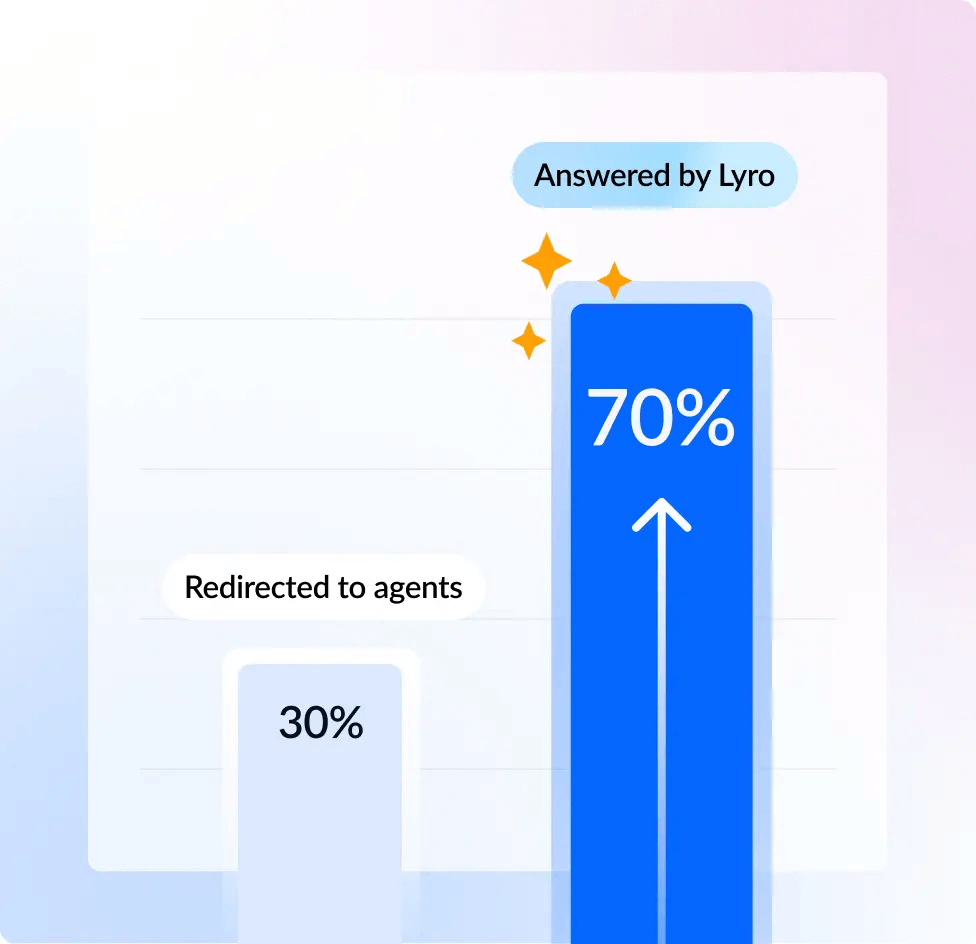
Lyro can answer from your knowledge base, ask follow-up questions, provide product recommendations and redirect conversations when it cannot help.
Tidio also offers AI-assisted replies and automated Flows for more structured journeys.
Melu’s public positioning is different. It sells human-operated managed messaging, not a configurable AI chatbot. Its operators can handle nuance, reassurance and unusual questions without forcing customers through a robotic maze.
That matters for businesses where trust is part of the sale.
A customer asking, “Can I cancel this?” may need policy information. A customer asking, “I’m worried this will not work for me,” may need empathy.
AI is fast. Humans are better at reading the room.
Who wins on support?
Tidio provides software support, with stronger support options available on higher plans.
Melu provides operational support through the service itself. Its team helps represent your business, manage conversations and improve the information used by operators.
The distinction is important:
- Tidio support helps your team use the tool.
- Melu’s service helps your customers get answers.
Who owns your customer conversations?
This is the part many comparison articles skip.
Both Tidio and Melu are closed-source SaaS platforms. You do not receive the source code, database schema or underlying conversation-routing system.
You are renting a workshop.
You can use the benches, tools and equipment while your subscription remains active. But you do not own the workshop, and you cannot move the entire building to another provider when you leave.
What do you actually keep?
With Tidio, you may keep access to conversation history, lead details and analytics while the account and retention rules allow it. Export and API capabilities can depend on your plan, with OpenAPI listed on higher tiers.
With Melu, you can access leads, transcripts and performance reports through the client portal. However, the service is designed around managed delivery rather than giving you a self-hosted copy of the system.
In both cases, ask these questions before signing up:
- Can we export all transcripts in a usable format?
- Can we export visitor, lead and tag data?
- How long is data retained after cancellation?
- Can we migrate the data into our CRM?
- Are exports manual, automated or API-based?
- What happens to AI knowledge bases, scripts and routing rules?
- Can we continue using the same conversation history elsewhere?
Your customers’ personal data rights are not the same thing as owning the software. GDPR access and portability rights may help you retrieve personal data, but they do not hand you the provider’s code or internal data model.
Golden Nugget: A conversation transcript may be portable. The platform organising, tagging, routing and analysing thousands of transcripts usually is not.
If ownership and portability matter, keep important lead details in a CRM you control. Store your FAQs, scripts and customer knowledge outside the chat platform too.
That turns the rented workshop into one useful tool inside a wider system, rather than the place where your entire customer relationship disappears.
Which tool suits your business?
For the freelancer or very small team
Choose Tidio if you can personally monitor chat and want to keep costs low.
Start with the free plan, add clear canned replies and use Lyro only for repetitive questions. Review conversation limits before sending paid traffic to the site.
For the agency
Choose Tidio if you need repeatable workflows, analytics and control across multiple client projects.
For broader marketing research, connect chat insights with tools such as Semrush, Hike and SE Ranking. Customer questions can reveal content gaps, buyer objections and new keyword opportunities.
For the business owner with no spare staff
Choose Melu if missed enquiries are costing more than the monthly service.
It is especially useful for professional services, local businesses and companies where every lead needs a prompt, human response.
For the control-conscious business
Neither tool is an owned asset.
Use either as a front-end communication layer, but keep your CRM, customer records, FAQs and reporting backups under your control.
You can find both tools, alongside other growth software, in the Grow Your Biz Toolbox.
For SEO and conversion work, follow Google’s people-first content guidance rather than creating content simply to chase rankings.
Final verdict
So, who wins Tidio vs Melu?
Tidio wins for software, AI, automation and control. It gives small businesses a flexible live chat platform that can grow from a free starting point into a more advanced customer service system.
Melu wins for convenience, human support and 24/7 lead capture. It removes the staffing headache and gives visitors a real person rather than another chatbot obstacle course.
Our final recommendation is simple:
- Pick Tidio when your team wants to manage conversations and automate repetitive work.
- Pick Melu when your business needs reliable human coverage without building an internal support rota.
- Pick neither blindly if you are not comfortable renting the system organising your customer conversations.
The best choice is not the one with the longest feature list.
It is the one that captures more valuable conversations, saves more staff time and leaves your business with a clear exit plan.
SEO Summary
- Focus Keyword: Tidio vs Melu
- SEO Title: Tidio vs Melu 2026: Best Live Chat Tool for Small Business?
- Slug:
tidio-vs-melu-2026 - Meta Description: Tidio vs Melu 2026 compared for small business. See pricing, usability, features, AI, support, data export risks and who owns your customer conversations.
- Alt Text Strategy: Include the focus keyword in every image alt tag. Describe the visual naturally, such as “Tidio vs Melu live chat team”, “Tidio vs Melu Lyro AI” and “Tidio vs Melu Grow Your Biz Toolbox”.


