

Attribution models are essentially the rulebooks we use to figure out which marketing touchpoints deserve credit for a conversion. Think of them as a referee in a match, deciding how to divvy up the praise when a customer finally makes a purchase. This is how marketers get a real sense of what's actually working.
Why Attribution Models Matter
Let's use a football analogy. The striker who scores the goal always gets the cheers, but what about the midfielder who made the pin-point pass? Or the defender who won the ball back to start the attack? Giving all the credit to the goal scorer misses the bigger picture of how the team worked together to win.
That’s a classic mistake in marketing. Without a proper attribution model, it’s all too easy to give 100% of the credit to the very last thing a customer did before buying – the "last click". This approach might make it look like your branded search ads are miracle workers, but it completely ignores the blog post, the social media ad, and the email newsletter that introduced your brand and guided that person towards the sale.
Attribution models help you see the whole story, not just the final chapter. They move you beyond celebrating the last click and give you a panoramic view of how all your channels team up to turn a stranger into a customer.
The Business Impact of Clear Attribution
Getting this full picture isn't just a nice-to-have; it directly affects your bottom line. When you put the right attribution model in place, you can start to:
- Make Smarter Budget Decisions: You'll see which channels are pulling their weight at different stages of the customer journey, so you can put your money where it will make the most impact.
- Justify Marketing Spend: You can finally show the true return on investment (ROI) for all your campaigns, not just the ones that happen to be at the end of the line.
- Optimise the Customer Journey: It becomes much easier to spot the weak links or friction points where you might be losing potential customers along the way.
There's a reason the UK business intelligence market, which covers these kinds of tools, is expected to grow at a compound annual rate of 9.2%. The move to cloud-based tools has made this technology far more accessible for everyone, with cloud attribution software alone seeing a huge 36.8% CAGR between 2018 and 2022. You can dig deeper into this market growth in the full report from Mordor Intelligence.
Ultimately, picking and using the right model is a fundamental part of any successful marketing strategy for a small business, because it gives you the clarity you need to grow your company efficiently.
Getting to Grips with Single-Touch Attribution Models

The simplest way to dive into attribution is by looking at single-touch models. As the name suggests, they work by giving 100% of the credit for a sale to just one marketing interaction. They are the absolute starting point for attribution, focusing on a single, decisive moment in the customer's journey.
While this simplicity is often seen as a weakness, it's also a major advantage, especially if you're just starting to figure out what works. It gives you a clear, uncomplicated answer to a very specific question. Let's break down the two main types: First-Touch and Last-Touch.
First-Touch Attribution: The 'Opener'
The First-Touch model is all about the beginning of the relationship. It gives full credit to the very first touchpoint a customer ever had with your brand. Think of it as rewarding the channel that first opened the door and brought someone new into your world.
This approach is incredibly valuable if your main goal is to build brand awareness and fill the top of your marketing funnel. It directly answers the question, "Which of our marketing efforts are best at finding brand-new customers?"
For instance, imagine someone stumbles upon your company by reading a blog post they found through a Google search. Even if they later see your social media ads and open a few marketing emails before buying, that initial blog post gets 100% of the credit for the sale.
Last-Touch Attribution: The 'Closer'
On the flip side, the Last-Touch model gives all the credit to the final interaction right before the customer converted. It’s the default setting in many popular analytics platforms, including Google Analytics, which has historically made it one of the most common models out there.
This model zeroes in on what ultimately pushed the customer over the line. It's perfect for understanding which channels are your best 'closers'. So, if a customer clicks on one of your paid search ads and immediately makes a purchase, that ad gets all the glory.
The biggest problem with any single-touch model is its tunnel vision. By assigning all the credit to one event, it completely ignores every other touchpoint that helped influence the customer's decision. This can paint a very skewed picture of what's really driving your success.
This oversimplification is the critical flaw you need to be aware of. The truth is, people rarely interact with a brand just once before they decide to buy. If you rely only on a single-touch model, you risk undervaluing all the hard work your other channels are doing to build awareness and nurture that relationship along the way.
Understanding Multi-Touch Attribution Models
While single-touch models are simple, they only ever show you a tiny slice of the customer's journey. To get the full picture, we need to look at multi-touch attribution models. These models work by sharing the credit for a sale across several different interactions, recognising that a conversion is almost never the result of a single click.
Instead of heaping all the glory on one "hero" channel, these more sophisticated models act like a panel of judges, carefully scoring each interaction that nudged a customer towards the final decision. This gives you a much more balanced and realistic view of what’s actually working in your marketing.
The image below breaks down the three main types of rules-based multi-touch models.
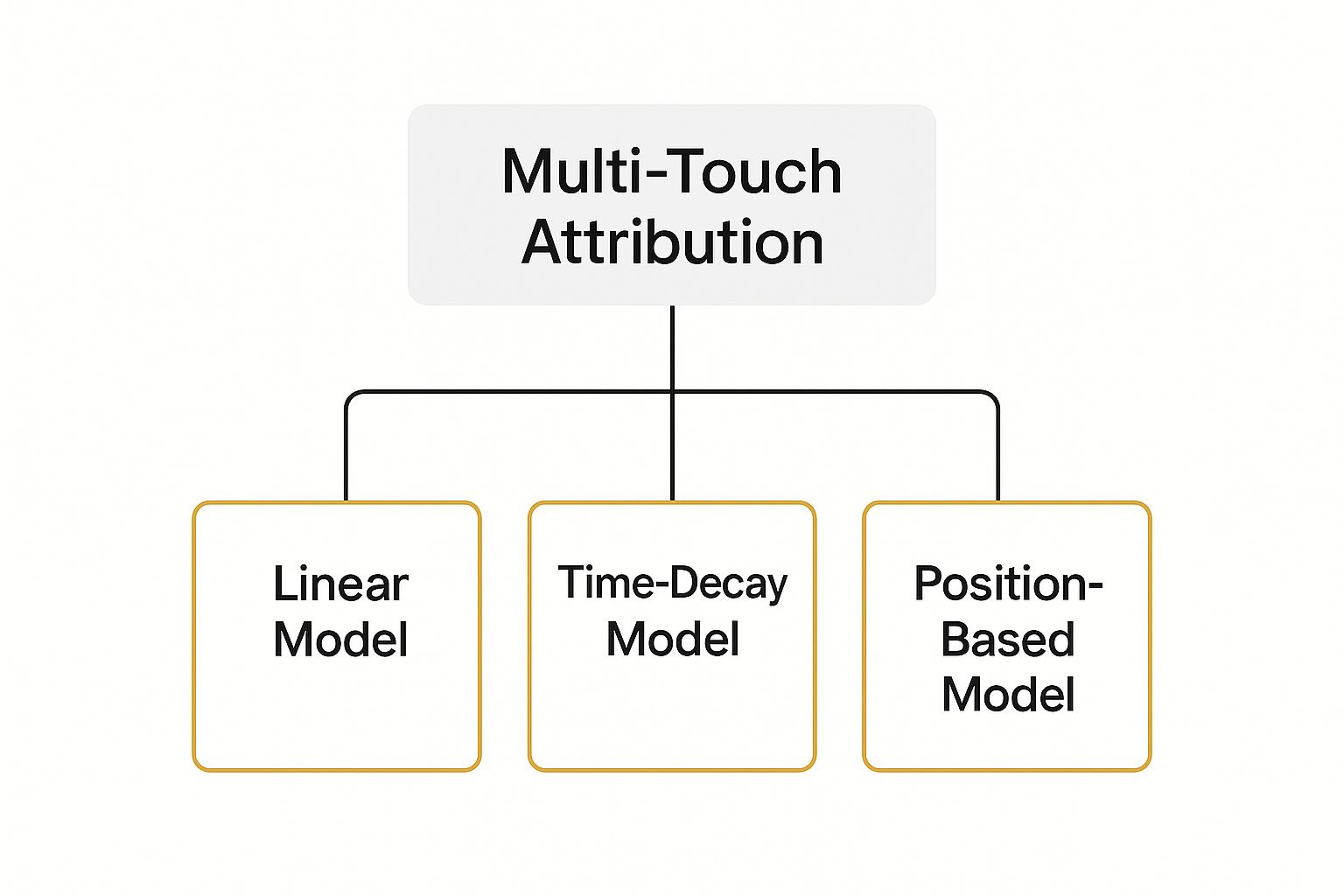
You can see how Linear, Time-Decay, and Position-Based models each offer a different lens for assigning credit to the various touchpoints along the path to purchase.
The Linear Model
The Linear model is the most democratic of the multi-touch approaches. It simply splits the conversion credit equally between every single touchpoint a customer engaged with before converting.
Let's say a customer makes a £100 purchase after this journey:
- Clicked a social media ad
- Read a blog post from organic search
- Opened an email newsletter
- Clicked a final paid search ad
With a Linear model, each of these four touchpoints gets exactly 25% of the credit (£25 each). It's simple, fair, and ensures no channel gets left out, giving you a baseline view of everything that contributed.
The Time-Decay Model
The Time-Decay model works on a different principle: the closer a touchpoint is to the final conversion, the more credit it should get. While all interactions receive some credit, the ones that happened most recently are given more weight.
Think of it like cramming for an exam. The chapter you reviewed the night before is much fresher in your mind than the one you studied two weeks ago. This model is especially handy for businesses with longer consideration periods, as it helps you see which channels are best at pushing prospects over the finish line.
The Position-Based Model
Often called the U-Shaped model, this approach gives special importance to two critical moments: the very first interaction (the one that opened the door) and the final interaction that led to the conversion (the one that closed the deal).
A common setup gives the first and last touchpoints 40% of the credit each. The remaining 20% is then spread evenly across all the interactions that happened in the middle.
This model is fantastic for marketers who believe in the power of both discovery and decision. It values the channels that bring in new leads just as much as the ones that finally convince them to buy.
To give you a clearer picture, let's compare these models side-by-side.
Comparing Common Multi-Touch Attribution Models
This table summarises how each multi-touch model we've discussed distributes credit differently, helping you understand their core focus and where they shine.
| Model Type | How Credit Is Distributed | Best For Measuring |
|---|---|---|
| Linear | Credit is split equally across all touchpoints in the journey. | The overall impact of every channel, treating all interactions as equally important. |
| Time-Decay | Touchpoints closer to the conversion receive more credit. | The effectiveness of channels that accelerate the final purchase decision. |
| Position-Based | Most credit goes to the first and last touchpoints, with the rest shared in the middle. | The impact of both initial awareness-driving channels and final conversion channels. |
Each model tells a slightly different story about your marketing efforts. The key is picking the one that aligns with how you believe your customers make decisions.
It's no surprise that larger companies are the biggest adopters of these more nuanced models. In the United Kingdom, for instance, large enterprises account for over 66% of the revenue share in the marketing attribution software market. Their marketing is often a complex web of digital ads, social media, print, and even television, making these sophisticated models essential for getting an accurate read on performance. You can dig into more data on this trend in the full Grand View Research report.
Choosing the Right Attribution Model for Your Business

Trying to pick the perfect attribution model can feel a bit like choosing the right lens for a camera. There's no single 'best' option. The right one for you depends entirely on what you want to bring into focus, which all comes down to your business goals, how long it takes a customer to buy from you, and your marketing strategy as a whole.
To make a smart choice, you first need to answer a few honest questions about your business. Think of these as your compass—they'll point you towards the models that will give you the most useful, practical insights.
Key Questions to Guide Your Selection
Let's start by digging into these critical factors. Your answers will immediately highlight which parts of the customer journey you need to measure and understand most.
- What’s my main business goal right now? Are you trying to generate brand-new leads and get your name out there (top-of-funnel)? Or is your main priority to drive final sales and squeeze more conversions out of your existing traffic (bottom-of-funnel)?
- How long is my typical sales cycle? Do people tend to buy on the spot, or do they take weeks—or even months—of consideration before committing to a purchase?
- How complex is the customer journey? Is the path to purchase pretty straightforward, or do your customers typically interact with multiple marketing channels before they decide to convert?
Answering these questions gives you the clarity you need to connect your business needs with the right model.
Matching Your Business to a Model
Once you've got your answers, you can start mapping them to the attribution models that actually make sense for your situation. Each model offers a different perspective, tailored to specific business realities.
For instance, a fast-moving e-commerce shop with a short sales cycle, where impulse buys are common, might find the Last-Touch model works just fine. It tells them exactly which channels are closing deals. Simple.
But for a B2B company selling expensive software, the sales cycle is long and complicated. A Last-Touch model would completely miss months of crucial relationship-building. For them, a Time-Decay or Position-Based (U-Shaped) model would provide a much richer, more accurate picture.
Here’s a quick breakdown of how different businesses might approach this:
- If you're focused on lead generation: The First-Touch model is your friend. It’s perfect for understanding how people first discover you, highlighting the channels that are best at filling the top of your marketing funnel.
- If you have a long sales cycle: This is where the Time-Decay model really shines. It gives more weight to the touchpoints that happened closer to the sale, reflecting how late-stage nurturing often pushes a lead over the finish line.
- If you value both discovery and conversion: The Position-Based model is a fantastic all-rounder. It gives hefty credit to both the very first touchpoint that brought the customer in and the final one that sealed the deal, recognising the importance of both ends of the journey.
By carefully aligning your model choice with the reality of your business, you stop looking at generic data and start uncovering actionable insights that can genuinely guide where you spend your marketing budget.
How to Implement Your Attribution Model
Choosing the right attribution model is one thing, but actually putting it to work is where you’ll see the payoff. It’s a move from strategy on paper to real-world results, and that transition lives or dies by your technical setup. Without clean, reliable data, even the most sophisticated model is just a shot in the dark.
At the heart of it all is data integrity. This just means getting all your tools—your website analytics, your CRM, your advertising platforms—to talk to each other properly. The goal is to stitch together a single, clear picture of the customer journey, breaking down the walls between data silos that hide how your channels actually support one another. A solid setup is the foundation of any good digital marketing, and it’s non-negotiable for accurate measurement. If you're still getting to grips with the basics, our beginner's guide to digital marketing is a great place to start.
The golden rule of implementation is simple: track everything consistently. Bad data is often worse than no data at all, because it gives you the confidence to make the wrong decisions.
Laying the Groundwork for Accurate Tracking
Before you can even think about analysing touchpoints, you need a way to see them in the first place. This means putting a few key pieces in place that work together to log every single interaction someone has with your brand. Think of it like setting up security cameras along your entire marketing path.
Here’s how to get your tracking in order:
-
Define Your Conversion Events: First things first, what does a "conversion" actually mean to you? Is it a sale? A lead form submission? A newsletter sign-up? Get specific, because this is the finish line you're measuring everything against.
-
Standardise UTM Parameters: Urchin Tracking Modules (UTMs) are the little tags you add to your links to see where your traffic is coming from. It's absolutely crucial to have a strict, consistent naming system for your
source,medium, andcampaigntags. This ensures a 'Facebook Ad' is always logged the same way, stopping your data from splintering into a useless mess. -
Integrate Your Platforms: Make sure your key systems, especially Google Analytics and your CRM, are properly linked. This connection is what lets you tie marketing clicks and visits directly to real customers and revenue, closing the gap between website behaviour and business results.
Configuring and Avoiding Common Pitfalls
With your tracking infrastructure built, you can finally start setting up your model inside your analytics tool. In Google Analytics, for instance, the Model Comparison Tool is your best friend. It lets you flick between different models—like First-Touch, Last-Touch, and Linear—to see exactly how the credit shifts from one channel to another.
But be warned, the road to implementation is paved with potential mistakes. One of the most common is inconsistent tracking. If your social media team uses one set of UTMs and your email team uses another for the same campaign, your data will be chaotic. Another classic blunder is forgetting to track offline touchpoints, like phone calls or event attendance, which can leave huge blind spots in the customer journey.
Get ahead of these issues from the start, and you'll build a system you can truly rely on for insights that make a difference.
The Future of Attribution: Moving Beyond Rules with AI and Data

So far, we've walked through attribution models that all follow a set of fixed rules. They're incredibly useful, but they have one common trait: they rely on you to make an assumption about which touchpoints deserve the credit. The future, however, is all about letting the data do the talking, powered by machine learning and artificial intelligence.
This shift is already well underway with Data-Driven Attribution (DDA). You'll find it as the standard model in platforms like Google Analytics 4, and it's a huge leap forward. Instead of sticking to a rigid formula, DDA uses machine learning to sift through every single conversion path on your website.
It cleverly compares the journeys of customers who converted with those who didn't, hunting for patterns. The algorithm then figures out the real influence of each interaction and assigns credit accordingly. It's no longer about guesswork; it's about probability.
Think of it this way: Data-Driven Attribution doesn't care about your opinion of what should be important. It uses your actual performance data to calculate what is important, giving you a far more objective and accurate picture of what's really working.
Beyond DDA: The Rise of Predictive AI
The potential for artificial intelligence in marketing measurement doesn't stop there. As AI becomes more sophisticated and easier to access, we're seeing the emergence of truly bespoke and even predictive attribution.
These advanced systems can crunch enormous amounts of data from all corners of your business—not just social media clicks and email opens, but offline sources like in-store visits or calls to your support team. By stitching all these threads together, AI builds a genuinely complete view of the entire customer journey.
- Predictive Power: AI models can start to forecast which marketing touchpoints are most likely to drive future conversions, helping you get ahead of the curve and optimise your campaigns proactively.
- Truly Custom Models: You can move beyond off-the-shelf solutions. AI can build an attribution model that’s created just for your business, taking into account your specific industry, sales cycle, and customer habits.
- Constant Learning: Perhaps most importantly, these models learn and adapt on the fly. As your customers change their behaviour, an AI model automatically adjusts how it assigns credit, ensuring your insights never go stale.
This move towards intelligent analysis is the next frontier for attribution models. It points to a future where our marketing decisions become more precise, predictive, and powerful than ever before.
Frequently Asked Questions About Attribution Models
https://www.youtube.com/embed/Cr8UQXIcQ50
Even when you've got the basics down, a few practical questions always pop up once you start digging into marketing attribution. Let's tackle some of the most common ones you'll likely face as you get your hands dirty.
What’s the Simplest Attribution Model to Start With?
If you're just dipping your toes into attribution, the Last-Touch model is your best starting point. It's straightforward and often the default setting in analytics platforms like Google Analytics. It simply gives 100% of the credit for a sale to the very last thing a customer clicked on.
Sure, it has its blind spots—it completely ignores all the earlier touchpoints that warmed the customer up. But it’s a fantastic first step. You'll get a quick, clear view of which channels are the final closers in your customer's journey.
How Often Should I Review My Attribution Model?
There's no single right answer, but a good rule of thumb is to take a fresh look at your model every quarter. You should also revisit it anytime you make a big shift in your marketing strategy.
For example, if you launch a major new channel like a podcast or your main business goal shifts from pure lead generation to building brand awareness, your old model probably won't tell you the whole story anymore. It's time for an update.
Can I Use More Than One Attribution Model at a Time?
Absolutely! In fact, you should. Looking at your data through the lens of a few different attribution models at the same time is one of the most powerful things you can do. It paints a much richer, more nuanced picture of how your marketing is really working.
You might see that your email campaigns look underwhelming with a Last-Touch model. But switching to a First-Touch view could reveal the immense advantages of email marketing in introducing your brand to new people. The Model Comparison Tool in Google Analytics is brilliant for this, letting you compare how channels perform as both initiators and closers.
At The Digital Marketing Toolbox, we centralise the best tools to help you measure, analyse, and grow your business. Find everything you need to implement a powerful attribution strategy at https://grow-your-biz.com.


