

When we talk about automating customer service, we're really talking about using smart tech like AI chatbots and intelligent ticketing systems to handle the straightforward, everyday customer questions on the spot. This isn't about replacing people; it's about freeing up your experienced support team to tackle the tricky, high-value problems that genuinely need a human touch. The result? A more efficient operation and happier customers.
Why Smart Automation Is Your New Competitive Edge
Let's be real—customer service automation has moved far beyond being a simple cost-cutting exercise. It’s now about meeting your UK customers right where they are, with the expectation of getting helpful, instant answers at any time of day or night. The conversation is no longer about just saving a few quid; it's a fundamental part of strategic business growth. The most successful businesses aren't getting rid of their support teams; they're giving them much better tools to work with.
The best way to think about it is as a partnership between your people and your technology. When you automate the common queries—the "Where is my order?" or "How do I reset my password?" type of questions—you hit two massive goals at once. First, you deliver the instant gratification customers have come to demand. Second, you rescue your skilled agents from the monotony of repetitive tasks, letting them apply their expertise to complex situations that actually build lasting customer loyalty.
A well-thought-out automation plan isn’t just a support department function. It’s a core business strategy that drives efficiency, delights customers, and can become a defining part of your brand's reputation.
From Cost Centre to Value Driver
Viewing your support team as a cost centre is a seriously outdated mindset. When you get automation right, you transform customer service into a part of the business that actively generates value. This shift is already happening all around us. For instance, UK retailers are leading the charge, using AI to redefine the modern shopping experience. It's predicted that by 2025, advanced AI will handle most routine questions, letting staff concentrate on the more nuanced issues. You can dive deeper into these evolving UK customer service trends.
Before we get into the "how," it's worth summarising some of the practical benefits of this approach.
Here are the key areas where customer service automation can truly make a difference, turning routine tasks into opportunities for efficiency.
Key Areas for Customer Service Automation
| Automation Area | Primary Benefit | Common Tools |
|---|---|---|
| Initial Query Triage | Instantly routes customers to the right department or agent. | AI Chatbots, IVR Systems |
| FAQ & Knowledge Base | Provides 24/7 self-service answers to common questions. | Help Centres, Chatbots |
| Order Status Updates | Gives customers real-time information without needing an agent. | E-commerce Integrations, Automated Emails/SMS |
| Password Resets | Securely handles a high-volume, low-complexity request. | Secure Web Forms, Automated Workflows |
| Ticket Categorisation | Automatically tags and prioritises incoming support tickets. | Intelligent Ticketing Systems |
Ultimately, a smart automation strategy delivers clear advantages that ripple across the business:
- Improved Agent Focus: When your team isn't drowning in basic, repetitive questions, their job satisfaction and performance skyrocket. They get to spend their time building relationships and solving problems that actually matter.
- Consistent Brand Voice: Automation ensures that every first point of contact is consistent, on-brand, and reliable. It creates a dependable experience for every single customer.
- Scalable Support: As your business grows, you can manage a much higher volume of enquiries without having to proportionally increase your team size. This makes your growth far more sustainable and profitable.
What you end up with is a powerful feedback loop. The data gathered from all these automated interactions gives you priceless insights into your customers' biggest frustrations, helping you constantly improve your products, services, and the support process itself. This guide will show you exactly how to build that winning strategy.
Building Your Automation Game Plan

Diving into automation without a clear destination in mind is a classic mistake. Before you even think about specific tools or software, you need a solid game plan. This isn't about vague ideas like "being more efficient"; it's about setting concrete, measurable targets that genuinely move the needle for your business.
Your first job is to become a detective. Scour your support channels for the most common, mind-numbingly repetitive questions that eat up your team's time. These are your golden opportunities for automation. What are the queries your agents could answer in their sleep? That’s your starting point.
For example, I once worked with a UK-based online fashion retailer who realised a staggering 60% of their emails were simple "Where is my order?" (WISMO) queries. We set a clear, actionable goal: Automate 75% of all WISMO enquiries within three months using a chatbot. This simple move freed up their team to focus on tricky returns and valuable pre-sales fashion advice.
Another common one is for SaaS companies. They often see a huge number of tickets for password resets. A smart target here would be to reduce password reset tickets by 90% by launching a simple self-service portal.
The secret is to find a specific, high-volume bottleneck and define exactly what a "win" looks like in numbers. This clarity is absolutely essential for proving the value of your efforts down the line.
Defining Your Core Objectives
To build out your plan, you need to get comfortable with your support data. Dig into your helpdesk reports and look for the most frequent ticket categories and, just as importantly, how much time your team spends on each one. With this information, you can set what are often called SMART goals (specific, measurable, achievable, relevant, and time-bound).
Here are a few real-world examples I've seen work well:
- For an e-commerce store: Reduce first-response time for non-order queries by 40%. The method? Use a chatbot to collect the customer's name, email, and issue before it gets to a human agent.
- For a local service business: Decrease inbound phone calls for appointment scheduling by 50%. This is often achieved by adding an automated booking system directly onto the website.
- For a subscription box company: Increase customer self-service resolutions by 30%. The key is to build a fantastic, easily searchable knowledge base that answers all the common account questions.
Setting these kinds of precise targets does more than just help you pick the right tool. It directly connects your customer service improvements to your wider business goals. In fact, it’s a vital piece of any good marketing strategy for small business because it has a direct impact on customer satisfaction and loyalty.
Creating a Phased Rollout Plan
Don't try to boil the ocean. You don't need to automate everything on day one. A phased, methodical rollout is nearly always the better, safer, and more successful approach. Start with that single biggest pain point you identified earlier.
Here’s a sensible way to structure it:
- Start with a Pilot: Launch your first automation—let's say it's that WISMO chatbot—to a small, controlled segment of your website visitors. This is your sandbox. It lets you test, learn, and fix things in a low-risk environment.
- Review and Refine: Check the pilot's performance against your goal. Did it actually deflect the number of tickets you hoped for? What did customers think of it? Use this real-world feedback to make smart adjustments.
- Go Live: Once you're happy with how it's performing, roll it out to all your customers.
- Tackle the Next Target: With one win under your belt, you can confidently move on to the next highest-priority project on your list.
This step-by-step process keeps you from overwhelming your team and, crucially, your customers. It means that every move you make to automate customer service is a calculated one, built on a foundation of solid data and proven results. Your game plan isn't a static document; it's a living guide that will grow and adapt right alongside your business.
Finding the Right Automation Tools for Your UK Business

So, you've got your goals mapped out. Now for the tricky part: picking the right software from a very, very crowded market. It’s easy to get overwhelmed by flashy features and aggressive sales pitches. Rushing this decision often leads to buyer's remorse, wasted cash, and a tool your team quietly resents using.
The secret is to match the tool to the task. You wouldn’t use a sledgehammer to hang a picture, right? The same logic applies here. You need software that solves the specific bottlenecks you've already identified, fits your budget, and can scale up as your UK business grows.
Let's look at the main types of tools you'll come across and figure out which one makes the most sense for you.
Getting to Grips With Your Tool Options
Not all automation is built the same. The tools on offer range from simple, single-purpose apps to hugely complex platforms. Understanding the fundamental categories from the get-go will save you a ton of time.
-
AI Chatbots: This is what usually springs to mind first. These bots live on your website and can handle a massive range of customer queries, from answering common questions to guiding someone through a returns process. The good ones use natural language processing (NLP) to understand what people are actually asking and respond in a surprisingly human way.
-
Automated Helpdesks & Ticketing Systems: Think of these as the central nervous system for your support team. They automatically grab enquiries from email, social media, and contact forms, then categorise and send them to the right person. It’s all about making sure no query ever falls through the cracks.
-
Self-Service Knowledge Bases: These are brilliant for deflecting tickets. By building a searchable library of articles, how-to guides, and FAQs, you give customers the power to find their own answers, 24/7, without ever needing to speak to a person.
Imagine a local plumbing business in Manchester. They probably just need a straightforward, rule-based chatbot on their website to handle booking enquiries and answer basic questions about their service area. It's a low-cost solution that solves a high-volume problem.
Now, think about a large UK e-commerce shop selling vintage clothing. Their needs are far more complex. The ideal setup might be an AI chatbot that integrates with their inventory for real-time stock checks, an automated helpdesk to manage returns and exchanges, and a detailed knowledge base with sizing guides and clothing care instructions.
Your business size and the complexity of your customer queries are the two biggest factors here. Don't get upsold on enterprise-level features if you only need to solve one or two core problems.
The Non-Negotiable Features to Look For
As you start comparing different platforms, some features are simply essential for a smooth and effective setup. You need to cut through the marketing fluff and focus on what will genuinely make a difference for your team and your customers.
Here’s a checklist of what to put at the top of your list:
-
Seamless CRM Integration: Your automation tool absolutely must talk to your Customer Relationship Management (CRM) system. This gives both your bot and your agents a full customer history, which is the key to providing support that feels personal and context-aware.
-
Customisation and Brand Voice: Can you change the colours, fonts, and, most importantly, the tone? Your automated responses need to sound like they come from your brand, not a generic, off-the-shelf robot.
-
Robust Analytics and Reporting: How do you know if it’s actually working? A good tool will have clear dashboards showing you vital metrics like ticket deflection rates, average resolution times, and customer satisfaction scores for automated chats.
-
Clear Escalation Paths: Let's be realistic: no bot can answer everything. A critical feature is the ability to seamlessly hand a conversation over to a human agent the moment a query gets too complex or a customer shows signs of frustration.
By focusing on these core capabilities, you can evaluate your options with confidence and choose a platform that will not only help you automate customer service today but also support your business as it grows.
Launching Your Automation System Without the Headaches
Getting your new automation system off the ground smoothly is absolutely critical. If you get this part right, your team and your customers will embrace it. A rushed launch, on the other hand, can create a mountain of new problems, leaving you with frustrated users and a team that’s lost faith in the whole project.
The secret is to be methodical. You need to start small and build on your wins.
The best place to begin is by mapping out your customer query flows. I mean this literally: get your support team in a room with a whiteboard and draw out the typical journey for your most frequent enquiries. Where does a query start? What key bits of information are needed along the way? Crucially, at what point does a human really need to get involved? This visual map is your blueprint for building effective automation rules and chatbot scripts.
This process is what makes automation feel helpful rather than like a barrier. For instance, a chatbot handling an order query shouldn't just bluntly ask for an order number. It's much more natural to first ask, "Are you getting in touch about an existing order?" If the customer says yes, then it asks for the number. It’s a small tweak that makes the conversation feel logical and less robotic.
Remember, the goal isn't just to deflect tickets; it's to resolve issues efficiently. A well-designed flow guides customers to a solution—whether that’s automated or human—with the least amount of friction.
Starting with a Phased Launch
If I could give just one piece of advice here, it would be this: avoid a "big bang" launch. Trying to automate everything at once is a classic recipe for disaster. Instead, you need to think in phases. Start with a small, manageable pilot programme that targets your most common, simple-to-solve issues.
Let’s say "how to track my delivery" is your number-one query. Make that your sole focus for phase one. Roll out your new chatbot or workflow to handle only that specific question, and only for a limited audience—maybe just 5% of your website visitors. This gives you a low-risk sandpit to work out the technical gremlins and polish your scripts based on how real people actually interact with them.
This infographic breaks down a simple flow for rolling out your automation, from the initial analysis right through to measuring what’s working.
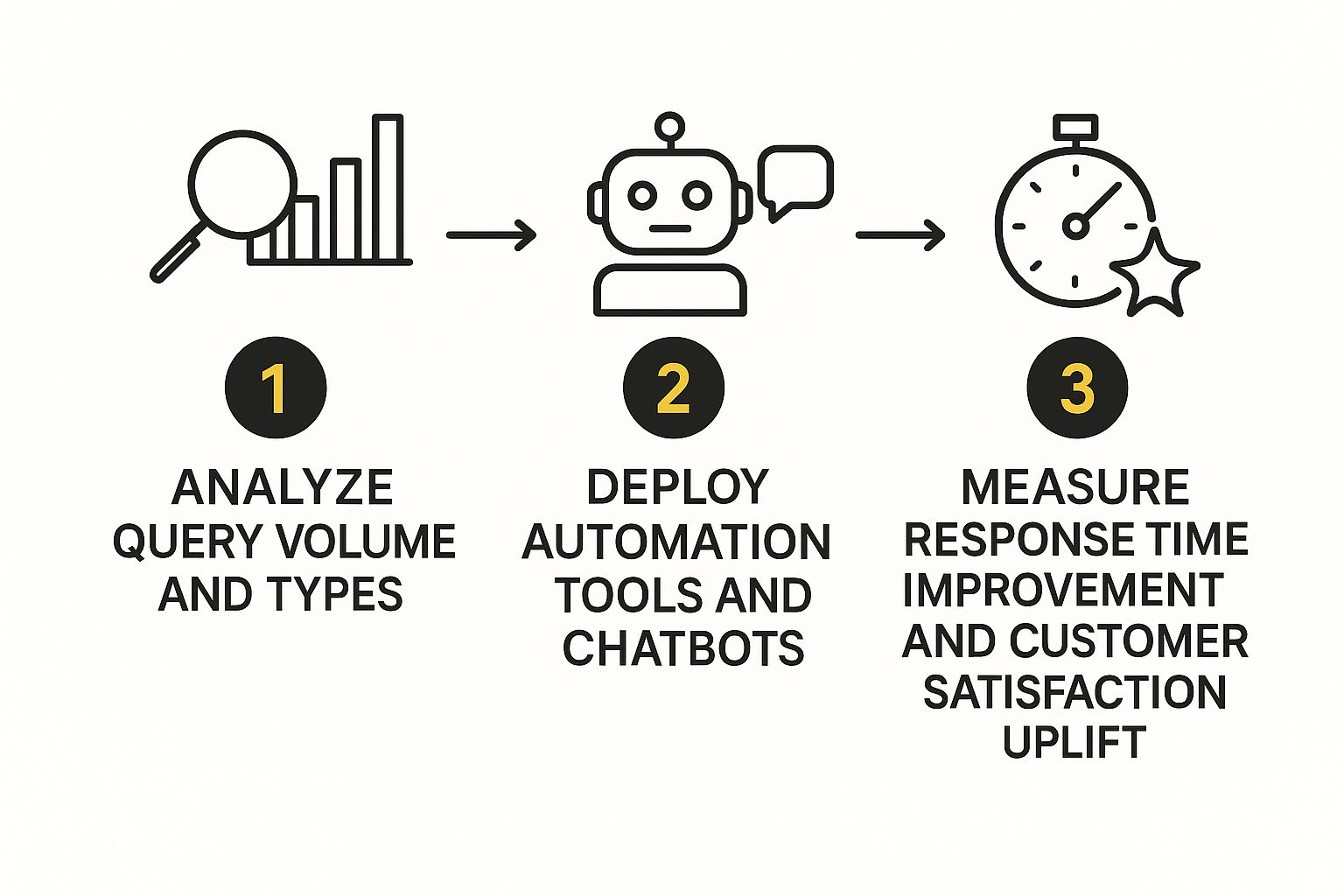
As the diagram shows, a successful rollout isn't a one-and-done task. It's a continuous loop where the data you gather directly fuels your next set of improvements.
Ensuring a Seamless Experience
As you get ready to go live, it’s vital to remember that automation has to fit neatly into your wider customer service ecosystem. Recent data from the UK Customer Satisfaction Index shows that while overall satisfaction is on the up, 26% of customers still have to jump between different channels to resolve a single issue. This just goes to show how important it is to have a connected, omnichannel strategy where automation is just one piece of the puzzle. You can read more about these UK customer service findings on the Institute of Customer Service website.
To make sure the transition is as smooth as possible, work through this practical checklist:
- Pre-Launch Testing: Get your internal team—not just the project managers—to try and "break" the system. Ask them to pose as customers with all sorts of problems to see how the automation copes under pressure.
- Clear Escalation Paths: The hand-off to a human agent needs to be flawless. This means the agent must get the full chat transcript so the customer never has to repeat themselves. It’s one of the biggest customer frustrations.
- Agent Training: Your team needs to feel confident. Don't just show them how the tools work; train them on how their roles will evolve. The goal is for them to focus on more complex, valuable and rewarding work, not to feel replaced.
By taking a deliberate, phased approach, you can successfully automate customer service functions in a way that genuinely helps your customers, empowers your team, and delivers tangible results for your business.
Getting Your Team and Your AI Working in Harmony
Bringing in new automation tools is one thing, but getting them to actually work for you is another beast entirely. The real magic happens when you build a powerful partnership between your people and your AI. This isn't a 'set it and forget it' situation. Think of it as an ongoing collaboration, where human insight constantly makes your technology smarter.
The first move is to change how your support agents see their own roles. They aren't being replaced; they're being promoted. Your training needs to shift their focus away from a high volume of simple, repetitive questions. Instead, they're becoming the masters of the new system—specialists who tackle the complex, high-stakes problems that need a human touch.
This means you’re equipping them with a whole new set of skills. They'll be analysing chatbot transcripts to spot recurring snags, escalating tricky cases with all the right context, and delivering the kind of nuanced, empathetic support that no AI can ever truly replicate. Their value isn't measured in speed anymore, but in depth.
Building a Cycle of Constant Improvement
To really get the best performance, you need to create a feedback loop where your team and your AI are always learning from each other. This is an active, hands-on process, not just a box you tick during setup. It's about regularly diving into the data to see where your automation is shining and, just as importantly, where it's dropping the ball.
This proactive approach is vital. Here in the UK, we're already seeing the huge benefits of automating customer service. In 2025, around 79% of contact centre agents said AI assistants give their productivity a major boost, helping them resolve issues far more quickly. These tools are there to enhance human skills, not make them redundant. You can discover more insights about these 2025 customer service trends to see how this partnership plays out in the real world.
Here’s how you can build that powerful improvement cycle:
- Scour your conversation logs. Make it a regular habit to analyse chatbot conversations. Pinpoint the exact moments where the bot gets confused, misunderstands a user's intent, or gives a dead-end answer. These are goldmines for improvement.
- Refine your AI's knowledge. Use what you find in the logs to update and sharpen your chatbot’s scripts and knowledge base. If customers keep asking the same question but phrasing it differently, teach your bot to recognise all those variations.
- Listen to your agents. Your team is on the front line every single day. Set up regular check-ins to ask them what’s working and what’s causing headaches. They’ll have brilliant, practical ideas for improving automated workflows and making escalations smoother.
The best way to think about it is to treat your AI like a new hire. It needs consistent training, honest feedback, and fresh information to do its job well. This collaborative process is what makes your automation smarter and more effective over time.
This constant feedback loop doesn't just make your support better—it can uncover valuable insights for other departments, too. For example, data from customer chats can highlight common questions about a product or points of confusion in your marketing. This is quite similar to the advantages of email marketing, where understanding your audience helps you send more relevant messages. When you connect these dots, your automation becomes a central part of a smarter, more customer-focused business.
Measuring the Real-World Impact of Your Automation

You’ve planned the strategy, rolled out the tools, and got the team up to speed. But here’s the million-dollar question: is any of it actually working? Proving the return on your automation investment isn’t just a box-ticking exercise; it's how you justify the budget and make savvy decisions about what comes next.
This is where you have to circle back to those specific, measurable goals you set right at the start. A vague sense that things are "more efficient" just won't fly. You need cold, hard data to prove precisely how you’ve managed to automate customer service in a way that helps your customers and your balance sheet.
Thankfully, most decent automation platforms come with built-in analytics dashboards. Your job is to cut through the noise, focus on the metrics that truly matter, and use them to tell a clear story of success. This data is your best friend for fine-tuning your approach and proving its value.
Key Performance Indicators You Must Track
To get a full picture of how your automation is performing, you need to track a mix of efficiency metrics and customer-focused ones. It's easy to get lost in a sea of data, so start by building a simple dashboard that zeroes in on these core Key Performance Indicators (KPIs).
-
Ticket Deflection Rate: Honestly, this is the big one. It measures the percentage of customer queries that your automation—be it a chatbot or a knowledge base—handled successfully without ever needing a human agent. A high deflection rate is a sure-fire sign your automation is doing its job.
-
Average Resolution Time (Automated vs. Human): Pit your bot against your human agents. For simple, repetitive questions, automation should be near-instantaneous. Comparing the two clearly highlights the speed and time-saving advantages your system is delivering.
-
Customer Satisfaction (CSAT) for Bot Interactions: Speed is great, but it’s nothing without satisfaction. Most chatbots can pop a quick "Did I resolve your issue?" question at the end of a conversation. Tracking this specific CSAT score is crucial for knowing whether you’re creating helpful experiences or frustrating roadblocks.
The ultimate goal is to find the sweet spot between efficiency and satisfaction. A sky-high ticket deflection rate looks brilliant, but not if your bot-specific CSAT scores are in the gutter. These metrics have to be looked at side-by-side.
Analysing the Data to Make Smarter Decisions
Once you're consistently tracking these KPIs, you can move from just gathering data to actually using it to improve.
For example, if you spot that your chatbot’s CSAT score plummets whenever it handles questions about returns, that's a massive red flag. You can then dive into those chat transcripts to see exactly where customers are getting stuck and refine the bot’s script to be clearer and more helpful.
Likewise, if your ticket deflection rate isn't hitting the mark, it might be a clue that your knowledge base articles are buried too deep, or your chatbot is struggling to understand certain types of questions. The data gives you a clear, actionable to-do list.
This continuous cycle—measure, analyse, refine—is what turns a basic automation setup into a powerhouse system that drives both customer loyalty and a healthier bottom line.
Still Have Questions About Customer Service Automation?
Even with the best-laid plans, it’s completely normal to have a few lingering questions before diving into customer service automation. In fact, most UK businesses we talk to have similar concerns. Let’s walk through some of the most common ones.
The biggest worry is often whether automation will make skilled team members redundant. The short answer? Absolutely not. Modern automation is built to support your team, not replace it.
Think of it this way: automation takes care of the repetitive, high-volume tasks like "Where's my order?". This frees up your human experts to tackle the complex, sensitive issues where they can truly shine—the problems that require real empathy and critical thinking. The result is often a more fulfilled and effective team.
Another common question revolves around cost. The investment can be anything from a modest monthly fee for a basic chatbot to a more significant sum for a bespoke AI system. The trick is to avoid boiling the ocean. Start by identifying your single biggest pain point and find a tool that solves it. This approach delivers a clear return on investment and gives you the confidence to expand later.
Will It Actually Understand Our UK Customers?
This is a brilliant question, and a crucial one for any UK-based company. Can a bot really get to grips with a Scouse accent, grasp a bit of Mancunian slang, or understand the nuances of a customer from Glasgow?
Yes, it can. Today's AI and Natural Language Processing (NLP) technology are surprisingly sophisticated. The leading platforms are trained on vast amounts of data that specifically include regional dialects, common slang, and different accents from across the UK.
When you're evaluating potential tools, make it a point to ask vendors directly about their model's training on British English. This is key to ensuring your bot feels genuinely helpful and doesn't just sound like a confused American import.
The aim of automation isn't to build a wall between you and your customers. It's about offering a faster, more direct route to an answer. For simple queries, a well-designed bot can feel just as effective as a person.
Remember, automation is just one piece of the puzzle. It works best as part of a wider plan to engage with your audience. For more on this, our beginner's guide to digital marketing offers a great overview of the bigger picture.
Ready to find the right tools for your business? The Digital Marketing Toolbox helps you discover and compare the best chatbots, helpdesks, and AI assistants to power your growth. See what's out there at https://grow-your-biz.com.


