
In today's competitive market, choosing the right email marketing platform is a critical business decision that directly impacts your customer engagement strategy. With dozens of tools all promising superior deliverability, advanced automation, and seamless integrations, finding the one that truly aligns with your specific goals, budget, and audience can feel overwhelming. This comprehensive guide is designed to cut through the noise and simplify that decision.
We will provide a detailed analysis of the best email marketing platforms available to UK businesses, moving beyond surface-level feature lists. For each platform, we explore practical use cases, present an honest assessment of its limitations, and highlight crucial implementation considerations, such as UK and EU data residency and GDPR compliance. This resource is organised to help you quickly compare your options and identify the ideal solution.
Whether you're a small business owner seeking a cost-effective tool, an e-commerce manager aiming to boost conversions, or a marketing professional exploring sophisticated AI-driven automation, this article will help you find your perfect match. Each review includes screenshots and direct links to help you evaluate the platforms efficiently. We've done the in-depth research, so you can confidently select the right tool to elevate your email marketing efforts.
1. Email Marketing – Grow Your Biz
Kicking off our list is not a single platform, but an expertly curated resource hub from Grow Your Biz. This isn't your typical software provider; instead, it acts as a strategic launchpad, aggregating and analysing some of the industry's most powerful email marketing tools. This unique approach makes it an invaluable starting point for any business trying to navigate the often-crowded market of email solutions.
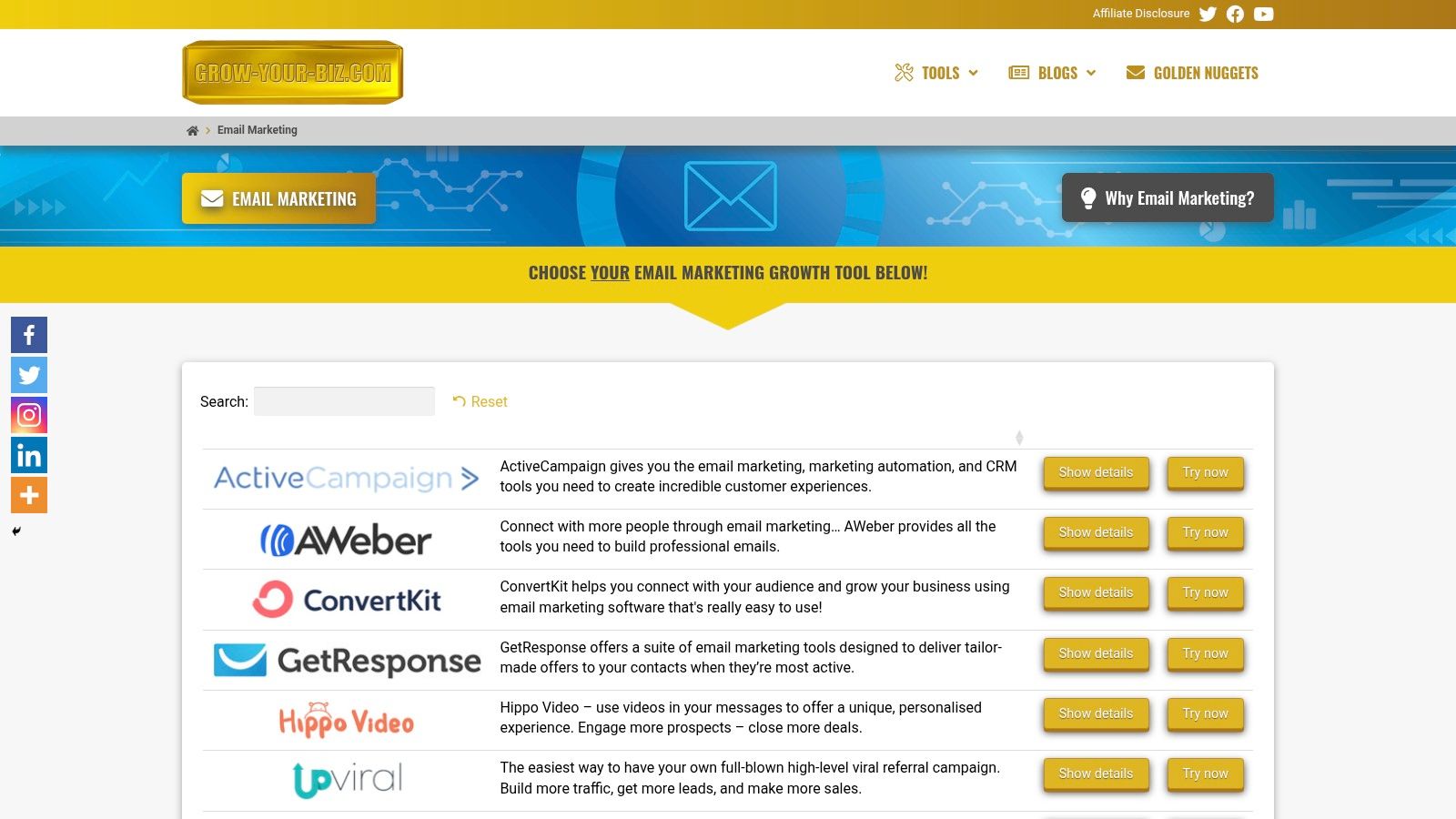
The primary strength of the Grow Your Biz hub is its focused curation. Rather than overwhelming you with dozens of options, it spotlights a select group of vetted platforms: ActiveCampaign, AWeber, ConvertKit, and GetResponse. This allows you to perform a direct, side-by-side comparison of features, pricing structures, and unique specialisations, all in one place. It saves considerable research time and centres your decision-making on proven, reliable options.
Key Strengths and Use Cases
The hub excels by translating complex feature sets into practical benefits, making it easier to determine which platform aligns with your specific business needs.
- For Growing Businesses: If you’re scaling up and need robust automation, the hub’s breakdown of ActiveCampaign’s CRM and automation capabilities provides clear, actionable insights.
- For Content Creators: For bloggers or creators focused on audience connection, the analysis of ConvertKit’s creator-centric tools is particularly useful.
- For Agencies: Marketing agencies can use the hub to quickly evaluate which platform offers the best multi-client management and reporting features.
Why It Stands Out
What truly distinguishes this resource is the layer of expert analysis. Instead of just listing features, Grow Your Biz provides context on why a specific tool is a good fit for a particular goal. This guidance helps you move beyond basic feature checklists to understand the strategic value of each platform. While email is a powerful channel, it's also wise to understand the broader digital marketing landscape. For instance, a detailed comparison of SMS marketing vs. email marketing can help you decide when to use each channel for maximum impact.
Key Takeaway: The Grow Your Biz hub is one of the best email marketing platforms resources because it simplifies the selection process, offering a trusted, pre-vetted shortlist that accelerates your journey to finding the perfect tool.
Best For: Businesses, freelancers, and agencies who want to save time by comparing top-tier, pre-vetted email marketing solutions.
Access: Visit the Email Marketing Hub on grow-your-biz.com
2. Mailchimp
Mailchimp is often the first platform that comes to mind for email marketing, and for good reason. It has established itself as a go-to solution for small to medium-sized businesses (SMBs) due to its user-friendly interface, comprehensive feature set, and scalable pricing. Its drag-and-drop builder and extensive template library make it incredibly easy for beginners to create professional-looking campaigns without any coding knowledge. This focus on simplicity and powerful core features makes it one of the best email marketing platforms for those just starting out or managing a growing list.
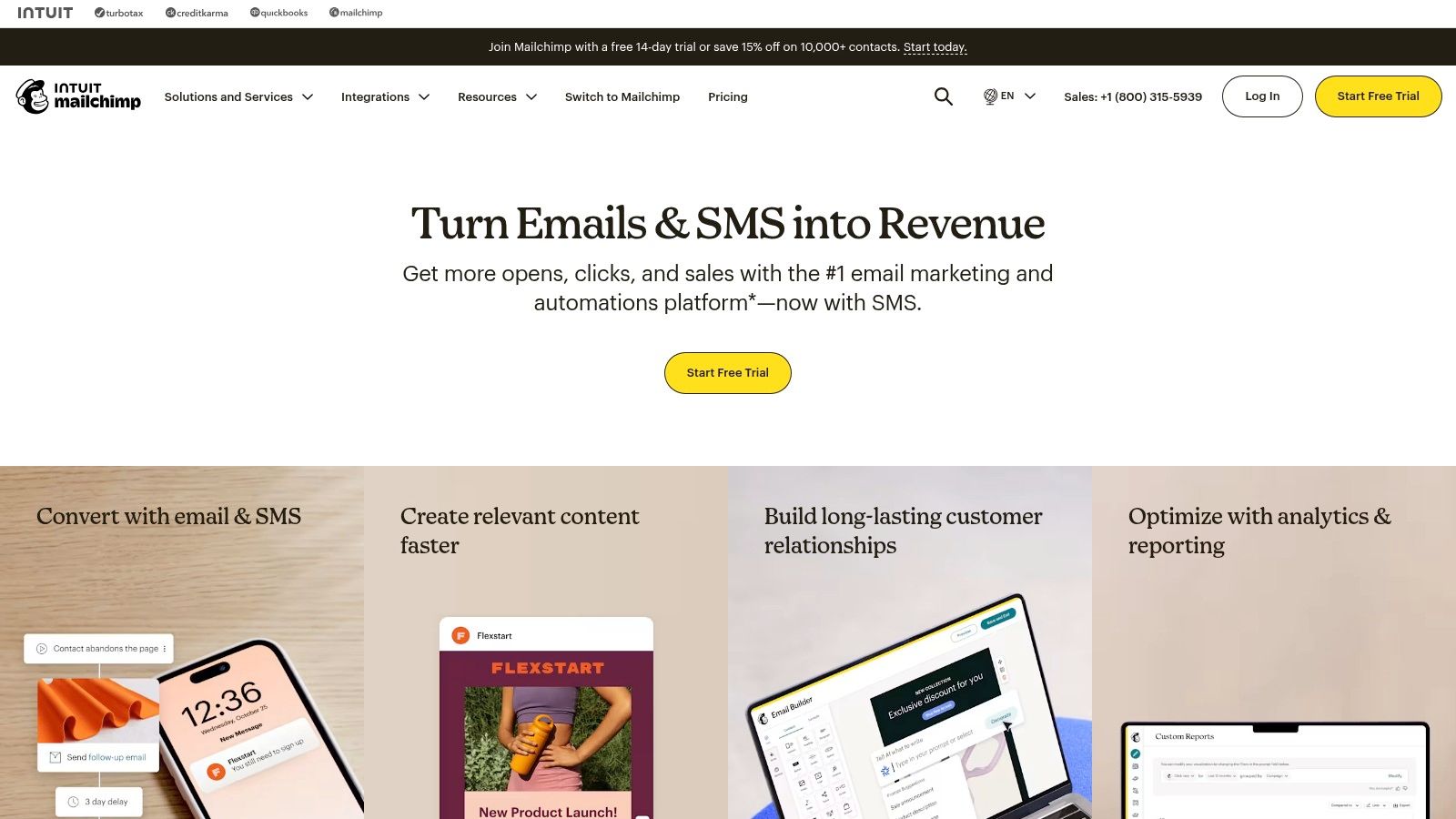
Mailchimp’s real strength lies in its all-in-one marketing approach, which combines email with basic CRM, landing pages, and social media ads. This makes it an ideal central hub for a small business's digital presence. Integrating it into your broader marketing strategy is key to maximising its potential; learn more about developing an effective marketing strategy for your small business.
Key Features & Ideal Use Case
- Best For: SMBs, bloggers, and startups looking for an easy-to-use, all-in-one platform with a clear growth path.
- Pricing: Offers a generous Free plan, with paid tiers starting at Essentials, then Standard, and Premium. Costs scale based on contact count and feature access.
- Standout Feature: Its vast integration marketplace allows you to connect Mailchimp to hundreds of other apps like Shopify, Canva, and Zapier, creating a seamless workflow.
- Pro Tip: Use Mailchimp's segmentation tools to send targeted campaigns based on user behaviour, such as purchase history or email engagement. This can significantly improve your open and click-through rates.
Pros:
- Intuitive and beginner-friendly interface.
- Excellent reporting and analytics tools.
- Strong ecosystem and community support.
Cons:
- Can become expensive as your list grows compared to some competitors.
- UK/EU users should note that data transfers rely on SCCs/DPF due to its US-based servers, which requires careful consideration for GDPR compliance.
Website: https://mailchimp.com
3. Brevo (formerly Sendinblue)
Brevo, previously known as Sendinblue, has carved out a strong position as one of the best email marketing platforms by offering a feature-rich, all-in-one suite at a highly competitive price point. Its unique selling proposition is its pricing model, which is based on email volume rather than contact list size, making it exceptionally budget-friendly for businesses with large audiences but infrequent sending needs. This approach, combined with its powerful multichannel capabilities, makes it a versatile choice for small and medium-sized enterprises (SMEs).
Beyond standard email campaigns, Brevo integrates SMS, WhatsApp, a sales CRM, and landing pages into a single dashboard. This allows for a more unified customer communication strategy without the need for multiple subscriptions. For UK and EU-based businesses, its commitment to hosting data on EU-based servers via OVH and Google Cloud is a significant advantage, simplifying GDPR compliance and data processing considerations.
Key Features & Ideal Use Case
- Best For: Cost-conscious startups, SMEs, and seasonal businesses looking for an affordable, multichannel marketing platform with strong automation features.
- Pricing: Offers a generous Free plan with up to 300 emails/day. Paid tiers include Starter and Business, with pricing based on monthly email volume.
- Standout Feature: Its multichannel functionality allows you to orchestrate campaigns across email, SMS, and WhatsApp from one place, providing a truly integrated customer experience.
- Pro Tip: Leverage the marketing automation workflow builder, even on lower-tier plans, to create sequences for welcoming new subscribers or recovering abandoned carts, maximising engagement with minimal effort.
Pros:
- Transparent and scalable volume-based pricing is great for large lists.
- Comprehensive all-in-one platform includes CRM, SMS, and more.
- EU-based data hosting simplifies GDPR compliance for UK/EU users.
Cons:
- The free plan is limited to 300 daily emails and includes Brevo branding.
- Some advanced features like A/B testing and send-time optimisation require a higher-tier Business plan.
Website: https://www.brevo.com
4. MailerLite
MailerLite excels by combining a clean, intuitive interface with a powerful feature set at a highly competitive price point, making it a favourite among creators, small businesses, and non-profits. It strips away unnecessary complexity to focus on core email marketing essentials, allowing users to build beautiful campaigns, automated workflows, and even entire websites with ease. This streamlined approach makes it one of the best email marketing platforms for those who need professional tools without a steep learning curve or high budget.
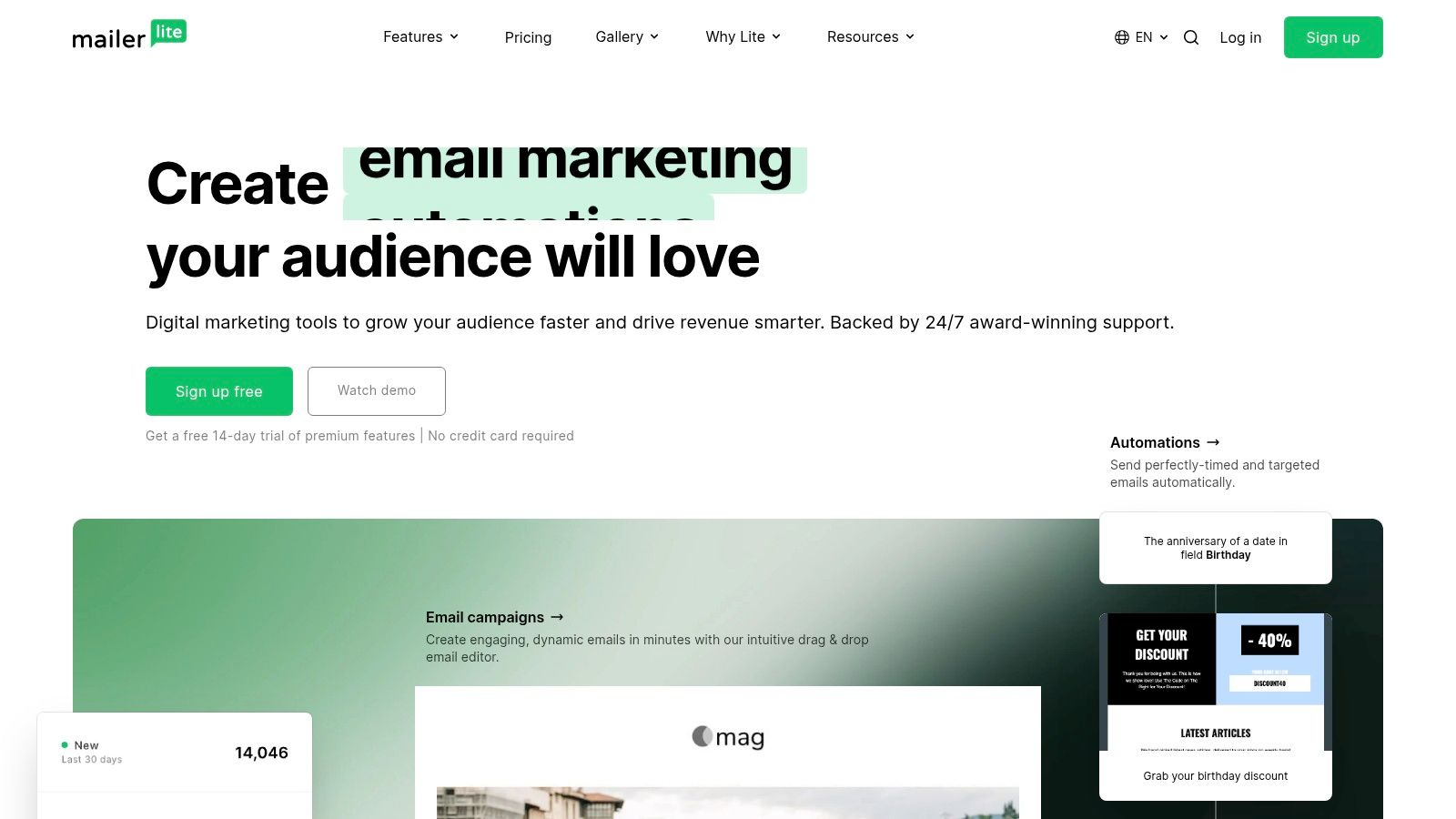
Its commitment to user-friendliness is evident in its drag-and-drop editor and helpful AI writing assistant, which helps overcome creative blocks. For UK and EU businesses, MailerLite offers a significant advantage with EU-based data hosting, simplifying GDPR compliance. This focus on providing strong value and regional data consideration cements its place as a top contender for budget-conscious marketers.
Key Features & Ideal Use Case
- Best For: Creators, freelancers, and SMBs seeking an affordable, easy-to-use platform with strong core features like automation and landing pages.
- Pricing: Offers a Free plan for up to 1,000 subscribers, with paid plans including Growing Business and Advanced. Pricing is highly competitive as your list grows.
- Standout Feature: The ability to build unlimited websites and landing pages, even on paid entry-level plans, provides exceptional value and centralises your digital marketing efforts.
- Pro Tip: Use the built-in automation builder to create a welcome email series for new subscribers. This is a simple but highly effective way to engage your audience from the very first interaction.
Pros:
- Clean, minimalist user interface that is very easy to navigate.
- Excellent value for money, with generous feature sets on all plans.
- EU data residency option is a major plus for GDPR compliance.
Cons:
- Lacks some of the deeply advanced automation and reporting features found in more enterprise-focused platforms.
- The free plan has MailerLite branding which can only be removed on paid tiers.
Website: https://www.mailerlite.com
5. Campaign Monitor
Campaign Monitor positions itself as a premium email marketing platform for brands that prioritise design and professionalism. It empowers businesses to create visually stunning, on-brand emails with an intuitive drag-and-drop builder and a library of beautiful, mobile-responsive templates. Its focus on polished aesthetics and powerful personalisation makes it an excellent choice for organisations where brand image is paramount. This platform excels at helping you deliver a consistent and high-quality experience directly to your audience's inbox.
Where Campaign Monitor truly distinguishes itself is in its features tailored for marketing agencies and multi-brand companies. It offers robust tools for managing multiple clients under a single account, including private labelling (white-labelling) and specific user permissions. This makes it one of the best email marketing platforms for agencies seeking to provide branded email services, as it streamlines client management and billing while maintaining a professional front.
Key Features & Ideal Use Case
- Best For: Design-conscious brands, e-commerce stores, and marketing agencies managing multiple client accounts.
- Pricing: Offers a Lite, Essentials, and Premier plan, with costs scaling based on your contact list size. A limited free trial is available to test the platform.
- Standout Feature: Its comprehensive agency toolset, which includes client dashboards, private labelling, and mark-up billing, provides a complete solution for resellers.
- Pro Tip: Use the built-in Link Review tool before sending any campaign. It automatically crawls your email and flags any broken or missing links, preventing embarrassing errors and ensuring a seamless user experience.
Pros:
- Exceptional, visually attractive email templates and a user-friendly editor.
- Agency-friendly features for multi-client and white-label management.
- Strong analytics and reporting to track campaign performance effectively.
Cons:
- Pricing can become expensive compared to competitors as your list size increases.
- Some advanced features, like send-time optimisation, are restricted to higher-priced tiers.
Website: https://www.campaignmonitor.com
6. ActiveCampaign
ActiveCampaign positions itself as a customer experience automation platform, going far beyond standard email marketing. It excels by tightly integrating powerful marketing automation with a native CRM, making it a top choice for sales-driven businesses that need to nurture leads through a complex sales funnel. Its visual automation builder is one of the most sophisticated on the market, allowing you to create intricate workflows based on user behaviour, site visits, and custom events. This makes it one of the best email marketing platforms for businesses focused on lead scoring and sales alignment.
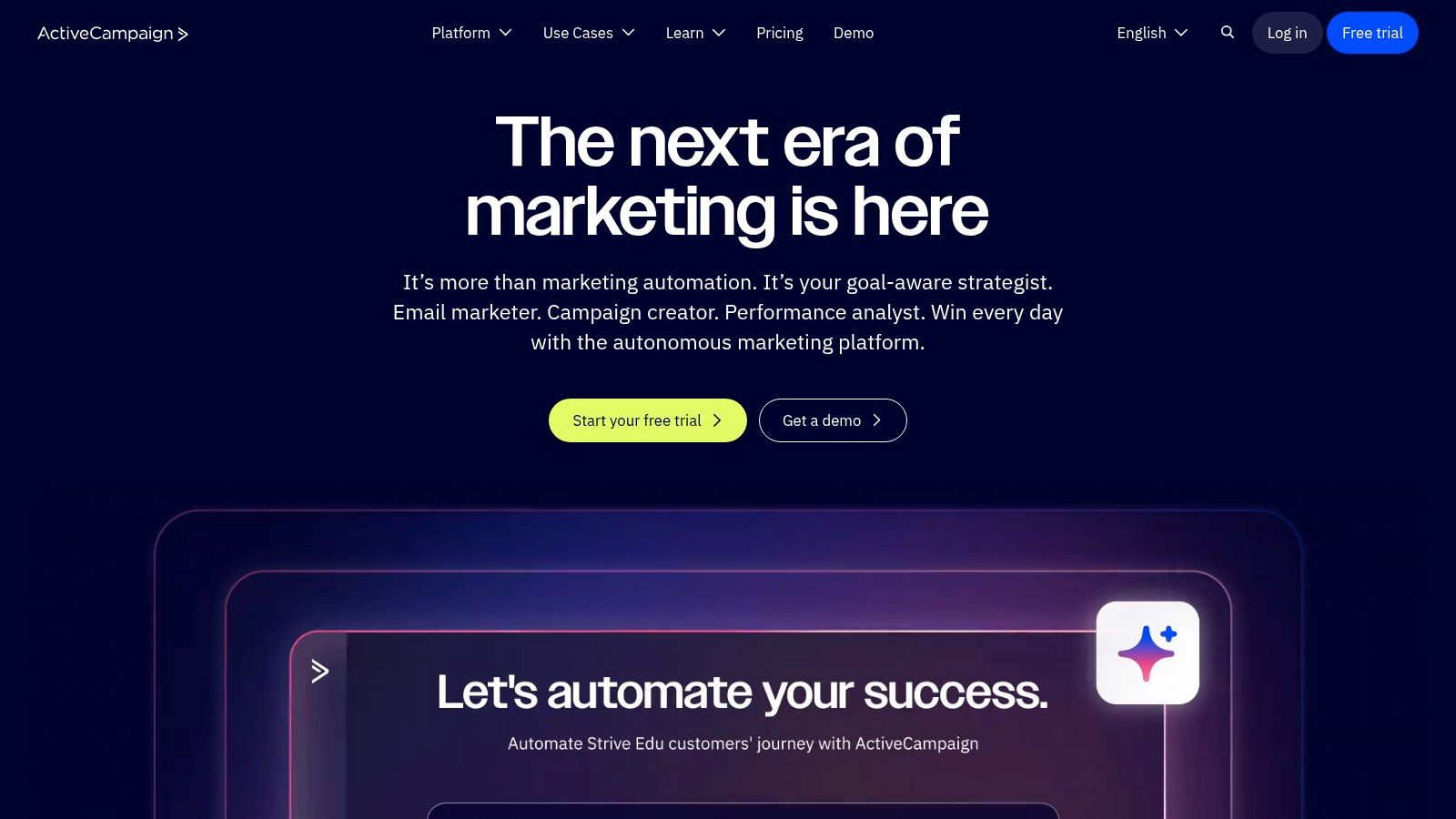
The platform's strength is its ability to centralise marketing and sales activities. By combining email, CRM, and even WhatsApp marketing, ActiveCampaign helps teams maintain a single source of truth for every customer interaction. This unified approach is ideal for service-based businesses or e-commerce stores where personalised follow-up and long-term relationship building are crucial for driving revenue.
Key Features & Ideal Use Case
- Best For: Sales-focused SMEs, B2B companies, and advanced marketers who need robust automation and an integrated CRM.
- Pricing: Pricing is tiered (Marketing Lite, Plus, Professional) and based on contact numbers. A Sales Plus plan adds more CRM features. Discounts are available for non-profit organisations.
- Standout Feature: Its visual automation builder provides unparalleled flexibility, with deep triggers like site tracking, event tracking, and conditional logic that enable truly personalised customer journeys.
- Pro Tip: Leverage the built-in CRM to create segments based on deal stages or lead scores. This allows you to send hyper-targeted emails that align perfectly with a contact's position in the sales pipeline.
Pros:
- Industry-leading marketing automations with deep triggers and logic.
- Integrated CRM and marketing reduces the need for multiple tools.
- Excellent segmentation and personalisation capabilities.
Cons:
- The complex pricing and packaging structure can be confusing to navigate.
- Presents a steeper onboarding curve for beginners compared to simpler platforms.
Website: https://www.activecampaign.com
7. Klaviyo
Klaviyo has carved out a dominant position as the email and SMS platform built specifically for e-commerce brands. Its power lies in its deep, native integrations with major online store platforms like Shopify, BigCommerce, and WooCommerce. This allows for incredibly sophisticated, data-driven automation that goes far beyond standard email marketing. For online retailers, particularly in the UK, Klaviyo is often considered one of the best email marketing platforms because it ties every campaign directly back to revenue.
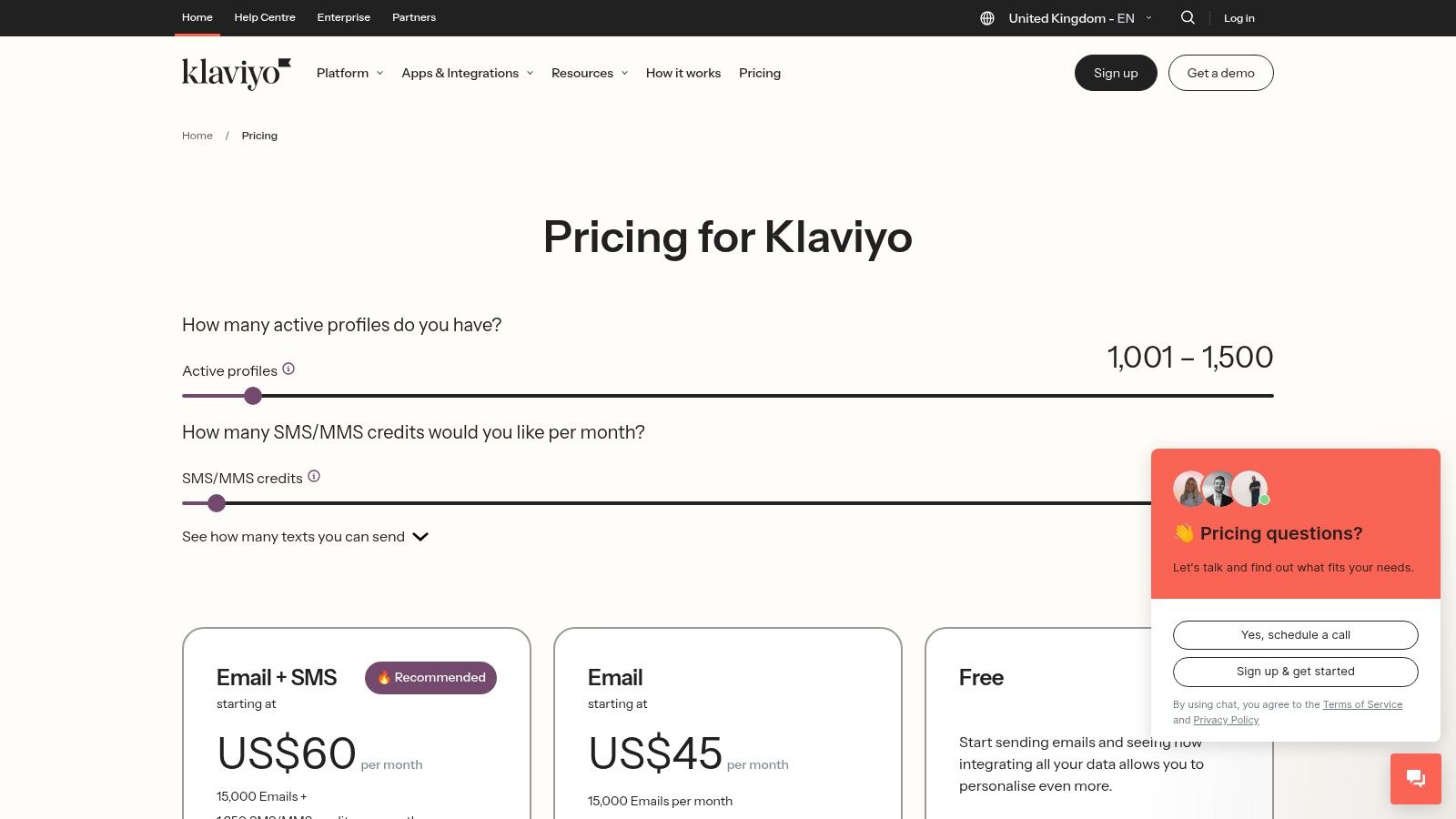
The platform enables businesses to leverage rich customer data, such as browsing behaviour, cart contents, and purchase history, to create highly personalised experiences. This focus on e-commerce-centric data makes it an indispensable tool for brands aiming to drive repeat purchases and increase customer lifetime value through targeted communication.
Key Features & Ideal Use Case
- Best For: E-commerce businesses of all sizes, especially those on Shopify or WooCommerce, that need powerful, revenue-focused automation.
- Pricing: Offers a Free plan for up to 250 contacts. Paid plans scale based on the number of contacts and email/SMS sends, with combined or separate pricing available.
- Standout Feature: Its pre-built, e-commerce-specific automation flows, such as abandoned cart reminders, browse abandonment, and customer win-back series, are best-in-class and can be deployed quickly.
- Pro Tip: Utilise the predictive analytics feature to segment customers based on their likelihood to purchase, expected next order date, or churn risk. This allows for proactive and highly effective campaign targeting.
Pros:
- Unparalleled integration and data sync with e-commerce platforms.
- Advanced segmentation based on real-time shopping behaviour.
- Strong reporting that directly attributes revenue to email and SMS campaigns.
Cons:
- Can become one of the more expensive options as your contact list and SMS usage grow.
- The sheer number of features can present a steeper learning curve for complete beginners compared to simpler platforms.
Website: https://www.klaviyo.com/uk/pricing
8. HubSpot Marketing Hub
HubSpot Marketing Hub is more than just an email tool; it's a complete marketing automation platform built upon a powerful CRM. It’s designed for businesses that are scaling from small to mid-market and require sophisticated, multi-channel campaign management. By unifying email, social media, landing pages, and ads in one place, it provides a holistic view of the customer journey, making it one of the best email marketing platforms for data-driven teams.
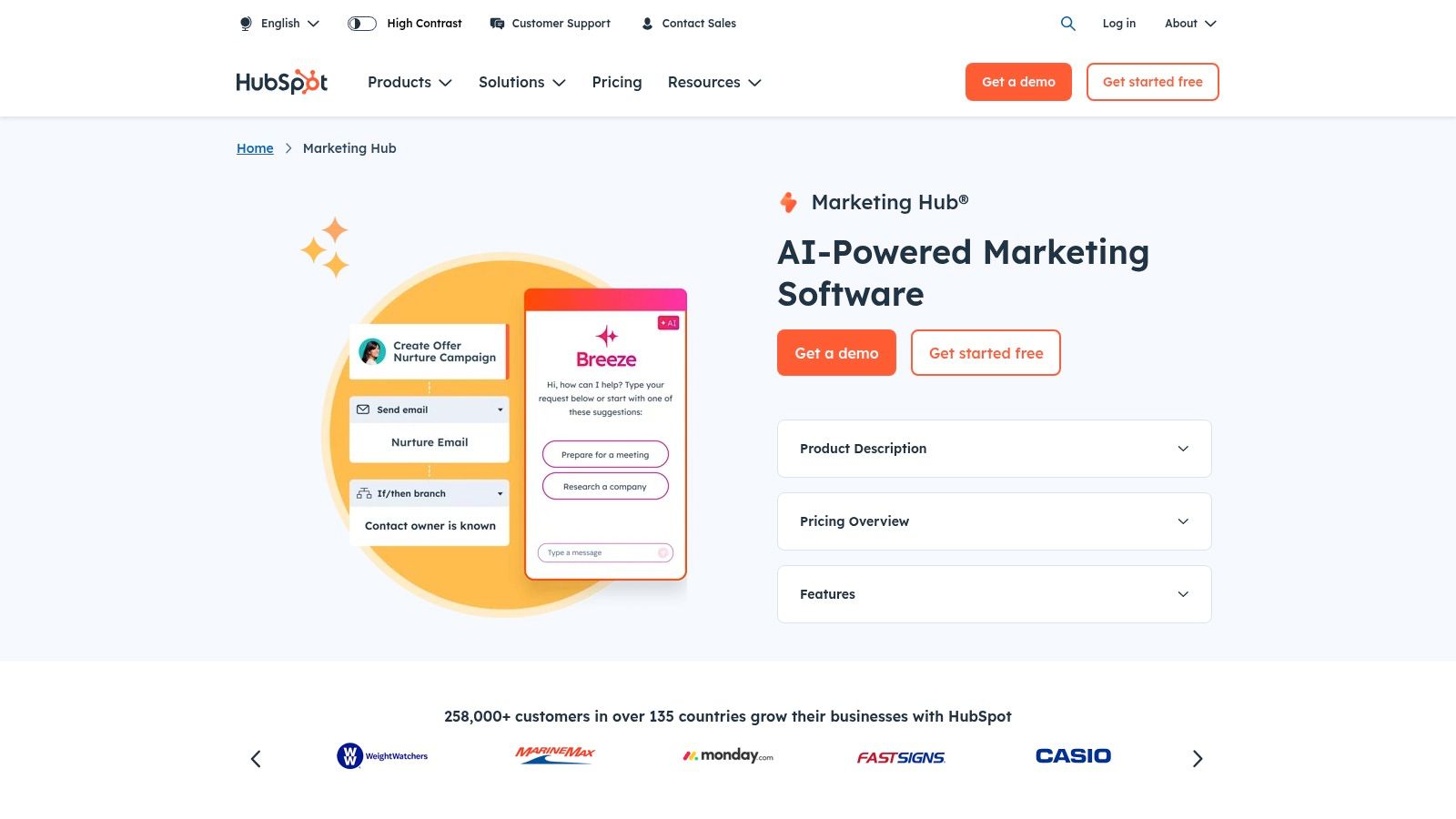
The platform's true advantage lies in its seamless integration with the HubSpot CRM, allowing for incredibly personalised and automated marketing based on real-time customer data. This integrated approach is a core concept in modern digital marketing, and leveraging it effectively can transform your outreach. To understand the fundamentals, you can explore this beginner's guide to digital marketing.
Key Features & Ideal Use Case
- Best For: SMEs and mid-market companies needing an all-in-one CRM and marketing automation solution with advanced reporting.
- Pricing: Starts with a range of Free tools. Paid plans are Starter, Professional, and Enterprise, with costs increasing based on marketing contacts and features.
- Standout Feature: The unified data model where marketing actions are directly tied to CRM records, enabling enterprise-grade analytics and detailed customer journey mapping.
- Pro Tip: Utilise the advanced workflow builder in Professional and Enterprise tiers to create automated nurturing sequences that trigger based on specific contact properties or website interactions, guiding leads through the funnel with minimal manual effort.
Pros:
- Deeply integrated CRM provides a single source of truth for customer data.
- Powerful analytics and customisable reporting on higher-tier plans.
- Comprehensive multi-channel campaign management capabilities.
Cons:
- Can be very expensive, especially with the per-seat pricing and mandatory onboarding fees for Professional/Enterprise tiers.
- The sheer number of features can present a steep learning curve for new users.
Website: https://www.hubspot.com/products/marketing
9. GetResponse
GetResponse positions itself as more than just an email service; it’s an all-in-one marketing platform designed for businesses that need a wide range of tools without a hefty price tag. It excels by integrating powerful features like sales funnels and webinar hosting directly into its core offering, which is a significant advantage for course creators, coaches, and content marketers. This consolidation of tools makes it one of the best email marketing platforms for entrepreneurs who want to manage lead generation, nurturing, and conversion from a single dashboard.
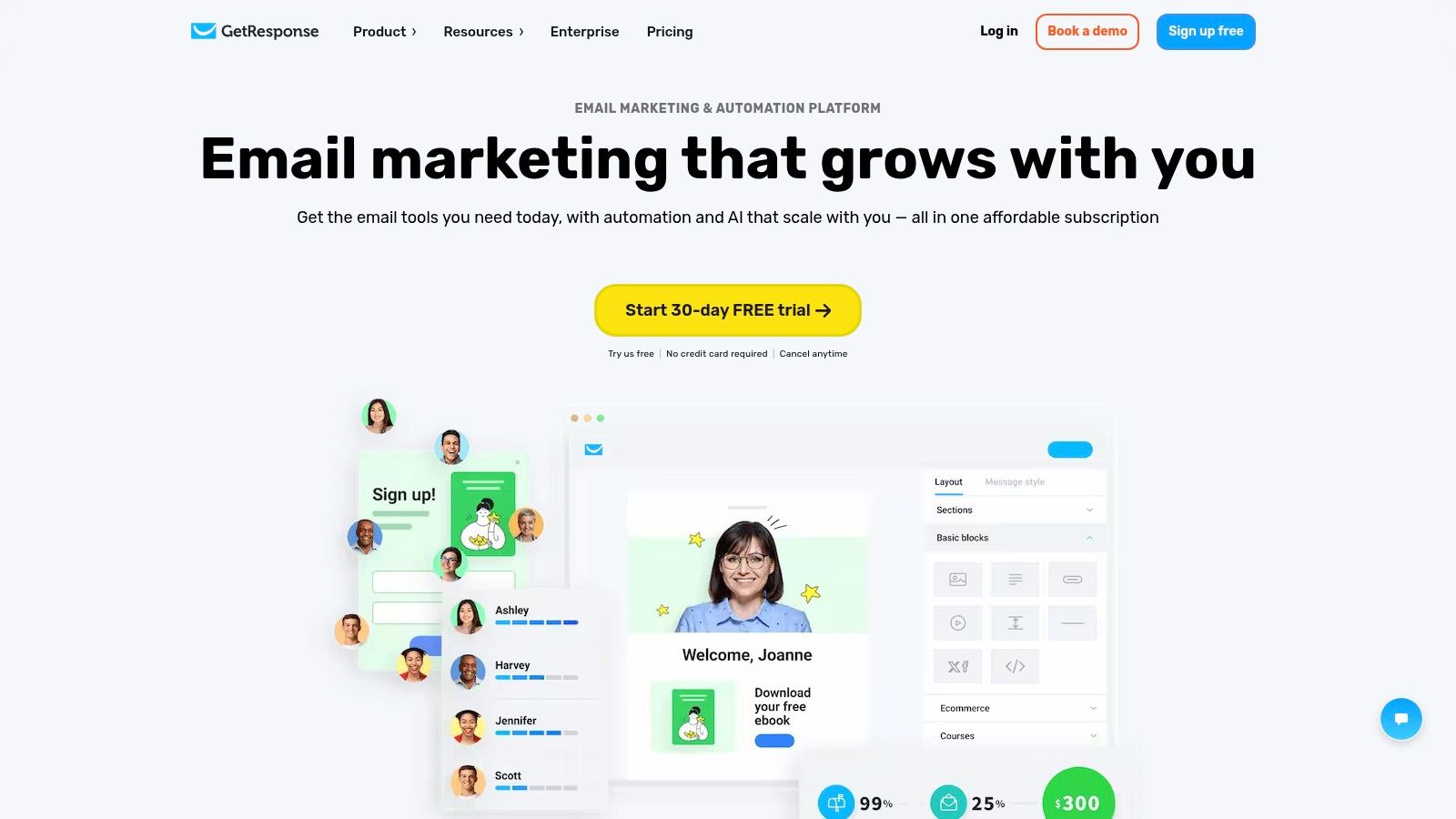
The platform’s strength is its ability to support the entire customer lifecycle, from capturing leads with landing pages to engaging them with automated emails and converting them through live webinars. This holistic approach helps streamline marketing efforts, reducing the need to patch together multiple third-party applications and saving both time and money. Its focus on conversion-oriented features provides a clear path for businesses aiming to monetise their audience.
Key Features & Ideal Use Case
- Best For: SMBs, course creators, and marketers looking for an affordable, all-in-one solution with built-in webinar and sales funnel capabilities.
- Pricing: Offers a free-forever plan. Paid tiers include Email Marketing, Marketing Automation, and Ecommerce Marketing, with costs scaling by contact list size.
- Standout Feature: The integrated webinar builder and conversion funnel creator allow you to build sophisticated marketing campaigns without needing extra software like WebinarJam or ClickFunnels.
- Pro Tip: Use the conversion funnel feature to visualise and build your entire customer journey. Start with a signup form, lead them through an automated email sequence, and direct them to a sales page or webinar, all within GetResponse.
Pros:
- Strong built-in webinar and funnel tools reduce the need for extra software.
- Competitive and affordable entry-level pricing.
- Excellent 24/7 live chat support is available on most plans.
Cons:
- The interface can feel busy and complex for absolute beginners.
- Advanced features like the webinar functionality are limited on lower-tier plans.
Website: https://www.getresponse.com
10. dotdigital (Engagement Cloud)
Dotdigital, a UK-founded marketing automation powerhouse, is tailored for mid-market and enterprise businesses that prioritise sophisticated automation and rigorous data compliance. While many platforms offer basic email features, dotdigital excels with its enterprise-grade security, multichannel capabilities, and a deep focus on data governance. This makes it a standout choice for organisations in regulated industries or those operating within the strict confines of GDPR, as it offers a robust framework for managing customer data responsibly.
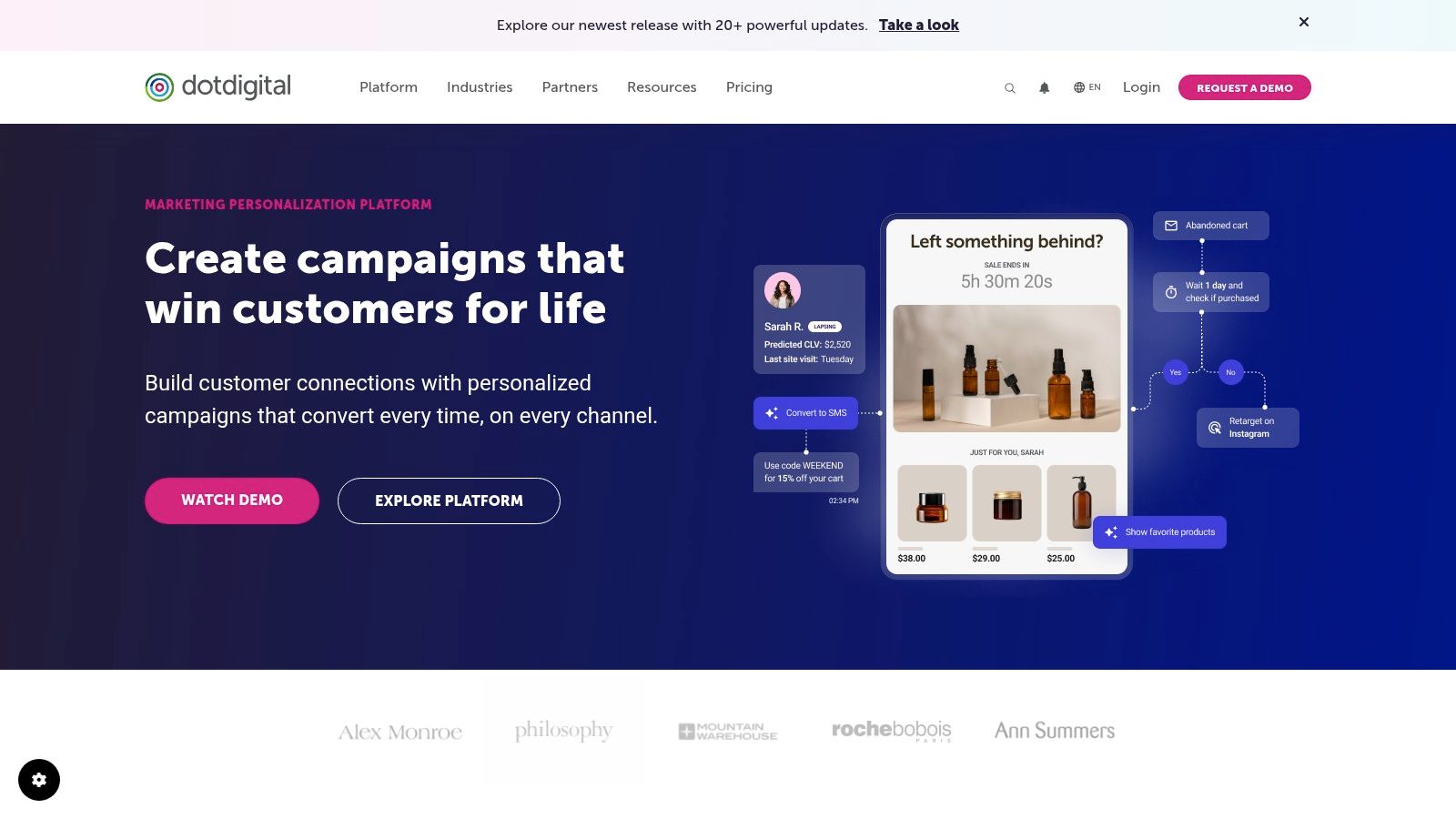
The platform’s real value is revealed in its advanced segmentation and automation workflows, which allow for highly personalised customer journeys across email, SMS, push notifications, and live chat. For ecommerce businesses, its seamless integrations with platforms like Magento, Shopify Plus, and BigCommerce enable powerful, data-driven campaigns based on real-time customer behaviour. This comprehensive approach makes it one of the best email marketing platforms for scaling businesses that have outgrown simpler tools and require more powerful, secure solutions.
Key Features & Ideal Use Case
- Best For: Mid-market to enterprise-level businesses, especially in the UK/EU, requiring advanced automation, multichannel marketing, and strong data security.
- Pricing: Available via custom quote only. Pricing is tailored to specific business needs, scale, and feature requirements, reflecting its enterprise focus.
- Standout Feature: Its commitment to data security and compliance, demonstrated by ISO 27001/27701 certifications and dedicated UK/EU data residency options, provides peace of mind for data-sensitive organisations.
- Pro Tip: Leverage the platform’s Program Builder to create complex, multi-stage automation flows that adapt to customer actions. For instance, you can combine email follow-ups with an SMS notification for abandoned carts to maximise recovery rates.
Pros:
- Strong UK presence with excellent compliance credentials (ISO, Cyber Essentials Plus).
- Powerful multichannel automation across email, SMS, and more.
- Enterprise-grade security and dedicated support.
Cons:
- Pricing is not transparent and requires a direct sales consultation.
- May be overly complex and cost-prohibitive for small businesses or those with basic needs.
Website: https://dotdigital.com
11. EmailOctopus
EmailOctopus is a UK-based platform that champions simplicity and affordability in email marketing. It’s designed for those who need a robust, no-frills tool without the overwhelming complexity of larger marketing suites. This focus on core functionality makes it an excellent choice for creators, charities, and lean startups who prioritise sending effective emails and managing their lists without a steep learning curve or high costs. Its straightforward approach to campaigning and automation delivers reliable performance.
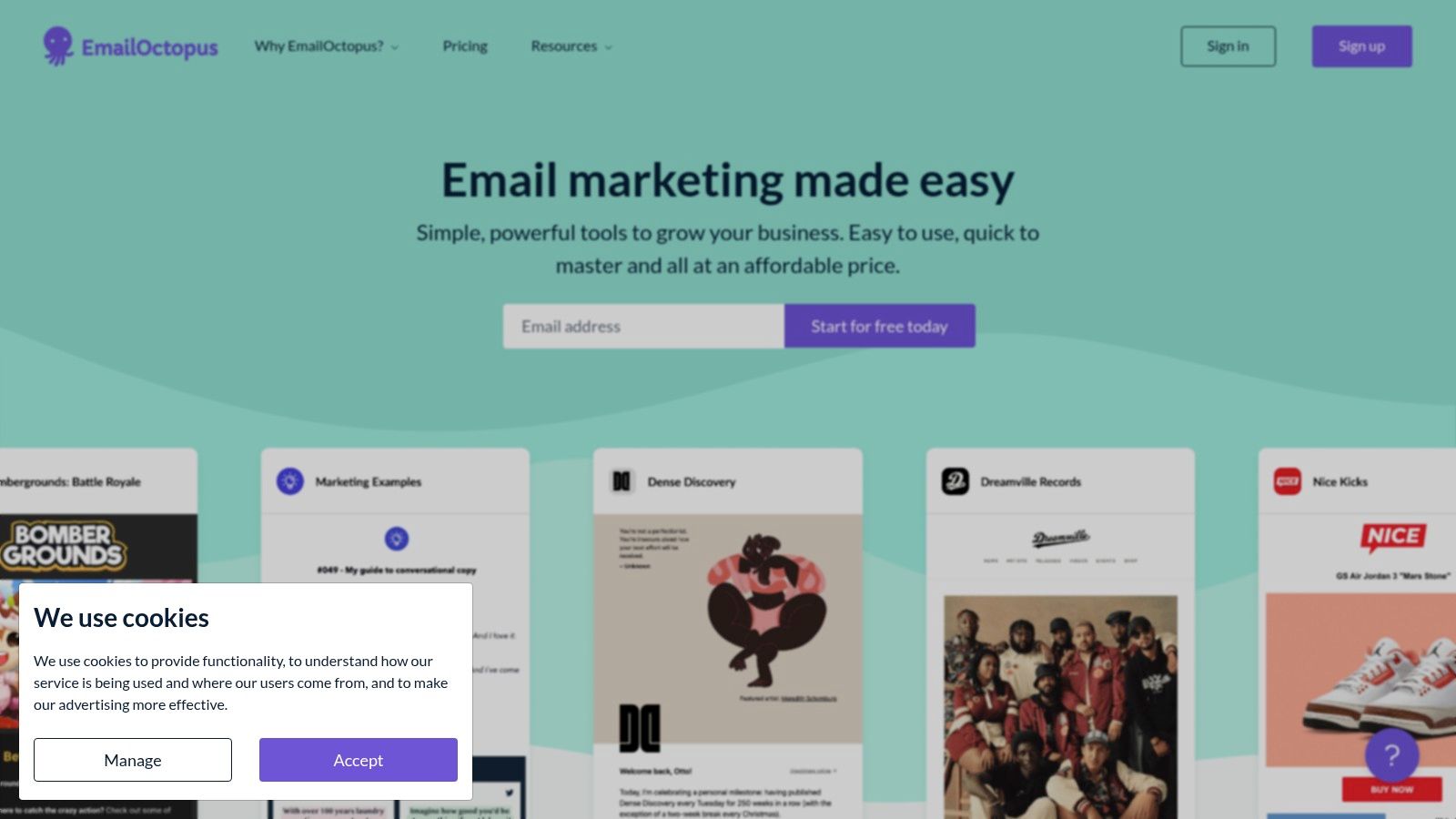
As a UK company, EmailOctopus offers a significant advantage for businesses operating in the same region through its localised support during GMT hours. This, combined with its simple interface and excellent deliverability, solidifies its position as one of the best email marketing platforms for budget-conscious users who value direct, effective communication and responsive, regional customer service.
Key Features & Ideal Use Case
- Best For: Charities, content creators, and startups seeking a cost-effective, easy-to-use platform with strong deliverability.
- Pricing: Offers a generous Starter plan (free for up to 2,500 subscribers) and a straightforward Pro plan. It also provides a 20% lifetime discount for non-profits.
- Standout Feature: Its UK-based support team provides timely and knowledgeable assistance during UK business hours, a major benefit for local organisations.
- Pro Tip: Leverage the automation sequences for welcome emails or simple drip campaigns. While not as complex as other platforms, they are highly effective for nurturing new subscribers.
Pros:
- Highly cost-effective, especially the generous free tier.
- Clean, intuitive user interface that is very easy to navigate.
- Strong focus on deliverability ensures your emails reach the inbox.
Cons:
- Lacks the advanced segmentation and automation features found in more expensive suites.
- The template library is more basic compared to competitors.
Website: https://emailoctopus.com
12. Kit (formerly ConvertKit)
Kit, which you may know by its former name ConvertKit, is a powerful platform built from the ground up with creators in mind. It has carved out a niche by focusing specifically on the needs of authors, course creators, podcasters, and professional bloggers. Its philosophy is email-first, providing robust tools for building an audience, nurturing that relationship through newsletters, and monetising it directly with built-in commerce features. This makes it one of the best email marketing platforms for anyone whose business model revolves around content and digital products.
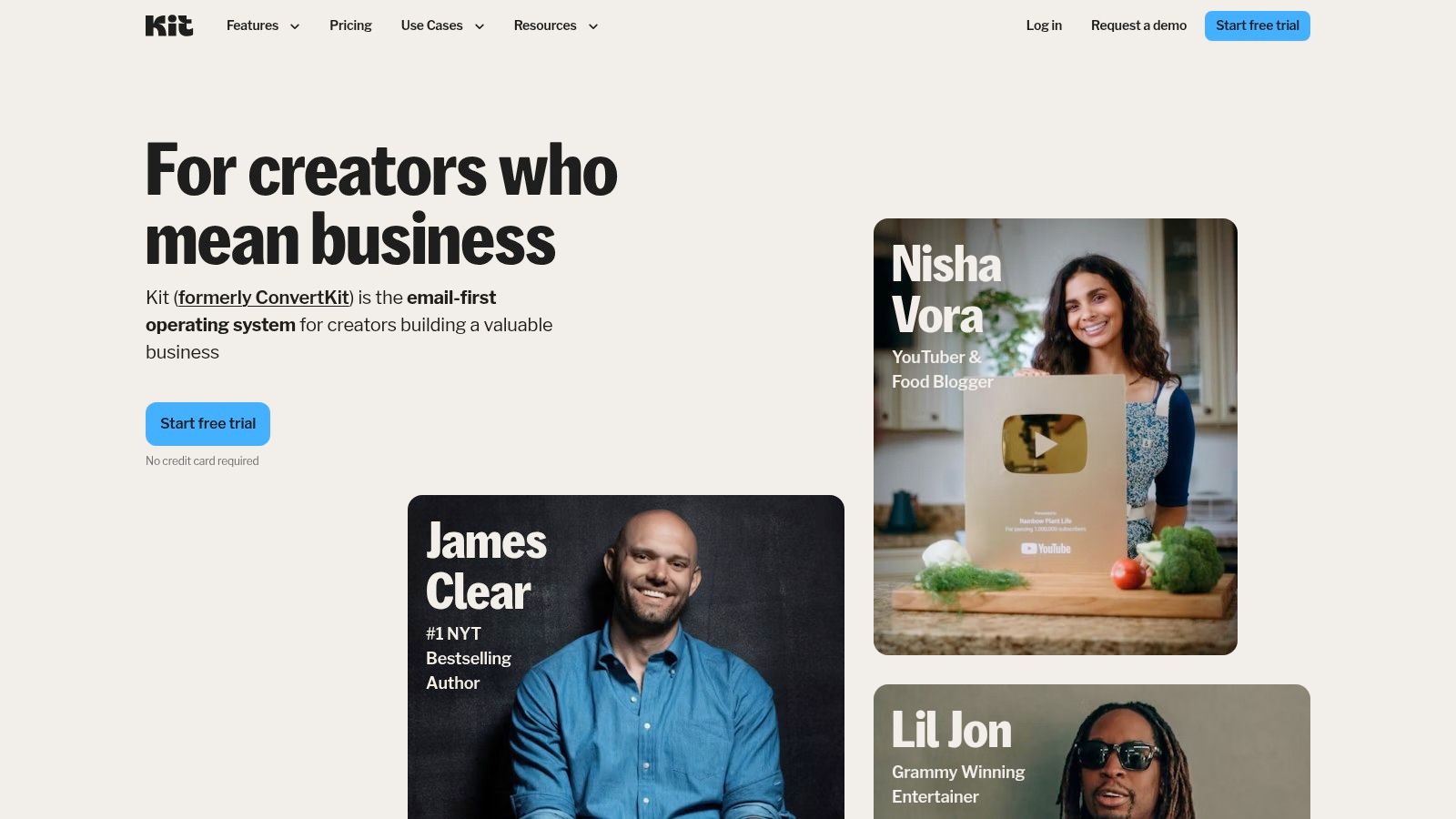
The platform excels at audience segmentation through a flexible tagging system rather than rigid lists, allowing for highly personalised messaging. Its strength lies in treating subscribers as individuals on a journey, not just entries in a database. This creator-centric approach is supported by excellent community resources, tutorials, and dedicated support to help users migrate and grow their businesses effectively.
Key Features & Ideal Use Case
- Best For: Professional creators, media newsletters, and anyone selling digital products or paid subscriptions.
- Pricing: A generous Free plan for up to 10,000 subscribers with basic automations and commerce. Paid plans like Creator and Creator Pro add advanced features. A 14-day free trial is available for paid tiers.
- Standout Feature: Its integrated commerce system allows creators to sell digital products and paid newsletters directly from the platform, streamlining the monetisation process without needing third-party tools.
- Pro Tip: Use the visual automation builder on paid plans to create complex subscriber journeys. You can automatically tag users based on link clicks, product purchases, or form submissions to deliver hyper-relevant content.
Pros:
- Purpose-built for individual creators and media-focused businesses.
- Extremely generous free tier for list growth.
- Simple and effective setup for selling digital goods.
Cons:
- Advanced analytics and automations are locked behind the highest-tier Creator Pro plan.
- Some users report the email editor can feel less performant than other platforms.
Website: https://kit.com
Top 12 Email Marketing Platforms Comparison
| Platform | Core Features ✨ | User Experience ★★★★☆ | Value Proposition 💰 | Target Audience 👥 | Unique Selling Points 🏆 | Price Points 💰 |
|---|---|---|---|---|---|---|
| Email Marketing – Grow Your Biz | Curated top platforms (ActiveCampaign, AWeber etc.) | Expert-vetted hub, easy comparison | Saves time with curated recommendations | Freelancers, agencies, growing biz | Expert-backed, focused on decision ease | Free access |
| Mailchimp | Templates, automation, CRM, ecommerce | Strong support, large community | Clear upgrade path, robust docs | SMBs, growing lists | Huge integrations and community | Free to Premium plans |
| Brevo (Sendinblue) | Email, SMS, WhatsApp, CRM, automation | Budget-friendly, EU GDPR-compliant | Volume-based pricing | SMEs, startups | Multichannel under one roof, EU hosting | Free to Business plans |
| MailerLite | Automations, landing pages, AI writing | Clean UI, quick setup | Strong value, nonprofit discounts | Creators, SMBs, nonprofits | AI assistant, EU data residency | Free to Enterprise plans |
| Campaign Monitor | Polished design, analytics, agency features | Attractive templates, good analytics | Agency-friendly, multi-client mgmt | Design-focused brands, agencies | White-labeling, in-app billing | Free trial, tiered pricing |
| ActiveCampaign | Automation, CRM, 900+ integrations | Powerful but complex onboarding | Integrated CRM & marketing | Sales-driven SMEs, advanced marketers | Industry-leading automations | Tiered pricing, nonprofit discounts |
| Klaviyo | Ecommerce SMS + email, segmentation | Sophisticated flows & segmentation | Best ecommerce trigger & attribution | UK ecommerce retailers | Deep Shopify/WooCommerce integration | Free tier, pay-as-you-grow |
| HubSpot Marketing Hub | Multi-channel, workflows, CRM integration | Enterprise-grade analytics | All-in-one marketing stack | SMEs to enterprise | Unified CRM & marketing data model | Free to Enterprise, per-seat pricing |
| GetResponse | Webinars, funnels, AI email generator | Feature-rich but complex UI | Webinar + funnel tools included | SMBs, content marketers | Strong webinar & funnel integration | Tiered pricing |
| dotdigital (Engagement Cloud) | Advanced segmentation, SMS, ecommerce | Enterprise-level support | Strong compliance focus | Mid-market, enterprise | UK-based compliance & security | Custom quotes only |
| EmailOctopus | Simple automation, templates, UK support | Simple UI, deliverability focus | Very cost-effective | Charities, creators, lean startups | UK-based support, nonprofit discounts | Free + Pro plans |
| Kit (formerly ConvertKit) | Newsletter plans, commerce tools | Creator-focused, good community | Generous free tier | Individual creators, media newsletters | Built-in commerce, strong community | Free + paid Creator plans |
Making Your Final Choice: Which Platform Will Drive Your Growth?
Navigating the crowded landscape of the best email marketing platforms can feel daunting, but after exploring the detailed strengths and weaknesses of top contenders, you are now in a powerful position. The journey from a long list of options to a single, strategic choice is not about finding a universally "perfect" platform; it is about identifying the one that aligns perfectly with your unique business reality.
The key takeaway is that the "best" tool is entirely contextual. A decision that drives exponential growth for one business could be a costly mismatch for another. Your final selection hinges on a clear-eyed assessment of your specific goals, operational capacity, and long-term vision.
Recapping the Core Decision Factors
To crystallise your thinking, let’s revisit the critical questions you should ask before committing to a platform. This isn’t just a software purchase; it’s an investment in a core pillar of your marketing engine.
-
Primary Goal Alignment: What is your number one objective? Is it driving direct sales for your Shopify store? If so, Klaviyo's deep e-commerce integrations are hard to beat. Or are you focused on nurturing high-value B2B leads through a complex sales funnel? In that case, the sophisticated automation of ActiveCampaign or HubSpot’s all-in-one CRM approach might be a better fit. For creators and bloggers, the audience-centric features of Kit (formerly ConvertKit) are designed for building a loyal community.
-
Scalability and Future Growth: Think about where your business will be in one, three, or five years. A platform like MailerLite or EmailOctopus offers a fantastic, budget-friendly starting point. However, if you anticipate needing advanced segmentation, multi-channel marketing, and predictive analytics down the line, starting with a more scalable solution like dotdigital or GetResponse could prevent a complicated migration later on.
-
Technical Expertise and Team Resources: Be honest about your team’s technical comfort level. Platforms like Mailchimp and Campaign Monitor are renowned for their user-friendly interfaces, allowing you to get campaigns up and running with minimal fuss. In contrast, harnessing the full power of HubSpot or ActiveCampaign may require a more significant investment in learning and implementation.
-
Budgetary Realities: Your budget is a non-negotiable filter. Calculate the total cost of ownership, not just the advertised monthly fee. Factor in contact list size, sending volume, and access to premium features. Brevo (formerly Sendinblue) stands out for its generous free plan and transactional email capabilities, offering immense value for businesses keeping a close eye on expenditure.
A Strategic Framework for Your Final Decision
To make your final choice, move beyond feature lists and focus on strategic fit. A powerful platform is useless if it doesn't integrate with your existing technology stack or if its complexity overwhelms your team.
Consider the implementation phase as a critical part of your decision. How easy will it be to migrate your existing subscriber list? Does the platform offer robust support and documentation to guide you? For UK businesses, data residency is a crucial consideration. Platforms like dotdigital, which emphasise UK data centres, offer an added layer of compliance and peace of mind.
Ultimately, choosing from the best email marketing platforms is a strategic move that should empower, not complicate, your marketing efforts. You’ve reviewed the top players, from the all-in-one powerhouses to the lean and focused specialists. By grounding your choice in your specific goals, budget, and team capabilities, you are not just selecting software. You are building a foundation for stronger customer relationships and sustainable business growth.
Feeling overwhelmed by the options? The Digital Marketing Toolbox simplifies the process by providing curated comparison guides, exclusive software deals, and practical frameworks to help you choose the right tools with confidence. Visit The Digital Marketing Toolbox to compare top contenders like ActiveCampaign and GetResponse side-by-side and find the perfect fit for your business today.


