

Creating a buyer persona isn't just a box-ticking exercise. It’s about diving deep into your audience, spotting the patterns in how they behave and the challenges they face, and then building a detailed profile of your ideal customer. Think of it as turning cold, hard data into a relatable character your whole team can get behind.
Why Generic Audiences Fail in Today's Market

In a market this crowded, shouting generic messages into the void is a guaranteed way to burn through your budget. Simply targeting a broad demographic like "males aged 25-40 in Manchester" tells you very little. It tells you what they are, but it completely misses the who. You have no idea what motivates them, what keeps them up at night, or what they're trying to achieve professionally.
This surface-level approach inevitably leads to content that tries to speak to everyone but ends up connecting with no one. Today's buyers are savvy; they expect you to understand their specific problems and offer a solution that feels like it was made just for them. A generic message just feels lazy and impersonal, which is a big reason why cold outreach often fails to get any real traction.
The Power of Specificity
This is where a well-crafted buyer persona changes the game. It takes all that abstract data and weaves it into a focused, human story. You're forced to dig deeper and ask the questions that actually lead to marketing that works.
- Sharpened Marketing Focus: Forget broad-stroke campaigns. You can create content that hits on a persona's specific pain points, using the exact language they would use.
- Smarter Product Development: Personas give you crystal-clear insight into the features your most valuable customers are crying out for, helping to shape your product roadmap.
- Total Team Alignment: A good persona creates a shared understanding across sales, marketing, and support. Everyone is on the same page, working to attract and delight the same ideal customer.
Moving from a vague audience to a sharp persona isn't just about better targeting—it's about building genuine empathy. You start seeing the world through your customer's eyes, and that's the secret to any marketing that truly connects.
To really see the difference, let’s compare a typical audience description with a focused persona.
From Generic Audience to Specific Persona
| Attribute | Generic Audience | Detailed Persona ('Marketing Director Maya') |
|---|---|---|
| Role | Marketing professionals | Marketing Director at a mid-sized UK tech firm (100-250 employees) |
| Goals | Increase brand awareness | Prove ROI on marketing spend to the board; increase qualified leads by 20% |
| Challenges | Budget constraints, time management | Overwhelmed by manual reporting, struggles to connect campaigns to revenue |
| Watering Holes | LinkedIn, industry blogs | Follows specific influencers like Rand Fishkin, reads Marketing Week |
| Pain Points | Showing ROI is difficult | "I spend hours pulling data from five different platforms for one report." |
See the difference? The persona gives you a real person to market to, not just a faceless category.
From Data to Decisions
The journey starts with collecting and analysing data from your CRM, website analytics, and social media channels. It’s a fact that up to 70% of the buyer's journey now happens digitally before they even think about contacting a salesperson. That digital footprint is an absolute goldmine. By digging into those online interactions, UK businesses can spot the crucial trends needed to build genuinely accurate profiles.
Ultimately, this is about more than just better ads. It’s about making smarter business decisions across the board. When you know that 'Marketing Director Maya' is bogged down by reporting and is desperate for tools that give her time back, you can completely change your approach. You can tailor your sales pitch, write blog posts that solve her immediate problems, and build a product she can't imagine living without.
That’s how you create buyer personas that don't just gather dust in a folder—they actively fuel your company's growth.
Gathering Your Raw Persona Ingredients

Powerful buyer personas are built on real data, not guesswork. Think of this stage as gathering high-quality, raw ingredients for a compelling profile. To really understand how to create buyer personas that work, you need a healthy mix of two things: the hard numbers (quantitative) and the human stories (qualitative).
When you blend these two sources, you get the full picture. The numbers show you what people are doing, and the stories explain why they're doing it.
Uncovering Insights from Your Quantitative Data
Your first port of call should always be the data you already have. This gives you a solid, objective baseline for understanding your customers at scale.
Start by digging into your existing systems for patterns. You’re not hunting for individual anecdotes just yet, but for broad trends that will point your qualitative research in the right direction.
- Customer Relationship Management (CRM) System: Dive into your CRM and see how leads and customers found you in the first place. Look for common threads in demographics like their location, company size, or the job titles that keep cropping up among your best customers.
- Website Analytics: Tools like Google Analytics are a goldmine. Which blog posts pull in the most traffic? What paths do people take on your site before they finally convert? This is a direct line to understanding what content truly resonates.
- Social Media Insights: Check out the demographics of your followers on platforms like LinkedIn or Instagram. Pay close attention to the posts that spark the most conversation—that engagement is a clear signal of what your audience actually cares about.
These sources provide the skeleton of your persona. For instance, your analytics might reveal that 45% of your leads come from organic searches around "B2B marketing automation." That’s a massive clue. It tells you where your ideal customer is looking and what problems they're trying to solve.
Understanding this is a cornerstone of any good digital marketing strategy, as it directly shapes your content and SEO. For a deeper dive, our beginner's guide to digital marketing shows how these concepts all fit together.
The Power of Qualitative Conversations
Numbers give you scale, but conversations give you depth. Qualitative research is where you’ll unearth the real motivations, daily frustrations, and career goals that data alone can never show you. The aim here is to speak directly with people who represent both your ideal customer and those who didn't quite make the cut.
The most profound insights rarely come from a spreadsheet. They come from listening to a customer describe their biggest frustration in their own words. That’s where the real magic happens.
Getting these conversations organised is vital. You'll want to tap into a few different groups to get a well-rounded view.
Structuring Your Persona Interviews
To get the most out of your interviews, you really need to speak to a mix of people. Each group offers a unique and valuable lens on your business and the problems you solve.
- Your Best Customers: These are your champions. They already see the value in what you do, so they're perfect for understanding what you're getting right. Ask them about the "before" picture—what was their world like before they started working with you?
- Recent Leavers or Lost Deals: I know, this can be an uncomfortable chat, but the insights are priceless. Why did they choose a competitor, or decide not to buy at all? Their feedback will put a spotlight on weaknesses in your messaging or product.
- Your Sales Team: Your salespeople are on the front line every single day. They have a deep, practical understanding of customer objections, the questions that come up constantly, and the pain points they hear about time and time again.
When you sit down for these chats, steer clear of simple yes/no questions. Instead, use open-ended prompts to encourage them to tell you a story:
- "Could you walk me through a typical day in your role?"
- "What's the single biggest challenge you're facing with [their area of work] right now?"
- "What tools or resources do you rely on to do your job well?"
This approach of blending diverse data streams is validated by experts. Statistical evidence from UK agencies shows that persona creation isn't a one-off task but a process of continuous refinement. By combining your internal data with these rich, human stories, you'll gather all the ingredients you need to build personas that feel real, relatable, and incredibly effective.
Finding the Patterns in Your Research
Right, you’ve done the hard graft and collected a mountain of raw data. Now comes the interesting part: turning all those interview notes, survey answers, and analytics reports into a clear story about your customers. The goal here is to sift through the individual comments and data points to find the recurring themes, habits, and motivations that tie certain groups of people together.
Think of yourself as a detective laying out clues on a corkboard. A single footprint doesn't solve the case, but when you see it alongside a witness statement and a dropped business card, a picture starts to form. That's exactly what you're doing here—connecting the dots between someone's job title, a frustration they mentioned, and how they behave on your website.
This is a great illustration of how different data sources typically contribute to persona research, showing that a mix of qualitative and quantitative information is essential.
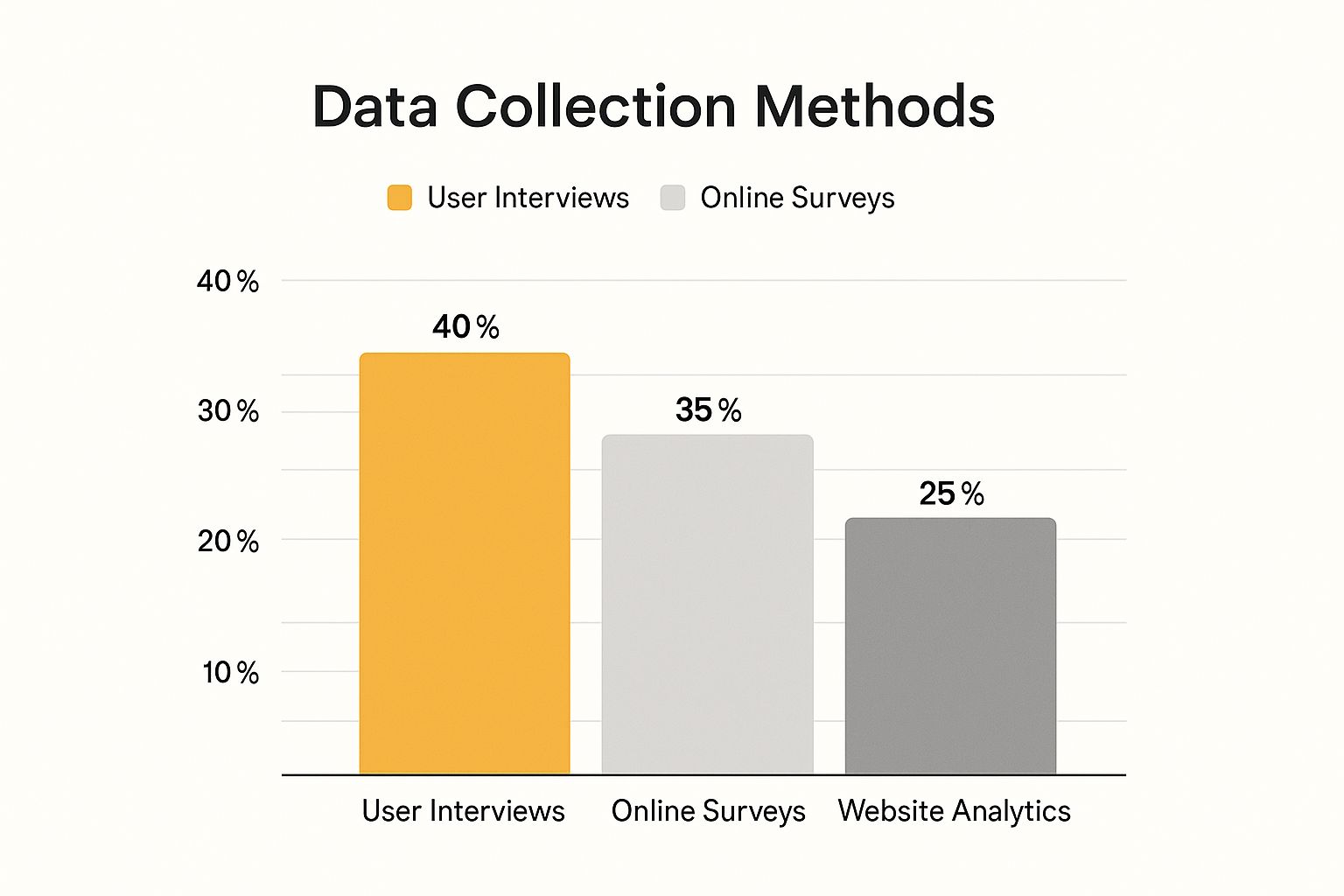
As you can see, interviews often carry the most weight because they provide that crucial qualitative depth, but they're backed up by the hard numbers from other sources.
Getting Your Findings Organised
Your first practical task is to get all your data into one place. A spreadsheet or a collaborative tool works perfectly for this. You need to group similar responses and observations together to start making sense of it all. A big part of this process is knowing how to analyze qualitative data properly; it’s the skill that turns messy interview transcripts into the foundations of a solid persona.
Start by setting up columns for the key categories you've been researching. This simple structure makes it much easier to spot emerging patterns.
- Demographics: Note down the basics like their job title, company size, and industry.
- Goals: What are they actually trying to achieve in their day-to-day role? Look for repeated objectives.
- Challenges: Pinpoint the specific frustrations and roadblocks they mentioned. It helps to use their exact words here.
- Watering Holes: Where do they get their information? Make a note of any blogs, influencers, or social media platforms they follow.
- Quotes: Pull out a few powerful, direct quotes that really capture a key problem or emotion.
As you fill this out, you’ll begin to see clusters forming almost on their own. For example, you might realise that marketing managers in UK-based tech firms all seem to be talking about "proving ROI" and many of them read Marketing Week. That's the seed of a persona, right there.
The table below breaks down some common data sources and how you can use them to build out these profiles.
Data Sources for Persona Development
| Data Source | Type of Insight | Key Questions to Ask |
|---|---|---|
| Customer Interviews | Qualitative (Deep) | What are your biggest daily challenges? How do you define success in your role? What does a typical day look like? |
| Surveys | Quantitative & Qualitative | Which features are most important? How did you first hear about us? On a scale of 1-10, how satisfied are you? |
| Website Analytics | Behavioural (Quantitative) | Which pages get the most traffic? What are the common user journeys? What search terms are people using to find us? |
| Sales Team Feedback | Anecdotal & Qualitative | What are the most common objections you hear? What questions do prospects always ask? |
| Social Media Listening | Qualitative (Candid) | What are people saying about our industry? What pain points are they discussing in relevant groups? |
Each source gives you a different piece of the puzzle, so combining them is what creates a truly three-dimensional view of your audience.
Connecting Who They Are to What They Do
The real magic happens when you connect the demographics (who they are) with their behaviours (what they do). A job title is just a label, but when you link it to a specific set of challenges and online habits, you get an insight you can actually act on.
For instance, your research might show that junior-level marketers are constantly searching for "how-to" guides, while director-level marketers are more interested in high-level strategic frameworks and tools that show ROI. That single distinction is gold for tailoring your content strategy.
The most powerful insights are found where different data sets overlap. It’s not just that your customer is a Finance Director. It's that Finance Directors in the UK retail sector are overwhelmingly using LinkedIn for their professional development and are most concerned with streamlining payment processes. That is a pattern you can build a marketing strategy around.
Understanding Deeper Motivations
Beyond the practical goals and day-to-day challenges, you need to dig into the why. What are the underlying psychological drivers behind their decisions? This is especially important in the UK, where we’re seeing a significant cultural shift. Many younger consumers, for example, prioritise experiences over simply owning things.
This leads to interesting behaviours, like purchasing luxury goods on credit despite having limited disposable income. It’s not a purely logical decision; it points to deeper psychological needs like reinforcing their identity or seeking social status. Understanding this allows you to create messaging that connects on a much more emotional level.
Identifying Your Core Persona Groups
Once you've organised and analysed everything, you should start to see at least 3-5 distinct groups taking shape. These are your primary persona archetypes. Each one will have its own unique mix of goals, challenges, and behaviours that sets it apart from the others.
Give each emerging group a simple working title for now, like "The ROI-Focused Director" or "The Overwhelmed Small Business Owner." This small step starts to make the abstract data feel more real and gives your team a shared language to talk about your customers. From here, you’re ready to start fleshing out these skeletons into fully-formed, relatable profiles.
Bringing Your Personas to Life
Right, you’ve done the heavy lifting. You’ve waded through the research, spotted the patterns, and now you have a clear idea of your different customer groups. The next step is where the magic happens: turning that raw data into a living, breathing document that your team will actually pick up and use.
This is all about moving beyond just a name and a stock photo. We're aiming to build a profile that feels like a real person – someone with goals, frustrations, and specific daily habits. Think of it less as a creative writing exercise and more as translating your research into a practical tool that shapes real business decisions. When your team talks about ‘Project Manager Paul’, everyone needs to have the exact same person in mind.
Start with a Story, Not Just Stats
The best personas I’ve ever worked with always start with a story. It doesn't have to be a novel, just a brief narrative that helps to humanise the data and make the persona stick in people's minds. A good backstory gives context to their goals and challenges, making them far more than a collection of bullet points.
This little bio should quickly cover their professional journey, what their world looks like right now, and what they’re trying to achieve. It’s like their LinkedIn "About" section, but with a bit more personality and insight pulled directly from your qualitative interviews.
For instance, instead of just stating a job title, your narrative could explain:
- How they got here: What was their career path? This tells you a lot about their ambition and experience.
- A recent win: What are they genuinely proud of? This shows you what they value and what success looks like in their world.
- What keeps them up at night: What’s the big-picture problem they’re grappling with? This is your emotional hook.
This story becomes the foundation for everything else, making sure the entire profile is grounded in a relatable reality.
The Must-Have Details for a Genuinely Useful Persona
For a persona to be a practical tool, it needs to be packed with specific, actionable details. These components are the heart of the document, the bits that will directly guide your marketing, sales, and product teams.
Your finished profile absolutely must include:
- Goals: What are they actually trying to achieve in their job? Think about both their main goal (e.g., "Increase team efficiency by 15%") and their secondary, more personal goals (e.g., "Get recognised by the senior leadership team").
- Challenges: What gets in their way? Be incredibly specific here. "Budget issues" is too vague. Something like "Struggles to get sign-off for new software without a bulletproof ROI projection" is far more useful.
- Watering Holes: Where do they hang out online and offline to get information? Name specific blogs, publications (like The Economist for a UK finance director), the influencers they follow on LinkedIn, and the industry events they actually go to.
- How They Communicate: How do they really prefer to be contacted? Your research might show they instantly delete cold emails but will always open one with a subject line about new industry data.
- Real Quotes: This is crucial. Pull a direct quote from one of your interviews that perfectly captures their main frustration or desire. A powerful, authentic quote is often the most memorable part of the whole profile.
When you can articulate your customer's problem better than they can, they automatically assume you have the solution. A detailed persona gives you the language to do just that.
A Real-World B2B Persona Example: Meet Paul
Let's pull all this together and build out a UK-specific B2B persona. Let's call him 'Project Manager Paul'.
Persona Profile: Project Manager Paul
- Background: Paul is 38 and lives just outside Reading. He's a pragmatic, detail-obsessed Project Manager at a mid-sized construction firm. He's spent over a decade in the industry, working his way up from being on-site. Because of this, he has huge respect for practical solutions that work in the real world, not just on paper.
- Demographics:
- Age: 38
- Role: Senior Project Manager
- Industry: Construction & Property Development
- Company Size: 200-500 employees (UK-based)
- Location: Thames Valley
- Goals:
- Deliver projects on time and under budget by at least 5%.
- Slash the time his team wastes on manual admin and reporting.
- Improve the flow of information between the site teams and the head office.
- Challenges:
- He’s constantly battling disconnected software systems that don't talk to each other, which means endless double-entry of data.
- Getting a real-time, accurate view of project progress is a nightmare; he’s always chasing people for updates.
- His team will push back hard against any new tech if it seems overly complicated or messes with their established routines.
- Watering Holes:
- Reads: Construction News, Project Manager Today
- Follows: Industry bodies like the Chartered Institute of Building (CIOB) on LinkedIn.
- Attends: UK Construction Week at the NEC Birmingham.
- Quote: "I spend more time chasing paperwork and updating spreadsheets than I do actually managing the project. There has to be a better way to see exactly where we stand at any given moment."
See? This profile gives every team a clear, actionable picture. The content team knows to write blog posts about "slashing admin time in construction." The sales team knows to lead their demo with a real-time project dashboard. And the product team knows that ease of use is a non-negotiable feature for Paul's team. That’s how a well-crafted persona directly shapes your strategy.
Putting Your Buyer Personas to Work

It’s one thing to create detailed buyer personas; it’s another to actually use them. Let's be honest, a persona that just gathers dust in a shared drive isn't doing anyone any good. The real magic happens when you weave these customer profiles into the very fabric of your daily work, making them a go-to reference for big decisions across the entire company.
This is where all that research starts to pay off. When you put your personas into action, you stop guessing and start making truly data-driven decision making. It's about turning those carefully crafted profiles into practical, everyday tools that genuinely guide your strategy.
Tailoring Your Marketing Content
Your marketing team is probably the first place you'll see the impact of well-defined personas. Instead of shouting into the void with generic content, they can now have a real conversation, speaking directly to the specific goals and frustrations of each persona to build a much stronger connection.
A simple yet powerful way to put this into practice is by creating a content matrix. Think of it as a grid that maps your personas against the different stages of their buying journey (like awareness, consideration, and decision). This gives you a bird's-eye view of your content, helping you spot any gaps and ensuring you're delivering the right message to the right person at exactly the right time.
Let's go back to 'Project Manager Paul'. Your matrix might show you need:
- For Awareness: A blog post like, "5 Telltale Signs Your Construction Project Software is Holding You Back."
- For Consideration: A detailed comparison guide looking at your software versus a main competitor, focusing on features that make life easier for on-site teams.
- For the Decision: A case study showing how a similar UK construction firm cut its admin time by 30%.
This strategic thinking also helps you choose where to spend your marketing budget. You know Paul reads Construction News, so a targeted ad or a sponsored article there will likely be far more effective than a generic social media blast.
Empowering Your Sales Team
For your sales team, personas are like a secret weapon for having more meaningful conversations. When a new lead comes in, quickly identifying which persona they fit gives your reps a massive head start. They can anticipate objections, highlight the most relevant product features, and build rapport almost instantly.
This insight allows them to tailor their entire pitch. For example, when they get on a call with someone like 'Project Manager Paul', they know to immediately bring up the real-time project dashboard and highlight how it solves the headache of chasing people for updates. They can even echo his own language: "It sounds like you’re spending more time chasing paperwork than actually managing your projects."
When your sales team can articulate a prospect's problem better than they can, it builds instant trust. Personas give them the script to do just that.
This is how you get your sales and marketing teams perfectly aligned, creating a seamless experience from the first ad someone sees to the final sales call. To learn more about weaving these ideas together, check out our guide on building a cohesive https://grow-your-biz.com/marketing-strategy-for-small-business/ for lasting success.
Guiding Product Development
Last but not least, your product team can lean on personas to build a smarter roadmap for the future. These profiles provide a crucial customer-centric filter for prioritising new features and improvements. Instead of relying on internal hunches or just listening to the loudest voice in the room, the team can ask a simple, powerful question: "How would this actually help Paul?"
This keeps product development grounded in solving real-world problems. For instance, knowing Paul's team is resistant to overly complex technology, your product team might decide to simplify the user interface rather than add a niche, advanced feature. This focus helps ensure that the things you build will actually get used and valued by your ideal customers.
When you embed personas across these core parts of your business, they stop being static documents. They become dynamic tools that drive strategy, create alignment, and fuel real, sustainable growth.
Common Persona Questions Answered
Even with a great plan in hand, a few practical questions always come up when you start building out your buyer personas. Let's tackle some of the most common ones I hear. Getting these details right from the start can be the difference between a persona that gathers dust and one that genuinely shapes your strategy.
So, where do people usually get stuck? The first stumbling block is often just figuring out how many of these things you actually need.
How Many Buyer Personas Should We Create?
There's no magic number, but there is a sweet spot. For most businesses, creating three to five core personas is the perfect starting point. This gives you enough coverage for your most important customer segments without spreading your team too thin.
If you try to create ten personas from day one, you'll dilute your focus. It becomes a logistical nightmare to create truly tailored marketing for each one. The trick is to begin with the audiences that drive the most value for your business. You can always add more later on, but only when you have a solid reason—and the resources to do it right.
The Difference Between a Persona and a Target Audience
This is a big one. It's a subtle distinction, but it’s absolutely crucial to grasp. Think of it as the difference between a crowd and an individual you know by name.
A target audience is a broad description of a group. For example: "women aged 25-40, living in London, interested in sustainable fashion." It's a useful starting point, but it's completely impersonal.
A buyer persona, on the other hand, is a deep dive into one specific, ideal individual from within that audience. We give her a name, a job, personal goals, and we understand her daily frustrations. The persona makes the abstract "who" of your audience feel like a real person you can connect with.
A target audience points you in the right direction. A buyer persona tells you exactly who you’re talking to, what they care about, and how you can help them solve a problem.
That's why personas are so effective. Instead of blasting a generic message to thousands, you’re crafting something that feels personal and genuinely helpful. When you can picture the exact person opening your email, understanding the real advantages of email marketing becomes second nature.
How Often Should We Update Our Personas?
Let's be clear: creating personas isn't a "set it and forget it" task. Markets shift, customer needs evolve, and your business changes. Your personas need to reflect that reality, otherwise they become outdated and useless. Think of them as living documents, not static portraits.
As a rule of thumb, plan to give your personas a quick health check at least once a year. This is a great time to sit down with your sales and customer support teams. Ask them, "Do these profiles still sound like the people you're talking to every day?"
You'll need to do a much deeper refresh, however, whenever there's a major change in:
- Your industry: New tech or changing regulations can completely alter customer priorities.
- Your business: If you launch a major new product, you'll likely attract a new type of customer.
- Customer behaviour: Think about how major economic or social events can reshape buying habits almost overnight.
Your customer-facing teams are your canaries in the coal mine. Listen to them. They'll give you the earliest clues that it's time for an update, ensuring your personas remain a valuable asset.
Ready to build a smarter marketing stack without the guesswork? The Digital Marketing Toolbox provides a curated catalogue of the best tools for SEO, email, social media, and more, helping you find the perfect solutions to grow your business. Start exploring and comparing top-rated software today at https://grow-your-biz.com.


