

Gathering customer feedback is all about opening a direct line to the people who matter most—your customers. It's about asking smart questions, then taking what you learn to genuinely fuel your company's growth. This means actively listening across all your channels, from surveys to social media DMs, to get a real sense of what people truly think about what you do.
Why Customer Feedback Is a Growth Engine, Not a Support Task

It’s all too easy to think of customer feedback as something for the support team to handle—a chore to tick off when a problem arises. But that view completely misses the point. When you learn how to collect and use feedback properly, you’re not just putting out fires; you're firing up a powerful engine for business growth.
Think about it. Every single comment, whether it's glowing praise or a frustrated rant, is a piece of intelligence that can steer your entire strategy. It’s the difference between guessing what your market wants and knowing what it needs.
Shaping Loyalty and Your Brand
When you consistently listen, you build trust. It’s that simple. Customers who feel heard are far more likely to stick around. This process is what shapes your brand’s reputation out in the wild, turning happy clients into your most powerful advocates.
This is especially true here in the UK. The latest UK Customer Satisfaction Index (UKCSI) reveals that overall satisfaction has climbed to 77.3 out of 100—a recent high. This tells us that the businesses actively listening and responding are the ones pulling ahead of the pack.
What's really telling is that the report found 26% of customers had to use more than one channel to get an issue sorted. That fact alone screams for a joined-up, multi-channel feedback strategy. You can dig into more of these findings in the full report.
Informing Your Product and Marketing Roadmap
Feedback is the ultimate reality check for your product roadmap and marketing plans. I've seen it happen time and again: a UK software company, for instance, might roll out a new feature they believe is a game-changer, only to learn from feedback forms that users are just plain confused by it.
Treating feedback as a strategic asset lets you pivot quickly. You can re-channel your time and money into the features your customers are actually crying out for, saving you from wasting resources on a dud.
This customer-first mindset is the bedrock of any solid marketing strategy for a small business. Instead of blowing your budget on educated guesses, you can build campaigns that speak directly to the frustrations and desires your customers have already shared with you. That kind of direct insight is priceless for creating messages that truly connect and convert.
Choosing the Right Customer Feedback Channels
Figuring out where and when to ask for feedback is every bit as important as the questions you ask. If you try to be everywhere at once, you'll just create a lot of noise and overwhelm your team. But stick to just one channel, and you'll end up with a seriously skewed perspective of what your customers actually think.
The real key to gathering customer feedback that you can actually use is to build a smart, customised system. It's all about matching the right channel to the right moment in your customer's journey.
You can't just treat every channel the same. Some are proactive, where you're actively reaching out for input, while others are passive, where you're tuning into conversations already happening.
Proactive vs. Passive Feedback: Knowing When to Ask and When to Listen
Proactive methods put you in the driver's seat. Think about those post-purchase email surveys, Net Promoter Score (NPS) pop-ups, or even an old-fashioned phone call. You control the timing and the questions, which makes these methods brilliant for collecting specific, structured data. A software company, for instance, might fire off an in-app survey the moment a user engages with a brand-new feature.
Passive channels, on the other hand, are all about listening and observing. This means paying attention to social media mentions, keeping an eye on third-party review sites like Google or Trustpilot, and digging into the transcripts from customer support chats. Here, the feedback is unsolicited and often brutally honest. An e-commerce brand might spot a recurring problem with its packaging by seeing tagged photos on Instagram—an insight they would never have gained from a formal survey.
A truly solid strategy needs a healthy mix of both. You use proactive channels to measure what you already know you need to track, and you use passive channels to discover the "unknown unknowns" you hadn't even thought to ask about.
The image below gives you a realistic idea of the response rates you can expect from different proactive channels, which can help you decide where to focus your energy first.
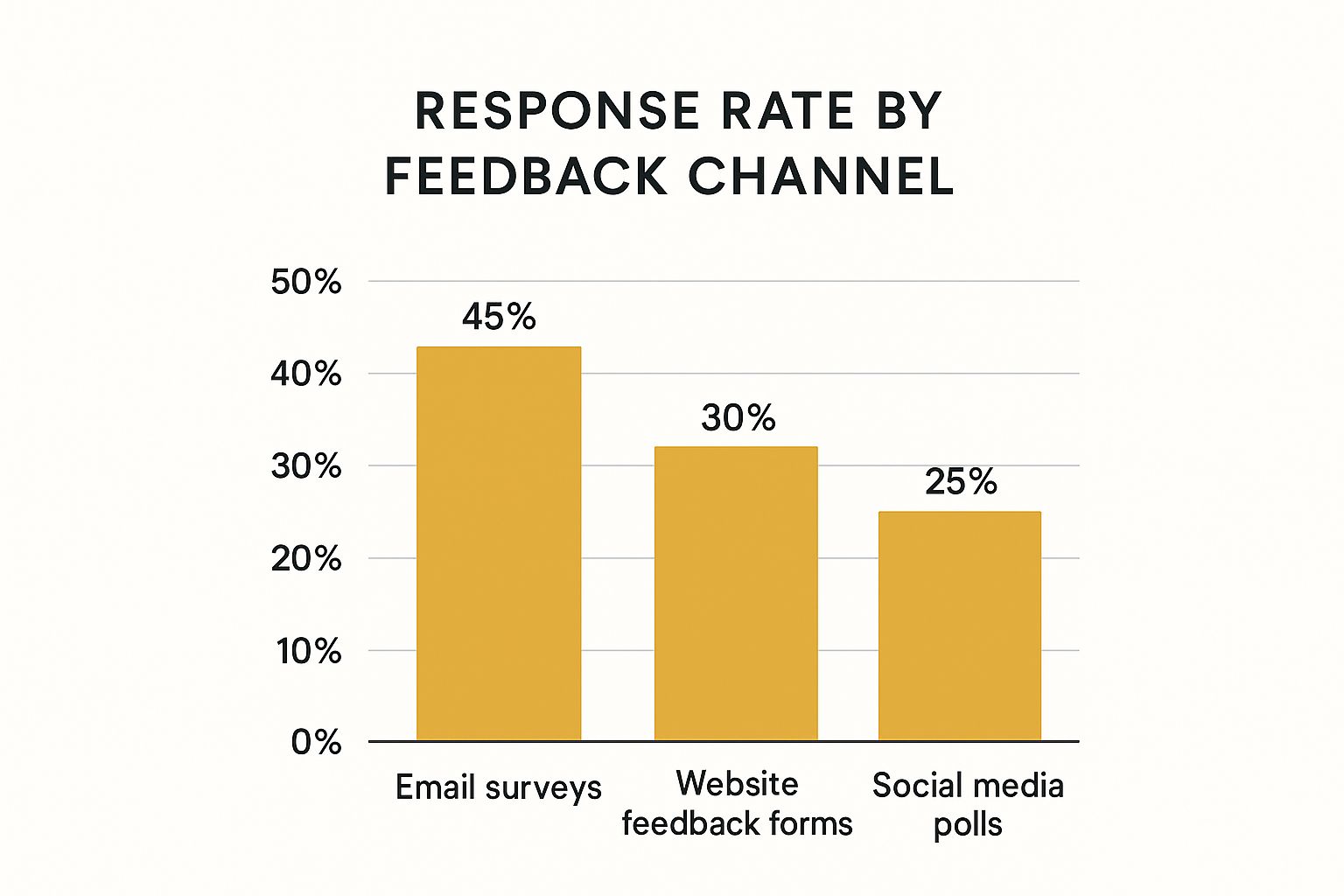
As you can see, email still packs a punch with a higher response rate, making it a reliable workhorse for gathering detailed feedback after a specific transaction.
To help you decide on the right mix, let's look at some of the most common channels.
Choosing Your Customer Feedback Channels
This table breaks down some of the most common feedback channels, what they're best for, and their pros and cons. It's a quick guide to help you build a well-rounded strategy.
| Feedback Channel | Best For | Pros | Cons |
|---|---|---|---|
| Email Surveys | Post-purchase or post-interaction feedback. | High response rates, can ask detailed questions. | Can feel impersonal; over-surveying leads to fatigue. |
| In-App/On-Site Pop-ups | Contextual feedback on specific features or pages. | Timely and highly relevant; easy for users. | Can be intrusive if not implemented carefully. |
| Social Media Listening | Unsolicited, candid opinions and brand sentiment. | Raw, honest insights; spots emerging trends. | Can be unstructured "noise"; requires monitoring tools. |
| Third-Party Review Sites | Overall brand reputation and major service issues. | High credibility with potential customers. | Feedback is public; can be difficult to manage. |
| Customer Support Chats | Identifying friction points and common problems. | Direct insight into user frustrations in real time. | Represents users with problems, not necessarily all users. |
Remember, you don't need to use all of them. Start with a couple that make sense for your business and build from there. The goal is to get a complete picture, not just a single snapshot.
Match the Channel to the Customer Journey
To build a system that works, think about your customer's path and place your feedback touchpoints strategically along the way.
-
Awareness & Consideration: Early on, social media listening and review sites are absolute gold. This is where you find out what people really think about your brand and your competitors, often before they've even landed on your website.
-
Purchase & Onboarding: This is prime time for transactional feedback. A simple post-purchase email or a slick feedback widget on the order confirmation page can capture what someone thought about the buying experience while it's still fresh in their mind.
-
Usage & Support: In-app surveys, customer support interactions, and usability tests give you a direct window into how people are using your product. This is where you'll uncover those crucial friction points and find massive opportunities for improvement.
If you're using physical touchpoints like product packaging or in-store displays, QR codes linking to a survey can be a great option. Just make sure you know if people are actually using them. It's worth learning how to track QR code scans effectively to see if your efforts are paying off.
A classic mistake I see all the time is asking for big-picture relationship feedback (like an NPS score) immediately after a tiny, transactional interaction, like a password reset. That's just going to get you skewed data. The context of the ask must match the question you're asking.
Ultimately, you're aiming to create a seamless feedback loop. The insights you gather from one channel should fuel the actions you take in another. This integrated approach is what turns a random collection of comments into a clear, actionable roadmap for making your business better.
Designing Surveys People Actually Want to Complete

Let's be honest. The biggest challenge in collecting customer feedback often comes down to one simple thing: getting people to actually respond. A clunky, poorly designed survey is the fastest way to get your request ignored. I've learned to think of survey design as an art—it’s about clarity, respecting the customer's time, and, most importantly, asking the right questions.
Think about Netflix's move away from a five-star rating system to a simple thumbs-up or thumbs-down. It was a brilliant simplification. That one small change reportedly boosted user interaction with the feature by a staggering 200%. Why? Because it was effortless. That’s precisely what you should be aiming for.
Crafting Questions That Elicit Real Answers
The feedback you get is only as good as the questions you ask. If your questions are vague or leading, you'll end up with murky, biased data. The trick is to stay specific and neutral.
-
Ditch the Leading Questions: Don't ask, "How much did you enjoy our fantastic new feature?" This just nudges people towards a positive answer. Instead, try something neutral like, "What are your thoughts on our new feature?"
-
Keep it Clear and Direct: Avoid industry jargon. A question like, "How would you rate the overall UI/UX of the platform?" might make sense to you, but not to your customers. A much better approach is, "How easy was it to find what you were looking for on our website?"
Even tiny changes in wording can have a huge impact on the quality of the insights you collect.
A classic mistake I see all the time is asking double-barrelled questions. For example, "Was our website easy to navigate and was the checkout process smooth?" This is asking for a single answer about two completely different experiences. You absolutely have to split these into separate questions to get accurate feedback on each part of the journey.
Finding the Sweet Spot with Question Types
A truly effective survey uses a mix of question formats. This keeps it interesting for the user and allows you to capture both the "what" and the "why." You really need a blend of quantitative questions (think ratings and scores) and qualitative ones (open-ended text).
For example, you could start with:
- On a scale of 1-10, how likely are you to recommend our product? (This is your quantitative part).
- What is the main reason for your score? (And here's the qualitative follow-up).
This one-two punch is incredibly powerful. The first question gives you a hard metric you can track over time. The second gives you the all-important context behind that number, telling you exactly where you need to focus your efforts.
To see how this works in the real world, it's worth looking at how different industries handle it. To design truly impactful surveys that resonate with your audience and gather valuable data, explore various effective hotel feedback form examples for inspiration.
Timing and delivery matter, too. Sending a survey via email can be an incredibly effective method. In fact, there are many advantages of email marketing that go far beyond just collecting feedback. By asking the right questions at the right time through the right channel, you turn what could be a chore into a genuine, strategic conversation with your customers.
Building Proactive Feedback Systems That Work
If you’re waiting for customers to complain, you’re already behind. It's like waiting for a tiny drip to turn into a full-blown flood before you call the plumber. The best approach is to get out ahead of it by building systems that actively seek out customer insights before problems have a chance to grow.
This isn't about just sitting back and letting comments roll in. It’s about strategically turning every interaction into a chance to learn, transforming your customer service from a reactive cost centre into a proactive intelligence team. You can design automated triggers that ask for feedback at just the right moment—not to annoy your customers, but to make the ask timely, relevant, and incredibly easy for them to answer.
Turning Interactions into Insights
Think about the life cycle of a standard customer service ticket. When an agent marks an issue as "resolved," your job isn't quite finished. This is the perfect opportunity to automatically send a simple, one-question email: "On a scale of 1-10, how well did we resolve your issue?" It takes the customer two seconds to click a number, and that single data point immediately tells you if the 'resolution' actually felt like one to them.
Chatbots are another goldmine for this. After a bot successfully helps a customer find what they need or answers a question, it can wrap up the conversation with a quick check-in.
"Glad I could help! Did this conversation fully answer your question? (Yes/No)"
This simple yes/no response is effortless to collect and gives you a real-time pulse on how well your automated support is performing. You're not waiting for someone to get frustrated and file a complaint; you're confirming satisfaction on the spot.
Using Data to Target Your Questions
Your proactive system gets even smarter when you use the data you already have to ask better questions. The UK telecoms sector is a brilliant real-world example of this in action. Providers know that a huge chunk of their complaints centres on a few specific issues, so they can be incredibly precise with their feedback requests.
Data from Ofcom's customer service report, for instance, showed that payment issues were behind a staggering 38% of all complaints. Armed with that knowledge, a telecoms company could create a specific, automated feedback request that triggers only after a customer interacts with the billing department or uses the online payment portal. This targeted approach is how you gather customer feedback that you can actually do something with.
It's this kind of systematic improvement that has likely helped push complaint handling satisfaction among mobile customers from 53% up to 61%. You can dig deeper into these trends by checking out Ofcom's service quality research.
Practical Proactive Systems to Implement
You don’t need a massive budget to start building a proactive feedback engine. It’s really about being clever and systematic. Here are a few practical ideas you can put into practice right away:
- Post-Support Follow-ups: Automatically email a one-click satisfaction (CSAT) survey about 24 hours after a support ticket is closed. This gives the customer a little time to breathe and reflect on whether their problem is really solved.
- eCommerce Post-Purchase Checks: If you run an online shop, send a quick survey a week or so after an order has been delivered. Ask about the product quality and the delivery experience separately to get clear, distinct feedback.
- Abandoned Cart Feedback: When a shopper abandons their cart, why not trigger an email asking if they ran into any problems? You might uncover a technical glitch on your checkout page or realise your shipping costs are a major roadblock.
By setting up these kinds of automated, proactive touchpoints, you build a machine that is constantly hunting for valuable insights. You stop being a passive bystander and become an active participant in the conversation, always staying one step ahead.
Creating a Unified View of Your Customer Feedback

Feedback has a habit of showing up everywhere. A customer might praise your new feature in an Instagram DM, flag a bug through your website form, and then ask a billing question on live chat—all in the same week. If those conversations are trapped in different systems, you’re only ever seeing fragments of their experience. You're missing the real story.
The aim is to get past this fragmented view and build a single, complete picture of each customer. This is what a true omnichannel feedback strategy is all about. It means that whether a customer reaches out on WhatsApp, email, or a review site, their experience is consistent and, crucially, all that information flows into one central hub. It's about breaking down the walls between your teams so everyone can see the whole customer journey.
The Challenge of Data Silos
Data silos are the single biggest obstacle to genuinely understanding your customers. It’s what happens when your marketing team's social media insights never make it to the product team, or when customer support's chat logs are invisible to sales. Each department is sitting on a valuable piece of the puzzle, but no one can put the whole picture together.
Think about a UK eCommerce business. They might see a spike in support tickets complaining about late deliveries. At the same time, their social media manager is fielding frustrated comments about the exact same issue. If those two streams of feedback aren't connected, the company won't realise just how big the problem is until their reputation has taken a serious hit.
By funnelling all feedback into a single platform—whether that’s a dedicated customer feedback tool or a CRM with powerful integrations—you can finally start connecting the dots. Suddenly, a jumble of complaints becomes a clear, actionable insight.
Meeting Modern Customer Expectations
Today’s customers, especially in a competitive space like UK eCommerce, don’t just expect a smooth experience; they expect a fast one. This isn't just a feeling; recent industry insights show that 67% of UK shoppers now expect a response to their queries within two hours. An integrated system isn't a luxury anymore—it’s a necessity. When all your feedback is in one place, your team can respond quicker and with the full context.
In fact, the same research found that retailers using integrated platforms reported 40% fewer complaints about communication gaps compared to businesses with disconnected systems. That’s a direct link between unified feedback and happier customers. You can dig into more of these findings by reading the complete UK customer service trend report.
To get there, you'll want to look for tools that offer a few key features:
- Centralised Inbox: This is your command centre, pulling in messages from email, social media, and chat apps into a single view.
- Customer Timelines: A complete history of every single interaction a customer has had with your brand, all in one place.
- Tagging and Categorisation: This allows you to label feedback by theme (like "product-feature-request" or "shipping-issue") so you can easily spot trends.
Building this single source of truth is the most powerful thing you can do to gather customer feedback that actually drives change. It’s how you turn a chaotic stream of comments into an organised library of customer intelligence.
Closing the Loop and Turning Feedback into Action
Collecting all that customer feedback is a great start, but it’s really only half the job. The real magic happens when you actually do something with that information and—this is the crucial part—let your customers know about it. This whole process is called closing the feedback loop. It’s what separates businesses that just hear from those that genuinely improve.
Think about it: when a customer takes the time to share their thoughts, they’re giving you a gift. Just letting that feedback sit in a spreadsheet doesn't do anyone any good. Acting on it shows their voice matters, which builds incredible loyalty and can turn everyday customers into your biggest fans. This is how raw data becomes real-world product updates, better service, and smarter training for your team.
From Insight to Implementation
First things first, you need a way to make sense of all the feedback pouring in. Let's be realistic—not every suggestion will be practical or even align with where you want to take your business. A simple but effective way I’ve always prioritised feedback is with an impact/effort matrix. It’s just a straightforward grid that helps you sort ideas based on the value they'll create versus the resources needed to get them done.
Here’s how it usually breaks down:
- High Impact, Low Effort (Quick Wins): These are your absolute top priorities. We're talking about things like fixing some confusing wording on your website or adding a helpful link to your post-purchase email. Easy fixes, big results.
- High Impact, High Effort (Major Projects): These are the game-changers, like developing a new feature that customers have been asking for repeatedly. They need careful planning and resources but can deliver massive value.
- Low Impact, Low Effort (Fill-ins): Think of these as nice-to-haves. They’re small improvements you can knock out when your team has a bit of downtime.
- Low Impact, High Effort (Time Sinks): These are the ideas you should probably park for now, or even discard. The return just isn’t worth the effort.
Using a framework like this stops your team from getting swamped with tiny requests and ensures the big opportunities don’t get missed.
So many businesses fall into the trap of only acting on negative feedback. While putting out fires is essential, don't ignore the good stuff. Digging into what your customers love tells you exactly what your strengths are and what you should be doubling down on.
Communicating Your Progress
Right, so you’ve made a change based on feedback. Now what? You have to close the loop. It’s the final step, and honestly, the one most people forget. But it’s arguably the most powerful for building lasting relationships.
You don't have to send a personal email to every single person. Instead, think bigger. If dozens of customers asked for a particular feature and you finally built it, that’s perfect content for your next newsletter.
A simple "You asked, we listened" update on your blog or social media can do wonders. It sends a clear message to your entire customer base: you're not just collecting data for the sake of it, you're building a better experience with them. This entire cycle of listening and responding is fundamental to building a strong brand, something we cover in more detail in our beginner’s guide to digital marketing.
By consistently closing that feedback loop, you create a culture of improvement that your customers can actually see and feel. That’s how you earn trust.
Common Questions About Gathering Customer Feedback
Even with the best plan in place, you’re going to have questions as you start collecting feedback. That’s perfectly normal. Getting this right is much more of a continuous effort than a one-and-done project.
To help you move forward with confidence, I've gathered some of the most common questions we hear from business owners and managers. Consider this your go-to guide for tackling those frequent hurdles.
How Often Should We Be Asking For Feedback?
There’s no magic number here. The right frequency really depends on what you’re asking about. Ask too often and you’ll annoy people into ignoring you—the dreaded 'survey fatigue'. Ask too rarely and you’ll miss golden opportunities to improve.
The best approach is to think in two categories:
- Transactional Feedback: This is for specific moments, like a recent purchase or a chat with your support team. You'll want to ask for this almost immediately. The experience is fresh, so the feedback will be specific and honest. A simple, automated email sent within 24 hours of the interaction is usually perfect.
- Relationship Feedback: This is about the bigger picture—how customers feel about your brand overall. Think of things like your Net Promoter Score (NPS). For these, a slower pace is better. Aiming for quarterly or twice a year gives you enough data to spot trends without bugging your most loyal customers.
What's The Best Way To Handle Negative Feedback?
Let’s be honest, negative feedback can sting. But it's also one of the most valuable assets you can get. It's essentially free consultancy telling you exactly what to fix. The trick is having a solid process for handling it professionally.
First, always reply quickly and with empathy. Simply acknowledging their frustration shows you're listening. Next, take ownership of the problem. Avoid getting defensive or making excuses. A simple, "We're sorry you had this experience, and we're looking into what went wrong," can make all the difference.
Then, tell them exactly what you're doing to fix their specific issue. And here's the most important part: use that feedback internally to solve the root cause. This is how you turn a single bad experience into a long-term improvement for everyone.
"View every piece of negative feedback not as a complaint, but as a gift. It's a direct, unfiltered roadmap showing you exactly where you need to improve your business."
How Can a Small Business Manage Feedback Without Expensive Tools?
You absolutely don’t need a massive budget to build a brilliant feedback system. For smaller businesses, the focus should be on starting simple and being consistent, not on buying fancy software from the get-go.
Lean on free and low-cost tools that are more than capable:
- Surveys: Google Forms is completely free and incredibly versatile. Typeform also has a great free plan for creating beautiful, engaging surveys.
- Collection: Create a dedicated email address, like
feedback@yourcompany.co.uk. It’s a simple, central inbox for all comments and suggestions. - Monitoring: Keep a close eye on your social media mentions and direct messages. A tool like Hootsuite offers free plans that let you track brand mentions and keywords.
Remember, the tool is less important than the process. The real magic happens when you block out time each week to actually read the feedback, discuss it with your team, and decide what actions to take.
Ready to unify your marketing efforts and act on feedback more efficiently? The The Digital Marketing Toolbox from Grow Your Biz provides a curated selection of tools for analytics, social media, and customer engagement, all in one place. Find the right solutions to grow your business today.


