

If you're wondering how to increase blog traffic, the formula is actually pretty straightforward. It boils down to two key things: creating content that genuinely solves problems your audience has, and then having a proactive plan to get that content in front of them. It all starts with a steady rhythm of valuable articles, backed by smart SEO and a solid distribution strategy.
Building Your Content Foundation for Growth
Let's move past the tired advice to just “write great content.” Of course, quality matters, but the real engine behind a high-traffic blog is a strategic content foundation. This isn't about publishing posts into the void and hoping someone stumbles upon them. It's about methodically building a library of assets that consistently attracts and helps your ideal reader, time and time again.
This whole process is anchored in consistency. A regular publishing schedule does more than just fill your archives; it signals reliability to both search engines and your readers. It tells them your blog is alive, current, and a place they can trust for fresh information.
Establish a Realistic Publishing Rhythm
Forget trying to hit some magic number of posts per week. The best publishing frequency is the one you can actually stick to without your quality nose-diving. I've seen so many bloggers burn out trying to post daily. It's a classic mistake that only leads to thin, rushed content that doesn't help anyone.
Instead, figure out a cadence that feels sustainable for you. Can you genuinely commit to one deeply researched, high-quality post every week? Or maybe two substantial articles a month is more your speed. Consistency is far more important than sheer volume. A blog that reliably drops one brilliant article every Tuesday is infinitely more valuable than one that spams five mediocre posts one week and then goes silent for a month.
The data backs this up. In the UK digital market, a staggering 55% of bloggers say they struggle to promote their blogs. A strategic publishing plan is essential. Studies consistently show that bloggers who publish more often tend to attract more visitors, with those managing 3-4 posts a week having a better shot at building a loyal readership. Often, this goes hand-in-hand with creating longer, more valuable articles around 1,500 words. You can dig deeper into these blogging statistics and facts on Wix.com.
Create Genuinely Helpful, In-Depth Content
Once you've locked in your schedule, it's time to focus on the substance. Your goal should be to create the single best resource on the internet for any given topic you tackle. This means going way beyond surface-level tips and writing comprehensive, pillar-style posts that solve a reader's problem from start to finish.
Think about it from their perspective. Someone searches “how to start container gardening.” A generic post might list five easy plants. A truly helpful, authority-building post would cover:
- Which container materials and sizes are best (and why).
- The ideal soil mix for proper drainage and nutrients.
- A curated list of beginner-friendly plants, complete with sun requirements.
- A step-by-step guide to actually planting the seeds or seedlings.
- Common, costly mistakes to avoid.
This is the kind of content that does more than just answer a question. It builds deep trust and positions your blog as the go-to authority.
The most successful blog posts don't just provide information; they solve a complete problem. When a reader leaves your site feeling confident and equipped to take action, you've created a loyal follower.
Master the Art of Click-Worthy Headlines
Your headline is the front door to your content. You could write the most profound article in history, but if the headline is a dud, no one will ever read it. A great headline makes a powerful promise and sparks immediate curiosity.
It's time to move beyond the generic templates. “Tips for Better Sleep” is boring. “7 Unconventional Habits for Deeper Sleep That Actually Work”? Now that’s a headline that makes you want to click. It offers a specific benefit and triggers an emotional response.
What makes a headline work? There's a bit of psychology to it. It should be:
- Specific: Clearly state what the reader will get.
- Intriguing: Use power words or numbers to create curiosity.
- Useful: Promise a tangible solution to a real problem.
- Accurate: Make sure your content delivers on the headline's promise. Don't resort to clickbait.
When you combine a consistent schedule, in-depth articles, and compelling headlines, you build a powerful content foundation. This isn't about chasing fleeting algorithm changes; it’s about creating a strategic library of quality content that generates unstoppable momentum. This is the first, most critical step in learning how to increase your blog traffic for the long haul.
Mastering SEO for Sustainable Traffic

While social media and email outreach can give you those exciting, short-term traffic spikes, Search Engine Optimisation (SEO) is what builds the engine for steady, long-term growth. It's the most reliable way I've found to consistently increase blog traffic.
Forget thinking of SEO as some dark art. At its heart, it’s just a way of making it crystal clear to search engines like Google what your content is about and why it deserves to be the top result for someone’s search. You're not trying to trick a robot; you're helping it connect a real person with the perfect answer—your answer.
The Core of On-Page SEO
On-page SEO covers all the tweaks and optimisations you make directly on your blog posts. This all begins with how you use keywords—the actual phrases people are typing into Google.
The old way was to cram a keyword into every paragraph. That doesn't work anymore. Today, it’s about writing naturally. For instance, if you're targeting “best indoor plants for beginners,” your article should organically include related phrases like “low-maintenance houseplants,” “easy-to-care-for plants,” and “plants that thrive in low light.” This demonstrates a comprehensive understanding of the topic, which is exactly what Google wants to see.
This is a cornerstone of any good content strategy. You can see how SEO fits into the bigger picture in our beginner's guide to digital marketing.
Key Takeaway: Great SEO isn't about gaming the system. It's about creating a genuinely helpful, user-friendly experience that naturally signals your content's quality to search engines.
Once you’ve written your brilliant piece, you need to package it properly for search engines. This comes down to a few critical elements:
- Compelling Meta Descriptions: This is the short summary under your title in the search results. While it won't directly boost your rank, a persuasive one can dramatically increase the number of people who actually click on your link. Make it a tiny, powerful advert for your post.
- User-Friendly Headings: Good structure is a win-win. Using headings (H2s for main sections, H3s for sub-points) helps readers scan your content and allows search engines to quickly grasp the hierarchy and key topics of your article.
- Optimised Images: Don’t just upload
IMG_4567.jpg. Name your image files descriptively (e.g.,beginner-indoor-plants.jpg) and always add “alt text” to describe what the image shows. This helps you rank in image search and makes your site more accessible.
Technical Fundamentals You Cannot Ignore
Beyond the words on the page, a few technical aspects can make or break your ranking potential. You don’t need to be a web developer to get these right, but you absolutely can't afford to ignore them. The two big ones are site speed and mobile-friendliness.
A slow website is a traffic killer. Seriously. Studies have shown that even a one-second delay in page load time can slash conversions by 7%. People are impatient; if your blog takes too long to appear, they’ll just hit the back button.
Equally important is how your site works on a phone. With most web traffic now coming from mobile devices, Google prioritises websites that provide a great mobile experience. If your blog is a pinch-and-zoom nightmare on a smartphone, your rankings will suffer everywhere.
Fortunately, free tools like Google's PageSpeed Insights can diagnose your site's performance and give you clear, actionable advice. Often, the fixes are surprisingly simple, like compressing your images or choosing a better-coded theme. Nailing this technical foundation ensures that Google can find, understand, and confidently recommend your content, turning search engines into your most powerful source of traffic.
Winning with a Mobile-First Experience

If you're serious about getting more traffic to your blog, it's time to start thinking small. As in, small screens. A clunky, slow, or hard-to-read mobile site isn't just an annoyance anymore; it's a direct roadblock to growth. Ignoring your mobile visitors is like locking your doors to three out of every four people who try to come inside.
It's just the reality of the web today. In fact, projections show that mobile devices will soon account for over 75% of all web traffic. When you combine that with the average reader spending just 52 seconds on a post, you can see how a frustrating mobile experience guarantees they won't stick around. You can dig deeper into these vital blogging insights at GlobalTechStack.com.
Adopting a True Mobile-First Mindset
Thinking “mobile-first” is about a fundamental shift in perspective. It means you design for the smallest screen first and then scale the experience up for tablets and desktops. This is the complete opposite of the old way, where we’d build a huge, complex desktop site and then desperately try to shrink it down for a phone.
So, why does this matter so much? Because Google now uses mobile-first indexing. This is a big deal. It means Google primarily looks at your site's mobile version to figure out its ranking. If your mobile site is a poor, stripped-down version of your desktop one—or worse, just a broken mess—your search visibility will take a direct hit across the board.
A seamless mobile experience is no longer a “nice-to-have”. It's a core requirement for search engine visibility and keeping users happy. A poor mobile site sends strong negative signals to Google, which directly harms your traffic potential.
Key Elements for a Flawless Mobile Experience
So, what does it take to get your blog looking perfect for your mobile audience? It really boils down to a few critical components working together to give every visitor a smooth, intuitive experience, regardless of their device.
Your first line of defence, and frankly a non-negotiable one, is a responsive theme. A responsive design automatically adjusts your blog's layout to fit any screen, from a huge monitor right down to a small smartphone. Most modern WordPress themes and website builder templates are responsive straight out of the box, but you should always test it for yourself.
Beyond that, you need to be obsessed with these details:
- Fast Loading Speeds: Mobile users are notoriously impatient. Always compress your images before uploading them, and look into using a caching plugin to serve your pages much faster.
- Readable Fonts: Your text absolutely must be large enough to read easily without pinching and zooming. Go for a clean, simple font and make sure you have plenty of contrast between the text colour and the background.
- Clickable Elements: Every button and link needs to be large enough and spaced far enough apart for someone to tap easily with their thumb. There's nothing more infuriating than trying to hit a tiny link and tapping the wrong one over and over again.
A Practical Mobile-Friendly Checklist
Don't just rely on desktop simulators to check your site. Pull out your own smartphone and audit your blog regularly. This is a real-world test that will reveal glitches you'd otherwise completely miss.
Use this simple checklist to guide your review:
- Navigation: Is the menu easy to spot and use? A “hamburger” icon (three horizontal lines) is the universal symbol for a mobile menu, so it's a safe bet.
- Readability: Can you read entire paragraphs without squinting or needing to zoom in?
- No Horizontal Scrolling: Does all your content fit neatly within the width of the screen?
- Pop-ups: Are your pop-ups intrusive or impossible to close on a small screen? Be careful here, as Google can penalise sites for this.
By making these elements a priority, you ensure every visitor has a fantastic experience. That encourages them to stay longer, read more of your content, and come back for more in the future—a cornerstone strategy for sustainably growing your blog traffic.
Getting Your Content in Front of the Right People
Hitting ‘publish' on a brilliant article feels great, but honestly, that's just the starting line. A fantastic post that nobody reads is a wasted effort. To really see your blog traffic climb, you need to think less like a writer and more like a promoter. This means having a solid plan to get your work seen by the right audience, long after it first goes live.
Too many bloggers fall into a trap: publish, share once on social media, and immediately start worrying about the next post. This is a huge misstep. I've seen a single, well-promoted article outperform ten posts that were just left to gather dust. It's all about being deliberate with your distribution.
Start Building Your Email List Yesterday
If there’s one asset you should treasure above all others, it’s your email list. Think about it: social media platforms can change their algorithms overnight, and your reach can vanish. But your email list? That’s a direct line to your most loyal readers. These are the people who’ve actively said, “Yes, I want to hear from you.”
Don't put this off. You need a simple sign-up form on your blog from day one. To sweeten the deal, offer a small but genuinely useful incentive—what we call a ‘lead magnet'. This doesn't have to be complicated; it could be a handy checklist, a short PDF guide, or even a mini email course related to your niche.
A social media following is rented space, but an email list is an audience you truly own. Focusing on email is the most reliable way I know to build a real community and drive consistent, repeat traffic every time you publish something new.
Once people subscribe, don't just bombard them with your latest articles. Set up an automated welcome sequence—an autoresponder series—to introduce them to your best work. This is your chance to make an incredible first impression and guide new readers to your foundational, cornerstone content they might have otherwise missed.
This is why email is so powerful. Look at the typical engagement you can expect:
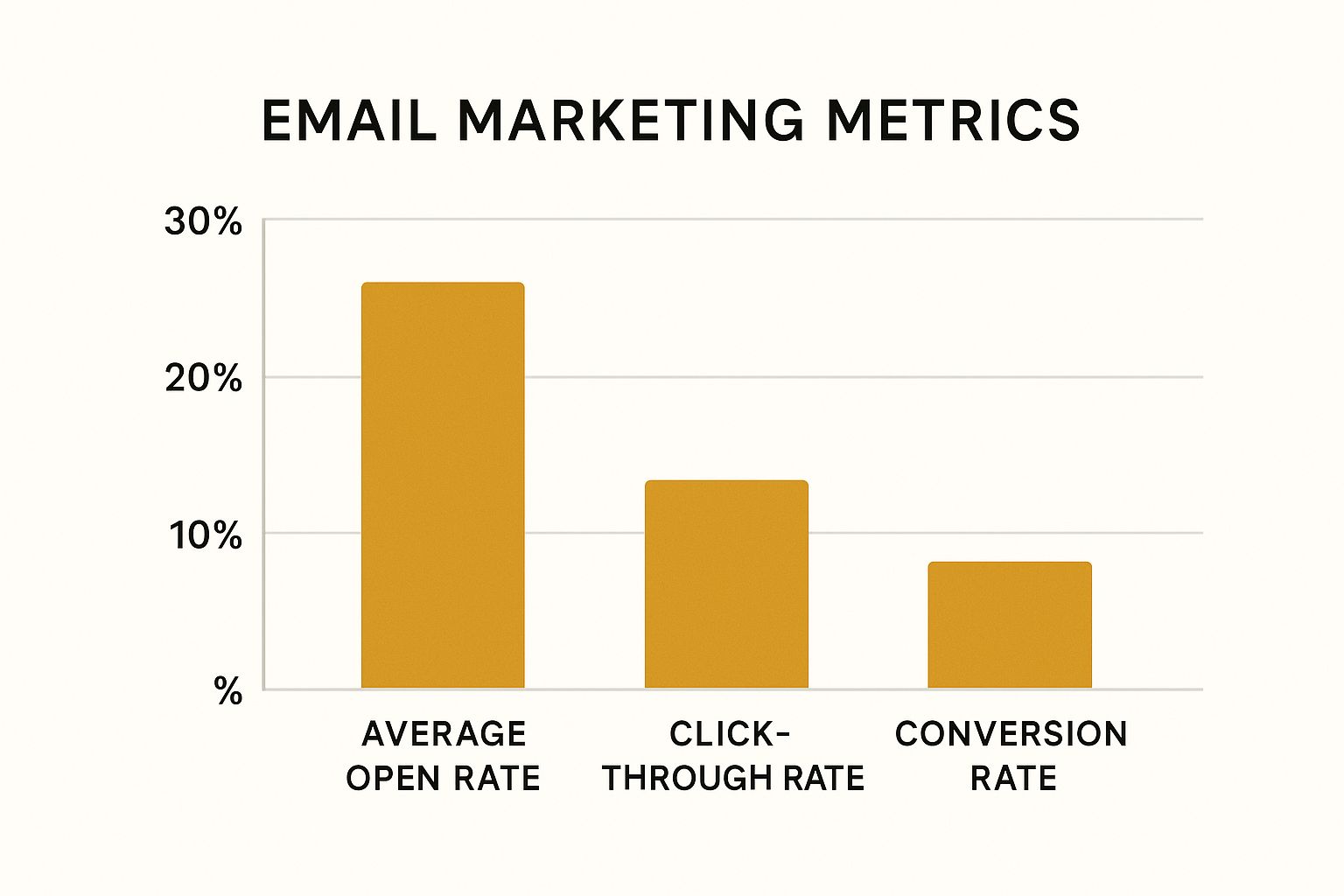
Even with a modest open rate, a good chunk of your most dedicated readers will click through. That's the power of a direct, personal channel.
Go Where Your Audience Actually Spends Their Time
Spreading yourself thin across every social media platform is a recipe for burnout and mediocre results. The smart move? Figure out the one or two places where your ideal reader is already active and go all-in there.
- Working in a visual niche? If you're blogging about food, travel, or interior design, Pinterest isn't just social media; it's a visual search engine that can drive traffic for years.
- Talking business, tech, or finance? LinkedIn and X (formerly Twitter) are the places to be. They're perfect for sharing sharp insights and joining professional conversations.
- Building a community? For niches like parenting, gardening, or other hobbies, a dedicated Facebook Group can become a thriving hub for discussion and a fantastic place to share your content.
The trick is to do more than just drop links. You need to repurpose your content to fit the platform. For instance, turn a list-based article into a punchy X thread, pull a compelling statistic for a LinkedIn post, or design a set of eye-catching Pins. If you want to dive deeper, our guide on creating a marketing strategy for small business has some great pointers on choosing the right channels.
Effective Traffic Driving Channels for UK Blogs
Choosing where to focus your promotional energy can be tough. Here’s a quick breakdown of some of the most effective channels for UK bloggers to help you decide where to invest your time.
| Channel | Primary Benefit | Best For | Effort Level |
|---|---|---|---|
| Email List | Direct, owned audience with high engagement | Nurturing a loyal community and driving repeat traffic | Medium |
| Long-term, compounding traffic from visuals | Food, travel, home decor, fashion, and DIY niches | Medium-High | |
| Professional networking and authority building | B2B, tech, finance, marketing, and career-focused blogs | Medium | |
| Facebook Groups | Fostering community and direct engagement | Hobby-based or community-centric niches (e.g., parenting) | High |
| SEO | Passive, organic traffic from search engines | Informational and “evergreen” content | High |
| Blogger Outreach | Authority building and referral traffic | Any niche with established blogs and influencers | High |
Ultimately, the best approach is to pick one or two channels that align perfectly with your audience and content, and master them before trying to expand.
Learn the Art of Blogger Outreach
One of the most powerful—and most overlooked—ways to get targeted traffic is through blogger outreach. This isn't about sending spammy, templated emails. It's about building real relationships with other creators in your space.
Start by making a list of non-competing blogs that write for the same kind of people you do. Then, become a genuine part of their community. Leave thoughtful comments on their posts. Share their articles with your own audience (and tag them!).
After you've built a bit of a rapport, you can start exploring ways to work together:
- Guest Posting: Writing an article for someone else’s blog is a brilliant way to get in front of a fresh, relevant audience. It also earns you a valuable backlink. Your only job is to provide them with an absolutely fantastic post.
- Strategic Link Building: If you’ve created a truly exceptional resource—like an ultimate guide or a study with original data—you can reach out to bloggers who have written on that topic and politely suggest they add a link to your piece.
This strategy takes patience and a personal touch, but the results can be massive. A single mention or link from a well-respected blog can send a steady stream of high-quality traffic your way for years. It's how you borrow credibility from established players to boost your own.
Finding Your Content Rhythm: When to Create and When to Update
Sooner or later, every blogger hits a crossroads. Your site is picking up steam, you've got a decent number of articles, and then the big question looms: should you keep churning out new content, or is it time to look back and improve what you've already published?
This is the classic quality vs. quantity debate, but the answer isn't a simple choice between one or the other. It’s about finding your content velocity—the perfect rhythm of creating new posts and refreshing old ones that will actually lead to sustainable growth.
It’s easy to fall into the trap of thinking more is always better. In the early days, every new post is a new lottery ticket for Google rankings. But chasing a high publishing frequency forever has diminishing returns. If you're so laser-focused on the next article that your existing posts gather dust, you're building a library of slowly decaying assets. Statistics go stale, advice becomes outdated, and those once-great articles will quietly slide down the search results.
New Content vs. Updates: Timing is Everything
The right strategy really depends on where you are in your blogging journey. What works for a brand-new blog is completely different from what an established site needs.
- New Blogs (0-50 posts): At this stage, it's all about creation. You need to build a solid foundation of high-quality, keyword-focused articles. Your main job is to establish your topical authority and show search engines what your corner of the internet is all about. A good rule of thumb is an 80/20 split, with 80% of your effort going into brand-new content.
- Established Blogs (50+ posts): Now, the balance starts to shift. You have a valuable archive—a collection of digital assets just waiting to be polished. It's time to move closer to a 50/50 split between creating new posts and refreshing your existing ones. Your older content already has history, backlinks, and some ranking authority. It's primed for a boost.
Diving into the data, you’ll find a strong connection between the number of articles on a blog and the traffic it gets. Bloggers often see their monthly page views climb steadily until they hit around the 500-post mark. After that, some find their average traffic per post actually drops off. Why? Because maintaining SEO and quality across such a massive library is incredibly difficult without a solid update strategy. This just goes to show that more content is only better if you're actively maintaining it. You can see more data on blogger earnings and traffic patterns on ProductiveBlogging.com.
The Surprising Power of a Content Refresh
Updating your existing articles is one of the most effective, high-impact things you can do to get more traffic. From my experience, it's often far quicker and more efficient than writing a new post from scratch. You aren't starting from zero; you're building on an asset that already has a foothold.
So, what does a “refresh” actually involve?
- Update the facts: Swap out old statistics, fix broken links, and correct any information that's no longer accurate.
- Expand the content: Could you add new sections or answer more questions? Turning a good post into an amazing, comprehensive guide can give it a serious ranking boost.
- Sharpen the SEO: Revisit your keywords. Are there new, related terms you could target? Tweak your title, meta description, and headings for better click-through rates.
- Add fresh media: Can you embed a new video, create a simple infographic, or add better images to make the post more engaging and valuable?
I always tell people to think of their blog archive as a garden, not a newspaper. A newspaper is old news by tomorrow. A garden, on the other hand, needs constant tending—pruning, watering, and planting—to keep it flourishing year after year.
How to Spot the Posts Worth Updating
Don't just pick posts at random. Your analytics are your best friend here. Dive into your Google Search Console or whatever analytics platform you use to find the prime candidates for an update.
I always look for posts with these tell-tale signs:
- Good, but not great, rankings: Articles stuck on the bottom half of page one or on page two of Google are goldmines. They're so close! A little push is often all it takes to get them into those coveted top spots.
- High impressions, but low clicks: This is a classic signal that your topic is in demand, but your headline or meta description just isn't cutting it. A simple rewrite can make a world of difference.
- The “has-beens”: Hunt down articles that used to bring in a lot of traffic but have seen a steady decline. This is a clear sign of content decay, and it’s almost always reversible with a solid refresh.
By striking the right balance between creating fresh content and strategically maintaining your existing library, you turn your entire blog into a powerful, traffic-generating machine. This approach builds a truly valuable and evergreen asset that will keep paying dividends for years to come.
Common Questions About Growing Blog Traffic

Even after you've mapped out a brilliant growth strategy, the reality of growing a blog is that you'll still have questions. It’s completely normal. Knowing the answers to these common sticking points helps you set realistic goals, put your energy in the right places, and ultimately stay motivated for the journey ahead.
So, let's dive into some of the most frequent questions I hear from fellow bloggers.
How Long Does It Realistically Take To See Traffic Growth?
This is the big one, isn't it? The most honest, albeit frustrating, answer is: it depends. But that doesn't mean we can't set some realistic expectations. For a completely new blog, you should be prepared to see noticeable, meaningful traffic growth within 6 to 12 months of consistent work.
Sure, you might get early wins from social media shares or a shout-out from another blogger. Those are great for morale! But the real, sustainable traffic comes from SEO, and SEO is a long game. Google needs time to discover your content, figure out what it's about, and trust that you're a reliable source of quality information.
Don’t panic if you don’t see a huge surge in organic traffic after your first month. Think of those initial six months as laying the groundwork. Every high-quality post is a new brick in your foundation, and their combined impact will grow exponentially over time.
If you have an established blog that you're just now optimising for growth, you'll likely see results faster—perhaps within 3 to 6 months—because you already have some domain history. Either way, the non-negotiable ingredient is unwavering consistency.
Should I Focus On New Content Or Update Old Posts?
This is a classic dilemma, and the truth is, you need to do both. The key is knowing how to balance your efforts as your blog evolves.
- When you're starting out: Your main job is to create. You need to build a solid library of foundational content. I recommend an 80/20 split, pouring 80% of your time into publishing new articles and the remaining 20% into making small improvements to your existing posts.
- Once your blog is established: After you have a decent archive (say, 50+ posts), it’s time to shift your focus. Updating old content becomes your secret weapon for growth. At this stage, I’d move closer to a 50/50 split between creating new content and refreshing your old material.
Why the change? Because updating an existing post is often the quickest path to a traffic win. You can find articles that are hovering on the second or third page of Google search results and give them a serious boost. By adding fresh information, updating statistics, and improving the on-page SEO, you can often push that content onto the first page and see a significant, almost immediate, return on your effort.
Which Social Media Platform Is Best For My Blog?
Don't make the common mistake of trying to be everywhere at once. It’s a fast track to burnout with very little to show for it. The best social media platform isn't the one with the most users; it's the one where your ideal readers are already hanging out. My advice? Pick one or two and truly master them.
Let your niche be your guide:
- Visual Niches (Food, Travel, Decor): Your best bets are Pinterest and Instagram. I especially love Pinterest because it functions more like a visual search engine, meaning your pins can drive traffic for months, or even years.
- Business or Tech Niches: Conversations in these fields are happening on LinkedIn and X (formerly Twitter). These platforms are perfect for sharing sharp insights and positioning yourself as an authority.
- Community-Focused Niches (Parenting, Hobbies): Building a dedicated Facebook Group can be a game-changer. It gives you a direct line to your audience and fosters a real sense of community.
While social media is fantastic for discovery, remember that your email list is where your most valuable connections are made. You can explore the many advantages of email marketing to understand how it builds a direct, reliable relationship with your core audience.
Ready to stop guessing and start growing? The Digital Marketing Toolbox is your all-in-one resource for finding the best tools to increase your blog's traffic, from SEO and analytics to email marketing and social media automation. Discover curated solutions that drive real results at https://grow-your-biz.com.


