
If you're serious about increasing your ecommerce sales, you can't just focus on one thing. It's about taking a comprehensive look at your entire operation – customer experience, marketing, and data-driven optimisation all have to work together. The real magic happens when you make small, consistent improvements across the board. Think of it as a compounding effect; each little win builds on the last, driving sustainable, long-term growth.
Your Framework for Real Ecommerce Growth
Feeling stuck trying to get your online revenue moving in the right direction? You're definitely not alone. The path to more sales isn't about some secret hack; it’s about building a solid, strategic framework. This guide cuts through the generic advice to give you practical, actionable steps designed for UK ecommerce businesses that are ready for real growth.
We’re going to skip the fluff and focus on what actually works. My goal is to hand you a clear roadmap, helping you put your energy (and budget) into the efforts that will give you the best return.
Setting the Stage for Success
Before we get into the nitty-gritty tactics, it’s crucial to grasp the big picture. Your business is more than just a website; it’s an entire ecosystem. Every single part affects the others. You could have the most brilliant marketing campaign in the world, but it will fall flat if your checkout process is a nightmare.
This is why a holistic approach isn't just a good idea—it's essential. We'll break down the key pillars that must work in harmony to create a powerful sales engine:
- Conversion Rate Optimisation (CRO): This is all about getting more of your current website visitors to actually buy something.
- Customer Experience Technology: We're talking about using smart tools like AI and AR to create shopping journeys that are genuinely helpful and memorable.
- Mobile-First Commerce: It's no secret that most people shop on their phones now. Your site has to be built for it.
- Smart Marketing & SEO: This is how you expand your reach and attract qualified customers who are already looking for what you offer.
The most successful ecommerce brands I've worked with have one thing in common: they realise that real growth comes from compounding small wins. Optimising your checkout for a 1% conversion lift or tweaking an email for a 1% higher click-through rate might not sound like much. But trust me, those gains add up to significant revenue over time.
To really build a strong foundation, I recommend exploring the top ecommerce growth strategies for a deeper dive into what's working right now.
Key Pillars for Boosting Online Sales
To help you visualise how everything fits together, let’s map out the core strategic areas we’ll be covering. The table below gives you a simple breakdown of each pillar, its primary focus, and what you can expect to achieve.
| Strategic Pillar | Primary Focus | Expected Outcome |
|---|---|---|
| Digital Storefront | Optimising user experience and simplifying the checkout process. | Higher conversion rates and lower cart abandonment. |
| Technology | Implementing AI, AR, and chatbots for a better customer journey. | Increased engagement, higher add-to-cart rates, and fewer returns. |
| Mobile Strategy | Designing a seamless experience for smartphone and tablet users. | Improved mobile conversion and capturing younger demographics. |
| Marketing & SEO | Driving targeted traffic through organic search and smart campaigns. | Increased brand visibility and consistent lead generation. |
When you start focusing on these interconnected areas, you stop chasing single wins and start building a robust, reliable system for growth.
Honing Your Digital Storefront to Boost Conversions
Think of your website as your best salesperson, working tirelessly 24/7. But is it actually closing deals? When you start asking how to increase ecommerce sales, the answer often lies right here, with your digital storefront. It all comes down to Conversion Rate Optimisation (CRO) – the art and science of turning more of your visitors into paying customers.
This isn't just about a flashy design. It’s about getting inside your customer's head, identifying and removing any friction, and creating a shopping journey that feels natural and trustworthy from the second they land on your site. You'd be amazed how seemingly minor tweaks can have a massive impact on your revenue.
Streamline the Path to Purchase
If there's one thing that consistently kills conversions, it's a clunky, confusing checkout process. Study after study confirms that a huge number of shoppers who add items to their basket never actually finish the purchase, with a complicated checkout being the main reason they bail. Your number one goal should be to make buying from you as easy as possible.
Imagine walking into a physical shop, but to pay, you had to fill out a long form and stand in three different queues. You'd walk out, wouldn't you? It's the exact same principle online.
Here's how to smooth things over for your customers:
- Embrace Guest Checkout: Forcing people to create an account is a massive barrier. Always, always give them the option to check out as a guest. You'll capture sales from first-timers and people in a hurry.
- Slash Your Form Fields: Only ask for what you absolutely need to process the order. Do you really need their date of birth right now? Every extra box they have to fill is another reason for them to give up.
- Show a Progress Bar: Let people know exactly where they are in the process (e.g., Shipping > Payment > Review). It manages their expectations and cuts down on the anxiety of a checkout that feels like it’ll never end.
This visual shows just how much smoother a simplified checkout can feel on a mobile device, guiding the user straight to completion.
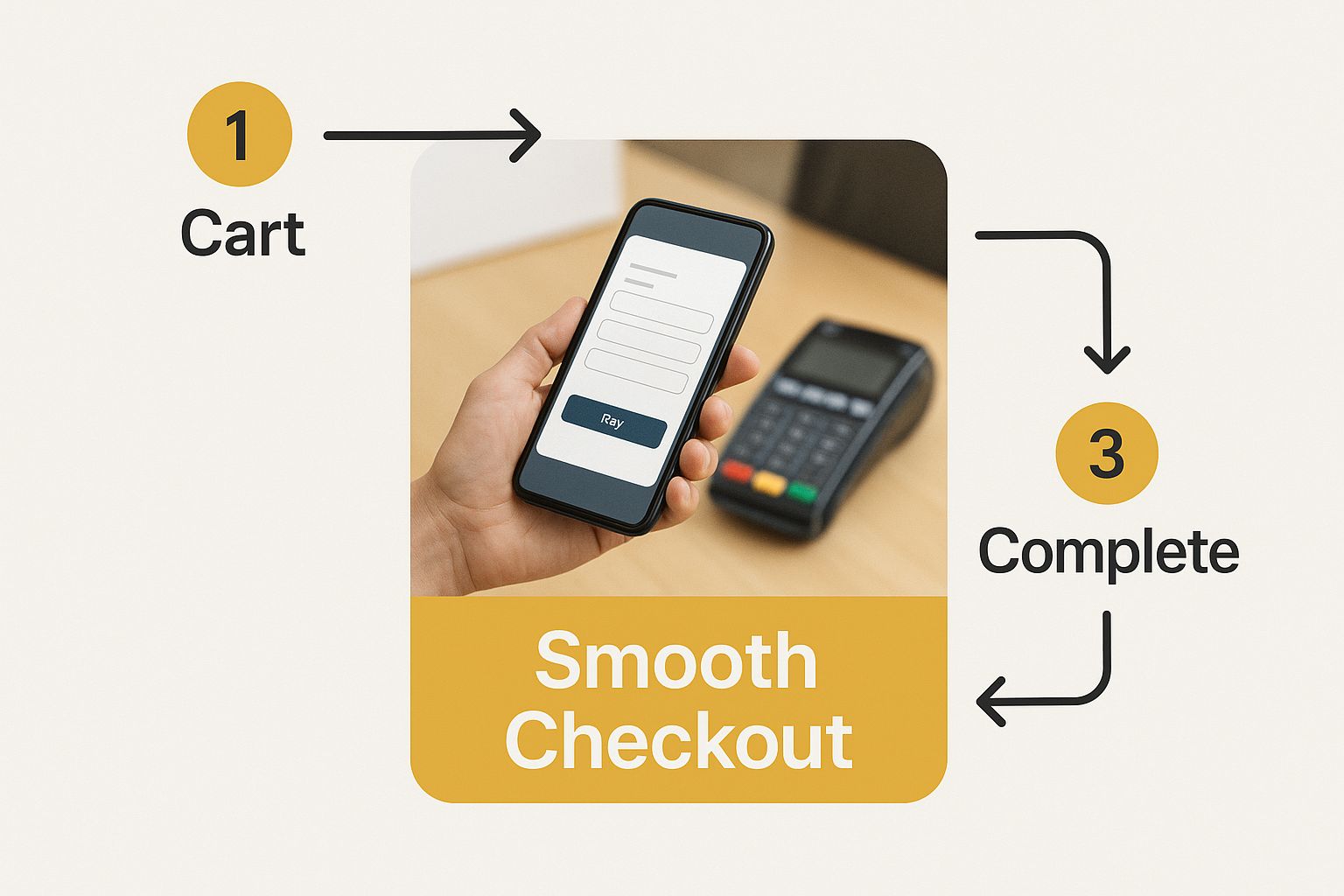
The takeaway is simple: removing steps and visual clutter directly leads to a better chance of purchase, especially on the small screen of a phone.
Build Unshakeable Customer Trust
Without a physical shop or face-to-face interaction, trust becomes the most valuable currency in ecommerce. A new visitor needs to feel certain that your business is legitimate, their payment details are safe, and that you'll be there for them if something goes wrong. Earning that trust isn't a one-and-done job; it’s an ongoing effort.
One of the most powerful ways to build it is with social proof. When potential buyers see that other people have already bought from you and had a great experience, their own hesitation starts to melt away.
I once worked with a fashion retailer whose product pages looked stunning but just weren't converting. We ran a simple A/B test. On the new version, we added a small section of authentic customer photos just below the professional model shots. The result? The version with user-generated content saw a 12% lift in 'add to cart' clicks. It gave the products real-world context and built instant credibility.
To really get this right, you should dive into expert e-commerce conversion rate optimization strategies. In the meantime, here are a few essential trust-builders you should have in place:
- Showcase Real Customer Reviews: Put star ratings and written testimonials front and centre on your product pages.
- Use High-Quality Photos and Videos: Let customers see your products from every angle, in use, and with a zoom function. Professional visuals signal a professional brand.
- Display Trust Badges: Feature the logos of secure payment options you accept (like Visa or PayPal) and any security seals you have (like an SSL certificate).
- Make Your Returns Policy Obvious: Your policy should be easy to find and even easier to understand. A fair, clear policy can be the final push a hesitant customer needs.
Craft Product Descriptions That Sell Solutions
Your product descriptions have a bigger job than just listing features. They need to sell a solution to a customer's problem or a genuine upgrade to their life. The trick is to connect the what (the feature) to the why (the benefit).
For example, instead of just saying, "This backpack is made from water-resistant nylon," try something like, "Keep your laptop and books bone-dry on any commute with our weather-sealed nylon backpack." The first is a feature; the second is a benefit—peace of mind.
A great approach is to combine that compelling, benefit-focused copy with scannable bullet points that cover the key technical specs. This caters to both the emotional buyers who connect with a story and the logical buyers who just want the facts. If you're new to writing compelling copy, our https://grow-your-biz.com/beginners-guide-to-digital-marketing/ offers a great starting point.
By methodically working on these core elements, you’re not just building a storefront that attracts visitors—you're creating one that actively turns them into loyal customers.
Using Technology for a Better Customer Experience
Let's be clear: technology isn't just the engine running your online shop in the background. It's one of the most powerful tools you have for creating customer journeys that are genuinely helpful, memorable, and drive people to buy.
When you use it right, tech bridges that frustrating gap between the ease of online shopping and the confidence a customer feels when they're in a physical shop. The real goal here is to get past the gimmicks and start using tools that actually solve your customers' problems.
Bringing Products to Life with Immersive Tech
One of the biggest hurdles we all face in ecommerce is that customers can't physically touch, hold, or try on our products. This is where immersive technologies like Augmented Reality (AR) are completely changing the game. They let people "try before they buy" right from their own homes.
Imagine you sell furniture. Instead of a customer trying to guess if that stylish new sofa will fit in their living room, AR lets them use their phone's camera to place a true-to-scale 3D model right in their space. Instantly, all that guesswork and anxiety just disappears. This works wonders for fashion, too, letting someone virtually try on a pair of sunglasses or see how a new lipstick shade actually looks on them.
This image here gives a great example of AR in action, showing how you can overlay a digital product—in this case, furniture—onto a real-world environment.
It’s all about giving customers that crucial visual and spatial context. Often, that’s the final piece of the puzzle they need to feel confident enough to click "buy".
Not long ago, implementing AR would have cost a fortune and required a whole team of developers. These days, platforms have made it surprisingly accessible for smaller businesses. For brands in home goods and cosmetics especially, the investment often pays for itself very quickly through higher conversion rates and, just as importantly, fewer returns.
The data backs this up. With 5G rolling out across the UK, mobile speeds are making these experiences smoother and more practical than ever. In fact, studies have shown that AR can boost conversion rates by up to 40%.
Smart Automation for a Personal Touch
Beyond the cool visuals, AI-driven tools are adding a whole other layer of personalisation and support. These systems quietly work behind the scenes to make the shopping experience feel more intuitive and tailor-made for every single visitor.
- AI-Powered Product Recommendations: Think of this as your best shop assistant, working 24/7. These tools analyse a shopper's browsing history, previous purchases, and what’s in their basket to suggest other items they’ll almost certainly love. It’s the digital version of saying, "If you like that, you might also like this."
- Intelligent Chatbots: Today’s chatbots are worlds away from the clunky, robotic assistants of the past. They can now offer real-time support around the clock, answer common questions about delivery times or returns, and even guide customers to the right product for their needs.
These automated tools free up your human support team to deal with the more complex, high-touch issues, all while ensuring no customer is ever left waiting for an answer.
Weaving Technology into Your Marketing
The tech on your website can also be a goldmine for your marketing efforts off-site. That friendly chatbot, for instance, is a brilliant tool for capturing email addresses. A simple offer of a discount code in exchange for signing up during a chat can work wonders.
This creates a seamless journey from a casual on-site chat to a long-term relationship. Once you have their permission, you can start nurturing that lead with targeted campaigns. To get the most out of this, it’s worth diving into the fundamental advantages of email marketing and seeing how it can become a powerhouse for repeat business.
By thoughtfully integrating these technologies, you move beyond simply selling products. You start building a smarter, more responsive, and ultimately more profitable ecommerce business.
Nail Your Mobile-First Commerce Strategy
If your mobile experience feels like a shrunken-down version of your desktop site, you're leaving a serious amount of money on the table. Let’s be clear: mobile commerce isn't some up-and-coming trend. For a huge chunk of your customers, it’s the only way they shop.
Thinking mobile-first means every decision you make, from your menu design to the final checkout click, is viewed through the lens of someone on their phone. They’re often distracted, probably using one hand, and have zero patience for slow-loading pages or fiddly little buttons. You aren't just designing for a smaller screen; you're designing for a completely different mindset and environment.
Design for Taps, Not Clicks
The first big mental shift is to stop thinking about mouse clicks and start thinking about thumbs. A desktop user has a precise cursor. A mobile user has a much less precise thumb. This simple fact should guide every layout choice you make.
Your buttons need to be big and satisfying to tap, with enough space around them to prevent accidental presses on neighbouring links. Menus should be dead simple—the classic "hamburger" icon is your friend here for a reason. And of course, your product images must respond to the gestures people use every day, like pinching to zoom and swiping to see the next shot. It's all about making the experience feel effortless and intuitive.
Speed and Simplicity are Everything
Mobile users are impatient. We all are. A page that hangs for more than a few seconds is a guaranteed bounce. You have to be ruthless about optimising for speed by compressing images, cleaning up your code, and getting rid of any heavy scripts. Every single millisecond matters.
Beyond raw speed, simplicity is your greatest ally on a small screen. Every element has to earn its place.
- Rethink Your Navigation: Use clear, short menu labels. That complex, multi-level dropdown menu that works beautifully on a desktop is a usability nightmare on a phone.
- Declutter Product Pages: Focus on the essentials: a brilliant hero image, a clear price, an unmissable call-to-action, and a short, scannable description. You can tuck away the extra details in expandable tabs.
- Create a Zero-Friction Checkout: The mobile checkout process needs to be brutally efficient. Offer mobile wallet options like Apple Pay and Google Pay, and use features that automatically fill in address details. The mission is to get the customer from basket to confirmation in the fewest taps humanly possible.
I had a real eye-opener with a client in the beauty space. Their mobile traffic was fantastic, but conversions were in the gutter. A quick look showed us why: their mobile checkout had seven separate steps. We redesigned it down to just three steps and added express payment options. The result? We boosted their mobile conversion rate by over 30% in a single month.
This really drives home a key point for the UK market. A huge opportunity for increasing ecommerce sales lies in mastering mobile. While the overall market is maturing, mobile transactions are where the growth is, especially with Gen Z shoppers. Sectors like tech and beauty are seeing particularly high online demand, which makes a solid mobile strategy non-negotiable. To get a fuller picture of the market, you can discover more insights about the UK ecommerce forecast on emarketer.com.
Meet Your Customers Where They Already Are: Social Commerce
A true mobile-first strategy doesn't end on your website. It’s about being shoppable on the platforms where your audience is already scrolling—namely, social media. Social commerce means integrating the entire shopping experience directly into apps like Instagram, TikTok, and Facebook.
A user can spot a product in their feed, tap to learn more, and complete the purchase without ever leaving the app. This creates an incredibly smooth, impulse-driven buying journey. For reaching younger demographics who value convenience above all else, setting up shoppable posts and an in-app shop is now just a fundamental part of the game. It’s no longer just about marketing on social media; it's about selling there, too.
Expand Your Reach with Smart Marketing and SEO
Having a beautifully optimised digital storefront is a great start, but it's only half the job. If potential customers can't find you, even the world's best website won't make a single sale. This is where a proactive marketing and search engine optimisation (SEO) strategy becomes your most valuable asset. It’s how you stop waiting for customers to stumble upon you and start actively bringing them to your digital doorstep.
The aim isn't just to get more traffic; it's to attract the right kind of traffic. We're talking about people who are genuinely searching for the solutions your products offer. By making yourself more visible in search results and expanding your presence, you build a reliable pipeline of high-quality leads.
Laying the Groundwork with SEO
At its core, SEO is simply the practice of making your online shop more attractive to search engines like Google. When you get it right, your products appear in front of customers at the very moment they’re looking to buy. It’s a long-term game, for sure, but the return on that investment is hard to beat.
Think of it this way: paid ads stop working the second you stop paying for them. A strong organic ranking, on the other hand, can deliver a steady stream of high-quality traffic for years. It’s a foundational asset for your business.
Here’s where you need to focus your energy:
- Product Keyword Research: Don't just guess. Use keyword tools to find out what your customers are actually typing into Google. Instead of a generic term like "women's boots," you might find people are searching for "waterproof leather ankle boots UK." That specificity shows a much stronger intent to purchase.
- On-Page SEO: This is all about optimising your individual product and category pages. Make sure your product titles, descriptions, and even your image alt-text include those target keywords in a natural, readable way. A well-optimised page sends a crystal-clear signal to Google about what you're selling.
- Create Genuinely Useful Content: A blog is one of your best friends in SEO. A furniture shop, for example, could write an article on "How to Choose the Right Sofa for a Small Flat." This not only attracts potential buyers early in their decision-making process but also positions your brand as a helpful expert.
A common mistake I see is businesses treating their blog as an afterthought. Your blog is a powerful SEO magnet. Each well-written article is another chance to rank on Google, another entry point to your store, and another opportunity to build trust with your audience.
This consistent effort to improve your organic visibility really does pay off. For a deeper dive into putting a solid plan together, check out our complete guide on building a marketing strategy for a small business.
The Untapped Potential of International Sales
Once you've got a solid SEO foundation, one of the biggest growth levers you can pull is to look beyond your home market. Going international might feel like a huge step, but it opens up a massive new pool of potential customers. The trick is to start small and be strategic.
Don't try to conquer the world overnight. A great place to start is by analysing your current website traffic. Are you already getting a surprising number of visitors from a specific country? That’s often the lowest-hanging fruit and a clear sign that there's already demand for what you sell.
Getting the logistics right is the next crucial part of the puzzle. You'll need to figure out:
- Shipping and Fulfilment: Find reliable international couriers that offer tracked shipping. You absolutely must be transparent with customers about delivery times and costs right from the start to manage their expectations.
- Currency and Payments: Use a payment gateway that handles currency conversion automatically. Simply showing prices in a visitor's local currency can make a huge difference to your conversion rates by removing mental friction and building trust.
- Duties and Taxes: Be upfront about who is responsible for customs duties. Many platforms now have tools that can calculate and collect these fees at the checkout, which creates a much smoother, surprise-free experience for the customer.
This combined focus—driving organic traffic and tapping into new markets—is a proven formula for seriously increasing ecommerce sales. The potential is massive, especially when you look at the wider retail market. Recent data from July 2025 showed that ecommerce platforms nailing these areas saw a remarkable 32.66% year-over-year sales increase, which completely dwarfed the 1.8% growth seen in general UK retail. This just goes to show how impactful a strong online and international strategy can be. You can discover more insights about UK ecommerce market data on irpcommerce.com. By strategically expanding your reach, you aren't just finding new customers; you're building a more resilient and profitable business for the long haul.
Got Questions About Boosting Your Ecommerce Sales? We’ve Got Answers.
When you're trying to grow your online store, it feels like a million questions pop up. It's completely normal. I've been there, and so have countless other store owners. To help you cut through the noise, I've rounded up some of the most common questions I hear and broken them down with straightforward, practical advice.
What's the Fastest Way to Get More Online Sales?
Everyone's looking for that magic button, right? While there isn't one, the closest thing we have is Conversion Rate Optimisation (CRO). Seriously. Instead of blowing your budget on getting more eyeballs on your site, you focus on converting the visitors you already have. It’s about working smarter, not just harder.
The biggest culprit I see time and again? A clunky checkout process. It's the number one reason people abandon their baskets.
Here are a few things you can fix this afternoon:
- Slash those form fields. Do you really need their fax number? No. Only ask for what's absolutely essential to get the order out the door.
- Let people check out as a guest. Forcing someone to create an account before they've even bought from you is like asking for marriage on the first date. It’s a huge turn-off.
- Show them they can trust you. Plaster those security badges (like SSL certificates) and payment logos (Visa, PayPal, etc.) where people can see them. It instantly puts minds at ease.
Another quick win is to A/B test your 'Add to Basket' button. I’ve seen small changes—like switching from blue to a vibrant orange—make a surprising difference. Make it big, make it bold, and make the text crystal clear.
How Much Does Customer Service Really Affect Revenue?
Think of customer service less as a cost and more as a powerful sales engine. It's not just about solving problems; it’s about building the trust that turns one-time buyers into lifelong fans. This is how you massively increase your customer lifetime value (CLV). A happy, supported customer will always come back for more.
And don't forget, great experiences create your best marketing material. People love to share when a company has treated them well. Those glowing reviews and word-of-mouth referrals? That's pure gold, bringing you new customers at a fraction of the usual cost.
Every single customer interaction is a sales opportunity. A quick, helpful answer on live chat can be the exact thing that convinces a hesitant shopper to click 'buy'. You're right there, in the moment, to erase their doubts and close the sale.
Even your returns policy is a sales tool. A clear, no-fuss returns process might feel like you're inviting costs, but it actually builds incredible trust. It tells a nervous shopper, "Go on, give it a try. We've got your back if it's not right." That safety net is often all they need to make a purchase.
Should I Chase New Customers or Focus on the Ones I Already Have?
This is the classic ecommerce dilemma. For real, sustainable growth, you need both. But here's the mistake I see so many businesses make: they pour almost all their money into finding new customers, completely ignoring the goldmine sitting right in front of them.
The numbers don't lie. It can cost up to five times more to win over a new customer than to keep an existing one.
When you do the maths, it's a no-brainer. Focusing on retention delivers a much higher return on your investment. Nurturing the relationships you've already worked so hard to build is one of the most profitable things you can do.
Want to get started? Try these:
- Set up a simple loyalty programme. Reward your best customers with points, exclusive discounts, or a first look at new products. Make them feel like VIPs.
- Get personal with your email marketing. Use their past purchases to send genuinely useful recommendations. Show them you get what they like, and they'll keep opening your emails.
Of course, you can't stop trying to attract new people with good SEO and smart ads. But never, ever take your existing customers for granted. They're the foundation your entire business is built on.
At The Digital Marketing Toolbox, we hand-pick the best tools to help you tackle everything from customer retention to conversion optimisation. Find the right solutions to grow your business and take the guesswork out of growth.


