
Ever wondered what a single customer is really worth to your business over time? A lifetime value of customer calculator is the tool that gives you the answer. It’s a strategic way to estimate the total revenue you can realistically expect from an average customer throughout your entire relationship with them.
This moves you beyond the short-term thrill of a single transaction to forecast long-term profitability, giving you a much clearer picture of what sustainable growth actually looks like.
Why Your Business Needs to Look Beyond a Single Sale

It’s easy to get caught up in the immediate victory of a sale. That first purchase feels like a win, but genuine, lasting growth comes from seeing the bigger picture. Focusing only on one-off purchases is like celebrating a single apple while ignoring the entire orchard that could bear fruit for years to come.
This narrow view misses the most vital part of a healthy business: the ongoing relationship you build with your customers. Some will buy once and vanish, sure. But others will return again and again, becoming your biggest fans and generating significant revenue over months or even years. The real trick is learning how to tell them apart and building a business that attracts more of the loyal ones.
The Strategic Shift to Customer Value
This is where Customer Lifetime Value (CLV)—sometimes called LTV—changes the game. It represents the total net profit you can expect from an average customer over the entire time they do business with you. It finally answers that all-important question: "How much is a customer truly worth to us in the long run?"
Thinking in terms of CLV helps you make smarter decisions everywhere in your business. It shines a light on things like:
- Marketing Budgets: Once you know what a customer is worth, you can confidently decide how much to spend to get a new one.
- Customer Retention: It shows you just how valuable your loyal customers are, making it a no-brainer to invest in great service and loyalty programmes.
- Product Development: Understanding who your best customers are helps guide what you should build or improve next.
A lifetime value of customer calculator isn’t just for crunching numbers. Think of it as a strategic compass that turns raw data into a clear roadmap for profitability and sustainable growth.
By shifting your focus from one-off sales to the entire customer journey, you can build a much stronger business model. A solid marketing strategy for a small business is often built on this exact idea: maximising long-term value over short-term wins. It's the secret to building a company that doesn't just survive, but thrives.
The Nuts and Bolts of a CLV Calculator
Before you can get any real value out of a CLV calculator, you need to understand what makes it tick. Think of it like a recipe: the calculator is just the final step of combining a few core ingredients. Without knowing what those ingredients are and why they matter, the final number won't mean much.
The good news is, you likely have all this information already. It’s probably sitting right there in your sales reports, CRM, or analytics dashboards. Our job is to pull those numbers out and plug them into a formula that brings your customer's long-term worth into sharp focus.
Let's break down the essential metrics you'll need. I've put them into a simple table to give you a quick overview, and then we'll dive into each one.
Key Metrics for Your CLV Calculator
This table breaks down the three essential inputs for any CLV calculation. They’re simple to understand and, for most businesses, fairly easy to find.
| Metric | What It Measures | Example |
|---|---|---|
| Average Purchase Value (APV) | The average amount a customer spends in a single transaction. | A local bookshop's total sales for a month are £15,000 from 500 transactions. The APV is £30. |
| Purchase Frequency (PF) | How often the average customer makes a purchase in a given period. | The same bookshop had 200 unique customers make those 500 purchases. The PF is 2.5 (500 ÷ 200). |
| Customer Lifespan (CL) | The average length of time a person remains an active customer. | The bookshop's data shows the average customer stays loyal for about 3 years before they stop buying. The CL is 3. |
Each of these metrics tells a small part of the story on its own. But when you combine them, you get a powerful, predictive view of your business's health. Let's look at each one more closely.
Average Purchase Value (APV)
First up is your Average Purchase Value. This is simply the average amount of money a customer hands over in a single transaction. It’s the foundational block of the whole CLV calculation.
To find it, you just need two figures from a specific period, say, the last quarter or year:
- Total Revenue: All the money your business brought in.
- Total Number of Purchases: The total count of individual sales.
The formula is dead simple: Total Revenue ÷ Total Number of Purchases = APV.
Imagine a local coffee shop made £10,000 last month from 2,000 separate transactions. Their APV would be £5. This number tells them what the average till receipt looks like.
Purchase Frequency (PF)
Next, we need to figure out how often your customers come back for more. This is your Purchase Frequency. It’s a fantastic indicator of customer loyalty and how much of a habit your product or service has become.
To calculate this, you'll need:
- Total Number of Purchases: The same figure you used for APV.
- Number of Unique Customers: The count of individual people who made all those purchases.
The formula here is: Total Number of Purchases ÷ Number of Unique Customers = PF.
If that same coffee shop had 400 unique customers make those 2,000 purchases, their purchase frequency would be 5. This means the average customer popped in five times that month.
APV tells you how much customers spend at once, while PF tells you how often they return to spend again. Right away, these two metrics start painting a clear picture of customer behaviour.
Customer Lifespan (CL)
Finally, we need to estimate the Average Customer Lifespan. This is how long you can expect a customer to keep buying from you before they churn, or simply stop coming back. This is the crucial time-based element that turns a simple snapshot of sales into a long-term forecast.
For subscription-based businesses, this is often straightforward—you can calculate it directly from your churn rate. For retail or e-commerce, it can be a bit trickier, often requiring you to look at historical data to see when customers typically drop off.
Let's go back to our coffee shop. After looking at their loyalty card data, they notice that most customers stay active for about two years before they move out of the area or change their habits. So, their average customer lifespan is 2 years. With that final piece in place, we have everything we need to calculate customer lifetime value.
How to Calculate Customer Lifetime Value Step by Step
Alright, now that we’ve got a handle on the key ingredients, let’s put them all together. Calculating Customer Lifetime Value (CLV) isn't some dark art reserved for data scientists; it's really just about connecting the dots between what your customers spend, how often they come back, and how long they stick around.
We'll kick things off with the standard formula. Think of this as your foundational calculation—it gives you a solid baseline for customer value based purely on revenue. It’s the perfect first step to get a real sense of your customer relationships' long-term health.
The Standard CLV Calculation
The most common way to work out CLV focuses on the top-line revenue a customer brings in. It’s a simple multiplication of the three metrics we’ve just unpacked, which makes it ideal for getting a quick, high-level snapshot of what an average customer is worth to your business.
This infographic breaks down how those core components build on each other to give you that final CLV figure.
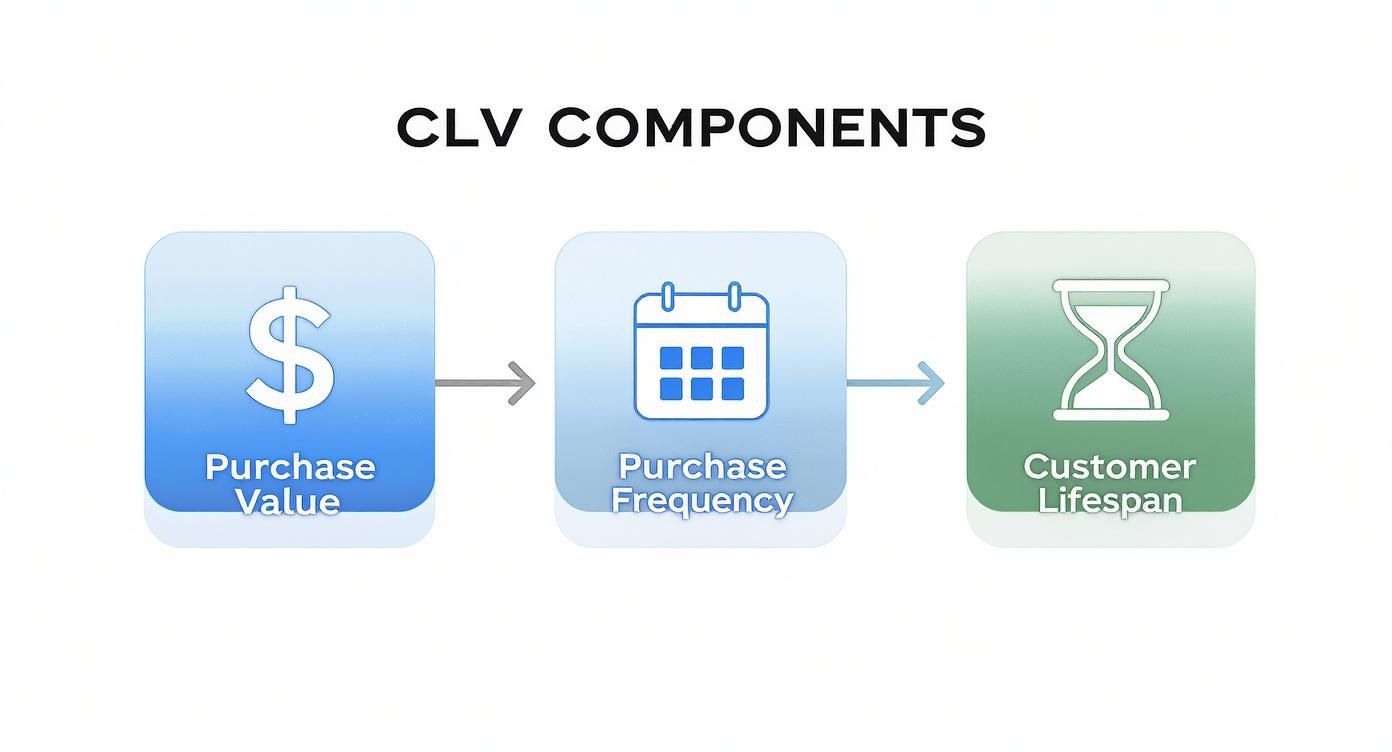
As you can see, the value of each purchase, how frequently those purchases happen, and the total time someone remains a customer are the essential building blocks for this calculation.
Let's ground this in a real-world example. Imagine you run an online shop selling artisanal coffee beans. After digging into your sales data, you find the following:
- Average Purchase Value (APV): Your customers typically spend £25 per order.
- Purchase Frequency (PF): On average, a customer buys from you 6 times a year.
- Average Customer Lifespan (CL): A typical customer stays loyal for about 4 years.
Now, we can plug these numbers straight into the standard formula.
CLV = Average Purchase Value × Purchase Frequency × Average Customer Lifespan
For our coffee shop, it looks like this:
CLV = £25 × 6 × 4 = £600
This tells us that, on average, each new customer is worth £600 in revenue over their entire relationship with your brand. That single number is incredibly powerful. It gives immediate context to your marketing spend and retention efforts, especially in the UK's competitive ecommerce market, where a repeat customer is 60-70% more likely to buy again than a new one.
A More Accurate Formula for Profitability
The standard formula is a fantastic starting point, but it only tells half the story—the revenue half. To truly understand what each customer is worth, you need to factor in your costs. This is where a more advanced calculation comes in, one that incorporates your Gross Profit Margin.
By doing this, you're no longer looking at just revenue; you're looking at the actual profit each customer generates. This is the number that should be guiding your financial decisions.
Profit-Based CLV = (Average Purchase Value × Purchase Frequency × Average Customer Lifespan) × Profit Margin
Let's go back to our coffee shop. They've done their sums and know their profit margin on each bag of beans is 40% (or 0.40).
Profit-Based CLV = (£25 × 6 × 4) × 0.40
Profit-Based CLV = £600 × 0.40 = £240
Now that is a much more useful figure. It reveals that each customer contributes £240 in actual profit to the business over their lifetime. With this number in hand, you can confidently set a sensible budget for your customer acquisition costs (CAC) and ensure you’re growing profitably.
For anyone serious about building financial models that drive business growth, getting this level of detail is non-negotiable. Using a lifetime value of customer calculator that accounts for profit margin provides the clarity you need to make sure your acquisition strategy is a sound investment.
How to Turn Your CLV Results Into a Winning Strategy
Getting your Customer Lifetime Value (CLV) calculated is a huge step, but the number itself is just the starting line. The real magic happens when you start using that figure to make smarter, more informed business decisions.
Think of your CLV as a diagnostic tool. It gives you a snapshot of your company’s health, but it's up to you to write the prescription for growth.
A CLV figure on its own doesn't tell the whole story. To truly understand what it means, you need to compare it with another vital metric: your Customer Acquisition Cost (CAC). Simply put, this is how much you spend on sales and marketing to bring a new customer through the door.
The tug-of-war between these two numbers is what really tests the strength and viability of your entire business model.
The All-Important CLV to CAC Ratio
The CLV to CAC ratio is your reality check. It tells you exactly how much value you're generating for every single pound you invest in winning new business.
Across most industries, a healthy ratio to aim for is 3:1 or better. This means that for every £1 you spend to get a customer, you can expect to get £3 back in profit over their entire relationship with you.
Let’s break down what different ratios mean:
- Below 1:1: This is a serious red flag. You're losing money on every customer you sign up.
- Exactly 1:1: You're just breaking even on your marketing spend, with nothing left over for other operational costs or, crucially, profit.
- 3:1 or higher: This signals a strong, profitable, and scalable business model. It's the kind of number that gets investors excited.
Knowing this ratio helps you build a marketing budget with confidence. If you know a new customer is worth £300 in lifetime profit, you can feel comfortable spending up to £100 to acquire them while still protecting your bottom line. To get more ideas on making that budget work harder, have a look at our beginner's guide to digital marketing.
Find Your VIPs by Segmenting Customers
Here's a truth every experienced business owner knows: not all customers are created equal. Your CLV data is the proof.
One of the most powerful things you can do with your CLV is to segment your customer base by their value. This exercise quickly reveals who your true VIPs are—that small but mighty group of customers who often drive the lion's share of your revenue.
For some UK businesses, the top 25% of customers can be responsible for as much as 75% of all sales.
Once you’ve identified these different groups, you can stop using a one-size-fits-all approach and start tailoring your strategy:
- High-CLV Customers: These are your champions. Treat them like gold with exclusive offers, loyalty programmes, and first-class service. The goal here is simple: keep them happy and keep them loyal.
- Mid-CLV Customers: This group is full of potential. Focus your efforts on increasing their purchase frequency or average spend through smart upselling and cross-selling.
- Low-CLV Customers: A low CLV can be a symptom of a deeper problem. Is your pricing right? Is the product meeting their needs? Analyse this segment to figure out why they aren’t spending more or sticking around.
By focusing your best efforts on your most valuable customers, you ensure your marketing budget delivers the highest possible return. This also helps you tackle a widespread issue, as a staggering 83% of UK consumers feel that the brands they are loyal to don't value them enough. You can discover more insights about UK consumer loyalty on marketingtechnews.net to learn more about this.
At the end of the day, using a lifetime value of customer calculator is about moving away from guesswork and towards a data-driven strategy. It turns CLV from a static number into a dynamic guide for better marketing, stronger customer relationships, and real, sustainable growth.
Proven Strategies to Increase Customer Lifetime Value

So, you've run the numbers through your lifetime value of customer calculator and you have your result. What now? That figure isn't just a metric to track; it's a launchpad for action. Boosting your CLV isn’t about some massive, complex overhaul. It's about a series of smart, consistent improvements that give customers more reasons to stick around and spend more with you.
At its heart, it all boils down to deepening the relationship. Every single interaction—from a simple support email to a new purchase—is a chance to build more trust and show your customer you truly value their business.
Elevate Your Customer Service
One of the most powerful levers you can pull to increase CLV is simply providing brilliant customer service. When people feel properly looked after, especially when there’s a problem, they are far more likely to forgive, forget, and buy again. Stop thinking of your support team as a cost centre and start seeing them as your front-line retention engine.
A few things that make a world of difference:
- Faster Response Times: Don't leave people hanging. Aim to get issues sorted quickly and without hassle.
- Empathetic Communication: Train your team to actually listen and respond with genuine care. A little empathy goes a long way.
- Proactive Support: Why wait for a problem? Reach out to customers with helpful tips or check-ins before they even think to ask.
This isn't just fluff; it builds a real emotional connection. Customers who feel that connection have a 306% higher lifetime value. And get this: improving retention by just 5% can rocket your profits by anywhere from 25-95%.
Master Upselling and Cross-Selling
Getting customers to spend a little more each time they buy is a classic way to bump up their total value. The trick is to be genuinely helpful, not just a pushy salesperson.
- Upselling: This is about offering a better version of what they already want. Think of the barista asking if you want to go large for an extra 30p. It's a small step up that makes sense.
- Cross-selling: This involves suggesting related items that complement their purchase. Someone buying a new phone? They'll probably need a protective case.
If you’re looking for more practical ideas on this, check out a real guide to improving Customer Lifetime Value for some great tips.
Implement Smart Personalisation and Loyalty Programmes
The days of one-size-fits-all marketing are long gone. You need to use the data you have to make customers feel like you 'get' them. This could be as simple as sending tailored product recommendations or targeted email campaigns based on their past purchases. Personalisation makes every touchpoint feel more relevant and strengthens that all-important customer bond. Digging into the advantages of email marketing can really help you nail this part of your strategy.
A well-designed loyalty programme is a proven CLV booster. It gives customers a clear incentive to choose you over a competitor, rewarding them for their repeat business with points, discounts, or exclusive access.
Ultimately, these strategies all point in the same direction: building a business that puts the customer first. By focusing on stellar service, offering relevant add-ons, and making the experience personal, you start turning one-time buyers into loyal advocates. And that's how you steadily and sustainably grow their lifetime value.
Got Questions About CLV Calculators?
Even when you've got the formulas down, putting a lifetime value of customer calculator to work in the real world can throw up a few tricky questions. This last section is all about tackling those common queries head-on, giving you clear, straightforward answers so you can use this powerful tool with confidence.
Think of it as your go-to guide for clearing up any final sticking points. We'll cover everything from how often you should be crunching the numbers to the crucial differences between the main CLV models.
How Often Should I Be Calculating CLV?
There isn't a single, magic answer here, but a solid rule of thumb is to review your CLV at least annually. This gives you a great high-level picture of how customer value is trending over a meaningful stretch of time.
That said, if you're in a fast-paced industry or you're running a lot of specific marketing campaigns, a quarterly calculation is a much smarter move. Doing it more often helps you to:
- See how your latest marketing efforts are affecting customer loyalty.
- Spot and react to shifts in customer buying habits much faster.
- Fine-tune your budgets and strategies with more up-to-date information.
Ultimately, the best frequency really hinges on your own business cycle. The most important thing is to be consistent, so you can draw reliable comparisons from one period to the next.
What’s the Difference Between Historic and Predictive CLV?
Getting your head around this distinction is absolutely key to using your calculator effectively. They’re two different lenses for viewing customer value, and each serves a unique purpose.
-
Historic CLV: This is all about looking backwards. It adds up the actual, known profit a customer has already brought into your business. It's solid, based entirely on past purchases, and is brilliant for figuring out who your most valuable customers have been up to this point.
-
Predictive CLV: This is a forecast, looking into the future. It uses patterns from past behaviour and statistical models to estimate how much a customer is likely to spend over their entire relationship with you. This is the one you need for making proactive decisions about marketing spend and retention efforts.
To put it simply, historic CLV tells you what a customer was worth. Predictive CLV estimates what they will be worth. For shaping future strategy, the predictive model is almost always the one you'll turn to.
Can I Use a CLV Calculator if I Run a Service-Based Business?
You certainly can. The core ideas behind CLV are just as relevant for businesses that sell services—think consultancies, agencies, or subscription software—as they are for e-commerce shops. You just need to think about the inputs a little differently.
Let's take a digital marketing agency as an example. Here’s how they might define their inputs:
- Average Purchase Value: This would simply be the average monthly retainer fee they charge a client.
- Purchase Frequency: For a client on a monthly contract, this is a constant – 12 times per year.
- Customer Lifespan: This is the average number of years a client sticks with the agency.
The formula itself doesn't change a bit. For any service business, calculating CLV is a vital way to understand client profitability and make smarter decisions about which new clients are the right fit.
Ready to put these insights into practice? The Digital Marketing Toolbox offers a hand-picked catalogue of the best tools out there to help you improve customer retention and drive up your CLV. From powerful analytics platforms to smart email automation, discover what you need to build more profitable customer relationships at https://grow-your-biz.com.


