
Unlocking Growth: The Power of Marketing Automation
Struggling to keep up with marketing demands? This list of top 10 marketing automation tools for 2025 helps you reclaim your time and boost results. Whether you're a small business in the UK or a large agency, these tools solve the challenge of repetitive tasks, allowing you to personalize customer interactions and optimise campaigns. Discover which marketing automation tools fit your needs and budget, from email marketing and social media management to lead nurturing and CRM integration. We cover key features and benefits of platforms like HubSpot, Mailchimp, and more, empowering you to make informed decisions and drive growth.
1. The Digital Marketing Toolbox
The Digital Marketing Toolbox earns its top spot on this list by offering a comprehensive, centralised platform for discovering and implementing a wide range of marketing automation tools. It’s designed to empower small business owners, marketing agencies, e-commerce managers, and content creators in the UK to streamline their workflows and optimise their campaigns without needing advanced technical skills. Think of it as a one-stop shop for all your digital marketing needs, connecting you with leading vendors and cutting-edge technologies. Whether you’re looking to boost your SEO, automate email marketing, leverage AI-driven content generation, or implement new website widgets, this toolbox has something to offer. It allows you to compare features, access exclusive trial offers, and integrate tools seamlessly, ultimately driving measurable results and improving ROI.
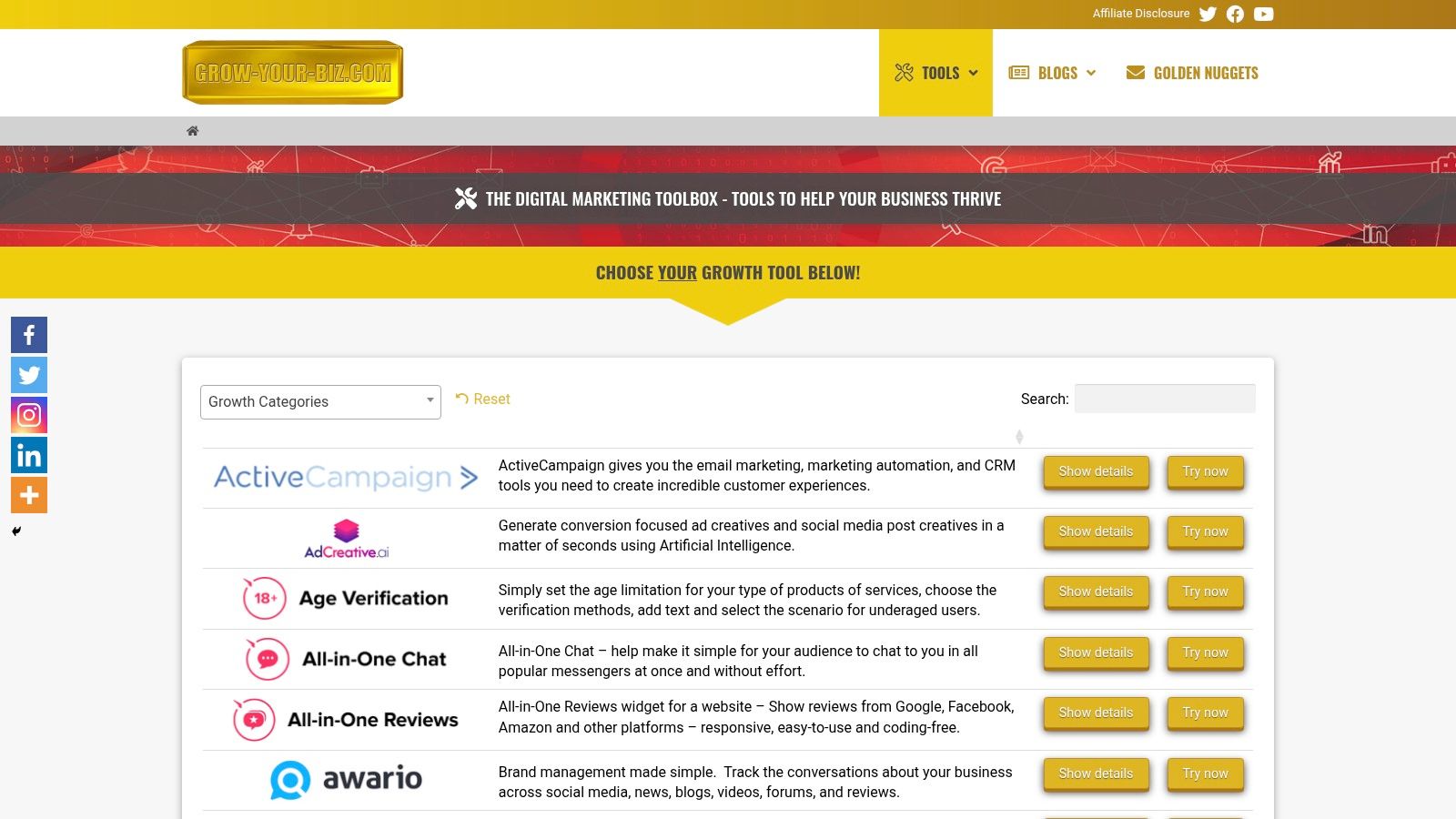
For a UK small business owner struggling to manage multiple marketing channels, the Toolbox simplifies things. Imagine wanting to improve email open rates and simultaneously run a social media campaign. The platform lets you explore email marketing automation tools like ActiveCampaign and AWeber, comparing their features side-by-side. Simultaneously, you can discover social media management tools within the same platform, making integration and cross-platform promotion significantly easier.
For a digital marketing agency in the UK looking to expand its service offerings, The Digital Marketing Toolbox provides access to a diverse range of tools, including AI-driven content generation platforms like Copy.ai and website enhancement widgets from Elfsight. This allows agencies to quickly assess and integrate new solutions for their clients, offering a more comprehensive and competitive service package.
E-commerce managers can leverage the platform to find tools that boost conversions and engagement. From push notification services to review widgets and chatbot integrations, The Digital Marketing Toolbox provides access to a suite of solutions designed to enhance the customer journey and increase sales.
Content creators and bloggers can explore tools for SEO optimisation, social media scheduling, and even AI-powered content generation, helping them streamline their content strategy and reach a wider audience.
Key Features and Benefits:
- Comprehensive Tool Catalog: Covering SEO, email marketing, PPC, social media, AI-driven content generation, website widgets, and more.
- User-Friendly Interface: Easy navigation, smart filters, and side-by-side tool comparisons make it simple to find the right solutions.
- Exclusive Trial Offers: Access special trial periods from leading vendors like ActiveCampaign, AWeber, Copy.ai, and Elfsight.
- Workflow Automation: Streamline repetitive tasks and optimise campaigns for better efficiency.
- No Technical Expertise Required: Designed for users of all technical levels.
Plus:
- One-stop platform for discovering and integrating a wide range of marketing automation tools.
- User-friendly interface facilitates easy comparison and selection.
- Access to exclusive trial offers from top-tier vendors.
- Enables automation and optimisation without requiring technical expertise.
- Caters to diverse users, from small businesses to agencies and content creators.
Website: https://grow-your-biz.com
The Digital Marketing Toolbox offers a valuable resource for anyone in the UK looking to leverage marketing automation tools to grow their business. While the lack of centralised pricing information requires a bit of extra legwork, the platform's comprehensive catalogue, user-friendly interface, and access to exclusive trial offers make it a worthwhile investment for businesses seeking efficient, scalable, and cost-effective marketing solutions.
2. HubSpot Marketing Hub
HubSpot Marketing Hub is a comprehensive marketing automation platform designed to help businesses attract, engage, and delight customers. It offers a wide array of tools encompassing content creation, SEO, social media management, email marketing, landing page building, and advanced analytics, all working together to streamline your marketing efforts. A key strength of HubSpot is its centralised CRM system, which provides a unified view of customer interactions across marketing, sales, and service teams, enabling highly personalised marketing campaigns and a 360-degree view of the customer journey. This makes it a powerful tool for businesses in the UK looking to enhance their marketing performance and build stronger customer relationships.
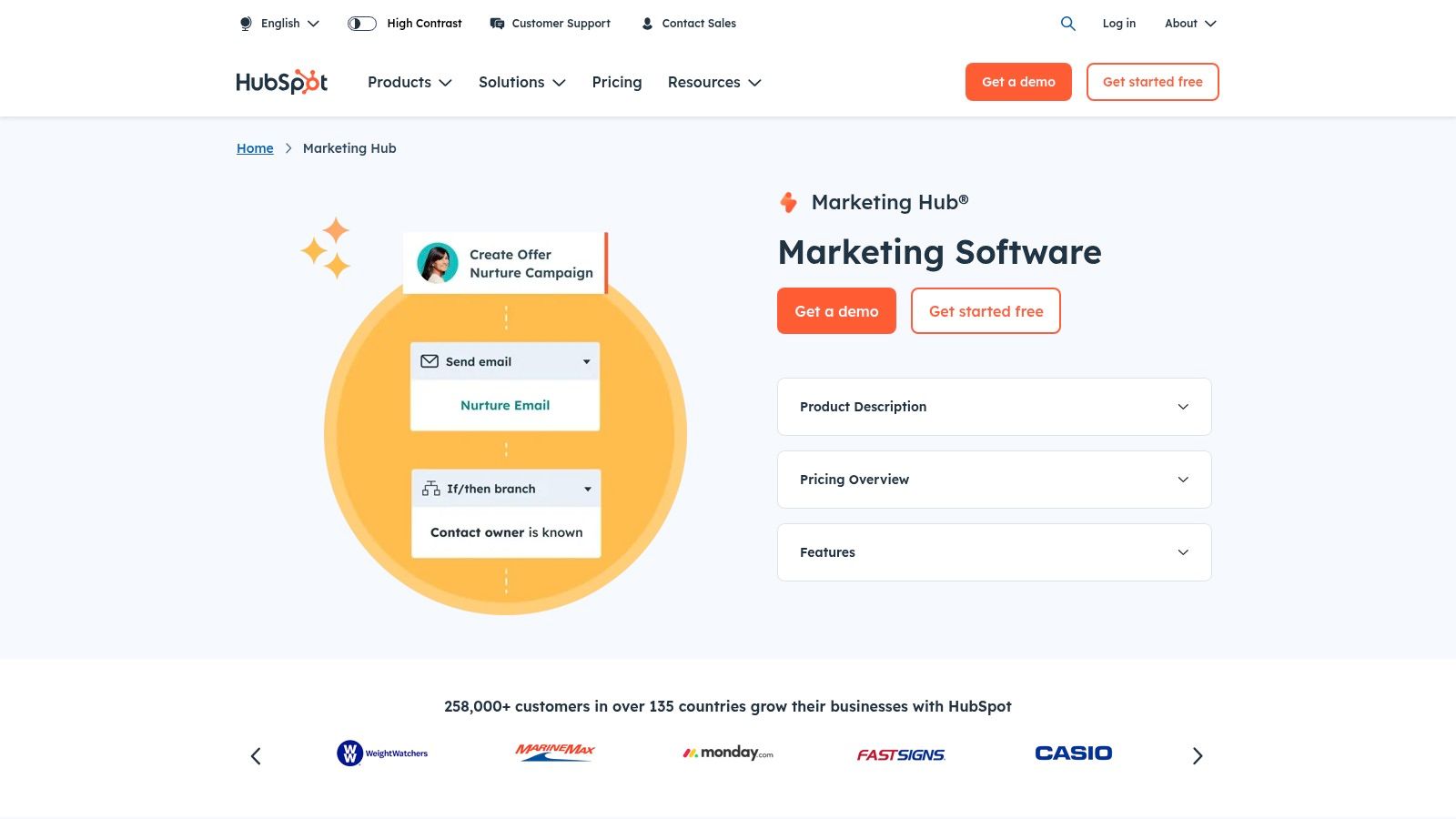
HubSpot Marketing Hub earns its place on this list of top marketing automation tools due to its all-in-one nature and robust feature set. Whether you're a small business owner in London looking to automate email campaigns, a digital marketing agency in Manchester integrating new tools, or an e-commerce manager in Edinburgh aiming to boost conversions, HubSpot offers solutions tailored to diverse needs. Content creators and bloggers will appreciate the SEO recommendations and social media management features, while marketing professionals will find the AI-driven automation and analytics invaluable.
Features:
- Email Marketing Automation: Create automated email workflows with personalised content triggered by specific actions, such as website visits, form submissions, or purchases.
- Lead Generation & Management: Generate leads through forms, landing pages, and live chat, then nurture them with targeted content and automated follow-ups.
- Content Management System (CMS): Build and manage your website content with integrated SEO recommendations to improve organic search visibility.
- Analytics & Reporting: Track key marketing metrics and campaign performance with a comprehensive analytics dashboard.
- Multi-Channel Marketing: Manage your social media presence, run ad campaigns, and coordinate your email marketing all within a single platform.
Pros:
- All-in-One Integration: Seamlessly integrates with HubSpot's CRM, Sales Hub, and Service Hub, creating a unified platform for all customer-facing activities.
- User-Friendly Interface: Intuitive workflow builders and drag-and-drop editors make it easy to create and manage complex marketing campaigns, even without technical expertise.
- Scalable Pricing: Offers a robust free plan and tiered pricing options to accommodate businesses of all sizes, from startups to enterprises.
- Excellent Support: Provides extensive educational resources and dedicated customer support to help users maximise the platform's potential.
Cons:
- Pricing: Can be expensive, particularly for enterprise-level businesses requiring advanced features.
- Advanced Features in Higher Tiers: Some advanced features, like predictive lead scoring and custom event triggers, are only available in the higher-tier plans.
- Overkill for Small Businesses: The extensive feature set can be overwhelming for small businesses with limited marketing needs.
Website: https://www.hubspot.com/products/marketing
Implementation Tips:
- Start with the free plan: Explore the free plan to familiarise yourself with the platform before committing to a paid subscription.
- Define your marketing goals: Clearly outline your marketing objectives and identify the HubSpot features that will help you achieve them.
- Utilise HubSpot Academy: Take advantage of HubSpot Academy's free courses and certifications to learn best practices and maximize your use of the platform.
- Integrate with existing tools: Connect HubSpot with your existing marketing tools, such as your CRM or email marketing platform, to streamline your workflows.
HubSpot Marketing Hub provides a powerful set of marketing automation tools for businesses of all sizes in the UK. While the pricing might be a consideration, particularly for smaller businesses, the platform's comprehensive features, user-friendly interface, and excellent support make it a worthwhile investment for businesses looking to scale their marketing efforts and achieve significant growth. Consider your specific needs and budget when evaluating whether HubSpot Marketing Hub is the right solution for your business.
3. Marketo Engage (Adobe)
Marketo Engage, now integrated into Adobe Experience Cloud, stands as a powerful enterprise-grade marketing automation platform tailored for the complex demands of B2B marketing. This robust tool empowers businesses to orchestrate sophisticated, multi-touch, multi-channel campaigns, offering advanced lead management, account-based marketing (ABM), and in-depth customer engagement solutions. Its strength lies in refined targeting, extensive integration possibilities (particularly beneficial for businesses already utilising Adobe products), and the ability to manage intricate marketing workflows. This makes it a top contender amongst marketing automation tools for larger organizations.
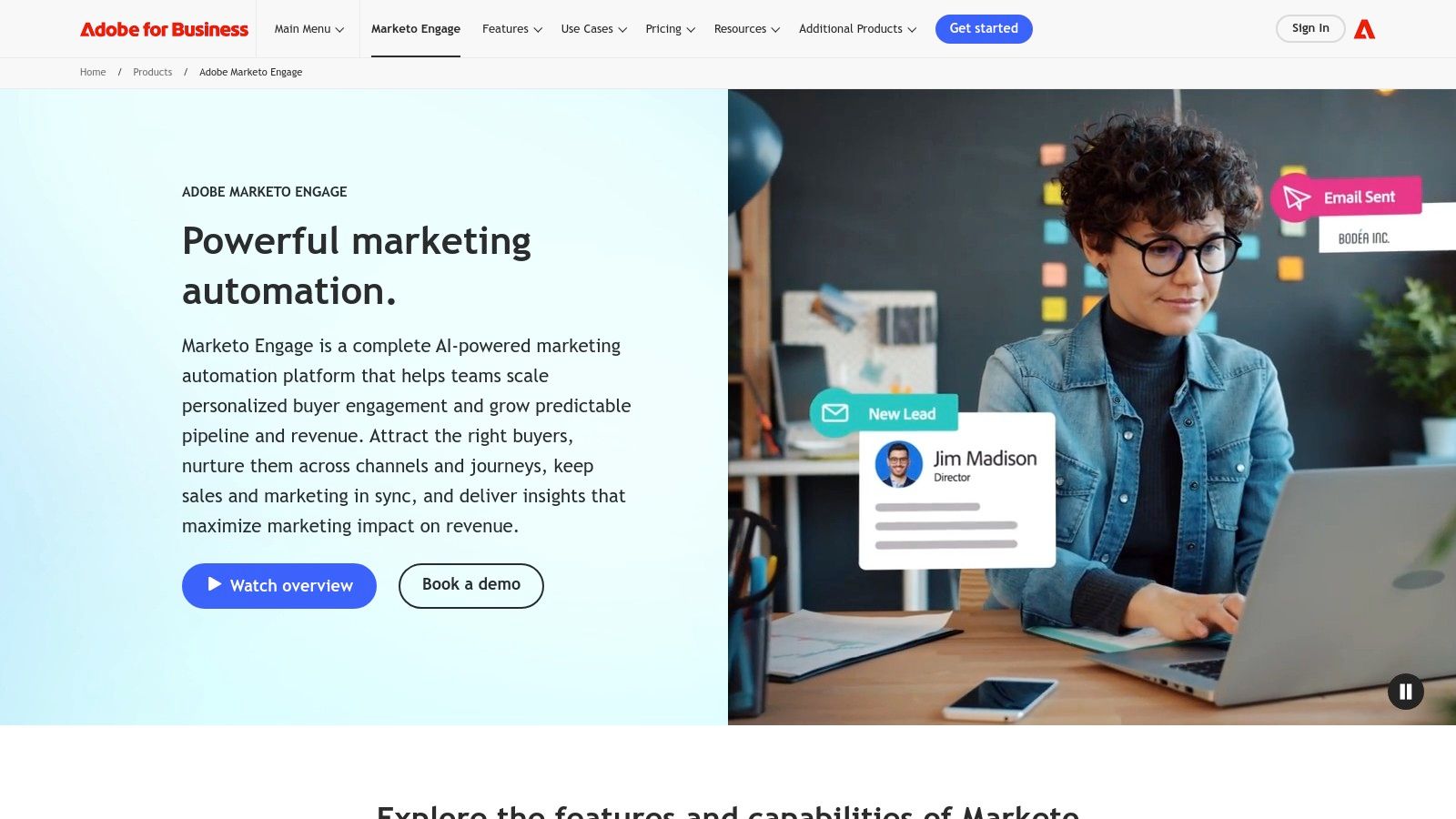
For UK businesses operating in the B2B space and dealing with complex sales cycles, Marketo Engage offers a comprehensive suite of features designed to streamline and automate key marketing processes. Imagine a scenario where a UK-based SaaS company wants to target specific enterprise accounts. Marketo Engage allows them to build targeted ABM campaigns, personalize web experiences for key decision-makers within those accounts, nurture leads with automated email sequences tailored to their specific needs and pain points, and ultimately track the revenue generated from these efforts. This level of granular control and automation is particularly valuable for high-value, complex sales.
Features:
- Advanced lead scoring and nurturing: Identify and prioritize high-potential leads with custom scoring models and automate personalized nurture campaigns to guide them through the sales funnel.
- Account-based marketing (ABM) functionality: Target key accounts with tailored campaigns, personalized messaging, and coordinated efforts across different channels.
- Revenue attribution and analytics: Gain clear insights into the effectiveness of marketing campaigns and accurately attribute revenue generated.
- Personalized web and mobile engagement tools: Create dynamic web experiences and personalized mobile interactions to enhance customer engagement.
- Native CRM integration with Salesforce and other platforms: Seamlessly integrate with existing CRM systems like Salesforce to ensure data consistency and streamlined workflows. This is especially relevant for UK businesses already using Salesforce as their CRM.
Pros:
- Robust scalability for enterprise-level marketing operations: Handles large volumes of data and complex workflows with ease.
- Powerful automation capabilities for complex marketing workflows: Automates repetitive tasks and frees up marketing teams to focus on strategic initiatives.
- Extensive integration capabilities with Adobe Experience Cloud: Seamlessly integrates with other Adobe products for a holistic marketing ecosystem.
- Advanced reporting and analytics for marketing attribution: Provides detailed insights into campaign performance and ROI.
Cons:
- Steep learning curve requiring specialized knowledge: Requires dedicated training and expertise to fully utilize its capabilities. This might be a drawback for smaller UK businesses with limited resources.
- Higher price point designed for enterprise budgets: Might not be the most cost-effective solution for smaller businesses or startups.
- Implementation and setup can be time-consuming: Requires careful planning and execution to ensure successful implementation.
- User interface is less intuitive than some competitors: Can be challenging to navigate for new users.
Pricing and Technical Requirements:
Pricing for Marketo Engage is typically quote-based and varies depending on the specific needs and scale of the business. Technical requirements will depend on the chosen deployment model (cloud-based or on-premise) and integration with existing systems. Contact Adobe directly for detailed pricing and technical specifications.
Implementation Tips:
- Start with a clear strategy and defined objectives: Outline your marketing goals and identify key performance indicators (KPIs) before implementing Marketo Engage.
- Invest in training and onboarding for your team: Ensure your team has the necessary skills and knowledge to effectively use the platform.
- Plan your integration with existing systems carefully: Map out data flows and ensure seamless integration with your CRM and other marketing tools.
- Start with a pilot project and gradually scale up: Test the platform with a smaller project before rolling it out to the entire organization.
Comparison with Similar Tools:
While other marketing automation tools like HubSpot or Pardot offer robust functionalities, Marketo Engage distinguishes itself with its enterprise-grade scalability and advanced features for complex B2B marketing scenarios. Its tight integration with the Adobe Experience Cloud makes it a compelling choice for organizations already invested in the Adobe ecosystem.
Website: https://business.adobe.com/products/marketo/adobe-marketo.html
Marketo Engage earns its place in this list as a premier solution for large businesses requiring sophisticated marketing automation. While the cost and complexity may not be suitable for all, its power and extensive features provide the control and insights needed for effective B2B marketing at scale within the UK market and beyond.
4. ActiveCampaign
ActiveCampaign is a powerful marketing automation tool that goes beyond basic email marketing by incorporating sales automation and CRM functionalities into a single platform. This makes it a compelling option for businesses in the UK looking to streamline their marketing and sales processes. Its sophisticated automation capabilities allow you to create personalised customer journeys based on individual behaviours, preferences, and past interactions, ultimately leading to increased engagement and conversions. This comprehensive approach distinguishes it from simpler email marketing platforms and justifies its place among the leading marketing automation tools.
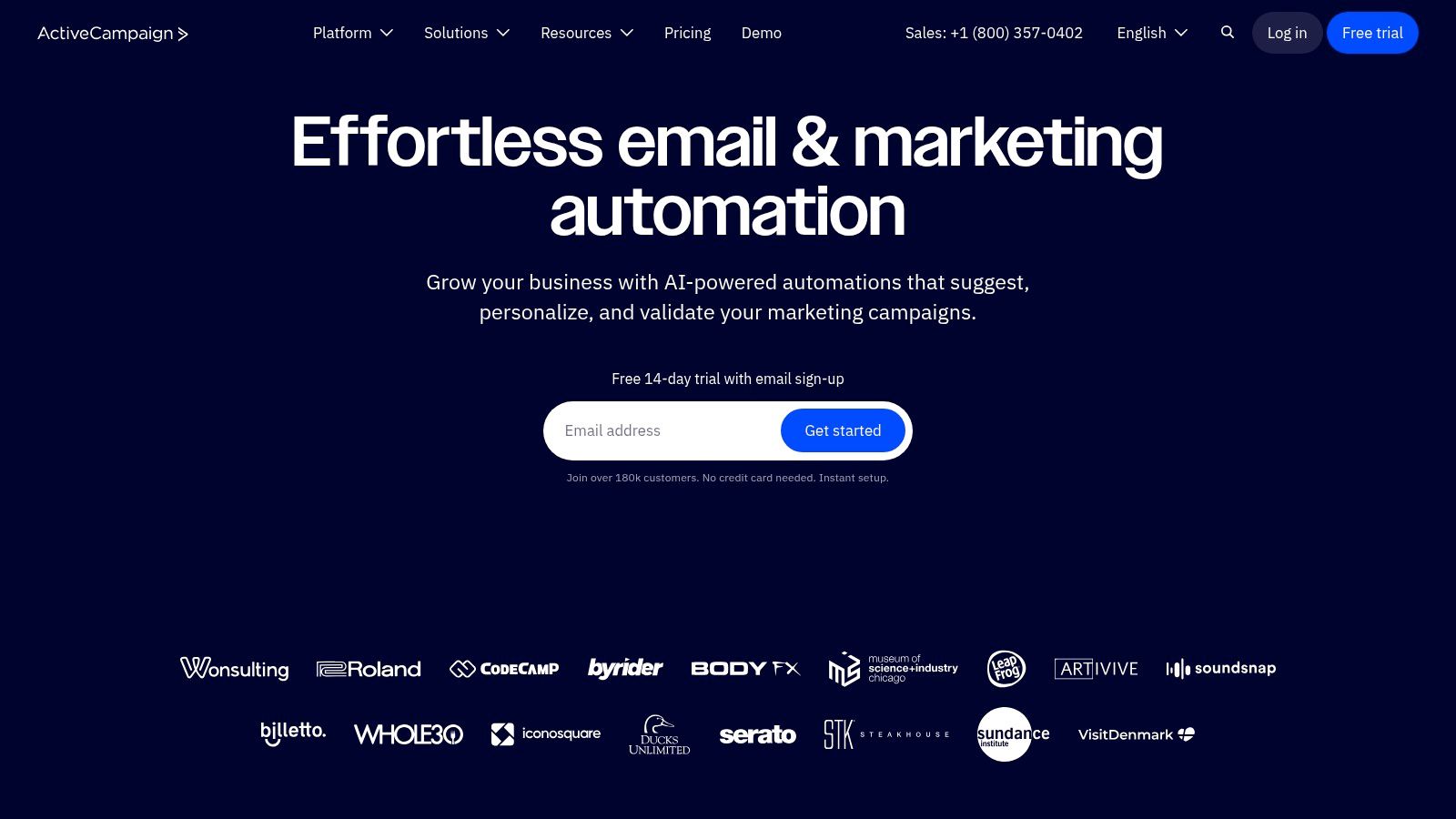
For example, an e-commerce business could use ActiveCampaign to send targeted product recommendations based on previous purchases, trigger abandoned cart emails with personalised discounts, or segment customers based on their engagement levels for tailored follow-up campaigns. Digital marketing agencies in the UK can leverage ActiveCampaign to manage multiple client accounts, automate reporting, and implement complex marketing strategies across various channels. Content creators can automate their social media posting schedules, nurture leads through email sequences, and segment their audience based on engagement metrics.
ActiveCampaign's visual automation builder, with its conditional logic and branching capabilities, provides immense flexibility. This allows businesses to create complex automated workflows without needing extensive coding knowledge. Features like machine learning-powered predictive sending and content further enhance personalisation by optimising email delivery times and content relevance. Site tracking enables behaviour-based automation triggers, allowing you to target users based on their website activity. Split testing features for both emails and automation workflows empower data-driven optimisation for continuous improvement. The integrated CRM with sales automation and pipeline management streamlines sales processes, all within the same platform.
Pros:
- Powerful automation capabilities at a mid-market price point: ActiveCampaign offers enterprise-level features without the enterprise-level price tag, making it an attractive option for growing businesses in the UK.
- Excellent email deliverability rates: Ensures your messages reach your target audience's inboxes.
- Flexible pricing model based on contacts and features: Allows you to choose a plan that aligns with your specific needs and budget.
- Strong integration capabilities with 850+ apps: Seamlessly connects with other tools you might already be using, such as CRM systems, e-commerce platforms, and social media platforms.
Cons:
- Interface can feel cluttered as you build complex automations: The extensive functionality can sometimes lead to a less intuitive user experience, particularly for complex workflows.
- Learning curve for utilizing advanced features effectively: While the basic features are easy to grasp, mastering the advanced automation capabilities requires some time and effort.
- Limited landing page and form builder functionality compared to competitors: While functional, dedicated landing page builders might offer more advanced design and customisation options.
Pricing: ActiveCampaign offers tiered pricing based on the number of contacts and features, starting from approximately £15 per month for smaller businesses and scaling up for larger enterprises.
Website: https://www.activecampaign.com
Implementation Tips:
- Start with a clear understanding of your marketing goals and how automation can help you achieve them.
- Map out your customer journeys and identify key touchpoints where automation can add value.
- Begin with simpler automations and gradually increase complexity as you become more familiar with the platform.
- Take advantage of ActiveCampaign’s extensive resources and support materials, including tutorials, webinars, and documentation.
ActiveCampaign is a robust marketing automation tool suitable for businesses of all sizes in the UK. While it may require some initial investment in learning the platform, its powerful features and flexible pricing make it a worthwhile investment for businesses looking to scale their marketing efforts and improve customer engagement. It stands out amongst marketing automation tools thanks to its integrated approach, combining email marketing, sales automation, and CRM into a single, powerful platform.
6. Salesforce Marketing Cloud
Salesforce Marketing Cloud is a robust enterprise marketing automation platform ideal for large, complex organisations. As part of the larger Salesforce ecosystem, it offers a comprehensive suite of tools encompassing email marketing, mobile messaging, social media management, web personalisation, advertising, content creation, and robust data management. Its strength lies in creating unified, seamless customer experiences across various channels and touchpoints, leveraging powerful data management capabilities. This makes it a strong contender for businesses with diverse marketing needs seeking a single platform solution.
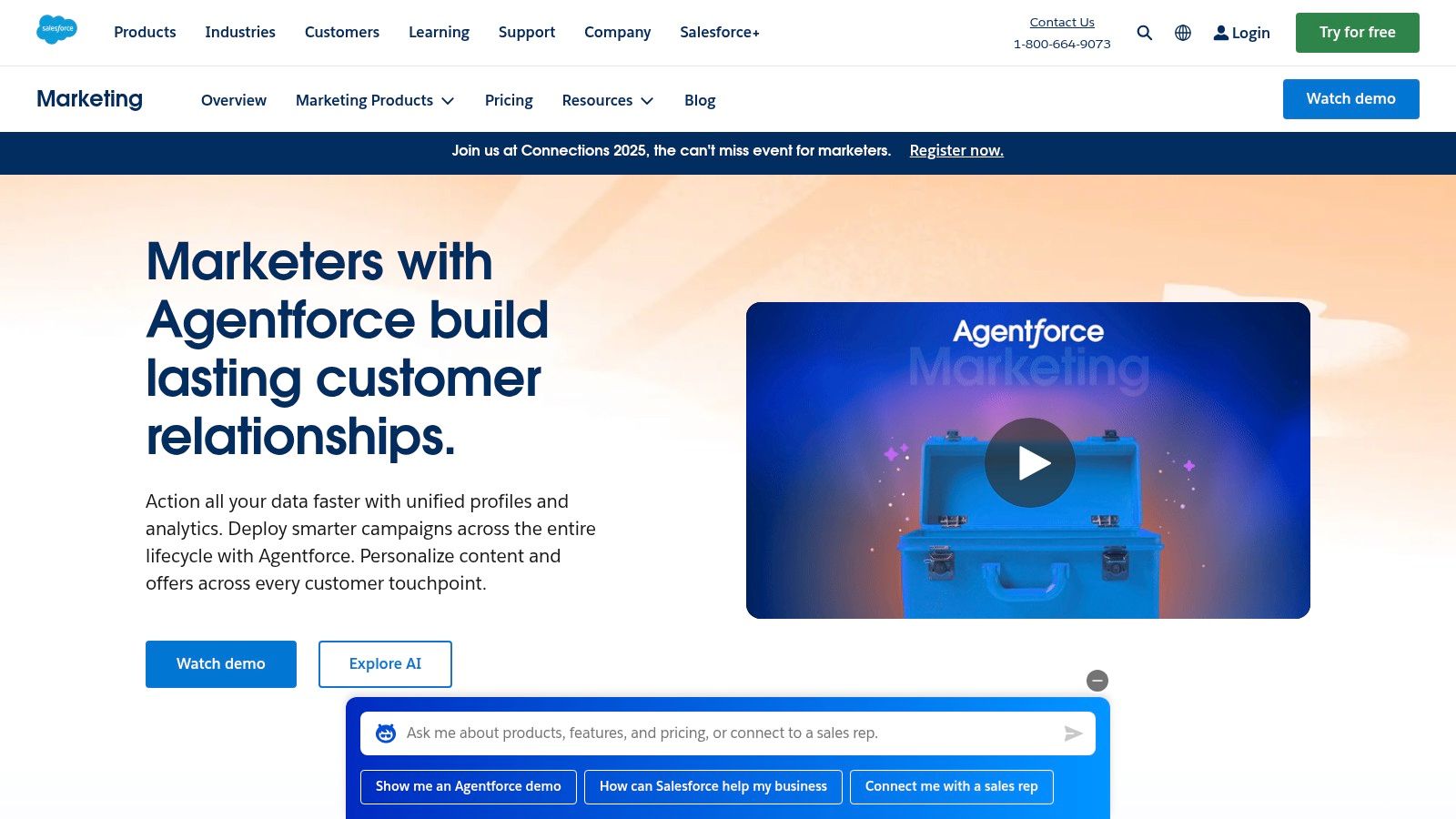
For UK businesses handling large volumes of customer data and requiring sophisticated automation, Salesforce Marketing Cloud presents a compelling solution. Imagine a UK-based e-commerce company wanting to personalize the online shopping experience. Salesforce Marketing Cloud's Interaction Studio allows them to tailor website content and product recommendations in real-time based on individual customer behaviour, boosting conversions and customer satisfaction. Similarly, a digital marketing agency in London could utilize Journey Builder to orchestrate complex, multi-channel campaigns for their clients, from initial email engagement to retargeting ads and personalized website experiences, all managed within a unified platform.
Key features that solidify Salesforce Marketing Cloud’s place among the top marketing automation tools include Journey Builder for visually designing and automating customer journeys across multiple channels, Einstein AI for predictive analytics and intelligent personalisation, Audience Builder for granular segmentation and targeting, Interaction Studio for real-time website personalisation, and Datorama for comprehensive cross-channel marketing analytics and attribution. This breadth of functionality makes it a true powerhouse for enterprise-level marketing.
Pros:
- Deep Salesforce Integration: Seamlessly integrates with Salesforce CRM and other Salesforce clouds, creating a unified view of the customer and streamlining data flow.
- Enterprise-Grade Scalability and Security: Designed to handle large data volumes and complex marketing operations with robust security features.
- Comprehensive Toolkit: Covers virtually every digital marketing channel, from email and mobile to social and web.
- Powerful Data Management: Offers advanced data management and integration capabilities for personalized, data-driven marketing.
Cons:
- Significant Investment: Requires a substantial financial investment and dedicated resources for implementation and ongoing management. This makes it less suitable for small businesses with limited budgets.
- Complex Implementation: Implementation can be complex and time-consuming, often requiring specialized expertise and consultants.
- Disjointed User Experience: Acquired components can feel disconnected, leading to a less intuitive user experience compared to more streamlined solutions.
- Steep Learning Curve: Mastering the platform's full capabilities requires a significant time investment and training.
Pricing: Salesforce Marketing Cloud offers various editions with pricing based on features and usage. Contact Salesforce directly for detailed pricing information tailored to your specific needs. This lack of transparent pricing can be a hurdle for smaller businesses seeking budget-friendly marketing automation tools.
Technical Requirements: As a cloud-based solution, the primary technical requirement is a stable internet connection. Integration with existing CRM or other systems may require additional technical setup.
Comparison: While platforms like HubSpot or Marketo offer more streamlined user experiences and potentially lower costs, they may lack the enterprise-grade scalability and deep Salesforce integration offered by Marketing Cloud. Choosing the right tool depends on your specific business needs and resources.
Implementation Tips:
- Clearly Define Your Objectives: Before implementing, clearly define your marketing goals and how Salesforce Marketing Cloud will help achieve them.
- Phased Rollout: Implement the platform in phases, starting with core functionalities and gradually expanding to more advanced features.
- Invest in Training: Ensure your team receives adequate training to effectively utilize the platform's capabilities.
- Leverage Salesforce Partners: Consider working with a certified Salesforce partner for implementation and ongoing support.
Website: https://www.salesforce.com/products/marketing-cloud/overview/
Salesforce Marketing Cloud earns its place on this list due to its comprehensive suite of tools, powerful data management capabilities, and deep integration with the Salesforce ecosystem. While the investment may be substantial, it offers a robust solution for enterprise-level organizations seeking a single platform to manage complex marketing automation and deliver personalized customer experiences.
7. Klaviyo
Klaviyo is a powerful marketing automation platform specifically designed to supercharge e-commerce businesses in the UK and beyond. Unlike generic marketing automation tools, Klaviyo focuses solely on email and SMS marketing, deeply integrating with popular e-commerce platforms like Shopify, Magento, and WooCommerce. This specialization allows it to leverage detailed customer data, including purchase history and browsing behaviour, to create highly targeted and personalized marketing campaigns that genuinely drive sales. If your primary goal is to boost conversions and customer lifetime value, Klaviyo deserves serious consideration.
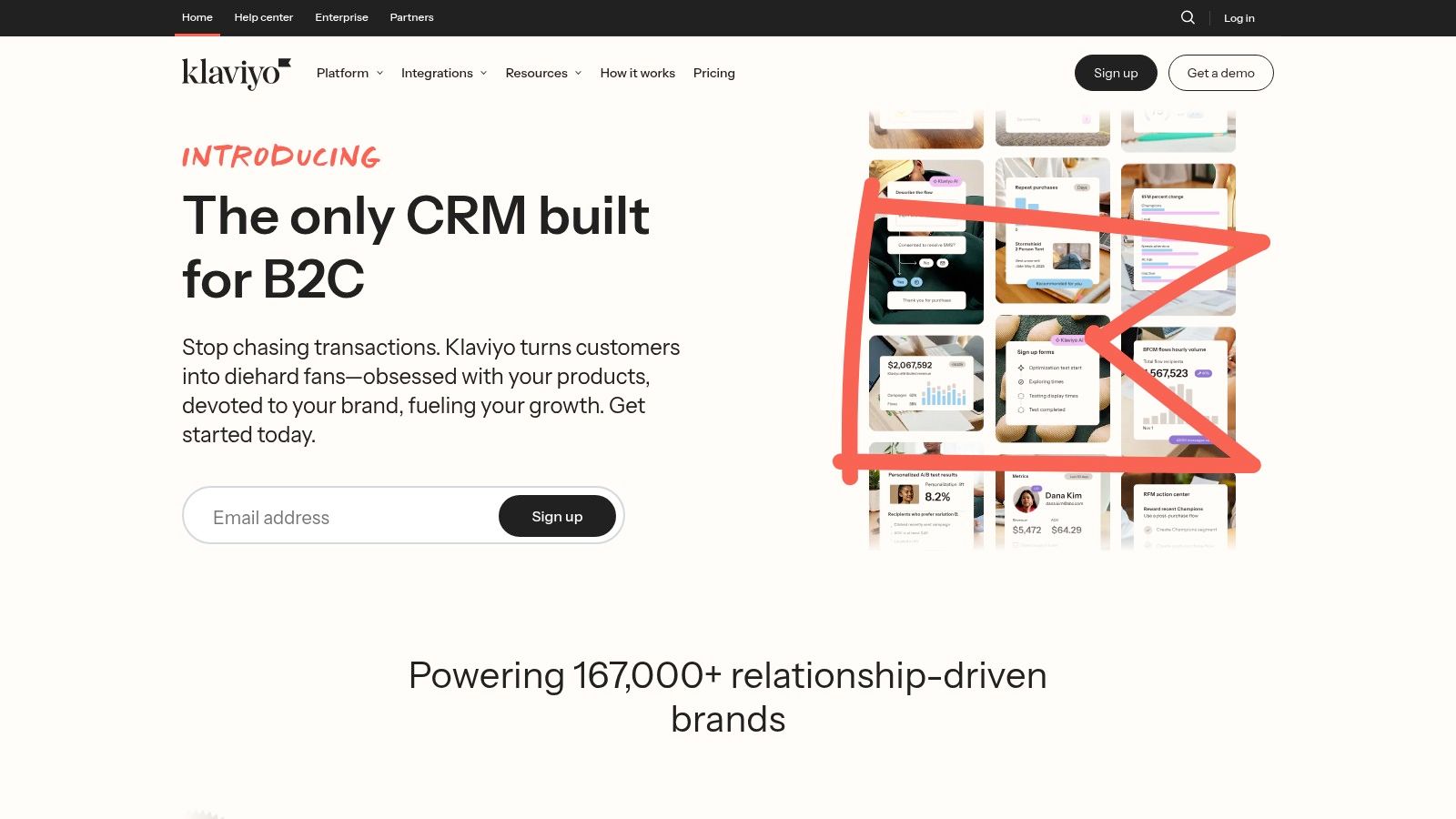
Klaviyo's strength lies in its pre-built automation flows tailored for e-commerce scenarios. Think abandoned cart recovery, post-purchase follow-ups, welcome series, and win-back campaigns – all automated and ready to personalize. Advanced segmentation allows you to target specific customer segments based on their interactions with your online store. For instance, you could send personalized product recommendations to customers who viewed specific items but didn't purchase, or offer exclusive discounts to loyal customers who have spent a certain amount. Built-in SMS marketing capabilities further extend your reach and enable timely promotions and updates.
For e-commerce managers in the UK, Klaviyo’s focus on revenue attribution and e-commerce-specific metrics is invaluable. You can track the direct impact of your marketing campaigns on sales and revenue, providing clear ROI justification. Real-time data synchronization with your e-commerce platform ensures that your campaigns are always based on the most up-to-date customer information.
Pros:
- Purpose-built for e-commerce: Deep integrations with leading platforms streamline setup and data synchronization.
- Powerful segmentation: Target specific customer segments based on real shopping behaviour.
- ROI focused: Track the impact of campaigns on revenue and other key metrics.
- Real-time data: Ensure your campaigns are always up-to-date.
Cons:
- Pricing: Costs can escalate quickly as your subscriber list grows, which might be a concern for smaller businesses.
- E-commerce focus: Limited versatility for businesses outside the e-commerce space.
- Email template editor: Customization options may be less extensive than some competitors.
Implementation Tips:
- Plan your segmentation strategy: Identify key customer segments and tailor your messaging accordingly.
- Utilize pre-built flows: Leverage Klaviyo’s automated workflows to streamline your marketing efforts.
- A/B test your campaigns: Experiment with different subject lines, content, and offers to optimize performance.
- Monitor your metrics: Track your key performance indicators and adjust your strategies based on the data.
While Klaviyo's pricing scales with subscriber count and can become a significant investment, its powerful e-commerce-focused features make it a leading marketing automation tool. Compared to more general platforms, Klaviyo's specialized approach offers significant advantages for online retailers. Businesses in the UK can leverage its advanced features and integrations to drive sales, boost customer engagement, and ultimately, grow their business. For a deeper dive, visit their website: https://www.klaviyo.com
8. Pardot (Salesforce)
Pardot, a Salesforce product, stands out among marketing automation tools as a powerful B2B platform specifically engineered to empower sales teams with high-quality leads. It offers a comprehensive suite of tools encompassing lead generation, nurturing, scoring, and management, fostering seamless collaboration between marketing and sales departments. This focus on alignment, coupled with robust ROI attribution capabilities, makes Pardot a valuable asset for businesses looking to streamline their lead-to-revenue cycle. For UK businesses particularly, where data privacy and compliance are paramount, Pardot's strong security features offer peace of mind.
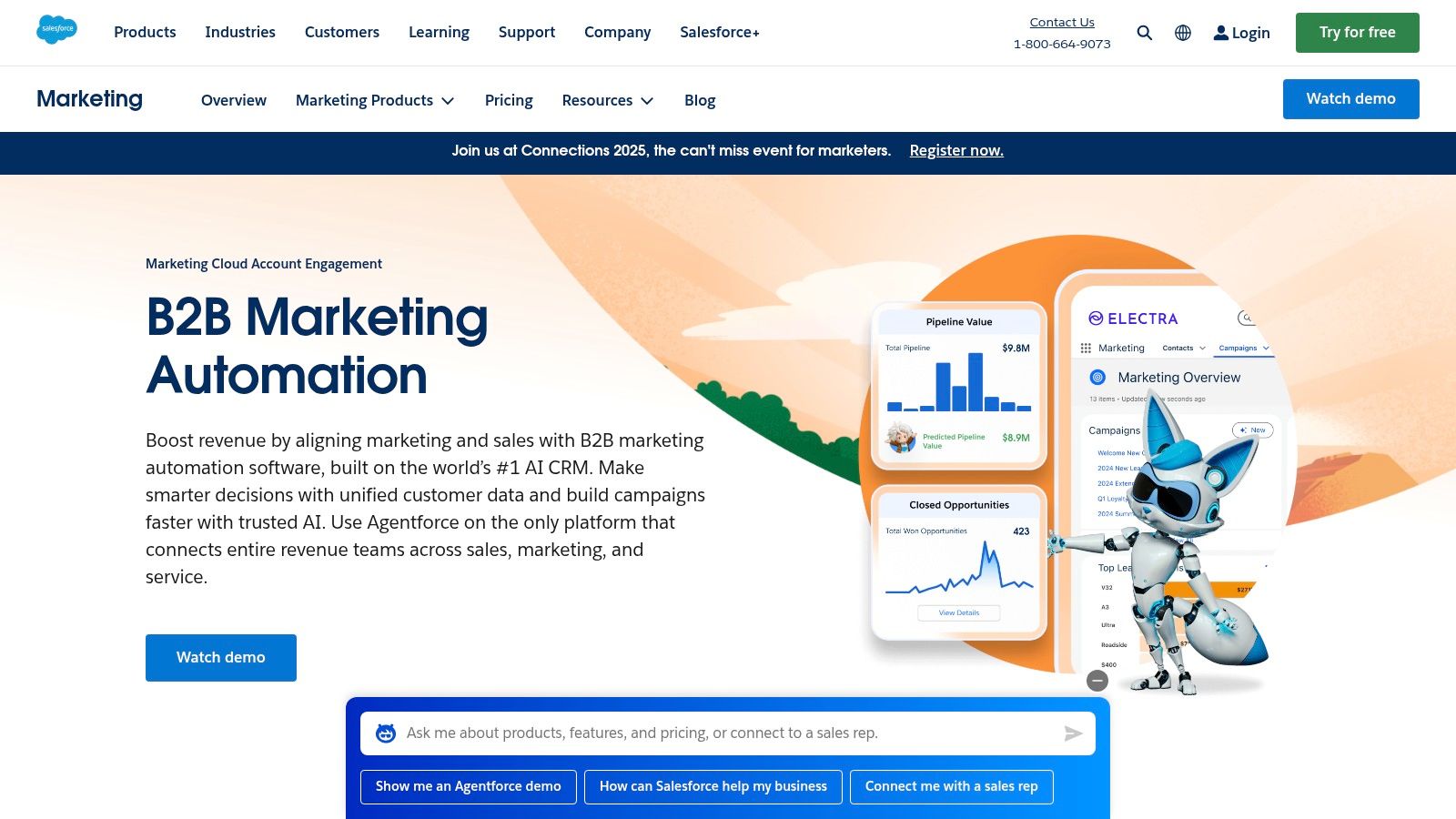
Pardot shines in its ability to bridge the gap between marketing efforts and sales outcomes. Features like the lead scoring and grading system allow marketing teams to prioritize prospects based on their engagement and demographics, ensuring sales teams focus on the most promising leads. Engagement Studio, Pardot's visual marketing automation builder, enables the creation of highly personalized nurture campaigns, guiding prospects through the sales funnel with targeted content and automated actions. This, combined with detailed ROI reporting and campaign attribution, provides clear visibility into the effectiveness of marketing activities. From landing page and form builders for efficient lead capture to its native integration with Salesforce CRM, Pardot offers a complete solution for managing the entire lead lifecycle.
For small business owners in the UK, Pardot's robust lead qualification features can be a game-changer, ensuring efficient use of resources by focusing on high-potential prospects. Digital marketing agencies can leverage Pardot's automation capabilities to streamline client campaigns and demonstrate clear ROI through comprehensive reporting. E-commerce managers can utilize the platform to segment audiences, personalize email marketing, and boost conversions. While less geared towards content creators and bloggers seeking dedicated SEO and social media support, marketing professionals focused on lead generation and sales alignment will find Pardot's advanced features and analytics invaluable.
Pros:
- Seamless alignment between marketing and sales processes.
- Robust lead qualification and scoring capabilities.
- Excellent reporting on campaign influence and attribution.
- Strong compliance and security features for enterprise use, particularly relevant for UK GDPR compliance.
Cons:
- Higher price point compared to SMB-focused marketing automation tools. While pricing isn't publicly available, it's generally understood to cater to enterprise-level budgets.
- Deep Salesforce knowledge is often required for optimal use and customization.
- The user interface can be less intuitive compared to some newer platforms, potentially requiring more training for users.
- Limited functionality when not paired with Salesforce CRM.
Implementation Tips:
- Plan your integration with Salesforce CRM carefully to maximize the benefits of Pardot's native connectivity.
- Invest in training for your marketing and sales teams to ensure effective utilization of the platform's features.
- Develop a clear lead scoring and grading strategy to prioritize prospects effectively.
Pardot earns its place on this list of marketing automation tools due to its specialized focus on B2B lead management and its deep integration with the Salesforce ecosystem. While the price point may be higher than other solutions, the comprehensive features and powerful analytics justify the investment for businesses prioritizing sales and marketing alignment. For UK businesses seeking a robust and secure solution, Pardot offers a compelling option. You can explore more on their website: https://www.pardot.com
9. Omnisend
For e-commerce businesses in the UK seeking a robust yet user-friendly marketing automation platform, Omnisend stands out as a strong contender. It allows you to connect with customers across multiple channels, automating key marketing tasks to boost sales and improve customer retention. Unlike broader marketing automation tools, Omnisend focuses specifically on the needs of online retailers, providing tailored features and workflows that streamline common e-commerce marketing processes. This makes it a valuable addition to our list of top marketing automation tools.
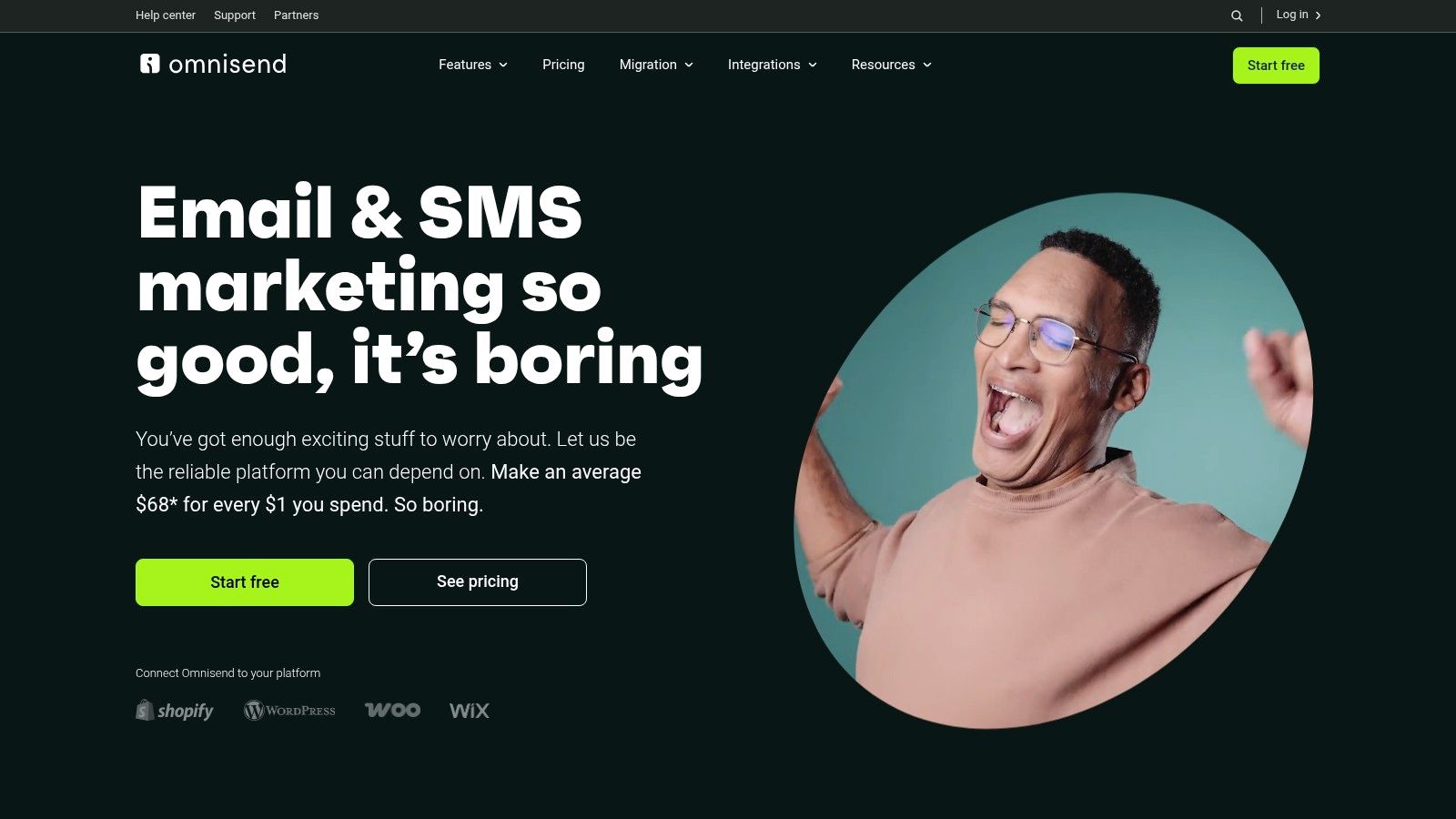
Omnisend's strength lies in its omnichannel approach. It integrates email, SMS, push notifications, and other channels like Facebook Messenger and WhatsApp into a single platform. This enables you to create coordinated campaigns that reach customers at various touchpoints, delivering a consistent brand experience and maximising engagement. Imagine a customer abandoning their cart. Omnisend can automatically trigger a series of targeted messages: an initial email reminder, followed by an SMS message with a discount code if the cart remains abandoned, and finally a push notification highlighting a related product. This coordinated approach is significantly more effective than relying on a single channel.
Key features for e-commerce businesses include pre-built automation workflows for scenarios like welcome series, cart abandonment, post-purchase follow-ups, and product recommendations. These workflows can be customised using a visual drag-and-drop builder, making it easy to tailor the automation to your specific needs, even without coding skills. Customer segmentation based on shopping behavior and preferences allows you to target specific customer groups with personalised messages, further enhancing the effectiveness of your marketing efforts.
Pros:
- Purpose-built for e-commerce: Offers pre-built templates, workflows, and integrations specifically for online retailers.
- User-friendly interface: Drag-and-drop editors and intuitive navigation make it easy to create and manage campaigns.
- Competitive pricing: Offers a range of plans suitable for businesses of all sizes, including a free plan for getting started.
- Good e-commerce integrations: Integrates seamlessly with popular platforms like Shopify, WooCommerce, and BigCommerce.
Cons:
- E-commerce focus: Less versatile than broader marketing automation platforms for businesses outside the e-commerce sector.
- Limited integrations outside e-commerce: Fewer integrations with tools like CRM or project management software compared to more general platforms.
- Advanced features require higher-tier plans: Features like advanced reporting and custom IP addresses are locked behind more expensive plans.
Implementation Tips:
- Start with a free plan to explore the platform and test its functionalities.
- Integrate Omnisend with your e-commerce platform to leverage customer data and automate key workflows.
- Utilize pre-built automation workflows as a starting point and customize them to match your brand and target audience.
- Segment your customer base based on purchase history, browsing behavior, and other relevant data to personalize your messaging.
For UK businesses seeking a marketing automation tool specifically designed for e-commerce, Omnisend is a powerful solution. Its omnichannel capabilities, pre-built workflows, and user-friendly interface make it an excellent choice for boosting conversions and building customer loyalty. Visit their website (https://www.omnisend.com) to explore pricing and available plans. You can compare it with other platforms like Klaviyo, which offers similar features, but Omnisend often presents a more cost-effective solution, particularly for smaller businesses or those just beginning with marketing automation.
10. Keap (formerly Infusionsoft)
Keap, formerly known as Infusionsoft, stands out among marketing automation tools as a powerful all-in-one platform specifically designed for the needs of small businesses in the UK. It combines CRM, marketing automation, and e-commerce functionalities into a single solution, enabling businesses to streamline their sales and marketing processes without the complexity of enterprise-level software. This makes it a compelling choice for small businesses looking to automate tasks like customer follow-up, lead nurturing, and sales processes.
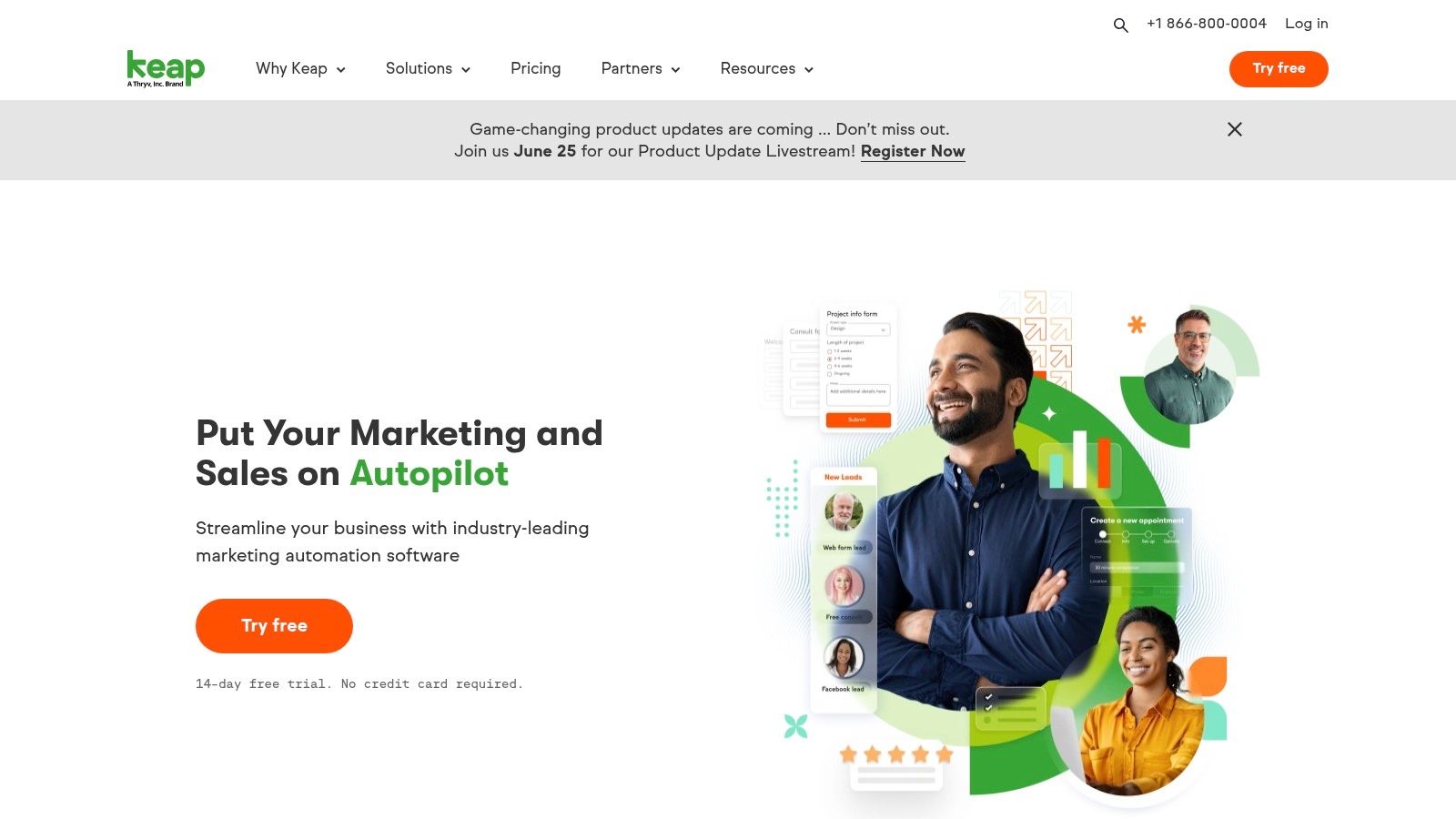
Keap's campaign builder provides a visual automation workflow editor, allowing users to easily create and manage complex marketing campaigns. The integrated CRM system helps manage contacts, track sales pipelines, and segment audiences effectively. Its email marketing features offer templates and personalization options to craft targeted messages, while the built-in e-commerce and payment processing integration facilitates seamless transactions. This comprehensive approach differentiates Keap from other marketing automation tools that may focus solely on one aspect of the marketing process. For e-commerce managers in the UK, the ability to integrate sales and marketing automation directly with payment processing can significantly boost conversions and engagement.
For small businesses, automating repetitive tasks through Keap frees up time and resources to focus on growth and strategy. Content creators and bloggers can also benefit from Keap's automation for social media and SEO management, enabling them to reach a wider audience. Digital marketing agencies in the UK evaluating new tools for their clients will find Keap's all-in-one nature appealing for its streamlined approach to CRM, email marketing, and sales pipeline management. Marketing professionals looking to explore AI-driven automation and analytics will appreciate Keap's robust features for lead capture, lead scoring, and customer segmentation.
While Keap offers a robust suite of features, it’s worth noting that there is a steeper learning curve compared to some other SMB-focused marketing automation tools. The user interface, while functional, can feel somewhat dated compared to newer platforms. Setting up and implementing Keap can also be challenging without professional assistance, and customization options are more limited than those offered by enterprise-level platforms.
Key Features & Benefits:
- Campaign Builder: Visual workflow editor for easy automation setup.
- CRM: Contact management, pipeline tracking, and segmentation.
- Email Marketing: Templates, personalization, and automated campaigns.
- E-commerce Integration: Built-in payment processing and sales automation.
- Lead Capture: Forms and landing pages for effective lead generation.
Pros:
- All-in-one solution combining CRM, marketing, and sales tools.
- Designed specifically for small business needs.
- Strong focus on lead conversion through automation.
- Built-in e-commerce and payment processing.
Cons:
- Steeper learning curve than some alternatives.
- Dated user interface.
- Setup can be complex.
- Limited customization options.
Website: https://keap.com
(Pricing and technical requirements were not readily available at the time of writing and should be checked directly on the Keap website.)
Keap's comprehensive feature set and focus on small businesses make it a valuable marketing automation tool, deserving its place on this list. However, businesses should carefully consider the learning curve and implementation challenges before committing. For those willing to invest the time and resources, Keap offers a powerful platform to streamline marketing and sales, ultimately driving growth and efficiency.
Top 10 Marketing Automation Tools Comparison
| Platform | Core Features & Automation ✨ | User Experience & Quality ★ | Value & Pricing 💰 | Target Audience 👥 | Unique Selling Points 🏆 |
|---|---|---|---|---|---|
| The Digital Marketing Toolbox 🏆 | Centralized tool discovery, workflow automation, broad categories | Intuitive UI, smart filters, easy comparison | Free trial access; pricing varies by vendor | Small businesses, agencies, e-commerce, creators | One-stop platform with exclusive vendor trials |
| HubSpot Marketing Hub | Multi-channel marketing, CRM integration, advanced analytics | User-friendly, intuitive workflows | Robust free plan, scalable pricing | SMBs to enterprises needing integrated CRM | Seamless CRM + marketing suite integration |
| Mailchimp | Email campaigns, customer journeys, A/B testing | Intuitive, beginner-friendly | Generous free plan; pricing grows with contacts | Small to medium businesses | Strong integrations with e-commerce tools |
| Marketo Engage (Adobe) | Lead scoring, ABM, revenue analytics | Less intuitive, steep learning curve | Enterprise pricing, high cost | Large enterprises, B2B marketing teams | Powerful for complex multi-channel B2B |
| ActiveCampaign | Visual automation builder, predictive sending | Feature-rich but can feel cluttered | Flexible mid-market pricing | SMBs, growing businesses | Advanced automation without enterprise bloat |
| Salesforce Marketing Cloud | Cross-channel journeys, AI personalization | Complex, needs expert users | Enterprise-level investment | Large enterprises with diverse needs | Deep Salesforce ecosystem integration |
| Klaviyo | E-commerce focused flows, SMS, product recommendations | User-friendly for e-comm | Pricing grows fast with subscribers | E-commerce businesses | Purpose-built for e-commerce ROI |
| Pardot (Salesforce) | Lead scoring, nurture campaigns, ROI attribution | Less intuitive, Salesforce-dependent | High enterprise pricing | B2B sales & marketing teams | Strong marketing-sales alignment |
| Omnisend | Omnichannel (email, SMS, push), e-comm workflows | Easy drag-and-drop | Competitive e-comm pricing | E-commerce brands | Multi-touchpoint e-commerce marketing |
| Keap (formerly Infusionsoft) | CRM + marketing automation + payments | Dated UI, steeper SMB learning curve | SMB-focused pricing, setup challenges | Small businesses needing all-in-one tool | Combines CRM, marketing, and e-commerce |
Choosing the Right Automation Ally
From email marketing giants like Mailchimp and Klaviyo to CRM powerhouses like HubSpot, Salesforce Marketing Cloud, and Pardot, and more agile solutions like ActiveCampaign, Keap, and Omnisend, the world of marketing automation tools is vast and varied. We’ve explored ten leading platforms in this article, each catering to specific needs and budgets. Remember, the best marketing automation tool isn't a one-size-fits-all solution. The ideal choice for a small e-commerce business in the UK might differ significantly from the needs of a large enterprise or a digital marketing agency managing multiple clients.
Key takeaways include understanding the importance of aligning your chosen tool with your business goals, budget, and technical capabilities. Whether you’re a content creator looking for SEO and social media support or an e-commerce manager aiming to boost conversions, the right marketing automation platform can revolutionise your workflow. Factors such as ease of use, integration capabilities with existing systems, and the level of customer support provided are crucial considerations. Before committing, take advantage of free trials and demos to get a hands-on feel for each platform.
Selecting and implementing the right marketing automation tools is a strategic investment that can transform your marketing efforts. By automating repetitive tasks, you free up valuable time to focus on strategic initiatives, build stronger customer relationships, and ultimately, drive significant business growth.
Ready to explore a wider range of marketing automation tools and discover the perfect solution for your business? The Digital Marketing Toolbox provides a curated selection of leading marketing automation platforms, helping you compare features, pricing, and integrations to make an informed decision. Start streamlining your marketing today and unlock your growth potential!


