

Marketing Funnel Examples to Inspire Your Strategy
Understanding the marketing funnel is one thing; seeing it in action is another. A well-designed funnel guides potential customers from initial awareness to a final purchase, but theoretical models only get you so far. To build a system that genuinely drives growth, you need to analyse what works for real businesses. This article moves beyond abstract concepts to provide a detailed breakdown of powerful marketing funnel examples from various industries. We will dissect the exact strategies and tools successful companies use to attract, engage, and convert their audiences.
Instead of generic overviews, you will find a deep dive into specific campaigns. We will explore everything from the AIDA model to the innovative Flywheel and data-driven Pirate Metrics (AARRR) framework. For each example, we will uncover:
- The strategic framework: How the funnel is structured from top to bottom.
- Tactical execution: The specific content, ads, and touchpoints used at each stage.
- Tools and technology: The software stack powering their automation and analytics.
- Actionable takeaways: Replicable methods you can adapt for your own business.
By the end of this guide, you will have a clear blueprint for constructing a high-performing marketing funnel tailored to your unique goals. Let’s get started.
1. AIDA Funnel (Attention, Interest, Desire, Action)
The AIDA model is one of the most enduring and foundational frameworks in marketing and advertising. Developed in the late 19th century by E. St. Elmo Lewis, this classic hierarchy of effects model outlines a linear, four-stage journey that a consumer takes when engaging with a product or service. AIDA stands for Attention, Interest, Desire, and Action, and it provides a simple yet powerful blueprint for crafting compelling marketing communications. It remains one of the most widely taught marketing funnel examples because its core psychological principles are timeless.

Strategic Breakdown
The AIDA model is particularly effective for direct-response marketing, where the goal is to elicit a specific, immediate response from the audience. Let's examine how each stage functions strategically:
- Attention: The first step is to cut through the noise. This can be achieved with a disruptive headline, a shocking statistic, a visually stunning image, or a provocative question. For instance, Dollar Shave Club’s viral launch video used humour and a bold claim (“Our Blades Are F***ing Great”) to instantly capture the attention of millions.
- Interest: Once you have their attention, you must sustain it. This stage involves providing valuable information that resonates with the audience’s needs. You need to elaborate on the initial hook, detailing features and benefits. Amazon’s product pages excel here, using detailed descriptions and bullet points to hold a potential buyer’s interest.
- Desire: This is the pivotal emotional stage where you transition from “this is interesting” to “I want this.” Marketers build desire by connecting the product's benefits to the consumer's lifestyle, aspirations, or pain points. Showcasing social proof like customer reviews, testimonials, and case studies is a powerful tactic to create this longing.
- Action: Finally, the funnel culminates in a clear call-to-action (CTA). This stage must be as frictionless as possible. Using urgent language (“Buy Now, Limited Stock!”), prominent buttons, and simple checkout processes encourages the consumer to take the final step, whether it's making a purchase, signing up for a newsletter, or booking a consultation.
Actionable Takeaways
- Map Your Content: Create specific content pieces for each AIDA stage. For example, use social media ads for Attention, blog posts for Interest, customer testimonials for Desire, and a clear landing page for Action.
- Simplify the Action: Reduce the number of clicks and form fields required to convert. Every extra step is a potential point of abandonment.
- Test and Optimise: A/B test your headlines (Attention), your value propositions (Interest), your social proof (Desire), and your CTAs (Action) to continuously improve conversion rates throughout the funnel.
2. Sales Funnel (Awareness, Interest, Consideration, Purchase)
The traditional Sales Funnel is a visual representation of the customer journey, moving from broad initial awareness to a specific final purchase. Popularised by CRM pioneers and modern marketing automation platforms like HubSpot and Salesforce, this model is fundamental to sales and marketing alignment. It’s called a ‘funnel' because the number of prospects logically decreases at each successive stage, filtering the audience down to only the most qualified and purchase-ready buyers. This framework is one of the most vital marketing funnel examples for businesses focused on lead generation and nurturing.

Strategic Breakdown
This funnel excels at systematically converting strangers into customers by providing increasing value at each step. It is a cornerstone of inbound marketing and a core component of any effective marketing strategy for small business. Let's examine its stages:
- Awareness: At the top of the funnel (TOFU), the goal is to attract a wide audience. This is achieved through valuable, non-promotional content like blog posts, social media updates, and infographics that address a potential customer’s problems. HubSpot masters this by creating comprehensive blog content that ranks for thousands of industry keywords, making potential customers aware of their brand.
- Interest: Once aware, prospects move into the middle of the funnel (MOFU), where they actively seek solutions. Here, you offer more in-depth, gated content like ebooks, whitepapers, or webinars in exchange for contact information, turning visitors into leads.
- Consideration: In this stage, qualified leads evaluate their options. This is where you demonstrate why your solution is the best choice. Tactics include offering case studies, free tools, or product demonstrations. Tesla's online configurator is a prime example, allowing potential buyers to actively consider ownership by customising their ideal vehicle.
- Purchase: At the bottom of the funnel (BOFU), the prospect is ready to buy. The focus shifts to conversion through targeted offers, sales consultations, or free trials that lead directly to a purchase decision. Netflix’s free trial is a classic purchase-stage tactic, allowing users to experience the full value before committing to a subscription.
Actionable Takeaways
- Stage-Specific Content: Develop a content map that aligns specific assets to each funnel stage, from TOFU blog posts to BOFU consultations.
- Implement Lead Scoring: Use marketing automation to assign points to leads based on their actions (e.g., downloaded an ebook, visited the pricing page). This helps the sales team prioritise the most engaged prospects.
- Utilise Retargeting: Launch retargeting campaigns for prospects in the Consideration stage, showing them ads with customer testimonials or special offers to encourage a final decision.
3. Flywheel Marketing Model
Popularised by HubSpot, the Flywheel model challenges the linear nature of traditional funnels. It reimagines the customer journey not as a top-down process that ends at purchase, but as a continuous, circular system. This model is built on the idea that satisfied customers are the most powerful growth engine. By focusing on delighting existing customers, companies can turn them into active promoters who fuel the “flywheel,” attracting new prospects and creating self-sustaining momentum. It stands out among marketing funnel examples for its emphasis on post-purchase experience and customer-centric growth.
The infographic below illustrates the three core stages of the Flywheel model: Attract, Engage, and Delight, highlighting key metrics for each phase.
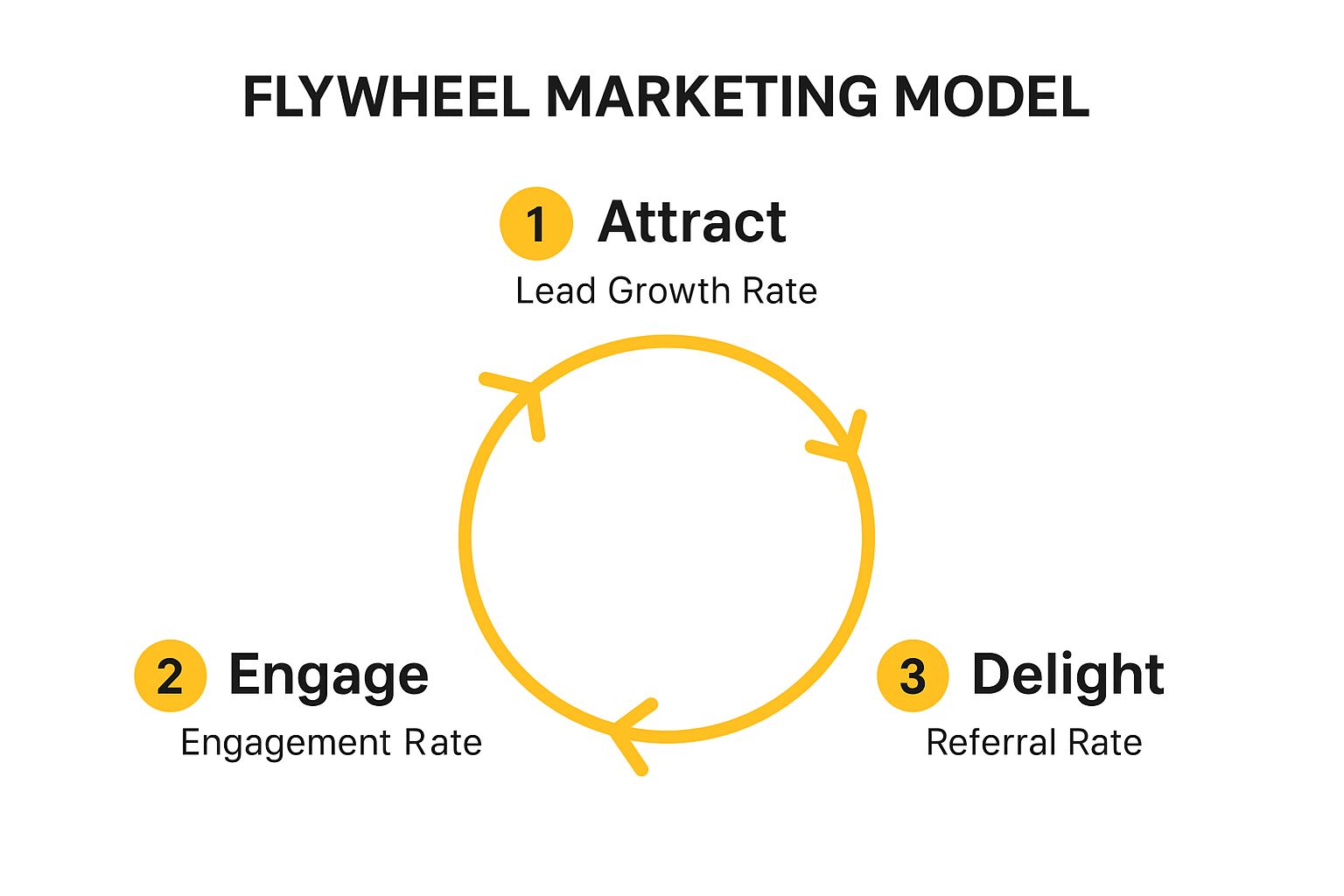
The visualisation shows how focusing on the complete customer lifecycle, particularly through referral rates in the Delight stage, directly fuels new lead growth, creating a powerful, compounding effect.
Strategic Breakdown
The Flywheel's strategy revolves around two core concepts: reducing friction and applying force. Friction is anything that slows down the customer, while force is anything that speeds up the flywheel, such as exceptional service or valuable content.
- Attract: This stage focuses on drawing in prospects with valuable content and conversations that establish you as a trusted advisor. Unlike traditional funnels that might use disruptive ads, the Flywheel uses inbound marketing tactics like SEO, blogging, and social media to provide value upfront. The goal is to earn attention, not steal it.
- Engage: Once attracted, the focus shifts to building lasting relationships by providing insights and solutions that align with their pain points. This is about making it easy to shop and buy from you, using tools like conversational bots, personalised email marketing, and multi-channel customer service. Slack excels here, as its seamless user experience encourages teams to invite more users, organically expanding its reach within an organisation.
- Delight: This is where the Flywheel truly differentiates itself. The goal is to provide an outstanding experience that helps customers achieve their goals. Success at this stage turns customers into advocates who provide testimonials, write positive reviews, and refer new business. HubSpot’s free tools and comprehensive customer success programmes are a prime example of delighting users into promoters.
Actionable Takeaways
- Map Customer Touchpoints: Conduct a full audit of your customer journey to identify and eliminate points of friction. Where do customers get stuck or frustrated? Streamline those processes.
- Invest in Customer Success: Shift resources towards robust onboarding, proactive support, and educational content. Your customer service team should be seen as a growth centre, not a cost centre.
- Systemise Feedback and Advocacy: Implement systems like Net Promoter Score (NPS) surveys to consistently gather feedback. Create formalised referral and affiliate programmes to incentivise and empower happy customers to spread the word.
4. Pirate Metrics Funnel (AARRR)
Coined by venture capitalist and 500 Startups founder Dave McClure, the AARRR framework is affectionately known as ‘Pirate Metrics' because its acronym sounds like a pirate's signature growl. This model is a favourite within the startup and SaaS communities because it moves beyond simple awareness and focuses on the entire customer lifecycle. It outlines five crucial, metric-driven stages for sustainable business growth: Acquisition, Activation, Retention, Referral, and Revenue. Unlike traditional funnels, AARRR provides a clear, data-centric dashboard for growth hackers and product managers to diagnose and optimise business performance.
Strategic Breakdown
The AARRR model is powerful because it forces businesses to think holistically about the customer journey, from first contact to long-term value. Its focus on user behaviour makes it one of the most practical marketing funnel examples for digital products.
- Acquisition: How do users find you? This stage covers all channels where customers first encounter your brand, such as organic search (SEO), paid advertising (PPC), social media, or content marketing. The goal is to drive traffic to your website or app efficiently.
- Activation: This is where a user has their first “happy” experience. It’s not just about signing up; it’s about them taking a key action that demonstrates engagement. For Dropbox, this was a user successfully uploading their first file. For Spotify, it’s a user creating their first playlist or saving a song.
- Retention: Do users come back? This is arguably the most critical stage for sustainable growth. High retention indicates a valuable product. This is measured by tracking repeat visits, session lengths, or continued use of key features over time.
- Referral: Do users like your product enough to tell others? This is the viral growth engine. Dropbox famously mastered this with its “get more free space” referral programme, turning its user base into a powerful acquisition channel.
- Revenue: How do you make money? This final stage tracks the behaviours that lead to revenue, such as upgrading to a premium plan, making a purchase, or clicking on an ad. It connects all preceding stages to the ultimate goal of profitability.
Actionable Takeaways
- Define Your Key Metrics: For each AARRR stage, identify one or two key performance indicators (KPIs). For Activation, it might be “user invites a collaborator.” For Retention, it could be “logs in 3 times in the first week.”
- Focus on Onboarding: A seamless and value-driven onboarding process is crucial for Activation. Guide new users directly to the “aha!” moment where they experience the core value of your product.
- Implement Cohort Analysis: Group users by when they signed up (their “cohort”) and track their behaviour over time. This helps you understand if changes you make to your product are improving retention for new users compared to old ones.
5. Content Marketing Funnel
The Content Marketing Funnel strategically aligns content creation with the stages of the buyer's journey. Instead of direct selling, this model focuses on attracting, educating, and nurturing prospects by providing valuable, relevant information at each step. Popularised by organisations like the Content Marketing Institute and HubSpot, it builds trust and establishes authority, guiding potential customers from initial awareness to a final purchase decision. This approach is a cornerstone of modern inbound strategies and stands as one of the most effective marketing funnel examples for building long-term customer relationships.
Strategic Breakdown
This funnel excels in B2B and high-consideration B2C markets where buyers conduct extensive research before purchasing. It systematically moves prospects through the funnel by offering progressively more specific and valuable content.
- Top of Funnel (ToFu) – Awareness: The goal here is to attract a wide audience and make them aware of a problem or need. Content is broad, educational, and often SEO-driven. Examples include blog posts, infographics, social media updates, and introductory videos. HubSpot's massive blog, which answers thousands of marketing and sales-related questions, is a prime example of effective ToFu strategy.
- Middle of Funnel (MoFu) – Consideration: At this stage, prospects are aware of their problem and are evaluating solutions. The content becomes more in-depth, often gated behind a form to capture lead information. Ebooks, white papers, case studies, and webinars are common here. Salesforce’s Trailhead platform offers free, in-depth training that demonstrates the platform's power, moving users from education to serious consideration.
- Bottom of Funnel (BoFu) – Decision: The prospect is now ready to buy. Content at this stage is product-focused and designed to convert. It addresses specific objections and provides final proof. Examples include free trials, product demos, detailed pricing pages, and customer testimonials. Buffer’s transparent blog posts and free tool tier effectively convert engaged readers into paying customers.
Actionable Takeaways
- Develop Buyer Personas: Create detailed profiles of your ideal customers to ensure your content addresses their specific pain points, questions, and motivations at each funnel stage.
- Use Lead Magnets: Offer high-value content like an ebook or a checklist (MoFu content) in exchange for an email address. This is crucial for moving prospects from the awareness to the consideration stage.
- Implement Marketing Automation: Use email marketing platforms to set up automated nurture sequences. Send targeted content to leads based on what they’ve downloaded or which pages they’ve visited, guiding them smoothly down the funnel. This is a key concept within the broader field of online promotion, and you can learn more about digital marketing to see how it fits together.
6. Social Media Marketing Funnel
The Social Media Marketing Funnel adapts the traditional customer journey specifically for social platforms. It acknowledges that modern consumers often discover, research, and purchase within a social ecosystem. This model moves beyond simple brand awareness, focusing on leveraging organic content, community engagement, and social proof to guide users from initial discovery through to conversion and, ultimately, brand advocacy. It has become one of the most vital marketing funnel examples for direct-to-consumer (D2C) brands that build their audiences from the ground up.

Strategic Breakdown
This funnel is less linear than traditional models, allowing users to enter at various stages. Its strength lies in building relationships and community, which drives long-term value.
- Awareness (Discovery): This top-of-funnel stage is about being seen. Users discover brands through entertaining or educational content on their feeds, shares from friends, or targeted ads. For example, Glossier built its empire on Instagram by creating aesthetically pleasing, user-centric beauty content that felt native to the platform, capturing the attention of its target audience organically.
- Consideration (Engagement): Once a user follows or shows interest, the goal is to foster engagement. This involves authentic interaction through comments, polls, Q&As, and direct messages. Nike excels here by running multi-platform campaigns with athlete endorsements and encouraging user-generated content, turning passive viewers into active participants in the brand's story.
- Conversion (Action): This stage focuses on turning engaged followers into customers. The path to purchase is shortened using platform-native tools like Instagram Shopping, Facebook Shops, or direct links in bios. The key is to make buying seamless without forcing the user to leave their preferred social environment.
- Loyalty & Advocacy (Post-Purchase): The funnel doesn't end at the sale. Encouraging customers to share their purchases, leave reviews, and join community groups turns them into brand advocates. This creates a powerful feedback loop where loyal customers generate authentic social proof that feeds new users into the top of the funnel.
Actionable Takeaways
- Create Platform-Native Content: Avoid a one-size-fits-all approach. Tailor your content's format, tone, and style to the specific platform you are using, whether it’s TikTok's short-form video or LinkedIn's professional articles.
- Engage Authentically: Don’t just broadcast; communicate. Respond to comments, ask questions, and use social listening tools to understand your audience’s pain points and desires. Wendy's famous Twitter persona is a masterclass in driving brand affinity through genuine, humorous engagement.
- Leverage Social Commerce: If available, implement social commerce features to reduce friction in the buying process. Tag products in your posts and stories to allow for direct, in-app purchasing.
7. Email Marketing Funnel
The Email Marketing Funnel is a strategic process that uses a sequence of targeted emails to guide subscribers from initial awareness to becoming loyal customers. Unlike broadcasting one-off promotions, this funnel method leverages the direct and personal nature of email to build a relationship over time. It nurtures leads by providing consistent value, addressing their specific needs, and gently moving them towards a conversion. Its effectiveness in creating and sustaining customer relationships makes it one of the most powerful and high-ROI marketing funnel examples available to businesses.
Strategic Breakdown
An email marketing funnel excels at turning passive subscribers into active buyers and advocates. It works by segmenting an audience and delivering tailored messages based on their behaviour and position in the customer journey.
- Lead Magnet & Sign-up (Awareness): The funnel begins with an irresistible offer, a lead magnet like a free ebook, webinar, or discount code, in exchange for an email address. This initial transaction sets the stage for future communication.
- Nurture Sequence (Interest & Consideration): Once subscribed, the lead enters an automated welcome or nurture sequence. These emails are not about selling; they are about building trust. For instance, Shopify provides new entrepreneurs with an educational series on starting an online business, establishing its platform as an indispensable resource.
- Conversion (Desire & Action): After providing value, the funnel introduces a specific offer. This could be a limited-time discount, a product launch, or a personalised recommendation. Airbnb uses this masterfully by sending tailored emails to hosts and guests based on their search history or booking patterns, creating a strong desire to book a trip or list a property.
- Loyalty & Advocacy (Post-Purchase): The funnel doesn't end at the sale. Post-purchase emails can include requests for reviews, offer related products, or provide exclusive content to foster loyalty. Morning Brew cultivates a massive daily readership, which it then converts to premium subscriptions and other paid products through its established authority and consistent engagement.
Actionable Takeaways
- Segment Your Lists: Do not send the same email to everyone. Segment your audience based on sign-up source, purchase history, and engagement level to send hyper-relevant content.
- Automate Your Welcome Series: Create a 3-5 part automated email sequence for new subscribers to introduce your brand, provide value, and set expectations.
- Prioritise Value Over Sales: Follow the 80/20 rule. 80% of your emails should be valuable and educational, while only 20% should be directly promotional. Exploring the advantages of email marketing can provide deeper insights into building this balance.
- Optimise Subject Lines and CTAs: Continuously A/B test your subject lines to improve open rates and your calls-to-action (CTAs) to increase click-throughs. Even small improvements can have a significant impact on your results.
7 Key Marketing Funnel Models Compared
| Model | Implementation Complexity 🔄 | Resource Requirements ⚡ | Expected Outcomes 📊 | Ideal Use Cases 💡 | Key Advantages ⭐ |
|---|---|---|---|---|---|
| AIDA Funnel | Low – simple four-stage linear model | Moderate – cross-channel content & CTA creation | Effective direct response, measurable at stages | E-commerce, SaaS, retail, B2C services | Easy to implement, time-tested, clear CTAs |
| Sales Funnel | Moderate – stage tracking & lead nurturing | Moderate – CRM and analytics tools | Clear conversion rates, sales forecasting | B2B and B2C sales processes | Visualizes journey, identifies bottlenecks |
| Flywheel Marketing Model | High – circular, customer-centric system | High – strong customer success investment | Sustainable growth, improved retention/referrals | SaaS, subscription businesses, customer-driven growth | Aligns teams, compounds growth, reduces CAC |
| Pirate Metrics Funnel (AARRR) | Moderate – metric tracking at 5 stages | High – data collection & analysis | Identifies growth bottlenecks, focuses on metrics | Startups, SaaS, digital businesses | Metrics-driven, growth-focused, easy team alignment |
| Content Marketing Funnel | Moderate – content creation & mapping | High – ongoing content production & SEO | Builds trust, organic leads, long-term growth | B2B SaaS, education-driven marketing | Builds authority, cost-effective, multi-format content |
| Social Media Marketing Funnel | Moderate – platform-specific strategies | Moderate to high – multi-platform content & engagement | Strong community engagement and brand awareness | Consumer brands, D2C, influencer marketing | High organic reach, real-time interaction |
| Email Marketing Funnel | Moderate – email automation & segmentation | Moderate – email platform & content creation | High ROI, nurtures leads through lifecycle | Direct marketing, e-commerce, SaaS | High ROI, personalized, highly trackable |
From Theory to Tangible Results: Building Your Own High-Converting Funnel
We've journeyed through a diverse landscape of powerful marketing funnel examples, deconstructing the strategies that industry leaders use to turn casual browsers into loyal customers. From the classic AIDA framework to the customer-centric Flywheel model and the data-driven Pirate Metrics, a clear pattern emerges: success isn't about finding a single magic formula. Instead, it’s about understanding the core principles of guiding a user's journey and then creatively adapting them to your specific audience, product, and industry.
The examples we analysed demonstrate that a well-optimised funnel is a dynamic, living system. It requires a deep understanding of your customer's psychology at each stage, from the initial spark of awareness to the final conversion and beyond into advocacy. The most effective funnels are never truly “finished”; they are continuously tested, measured, and refined.
Your Actionable Blueprint for Funnel Mastery
The key takeaway is that you have the power to architect a similar path for your own customers. The strategies are not secrets reserved for major corporations. By synthesising the insights from these real-world marketing funnel examples, you can begin building a more intentional and profitable marketing engine.
Here are your immediate next steps:
- Map Your Current Journey: Before building something new, audit what you already have. Use a simple framework like AIDA or the classic sales funnel to map out how a potential customer currently discovers and interacts with your business. Identify the weak points and drop-off rates. Where are you losing people?
- Select Your Core Model: Based on your business type, choose a primary funnel model to guide your strategy. Is your goal rapid growth and user acquisition (consider Pirate Metrics)? Or is it building a sustainable, customer-powered community (the Flywheel might be ideal)?
- Implement One Tactical Change: Don't try to overhaul everything at once. Pick one high-impact tactic you learned from the examples. This could be introducing a lead magnet at the top of your funnel, setting up a simple email nurture sequence for new subscribers, or adding a retargeting campaign to re-engage visitors who abandoned their carts.
- Measure and Iterate: Define the one key metric that will signal success for your new tactic (e.g., lead magnet download rate, email open rate, conversion rate from the retargeting ad). Track it closely and be prepared to adjust your approach based on the data.
Building a sophisticated marketing funnel is the most reliable way to create predictable business growth. It transforms your marketing from a series of random activities into a cohesive, goal-oriented system that consistently delivers results. By mastering these concepts, you move from simply hoping for customers to strategically engineering their journey, ensuring your business not only survives but thrives in a competitive digital marketplace.
Ready to stop guessing and start building with precision? The examples we’ve covered are powered by specific tools for analytics, automation, and content creation. To simplify this process, The Digital Marketing Toolbox provides an all-in-one suite of resources designed to help you build, manage, and optimise every stage of your marketing funnel. Explore the tools today at The Digital Marketing Toolbox and start turning your funnel strategy into reality.


