
In a world where the average person spends over four hours a day on their smartphone, a mobile-first mindset is no longer an advantage-it's essential for survival. Mobile devices have become the primary gateway to the digital world, fundamentally changing how consumers discover brands, engage with content, and make purchasing decisions. Ignoring this shift means leaving a significant portion of your audience behind and failing to capitalise on immediate consumer touchpoints. A robust mobile presence is crucial for staying competitive and relevant.
This article cuts straight to the chase, unpacking the 10 most effective mobile marketing strategies you can implement today to connect with customers where they are most active. We move beyond generic advice, providing actionable implementation steps, real-world examples, and the key metrics you need to track for each distinct strategy. Whether your goal is to drive app downloads, boost in-store footfall, or create viral social media campaigns, these insights will equip you to build a powerful and profitable mobile-optimised marketing framework. You will learn not just what to do, but precisely how to do it, ensuring your efforts deliver measurable results and a tangible return on investment.
1. App-Based Marketing: Building a Direct Channel to Your Customers
App-based marketing is one of the most powerful mobile marketing strategies because it creates a dedicated, branded space on a customer's most personal device: their smartphone. This strategy involves developing a mobile application that offers genuine value, such as exclusive content, streamlined services, or a loyalty programme, rather than just serving as a direct sales tool.
By building an app, you gain a direct channel to your audience, bypassing the noise of social media and email inboxes. It allows you to shape the entire customer journey in a controlled environment. The Starbucks app, for example, has mastered this by integrating mobile ordering with its rewards programme, now processing a significant portion of its transactions through the app and fostering immense customer loyalty. Similarly, the Nike Training Club app provides free, high-quality workout content, subtly promoting Nike products within a value-driven ecosystem.
How to Implement This Strategy
To succeed, your app must be more than a mobile version of your website. Focus on utility and creating a seamless user experience.
- Integrate a Loyalty Programme: Reward repeat usage with points, discounts, or exclusive access. This incentivises customers to keep your app installed.
- Use Push Notifications Wisely: Go beyond generic promotions. Send personalised alerts about abandoned carts, back-in-stock items, or location-based offers.
- Optimise Onboarding: Make the first interaction simple and highlight the app's core value immediately. A complicated sign-up process is a primary cause of app abandonment.
2. SMS/Text Message Marketing: Capitalising on Immediacy and High Open Rates
SMS marketing leverages the most direct communication channel available on a mobile device: the native text messaging app. This strategy involves sending targeted promotional texts, alerts, and transactional updates directly to customers who have opted in. With open rates often exceeding 98%, it stands out as one of the most immediate and effective mobile marketing strategies available.
Its power lies in its simplicity and urgency. Unlike emails that can sit unread for hours, text messages are typically read within minutes of receipt. This makes SMS ideal for time-sensitive promotions and critical updates. For instance, Papa John's uses SMS alerts for order tracking and exclusive deals, creating a seamless customer experience. Similarly, pharmacies like CVS use text reminders for appointments and prescriptions, a practice that has been shown to significantly reduce missed appointments and improve customer adherence.
How to Implement This Strategy
To succeed, SMS campaigns must be respectful, concise, and provide clear value. Building trust is paramount, as you are communicating on a highly personal channel.
- Prioritise Consent and Clarity: Always obtain explicit, opt-in consent before sending any messages. Every text should also include a simple and clear way for users to opt out, such as replying "STOP".
- Keep it Short and Actionable: Messages are limited in character count, so get straight to the point. Include a clear call-to-action (CTA), like "Show this text to save 20%" or a direct link to a landing page.
- Segment Your Audience: Avoid sending generic blasts. Group your subscribers based on their purchase history, location, or engagement level to send highly relevant and personalised offers that drive better results.
3. Mobile-Optimised Email Marketing
Mobile-optimised email marketing is one of the most crucial mobile marketing strategies today, focusing on designing email campaigns specifically for seamless viewing on smaller screens. With a majority of emails now opened on mobile devices, this approach ensures your messages are readable, engaging, and clickable, preventing the frustrating experience of pinching and zooming. It's about putting the mobile user experience first, not treating it as an afterthought.
This strategy is essential for capturing attention in a crowded, on-the-go environment. For example, Uber's ride receipts are models of simplicity, with a clear, single call-to-action (CTA) that works perfectly on a phone. Similarly, TheSkimm’s daily newsletter is built with a mobile-first, scannable format that respects the reader's time. These brands understand that mobile emails must deliver value instantly. For marketers seeking to master personalised campaigns that resonate on any device, diving into our comprehensive Ultimate Guide to Email Personalization in 2025 can provide advanced techniques.
How to Implement This Strategy
To succeed, your emails must be designed with the constraints and advantages of mobile in mind. Focus on clarity, speed, and ease of interaction.
- Adopt a Single-Column Layout: This is the most reliable way to ensure your email renders correctly across all mobile devices, avoiding awkward horizontal scrolling.
- Make CTAs Tappable: Design buttons to be at least 44×44 pixels. This makes them easy for users to tap with a thumb without accidentally hitting other links.
- Optimise for a Quick Glance: Use short subject lines (under 40 characters), larger fonts (at least 14px for body text), and place the most important information right at the top.
4. Location-Based Marketing (Geofencing & Geotargeting)
Location-based marketing is one of the most contextually relevant mobile marketing strategies, using a user's physical location to deliver hyper-targeted messages. This is achieved through technologies like GPS and beacons to trigger notifications, ads, or offers when a device enters a pre-defined virtual boundary, a technique known as geofencing. It is highly effective for driving immediate foot traffic to physical stores and delivering timely, valuable promotions.
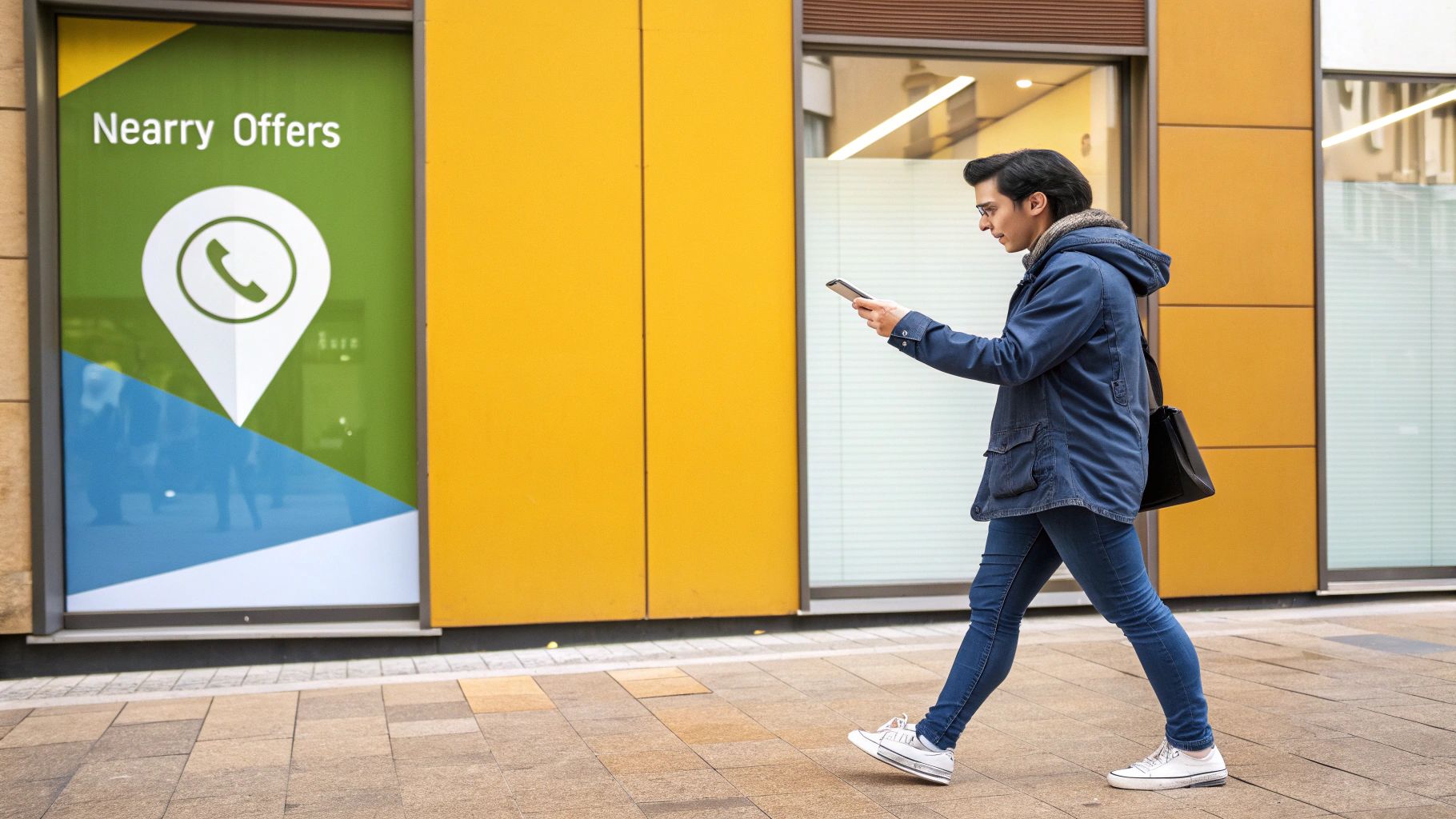
The power of this strategy lies in its timing and relevance. Burger King’s legendary "Whopper Detour" campaign, which offered a 1-cent Whopper to customers who were near a McDonald's location, perfectly illustrates this by cleverly turning a competitor's space into a marketing opportunity. Similarly, Starbucks regularly sends exclusive deals to users who are walking or driving near one of their coffee shops, capitalising on convenience and impulse.
How to Implement This Strategy
Success depends on delivering value without being intrusive, respecting user privacy at all times. The goal is to be helpful, not invasive.
- Be Transparent and Secure Consent: Clearly explain why you need location data and what benefits the user will receive. Always make opting in a conscious and easy choice.
- Create Genuinely Valuable Offers: A generic 5% discount may not be compelling enough. Offer something exclusive or highly convenient to justify the notification and encourage action.
- Test Geofence Radiuses and Timing: Start with a standard radius around your location and test different sizes. Also, cap the frequency of messages to avoid annoying your audience.
5. In-App Advertising: Reaching Users Where They Spend Their Time
In-app advertising is one of the most direct mobile marketing strategies, placing your brand message within third-party mobile applications. With users spending over 90% of their mobile time inside apps, this strategy allows you to reach a highly engaged and captive audience. Unlike other forms of digital advertising, in-app ads are served to users while they are actively using an app, offering a contextually relevant placement for your promotions.
This method leverages programmatic platforms like Google AdMob and Facebook Audience Network to deliver ads in various formats, from simple banners to immersive rewarded videos. For instance, the popular game Candy Crush effectively uses rewarded video ads, offering players extra lives in exchange for watching a short advertisement. Similarly, Spotify integrates audio and video ads between songs for its free-tier users, seamlessly blending promotions into the user experience. These examples show how in-app advertising can drive results without severely disrupting user engagement.
How to Implement This Strategy
A successful in-app campaign focuses on relevance and the user experience, ensuring ads add value rather than create annoyance.
- Choose Formats That Fit the Context: Use native ads that blend into an app's design for a less intrusive feel. For gaming apps, rewarded video ads are highly effective as they offer a clear value exchange.
- Prevent Ad Fatigue: Implement frequency capping to limit how many times a single user sees your ad within a certain period. Oversaturation can lead to negative brand perception.
- Target Based on Behaviour: Use data to target users based on their in-app actions, interests, and demographic information. This ensures your ads are shown to the most relevant audience, increasing conversion rates.
6. Mobile Social Media Marketing: Connecting Where Your Audience Lives
Mobile social media marketing is one of the most vital mobile marketing strategies as it targets customers on the platforms where they spend a significant portion of their screen time. This strategy involves creating and distributing content specifically optimised for mobile social platforms, recognising that over 90% of users access channels like Instagram, TikTok, and Twitter via their smartphones. It prioritises vertical video, Stories, Reels, and other mobile-first formats designed for quick, on-the-go consumption and immediate engagement.
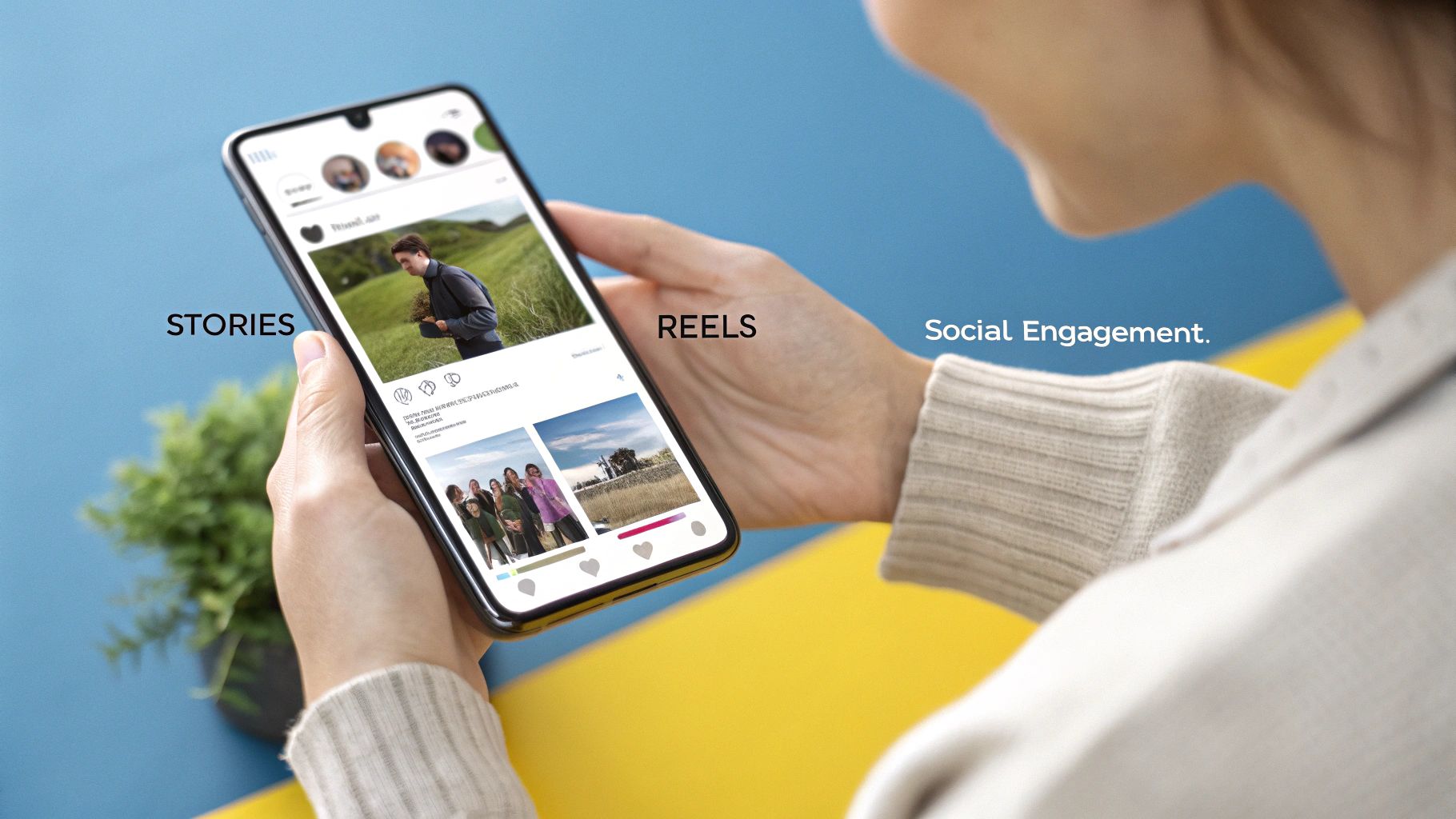
The power of this approach is its ability to build community and drive trends in real time. For instance, Chipotle's TikTok campaigns have leveraged hashtag challenges to generate billions of views, turning brand promotion into a viral user-generated phenomenon. Similarly, Wendy's has mastered mobile engagement on Twitter with witty, real-time responses that have built a distinctive and highly popular brand personality, perfectly suited for the platform's fast-paced nature. These tactics are a key component of any modern marketing strategy for small business owners looking to connect with a younger demographic.
How to Implement This Strategy
Success on mobile social media requires a shift away from traditional desktop-first content. The key is to create content that feels native to the platform and is designed for the mobile user experience.
- Create in Vertical Format: Design all visual content, especially video for Stories and Reels, in a vertical 9:16 aspect ratio to fill the entire mobile screen.
- Keep Content Concise: Aim to capture attention within the first three seconds and keep videos under 60 seconds to maximise retention rates on fast-scrolling feeds.
- Optimise for Silent Viewing: Add captions or on-screen text to all videos, as research shows up to 85% of users watch social media videos without sound.
- Time Your Posts Strategically: To truly maximise engagement and reach within your mobile social media campaigns, understanding optimal posting times is essential. You can find detailed platform-specific insights in resources covering the Best Time to Post on Social Media in 2025.
- Use Interactive Features: Leverage platform-specific tools like polls, question stickers, and quizzes to encourage active audience participation rather than passive consumption.
7. Mobile Search Advertising (SEM/PPC): Capturing High-Intent Users on the Go
Mobile search advertising is one of the most direct mobile marketing strategies for capturing customers at the exact moment of need. This strategy involves running paid search campaigns specifically optimised for users on smartphones and tablets. Given that mobile searches have long surpassed desktop, having a mobile-first approach to search engine marketing (SEM) is no longer optional; it is essential for reaching an active, high-intent audience.
This strategy is effective because it targets users actively looking for a solution. Domino's, for example, uses mobile search ads with click-to-call extensions, allowing hungry customers to place an order instantly. Similarly, Home Depot leverages location extensions to show nearby searchers the distance to their closest store, driving immediate foot traffic. These tactics transform a simple search query into a direct conversion, whether it's a phone call, a store visit, or an online purchase.
How to Implement This Strategy
A successful mobile search campaign requires more than just bidding on keywords; it demands a focus on speed, relevance, and convenience for the on-the-move user.
- Implement Mobile-Specific Extensions: Use click-to-call and location extensions to make it effortless for users to contact you or find your physical location directly from the search results.
- Create Mobile-Optimised Landing Pages: Ensure your landing pages load in under three seconds and are designed for easy navigation on a small screen. A slow or clunky page will cause users to abandon it immediately.
- Refine Your Bidding and Targeting: Use mobile bid adjustments to increase your bids for mobile users if they convert better. Employ ad scheduling to target peak mobile search times, such as during commutes or lunch breaks.
8. Mobile Video Marketing: Capturing Attention on the Small Screen
Mobile video marketing is a critical component of modern mobile marketing strategies, focusing on creating video content specifically designed and optimised for viewing on smartphones. With mobile devices accounting for the vast majority of all video consumption, this approach prioritises short-form, vertically oriented content that grabs attention instantly. It acknowledges that mobile viewing habits are different: users scroll quickly and often watch with the sound off.
This strategy capitalises on the native formats of platforms like TikTok, Instagram Reels, and YouTube Shorts. For instance, Tasty's viral recipe videos are famous for their quick, top-down style and clear on-screen text, making them perfectly shareable and easy to follow without audio. Similarly, Nike uses high-impact Instagram Stories to launch new products, leveraging the vertical, full-screen experience to create an immersive and engaging brand moment that feels native to the platform.
How to Implement This Strategy
Success in mobile video requires adapting your content to user behaviour, not just resizing a traditional advert. Your goal is engagement and shareability in a fast-paced environment.
- Design for Sound-Off Viewing: Assume most users will watch without audio. Use bold, clear captions or on-screen text to convey your message effectively.
- Embrace Vertical Formats: Create content in 9:16 (for Stories/Reels) or 1:1 (for feeds) aspect ratios. This fills the entire screen, maximising impact and minimising distractions.
- Hook Viewers Immediately: You have less than three seconds to capture attention. Start with your most compelling visual or message to stop users from scrolling past.
- Optimise for Quick Consumption: Keep videos concise, ideally under 60 seconds, to align with short mobile attention spans and encourage completion.
9. Mobile Commerce (M-Commerce) Optimisation
Mobile commerce (M-commerce) optimisation is one of the most critical mobile marketing strategies today, focusing on creating a frictionless shopping experience designed specifically for mobile users. With mobile now driving the majority of e-commerce traffic, this strategy goes beyond a simple responsive website. It involves simplifying every step of the buying journey, from product discovery to final payment, to minimise abandonment and maximise conversions on smaller screens.
This approach is essential because mobile users have different expectations; they demand speed, convenience, and security. Amazon pioneered m-commerce optimisation with its one-click ordering system, which radically reduced purchasing friction and now accounts for billions in sales. Similarly, fashion retailer ASOS has built a powerful app that includes features like visual search and barcode scanning, making the mobile shopping experience more intuitive and engaging than its desktop counterpart. These examples show how a mobile-first approach can build a significant competitive advantage.
How to Implement This Strategy
To effectively optimise for m-commerce, you must analyse and streamline the entire mobile path to purchase. The goal is to remove any and all barriers that might frustrate a user.
- Simplify the Checkout Process: Implement one-click purchasing options like Shop Pay or Apple Pay. Minimise form fields by only asking for essential information and enable guest checkout to reduce sign-up friction.
- Design for Touch: Use large, thumb-friendly buttons (at least 44×44 pixels) and ensure there is ample space between clickable elements to prevent accidental taps. Optimise product images for fast loading on mobile connections.
- Build Trust and Security: Prominently display security badges, customer reviews, and transparent return policies. Use auto-fill capabilities for shipping and payment details to speed up the process and reduce errors.
10. Mobile Influencer and User-Generated Content Marketing
Capitalising on the power of social proof, this strategy involves leveraging content created by influencers and everyday customers on mobile-first platforms. These mobile marketing strategies are effective because they harness the authenticity of peer recommendations, which modern consumers trust far more than traditional advertising. The content is inherently mobile-native, designed for vertical viewing on platforms like TikTok and Instagram.
This approach builds brand credibility and community by turning customers and creators into advocates. The watch brand Daniel Wellington famously built its empire almost entirely on Instagram influencer partnerships, flooding feeds with stylish, aspirational photos. Similarly, GoPro’s marketing is powered by its community, with its #GoPro hashtag generating a constant stream of high-octane, user-generated content that perfectly showcases the product’s capabilities in real-world scenarios.
How to Implement This Strategy
Success hinges on fostering genuine enthusiasm and making it easy for users to share their experiences. Focus on authenticity over overtly promotional content.
- Create a Branded Hashtag: Establish a unique and memorable hashtag to easily track and curate user-generated content (UGC), like Starbucks' annual #RedCupContest.
- Partner with Micro-Influencers: Collaborate with influencers in the 10K-100K follower range. They often have higher engagement rates and are perceived as more authentic than larger celebrities.
- Incentivise Content Creation: Run contests, offer discounts, or feature the best user submissions on your official channels to encourage participation and reward your community.
Mobile Marketing Strategies Comparison Matrix
| Marketing Type | Implementation Complexity 🔄 | Resource Requirements ⚡ | Expected Outcomes 📊 | Ideal Use Cases 💡 | Key Advantages ⭐ |
|---|---|---|---|---|---|
| App-Based Marketing | High – requires development, updates, multi-platform | High – developers, maintenance, marketing | Strong user engagement, loyalty, rich data | Brands wanting direct device access, loyalty | High engagement, offline use, personalization |
| SMS/Text Message Marketing | Low to Medium – setup automation, compliance | Low – simple tools, messaging costs | Immediate, high open/rates and conversions | Time-sensitive offers, reminders, personal msgs | Highest open rates, fast delivery, cost-effective |
| Mobile-Optimized Email Marketing | Medium – design, testing across devices | Medium – design tools, analytics platforms | Improved engagement, high ROI | Broad audience reach, detailed analytics | Cost-effective, detailed tracking, easy testing |
| Location-Based Marketing | Medium to High – needs location tech, permissions | Medium to High – tech integration, data | Increased foot traffic, highly targeted ads | Physical stores, local offers, competitor conquest | Contextual targeting, measurable visits, personalization |
| In-App Advertising | Medium – ad format integration, partnerships | Medium – ad networks, creatives | Targeted ads, high engagement, direct response | Monetizing app users, brand exposure | Captive audience, better targeting, varied formats |
| Mobile Social Media Marketing | Medium to High – constant content creation | Medium – content creation, social tools | High engagement, viral potential | Mobile social platforms, influencer partnerships | Massive reach, real-time engagement, cost-effective |
| Mobile Search Advertising (SEM/PPC) | Medium – ongoing optimization, budget control | Medium – ad spend, management tools | High-intent traffic, measurable conversions | Local and intent-driven searches | Precise targeting, fast results, call tracking |
| Mobile Video Marketing | Medium to High – video production and optimization | Medium to High – production, editing tools | High engagement, social sharing, emotional impact | Brand storytelling, product demos, social ads | High engagement, easy consumption, strong emotion |
| Mobile Commerce (M-Commerce) Optimization | High – requires seamless UX, payment integration | High – development, security, payments setup | Increased conversions, lower abandonment | E-commerce, impulse buys, mobile payments | Seamless checkout, higher conversions, personalization |
| Mobile Influencer & UGC Marketing | Medium – community management, partnerships | Medium – influencer payments, content curation | Authentic engagement, extended brand reach | Social platforms, authenticity-driven campaigns | Authentic content, high trust, cost-effective |
Integrating Your Mobile Strategies for Maximum Impact
Navigating the dynamic landscape of mobile marketing can seem complex, but the journey from understanding to execution is more accessible than ever. We've explored a diverse array of powerful mobile marketing strategies, from the direct intimacy of SMS campaigns and app-based marketing to the broad reach of mobile social media and search advertising. We've seen how location-based tactics can create hyper-relevant experiences and how mobile-optimised e-commerce can turn a casual browse into a completed sale.
The single most crucial takeaway, however, is not the mastery of any one of these channels in isolation. True success lies in integration. The most effective campaigns are not a series of disconnected actions but a symphony of coordinated efforts. Your mobile strategy should function as a cohesive ecosystem where each component amplifies the others, creating a seamless and engaging customer journey.
From Individual Tactics to a Unified Ecosystem
Think of how these strategies can work in concert. A targeted mobile search ad doesn't just earn a click; it can lead a user to your beautifully optimised m-commerce site. A compelling mobile video on social media can be the perfect vehicle to drive downloads for your new app. An SMS alert can notify a loyal customer of a flash sale, prompting them to open your app and make a purchase.
This synergy is where the real power is unlocked. By mapping your customer's mobile journey, you can identify the perfect touchpoints to deploy each strategy.
Key Insight: A holistic mobile marketing plan doesn't just reach customers on their preferred channels; it guides them smoothly from one channel to the next, reinforcing your brand message and making it easy for them to convert.
Your Actionable Next Steps
To transform these concepts into tangible results, start with a clear plan. Don't feel pressured to implement all ten strategies at once. Instead, focus on a strategic, phased approach:
- Audit Your Current Mobile Presence: Begin by evaluating your existing mobile assets. Is your website truly mobile-first? Do you have an active social media presence on mobile-centric platforms? Identify the low-hanging fruit and areas for immediate improvement.
- Define Your Primary Goal: What is the most important outcome you want to achieve? Is it driving app installations, increasing online sales, or boosting foot traffic to your physical store? Your primary goal will dictate which strategies to prioritise.
- Select Two or Three Core Strategies: Based on your goal and audience, choose a few complementary strategies to launch first. For example, an e-commerce business might combine mobile search ads, m-commerce optimisation, and mobile-optimised email marketing for a powerful sales-focused campaign.
- Measure, Analyse, and Refine: The digital world provides a wealth of data. Use analytics to track key performance indicators (KPIs) for each channel. Continuously test different approaches, measure the results, and refine your mobile marketing strategies based on what the data tells you. This iterative process is the foundation of sustainable growth and long-term success.
By adopting this integrated, data-driven mindset, you are no longer just marketing on mobile; you are building lasting relationships and creating value in the very space your customers inhabit every day.
Ready to put these strategies into action but not sure which tools to use? The Digital Marketing Toolbox is a curated directory designed to help you discover, compare, and manage the best software for SMS marketing, social media scheduling, app analytics, and more. Find the perfect tools to build your integrated mobile marketing stack today at The Digital Marketing Toolbox.


