
To really get a handle on your SEO, you have to keep a close eye on where your keywords are landing on Google's search results pages. This means using specific tools, or even just manual checks, to see how your site is performing for the search terms that matter most. It’s the only way to get the hard data you need to measure how well your organic search strategy is actually working.
Why You Absolutely Must Track Your Google SERP Rankings
Not tracking your Google rankings is like trying to drive to a new city without a map or satnav. In an online world where being seen is everything, knowing your position on the Search Engine Results Page (SERP) isn't just for show—it's a critical part of understanding your business's health. Your rank is directly tied to your website traffic, the leads you generate, and, ultimately, your bottom line.
Even tiny movements in your SERP positions can make a massive difference to your revenue. Slipping from the third spot to the fifth might not sound like a big deal, but it can easily cut your click-through rate in half. If you're not actively monitoring your rankings, you’re essentially letting your competitors walk all over you while they use real data to sharpen their own strategies.
The Unavoidable Reality of Google's Dominance
To really understand why this matters so much, you just have to look at the sheer scale of Google's influence. It's not just another search engine; it's the digital town square where almost every customer's journey begins.
Google's hold on the UK search market is staggering, commanding a massive 93.24% market share across all devices as of January 2025. This isn't a new trend; its dominance has been rock-solid for years, leaving rivals like Bing and Yahoo! in the dust. When you track your Google SERP rankings, you’re watching your performance on the one platform that dictates who sees you. For a deeper dive into these numbers, the UK market share report from Statista is well worth a read.
Let's be blunt: if you're not visible on Google, you're practically invisible online. Tracking your SERP performance is the first, non-negotiable step to carving out your space and building an SEO strategy that actually drives business growth.
What You Gain from Consistent Tracking
Keeping a regular check on your keyword positions gives you more than just a simple number. It's about gaining actionable insights that let you:
- Measure Your SEO ROI: You can finally connect the dots between the work you're putting in and the results you're getting, making it much easier to justify your marketing budget.
- Spot Quick Wins: Find those keywords that are lingering on the edge of page one. A little optimisation here and there can push them over the line for a fast traffic boost.
- Catch Problems Early: Notice a sudden drop in rankings before it turns into a catastrophic loss of traffic. This gives you time to figure out what went wrong and fix it.
- Benchmark Against Competitors: See exactly who is beating you and for which search terms. This is gold for understanding their tactics and uncovering gaps in your own strategy.
Building Your SERP Tracking Foundation
Before you even think about which tool to use, let's get the groundwork right. The absolute first step in tracking your Google positions effectively is to define what success actually looks like for your business. Just saying "I want to be number one" is a wish, not a strategy. A solid foundation connects your tracking directly to tangible business outcomes. It’s about moving beyond raw rank numbers and focusing on Key Performance Indicators (KPIs) that really move the needle.
Instead of getting fixated on rankings alone, shift your focus to metrics that truly matter. Are you shooting for a 20% increase in organic traffic to your key service pages this quarter? Or maybe the goal is to bump up the click-through rate (CTR) for your most valuable commercial keywords. When you tie your tracking to specific, measurable objectives, the data you collect becomes a strategic roadmap instead of just a list of numbers.
This is because better visibility on Google has a direct, cascading effect on your business's growth.
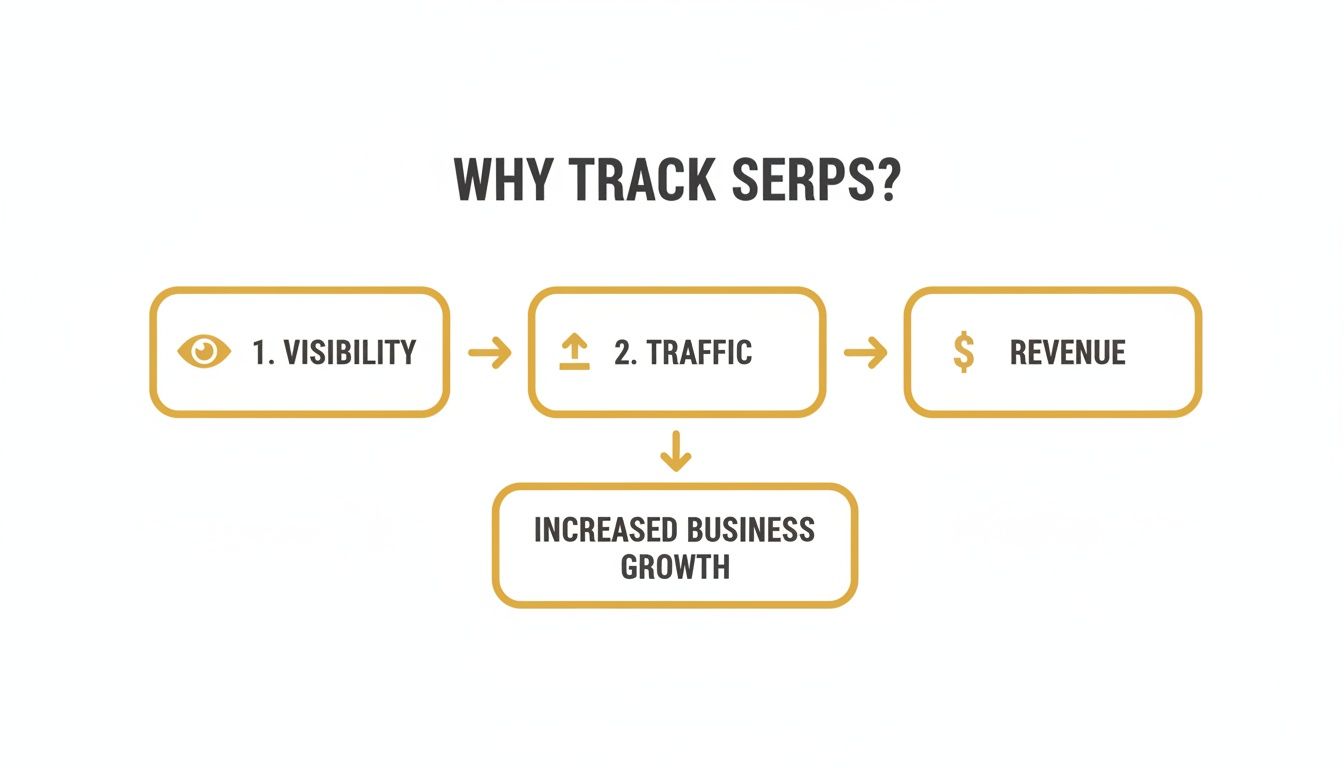
As you can see, climbing the SERPs directly fuels more website traffic. That traffic, in turn, creates more opportunities to generate revenue and grow.
Selecting Your Core Keywords
With your goals clearly defined, it's time to choose the right keywords to watch. A classic mistake I see all the time is tracking hundreds of irrelevant terms, creating a lot of noise. Your keyword list should be a carefully curated, strategic asset, not some disorganised data dump. You're aiming for a balanced portfolio that gives you a complete, accurate picture of your search performance.
Your keyword mix should cover a few key areas:
- Commercial Keywords: These are the high-intent phrases people use when they’re ready to buy. Think "emergency plumber in Bristol" or "buy vegan protein powder UK." Ranking for these has a direct and immediate impact on your bottom line.
- Informational Keywords: These are often longer questions, like "how to fix a dripping tap without a plumber." They might not convert on the first visit, but they're brilliant for attracting top-of-funnel traffic and establishing your brand as a helpful authority.
- Branded Keywords: It’s vital to monitor searches for your own company name. If you suddenly see a drop in rankings for your brand, it can be a red flag for serious technical SEO problems or even a reputation issue that needs your immediate attention.
By focusing on a strategic mix of keywords tied to specific business KPIs, you ensure your SERP tracking efforts provide actionable intelligence, not just vanity metrics. This foundational work makes every subsequent step more effective and impactful.
Of course, to build a truly robust foundation, it helps to understand the nuts and bolts. For anyone curious about the more technical side, here's a practical guide on how to scrape Google Search results that offers detailed insights into data collection. Knowing what happens "under the bonnet" will give you a much better appreciation for what the advanced tracking tools are actually doing.
Choosing Your Google SERP Tracking Toolkit
You've got your goals mapped out and your keywords lined up. Now it's time to assemble your toolkit. When it comes to tracking your performance on Google, the market is packed with options, from free and manual methods to powerful, automated platforms. The right choice really boils down to your budget, your goals, and how often you need to check in on your rankings.
For most people serious about SEO, a dedicated rank tracking tool is the way to go. Platforms like Semrush, Ahrefs, or SE Ranking handle all the heavy lifting for you, giving you daily (or even more frequent) updates on how your keywords are performing across different devices and locations. They’re built for efficiency, saving you a ton of time that would otherwise be spent trying to manually piece together historical data, competitor movements, and reports.
But you don't necessarily have to jump into a paid subscription right away. There are a few different paths you can take, and each has its own pros and cons.
Comparing Your Tracking Options
Fundamentally, you have three ways to approach tracking your rankings: dedicated automated platforms, Google's own foundational tools, and good old-fashioned manual spot-checks. Each one is useful for different reasons and suits different budgets and skill levels. Let's break down the common methods.
Here's a quick look at the main ways you can track your Google SERP rankings. This should help you figure out what makes the most sense for your current situation.
Comparison of SERP Tracking Methods
| Tracking Method | Best For | Pros | Cons |
|---|---|---|---|
| Automated SaaS Tools | Agencies, small businesses, and anyone needing frequent, detailed data. | Daily updates, competitor analysis, historical data, and reporting. | Can be costly, especially for large keyword lists. |
| Google Search Console | Everyone, especially those on a tight budget needing foundational data. | Completely free, provides CTR and impression data direct from Google. | Lacks daily rank tracking and direct competitor comparison features. |
| Manual Spot-Checks | Quick, occasional checks for a few critical keywords. | Free and instant for a snapshot view. | Highly inaccurate due to personalisation; not scalable. |
| SERP Scraping APIs | Developers and businesses needing custom, large-scale data solutions. | Ultimate flexibility, real-time data, integration with internal dashboards. | Requires technical skill to implement and manage; can be complex. |
Making the right choice here is key to getting reliable data without overspending. For a deeper dive into the leading platforms, our SEO tools comparison breaks down all the features and pricing to help you decide.
Ultimately, picking the best method depends on balancing your need for detailed, frequent data against your budget and technical resources.
Free vs. Paid: Where Should You Invest?
Before you spend a penny, make sure you're using Google Search Console. It's completely free and non-negotiable for anyone doing SEO. It gives you invaluable data on your average positions, how many people see your site in the results (impressions), and how many click on it (click-through rates). This is the ground truth, straight from Google, and should be the foundation of any tracking you do.
Once your SEO efforts start to mature, investing in a paid tool usually pays for itself. The ability to monitor your competitors' every move, see how you rank in different cities or countries, and get automated alerts when something big changes—that’s what lets you stay ahead of the game.
Think of it this way: Google Search Console tells you where you've been, while a dedicated rank tracker helps you see where you're going—and where your competitors are trying to overtake you. This foresight is what separates a basic SEO effort from a strategic one.
So, where do you start? Begin with the powerful, free data you get from Search Console. As your strategy becomes more sophisticated, layer in an automated tool to get that competitive edge and the detailed insights you need to win. This balanced approach gives you robust data without blowing your budget.
Getting Specific: How to Configure Your Tracker for Real-World Insights
Just dumping a list of keywords into a rank tracker and hitting 'go' won't cut it anymore. That's the old way of doing things. Modern search is so specific—down to the street you're on and the device in your hand—that you have to get granular to see what's really happening.
Most tools default to a broad, national-level view. The problem? This gives you a smoothed-out average that can easily hide major issues or opportunities. You might see you're ranking fourth for a keyword on desktop nationally, but what you don't see is that you're not even in the top 20 on mobile for someone searching from Manchester. That’s a massive blind spot, and without fine-tuning your settings, you'd be making decisions based on incomplete data.
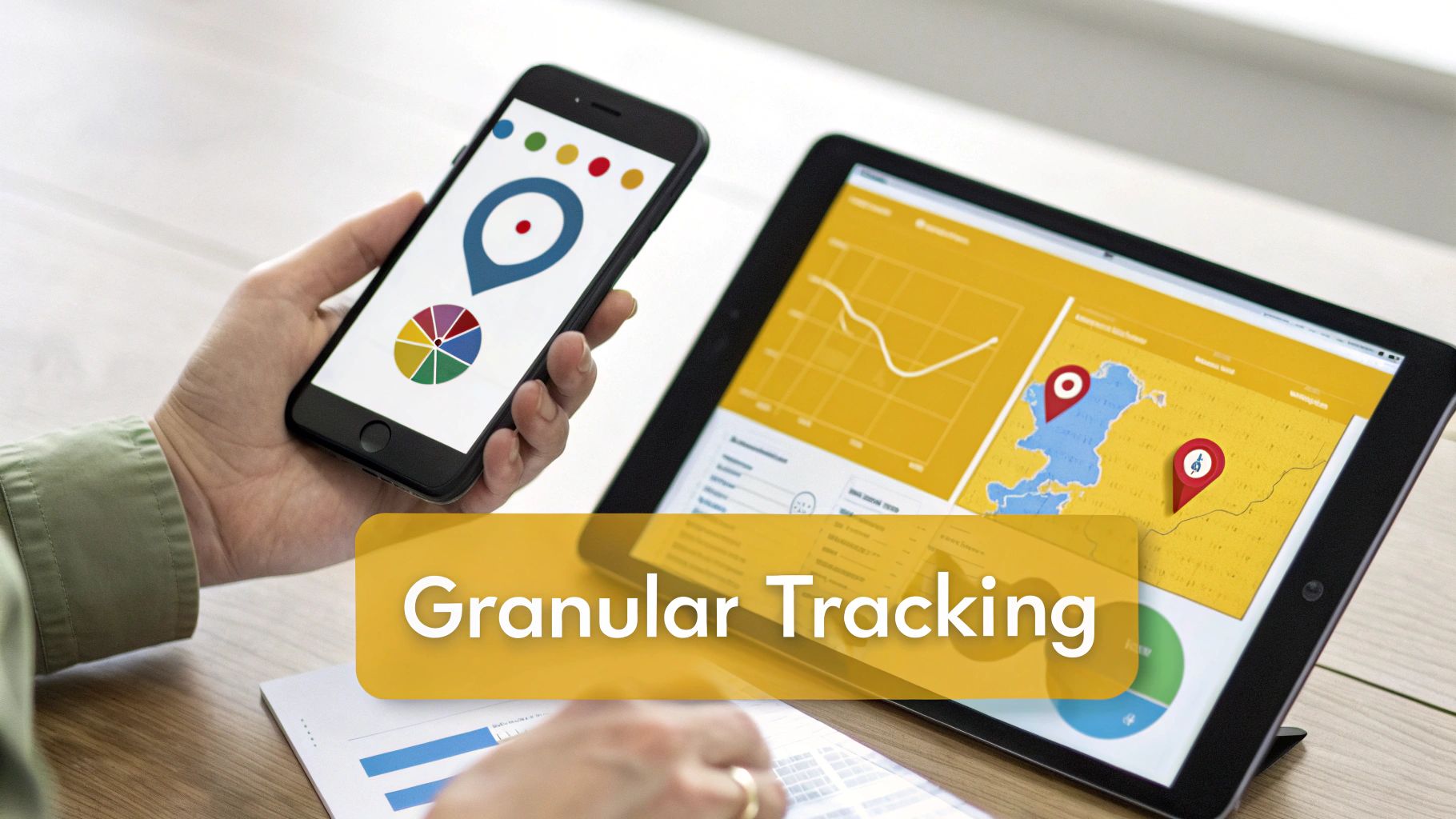
Think of this step as telling your tool exactly which version of Google’s search results you care about. It’s how you make sure the data you collect is a true reflection of what your actual customers see every day.
Start With Mobile—It’s Non-Negotiable
For years we've heard "mobile-first," but in rank tracking, it's often an afterthought. That's a huge mistake. How users search and what Google shows them can be worlds apart on mobile versus desktop, especially for anything with local intent.
Here in the UK, mobile search isn't just popular; it's practically a monopoly. As of November 2025, Google holds a mind-boggling 97.41% market share on mobile devices. If you’re not tracking mobile SERPs, you're ignoring the platform where almost all your customers are searching. For a deeper dive into these numbers, you can explore detailed mobile search engine statistics and see the full picture for yourself.
Drill Down With Hyper-Local Tracking
If you run a business with a physical shop or serve specific areas, national rankings are little more than a vanity metric. It's great if you rank for "solicitors in Leeds" across the country, but what really moves the needle is your visibility when someone searches from a specific LS6 postcode.
This is where you need to get precise with your tool's location settings:
- City-Level Tracking: At a minimum, set your location to key cities like "London," "Birmingham," or "Glasgow" to see how you stack up in major urban centres.
- Postcode-Level Tracking: This is essential for hyper-local businesses like plumbers or takeaways. Tracking by postcode gives you an incredibly accurate picture of your visibility, neighbourhood by neighbourhood.
- Google Business Profile Monitoring: Use these local settings to keep a close eye on your position in the "Map Pack." For many local businesses, this is the most valuable real estate on the page.
Getting this detailed helps you spot exactly where your local SEO efforts are paying off and which areas need a bit more love.
Winning in modern SEO isn't just about the classic "blue link" number one spot. It’s about owning valuable real estate across a diverse results page. Tracking SERP features is how you measure your success in this new arena.
Keep an Eye on Key SERP Features
Google's results pages are so much more than a list of ten blue links. They're a dynamic mix of answer boxes, images, videos, and local listings called SERP features. Showing up in these can be even more valuable than a traditional top ranking.
Your tracking setup should be configured to specifically monitor your presence in:
- Featured Snippets: The coveted "position zero" answer boxes that sit right at the top of the page.
- People Also Ask (PAA): Those dropdown boxes of related questions are a goldmine for visibility.
- Image Packs and Video Carousels: Absolutely vital if your products or services are visual.
- Local Packs: The map-based results that are often the first thing a local searcher sees.
Tracking these features separately helps you uncover new opportunities to get in front of your audience. With so much data now hidden from us, like the infamous "keywords not provided" issue in Google Analytics, monitoring your visibility across all these SERP elements is a smart way to reclaim those performance insights.
Turning Rank Data into Actionable SEO Wins
Collecting data is just the first lap. The real race in SEO begins when you have to turn those numbers into smart, effective decisions that actually move the needle. Raw data without interpretation is just noise; the goal is to find the story behind the fluctuations.
Sure, a sudden jump in rankings after a content update is an easy win to celebrate. But what about a slow, creeping decline across an entire keyword cluster? That’s where the real analysis begins, and where your expertise truly shines.
It all comes down to asking one simple question: "Why?" Is that dip in rankings because of a big Google algorithm update that shook up the results? Or did a competitor just publish a killer piece of content that's now eating your lunch? Sometimes, the cause is much closer to home—a sneaky technical issue on your own site that’s making it harder for Google to crawl and index your pages.

Pinpointing the root cause is everything. You simply can't apply the right solution if you don't truly understand the problem.
From Diagnosis to Action
Once you have a solid hypothesis about why your rankings have changed, it's time to build a clear plan of attack. Your response needs to be tailored to the specific issue you've found. Don’t just throw random tactics at the wall and hope something sticks; be strategic.
Here are a few common scenarios I’ve seen time and time again, along with the right way to respond:
-
Symptom: A key commercial page is slowly losing ground to a specific competitor.
- Action: It's time for a head-to-head content analysis. Dig into what your competitor is covering that you aren't, check out their backlink profile, and scrutinise their on-page experience. Your mission is to find the gaps and create a resource that is decisively better and more helpful.
-
Symptom: You've seen a sudden, site-wide drop in visibility right after a known Google update.
- Action: Get reading. Find out what the update targeted. Was it about content quality, link spam, or helpfulness? Now, perform an honest audit of your site against these new guidelines and start fixing what’s broken.
-
Symptom: Your rankings look great, but you're getting almost no clicks for a specific keyword.
- Action: This is almost always a problem with your SERP snippet—your title tag and meta description. They probably aren't compelling enough to earn the click. Time for a rewrite to make them more engaging. For some practical advice on this, our guide on how to write meta descriptions that actually work is a brilliant place to start.
The most successful SEO strategies aren't just reactive; they're proactive. By consistently analysing your SERP data, you can anticipate changes, address weaknesses before they become crises, and double down on what's already working to cement your position.
Presenting Your Findings Effectively
Finally, turning data into action often means getting buy-in from stakeholders, bosses, or clients. Just showing them a spreadsheet of ranking changes won't cut it. To really make an impact, you need to tell a story with your data.
Learning about modern keyword rankings and visibility reporting will help you present your findings in a way that highlights progress, explains challenges, and clearly outlines your proposed next steps. This is how you transform rank tracking from a simple monitoring task into a powerful strategic tool for driving real business growth.
Got Questions About SERP Tracking? We've Got Answers
Even with the best strategy laid out, you're bound to run into a few head-scratchers once you start tracking your Google rankings. It happens to everyone. Let's tackle some of the most common questions that pop up, so you can get clear, straightforward answers and get back to climbing the results page.
How Often Should I Actually Check My Rankings?
This is a classic question, and the honest answer is: it depends on the keyword's importance.
For your most critical, high-value keywords, you’ll want to check them daily or at least weekly. If you’re in a cut-throat industry or have just kicked off a major campaign, daily checks are non-negotiable. You need to be able to spot a sudden drop and react fast.
But for your broader, long-tail keywords, a weekly or even fortnightly check is perfectly fine. You're looking for long-term trends, not daily noise. The most important thing is to be consistent. Randomly checking in won't give you the full picture.
Remember, the point isn’t just to see a single number on a given day. The real value comes from understanding the trajectory. Consistent tracking is what turns a list of numbers into a story about your performance.
Help! My Rankings Look Different When I Search for Them Myself
Ah, the "manual check" problem. This trips up so many people, but there's a simple explanation.
When you type a search into Google, the results are tailored specifically for you. Google considers your physical location, your past search history, the device you're on, and a dozen other signals. The SERP you see is your own personal bubble, which is almost certainly not what your potential customers are seeing.
Rank tracking tools are built to solve this. They fetch results from specific locations without any personalisation, giving you a clean, objective view of where you really stand. It might be tempting to second-guess your tool, but it's giving you a far more accurate picture than a quick manual search ever could.
What's Considered a "Good" Position on Google?
Everyone wants to be number one, of course. But a "good" position is any rank that actually brings you valuable traffic and helps you meet your business goals.
Generally speaking, landing in the top 3 positions is the gold standard. That's where the lion's share of clicks goes. Being in the top 5 is still a fantastic result that can drive significant business.
Really, any spot on the first page (positions 1-10) is a win. You’re visible to the vast majority of searchers, which is a huge step. And don't forget about SERP features! Nabbing a Featured Snippet can sometimes be even more powerful than holding the traditional top spot.
Can I Track My Visibility in Google's AI Overviews?
Yes, you can, but it's a whole new ball game. As AI Overviews continue to roll out, just tracking the old-school "10 blue links" isn't going to cut it. The new goal is to become a citable source within the AI-generated summary.
To do this, you'll need more specialised tools. There are platforms and APIs popping up that are designed to monitor when your pages are cited in AI Overviews for certain queries. It’s definitely a more advanced type of tracking, but it's quickly becoming essential for anyone serious about future-proofing their SEO.
Ready to put this all into practice with the right software? You can find and compare the best SEO tools for your SERP tracking strategy on The Digital Marketing Toolbox. Take control of your Google visibility by visiting us at https://grow-your-biz.com to get started.


