
At its core, Conversion Rate Optimisation (or CRO) is the art and science of getting more visitors on your website to do what you want them to do. It isn't about chasing more traffic; it's about making the most of the traffic you already have.
Think of it as fine-tuning your website’s engine to make it run more efficiently.
Unpacking Conversion Rate Optimisation
Let’s use a simple analogy. Imagine your website is a high-street shop. Plenty of people are walking in the door – that's your website traffic. But for some reason, very few are actually making it to the till. CRO is everything you’d do to fix that.
You might rearrange the store layout, improve your window displays, make your signs clearer, or speed up the checkout queue. In the digital world, this means understanding how people navigate your site, what they’re clicking on, and crucially, what’s stopping them from taking that next step. The goal is to iron out those wrinkles and make the customer's journey as smooth as possible.
What Actually Counts as a Conversion?
A "conversion" isn't always about making a sale. It’s any meaningful action a visitor takes that brings them closer to becoming a customer. The first thing you need to do in any CRO strategy is to clearly define what these actions are for your business.
-
Macro-conversions: These are the big-ticket items, the primary goals. Think a completed purchase, a signed contract, or a formal request for a quote. They’re the home runs.
-
Micro-conversions: These are smaller, yet vital, steps along the way. Someone signing up for your newsletter, adding a product to their basket, or watching a demo video all signal interest and engagement.
How Is Conversion Rate Calculated?
The maths behind it is pretty simple. You take the number of conversions, divide it by your total number of visitors, and then multiply by 100 to get a percentage.
(Number of Conversions / Total Visitors) x 100 = Conversion Rate (%)
So, if your landing page gets 500 visitors in a week and 10 of them sign up for a trial, your conversion rate for that goal is 2%. The whole point of CRO is to methodically nudge that number upwards.
Key CRO Concepts at a Glance
To make this even clearer, let's break down the essential components of CRO into a simple table.
| Concept | Simple Explanation | Example |
|---|---|---|
| A/B Testing | Showing two versions of a page to different users to see which performs better. | Testing a red "Buy Now" button versus a green one. |
| User Experience (UX) | How easy and enjoyable it is for someone to use your website. | Ensuring your website is simple to navigate on a mobile phone. |
| Call-to-Action (CTA) | The button or link that prompts the user to take a specific action. | The "Add to Basket" or "Download Free Guide" button. |
| Conversion Funnel | The path a visitor takes on your site to complete a goal. | Homepage > Product Page > Shopping Basket > Checkout. |
| Landing Page | A standalone web page created specifically for a marketing campaign. | A page designed just for people clicking an ad for a new product. |
Understanding these building blocks is the first step towards building a website that doesn't just attract visitors, but turns them into loyal customers.
It's also worth remembering that performance isn't uniform everywhere. While the global average e-commerce conversion rate hovers around 1.7%, we often see well-optimised UK sites hitting between 2.5% and 3.5%.
By focusing on CRO, you’re not just tweaking buttons and colours; you’re investing in turning your website into a more powerful, profitable business asset. To get into the nuts and bolts, a complete guide on how to increase conversion rate offers a fantastic foundation for building websites that truly perform.
Why CRO Drives Sustainable Business Growth
Many businesses fall into the trap of pouring more money into advertising to get more traffic. Think of it like trying to fill a leaky bucket; you can keep adding water, but you’ll never fill it up until you plug the holes. Conversion rate optimisation is all about finding and fixing those leaks for sustainable, long-term growth.
Instead of constantly chasing new visitors, CRO shifts the focus to making the most of the traffic you already have. This isn't just more cost-effective—it builds a much stronger foundation for your business. When you improve your conversion rate, every single visitor becomes more valuable, which boosts the return on all your marketing efforts.
Beyond a Higher Conversion Rate
The real magic of CRO is in the ripple effects that spread far beyond a single metric. A smart CRO strategy helps you understand your customers on a much deeper level. By analysing their behaviour, running tests, and gathering feedback, you learn precisely what your audience wants, what trips them up, and what finally motivates them to act.
This kind of insight is marketing gold. It allows you to:
- Build Deeper Customer Trust: A website that’s easy to navigate and clearly shows its value just feels more trustworthy. When users have a smooth experience, their confidence in your brand naturally grows.
- Gain a Competitive Edge: While your competitors are busy spending more to attract the same people, you’re creating an experience that keeps visitors engaged and convinces them to convert.
- Improve SEO Performance: Search engines like Google reward websites that deliver a great user experience. Lower bounce rates and longer session times—both common results of CRO—are strong signals that your site is high-quality, which can help boost your rankings.
By optimising your website, you're not just increasing sales; you're building a more efficient, customer-focused business. Every improvement makes your marketing budget work harder, delivering compounding returns over time.
A Tale of Two Businesses
Imagine two online shops selling similar products. Business A focuses solely on acquiring traffic. They spend thousands on ads to drive visitors to a confusing website with a clunky checkout process. Their sales are unpredictable and entirely dependent on how much they spend on ads that day.

Business B, on the other hand, invests time in understanding its customers. They use tools to see where users get stuck, test different product descriptions, and simplify their checkout form. As a result, they don't just increase their conversion rate from 1% to 3%; they also build a loyal customer base that genuinely trusts their brand. This is a core part of any successful marketing strategy for small business because it creates a profitable and resilient operation.
Ultimately, CRO turns your website from a simple digital brochure into a powerful growth engine. It’s a strategic investment that pays dividends by creating better customer experiences, maximising profitability, and ensuring your business thrives for years to come.
Decoding Your Website’s Performance Metrics
To get CRO right, you need to swap guesswork for data. Your analytics dashboard isn't just a collection of numbers; it's a treasure map, pointing directly to your biggest opportunities. Think of it as learning to read the story of your user's journey.
By digging into the data, you start to see patterns. You can spot exactly where people are leaving your site and pinpoint the friction points that are killing your conversions. These metrics are the clues that lead to real, meaningful improvements.
Essential Metrics Beyond the Conversion Rate
Your overall conversion rate is the headline, but the real story is in the details. The supporting metrics are what reveal the "why" behind your performance, giving you a clear direction for what to test next.
Keep a close eye on these numbers:
- Bounce Rate: This is the percentage of people who land on a page and leave without doing anything else. A high bounce rate is often a red flag, signalling a mismatch between what your visitor expected and what they actually found.
- Session Duration: How long are people sticking around? Longer sessions usually mean they're engaged and finding your content valuable. It’s a great sign.
- Click-Through Rate (CTR): This tells you what percentage of people are clicking on a specific link or call-to-action. If a crucial button has a low CTR, it's practically begging for an update.
- Pages Per Session: This is the average number of pages someone views in one visit. More pages can mean they’re interested, but be careful—it could also mean they're lost and can't find what they're looking for.
Think of these metrics as your website's vital signs. A sudden spike in bounce rate is like a high temperature—it tells you something is wrong, and you need to investigate to find the cause.
Analysing Your Traffic Sources
It’s a simple truth: not all traffic is created equal. Figuring out where your best, most valuable visitors come from is absolutely crucial for focusing your CRO efforts where they’ll have the biggest impact.
Your analytics will show you a breakdown of your traffic channels—organic search, paid ads, social media, direct visits, and so on. Diving into this data often reveals which channels bring in people who are primed to convert. For instance, you might find that visitors from your email newsletter convert at a much higher rate than those who click through from a social media ad. Now that's an insight you can act on.
In the UK, for example, direct traffic sources consistently have the highest average conversion rates. In fact, research shows that users who type your website's URL directly or use a bookmark convert at an average of 3.3% across industries, and even hit over 5% in sectors like healthcare. This really underlines the value of building a strong, recognisable brand. These visitors already know you, and they’re often your most motivated audience. You can explore more data in these conversion rate optimisation statistics to see how different channels stack up.
The Four Stages of an Effective CRO Process
Getting conversion rate optimisation right isn't about throwing spaghetti at the wall to see what sticks. It’s certainly not about blindly following the latest design fads. True CRO is a disciplined, repeatable process that methodically turns your assumptions into hard, data-backed decisions.
Think of it like applying the scientific method to your website. It’s a structured framework that gives you a clear roadmap for making things better, one test at a time. Following these four stages ensures every change you make is a calculated step forward, not just a random shot in the dark.
Stage 1: Research and Analysis
Before you can even think about fixing anything, you have to understand what’s actually broken. This first stage is all about rolling up your sleeves and diving deep into the data to see how real people are interacting with your website. Put on your detective hat, because you’re about to gather some serious clues.
Your main goal here is to pinpoint the friction points—those annoying spots where your visitors get stuck, confused, or just give up and leave. To get the full story, you’ll need to blend two types of data:
-
Quantitative Data: This is the what. Tools like Google Analytics show you the numbers. You might spot a landing page with a shockingly high bounce rate or a checkout step where most people drop off. This tells you where to look.
-
Qualitative Data: This is the why. Tools that provide heatmaps or user session recordings let you see the behaviour behind the numbers. You might watch a recording and realise people are furiously clicking on a fancy image that isn't actually a link. Ah-ha!
Stage 2: Hypothesis Formulation
Once you've done your homework and gathered those insights, it’s time to turn them into a clear, testable statement. This is your hypothesis—essentially, an educated guess about what change will produce a specific, positive result.
A strong hypothesis isn't just a vague idea like "make the button bigger." It's a precise prediction. It should always follow a simple structure: "If I change [X], then [Y] will happen, because [Z]."
Here's a concrete example:
If we change the CTA button text from "Submit" to "Get Your Free Quote," we believe form submissions will increase because the new text clearly communicates the immediate value the user will receive.
See how that works? It's specific, it’s measurable, and it’s directly tied to the insights you uncovered in your research. A solid hypothesis gives your test a real purpose.
Stage 3: Testing and Experimentation
This is where the rubber meets the road. It’s time to put that hypothesis to the test. The most common and reliable way to do this is with A/B testing, sometimes called split testing. It’s a beautifully simple experiment: you pit two versions of a page against each other—the original (Version A) and your new variation (Version B)—to see which one performs better.
You split your website traffic between the two versions, and the data tells you which one is more effective at achieving your goal.
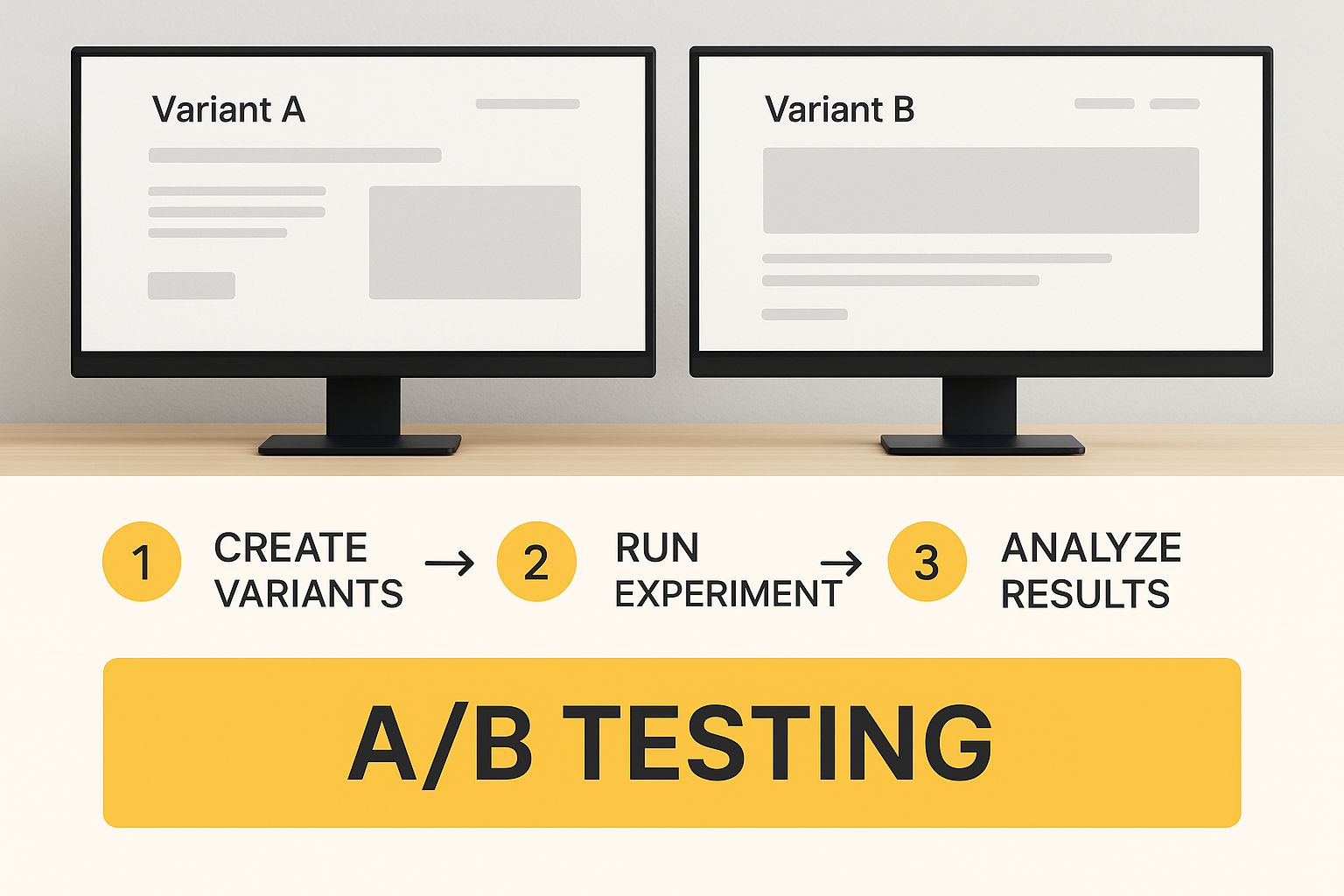
While there are more complex methods, A/B testing usually gives you the cleanest, most actionable results to work with.
Comparing Common CRO Testing Methods
To find the right approach, you need to understand the different tools in your testing toolkit. Here’s a quick breakdown of the most common methods.
| Testing Method | Best For | Complexity | Example Use Case |
|---|---|---|---|
| A/B Testing | Testing one significant change against a control. | Low | Changing the headline on a landing page. |
| Multivariate Testing | Testing multiple element changes at once to see which combination performs best. | High | Testing different headlines, images, and button colours simultaneously. |
| Split URL Testing | Testing two entirely different page designs hosted on separate URLs. | Medium | Comparing a short-form landing page against a long-form version. |
Choosing the right method depends entirely on your specific goal and the resources you have. For most, A/B testing is the perfect starting point.
Stage 4: Learning and Iteration
The final stage is all about looking at the results and figuring out what to do next. Did your new version win? Fantastic! You can confidently roll out the winning design to 100% of your audience.
But here’s the secret: a so-called "failed" test is often just as valuable. If your hypothesis was proven wrong, the data has still taught you something incredibly important about your users and what they don’t want.
This new insight feeds right back into Stage 1, creating a powerful, continuous loop of improvement. Every result—good or bad—makes you smarter and informs your next move. This is the engine that drives effective CRO.
Actionable CRO Strategies You Can Use Today

Alright, enough with the theory. Let's talk about what you can actually do. Conversion rate optimisation isn't always about massive, complicated experiments. Often, the biggest wins come from applying proven tactics that smooth out the common bumps in the user journey.
Think of these as high-impact strategies you can start working on right away. We'll break them down by the key areas of your website, giving you a practical toolkit for making changes that matter. The key is understanding why these tweaks work, not just what they are.
Optimise Your Landing Pages
Landing pages are your digital handshake. They’re often the very first thing a visitor sees, so they have to be sharp, convincing, and completely focused on one single goal. Get it wrong here, and you’ve lost a potential customer before they’ve even had a proper look around.
Start by nailing these core elements:
-
Craft a Compelling Headline: This is your big first impression. It must instantly tell the visitor, "You're in the right place." Your headline should be a perfect match for the ad or link they just clicked and shout your value from the rooftops.
-
Write a Clear Call-to-Action (CTA): Get rid of vague buttons like "Submit." Your CTA needs to be an active, benefit-driven command. Think "Get My Free Guide" or "Start My 30-Day Trial." Make sure the button’s colour and placement make it impossible to miss.
-
Leverage Social Proof: We’re hardwired to trust what others say. Adding testimonials, customer reviews, or the logos of well-known companies you've worked with is a shortcut to building credibility and easing the minds of new visitors.
Getting these fundamentals right is a massive step. To understand how CRO fits into your overall strategy, our Beginner's Guide to Digital Marketing is a great place to explore the bigger picture.
Simplify Your Forms and Checkout
Long, confusing forms are conversion killers. The same goes for a clunky checkout process. Every single field you force someone to fill out is another chance for them to get frustrated and leave. Your job is to make it ridiculously easy for them to give you their details.
Think of it this way: for every field you remove from a form, you remove another barrier. Simplicity is your most powerful tool for getting users across the finish line.
Be ruthless. Ask only for what you absolutely need right now. Can you get their phone number later? Do you really need to know their job title at this stage? Streamlining this part of the journey can have a huge impact on reducing basket abandonment and boosting your leads.
Tailor Strategies to Your Industry
It’s crucial to remember that there's no single "good" conversion rate. What's considered great in one industry might be poor in another, especially in the UK e-commerce market.
For example, B2B e-commerce sites often see an average conversion rate of around 1.8% because the buying cycle is longer and more considered. On the other hand, sectors like professional services can hit rates above 4% since the path to becoming a lead is often much shorter.
If you’re looking for a structured way to apply these tactics and make sure you haven't missed anything, this ultimate conversion optimization checklist is an excellent resource. It walks you through a step-by-step process for building a website that truly performs.
Your Top CRO Questions, Answered
As you start to get your hands dirty with conversion rate optimisation, a few questions always pop up. It's completely normal to wonder about how long things take, what a realistic budget looks like, and what "good" even means in this context. Let's clear up some of those common queries so you can move forward with confidence.
Think of this as the final piece of the puzzle, bridging the gap between theory and what actually happens on the ground. Here are the questions just about everyone asks when they first dive into CRO.
How Long Until I See Results?
The honest, if slightly frustrating, answer is: it depends. The speed at which you see results from CRO is almost entirely tied to how much traffic your website gets.
A busy e-commerce site with thousands of daily visitors might get a statistically sound test result in just a couple of weeks. On the other hand, a lower-traffic B2B site might need a couple of months to gather enough data for a single test to be conclusive.
The real trick is to stop thinking of CRO as a one-and-done fix. It's a long-term commitment to making your website better, little by little. These small, steady improvements are what compound over time to create serious growth.
What’s a Good Conversion Rate?
There’s no single magic number here. A "good" conversion rate is a moving target and changes massively depending on your industry, goals, where your traffic is coming from, and what you’re even counting as a conversion.
- A UK e-commerce shop might be happy with 2.5-3.5%.
- A B2B lead generation form could easily see rates above 5%.
- A simple newsletter sign-up could convert at 10% or even higher.
Instead of getting hung up on industry benchmarks, focus on beating your own numbers. The only measure of success that truly matters is seeing consistent, data-driven improvement over your site's past performance.
Can I Do CRO on a Tight Budget?
Absolutely. One of the biggest myths about CRO is that you need a massive budget to get started. While some of the big-name enterprise tools can be pricey, many of the most effective resources are either free or very affordable.
Google Analytics gives you a treasure trove of data for free. You can also find plenty of tools with generous free plans for heatmaps, visitor recordings, and A/B testing. Your biggest investment won't be money; it will be your time. Time spent digging into your data, getting to know your users, and testing your ideas methodically. If you focus on high-impact pages like your homepage or checkout process, you can get a great return without a big spend.
What Are the Biggest CRO Mistakes to Avoid?
Steering clear of a few common pitfalls will save you a world of pain and wasted effort. One of the biggest mistakes is testing without a proper, data-backed hypothesis—that's not optimising, it's just guessing. Another classic error is blindly copying what your competitors are doing without understanding if it's right for your audience.
A critical mistake is pulling the plug on a test too early. If you don't wait for your results to reach statistical significance, you're making decisions based on shaky data, which can be far more damaging than doing nothing at all.
Finally, don't get obsessed with tiny tweaks like button colours while ignoring glaring issues like a confusing value proposition or a clunky checkout flow. Always prioritise the tests that tackle the biggest friction points first. For instance, many businesses find the biggest advantages of email marketing come from applying CRO principles to their sign-up forms and welcome messages.
Ready to build a high-performing marketing stack? The Digital Marketing Toolbox is your go-to platform for discovering and comparing the best tools for analytics, SEO, email marketing, and more. Find the perfect solutions to drive your growth at https://grow-your-biz.com.


