
Let's be honest, "growth hacking" gets thrown around a lot. But what does it actually mean? At its core, growth hacking is a relentless, data-driven hunt for rapid and sustainable business growth. It's less a set of marketing tactics and more a mindset—a commitment to using low-cost, creative experiments to figure out the most effective ways to attract and keep customers.
Beyond The Buzzword: What Is Growth Hacking?

Here's a simple way to think about it. Imagine a traditional marketer as the captain of a cruise ship. They have a big budget, a set course, and a predictable schedule. A growth hacker, on the other hand, is skippering a speedboat. They're agile, quick, and constantly adjusting their route based on what the data tells them, all to find the fastest way to their destination. This approach swaps hefty budgets and long-planned campaigns for quick, iterative tests.
The whole point is to figure out why you're growing and then find ways to intentionally do more of it. This isn't just about getting that first click; it requires a deep understanding of the entire customer journey. While it has roots in digital marketing, growth hacking's reach is much wider, often pulling in product tweaks and even engineering solutions to fuel growth. For a solid foundation on the marketing side, our beginner's guide to digital marketing explains how these concepts fit together.
Growth Hacking vs Traditional Marketing: A Quick Comparison
To really see the difference, it helps to put the two approaches side-by-side. The table below breaks down the key distinctions in mindset, methods, and focus.
| Aspect | Traditional Marketing | Growth Hacking |
|---|---|---|
| Primary Goal | Brand awareness, lead generation | Rapid, scalable user acquisition & retention |
| Budget | Often large and pre-allocated | Lean, flexible, and tied to experiment results |
| Process | Campaign-based with long planning cycles | Continuous experimentation and iteration |
| Focus | Top of the funnel (awareness, acquisition) | The entire customer funnel |
| Metrics | Reach, impressions, brand sentiment | Conversion rates, LTV, CAC, virality |
| Team Structure | Siloed departments (marketing, sales) | Cross-functional teams (marketing, product, data) |
As you can see, the divergence is clear. Traditional marketing builds brands over time, while growth hacking is obsessed with finding scalable growth loops, fast.
A Focus On Experimentation And Data
At its heart, growth hacking is just the scientific method applied to growing a business. Every idea is treated as a hypothesis that needs to be tested, measured, and analysed. This laser focus on data strips out the guesswork, letting you quickly ditch strategies that aren't working and double down on the ones that are.
This has become absolutely vital for scaling businesses. For example, the UK's cybersecurity sector, which leans heavily on these tactics, generated £10.1 billion in revenue, partly by embracing rapid experimentation.
These days, modern growth hacking also weaves in tools like AI marketing automation to get scalable results faster than ever before. It's not about finding a single "magic bullet" but building a continuous process of improvement.
Growth hacking is not about a single trick. It’s a disciplined, data-driven process of rapid experimentation across the full customer funnel to drive scalable growth.
This mindset is built on a few core principles:
- Speed over perfection: It's better to launch a "good enough" experiment now than to wait weeks for a perfect one.
- Data-driven decisions: Every action is measured, and the results—not opinions—dictate what comes next.
- Cross-functional collaboration: The best ideas come when marketing, product, and engineering teams work together towards the same growth goals.
Where Did Growth Hacking Come From?
To really get what growth hacking is all about, we need to go back to its roots. This whole idea wasn't cooked up in some plush, corporate marketing department. Instead, it was forged in the fire of Silicon Valley startups—tiny companies with big ambitions and even smaller budgets.
For these early-stage businesses, it was a simple equation: grow fast or die. They were up against it, with immense pressure to get users on board without the luxury of a massive advertising budget. It was this constant 'make-or-break' pressure that forced them to think differently. They had to be smarter, more creative, and find unconventional ways to get noticed. This wasn't just a strategy; it was a survival tactic.
The Person Who Gave It a Name
The term “growth hacker” first popped up in 2010, thanks to a man named Sean Ellis. He’d already helped companies like Dropbox achieve incredible growth, and he realised the traditional title of 'marketer' just didn't fit what he did. His focus was laser-sharp and relentless.
"A growth hacker is a person whose true north is growth. Everything they do is scrutinised by its potential impact on scalable growth." – Sean Ellis
That quote nails it. A growth hacker isn't worried about the same things as a classic marketer. Their singular obsession is figuring out clever, repeatable ways to grow the business—and doing it at scale.
What started as a scrappy, underdog approach in the startup world quickly caught on. Bigger, more established companies started paying attention. They saw that the core principles—running fast experiments, obsessing over user behaviour, and letting data guide every decision—were incredibly powerful. The methods born out of pure necessity had just written a new rulebook for modern growth.
Navigating the AAARRR Growth Funnel
To make sense of all this data, growth hackers needed a roadmap. That map is the AAARRR growth funnel, famously nicknamed "Pirate Metrics" because of how it sounds when you say it out loud. It’s a simple, six-stage framework that traces the entire customer journey.
Think of it as a diagnostic tool for your business. Instead of viewing growth as one giant, messy challenge, the funnel lets you pinpoint exactly where you're succeeding and, crucially, where you're losing people along the way. It breaks down the user’s experience step-by-step, from the moment they first hear about you to the point where they’re happily telling their friends.
The Six Stages of the AAARRR Funnel
Getting to grips with each stage is the key to spotting opportunities for clever, high-impact experiments. Let’s unpack what each letter actually means.
-
Awareness: How are people discovering you? This isn't just about raw traffic; it’s about getting in front of the right people who are likely to become your ideal customers.
-
Acquisition: This is where a casual visitor becomes a genuine lead. They’ve taken a concrete step, like signing up for a newsletter or starting a free trial, showing they’re interested.
-
Activation: This is the "aha!" moment. It's that critical point when a new user truly experiences the core value your product offers and understands how it solves their problem.
-
Retention: Are people coming back for more? Strong retention is the bedrock of real growth. Without it, all your acquisition efforts are just pouring water into a leaky bucket.
-
Referral: Do your customers love your product enough to tell others about it? A solid referral system can become one of the most powerful and cost-effective growth engines you have.
-
Revenue: How do you actually turn user activity into money? This final stage ties all your efforts back to the bottom line, focusing on metrics like customer lifetime value (LTV) and upgrades to paid plans.
A common mistake is to obsess over Acquisition. A true growth hacking mindset means optimising every single stage of the AAARRR funnel, as a bottleneck in one area can undermine success everywhere else.
This infographic gives you a sense of where this whole mindset came from—it was born out of the pressure cooker environments of early-stage startups that needed to scale, and fast.
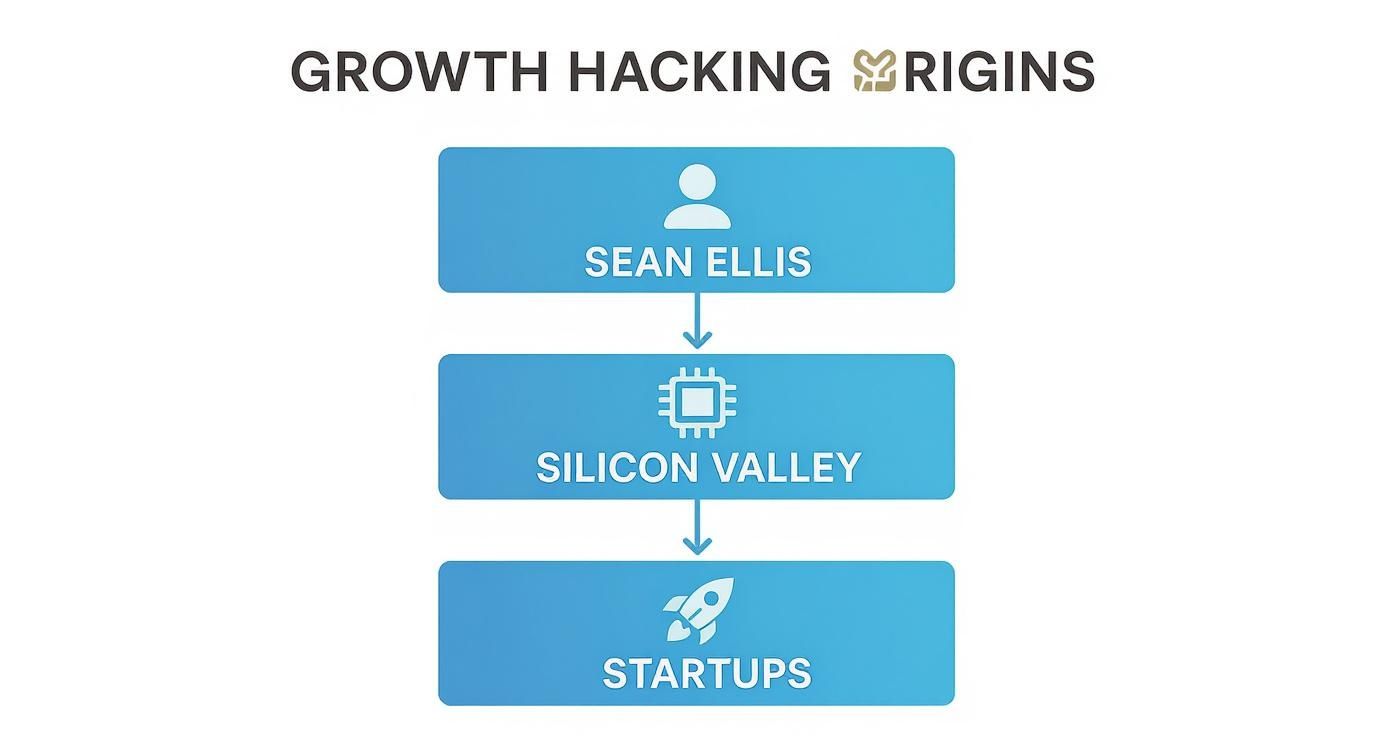
You can see a clear line from Sean Ellis's original idea, which was then battle-tested in Silicon Valley and adopted by startups that simply couldn't afford traditional marketing.
Asking the Right Questions at Each Stage
The real magic of the AAARRR framework is that it forces you to ask much better questions. Instead of setting vague goals like "we need more users," you can zero in on specific weaknesses with testable ideas.
Take the Activation stage. A weak question is, "Are people signing up?" A much better one is, "Are new users completing the key actions that help them experience our product's value in their first session?" If the answer is no, you have a clear starting point for an experiment, maybe by redesigning your onboarding or simplifying the user interface.
Or look at Retention. Instead of just trying to acquire more customers to replace the ones you're losing, you could investigate why 25% of your users churn after the first month. The framework helps turn the abstract idea of "growth" into a series of smaller, solvable puzzles.
Real-World Examples of Growth Hacking in Action
It’s one thing to talk about growth hacking in theory, but seeing it in the wild is what really makes the penny drop. The most famous growth hacking stories didn't come from huge marketing budgets; they were born from clever, scalable ideas that tapped directly into how people behave. These examples show how a data-obsessed mindset can turn a simple feature into a phenomenal growth engine.
Let's look at a few legendary growth hacks and see how they map back to the core principles we've discussed.
Dropbox: The Masterclass in Referrals
Dropbox’s early growth is the stuff of legend. Instead of funnelling money into traditional advertising, they built a brilliantly simple, two-way referral program right into the product itself. When a user invited a friend, they both received extra storage space.
This wasn't just a nice feature; it was an explosive growth mechanism.
- Acquisition & Referral: The program effectively turned their entire user base into a motivated sales team. It created a powerful viral loop where every new user had a direct incentive to bring in the next one.
- Activation: The reward—more free space—wasn't some random prize; it enhanced the core value of the product. This encouraged new sign-ups to start using the service immediately, uploading more files and getting hooked.
This single feature led to a permanent 60% increase in sign-ups and cemented the power of referral marketing in the growth hacking playbook forever.
Hotmail: The Original Viral Signature
Way before social media was a thing, Hotmail pulled off one of the first and most effective viral marketing stunts. It was incredibly simple. At the bottom of every single email sent from their platform, they added one little line: "P.S. I love you. Get your free email at Hotmail."
That signature acted as a constant, passive recommendation. Every email a user sent became a tiny, personal advert targeting a highly relevant audience—the recipient.
This tactic was a genius way to optimise the Referral part of the funnel, using their existing customers' everyday behaviour to drive new Acquisitions. The result was astonishing: Hotmail rocketed to 12 million users in just 18 months, proving that a clever, low-cost idea could completely outmanoeuvre expensive campaigns.
Airbnb: The Unofficial Craigslist Integration
In its early days, Airbnb had a classic chicken-and-egg problem. It needed properties to attract travellers, but it couldn't get property owners without a steady stream of travellers. So, they went looking for their target audience where they already were: Craigslist.
They engineered a way for people listing properties on Airbnb to cross-post their listings to Craigslist with a single click.
This wasn’t an official partnership; it was a crafty bit of code that tapped into a massive, pre-existing user base. By "piggybacking" on Craigslist's network, Airbnb put its listings right in front of millions of people who were already looking for a place to stay.
It was a masterstroke for generating Awareness and driving Acquisition.
These classic examples are still inspiring new approaches today. In the UK, for instance, businesses are applying a similar growth hacking mindset to quickly scale their cybersecurity defences and build customer trust, especially after the nation became the third most targeted for malware attacks.
To bring these ideas together, here's a quick look at some of the most famous growth hacks and what they achieved.
Iconic Growth Hacks and Their Impact
| Company | Growth Hacking Strategy | Key Metric Impact |
|---|---|---|
| Dropbox | Two-way referral programme offering free storage. | Achieved a 60% increase in permanent sign-ups. |
| Hotmail | Added a promotional signature to all outgoing user emails. | Grew from zero to 12 million users in 18 months. |
| Airbnb | Unofficial integration to cross-post listings on Craigslist. | Tapped into a huge existing market to solve the "chicken-and-egg" problem. |
| Allowed users to build their professional profile and "public resume". | Drove organic SEO traffic by creating value outside the core platform. |
Each of these examples highlights a core truth of growth hacking: the best ideas are often simple, user-focused, and baked right into the product experience. For small businesses, adopting this kind of experimental thinking is a crucial part of building an effective marketing strategy. For more on this, check out our guide on creating a marketing strategy for small business.
Essential Tools for Your Growth Hacking Stack

A growth hacker without the right tools is like a scientist without a lab. While the mindset is everything, it’s a well-chosen set of technology that turns bright ideas into measurable results. The aim isn’t to hoard every flashy new tool on the market, but to build a lean, powerful stack that supports your entire cycle of experimentation.
Think of your toolkit as having three core jobs: understanding user behaviour, testing your ideas, and gathering direct feedback. Each piece is vital for making decisions based on data, not guesswork.
Analytics and Behaviour Tracking Tools
This is your foundation. Before you can improve a single thing, you need a crystal-clear picture of what’s happening right now. These tools are your eyes and ears, showing you exactly how people interact with your website or product.
- Google Analytics: The classic starting point. It’s perfect for tracking website traffic, user demographics, and conversion goals. It answers the fundamental question: "Where are my users coming from and what are they doing?"
- Mixpanel or Amplitude: These platforms take you deeper with event-based tracking. They help you understand specific user actions inside your product, revealing which features keep them coming back and where they get stuck.
Experimentation and Testing Platforms
Once you have a hypothesis based on your data, you need a way to test it scientifically. A/B testing platforms are the real workhorses of growth hacking, letting you compare different versions of a page or feature to see which one performs best.
The experiment is the beating heart of growth hacking. Tools like Optimizely or VWO let you rapidly deploy tests on headlines, calls-to-action, or user flows, giving you clear, quantitative data on what actually drives conversions.
User Feedback and Experience Tools
Analytics data tells you what users are doing, but it rarely explains why. This is where qualitative tools come in, offering you a direct window into the user experience.
- Hotjar: A fantastic tool for generating heatmaps to see where users click, scroll maps to see how far down a page they go, and session recordings to watch their exact journey. It’s the next best thing to looking over their shoulder.
- SurveyMonkey or Typeform: Ideal for sending targeted surveys to gather direct customer feedback on their experience, needs, and pain points. Sometimes, you just need to ask.
In the UK, the need for rapid adaptation is particularly high. With nearly half of UK businesses facing a cyber attack last year, many are using a growth hacking approach to quickly test and roll out new security features and customer communication strategies. You can read more about how UK businesses are preparing for cyber threats to understand this trend better.
Building this stack allows you to create a continuous loop of learning and improvement, which is what growth hacking is all about. Another key piece of the puzzle is communication; discover more about the advantages of email marketing to see how it fits neatly into your toolkit.
Getting into the Growth Hacking Mindset
When you get right down to it, growth hacking isn't really a job title or a specific set of tools. It's a mentality. It’s a relentless way of thinking that’s built on a foundation of curiosity, data, and the core belief that there’s always a smarter way to grow.
This approach is all about speed, not perfection. Forget spending months agonising over the perfect campaign. A growth hacker would rather launch a "good enough" experiment today to get their hands on real-world data. This philosophy accepts that failure isn't just a possibility; it's a crucial part of the learning curve. Every failed test is a lesson that sharpens the next idea.
Always Be Experimenting
The absolute heart of this mindset is a deep-seated obsession with experimentation. Every single idea, whether it’s a tiny headline change or a major new product feature, is treated as a hypothesis that needs to be proven. To really get this, you have to understand the power of A/B testing and how it drives constant, small improvements.
This non-stop cycle of hypothesise, test, measure, and learn is what fuels real, sustainable progress. It demands a few key traits:
- Intense Curiosity: You have to constantly ask "what if?" and "why?" to dig up those hidden opportunities.
- Data Obsession: Decisions should be guided by cold, hard metrics—not opinions, and certainly not egos.
- Customer Focus: You need to be completely in sync with your users' needs to make sure you're solving problems they actually have.
A growth mindset means you're never really "done." Every win just sets a new baseline, and every part of the business—from marketing right through to product development—is seen as another opportunity for optimisation. Anyone can learn to think this way.
Got Questions About Growth Hacking? Let's Clear Things Up.
Even after getting the hang of the basics, a few common questions always seem to pop up when people first dive into the world of growth hacking. Let's tackle them head-on, so you can move past the theory and start putting these ideas into practice.
At its heart, remember that growth hacking is a process, not just a grab bag of tricks.
Isn't This Just a New, Trendy Name for Digital Marketing?
Not quite, though it’s easy to see why people make that connection. They often use the same channels, but their focus and scope are worlds apart.
Digital marketing typically concentrates on the top of the funnel – things like building brand awareness and generating leads. It usually operates within the clear boundaries of a marketing department.
Growth hacking, on the other hand, is completely obsessed with the entire customer journey. A growth hacker looks at everything from that first flicker of Awareness right through to the moment a customer is so thrilled they tell all their friends (Referral). It’s a team sport, pulling in people from product design, engineering, and data science to find the most direct path to sustainable growth. A growth hacker is just as likely to be redesigning the user onboarding flow as they are to be running a social media ad.
A digital marketer might ask, "How do we reach our target audience?" A growth hacker asks, "What's the single biggest roadblock to our growth right now, and what's the quickest experiment we can run to smash through it?"
Who Actually Benefits from Growth Hacking?
While the term was coined in the lean world of startups, the growth hacking mindset is incredibly valuable for almost any business that wants to scale up without breaking the bank.
- Startups and Small Businesses: When you’re running on a tight budget, this low-cost, experimental approach is a perfect match. It’s how you compete against the giants without a massive ad spend.
- SaaS Companies: The whole subscription model lives and dies by metrics like user activation and retention, which are core pillars of the AAARRR funnel.
- E-commerce Stores: Tiny, data-backed tweaks to a checkout process, a product page, or an email sequence can create huge uplifts in conversion rates.
- Established Corporations: Even large companies can inject a bit of growth hacking into their culture. It’s a great way for specific teams to innovate faster, challenge old assumptions, and find new avenues for growth.
So, What's the Very First Step?
The first step isn't to frantically search for a new tactic to try. It's much simpler: identify the one metric that matters most right now. This is often called the "One Metric That Matters" (OMTM).
Instead of trying to improve ten things at once, you rally your entire team around moving a single, critical number. For a brand-new app, that might be the percentage of users who complete a key action (Activation). Once you know your OMTM, you can start brainstorming experiments that are laser-focused on improving it. This discipline is what separates a real growth process from just throwing random ideas at the wall.
At The Digital Marketing Toolbox, we’ve put together a curated selection of tools to fuel your growth experiments, from A/B testing and analytics to email automation. Find the right solutions to build out your toolkit and start driving real, measurable results today. Explore the toolbox to get started.


