
Ever walked past two restaurants, one bustling with people and the other completely empty? Which one did you instinctively feel was the better choice? My guess is the busy one. That gut feeling is social proof in action.
It’s a simple but powerful psychological principle: when we’re unsure what to do, we look to others for clues on the right way to behave. Think of it as a mental shortcut we all use to make decisions feel safer and easier.
What Is Social Proofing?
At its heart, social proof is about building trust. When a potential customer is on the fence, they’re looking for signals that they’re making a good choice. Seeing that other people have already bought, used, and loved a product or service is a powerful form of validation.
Let’s say you’re shopping online for a new pair of headphones. You land on a product page with zero reviews or ratings. It feels a bit risky, doesn't it? Now, imagine another page for a similar pair, but this one is covered in five-star ratings, glowing testimonials, and even photos from happy customers. The decision is suddenly much clearer.
The second product has already proven its worth through the positive experiences of others. It answers the silent question in every customer's mind: "Is this a good idea?"
Why It Matters for Your Business
In a crowded market, social proof isn't just a nice-to-have marketing tactic; it's a critical tool for survival. It sends a strong signal that your business is trustworthy and that your products or services actually deliver on their promises. This is especially true for small businesses and agencies trying to build a reputation alongside bigger, more established players.
By showing genuine validation from real people, you change the conversation from "Here's what we say about ourselves" to "Here's what our customers say about us." That third-party endorsement carries far more weight than any sales copy you could ever write.
This approach gives potential customers the confidence they need in a few key ways:
- It Builds Instant Credibility: New visitors feel more comfortable trusting your brand right from the start when they see that others already do.
- It Reduces Purchase Anxiety: Buying from a new or unfamiliar business always feels like a bit of a gamble. Social proof acts as a safety net, showing that others have made the same choice and were happy with the outcome.
- It Helps People Visualise Success: Customer stories and photos allow prospects to see exactly how your product or service could fit into their own lives, making the benefits feel real and tangible.
Getting a firm grasp of what social proof is and how to use it is the first step in turning hesitant window-shoppers into confident, loyal customers.
The Five Essential Types of Social Proof
Social proof isn't a one-size-fits-all tactic; it's a whole toolkit of psychological triggers you can pull from. Just like a good mechanic knows which wrench to use for which job, a smart marketer knows which type of social proof will connect with their audience and nudge them towards a decision.
Let's break down the five most common and effective types you can start using to build that all-important credibility for your brand.
1. User Proof: Stories from Real People
This is the most authentic and relatable form of social proof. It comes straight from the horse's mouth—the customers who have actually bought and used your product or service. Think of it as the modern-day version of word-of-mouth.
When a potential buyer sees that someone just like them had a great experience, it immediately answers that nagging question in their mind: "But will this actually work for me?" User proof hits hard because it’s genuine and comes from a place of real satisfaction, not a marketing script.
- Customer Reviews and Ratings: Those little star ratings you see on product pages or Google My Business? They're instant visual shorthand for quality. In fact, nearly 70% of online shoppers read between one and six reviews before they even think about buying.
- Testimonials: These are the hand-picked, glowing quotes from your happiest customers. They work wonders on homepages and sales pages to build trust right from the get-go.
- User-Generated Content (UGC): Nothing beats seeing a real person using your product in the wild. Photos, videos, or social media posts from your customers are pure gold. For a deep dive into putting customer voices to work, check out these brilliant strategies for user-generated content campaigns.
2. Wisdom of the Crowd: The Power of Numbers
This one taps into a fundamental human instinct: we're drawn to what's popular. If a massive crowd is doing something, we naturally assume it must be the right, safe, or smart thing to do.
Showing off large numbers—like customer counts, downloads, or social media followers—signals that your brand is a popular and established choice. It calms the nerves of new customers by reducing the risk they feel. It’s the digital version of picking the busy restaurant over the empty one.
A large following or high user count acts as a powerful signal of trust. It tells newcomers, "Many people have chosen us, and you can feel confident doing the same."
This simple idea—that seeing others take action makes us feel safer—is at the heart of why social proof works. It builds credibility, eases anxiety, and ultimately, helps people feel good about their decision.
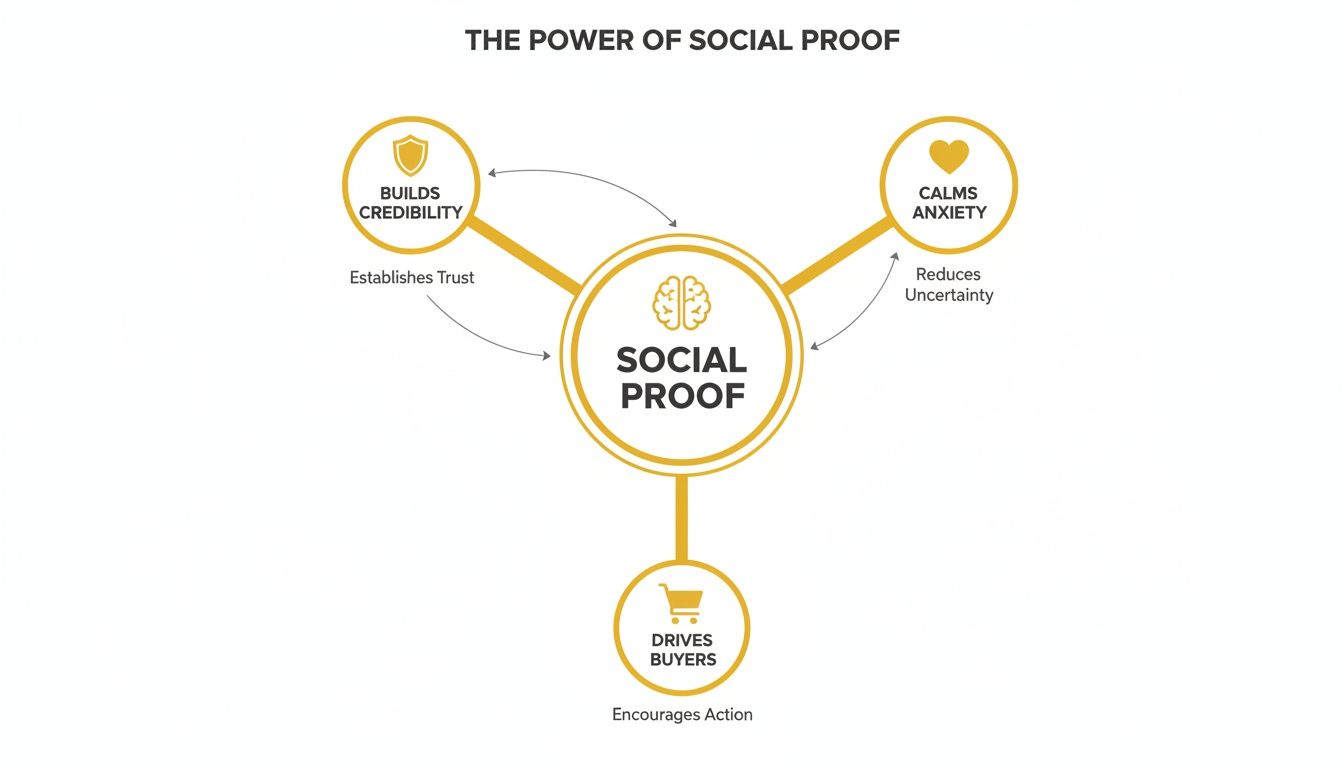
As you can see, it's a powerful trio of psychological benefits that makes a customer's journey feel much more reassuring.
3. Expert Proof: The Stamp of Approval
When a respected expert or an authoritative figure in your industry gives you the nod, their credibility instantly rubs off on your brand. It's like getting a seal of approval from someone whose opinion carries serious weight.
Expert proof is a fantastic shortcut. Instead of building trust from scratch, you're borrowing it from someone who has already earned it.
- Certifications and Badges: Displaying industry-recognised certifications or security badges is a quick way to show you meet a high standard of quality or safety.
- Expert Endorsements: A punchy quote from a well-known industry leader can be an incredibly powerful feature on your website.
- Media Mentions: Getting featured in a reputable publication or blog isn't just great for PR; it acts as a strong third-party endorsement that you know your stuff.
4. Celebrity Proof: Borrowing the Spotlight
This is all about using the status of a celebrity or a well-known influencer to endorse a product. It can be incredibly effective, but the key is finding someone whose personal brand aligns with yours and who genuinely connects with your target audience.
In the B2B world, a "celebrity" might not be a movie star. It could be a highly respected industry analyst or a thought leader with a massive following on LinkedIn. Their recommendation can open doors and introduce your brand to a very relevant, engaged audience.
5. Wisdom of Friends: The Ultimate Trust Signal
This is arguably the most powerful type of social proof out there. A direct recommendation from a friend, colleague, or family member often means more than any polished ad campaign ever could. We inherently trust the people in our inner circle.
This is the engine that drives referral programmes and encourages organic sharing on social media. It taps directly into our closest relationships, making it exceptionally persuasive. To understand more about how happy customers can become your best marketers, take a look at our guide on what is user-generated content.
Choosing the Right Social Proof for Your Business
With so many options, how do you know where to start? Not every type of social proof is a perfect fit for every business or every goal. This table breaks down which types tend to work best in different scenarios to help you make the right choice.
| Type of Social Proof | Best For | Example Use Case | Tool From The Toolbox |
|---|---|---|---|
| User Proof | E-commerce, SaaS, local services—any business with a customer base. | Displaying star ratings and reviews on product pages to increase add-to-cart rates. | Trustpilot |
| Wisdom of the Crowd | SaaS platforms, mobile apps, and online communities. | Showing a “25,000+ businesses use our software” banner on the homepage to build credibility. | Proof |
| Expert Proof | B2B services, tech companies, and health & wellness brands. | Featuring a quote from an industry analyst on a landing page to boost lead generation. | HARO |
| Celebrity Proof | Consumer brands (B2C), fashion, and lifestyle products. | Partnering with a fitness influencer on Instagram to promote a new line of activewear. | Upfluence |
| Wisdom of Friends | Subscription services, B2C products, and apps with network effects. | Creating a referral programme that gives both the referrer and the new customer a discount. | ReferralCandy |
Ultimately, the best approach is often a mix. Combining a few different types of social proof across your website and marketing materials creates a much more compelling and trustworthy brand image.
How Social Proof Drives Conversions and Builds Trust
Knowing the different flavours of social proof is a great start, but the real magic happens when you see how they directly help your business grow. Social proof isn't just a fluffy marketing concept; it's a core part of conversion rate optimisation (CRO) that genuinely drives sales and keeps customers coming back. At its heart, it works by calming the natural worries and doubts people have before they decide to buy something.
Think about it. Every time someone lands on your website, they’re asking themselves, "Is this company legitimate? Can I trust them?" Social proof gives them a clear, independent answer. When they see real reviews, a running tally of happy customers, or a stamp of approval from an expert, it sends a powerful signal that they're making a good decision. This simple reassurance is a game-changer, especially at that critical moment when they’re about to click "buy now".
The Direct Link to More Sales
The connection between social proof and better conversion rates is undeniable. For instance, putting well-known security badges like McAfee or Norton on your checkout page is a form of expert proof. It’s a small visual hint, but it can dramatically lower cart abandonment because it tells shoppers their payment details are safe.
Authentic customer reviews are another powerful sales tool. A product page with a handful of genuine four and five-star reviews will always feel more compelling than one with none. This user-generated content often hits home harder than slick advertising because it feels real and unfiltered. A customer’s blurry phone picture of your product in action can build more trust than a perfect studio photograph ever could.
This is especially true in the world of social commerce. In the UK, a staggering 93% of social media buyers have bought something through platforms like Facebook or Instagram. All those likes, shares, and comments act as public endorsements that encourage others to buy. If you’re interested in diving deeper into this trend, you can read the full research on social commerce to see how it’s shaping the UK market.
Building a Bedrock of Trust
Beyond just getting that initial sale, social proof builds the long-term trust that creates loyal customers and brand advocates. Every positive review, detailed case study, and happy social media tag is another brick in your brand's reputation. Over time, this accumulated trust becomes one of your most valuable assets.
When customers see that other people have had a great experience, it doesn't just convince them to make a one-off purchase. It makes them feel like they're joining a community, which is the key to building a loyal following that returns time and time again.
This trust-building is a continuous cycle that fuels sustainable growth. By consistently highlighting the great experiences of your current customers, you create a powerful feedback loop. New customers are attracted by the proof, they have a positive experience themselves, and then they add their own voice to the chorus, making your brand even stronger.
For more hands-on tips, have a look at our guide on how to increase website conversions with proven strategies.
Putting Social Proof Into Action on Your Website

Knowing what social proof is is one thing, but making it work for you is where the magic really happens. Weaving these psychological triggers into your website doesn't have to be complicated. The secret is placing the right kind of proof at the right time in your customer's journey, building their confidence just when they need it most.
Think about your most important pages. Your homepage needs to build trust instantly, making it a prime spot for a "Trusted By" logo bar with recognisable clients or media features. Product pages, on the other hand, are all about validation. This is where user-generated proof, like star ratings and customer reviews, shines when placed right under the product description.
This kind of smart placement anticipates a visitor's hesitations. Seeing a bunch of five-star reviews next to the "Add to Basket" button helps quiet those last-minute doubts and makes them feel good about their choice, pushing them over the finish line.
High-Impact Placement Strategies
Great social proofing is all about timing and subtlety. You're aiming to reassure visitors, not shout at them. One of the biggest mistakes I see is businesses burying all their glowing testimonials on a single page that nobody ever clicks on. A much better approach is to sprinkle them throughout your site where they’ll actually make a difference.
Here are a few high-value spots to get you started:
- Checkout Pages: This is where buyer's remorse can kick in. A short, punchy testimonial or a security badge right on the payment page can be the final nudge someone needs to pull out their card.
- Landing Pages: If you're a service business, a specific, results-driven quote from a delighted client can do wonders for your lead generation.
- Pop-up Notifications: You’ve seen them: those little alerts saying, "Jane from London just purchased this!" They create a real sense of buzz and popularity, showing your site is active and trusted by others right now.
The best social proof feels like a helpful tip from a friend, not a hard sell from a business. It should pop up naturally at the very moment a customer is looking for that little bit of reassurance, making their decision feel easier and safer.
By slotting your proof into these critical decision-making moments, you turn it from a static page element into a powerful conversion tool.
Crafting Compelling Narratives
Don't just stop at reviews. Case studies give you the space to tell a full story of how you solve real problems for real people. A brilliant case study isn't a dry, technical report; it's a success story. Just follow a simple structure: start with the client's problem, walk through the solution you delivered, and—most importantly—showcase the tangible results with hard data.
To give them that extra punch, weave in direct quotes from the client. This adds a human voice and a layer of authenticity that you just can't fake. There are lots of ways to gather this kind of feedback, including strategies like product seeding, where you gift your product to key people to get their honest thoughts and content.
Finally, remember that social proof has a shelf life. Your strategy should always involve collecting and refreshing your content. A review from last week is far more convincing than a testimonial from five years ago. To learn more about keeping your customer feedback current and visible, check out our guide on adding a Google reviews widget to your site.
Learning From Brands That Master Social Proof
Theory is one thing, but seeing social proof in action is the best way to truly grasp its power. Let's move beyond the definitions and look at how smart brands, from huge corporations to solo entrepreneurs, weave these psychological triggers into their websites to build trust and drive sales.
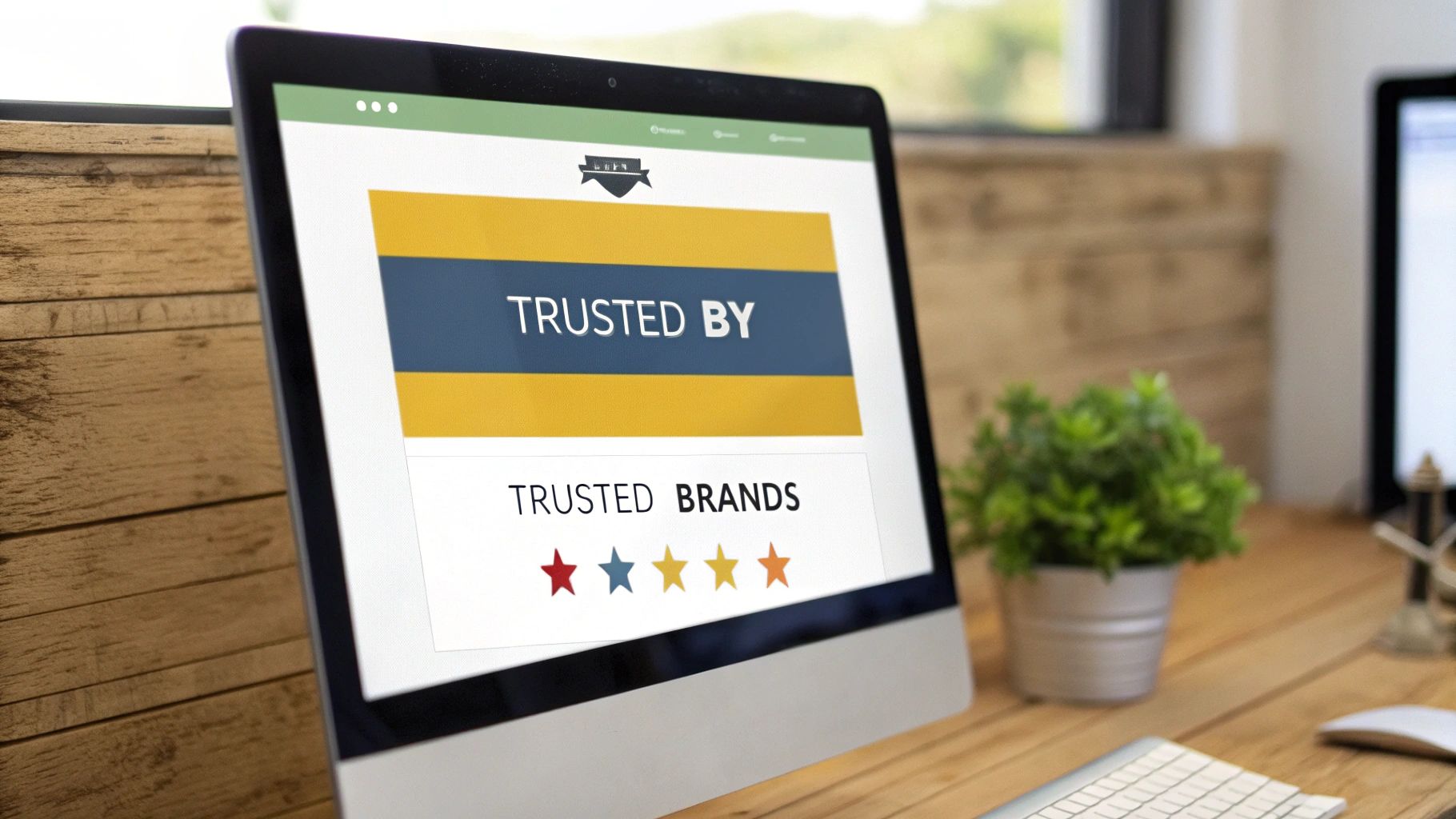
By breaking down their strategies, you can pick up proven ideas and adapt them for your own business, regardless of your industry or size. Think of these examples as a practical blueprint for turning hesitant visitors into confident customers.
The SaaS Credibility Play
Software companies have absolutely perfected the "Trusted By" logo bar. You’ve seen it a thousand times: a clean strip of recognisable client logos sitting right below the main headline on a homepage. This is a masterclass in using Expert Proof and the Wisdom of the Crowd.
- Why It Works: It sends an immediate, powerful signal to new visitors that well-known, successful companies are already paying for and using this product.
- The Psychology: This instantly lowers a potential buyer's guard. Their internal monologue shifts from "Can I trust this?" to "Well, if it's good enough for those big names, it's probably a safe bet for me." It’s a brilliant way to borrow credibility and establish authority in a matter of seconds.
The E-commerce Nudge
For an online shop, user reviews are the lifeblood of the business. A smart e-commerce brand will strategically place star ratings right under a product’s name and price. This is User Proof in its purest form, and its placement is key to nudging customers toward a decision.
When you see a product with 4.8 stars from 1,200 reviews, you get instant validation. It's a visual shortcut that screams "lots of people buy this, and they love it," which makes clicking that "Add to Basket" button feel like a much smaller risk.
The Creator's Authority Signal
If you're a consultant, coach, or content creator, your numbers are your authority. Displaying a bold "Join 50,000+ subscribers" on a newsletter sign-up form is a fantastic use of the Wisdom of the Crowd.
This simple line does so much work. It tells visitors they aren’t just signing up for emails; they’re joining an established, thriving community. It makes them feel like they're making a smart, popular choice instead of taking a chance on an unknown voice. Each of these examples shows how a specific type of social proof, placed thoughtfully, can directly influence a customer’s behaviour.
Frequently Asked Questions About Social Proof
As you start weaving social proof into your marketing, some practical questions will almost certainly pop up. Getting to grips with the finer points can help you steer clear of common pitfalls and make this psychological tool work much harder for you. Let's tackle some of the queries we hear most often.
Can Social Proof Ever Backfire?
Yes, absolutely. This is what's known as negative social proof, and it’s what happens when you accidentally draw attention to a lack of activity. For instance, a blog post with a "0 comments" counter or a product page proudly showing "0 reviews" doesn't just look empty—it actively signals unpopularity, which can scare off potential customers.
In these cases, it’s far better to show no proof at all than to display numbers that work against you. The aim is to showcase positive engagement. If the numbers aren't there yet, simply focus on other types of proof until they are.
How Can a Brand New Business Use Social Proof?
This is a classic chicken-and-egg problem for new businesses, but you're not stuck. A great place to start is with Expert Proof. This could be anything from earning an industry certification to getting a supportive quote from a respected mentor or featuring an endorsement from an expert in your field.
Another smart move is to offer your product or service to a small group of beta testers in exchange for their honest testimonials. You can also tap into the "Wisdom of the Crowd" on a smaller scale by celebrating early milestones, like "Join our first 50 subscribers!"
Social proof isn't just a game for established brands. For new businesses, it's about strategically borrowing credibility and celebrating small wins to build momentum. That initial trust is what turns curious visitors into your very first paying customers.
What's the Difference Between Social Proof and a Testimonial?
This is a really common point of confusion, but it’s quite simple when you break it down. Think of social proof as the overarching strategy, and a testimonial as just one of the tools in your toolbox to achieve it. Social proof is the broad psychological idea that people copy the actions of others to make the "right" decision.
A testimonial, on the other hand, is a specific tactic that falls under the umbrella of "User Proof." It sits alongside other tactics like star ratings, in-depth case studies, and social media shout-outs—all of which show that real people trust and get value from your brand.
How Quickly Do I Need to Respond on Social Media?
In today's always-on world, speed is everything. Your response time is a powerful, and often overlooked, form of social proof. In the UK, a quick reply shows you value your customers' time. In fact, some data shows that 73% of social users will switch to a competitor if a brand doesn't get back to them promptly. You can dig into more of these insights in Sprout Social's 2025 UK report.
Using tools like simple AI chatbots can be a brilliant way to manage expectations, instantly acknowledge messages, and show your brand is attentive and reliable around the clock.
Ready to put these powerful strategies into action? The Digital Marketing Toolbox offers a curated selection of tools, from review widgets to AI chatbots, designed to help you build trust and drive conversions. Explore the best solutions for your business at https://grow-your-biz.com.


