
Let's be honest, trying to market to "everyone" is like shouting into a hurricane and hoping someone hears you. Customer segmentation is the art and science of turning that shout into a meaningful conversation. It's the process of dividing your broad customer base into smaller, more manageable groups based on shared traits.
Think of it like this: you wouldn't recommend the same holiday to a thrill-seeking backpacker and a family with young children, would you? Of course not. Segmentation applies that same common sense to your business, recognising that your audience isn't a single, uniform blob but a collection of distinct groups with different needs, motivations, and behaviours.
What Is Customer Segmentation Anyway?
Let's strip away the business-speak. Imagine you run an online clothing shop. You’ll quickly spot different types of shoppers. You’ve got the bargain hunters who only visit during a sale, the trendsetters who snap up the latest arrivals at full price, and the loyalists who repeatedly buy your classic, staple items.
If you sent out a blanket "50% Off Everything!" email, you’d certainly catch the bargain hunters' attention. But the trendsetters might ignore it, assuming it's all last season's stock. The loyalists might even be a bit put off, wondering why the T-shirt they just bought at full price is now half off. That's where segmentation comes in – it’s simply about recognising these different groups and speaking to them in a way that makes sense to them.
Moving Beyond One-Size-Fits-All Marketing
The whole point is to ditch the generic, one-size-fits-all mindset. Instead of crafting a single message and crossing your fingers, you create specific, relevant communications for each group. This isn’t about putting people in boxes; it’s about understanding them well enough to serve them better.
This shift isn't just a "nice to have" anymore; it's central to modern business strategy. Recent findings show that 42% of businesses see reaching new customer segments as a top priority for the year. That puts it right up there with building brand awareness, proving that segmentation is now a fundamental goal for anyone serious about growth.
To give you a clear, bird's-eye view, here's a quick summary of what we're talking about.
Customer Segmentation at a Glance
| Concept | Primary Goal | Key Benefit |
|---|---|---|
| Grouping Customers | To divide a broad audience into smaller groups with shared characteristics. | Creates a more organised and understandable view of your customer base. |
| Personalised Messaging | To craft marketing messages and offers that resonate with each specific group. | Significantly increases engagement, relevance, and conversion rates. |
| Improved Experience | To deliver products, services, and support that align with each segment's needs. | Boosts customer satisfaction, fosters loyalty, and reduces churn. |
Ultimately, a well-executed segmentation strategy leads to smarter decisions and a stronger business.
Customer segmentation helps you find the right people, with the right message, at exactly the right time. It turns your marketing from a generic announcement into a personal conversation.
The Immediate Wins of Segmentation
When you truly get a handle on your customer groups, you can deliver more personalised experiences without having to do everything manually. This translates into some very real and immediate benefits. For a deeper dive into how this plays out in the real world, check out a practical guide to customer segmentation in e-commerce.
In a nutshell, segmentation leads directly to:
- Smarter Campaigns: Your marketing budget goes further because you’re focusing your spend on the people most likely to respond. No more wasted ad spend.
- Happier Customers: People feel seen and understood when they receive relevant offers. This connection is what builds genuine, long-term loyalty.
- Better Business Results: When your campaigns perform better and your customers stick around longer, the impact on your revenue and bottom line is undeniable.
Why Segmentation Is Your Marketing Superpower
Knowing what customer segmentation is is one thing, but the real magic happens when you see what it can actually do. Shifting from a one-size-fits-all approach to a segmented strategy is like swapping a blurry, black-and-white telly for a vibrant 4K screen. Suddenly, everything snaps into focus, revealing details you never knew were there.
Segmentation stops you from making hopeful guesses and transforms your marketing into a precise, targeted operation. It allows you to speak directly to the unique needs and desires of specific groups, creating genuine conversations that resonate instead of generic messages that just get ignored. This direct line into your customer's world is where the real power lies.
Drive Conversions with Relevant Messaging
When a marketing message feels like it was written just for you, it grabs your attention. It's not just a nice-to-have, either; research shows that people now expect tailored experiences. In fact, a whopping 65% of consumers expect businesses to use the data they have to provide clear, actionable insights. Segmentation is the engine that makes this happen.
Think about a fitness apparel brand. Instead of a generic "New Gear In!" email blast, they could send:
- A message to marathon runners highlighting new long-distance running shoes.
- A notification to yoga enthusiasts about a new line of flexible, breathable leggings.
- A special offer to recent buyers of weightlifting gloves for new protein shakers.
Each message is spot-on for the recipient's known interests, making them far more likely to click through and ultimately buy. This is the precision that turns a passive audience into active, engaged customers.
Optimise Your Marketing Budget
Every business wants to get the most out of its marketing spend. Without segmentation, you're inevitably wasting money advertising to people who have little to no interest in what you're selling. It’s like paying for a massive billboard in a town where none of your ideal customers even live.
Segmentation lets you focus your resources with surgical precision. Once you've identified your most profitable customer groups—the ones who buy often, spend more, and stay loyal—you can dedicate your budget to attracting and keeping more people just like them. This means your advertising spend works harder, generating a much healthier return on investment and cutting out the wasteful expenditure on irrelevant audiences.
By focusing on the right customers, you stop shouting into the void and start investing in conversations that lead to growth. It's the difference between casting a wide, expensive net and using a perfectly baited line.
Cultivate Deeper Customer Loyalty
Loyalty isn't built on transactions. It's built on relationships and a feeling of being understood. When customers feel that a brand "gets" them, they're far more likely to stick around. Segmentation is a brilliant tool for building these strong connections.
By understanding the unique challenges and goals of different segments, you can offer solutions that genuinely help. This could mean creating targeted educational content, developing new product features that solve a specific problem for a key group, or even offering proactive customer support.
This level of personalised attention shows you value your customers as individuals, not just as numbers on a spreadsheet. And satisfied customers who feel understood don't just come back for more; they become powerful advocates for your brand, driving growth through priceless word-of-mouth recommendations.
The Four Lenses of Customer Segmentation
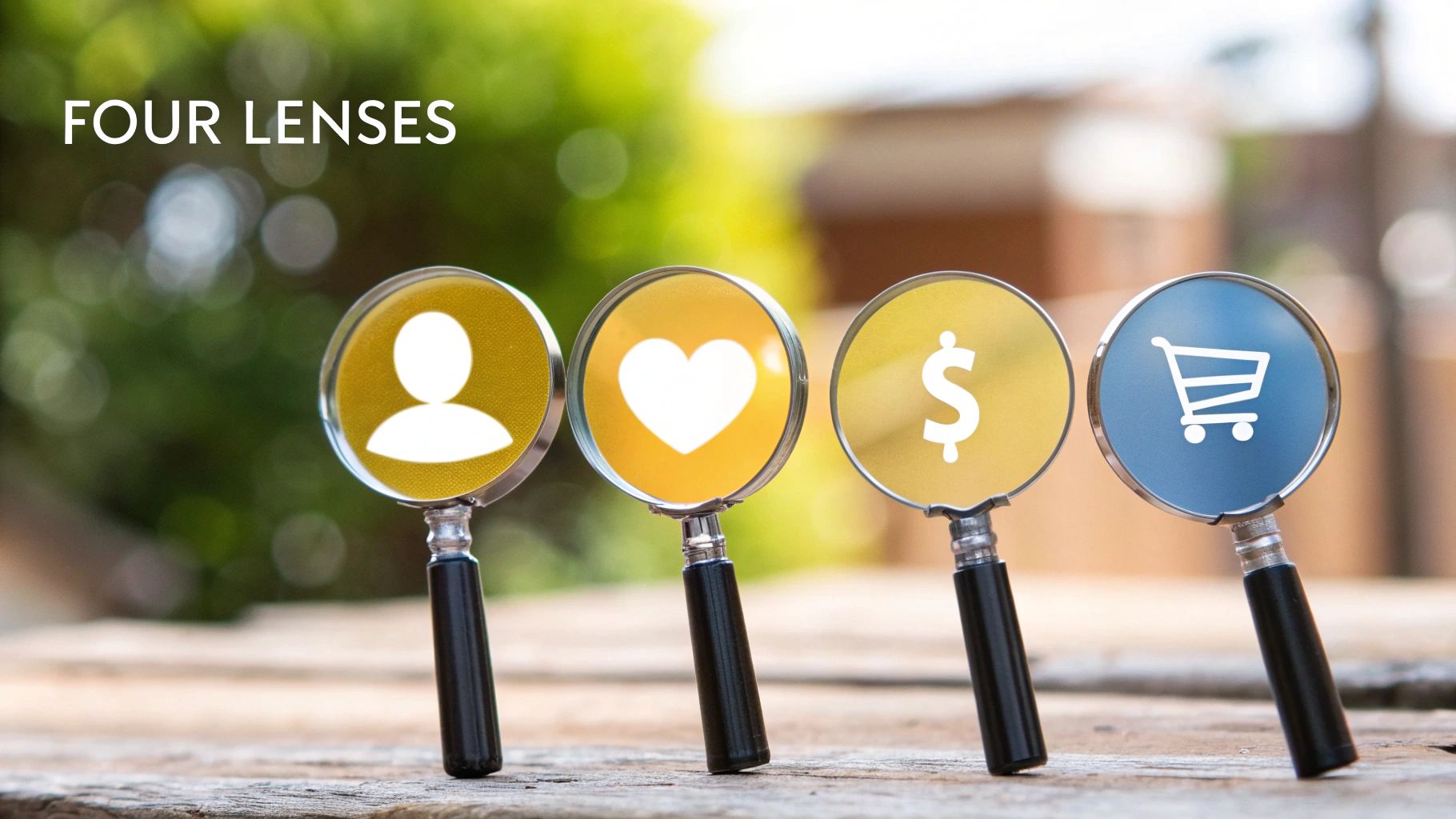
So, you know what customer segmentation is, but how do you actually start doing it? A great way to begin is by looking at your audience through four different "lenses."
Each one—Demographic, Geographic, Psychographic, and Behavioural—gives you a unique perspective. On their own, they’re useful. But when you combine them, you start to build a much richer, more complete picture of who your customers are and what makes them tick.
Let's break down these four fundamental approaches.
Demographic Segmentation: The "Who"
This is often the first stop on the segmentation journey because it’s the most straightforward. Demographic segmentation sorts people using objective, statistical data. It’s all about answering the basic question: Who is actually buying from me?
These are the clear, factual details you can usually gather quite easily. Think of things like:
- Age: Are you talking to Gen Z, Millennials, or Baby Boomers?
- Gender: Does your product naturally appeal to men, women, or is it universal?
- Income: Are your customers high-earners, budget-conscious, or somewhere in the middle?
- Education Level: Did they finish secondary school, or do they hold postgraduate degrees?
- Occupation: Are they students, creatives, healthcare workers, or enjoying retirement?
A classic example is a luxury car brand, which would obviously focus on a segment of higher-income individuals, likely over 30 years old. Demographics provide a solid foundation, but they don't give you the full picture.
Geographic Segmentation: The "Where"
Geographic segmentation groups customers based on their physical location, answering the question: Where are they? This might seem simple, but a customer's needs can shift dramatically depending on where they live.
The scope here can be as broad or as specific as you need:
- Country, Region, or City: Selling winter coats in Manchester is a very different game to selling them in Madrid.
- Climate: A company selling garden furniture will naturally target sunnier regions, especially as spring approaches.
- Population Density: Urban dwellers might need compact, space-saving products, whereas rural customers often have entirely different priorities.
For instance, a fast-food chain might push its spicier menu items more heavily in regions known for a love of fiery food. This kind of localisation makes marketing feel much more relevant.
Psychographic Segmentation: The "Why"
Now we get to the interesting part. Psychographics move beyond the "who" and "where" to explore the much deeper question: Why do they buy? This lens groups people based on their internal traits—their beliefs, values, and motivations.
Psychographics are what give your customer persona a personality. It’s the difference between knowing someone is a 35-year-old manager (demographic) and knowing they value sustainability, practise yoga, and would rather spend money on experiences than possessions (psychographic).
You’re looking for attributes like:
- Lifestyle: Are they urban adventurers, homebodies, or fitness fanatics?
- Values and Beliefs: Do they prioritise eco-friendliness, family, or personal achievement?
- Interests and Hobbies: What do they love doing? Are they into gaming, gardening, or gourmet cooking?
- Personality Traits: Are they outgoing and spontaneous, or cautious and analytical?
An outdoor gear company, for example, wouldn't just target an age group; they'd target a psychographic segment of "Thrill-Seeking Explorers" who value adventure and durability, no matter their income.
Behavioural Segmentation: The "How"
Finally, we have what is arguably the most powerful lens for marketing: behavioural segmentation. This approach groups customers based on their direct actions and interactions with your brand. It answers the critical question: How do they behave as customers?
Because it’s based on actual, concrete actions, this data is incredibly good at predicting future behaviour. For example, recent UK consumer reports from sources like McKinsey show that Gen Z consumers consistently pay more for convenience services like food delivery. This kind of insight allows brands to shape their offers and messaging for maximum impact.
Common behavioural data points include:
- Purchase History: What have they bought, when, and how often?
- Spending Habits: Are they frequent, low-value buyers or occasional big spenders?
- Brand Interactions: Do they open every email, browse your site weekly, or use your app daily?
- Loyalty Status: Are they a brand new customer, a loyal advocate, or someone who hasn't purchased in a while?
Understanding these actions helps you pinpoint your most valuable customers. If you want to dive deeper into this, check out our guide on using a lifetime value of a customer calculator. A software company, for instance, could create a segment of "Power Users" who use advanced features and send them exclusive tips to enhance their experience, building even greater loyalty.
To help you keep these models straight, here’s a quick-glance table comparing what each one tells you and how it's typically used.
Comparing Customer Segmentation Models
| Segmentation Type | What It Tells You | Common Use Case Example |
|---|---|---|
| Demographic | Who your customers are based on objective facts (age, income). | A fashion brand targeting their new clothing line at women aged 18-24. |
| Geographic | Where your customers are located (city, climate, region). | A surf shop running targeted ads in coastal towns with warm climates. |
| Psychographic | Why your customers buy, based on their values and lifestyle. | An organic food company marketing to health-conscious consumers who value sustainability. |
| Behavioural | How your customers interact with your brand (purchase history, loyalty). | An e-commerce site sending a special discount to customers who haven't purchased in 90 days. |
Each of these lenses provides a different but crucial piece of the puzzle. The real magic happens when you start layering them together to see your audience with true clarity.
Unlocking Deeper Insights with Advanced Segmentation
Once you've got a solid handle on the four core types of segmentation, it's time to explore the more powerful methods. This is where top marketers really earn their stripes, moving beyond simple categories to understand customer behaviour on a much deeper, more insightful level.
These advanced techniques group customers using complex business data, actual buying habits, and sometimes, patterns you didn't even know existed. Let's dig into three game-changing approaches: firmographic, RFM analysis, and AI-powered segmentation.
Firmographic Segmentation for B2B Targeting
If your customers are other businesses, firmographic segmentation is your secret weapon. Think of it as demographics, but for companies. Instead of looking at individual people, you're profiling entire organisations to find your ideal clients.
It's all about creating a blueprint of the perfect company you want to sell to. The most common firmographic variables include:
- Industry: Are you selling to tech start-ups, construction firms, or healthcare providers?
- Company Size: Do you work best with small local businesses or large multinational corporations? This is often measured by employee headcount.
- Annual Revenue: Targeting companies with over £10 million in revenue needs a very different approach than targeting those with less than £100,000.
- Location: Just like geographic segmentation, this could be based on a city, region, or country.
For instance, a software company selling payroll solutions might zero in on UK-based tech firms with 50-250 employees. This kind of precision makes sure their sales and marketing efforts aren't wasted on businesses that just aren't the right fit.
Identifying Your Best Customers with RFM Analysis
One of the most practical ways to segment customers is by their direct value to your business. That's where RFM analysis shines. It’s a brilliantly simple model that scores customers based on three key actions:
- Recency (R): How recently did they buy from you? A customer who bought last week is a much hotter prospect than someone who hasn't been back in a year.
- Frequency (F): How often do they come back to purchase? Someone who buys every month is far more valuable than a one-off buyer.
- Monetary (M): How much have they spent in total? High spenders are the lifeblood of your business.
By scoring every customer on these three factors, you can quickly spot your most valuable segments. You'll find your "Champions" (high R, F, and M) who buy often and spend a lot, but you'll also identify your "At-Risk" customers (low R, but previously high F and M), who used to be great but are now slipping away.
RFM analysis cuts through the noise to answer a critical question: Who are my best customers, right now? It shifts the focus from who customers are to how they act, enabling highly targeted retention and VIP campaigns.
This gives you a clear playbook. Your Champions might get an exclusive early-access offer, while your At-Risk group could receive a friendly "We Miss You" discount to tempt them back.
Uncovering Hidden Patterns with AI and Machine Learning
This is the real frontier of customer segmentation. While the other methods rely on you to define the segments, AI and machine learning can analyse massive amounts of data to find meaningful patterns and groups you would never spot on your own.
This is often done through something called clustering analysis. The algorithm sifts through all your customer data—every purchase, website click, and email open—and automatically groups people with similar behaviours. The result? Surprising and often highly profitable niche segments you never knew you had. You can see how this works in practice by reading our guide on using predictive analytics for marketing.
Modern segmentation has come a long way from simple demographics. Today's advanced models can incorporate hundreds of variables, from financial behaviour to channel usage and life-stage indicators. The Fair4All Finance model, for example, uses CACI's datasets to classify the UK population into 130 micro-segments, showing just how deep you need to go to truly understand customers. You can learn more about this sophisticated segmentation model and its applications.
By bringing these advanced methods into your strategy, you can develop a far more sophisticated understanding of your customers and, more importantly, put that knowledge to work to drive real business growth.
Your Step-By-Step Segmentation Action Plan
Knowing the theory is one thing, but turning that knowledge into real-world results is another. So, how do you actually do segmentation? This section breaks it down into a practical, five-step roadmap that takes you from a blank slate to a fully working strategy. Think of it as your blueprint for turning raw data into marketing that genuinely connects.
Step 1: Set Clear and Specific Goals
Before you dive into spreadsheets and analytics, you need to know what you're trying to achieve. Without a clear objective, segmentation is just an interesting academic exercise. Ask yourself: what problem am I trying to solve, or what opportunity am I trying to grab?
Your goals need to be specific and measurable. A vague goal like "improve marketing" won't cut it. Instead, aim for something concrete like:
- Increase repeat purchases from first-time buyers by 15% in the next quarter.
- Reduce churn within our "At-Risk" customer segment by 10% over six months.
- Boost the conversion rate for a new product line by tailoring promotions to high-affinity segments.
Having a defined target gives every other step a purpose and makes it far easier to measure your return on investment down the line.
Step 2: Gather and Consolidate Your Data
With your goals set, it’s time to collect the raw materials: your customer data. The aim here is to build a single, unified view of your customers by pulling information from every place they interact with your brand.
Don't just stick to one source. The richest insights come from blending different types of information.
- Customer Relationship Management (CRM) Systems: This is your goldmine for purchase history, contact details, and notes from direct interactions.
- Website and App Analytics: Tools like Google Analytics reveal what people actually do—which pages they visit, how long they stick around, and the actions they take.
- Customer Surveys and Feedback: Just ask! This is the most direct way to get psychographic data on your customers' preferences, challenges, and motivations.
- Social Media Insights: Analyse follower demographics and engagement patterns to get a feel for their interests and online habits.
The more complete your dataset, the more accurate and powerful your segments will be.
Step 3: Analyse Data and Identify Key Segments
Now for the fun part: the analysis. It's time to sift through all that data to find meaningful patterns and natural groupings. You're looking for common threads that tie customers together, whether it’s shared behaviours, demographics, or needs.
This is where you can start applying the models we’ve talked about. A great starting point is to identify your most valuable customers using RFM analysis (Recency, Frequency, Monetary). From there, you could layer on demographic data to see if your biggest spenders fall into a particular age group or live in a specific area.
The goal isn't to create dozens of tiny, unmanageable groups. Start by identifying three to five core segments that are distinct, substantial, and actually relevant to your goals. For instance, you might end up with "High-Value Loyalists," "Budget-Conscious Newcomers," and "Inactive Past Buyers."
This infographic illustrates a typical workflow for applying more advanced segmentation models.
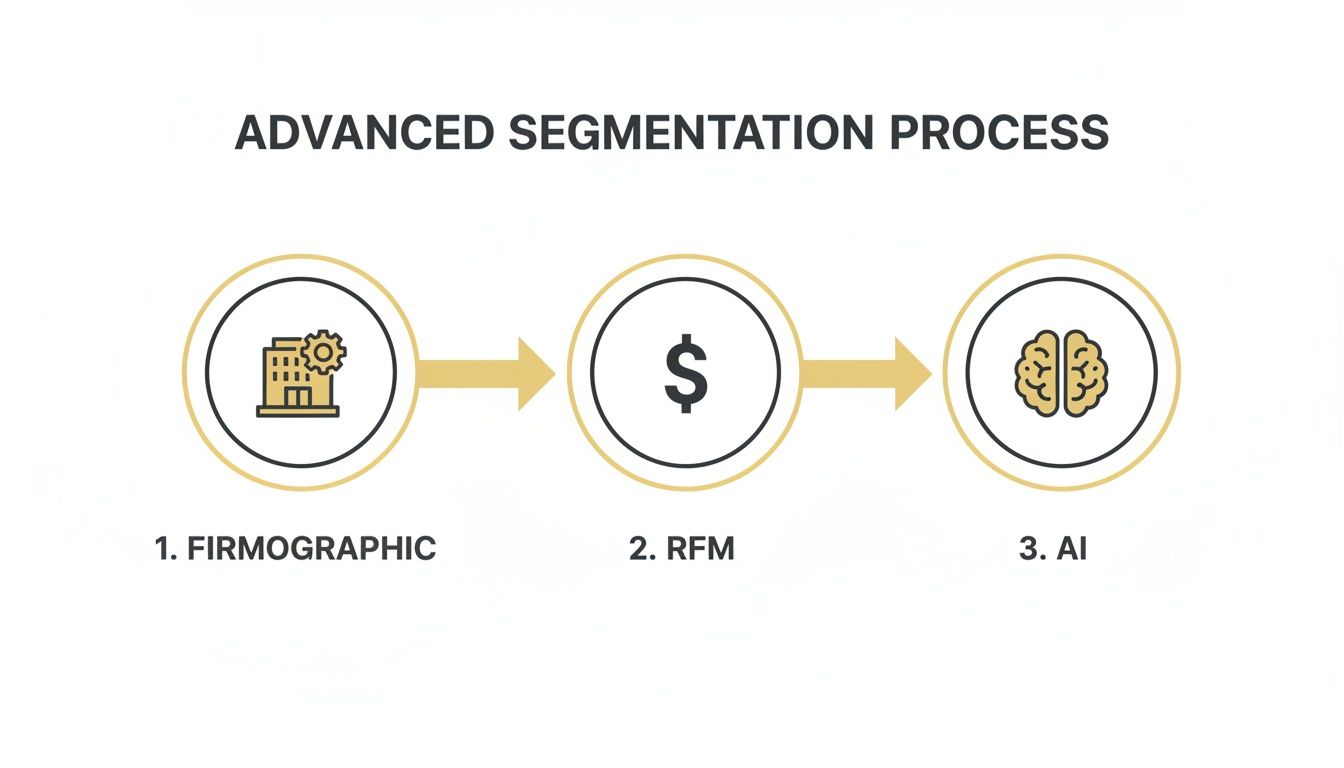
The process often moves from broad business data (Firmographics) to specific value-based metrics (RFM), and can even be supercharged with AI to uncover deeper patterns.
Step 4: Activate Your Segments with Targeted Campaigns
With your segments defined, it's time to put them to work. This means creating marketing strategies that speak directly to the unique needs and motivations of each group.
A segment is only as valuable as the action you take on it. Data without activation is just a collection of numbers.
For each segment, you need a different approach:
- High-Value Loyalists: Reward them. Offer exclusive perks, early access to new products, or even just personalised thank-you messages.
- Budget-Conscious Newcomers: Welcome them with an introductory offer, show them the value your products provide, and share educational content to build their trust.
- Inactive Past Buyers: Try to win them back. Launch a re-engagement campaign with a compelling "we miss you" discount or show them what’s new since they last visited.
Step 5: Measure, Learn, and Refine Continuously
Segmentation isn't a "set it and forget it" project. It’s a living process. Customer habits and market trends are always changing, and your segments need to evolve with them.
Set up dashboards to track the key metrics you identified in your goals. Are the campaigns for your "Budget-Conscious" group actually driving conversions? Is the churn rate for your "At-Risk" segment going down?
Use these insights to constantly refine your approach. If a campaign is flopping, test different messaging or offers. If you spot a new pattern emerging in the data, maybe it’s time to create a new segment. This continuous loop of measuring, learning, and refining is what turns a good segmentation strategy into a great one.
Finding the Right Tools for the Job

A brilliant customer segmentation strategy is only as good as the tools you use to bring it to life. Without the right software, even the most insightful plans can end up gathering dust in spreadsheets and slide decks. The aim here is to find a platform that doesn't just manage your data, but actually helps you act on what you've learned.
Choosing a tool can feel like a mammoth task, but it doesn't have to be. You can cut through the noise by focusing on what your business actually needs. Whether you're a small startup or a large enterprise, there's a solution out there that fits your scale and budget.
Matching Tools to Your Business Needs
You wouldn't use a sledgehammer to crack a nut, and the same logic applies here. Not every business needs a hugely complex, enterprise-level system. The secret is finding a tool that fits where you are now, while giving you room to grow.
-
For Small Businesses: Simplicity is your best friend. Look for tools with clean, intuitive interfaces that combine email marketing with basic segmentation. Platforms with simple tagging systems are perfect for grouping customers based on their behaviour without needing a data science degree. The right tool will give you clear reports that show what's working and what's not.
-
For E-commerce Managers: You live and breathe behavioural tracking. Your ideal tool will plug directly into your online store, capturing every click, purchase, and abandoned basket. You'll want advanced features like RFM analysis and automated workflows to send out personalised product recommendations and win-back campaigns without lifting a finger.
-
For Marketing Agencies: Versatility and client management are non-negotiable. You’ll need a platform that can juggle multiple client accounts, each with its own unique data and segmentation rules. Look for powerful reporting features that make it easy to show your clients the real-world value and ROI of your campaigns.
As you start looking, it's worth exploring some of the best marketing analytics tools on the market. After all, solid analytics are the bedrock of any good segmentation strategy.
Essential Features to Look For
No matter the size of your business, there are a few features that are absolutely essential for doing customer segmentation properly. Think of your chosen platform as the central nervous system for understanding and talking to your audience.
A great segmentation tool doesn't just store data; it makes that data actionable. It should turn your customer insights into automated, personalised experiences that drive growth.
Here are the key features you should insist on:
-
Easy Data Integration: The platform has to play nicely with your existing tech stack—your CRM, e-commerce platform, website analytics, and so on. A single, unified source of data is crucial for building a complete picture of your customers. For many smaller companies, finding the right CRM software for small business is the perfect starting point.
-
Automated Workflows: The ability to set up "if this, then that" rules is an absolute game-changer. This lets you automatically move customers between segments and trigger targeted campaigns based on their actions, which will save you an incredible amount of time.
-
Clear Reporting Dashboards: You need to see the results of your hard work at a glance. Look for clear, customisable dashboards that track key metrics like conversion rates, customer lifetime value, and engagement for each segment. This is how you prove what’s working and fine-tune your approach.
Common Customer Segmentation Questions Answered
As you start digging into customer segmentation, a few practical questions almost always pop up. Let's be honest, everyone has them. Getting clear on these early helps build confidence and makes sure your strategy starts on the right foot.
Here are the top three I hear all the time.
How Many Segments Should I Create?
It’s incredibly tempting to slice your audience into dozens of tiny, hyper-specific groups. The problem is, this usually leads to chaos and a strategy you can't actually manage. When you're just starting, less is definitely more.
The real goal isn't to create the most segments, but the most meaningful ones. Aim for three to five core segments to begin with. This is manageable and gives you enough variety to work with. Think in broad but distinct terms, like "Loyal High Spenders," "New Budget-Conscious Shoppers," or "At-Risk Customers."
What Is the Difference Between Market and Customer Segmentation?
This is a classic point of confusion, but the distinction is pretty straightforward once you see it.
Market segmentation is about the big picture. It looks at the entire potential market out there—everyone you could possibly sell to, including people who have never even heard of your brand. You're sizing up the total opportunity.
Customer segmentation, on the other hand, zooms in on the people you already have. It focuses exclusively on your existing customer base. It’s all about understanding the people you've already won over so you can keep them happy and find more just like them.
How Often Should I Update My Segments?
This is crucial: your segments aren't set in stone. People change, their needs evolve, and their buying habits shift. A segmentation model you built last year might already be out of date.
Think of your segments as living profiles, not stone carvings. They need regular check-ups to stay healthy and accurate.
As a rule of thumb, plan to do a deep review and refresh of your segments at least once a year. But don't just set it and forget it. Keep an eye on their performance quarterly. If you spot major changes in behaviour, you might need to adjust sooner. This keeps your marketing sharp and genuinely connected to who your customers are right now.
Ready to put these insights into action? The Digital Marketing Toolbox is your go-to platform for finding the perfect software to build, manage, and activate your customer segments. Discover and compare top-rated tools for analytics, CRM, and email marketing all in one place. Find your ideal solution and start growing smarter today at https://grow-your-biz.com.


