
At its most basic level, sentiment analysis is all about teaching computers to understand the feelings and opinions hidden inside written text. Think of it as an AI-powered tool that can read through thousands of customer reviews, social media comments, or support tickets and instantly tell you if the sentiment is positive, negative, or neutral.
So, What Is Sentiment Analysis in Plain English?
Imagine you launched a new product and wanted to know what people really think about it. You could spend weeks reading every single tweet, review, and forum post. Or, you could use sentiment analysis to do it for you in minutes.
That’s the magic of it. Also known as opinion mining, this technology goes beyond simple keyword counting. It’s designed to understand context and emotional tone, sifting through mountains of unstructured text to find the genuine feelings within. It can spot the difference between a genuinely happy customer saying your "service is incredible" and a sarcastic one complaining, "incredible, my package is late again." That nuance is everything.
Turning Customer Chatter into Clear Insights
Sentiment analysis takes all that messy, unfiltered customer feedback and organises it into something you can actually use. It helps you get straight answers to some of the most important questions for any business:
- Brand Health: How are people feeling about our brand this quarter compared to last?
- Product Reception: Which features are customers raving about, and which ones are causing frustration?
- Campaign Impact: Did our latest marketing campaign land well, or did it miss the mark?
By automatically classifying feedback on a massive scale, you can finally stop guessing and start making decisions based on real data. For a more detailed look at the mechanics and applications, this comprehensive guide to sentiment analysis for social media is a fantastic resource.
Here’s a quick breakdown to help you grasp the core ideas:
Sentiment Analysis At a Glance
| Concept | Simple Explanation | Business Application |
|---|---|---|
| Polarity | Is the text positive, negative, or neutral? | Quickly gauge overall customer satisfaction or reaction to a new campaign. |
| Subjectivity | Is the text an opinion or a factual statement? | Filter out objective news mentions to focus purely on customer opinions. |
| Emotion Detection | Does the text express joy, anger, sadness, etc.? | Identify passionate customers (both happy and unhappy) for follow-up. |
| Aspect-Based | What specific feature is being discussed positively/negatively? | Pinpoint exact issues, like "the battery life is poor" but "the camera is great". |
This table shows how sentiment analysis breaks down complex feedback into simple, actionable categories, helping you understand not just what people are saying, but how they feel about specific parts of your business.
Sentiment analysis gives any business a huge advantage in building a real connection with its audience. It’s the difference between just hearing your customers and truly understanding them.
Ultimately, getting a handle on customer sentiment means you can be more proactive. You can spot a potential PR crisis before it blows up, refine your marketing to resonate better, and build products that solve real problems. It's about listening smarter, not just louder.
How Does It Actually Work? Decoding Emotion From Text
So, how does a machine actually get a grip on human feelings like excitement, frustration, or even sarcasm, just from reading a block of text? It's not magic. The process is surprisingly logical, a bit like teaching a person a new language by starting with the alphabet and building up from there.
At its heart, sentiment analysis technology works by breaking down text into its core components, spotting the words that carry emotional weight, and then calculating an overall emotional score.
Think of it like training a new employee to sort through customer feedback. You wouldn't just give them a stack of comment cards and hope for the best. You'd give them a system. First, the software "cleans" the text by stripping out all the noise—punctuation, emojis, and common filler words like 'the', 'a', and 'is'. This pre-processing step is crucial because it helps the algorithm zero in on the words that actually matter.
Once the text is tidied up, the real analysis kicks off. There are a couple of major ways this happens.
The Main Methods for Analysing Sentiment
1. Rule-Based Systems
This is the classic, old-school approach. It works by using a set of manually created rules and dictionaries, often called lexicons. Think of a lexicon as a giant word list where every word has been given a score.
- Positive words like “amazing,” “love,” and “excellent” get a positive score (say, +1).
- Negative words like “terrible,” “awful,” and “disappointed” get a negative one (like -1).
The system then simply tallies up the positive and negative words in a sentence to come up with a final score. It’s straightforward, but it can be surprisingly effective for getting a basic read on sentiment.
2. Machine Learning Models
This is where things get much smarter. Instead of just following a rigid dictionary, a machine learning model is trained on a huge dataset of text that humans have already tagged as positive, negative, or neutral.
By chewing through millions of examples, the model starts to learn the patterns, context, and subtle nuances of language all on its own. It’s how a system can figure out that "sick" means something great in the phrase "That new design is sick!" but something terrible in "The app made my phone feel sick."
This infographic gives you a great visual of how raw, messy text gets turned into clean, useful insights.
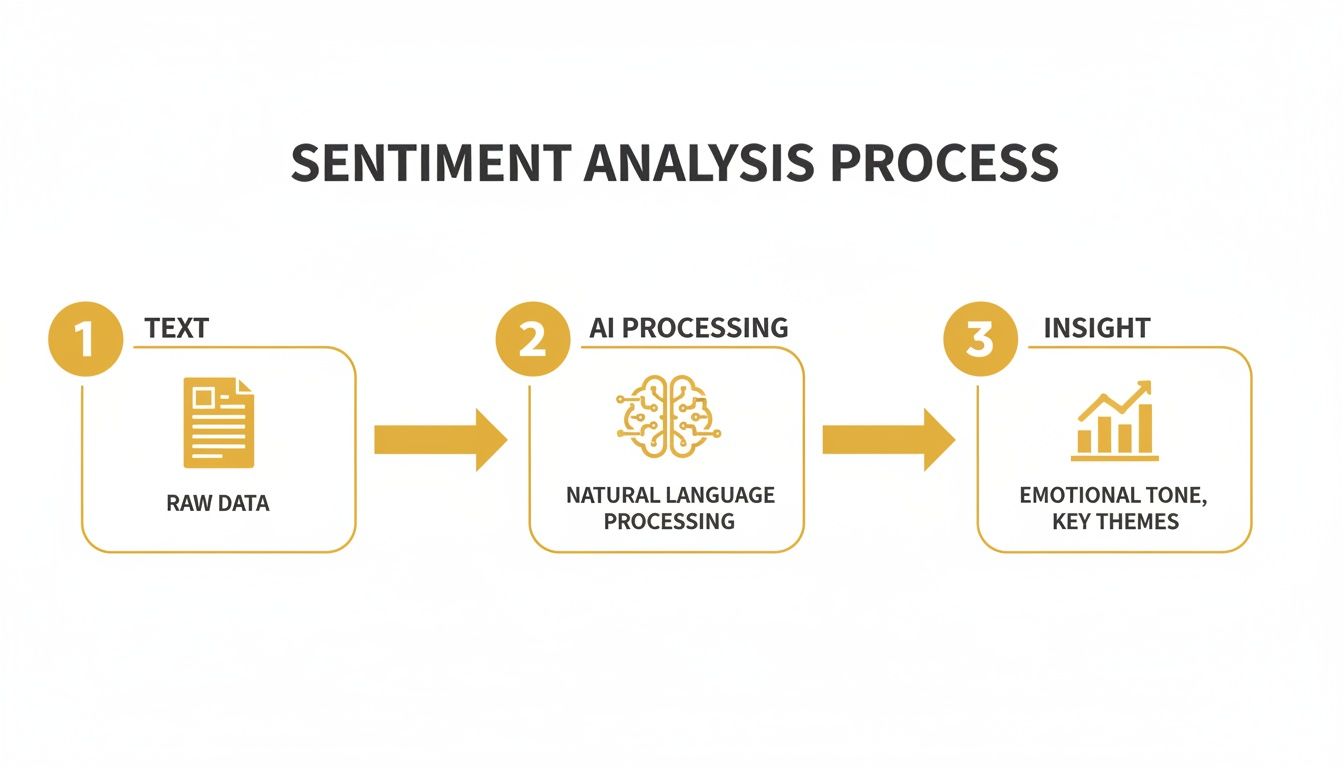
As you can see, it's a journey from collecting raw text, feeding it through an AI model, and getting structured data out the other side. That transformation from unstructured chatter into clear, actionable information is what makes sentiment analysis so powerful. To see how this fits into a bigger strategy, our guide on data analytics for marketing offers some great context.
In practice, the best results often come from a hybrid approach. This means blending the clear-cut rules of a lexicon-based system with the sophisticated, context-aware understanding of a machine learning model. This gives you the best of both worlds: high accuracy and the flexibility to keep up with new slang and evolving language.
Putting Sentiment Analysis to Work in Your Marketing

Knowing the theory is one thing, but the real magic happens when you start applying sentiment analysis to your marketing goals. It’s all about turning a sea of opinions—tweets, reviews, comments—into structured data you can actually use. This gives you a clear lens to see your brand, products, and campaigns exactly as your customers do, letting you swap guesswork for data-backed decisions.
Think of it as having a real-time finger on the pulse of your brand’s health. By tracking conversations across social media, forums, and review sites, you can see how public perception shifts day by day, not just every quarter when a report lands on your desk. This is what proactive reputation management looks like today.
A sudden spike in negative mentions can serve as an early-warning system, flagging a potential PR crisis before it snowballs. This gives your team the heads-up needed to react swiftly, address the core issue, and steer the conversation.
Drive Smarter Marketing and Product Decisions
Sentiment analysis isn't just for putting out fires; it's a powerful tool for growth. When you dig into customer feedback, you can pinpoint exactly what people love (or hate) about what you offer. These granular insights are gold for guiding product development and deciding which new features will actually hit the mark with your audience.
Let's say you've just rolled out a new software update. Sentiment analysis can tell you almost instantly which new features are getting rave reviews and which ones are causing headaches.
By identifying and addressing negative comments early, you can act on suggestions quickly. This not only helps the individual customer but also allows you to improve the experience for everyone else down the line.
This direct line to your customers can also supercharge your marketing campaigns. By analysing the very words people use when talking about their problems and how you solve them, you can sharpen your ad copy and SEO strategy. It’s about mirroring the language that resonates, making your marketing that much more effective.
Enhance Customer Service and Gain a Competitive Edge
A huge part of marketing is keeping the customers you have, and that comes down to fantastic support. Sentiment analysis tools can automatically flag mentions from angry or frustrated customers, helping your support team prioritise those conversations and jump in with a solution. Learning how to improve the customer experience is vital, and this technology gives you the real-time data to make it happen.
Better yet, you can point this same analytical lens at your competitors. Monitoring the sentiment around their brand and products uncovers their strengths and, more importantly, their weaknesses. You can spot gaps in the market, learn from their missteps, and benchmark your own performance. Are their customers constantly complaining about slow delivery? That’s your cue to highlight your speedy shipping. This kind of competitive intelligence helps you position your brand more effectively and win over more of the market.
Choosing the Right Sentiment Analysis Tools
Getting started with sentiment analysis doesn't mean you need a team of data scientists to build an AI from scratch. Thankfully, the market is packed with powerful, ready-made tools that make this technology accessible to almost any business.
The real challenge isn't finding a tool; it's finding the right one for your specific goals and budget.
Think of it like choosing a vehicle. A local coffee shop might just need a zippy scooter to keep an eye on nearby Google Reviews and Instagram comments. A national marketing agency, however, needs a lorry capable of hauling in massive amounts of data from every corner of the internet. The best tool always comes down to what you need it to do.
As you start looking, it helps to get familiar with the range of available Customer Sentiment Analysis Tools. Your goal should be to find a solution that gives you clear, actionable insights without drowning your team in unnecessary complexity.
Key Features to Look For
Before you sign up for anything, you need to be sure the tool is accurate, easy to use, and plays nicely with the software you already have. After all, a tool is only helpful if it actually fits into your daily workflow.
Here’s what to keep on your checklist:
- Accuracy and Nuance: How well does the platform understand sarcasm, slang, and your industry’s specific jargon? A good provider should be transparent about their accuracy scores. Don't be afraid to ask for a demo using your own data.
- Language and Source Support: Can it listen everywhere your customers are talking? Make sure it covers your essential social media channels, key review sites like TripAdvisor or Trustpilot, and maybe even your own customer support chats.
- Integration Capabilities: Does the tool connect easily with your CRM, helpdesk software, or social media scheduler? Smooth integration is crucial for avoiding data headaches and making sure the insights get to the right people.
A great sentiment analysis tool does more than just slap a "positive" or "negative" label on a comment. It should uncover the why behind the sentiment, highlighting key themes, tracking trends over time, and alerting you to any sudden shifts in customer mood.
Standalone Tools vs Integrated Platforms
One of the biggest decisions you'll make is whether to go for a dedicated sentiment analysis tool or a broader platform where it's just one feature among many.
Standalone tools are specialists. They are built for one purpose: deep, detailed opinion mining. These are brilliant if you have a specific, data-heavy research project or need to get incredibly granular with your analysis.
On the other hand, integrated platforms bundle sentiment analysis into a larger marketing suite, like a social listening or brand monitoring dashboard. For most small businesses and agencies, this is often the most practical and cost-effective route.
These all-in-one systems place sentiment data alongside other vital metrics, giving you a complete, 360-degree view of your brand's health online. If this sounds like a better fit, our guide on the best social listening tools is a great place to explore your options. This approach keeps your tech stack tidy and puts powerful insights right at your team's fingertips.
Navigating Common Challenges and Limitations

As powerful as sentiment analysis is, it's not a crystal ball. You have to be realistic about its limitations. After all, algorithms aren't human. They can easily get tripped up by the subtle, messy, and often contradictory ways we talk, which can lead to some wonky results if you're not paying attention.
Knowing where these tools can stumble is the first step to building a feedback system you can actually trust.
One of the biggest hurdles is sarcasm and irony. A customer might sarcastically post, "Oh, just great. My delivery is three days late." A basic tool sees the word "great" and instantly chalks it up as a win. It completely misses the frustration because it can't grasp the context.
This example gets right to the heart of the problem: for any automated analysis, context is everything.
The Problem with Nuance and Jargon
Human language is a minefield of nuance. Algorithms can struggle with industry-specific slang, subtle phrasing, or simple words that flip a sentence's meaning on its head.
- Industry-Specific Language: If you work in tech, hearing "That new feature is sick!" is high praise. In almost any other industry, it's a bad thing. A generic model trained on general web text won't know the difference.
- Negations: Take a phrase like, "I wouldn't say the service was bad." It's not exactly a glowing review, but it's not a complaint, either. Capturing that middle-ground, neutral-ish feeling is tough for many systems.
- Comparisons: A sentence like, "I prefer Brand A over Brand B," contains both positive and negative sentiment. It’s great for Brand A, not so much for Brand B. A simple analysis might get confused and misread the overall picture.
The accuracy of sentiment analysis is rarely 100%. Even the most advanced models make mistakes. The goal isn't flawlessness—it's to get a broad, directionally accurate view of customer opinion that’s worlds better than just guessing.
This is where a human touch becomes invaluable. Don't just take the results as gospel. Treat them as a starting point. Spot-check the data yourself. Have a real person review how the tool is categorising comments to see if it's making consistent mistakes.
Choosing a tool that has been trained on data from your specific industry can also make a world of difference. And finally, always pay attention to the model's reported accuracy scores. Knowing its potential for error helps you read the results with a healthy dose of scepticism and build a more reliable picture of how your customers really feel.
The Future of Understanding Your Customers
Adopting sentiment analysis isn't just about adding another tool to your marketing stack. It marks a real shift in how you run your business—moving towards a more empathetic, customer-focused approach. It’s about getting past the raw numbers on a spreadsheet and truly understanding the emotions that drive your customers' decisions. This technology lets you listen to the online conversation at scale, cutting through the noise to find clear, actionable signals.
The payoff is pretty straightforward. You can stop simply reacting to problems and start proactively shaping your brand's reputation. Instead of making educated guesses about what your customers want, you can use their own words to inform product development and sharpen your marketing messages. And this kind of power isn't just for the big players anymore; it's well within reach for businesses of all sizes.
Start Small but Think Big
Getting started is less daunting than it might seem. You don't need to boil the ocean and analyse your entire digital history all at once.
The trick is to begin with a specific, manageable chunk of data. This builds confidence and shows you the value right away. A great first step could be analysing last quarter's Google reviews or the comments on your social media posts from the past month.
This focused approach delivers quick wins and proves the value of listening more intelligently.
Once you see the results, you can start to expand. The long-term goal is to weave sentiment analysis into the fabric of your strategy. Use it to build stronger, more authentic relationships with your customers and to make smarter, more confident decisions. In a world where everyone is competing for attention, understanding how your customers genuinely feel isn't just a nice-to-have—it’s essential for lasting growth.
Got Questions? We've Got Answers
So, you've got the basics down, but you're probably wondering how sentiment analysis actually plays out in the real world. That's completely normal. Let's tackle some of the most common questions marketers and business owners ask when they're starting out.
Think of this as a quick chat to clear up the practical stuff, so you can feel confident about putting this technology to work for your brand.
How Accurate Is This Stuff, Really?
This is always the first question, and for good reason. The honest answer is that it's impressively accurate, but it’s not infallible. A top-tier tool can hit 80-90% accuracy, which is more than enough to give you a solid read on trends and overall customer feeling.
Where do things get tricky? Well, humans are complicated. Sarcasm, irony, and niche slang can easily fool an algorithm. For instance, a machine might read "Great, another flight delay" and flag the word "great" as positive, completely missing the sarcasm. That’s why it's best to view the data as a powerful guide, not gospel. A quick human spot-check on ambiguous comments is always a smart move.
Can It Look at Anything Besides Text?
At its core, sentiment analysis is built for text. It thrives on social media comments, product reviews, survey answers, and all the other written feedback your customers leave. That's its bread and butter.
However, the technology is definitely branching out. We're now seeing some fascinating developments in other areas:
- Voice Analysis: This technology can pick up on tone and pitch during customer service calls to tell if a customer is getting frustrated or is happy with the support.
- Facial Recognition: Used in some market research, this can gauge emotional responses by analysing facial expressions in videos or photos.
For most businesses right now, though, text is where the action is. It's the biggest and most accessible pool of customer opinion you can find.
The goal isn't to get a perfect score on every single comment. The real win is getting a reliable, big-picture view of how thousands of customers feel, fast. That's what lets you make smarter decisions without getting bogged down in the detail.
What's the Damage? How Much Does It Cost?
The price tag for sentiment analysis tools can swing pretty wildly, depending on what you need. If you're a small business just dipping your toes in, many social media management platforms bundle basic sentiment analysis into their plans, which might set you back £50-£150 per month.
For those needing to analyse huge amounts of data with a dedicated, high-powered platform, costs can climb into the hundreds or even thousands of pounds a month. My advice? Take advantage of free trials. They're the perfect way to test drive a tool and see if it’s the right fit before you pull out your credit card.
Ready to discover the perfect tools to understand your customers? At The Digital Marketing Toolbox, we've curated the best solutions to help you grow. Explore our catalog and find the right fit for your business today at https://grow-your-biz.com.


