
Ever wondered what makes a great marketing team truly hum? It's not just creative genius or a massive budget. Behind every successful campaign is a robust, well-oiled machine, and that machine is called Marketing Operations (MOps).
Think of it as the central nervous system of your entire marketing department. MOps is the strategic function that brings together your people, your processes, and your technology, all with one goal: to make marketing efficient, scalable, and completely accountable for its results. In short, MOps builds and maintains the engine that powers everything your marketing team does.
The Orchestra Conductor of Your Marketing Team

Let's use an analogy. Imagine your marketing team is a world-class orchestra. You have incredible musicians—the content creators, social media managers, and campaign specialists—all playing their part to create something beautiful that captivates an audience.
But who makes sure they all have the right sheet music? Who ensures their instruments are perfectly tuned, and that they all start and stop at the same time?
That's the conductor. And in our marketing orchestra, Marketing Operations is the conductor.
Without that guiding hand, the marketing team is just a collection of talented individuals playing their own tune. The result? Chaos. It’s inefficient, disjointed, and almost impossible to measure what's actually working. The MOps function brings order, rhythm, and harmony to all that creative energy.
To get a clearer picture, let's break down the core functions of Marketing Operations into its four main pillars. These are the key areas where the MOps conductor focuses their attention to create a flawless performance.
The Four Pillars of Marketing Operations
| Pillar | Core Function | Main Goal |
|---|---|---|
| Processes & Workflow | Designing and documenting repeatable workflows for campaign launches, lead management, and more. | To eliminate bottlenecks, reduce manual work, and ensure consistency. |
| Marketing Technology (MarTech) | Managing the entire marketing technology stack, from selection and integration to optimisation. | To build a connected, efficient system where all tools provide value. |
| Data & Reporting | Governing marketing data to ensure it's clean, accurate, and accessible for analysis. | To create reliable reports and dashboards for strategic decision-making. |
| Governance & Enablement | Ensuring the team has the right skills, training, and structure to succeed. | To define roles, foster collaboration, and empower the team. |
By mastering these four areas, Marketing Operations elevates marketing from just a creative department into a predictable, revenue-generating engine.
It’s this structure that allows marketing efforts to scale up without falling apart. You can grow your activities without sacrificing quality, efficiency, or your sanity.
Ultimately, the purpose of MOps goes beyond just making things run smoothly. It’s about making marketing accountable. It delivers the hard data and clear insights needed to prove a return on investment (ROI) and guide smart, strategic decisions for the future. It’s what ensures every single marketing action contributes directly to growing the business.
The Core Responsibilities of a Marketing Ops Team

So, we've established what marketing operations is in principle. Now, let’s get into the nitty-gritty of what a MOps team actually does day-to-day. If MOps is the conductor of the orchestra, these are the specific actions they take to make sure every instrument plays in perfect harmony.
Think of it as the engine room of the marketing department. While the rest of the team is steering the ship and engaging with passengers, MOps is down below, making sure the engine is powerful, efficient, and reliable. Their work generally falls into four key areas.
MarTech Stack Management
Modern marketing is built on a foundation of technology. This collection of software—from your email platform to your analytics tools—is known as the Marketing Technology (MarTech) stack. A huge part of the MOps job is to own and manage this entire ecosystem.
This isn't just about shopping for the latest shiny software. It's a deeply strategic role that involves:
- Selection: Figuring out what the business actually needs and then finding the right tool for the job, not the other way around.
- Integration: Making sure all the different platforms can talk to each other. A disjointed stack is a recipe for data silos and headaches.
- Governance: Setting the ground rules for who uses what, how they use it, and keeping a tight grip on costs.
- Optimisation: Regularly reviewing the tech stack to ditch what isn't working, avoid paying for overlapping tools, and squeeze every last drop of value from your investment.
Process Optimisation
Clunky, inefficient workflows can bring even the most brilliant marketing campaigns to a grinding halt. MOps steps in to design, map out, and constantly improve the processes that define how work gets done. They turn chaos into clarity.
This means creating repeatable systems for everything from launching a product to nurturing a new lead. A classic example is bridging the gap between sales and marketing. By implementing effective sales and marketing alignment best practices, MOps ensures leads are handed over smoothly and nothing falls through the cracks. They hunt down bottlenecks, automate tedious manual tasks, and build the frameworks that let the rest of the team execute flawlessly. Our guide on the best marketing workflow tools is a great place to start looking for solutions.
Data Management and Analytics
Data is the fuel for smart marketing, but it's completely worthless if it's messy, inaccurate, or impossible to understand. The MOps team acts as the guardian of all marketing data.
Their ultimate goal is to build and maintain a "single source of truth." This means creating a reliable, centralised data hub so that everyone, from the newest marketing assistant to the CMO, is working from the same numbers to make decisions and prove marketing’s contribution to the bottom line.
This is especially critical in the UK, where data-led strategies are a top priority. In fact, boosting sales revenue (62%) and increasing customer engagement (60%) are the primary objectives for UK marketers. This underscores just how vital it is for MOps to deliver clean data and clear reporting.
Governance and Compliance
Finally, someone has to set the rules of the road. MOps establishes the operating framework for the entire marketing organisation. This includes creating official campaign templates to keep branding consistent, managing budgets to prevent overspending, and making sure all activities comply with data privacy laws like GDPR.
They provide the guardrails that empower the creative teams to innovate and take risks, but without veering off-course or into legal trouble.
Building Your Marketing Operations Dream Team
Let's be honest, effective marketing operations is rarely a one-person show. As a business scales, the web of processes, tech, and data gets more complex. You need a team of specialists who each bring something different to the table. Building that team is all about adding the right people at the right time to turn your marketing engine into a well-oiled machine.
For a small business or a startup, this usually starts with one person. Think of them as a 'jack-of-all-trades'—someone who can wrangle the core tech stack, start documenting processes, and build out the first performance dashboards. They’re the ones laying the tracks for everything that comes next.
Core Roles in a Mature MOps Team
As your organisation grows, so does the need for deeper expertise. A fully-fledged marketing operations team is built to handle the heavy lifting of a sophisticated marketing function. Job titles can vary from company to company, but the responsibilities generally fall into these distinct roles:
-
Marketing Operations Manager/Director: This is your strategic leader. They’re the ones making sure MOps activities actually support the bigger business goals. They manage the budget, oversee the whole function, and act as the crucial link between marketing leadership and the technical specialists doing the work.
-
Marketing Technologist: The master of the MarTech stack. This person lives and breathes marketing software. Their job is to choose, connect, and manage every tool in your arsenal, from your CRM to your email platform. They make sure everything talks to each other properly and that you’re actually getting your money’s worth from your software.
-
Data Analyst: The insight finder. Buried in spreadsheets and dashboards, the data analyst is responsible for cleaning up data, building reports, and spotting the trends that guide your next move. They are absolutely essential for proving marketing's ROI and finding new ways to improve performance.
-
Campaign Operations Specialist: The execution expert. This role is all about the practical, hands-on work of getting campaigns out the door. They build the email workflows, set up the landing pages, and ensure every single piece of a campaign launches flawlessly and on time.
Structuring Your Team for Success
There's no single 'right' way to structure your team—it really depends on your company's size and stage. A smaller business might have one person doing both the technologist and campaign specialist roles. A huge enterprise, on the other hand, might have an entire team of analysts, each focusing on a different part of the customer journey.
The real secret is to hire for your biggest pain point first. If your technology is a chaotic mess, hire a technologist. If you're flying blind and can't prove your impact, bring in an analyst. This way, every new person you add delivers immediate, noticeable value.
Building a marketing operations dream team doesn’t happen overnight. It’s a gradual process. Start with a strong generalist, and then add specialists as your needs become more defined. This approach lets you scale your capabilities thoughtfully, ensuring you always have the right people to support your marketing ambitions as you grow.
Key Metrics and KPIs to Measure MOps Success
That old saying, "If you can't measure it, you can't improve it," really is the heart and soul of marketing operations. A solid MOps function isn't interested in so-called 'vanity metrics' like social media likes or email open rates. Instead, it gets down to the hard data that proves its worth and draws a straight line between marketing activities and business growth.
To get a true picture of performance, you need to track KPIs across three critical areas: how efficiently the machine is running, the health of your contact database, and the real-world impact on the business. This gives you the full story—not just how busy the marketing team is, but how effective they are at actually making money.
Efficiency and Process Metrics
First things first: how well is your marketing engine actually running? Are your processes smooth and agile, or are they clunky and slow? Things like sluggish campaign launches or a messy lead handoff process aren't just frustrating; they represent lost revenue opportunities.
A few key efficiency KPIs to keep an eye on include:
- Campaign Deployment Time: What’s the average time from the moment a campaign is requested to the second it goes live? A shorter cycle means your team can pounce on market changes much faster.
- Lead Processing Speed: How quickly does a new lead get from your marketing automation platform into the CRM for the sales team to follow up? Every minute of delay lets a warm lead go cold.
- Marketing Team Productivity: This is about output. How many campaigns, assets, or projects is the team completing each quarter? It’s a great way to see if your process improvements are helping the team get more done without causing burnout.
Database Health Metrics
Your marketing database is one of your most valuable assets, but only if it’s clean, accurate, and growing. A healthy database is what ensures your messages actually land in front of the right people and that all your personalisation efforts pay off. Bad data, on the other hand, just leads to wasted time and a damaged sender reputation.
Important database health KPIs are:
- Marketable Contact Growth Rate: What’s the percentage increase in contacts you can legally and effectively market to? This tells you if your list-building efforts are actually working.
- Data Enrichment Level: Look at the percentage of your contacts that have complete and accurate data in key fields like job title, company size, and industry.
- Contact Decay Rate: People change jobs and emails go defunct. This metric tracks the rate at which your contact data becomes invalid, reminding you to stay on top of your data cleansing.
Key Takeaway: Keeping tabs on these foundational metrics isn't just about internal housekeeping. This is the solid data foundation you need to make smart strategic decisions and accurately measure the real-world business impact of every single marketing campaign. You can explore more examples of powerful marketing performance metrics in our detailed guide.
Business Impact Metrics
At the end of the day, the board and the CEO really only care about one thing: revenue. This final group of KPIs is all about connecting your MOps activities directly to the bottom line. This is how you prove that marketing is a powerful growth driver, not just another cost centre.
In the UK, where SMEs make up a staggering 99.9% of all businesses, efficient and scalable operations are absolutely critical. MOps teams have to use metrics to show that their work in areas like SEO (a 48% priority for many) directly leads to measurable business results. For more context, you can check out the UK business population estimates on GOV.UK.
Top-line business KPIs include:
- Marketing-Sourced Revenue: The total revenue generated directly from activities led by the marketing team. This is the big one.
- Lead-to-Customer Conversion Rate: Out of all the leads you generate, what percentage actually become paying customers?
- Customer Acquisition Cost (CAC): How much does it cost, in total marketing and sales spend, to bring a new customer on board?
This shift in focus from 'what we did' to 'what we achieved' is fundamental to Marketing Operations. Here's a quick comparison to illustrate the difference.
Traditional Marketing Metrics vs MOps-Driven KPIs
| Focus Area | Traditional Metric (Vanity) | MOps-Driven KPI (Impact) |
|---|---|---|
| Email Marketing | Email Open Rate | Pipeline Generated from Email Nurturing |
| Content/SEO | Website Traffic & Keyword Rankings | MQLs from Organic Search |
| Social Media | Likes, Shares, Follower Count | Lead-to-Customer Conversion Rate from Social |
| Paid Ads | Impressions & Clicks | Customer Acquisition Cost (CAC) per Channel |
| Overall Activity | Number of Campaigns Launched | Marketing-Sourced Revenue |
As you can see, MOps elevates the conversation from simply reporting on activity to demonstrating tangible business value. It connects every click, every form fill, and every campaign directly to the financial health of the company.
How to Implement Marketing Operations in Your Business
Diving into marketing operations doesn't mean you have to rip everything up and start again with a huge budget. Think of it more as a gradual build, starting with one small, solid step. By taking it phase by phase, any business can develop a powerful MOps function that genuinely drives growth and stops the team from running in circles.
Your very first move is a simple audit. Before you can build anything better, you need a brutally honest picture of what’s happening right now. Pick a single, critical process – say, what happens from the moment a new lead fills out a form to when a sales rep actually follows up. Map out every single click, manual data entry, and frustrating delay. You’ll be surprised at what you find.
This audit is your treasure map. It gives you the clarity to move beyond vague goals like “we need to be more efficient.” Instead, you can set a tangible target like, “let’s get lead handoff time down from four hours to under 30 minutes.” That’s a goal that directly connects to a bigger business objective, like closing deals faster.
A Practical Implementation Roadmap
Once you know your biggest headaches and have a clear goal in mind, it’s time to start building. A structured approach keeps you from getting bogged down in the details.
-
Pick Your Core Tech Wisely: It’s so tempting to get distracted by shiny new software. Don't. Focus on solving the biggest problem you found in your audit first. For most, this means getting a solid CRM and a decent marketing automation platform in place. If you're wondering where to start, our guide on the top marketing automation tools can point you in the right direction.
-
Document Everything (Seriously): Create a central playbook for your processes. Write down how to use the new tools and the exact steps for your most important workflows. This isn’t bureaucracy; it’s your secret weapon for training new hires and keeping everyone on the same page as you grow.
-
Iterate and Improve: Your first version of a process will never be perfect, and that’s completely fine. Launch it, get feedback from the team who are actually using it, and then look for ways to tweak and improve it. MOps isn’t a one-and-done project; it’s about a culture of constant refinement.
Remember, the goal is progress, not perfection. By focusing on small, incremental wins, you build momentum and demonstrate value quickly, which is essential for getting buy-in from leadership for future investments.
This diagram shows how MOps pros think about measuring success. It’s a journey that starts with internal efficiency and ends with real business impact.
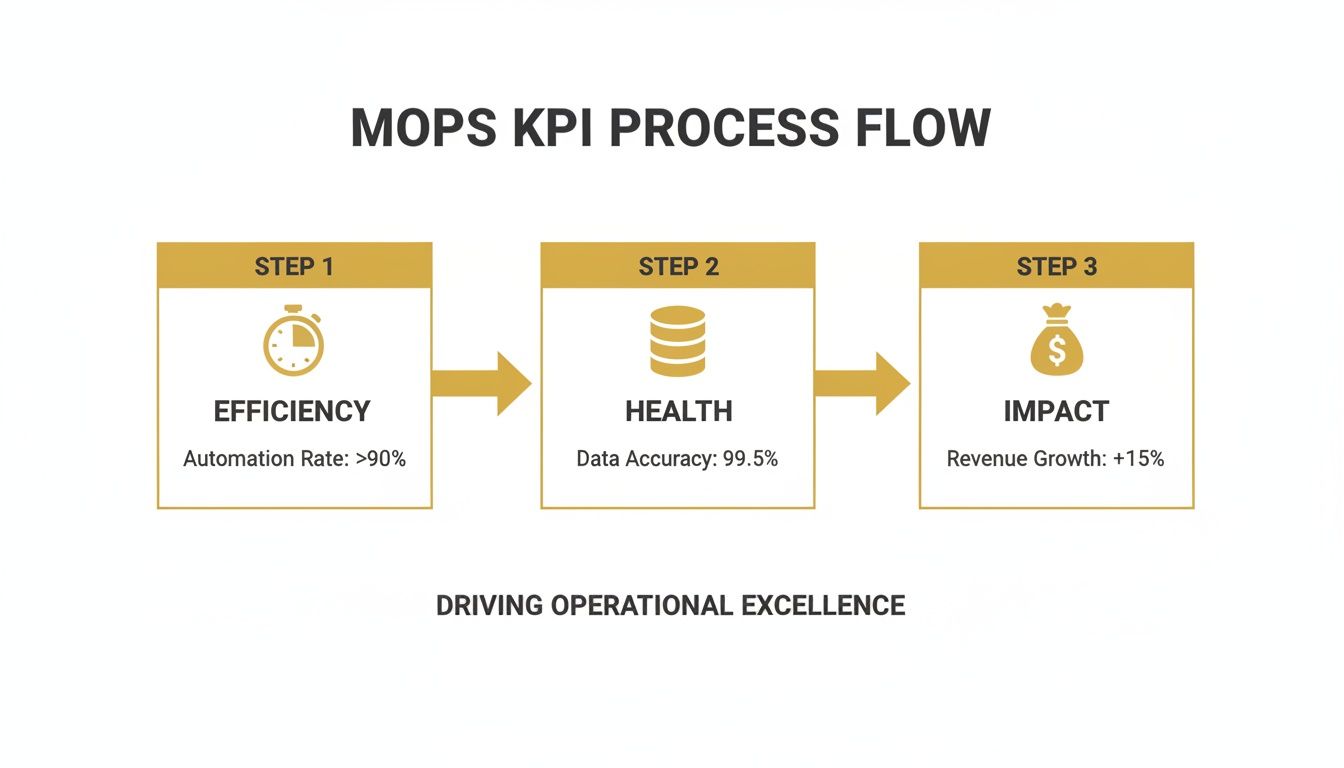
As you can see, solid operational efficiency and clean data are the foundations. Without them, you’re just guessing at your impact on the bottom line.
Overcoming Common Hurdles
This methodical approach is becoming essential across the UK, especially for B2B agencies. We’re seeing a fascinating trend where gross income is on the rise, even as the average team size has shrunk by 6.1%. This isn't magic; it’s MOps in action, helping teams do more with less. It's the perfect use case for a platform like The Digital Marketing Toolbox, which is designed to find those efficiency-boosting solutions.
If you don't have the internal bandwidth, don't let that stop you. Exploring the world of digital marketing outsourcing can be a smart way to get the expertise you need without hiring a full-time team. The key is simply to start small, prove the value, and build from there.
Got Questions About Marketing Operations? We’ve Got Answers
So, we've gone deep into what makes marketing operations tick. It's a lot to take in, and it's completely normal for a few questions to pop up. Let's tackle some of the most common ones I hear from people just getting their heads around it.
What's the Real Difference Between Marketing and Marketing Operations?
It's a great question. Imagine your marketing team is a group of star chefs. They come up with incredible new recipes (the campaigns), source the finest ingredients (the creative content), and understand exactly what will delight the customer's palate. They’re all about the vision and the final delicious product.
Marketing operations, on the other hand, is the head of the kitchen. They design the entire workflow, from how ingredients are ordered and stored to ensuring every station has the right equipment (the tech stack). They make sure the kitchen runs smoothly, efficiently, and without chaos, so the chefs can focus on creating amazing food.
Marketing dreams up the brilliant ideas; MOps builds the reliable, efficient system that brings those ideas to life and proves they worked.
I'm a Small Business. How Do I Even Start with This?
Don't panic and definitely don't think you need to buy a dozen expensive tools. The best way to start is to focus on your processes first, not the technology.
Pick one single, crucial workflow. A perfect example is what happens after someone fills out a contact form on your website. Map out every single step. Where does it go? Who follows up? How long does it take? You'll quickly spot the clumsy manual steps or the places where things fall through the cracks.
Find the one biggest bottleneck in that single process and look for a simple, low-cost tool that fixes just that one thing. The aim here is small, steady wins. Get one process running smoothly, prove its value, and only then move on to the next. It’s a much more manageable and budget-friendly way to build momentum.
What's the First MOps Role We Should Hire For?
For most businesses hitting that growth spurt, the first person you want to bring on board is a Marketing Operations Manager or a Marketing Technologist. You're not looking for a niche specialist just yet; you need a versatile doer.
This person should be someone who can talk strategy with the marketing lead in the morning and then dive into the backend of your CRM in the afternoon.
Their first jobs will almost certainly be:
- Wrangling the marketing database to get your contact data clean and organised.
- Taking ownership of core tools, like your email platform and CRM, and making sure they work together.
- Building the first real performance dashboards so you can finally see what's actually working.
Think of them as the person who lays the foundation. Once that's solid, and as your needs get more sophisticated, you can start hiring specialists for things like pure data analytics or complex automation.
Is Marketing Operations Just a Fancy Term for Managing Tech?
Not at all. That’s a common misconception. Technology is a huge part of the job, but it’s only one piece of the puzzle. The classic framework here is People, Process, and Technology, and it holds true. The most powerful software in the world is worthless if your team doesn't know how to use it (People) or if there are no clear workflows to guide how it's used (Process).
A brilliant MOps pro spends as much time training the team and documenting how things should be done as they do fiddling with software. Their real job is to weave those three elements together to create a marketing engine that is powerful, scalable, and repeatable.
Ready to find the right tools to build your marketing operations foundation? At The Digital Marketing Toolbox, we’ve curated the best solutions for everything from analytics to automation, helping you build an efficient and effective MarTech stack. Discover and compare top-rated tools to accelerate your growth today.


