

Let's be honest, a lot of marketing feels like guesswork. You launch a campaign, cross your fingers, and hope for the best. But what if you could swap that guesswork for genuine insight? That’s exactly what A/B testing brings to the table, turning your marketing strategy from a shot in the dark into a deliberate, scientific process for growth.
Why Smart A/B Testing Is Your New Secret Weapon

It’s all too easy to get stuck in a debate based on opinions. Your design team might be pushing for a bold, modern landing page, while your sales lead is convinced a more traditional layout will convert better. Without hard data, you’re simply picking a side and hoping for the best.
A/B testing, or split testing as it's often called, cuts through the noise by letting your audience be the judge. The idea is wonderfully simple. You create two versions of a marketing asset—be it a webpage, an email, or an online ad—and show them to two similar-sized groups from your audience. By changing just one thing between the two versions, you can see exactly which one performs better for the goal you've set.
Beyond Guesswork to Confident Decisions
For any UK business trying to get an edge, this data-led approach is essential. It moves the needle on the metrics that actually matter.
- Higher Conversion Rates: Finally discover which headline, call-to-action (CTA) button colour, or image truly persuades more people to take the next step.
- Improved Customer Engagement: Find out which email subject lines demand to be opened or which ad creative stops the scroll.
- Better Return on Investment (ROI): When you start optimising every part of your marketing funnel, you automatically make your budget work harder and stretch further.
The industry is clearly taking notice. The global A/B testing software market is on track to hit USD 1.25 billion by 2028. This isn’t surprising when you learn that well over half of UK marketers are already using A/B tests to make smarter, data-backed decisions. In fact, a significant 58% of companies are using it specifically for conversion rate optimisation. If you're curious, you can explore more A/B testing statistics to see just how widespread this practice has become.
Key Takeaway: A/B testing isn't just about picking a winner and moving on. It's about creating a system of continuous improvement, where every test provides a new insight. This builds the confidence to make bold decisions that lead to real, measurable growth.
Key Marketing Elements to A/B Test
To get started, it's wise to focus on the elements that can deliver the biggest impact first. Think about the most critical touchpoints in your customer’s journey. This could be the headline on your highest-traffic landing page, the main CTA in your weekly newsletter, or the hero image on your homepage.
This table highlights some of the most effective components to test, giving you a clear starting point for your optimisation efforts.
| Element | Variable A (Example) | Variable B (Example) | Potential Impact |
|---|---|---|---|
| Headlines | "Affordable Marketing Solutions" | "Grow Your Business Faster" | Captures attention, sets expectations |
| Call-to-Action (CTA) | "Sign Up Now" | "Get Your Free Trial" | Drives user action and conversions |
| Images & Visuals | Product photo | Lifestyle image with person | Creates emotional connection |
| Email Subject Lines | "Our Weekly Newsletter" | "5 Tips to Double Your Leads" | Boosts open rates and engagement |
Testing these core elements is a fantastic way to begin building a more effective, data-driven marketing machine. Each successful test not only improves a specific metric but also teaches you more about what truly resonates with your audience.
Building Your A/B Testing Framework
To get real, lasting results from A/B testing, you need to move beyond running random, one-off experiments. The goal is to build a repeatable system—a proper framework—that turns your tests into a reliable engine for business growth. This is where we stop guessing and start connecting our tests to tangible objectives.
It all starts with a solid hypothesis. An idea like, "Maybe a different button colour would be better?" isn't a hypothesis; it’s just a thought bubble. A truly powerful hypothesis is born from observation and data.
Let's say you've been watching session recordings and noticed people often pause right before hitting the "Submit" button on a lead form. That observation can fuel a real hypothesis: "Changing the button text from a generic 'Submit' to a benefit-driven 'Get Your Free Quote' will boost form submissions by clarifying the value and reducing user hesitation." See the difference? It's specific, measurable, and directly addresses an observed behaviour.
Forming a Powerful Hypothesis
Great hypotheses don’t just appear out of thin air. They’re built by digging into customer behaviour and getting your hands dirty with data. If you want to come up with ideas genuinely worth testing, you need to know where to look.
- Become a User Behaviour Detective: Fire up your heatmap and session recording tools. See exactly where people are getting stuck, what they’re ignoring, and where they’re abandoning ship. These are your testing goldmines.
- Listen to Your Customers: Comb through support tickets, live chat transcripts, and product reviews. What are people complaining about? What questions keep coming up? Their frustrations are your roadmap.
- Chat with Your Front-Line Teams: Your sales and customer support colleagues know what makes prospects hesitate. They hear the common objections and points of confusion every single day.
When you ground your ideas in this kind of real-world evidence, you shift from saying, "I think this might work" to "I believe this will work because…" That small change in approach makes all the difference in the quality and impact of your A/B tests.
A classic mistake is testing just for the sake of it. If your test isn't tied to a clear hypothesis and a business goal, you're just creating noise. A successful test doesn't just find a 'winner'—it proves or disproves a specific assumption you have about your audience.
Choosing Your Key Performance Indicators
Once your hypothesis is locked in, you need to define what success looks like. This means choosing the right Key Performance Indicator (KPI). Your primary KPI should be the one metric that directly proves or disproves your hypothesis.
If your hypothesis is about getting more sign-ups, your main KPI is the form submission rate. Simple. You might keep an eye on secondary metrics like time on page or bounce rate, but the submission rate is what will ultimately decide the winner. Trying to judge a test by five different metrics at once is a recipe for confusion and inconclusive results.
This flow shows how to line everything up before you even think about launching a test.
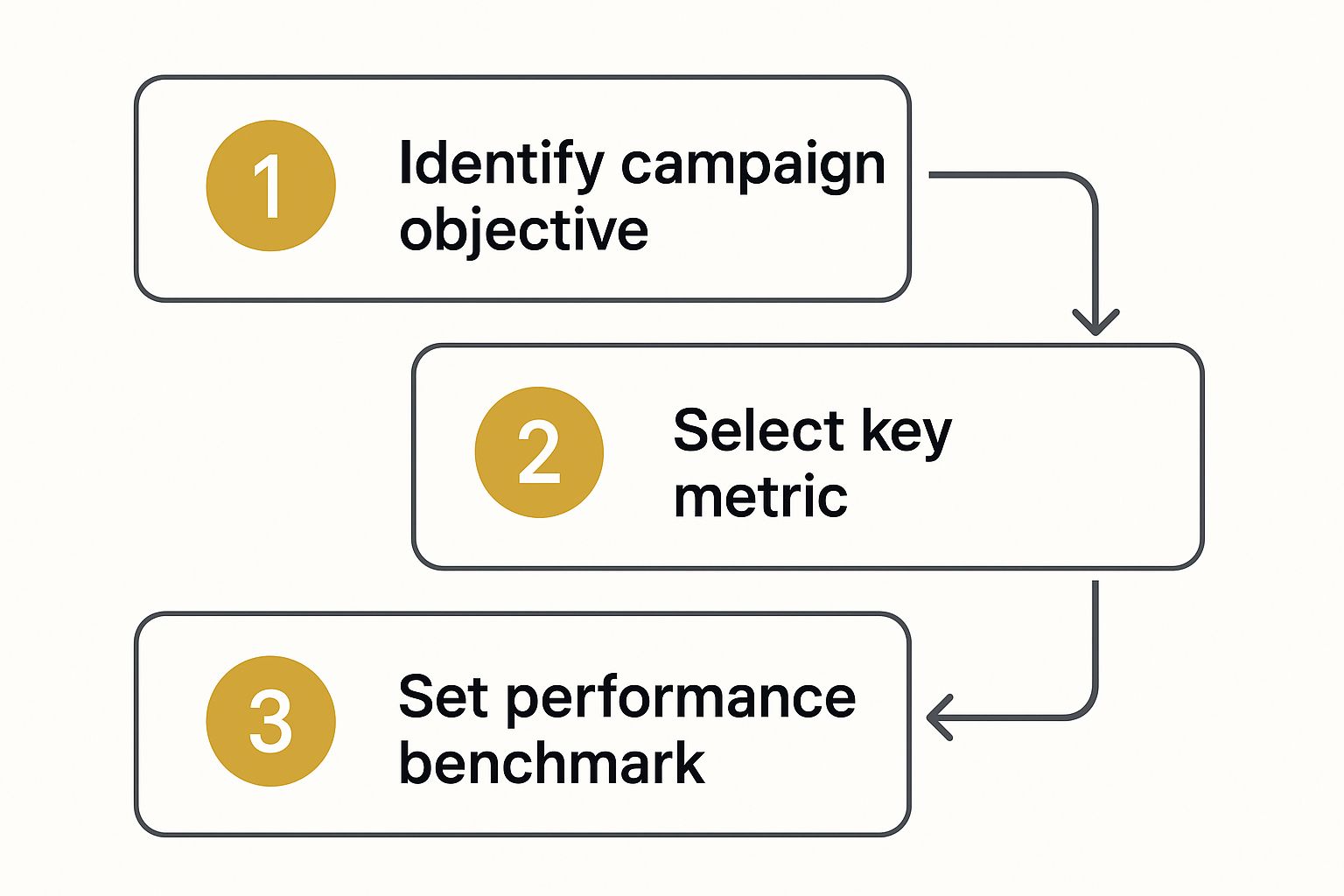
As the graphic illustrates, a clear line from your high-level objective to a specific, measurable benchmark is what makes every test purposeful.
Selecting the Right Tools for the Job
The tools you use can range from completely free to incredibly sophisticated. The good news? You don't need a pricey, top-of-the-line platform to get started. Google Analytics, with its built-in "Experiments" feature, is a fantastic, no-cost way to dip your toes into A/B testing on your website.
As your testing programme gets more advanced, you might want to look into dedicated platforms that offer more powerful features like integrated heatmaps and advanced audience segmentation. The key is to match the tool to your team's expertise and the complexity of your tests. For marketers just starting out, our beginner's guide to digital marketing can help you get to grips with the essential tools of the trade.
A famous example from right here in the UK comes from British Airways. Before they launched a new website, they meticulously A/B tested every single page over several months. It wasn’t a quick fix, but this methodical approach allowed them to fine-tune every element for a better user journey and improved conversions before the big reveal.
The final, crucial piece of this puzzle is statistical significance. This tells you if your results are genuine or just a fluke caused by random chance. Most testing tools will calculate this for you, but you should always aim for a confidence level of 95% or higher. Hitting that threshold means you can trust the result and make bold, data-backed decisions for your business.
Running Tests That Actually Give You Clear Answers

Alright, you've got a solid hypothesis and you know what success looks like. Now comes the fun part: putting your ideas into action. But executing a clean, effective A/B test is all about discipline. The real goal isn't just to run a test; it's to get unambiguous results you can confidently build a strategy on.
This is where the golden rule comes in: isolate a single variable. I know it’s tempting to test a new headline, a different image, and a snappier call-to-action all in one go. But if your conversions suddenly spike, what caused it? Was it the headline? The picture? You'll be left guessing. The true power of a/b testing marketing is in pinpointing precisely what moves the needle.
What This Looks Like In The Real World
The core principle—one change at a time—is universal, but how you apply it will look different depending on your marketing channel.
For Email Marketing
This is classic territory. The most common and often highest-impact test is the subject line. Your primary goal here is almost always to boost your open rate. For instance, you could pit a straightforward subject line against one that piques curiosity.
- Variation A: "Our July Marketing Newsletter Is Here"
- Variation B: "5 Secrets Your Competitors Don't Want You to Know"
A simple test like this can tell you so much about what grabs your audience's attention. As your email programme gets more sophisticated, you can test different sender names or preview text. When you have a reliable way to optimise your campaigns, you can really unlock the many advantages of email marketing.
For Landing Pages
On a landing page, your headline is everything. It's the first thing a visitor sees and it heavily influences whether they stick around or hit the back button. Let’s say you’re promoting a new software tool.
- Variation A (Control): "Powerful Project Management Software"
- Variation B (Challenger): "Finish Your Projects 30% Faster"
Notice how Variation B flips the script from the feature (what the software is) to the benefit (what it does for the user). This is a textbook test that often reveals whether your audience responds better to a direct description or a value-driven promise.
How To Avoid Ruining Your Own Test
A badly run test is genuinely worse than no test at all. Why? Because it gives you false confidence to make the wrong decisions. I’ve seen two mistakes derail tests more than any others.
First, changing variables mid-stream. Once a test is live, you have to resist the urge to tinker. If you "improve" one of the versions halfway through, you’ve just invalidated every piece of data you collected up to that point. Let it run its course, untouched.
The second big one is running too many tests at once with an overlapping audience. If a user sees your new ad creative (Test 1) and then lands on a page with a different headline (Test 2), their behaviour is now influenced by both changes. This "test pollution" makes it impossible to attribute a lift in conversions to either experiment with any accuracy.
A core tenet of good testing is patience. You must let a test run long enough to collect a meaningful amount of data and account for variations in user behaviour, such as differences between weekdays and weekends. Ending a test early because one variation has a slight lead is a classic rookie error.
Figuring Out Sample Size and Test Duration
So, how long should you run your test? The answer isn't a set number of days. It really comes down to two things: your traffic volume and the statistical significance you’re aiming for.
You simply need enough visitors to see each variation to be sure the results aren't just a fluke. A high-traffic site might get a clear winner in a few days, but a smaller site might need to run a test for several weeks to get a reliable result.
Your best bet is to use an online A/B test duration calculator. You’ll plug in your current conversion rate and the minimum improvement you want to be able to detect. The tool will then tell you the sample size you need for each variation and estimate how long the test will take based on your daily traffic.
Always aim for a statistical confidence level of at least 95% before you call it. This level of rigour is what separates professional optimisation from just guessing and hoping for the best.
Unlock Deeper Insights with Customer Segmentation
Getting a winning A/B test result feels great, but looking only at the overall average can hide what’s really going on. That big win might actually be a total flop with your most valuable customers. This is a trap I've seen many marketers fall into; a one-size-fits-all approach to testing will always hit a ceiling.
The real breakthroughs in a/b testing marketing happen when you start slicing your data into meaningful customer segments. When you do this, you move beyond broad, often misleading conclusions and start spotting the powerful, hidden opportunities tailored to specific groups.
Why Averages Can Be Deceiving
Let’s walk through a common scenario. Imagine you test a new, discount-focused headline against your standard, value-focused one. The overall result? A tie. It’s so tempting to just call it a wash and move on, but you’d be leaving the most valuable insight on the table.
Dig a little deeper, and you might discover that the discount headline was a massive winner with new visitors, boosting their conversion rate by 30%. At the same time, it was a complete failure with your returning customers, who found it cheap or off-brand and converted less. The average result was flat, but the segmented view tells you a powerful story: you need different messaging for different points in the customer journey.
A mediocre overall result could be masking a massive success with a niche segment. Failing to segment your test results is like trying to read a book by only looking at the cover—you miss the entire plot.
This segmented thinking is where your marketing gets personal and incredibly effective. You stop creating generic campaigns and start building experiences that truly resonate with specific needs and mindsets.
Common and Powerful Segmentation Strategies
You can segment your audience in countless ways, but from my experience, a few methods consistently deliver the goods. A great place to start is by looking at your audience through these lenses:
- New vs. Returning Visitors: It’s a classic for a reason. New visitors need to quickly grasp your value proposition. Returning visitors are often looking for something more—advanced information, new features, or offers that reward their loyalty.
- Mobile vs. Desktop Users: The user’s context is worlds apart. Mobile users are often on the move, needing concise info and big, thumb-friendly buttons. Desktop users, on the other hand, might have more time and be more willing to engage with detailed content or more complex forms.
- Geographic Location: Never underestimate regional differences. Customer preferences, cultural norms, and even the changing seasons can vary dramatically by location. A message that lands perfectly in London might fall flat in Manchester or Edinburgh.
This level of detail completely transforms your testing programme. For instance, in the UK referral marketing space, some brands have seen performance jump by up to four times in just six months by using customer cohort segmentation. Instead of blasting out generic promotions, UK marketers can tailor offers based on detailed customer behaviour. You can discover more about optimising referral marketing metrics to see just how effective this can be.
A/B Testing Scenarios by Customer Segment
The true power of segmentation really shines when you begin forming specific hypotheses for each group. The aim is to see how different segments react to the same core test, which can unlock some profound strategic insights.
Here’s a table showing how this might look in practice, moving from a general idea to specific, segment-focused tests.
| Customer Segment | Test Hypothesis | Variation A | Variation B | Expected Outcome |
|---|---|---|---|---|
| New Visitors | A headline focused on immediate benefits will convert better than a feature-led one. | "Advanced SEO Analytics Tool" | "See Your Top Keywords in 60 Seconds" | Variation B will significantly increase sign-ups for this first-time audience. |
| Mobile Users | A shorter, simpler form will reduce friction and generate more leads on smaller screens. | 5-field contact form | 2-field form (Name, Email) | Variation B will boost form completions specifically on mobile devices. |
| Returning Customers | Highlighting an exclusive loyalty discount will encourage repeat purchases from existing fans. | Standard product page | Product page with a prominent "15% Off For You" banner | Variation B will improve the add-to-cart rate for this specific segment. |
By analysing your results through these distinct lenses, you stop making compromises and start personalising the user experience at scale. You might end up showing one headline to new visitors and a completely different one to loyal customers, creating a more relevant and effective website for everyone. This is how you level up from basic A/B testing to a sophisticated optimisation programme that drives real, sustainable growth.
Turning Your Test Results Into Real Growth

Running the test and getting the numbers is one thing. The real skill is figuring out what those numbers actually mean and turning them into smart, practical decisions for your business. It's tempting to just glance at the results, see which version got more clicks, and call it a day.
But if you stop there, you’re leaving the most valuable insights on the table. To make A/B testing a genuine growth engine, you have to dig into the 'why' behind the 'what'. This is how you go from just data to deep-seated customer knowledge that can shape your entire marketing approach.
Looking Beyond the Winner
Once your test wraps up, the very first thing you need to check is statistical significance. Most testing tools will give you a confidence level, and you should be aiming for 95% or higher. Anything less, and your results could just be a fluke – not something you want to bet your strategy on.
Getting a 95% confidence level means there’s only a 5% chance the result was random. It’s the professional standard that separates real analysis from a lucky guess, giving you the confidence to act.
But even that isn’t the end of the story. The typical question is, "What was the conversion lift?" A much better question to ask is, "What did this teach me about my audience?"
A winning test doesn't just improve a single metric; it proves an assumption you had about your customers. And a losing or inconclusive test? That’s just as valuable. It tells you an assumption was wrong, stopping you from making a bad decision down the line.
When you start thinking this way, every test becomes a learning opportunity, win or lose. It’s a subtle shift in mindset, but it's absolutely crucial for building an effective a/b testing marketing programme.
Creating a Continuous Feedback Loop
The insights from one test should feed directly into the idea for the next one. This creates a cycle of learning and improving that pays bigger and bigger dividends over time.
Imagine you tested a benefit-focused headline ("Finish Projects 30% Faster") against a feature-focused one ("Powerful Project Management Software"). The benefit-led headline wins by a landslide.
This is more than just a win for a headline. It's a genuine insight into how your customers think.
- The Lesson: Your audience cares more about results and efficiency than the technical specs of your tool.
- Next Action: Start weaving this benefit-first approach into your other marketing materials.
- Next Hypothesis: "If focusing on benefits worked on our landing page, then rewriting our email subject lines to highlight outcomes should boost our open rates."
See how that works? You've created a logical thread connecting your tests, building your customer knowledge with each experiment. You’re no longer just running random tests; you’re developing a powerful understanding of what motivates your audience. This kind of connected thinking is at the heart of building a successful marketing strategy for small business.
Documenting and Sharing Your Learnings
Your test results are too valuable to be locked away on one person's dashboard. To really get your money's worth, you need a simple way to document what you’ve learned and share it with the rest of the company. This doesn't have to be a massive undertaking; a shared spreadsheet or a simple document in a shared drive can work wonders.
For every test you run, make sure you log these key details:
- The Hypothesis: What did you think would happen, and why?
- The Variations: Clear descriptions or screenshots of your original and the new version.
- The Results: The key numbers, the conversion lift, and that all-important statistical confidence level.
- The Core Insight: In plain English, what did you learn about your customers from this?
- Next Steps: What's the plan for implementing the winner, and what new test idea has this sparked?
This simple habit creates an incredibly valuable knowledge bank over time. It stops you from repeating old tests and ensures that the whole company—from sales to product development—benefits from a deeper understanding of the customer. This is how you align everyone around the user and turn A/B testing into a true driver of growth.
A/B Testing Marketing: Answering Your Common Questions
Even with the best plan in the world, you're bound to hit some tricky spots when you get down to the business of A/B testing. It happens to everyone. Let's walk through some of the most common questions and sticking points I see marketers struggle with, so you can navigate them with a bit more confidence.
This is all about getting past the textbook theory and into the real-world scenarios that can stall your progress or make you doubt your results.
How Long Should I Actually Run an A/B Test?
Honestly, there's no single magic number. If anyone tells you "run it for X days," they're oversimplifying things. The right duration for your test comes down to two things: your website traffic and the conversion rate of whatever you're trying to improve. Cutting this short is probably the fastest way to get data that lies to you.
Your test needs to run long enough to hit two essential milestones.
- Achieve Statistical Significance: This is the big one and it's non-negotiable. You simply must collect enough data for your testing software to say, with confidence, that the result isn't a fluke. You should be aiming for a confidence level of at least 95%.
- Cover a Full Business Cycle: People behave differently on a Tuesday morning than they do on a Saturday night. By running your test for at least one full week—and two is even better—you smooth out these natural peaks and troughs, giving you a much truer picture of performance.
For a busy e-commerce site, you might get there in a few days. For a B2B blog with less traffic, it could easily take several weeks. Patience really pays off here.
What if My Test Shows No Clear Winner?
First off, don't look at it as a failure. An inconclusive result is actually a result in itself, and it’s a valuable piece of intel. It’s telling you, quite clearly, that the change you made didn't have a meaningful impact on how your users behave.
Think of it this way: that result just saved you from rolling out a change that would have done nothing. It’s a signal to go back to the drawing board and think a bit harder about what really matters to your audience.
An inconclusive result often means your hypothesis wasn't bold enough. Tweaking a button from one shade of blue to another is unlikely to move the needle. This is your chance to dig back into your customer research and come up with a bolder hypothesis that tackles a more fundamental user problem.
A "flat" result pushes you away from tiny tweaks and towards bigger, more impactful ideas for your next experiment. It's not a dead end; it's a redirection.
Can I Test More Than One Thing at a Time?
You certainly can, but it's important to realise that you've moved beyond a standard A/B test. When you start testing multiple elements at once, you're getting into what's called multivariate testing (MVT).
Let's break down the difference, because it's a crucial one:
- A/B Testing: You test a single change (e.g., headline A vs. headline B). It's clean, simple, and tells you exactly which version performed better.
- Multivariate Testing (MVT): You test multiple combinations at once (e.g., two different headlines and two different images). This helps you see which combination of elements works best together.
MVT is a powerful technique for understanding how different page elements interact, but it has one major requirement: it needs a lot more traffic than a simple A/B test to deliver statistically significant results. For most businesses, especially if you're just building your optimisation programme, sticking to the clarity and simplicity of A/B tests is the smarter path.
What’s a “Good” Conversion Rate Uplift?
It's so easy to see a case study shouting about a 300% lift and feel like your own results aren't good enough. While those massive wins can happen, they're incredibly rare. The real goal of a healthy A/B testing marketing programme is to achieve consistent, incremental gains.
Think about it: a steady 5-10% uplift from a series of well-thought-out tests is a huge success. Over a year, those small, regular improvements compound and can have a massive effect on your revenue and growth.
Your focus should be on building a repeatable process of learning and improving, not on chasing a single "silver bullet" test. It’s the aggregation of these marginal gains that ultimately leads to outstanding performance over time.
Ready to stop guessing and start growing? The Digital Marketing Toolbox is your central hub for discovering and comparing the best tools for analytics, SEO, email automation, and more. Find the right solutions to power your testing and optimisation efforts today.


