
Understanding Your Local Market Like a Pro
Here's the catch: many local business owners think they know their market inside and out simply because they live there. But the truly successful ones dig much deeper. They understand that thriving locally means getting a feel for the area's unique pulse. It's more than just knowing your immediate rivals; it's about understanding the customer journey within your community. How do people in your area search for stuff online? What are their local concerns and values?
Think of a cafe owner. They might assume their competition is just the other coffee shops down the street. But their real competition might be the bakery that sells takeaway coffee, the mobile coffee van by the train station, or even the supermarket meal deal. This wider view opens up opportunities that others miss. Are you competing on convenience, price, quality, or a unique experience? Knowing what makes local customers tick is the key to effective advertising for local businesses.
Knowing your community's seasonal trends also dramatically impacts your advertising strategy. A florist, naturally, would ramp up advertising for Valentine's Day and Mother's Day. But maybe there's a local festival or annual event they could also tap into. This localized knowledge allows for smarter, more targeted campaigns. Small businesses are the backbone of the UK economy, making up 99% of all 5.5 million businesses nationwide – that’s about one business for every 13 people! For these local enterprises, effective advertising is essential for survival and growth.
Surveys, like LOCALiQ’s UK State of Digital Marketing Report in 2025, revealed that over 500 UK businesses get how important digital marketing is for competition and customer connection. And with the UK's projected social media advertising revenue hitting £9.95 billion by 2025, it's clear that local businesses are investing heavily in these platforms to reach their ideal customers. Want to dive into these numbers? Check out: UK Social Media Statistics
So, understanding your local market means blending online research with real-world intel. Talk to your customers. Go to local events. See where the foot traffic goes. This on-the-ground research, paired with data from tools like Google Trends, can tell you a lot about what your community is looking for and how they interact with businesses like yours. By getting this specific, your local business advertising becomes less about guessing and more about making genuine connections.
Crafting Your Local Brand Identity That Actually Connects
Your brand is way more than just a logo. It's the whole feeling customers get when they interact with your business. For local businesses, this boils down to truly understanding your community and reflecting its values in how you talk to them. That genuine connection is what turns local shops into neighborhood favorites.
Think of it this way: a local bookstore in Edinburgh might showcase Scottish authors and host Gaelic storytelling nights. They're tapping into the local culture, not just advertising. This weaves them into the community and creates a sense of belonging that big chains can’t match.
Visual Identity: From Storefront to Social Media
Your visual identity needs to be consistent everywhere – your physical store, your website, your Instagram feed. Everything needs to feel connected. Imagine a family-run bakery. Warm, inviting colors on their sign, website, and social media reinforce their homemade goodness. This consistency builds brand recognition, making them instantly recognizable around town.
Also, never underestimate the power of a good story. Sharing the story behind your business—maybe it’s been passed down for generations or was inspired by local traditions—builds trust and loyalty. Authenticity is key. People connect with real stories.
Showcasing Local Expertise and Community Involvement
Highlight what makes you uniquely local. A greengrocer could emphasize sourcing produce from nearby farms, supporting local growers and reducing food miles. This taps into the growing desire for sustainability and supporting local, giving them a real advantage.
Don’t be shy about your community involvement either. Sponsoring the local football team or joining neighborhood clean-up days can make a difference. Just keep it natural. Forced or fake gestures can actually hurt you.
Finally, remember that connecting with your community’s specific culture is crucial. A restaurant in Cardiff could offer special menus for local events like the Six Nations rugby. By engaging with local happenings, you become part of the conversation and build stronger bonds with your customers. This targeted approach really strengthens your brand’s local relevance and fosters a sense of shared experience.
Choosing Advertising Channels That Actually Pay Off
Picking the right advertising channels can feel overwhelming. What works for that hip cafe down the street might not work for your business. Instead of throwing money at every option, let’s get strategic and figure out what actually delivers. This isn't about theory; it's about real-world results and what's working for UK businesses right now. Choosing the right channels for local business advertising is even more critical. It’s all about knowing your audience and their habits. Where do they hang out? Are they scrolling through Instagram, listening to the local radio, or picking up the local paper?
Let's say you own a cool independent bookshop in Brighton. Instagram might be perfect for showing off new arrivals and author events. But if you're running a plumbing service in Birmingham, targeted Google Ads for “emergency plumber Birmingham” could be a game-changer. See the difference? It's about precision targeting, not just shouting your message into the void. If you're looking for a deeper dive into overall marketing strategy, check out this resource on developing a comprehensive marketing strategy.
Speaking of targeting, let's look at some real numbers about how different channels perform. The infographic below breaks down typical reach percentages for three popular local advertising methods.
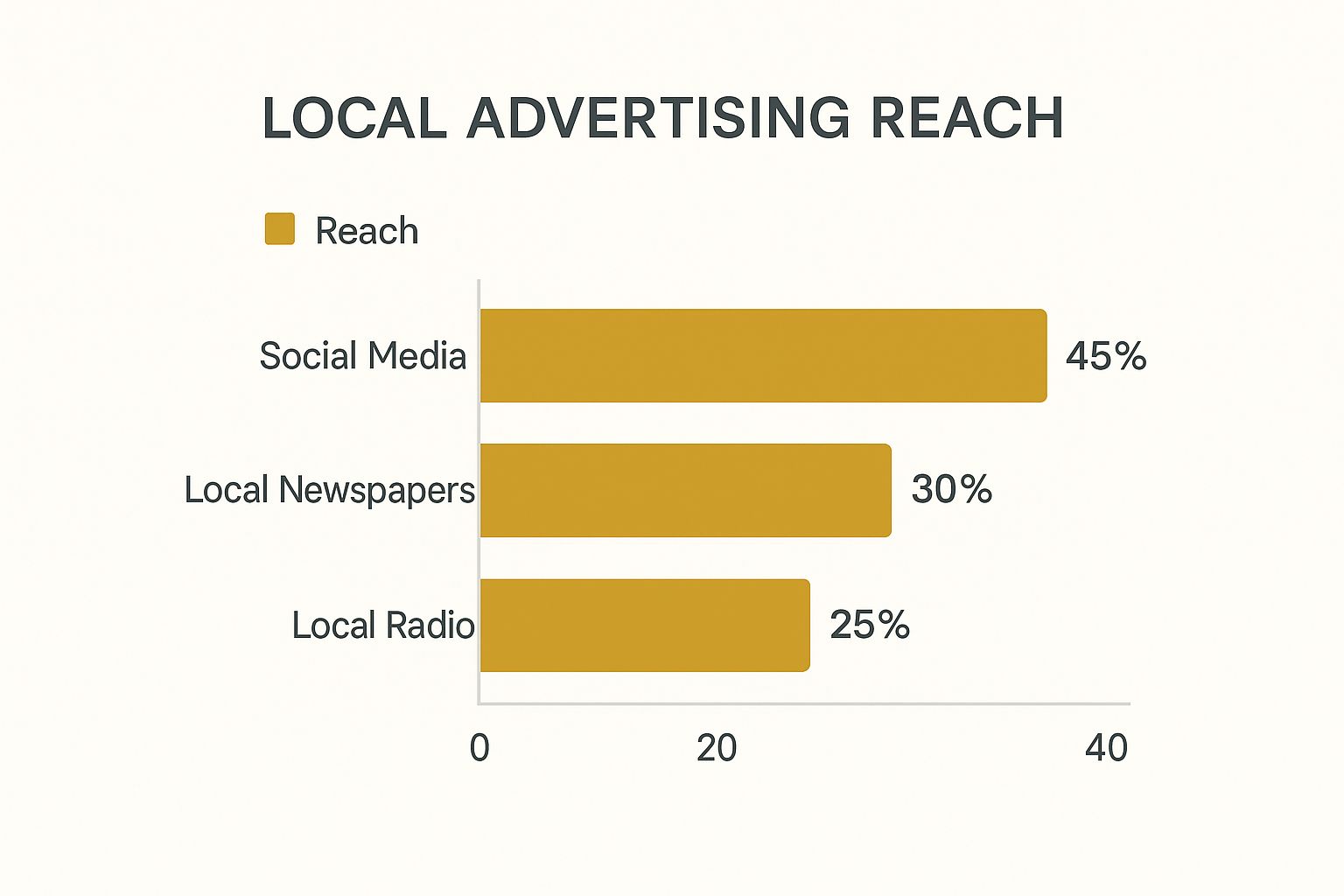
As you can see, social media comes out on top, reaching 45%. Local newspapers still hold their own at 30%, with local radio at 25%. This tells us that having a solid social media presence is key, but don’t count out those traditional methods just yet!
Riding the Mobile Wave
Another thing we can’t ignore? The power of mobile. The UK mobile advertising market was worth a whopping $18.8 billion in early 2021 and is predicted to hit $29.3 billion by 2025. Think about it: in 2021, digital video ad spending in the UK reached £5.5 billion – that’s nearly a quarter of all digital ad spend! This tells us two things: mobile-friendly ads are essential, and video is becoming king. For more insights into UK advertising trends, look here.
Testing and Free Opportunities
Don't be afraid to experiment with new channels, but do it strategically. Start small, track your results like a hawk, and be prepared to switch things up based on what you learn. And don't forget about all the free promotional opportunities out there! Teaming up with other local businesses, taking part in community events, or supporting local initiatives are all fantastic ways to boost your visibility and build relationships without spending a fortune.
To help you compare different advertising avenues, I've put together a quick comparison table:
Local Advertising Channels Comparison: Cost-effectiveness, reach, and suitability comparison of different advertising channels for local businesses
| Channel | Average Cost | Local Reach | Best For | Time to Results |
|---|---|---|---|---|
| Social Media (e.g., Facebook, Instagram) | Varies (can be low) | High (potential for viral reach) | Building brand awareness, engaging with customers, targeted campaigns | Relatively fast |
| Local Newspapers | Moderate to High | Moderate (depending on circulation) | Reaching older demographics, building credibility | Can be slower |
| Local Radio | Moderate | Moderate (depends on listenership) | Reaching specific demographics based on station format | Moderate |
| Google Ads | Varies (pay-per-click) | High (targeted based on search terms) | Driving traffic to your website, reaching customers actively searching for your products/services | Fast |
| Community Events/Partnerships | Low to None | Varies (depends on event and partners) | Building relationships, increasing local visibility | Can be slower, but builds long-term value |
This table gives you a quick overview of the pros and cons of each channel. Notice how each has its strengths and weaknesses. Social media offers high reach and fast results, but costs can vary. Local newspapers can build credibility, but they might not be the best for reaching younger audiences. Think carefully about your target audience and your goals when making your choices.
Creating Local Content That Makes People Take Action
Generic marketing just doesn't work at the local level. Authenticity reigns supreme in your neighborhood. The content that gets local customers walking through your doors isn't the same stuff big national brands pump out. So, how do you create local business advertising that actually gets results? It’s all about talking directly to your community.
I've witnessed firsthand how powerful this can be. A local bakery I partnered with started showcasing photos of their bread next to local landmarks in their Instagram posts. Their engagement suddenly took off. People loved seeing their town celebrated alongside beautifully crafted sourdough. It gave the bakery a real sense of belonging within the community. This is especially important in the UK, where supporting local businesses is a deeply ingrained cultural value. It fosters a sense of shared experience that large corporations just can't replicate.
Making Your Message Resonate Locally
Sprinkling in local flavor is essential, but it has to feel organic, not forced. Don't just randomly name-drop the local football team. Find genuine connections. Perhaps you offer a discount to fans on game days or feature a player who raves about your scones. That type of genuine connection resonates far more deeply than a generic “Support Local!” slogan.
Creating content around local events is another great tactic. Imagine a pub in Manchester promoting special offers during the Manchester International Festival. It becomes the place for pre-show drinks and post-show discussions. These connections build loyalty and make your business feel like a vital part of the neighborhood.
Compelling Offers and Attention-Grabbing Headlines
Think about offers that encourage immediate action. “20% off your first order” is good, but “20% off your first order plus a free Chelsea bun” is even better. That little something extra demonstrates how much you appreciate local customers.
The same principle applies to headlines. Instead of “Best Fish and Chips in Town,” try “The Fish and Chips Even Mancunians Queue For.” It sparks curiosity and makes people want to test your claim. You might also want to explore how email marketing can boost your local advertising by targeting specific customer groups.
Visuals That Pop Without Breaking the Bank
You don't need expensive photoshoots. Authenticity always beats over-polished visuals. High-quality smartphone photos are perfectly acceptable, especially on platforms like Instagram. Focus on capturing the spirit of your business and community. A behind-the-scenes glimpse of your team preparing those famous sausage rolls can be far more engaging than a sterile product shot. It’s that genuine human connection that turns casual customers into regulars.
Mastering Digital Platforms That Drive Local Traffic

So, we've talked about picking the right advertising channels. Now, let's get down to brass tacks: how do you actually own those digital spaces that really matter for local businesses? It's about making your Google My Business profile shine, crafting Facebook and Instagram ads that speak directly to your neighborhood, and using local SEO to make sure you pop up when potential customers are searching. Think of it like setting up a killer storefront on Main Street – you want it to be inviting and impossible to miss.
Google My Business: Your Digital Storefront
Your Google My Business profile is often the very first thing people see when they search for local businesses. It's your digital storefront, so treat it like gold. Double-check that all your info is accurate and current—opening hours, address, phone number, website link—you know the drill. Then, spice it up with some high-quality photos of your products, services, and even your team. It’s a chance to give potential customers a peek behind the curtain and build that all-important trust.
I remember when I first started consulting, I completely overlooked my Google My Business profile. Once I updated it with photos and accurate info, I saw a noticeable jump in inquiries. It really is a game-changer.
Facebook and Instagram: Connecting With Your Community
Facebook and Instagram are advertising powerhouses for local businesses. The beauty of location targeting is that you can narrow your ad audience down to a specific radius around your business. Imagine a fish and chips shop in Brighton—they could target people within a two-mile radius. That means your budget isn't being wasted on people miles away who aren't likely to visit. And don’t forget Facebook's local awareness campaigns, designed specifically to reach nearby residents and drive foot traffic to your door.
Local SEO: Getting Found When It Matters Most
Local SEO is all about making sure you appear high up in local search results. A key piece of this puzzle is keyword optimization. Figure out what keywords people use when they search for businesses like yours in your area. A bakery in Edinburgh might target keywords like “artisan bread Edinburgh” or “best cakes Edinburgh.” Then, weave those keywords naturally into your website content, Google My Business description, and social media posts. Interested in learning more about digital marketing? Check out our beginner's guide.
Speaking of the UK’s digital advertising scene, get this: in 2024, the sector saw a whopping £42.6 billion spent, a 7.6% real-term growth even with economic uncertainty. Online display advertising, in particular, took off, with a 15.1% year-on-year increase. This just shows how important these digital channels are. Want to learn more about this growth?
Online Reviews and Social Proof
Don't underestimate the power of online reviews. Encourage happy customers to leave reviews on Google, Yelp, and other relevant platforms. Responding to reviews, both good and bad, shows potential customers that you care about their feedback. This is all about building social proof, which is incredibly valuable for local businesses. Showcasing testimonials, case studies, and user-generated content builds credibility and trust within your community. It tells everyone that you’re the real deal.
Tracking What Actually Matters for Your Bottom Line
Let's be honest, “impressions” and “reach” sound impressive, but they don't pay the bills. As a local business, you need to focus on the metrics that actually bring in the cash. Forget the vanity metrics, we're talking about the real deal – the stuff that puts money in the till. So, how do you track what really works? Let's dive in.
Measuring What Matters: Foot Traffic, Calls, and Conversions
Instead of getting lost in a sea of data, smart local businesses zero in on a few key performance indicators (KPIs). Think of it like this: if you run a brick-and-mortar store, foot traffic is king. Are people actually walking through your door because of your ads? Something as simple as a sign-in sheet or a clicker can tell you a lot.
If your business relies on phone calls, then call conversions are your bread and butter. One trick I've used is setting up unique phone numbers for different ads. This way, you know exactly which campaigns are ringing the register (literally!). Services like CallRail can make this a breeze. And of course, if you have an online presence, tracking online conversions like website purchases or bookings is essential. Make sure you have conversion tracking set up in Google Ads and other platforms.
Benchmarks and Strategies for Continuous Improvement
How do you know if your numbers are good? Industry averages can be helpful, and so can chatting with other local businesses in your area. But honestly, the best benchmark is often your own past performance. Are you seeing improvement month over month? That's a great sign!
Don't be afraid to play around with your advertising. Try different ad copy, target new demographics, or even test out different ad platforms. The key is to constantly analyze and tweak what you're doing. This way, you're not starting from scratch every time, but rather fine-tuning your approach for maximum impact.
Setting Up Tracking Systems and Interpreting the Data
Setting up the right tracking systems from the get-go can save you a lot of headaches down the road. Google Analytics is your friend here. By linking your advertising campaigns to your analytics dashboard, you can see the entire customer journey – from the first click on your ad all the way to the final purchase.
Once you understand the data, you can make smarter decisions about where to spend your advertising dollars. For example, if your Facebook ads are driving more in-store visits than your Google Ads, shift more of your budget to Facebook. It’s all about making data-driven decisions, not just guessing.
Recognizing Warning Signs and Adapting Your Strategy
Catching underperforming campaigns early is crucial. Low click-through rates? Your ad copy might need some work. Low conversion rates? Maybe your landing page isn’t cutting it. Tracking the right metrics lets you spot these red flags and adjust your strategy before you waste your budget.
Let's talk about the metrics you should be watching. The table below outlines the essential KPIs for local businesses, why they matter, how to track them, what a good benchmark might look like, and tips for improvement.
Introducing the “Local Business Advertising KPIs Dashboard.” This table outlines the essential metrics to track for local advertising success, along with realistic benchmarks and how to measure them.
| Metric | Why It Matters | How to Track | Good Benchmark | Improvement Tips |
|---|---|---|---|---|
| Foot Traffic | Measures in-store visits driven by ads | Customer sign-in, clicker counter, POS system integration | Varies by industry and location, track your own trends | Targeted local ads, promotions, in-store events |
| Call Conversions | Tracks calls generated by specific ad campaigns | Unique phone numbers for different ads, call tracking software | Target conversion rate (e.g., 20% of calls lead to appointments) | Clear call to action in ads, optimized website for mobile |
| Online Conversions | Measures website actions like purchases or bookings | Conversion tracking in ad platforms and analytics | Varies by industry and platform, track your own trends | Targeted landing pages, A/B testing, retargeting campaigns |
| Click-Through Rate (CTR) | Shows how often people click your ads | Ad platform reporting | Aim for above industry average | Compelling ad copy, relevant keywords, eye-catching visuals |
| Conversion Rate | Measures how many clicks turn into desired actions | Ad platform reporting, analytics | Track your own progress and aim for steady improvement | Optimize landing pages, improve user experience, offer incentives |
This table gives you a practical framework for measuring what truly matters for your local business. By tracking these KPIs, you can gain valuable insights into your advertising performance and identify areas for improvement.
Local business advertising is a marathon, not a sprint. It's about constantly learning, adapting, and fine-tuning your approach. By focusing on the metrics that actually impact your bottom line, setting up effective tracking, and interpreting the data to make smart decisions, you'll be well on your way to maximizing your ROI and growing your business.
Your Practical Local Advertising Action Plan

Okay, let's get down to brass tacks. How do you actually put all this information into action? We're going to build a plan that’s doable, fits your specific needs, and works within your resources. This isn't about short-term gains; we’re building something sustainable. We’ll snag some quick wins to get the ball rolling, but also lay down a strategy for the long haul.
Think of it like planning a road trip. You wouldn't hit the road without a destination or a full tank of gas, right? Local business advertising is no different. You need a roadmap. What are you hoping to achieve? What's your budget looking like? Are you aiming for a sudden influx of customers next month, or are you playing the long game and aiming for steady growth over the next year? These are the questions that will shape your strategy.
Prioritizing Efforts and Setting Realistic Timelines
Prioritizing is absolutely essential. If your budget is a bit tight, perhaps start by polishing your Google My Business profile and experimenting with some hyperlocal Facebook ads. These are fantastic ways to see some quick results without spending a fortune, especially valuable for smaller businesses in the UK.
It's important to be realistic about your timelines. SEO is a marathon, not a sprint. You're not going to magically appear at the top of search results overnight. Paid advertising can bring faster results, but even then, it takes some testing and fine-tuning to find the sweet spot. Think of SEO as planting a tree – it takes time and nurturing to bear fruit. Paid advertising, on the other hand, is more like watering a plant – you see a more immediate response.
Launching Campaigns and Avoiding Rookie Mistakes
When you launch those first campaigns, start small. Test different ad copy, experiment with different demographics, and keep a close eye on your results. This allows you to adjust your approach as needed without putting your whole budget on the line. It’s like baking a cake – you try a small batch before baking a five-tiered masterpiece.
One common mistake I see businesses make is spreading their budget too thin across too many channels. Focus your initial energy on a couple of key platforms that really resonate with your target audience and support your specific goals.
Scaling Your Local Business Advertising as You Grow
As you start to see positive results, you can gradually ramp things up. Increase your ad spend on the platforms that are performing well, cautiously test new channels, and constantly refine your approach based on the data you gather. It’s important to remember that growth doesn’t happen overnight, but rather builds over time.
Measuring Progress and Staying Motivated
Consistency is king. Track your progress, celebrate the small victories, and be patient. Even if results seem slow, seeing those incremental improvements can be hugely motivating and keep you on the right track. Every business journey has its bumps in the road, so stay focused on the bigger picture.
Ready to take your digital marketing to the next level? Explore the Digital Marketing Toolbox for all the tools and resources you need to thrive online. Check it out!


