
Running a successful ecommerce business is about more than just selling products; it’s about building lasting customer relationships. As your store grows, managing customer data across multiple channels, from purchase history to support tickets and marketing emails, becomes a complex puzzle. This is where a Customer Relationship Management (CRM) platform becomes essential.
A dedicated ecommerce CRM centralises every customer interaction, transforming fragmented data into actionable insights that drive revenue. It empowers you to personalise marketing campaigns, automate cart abandonment follow-ups, and provide stellar support that turns one-time buyers into loyal brand advocates. To fully appreciate this power, it's helpful to first understand the fundamental customer relationship management basics.
Choosing the right platform, however, can feel daunting given the sheer number of options available. This guide is designed to simplify that decision. We've analysed the market to find the best CRM for ecommerce, breaking down each option with a focus on what matters most for online retailers.
Inside this comprehensive resource, you will find:
- Detailed reviews of top platforms like HubSpot, Klaviyo, and Salesforce.
- Practical pros, cons, and specific use cases for each tool.
- Direct links and screenshots to help you visualise how they work.
- Clear pricing information to match your budget and scale.
Our goal is to provide a straightforward comparison, helping you select the ideal CRM to organise customer data, enhance your marketing efforts, and ultimately, grow your business more effectively.
1. HubSpot CRM
HubSpot CRM stands out as a top contender for the best CRM for ecommerce, primarily due to its powerful, free-forever core platform combined with a dedicated focus on the user journey. It offers native data synchronisation with major ecommerce platforms like Shopify, allowing businesses to centralise customer data, order history, and browsing behaviour. This unified view empowers stores to build highly targeted segments and automate personalised marketing campaigns, from abandoned cart reminders to post-purchase follow-ups.
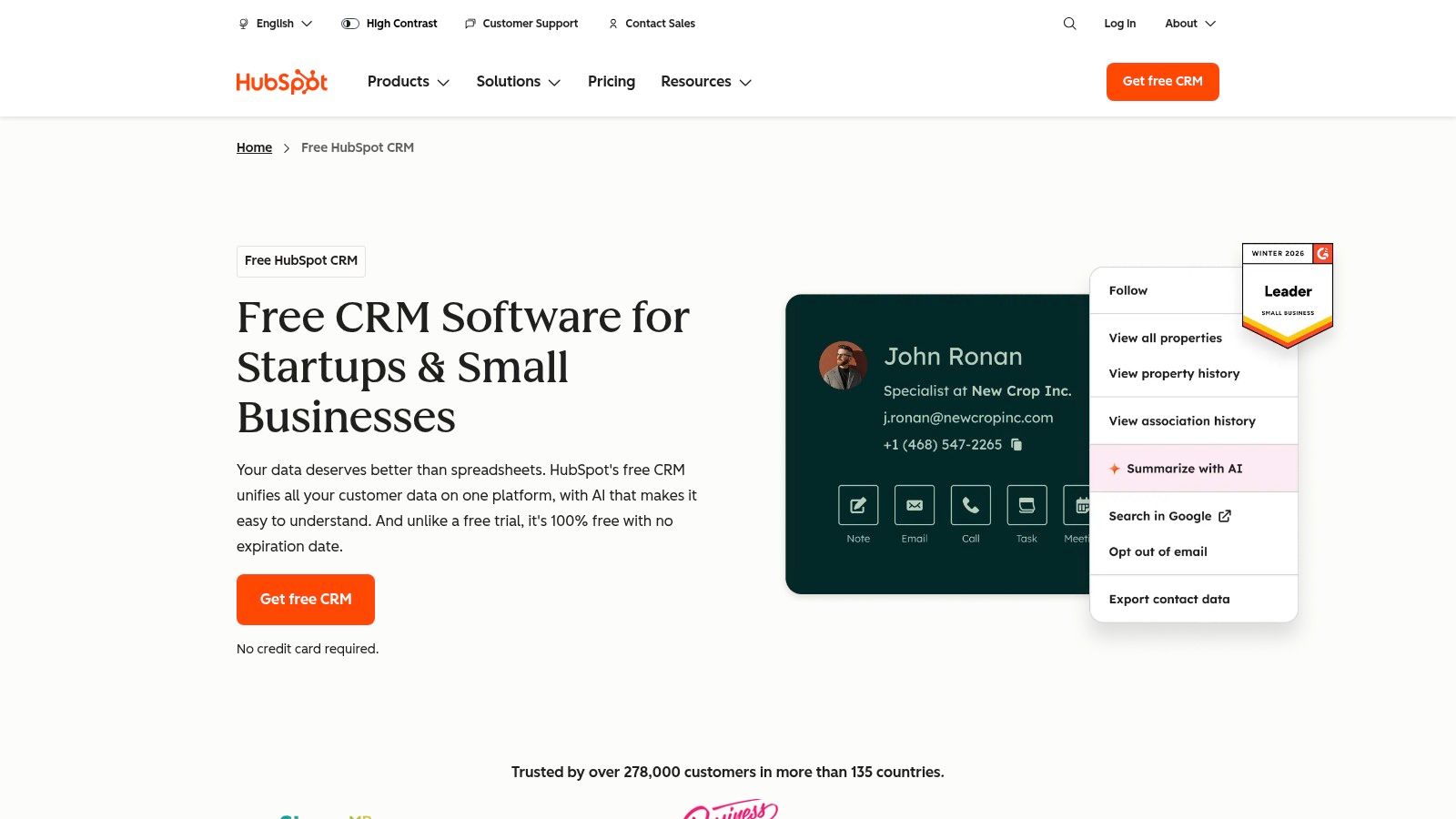
The platform's strength lies in its scalability and extensive integration marketplace. You can start for free and gradually adopt paid "Hubs" for Marketing, Sales, or Service as your business grows. This modular approach makes it accessible for small businesses while offering the depth needed for mid-market enterprises. To further enhance customer engagement within HubSpot, consider its HubSpot Live Chat integration for real-time support directly on your site.
Key Details & Pricing
- Best For: SMBs and mid-market ecommerce stores seeking an all-in-one, scalable solution.
- Pricing: Offers a robust free-forever plan. Paid tiers (Starter, Professional, Enterprise) for advanced features start from around £15/month and scale significantly based on contacts and features.
- Pros: Very low barrier to entry with excellent educational resources. Deep integration capabilities and a user-friendly interface.
- Cons: Advanced automation and reporting are locked behind more expensive tiers. The pricing structure can become complex as you add modules and user seats.
- Website: hubspot.com/products/crm
By leveraging HubSpot's automation, you can create nurturing sequences that significantly boost customer retention and loyalty over time.
2. Salesforce
Salesforce secures its place as a heavyweight contender for the best CRM for ecommerce, particularly for established businesses with ambitions to scale. It moves beyond basic contact management, offering enterprise-grade solutions like Commerce Cloud and powerful add-ons that create a truly unified view of the customer. By integrating tools like Data Cloud, businesses can consolidate every touchpoint, from initial ad click to repeat purchase and customer service interaction, into a single, actionable profile.
The platform’s core strength is its unparalleled customisation and extensibility via the AppExchange marketplace. This allows ecommerce brands to tailor the CRM precisely to their unique workflows, integrating everything from inventory management to specialised retail analytics. While the complexity might be daunting for newcomers, its robust infrastructure provides the power needed for sophisticated segmentation, AI-driven product recommendations, and complex B2B or B2C commerce operations, making it a future-proof investment for growing enterprises.
Key Details & Pricing
- Best For: Mid-market and enterprise-level ecommerce brands requiring deep customisation and scalability.
- Pricing: The Starter Suite begins at £20/user/month (billed annually). More advanced editions and specialised clouds like Commerce Cloud are priced separately on a custom basis.
- Pros: Extremely scalable with enterprise-grade security and compliance. Deep reporting and customisation capabilities through a vast ecosystem of apps.
- Cons: Can be overly complex and expensive for very small businesses. Often requires annual contracts, and essential features or support plans can add significant costs.
- Website: www.salesforce.com/uk/crm/pricing/
3. Klaviyo
Klaviyo has cemented its place as a leading CRM for ecommerce, particularly among direct-to-consumer (DTC) brands that prioritise lifecycle marketing. It functions as a powerful email and SMS marketing automation platform built around a unified customer profile. By deeply integrating with platforms like Shopify, WooCommerce, and BigCommerce, Klaviyo pulls in rich data-like order history, browsing behaviour, and lifecycle stage-to enable incredibly granular segmentation and hyper-personalised communication flows.
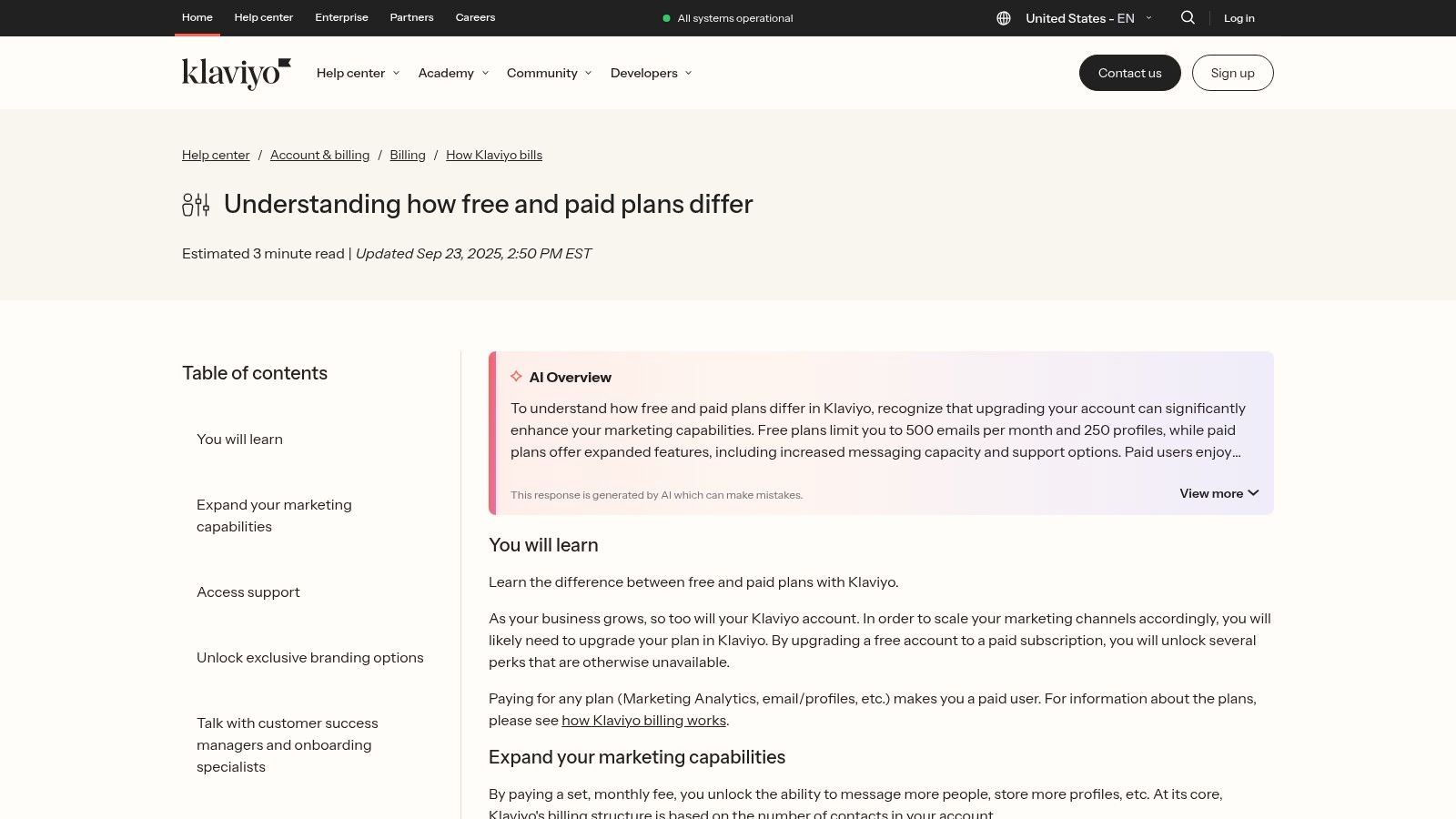
The platform's core strength is its focus on revenue-driving automation. Users can leverage a vast library of pre-built, ecommerce-native templates and flows for everything from welcome series to abandoned cart recovery and win-back campaigns. Its predictive analytics features, such as churn risk and customer lifetime value (CLV), empower businesses to make data-driven decisions, proactively engage at-risk customers, and identify their most valuable segments for targeted marketing efforts.
Key Details & Pricing
- Best For: DTC brands and ecommerce stores focused on sophisticated email and SMS lifecycle marketing.
- Pricing: Offers a limited free plan for up to 250 contacts. Paid plans are based on the number of email contacts and SMS credits, starting from £25/month for email and scaling up.
- Pros: Exceptional segmentation and automation capabilities built for ecommerce. Strong library of templates and industry benchmarks.
- Cons: Can become expensive as your active contact list grows. UK SMS pricing and features can sometimes lack transparency compared to other regions.
- Website: klaviyo.com
4. ActiveCampaign
ActiveCampaign earns its place as a top CRM for ecommerce through its powerful and mature marketing automation engine, specifically designed to guide customers through complex purchasing journeys. It excels at combining email marketing, automation, and a sales CRM into a cohesive platform. With deep integrations for Shopify, WooCommerce, and BigCommerce, it allows merchants to trigger sophisticated workflows based on real-time customer behaviour, such as abandoned carts, first-time purchases, or specific product views. This enables highly personalised and timely communication that directly impacts sales.
The platform is renowned for its visual automation builder, which provides a clear and intuitive way to map out intricate customer sequences. You can build everything from simple post-purchase follow-ups to advanced, multi-path nurturing campaigns that adapt based on customer engagement. While it started with a focus on email, ActiveCampaign has evolved to offer a more holistic view of the customer, making it a strong contender for businesses looking to scale their marketing sophistication without the complexity of an enterprise-level system.
Key Details & Pricing
- Best For: Growing SMBs and mid-market stores that prioritise advanced marketing automation and email deliverability.
- Pricing: Plans are based on contact numbers. The Marketing Lite plan starts around £25/month. Crucial ecommerce features and the sales CRM are available in higher tiers like Plus and Professional.
- Pros: Exceptional visual automation builder with deep triggers. Strong email deliverability and reputation. Good balance of power and user-friendliness for growing businesses.
- Cons: The most valuable ecommerce features are locked behind more expensive plans. The pricing structure has become more complex, and exact UK rates may require a sales quote.
- Website: www.activecampaign.com
5. Drip
Drip establishes itself as a purpose-built "Ecommerce CRM" (ECRM), focusing intensely on automating revenue-driving communication for direct-to-consumer brands. Its primary strength lies in its deep, native integrations with major ecommerce platforms like Shopify, BigCommerce, and WooCommerce, enabling immediate data synchronisation of customer profiles, purchase history, and on-site behaviour. This allows businesses to quickly deploy sophisticated, pre-built automation workflows and segment customers based on real-time shopping activity for highly relevant email and SMS campaigns.
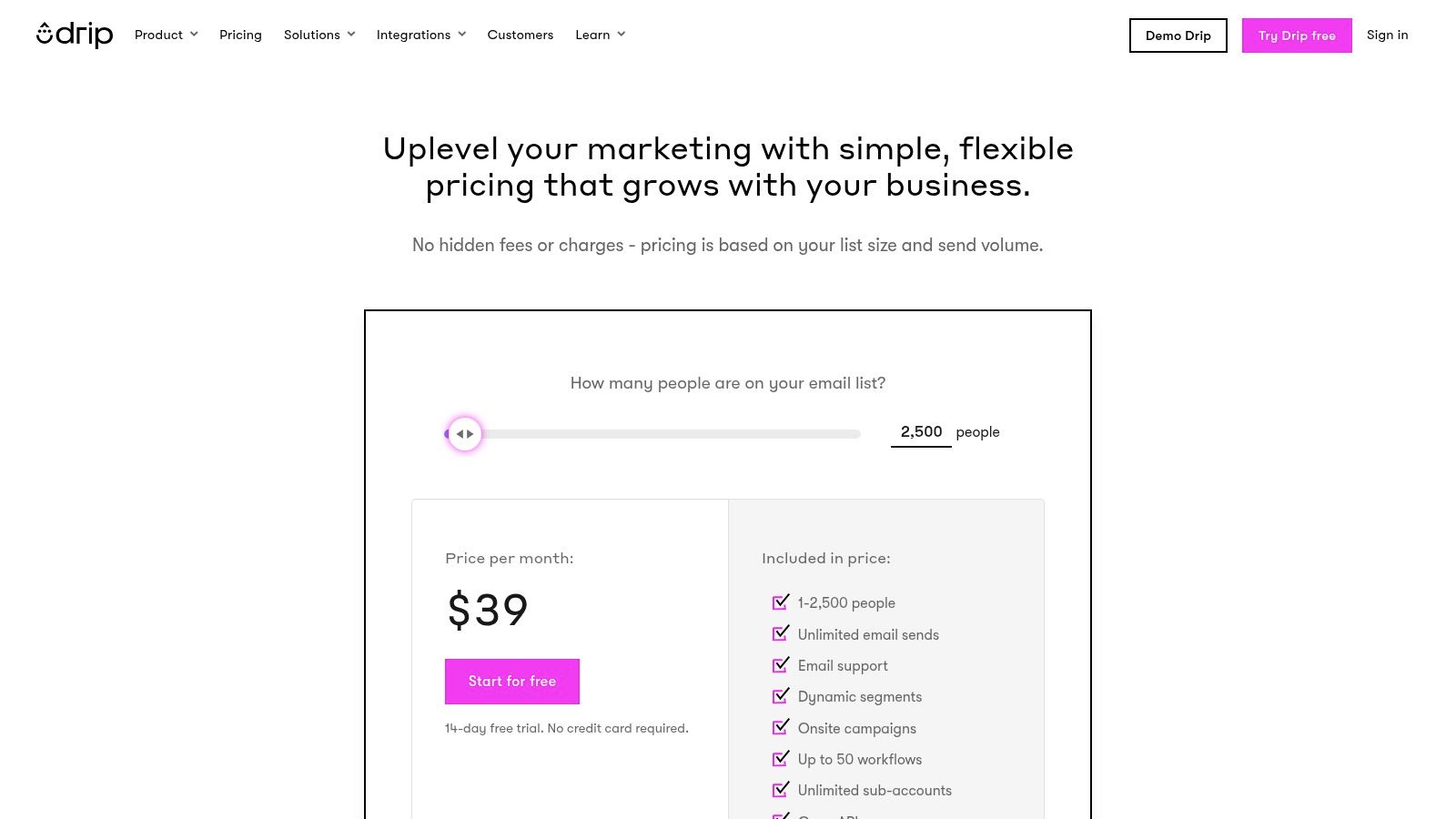
The platform is designed for rapid implementation, offering a visual workflow builder and a library of proven ecommerce automations. Revenue-centric dashboards provide clear attribution, showing exactly which campaigns and flows are generating sales. Its profile-based pricing model is straightforward, making it one of the more accessible options for stores that want a powerful, specialised marketing automation tool without the complexity of an all-in-one CRM.
Key Details & Pricing
- Best For: DTC brands and online retailers wanting a powerful, easy-to-use email and SMS automation platform with strong ecommerce integrations.
- Pricing: Offers a 14-day free trial. Pricing is based on the number of active profiles, starting at around £30/month for up to 2,500 people.
- Pros: Purpose-built for ecommerce with excellent, ready-to-use workflows. Transparent, profile-based pricing and a user-friendly visual builder.
- Cons: Primarily focused on marketing automation rather than sales or service CRM functions. Costs can increase significantly as your contact list grows.
- Website: https://www.drip.com/pricing
Drip's pre-built workflows are particularly effective for recovering sales; you can find more inspiration in these abandoned cart email examples to maximise your results.
6. Zoho CRM
Zoho CRM positions itself as a powerful and highly customisable option for businesses seeking flexibility without a high price tag. While not exclusively built for ecommerce, its strength lies in its ability to adapt. Through marketplace apps and connectors, you can integrate it with platforms like Shopify and BigCommerce to pull in customer and order data. This allows you to build custom sales pipelines and automate workflows that align specifically with your online store's processes, making it a solid choice for those who need a traditional CRM's power with added ecommerce functionality.
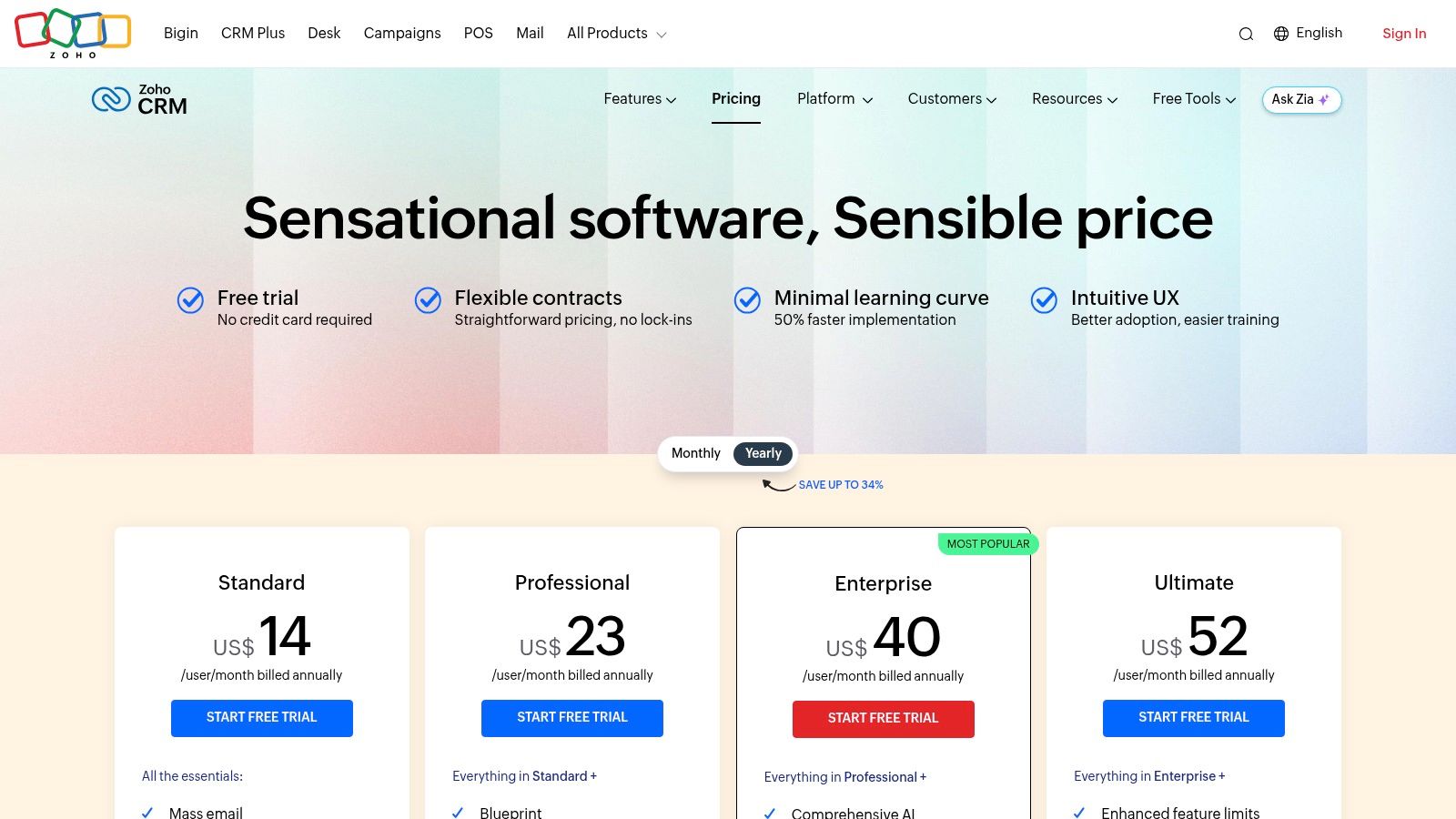
The platform is part of the larger Zoho ecosystem, offering an extensive suite of business apps that can be integrated for a more holistic operational view. Its affordable pricing tiers, including a free plan for very small teams, make it an attractive entry point for SMBs. Extensions for multi-currency support and global billing also cater to ecommerce businesses looking to scale internationally. This makes Zoho a strong contender for the best CRM for ecommerce for businesses on a budget that require deep customisation.
Key Details & Pricing
- Best For: Budget-conscious SMBs and mid-market businesses that require a highly customisable CRM and are willing to set up third-party integrations.
- Pricing: A free-forever plan is available for up to 3 users. Paid plans (Standard, Professional, Enterprise) start from around £12/user/month, offering significant value.
- Pros: Very budget-friendly with broad feature coverage across its paid tiers. A large ecosystem of extensions and marketplace apps allows for extensive customisation.
- Cons: Ecommerce features often rely on third-party connectors rather than native integration. The user interface can feel less ecommerce-native compared with more specialised platforms.
- Website: zoho.com/crm/zohocrm-pricing.html
7. Pipedrive
Pipedrive offers a compelling CRM solution for ecommerce businesses where the sales process is more hands-on, such as in B2B or high-value B2C sales. Its core strength is the visual sales pipeline, which allows teams to track deals and conversations with exceptional clarity. While not an ecommerce-native platform, it integrates with tools like Shopify and Zapier to pull in customer and order data, making it a viable option for stores that prioritise a streamlined, sales-focused workflow.
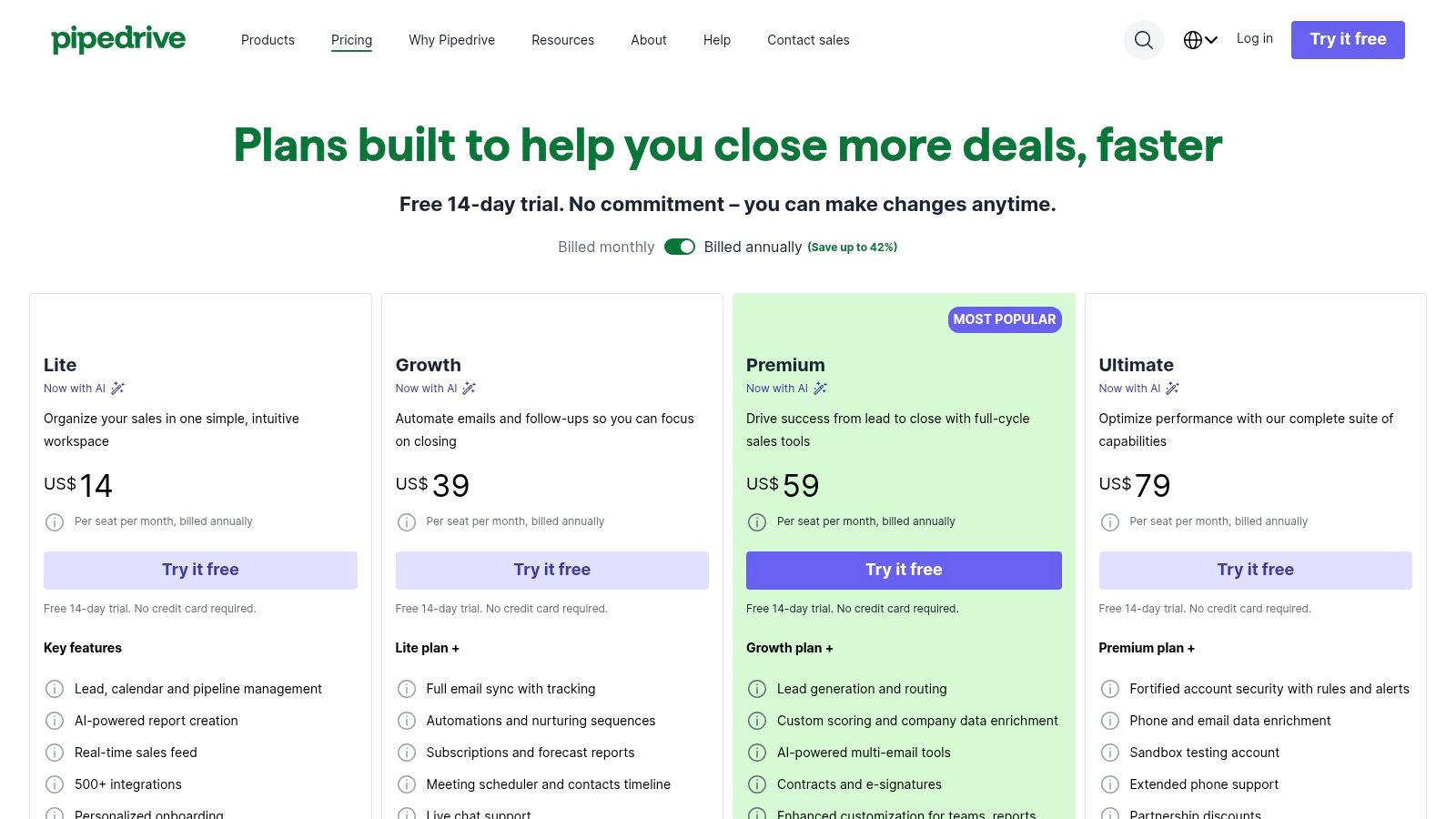
The platform’s simplicity and intuitive design make it incredibly easy to adopt. Pipedrive distinguishes itself with a modular approach, offering powerful add-ons like LeadBooster for lead generation and Campaigns for email marketing. This allows businesses to start with a lean sales tool and expand its capabilities as their needs evolve, providing a scalable path without overwhelming new users. It stands out as a strong candidate for the best CRM for ecommerce when a visual and activity-based sales process is central to the business model.
Key Details & Pricing
- Best For: B2B ecommerce businesses or B2C stores with a longer, more involved sales cycle.
- Pricing: No free-forever plan, but offers a 14-day free trial. Paid plans start from £14.90 per user/month. Add-ons like Campaigns and Web Visitors are priced separately.
- Pros: Extremely user-friendly with a highly visual interface. Modular add-ons allow for customised functionality. Quick to set up and onboard new team members.
- Cons: Core functionality is sales-focused, requiring integrations for deep ecommerce data. Marketing automation and lead generation tools come at an additional cost.
- Website: pipedrive.com/en/pricing
8. Ometria
Ometria positions itself not just as a CRM, but as a retail-focused Customer Data and Experience Platform (CDXP), making it a powerful contender for the best CRM for ecommerce. It excels at creating a single, unified customer view by consolidating data from multiple touchpoints. This allows mid-market and enterprise retailers to leverage predictive analytics and AI-driven insights for highly sophisticated personalisation across email, SMS, push notifications, and on-site experiences.
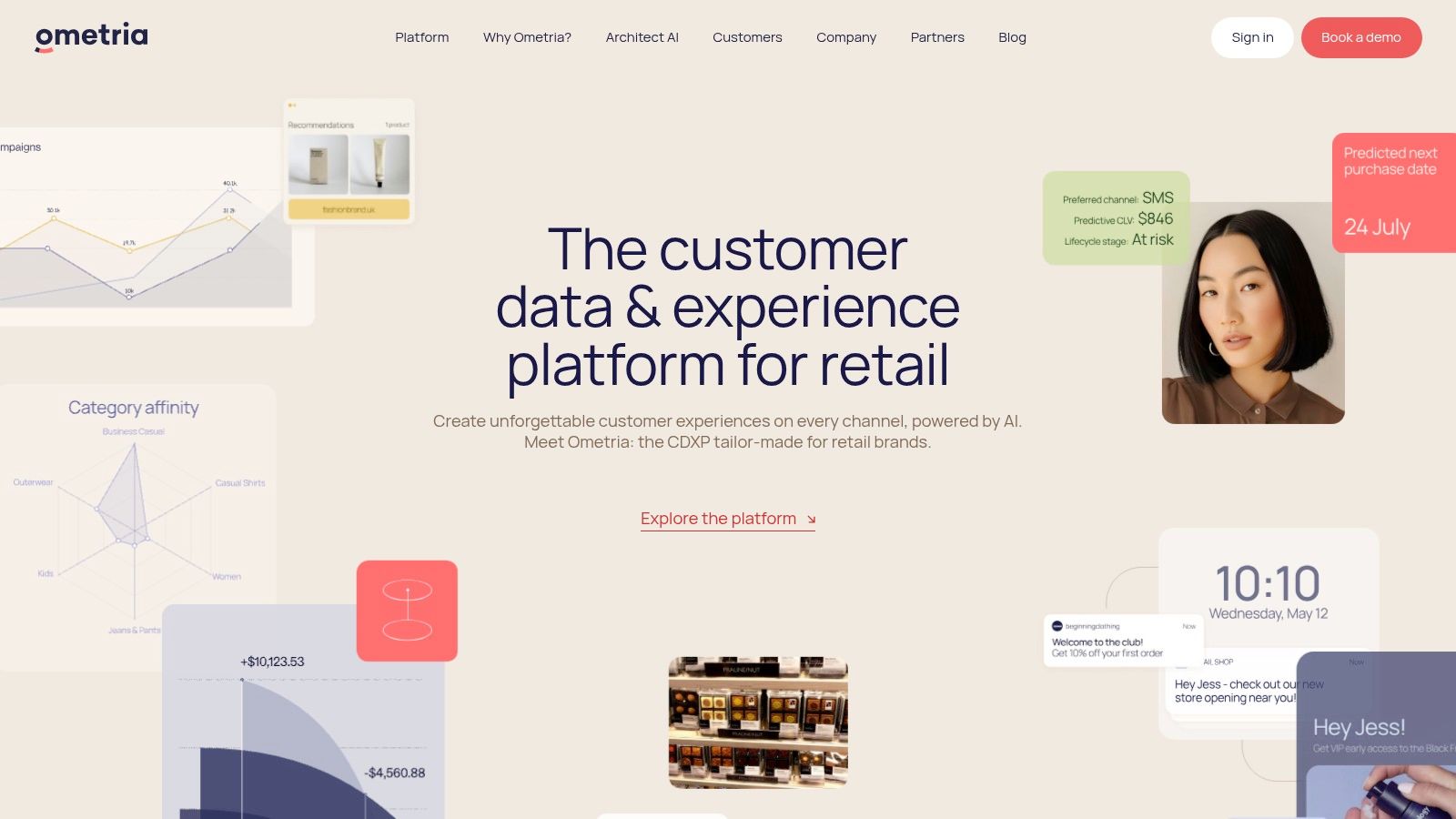
The platform’s core strength is its ability to orchestrate complex, multi-channel campaigns based on real-time customer behaviour and predictive segments. Instead of just reacting to past actions, Ometria helps brands anticipate future customer needs, enabling proactive marketing that drives loyalty and lifetime value. Its focus on enterprise support and a strong presence in the UK and EMEA markets make it a go-to for established brands looking for a dedicated retail marketing solution.
Key Details & Pricing
- Best For: Established mid-market and enterprise retail brands needing a specialist platform with advanced predictive analytics and multi-channel orchestration.
- Pricing: Custom pricing available through a demo and quote model. It is positioned as an enterprise solution, so expect a significant investment.
- Pros: Purpose-built for retail with deep on-site personalisation capabilities. Strong client base and support in the UK and EMEA. Advanced AI and predictive insights.
- Cons: Not accessible for smaller businesses due to its enterprise focus and pricing model. Less of a self-serve tool, requiring more initial setup and team involvement.
- Website: ometria.com
By using Ometria's orchestration tools, brands can effectively visualise and automate entire lifecycles, which is a key outcome of understanding what is customer journey mapping in a practical sense.
9. Brevo (formerly Sendinblue)
Brevo, formerly known as Sendinblue, carves out its niche as one of the best CRM for ecommerce options by packaging a lightweight CRM with a powerful, multi-channel marketing suite. It's designed for businesses that prioritise communication, offering integrated email, SMS, WhatsApp, and live chat functionalities. This allows ecommerce stores to manage customer interactions across various touchpoints from a single dashboard, creating a cohesive and personalised journey from initial contact to post-purchase engagement.
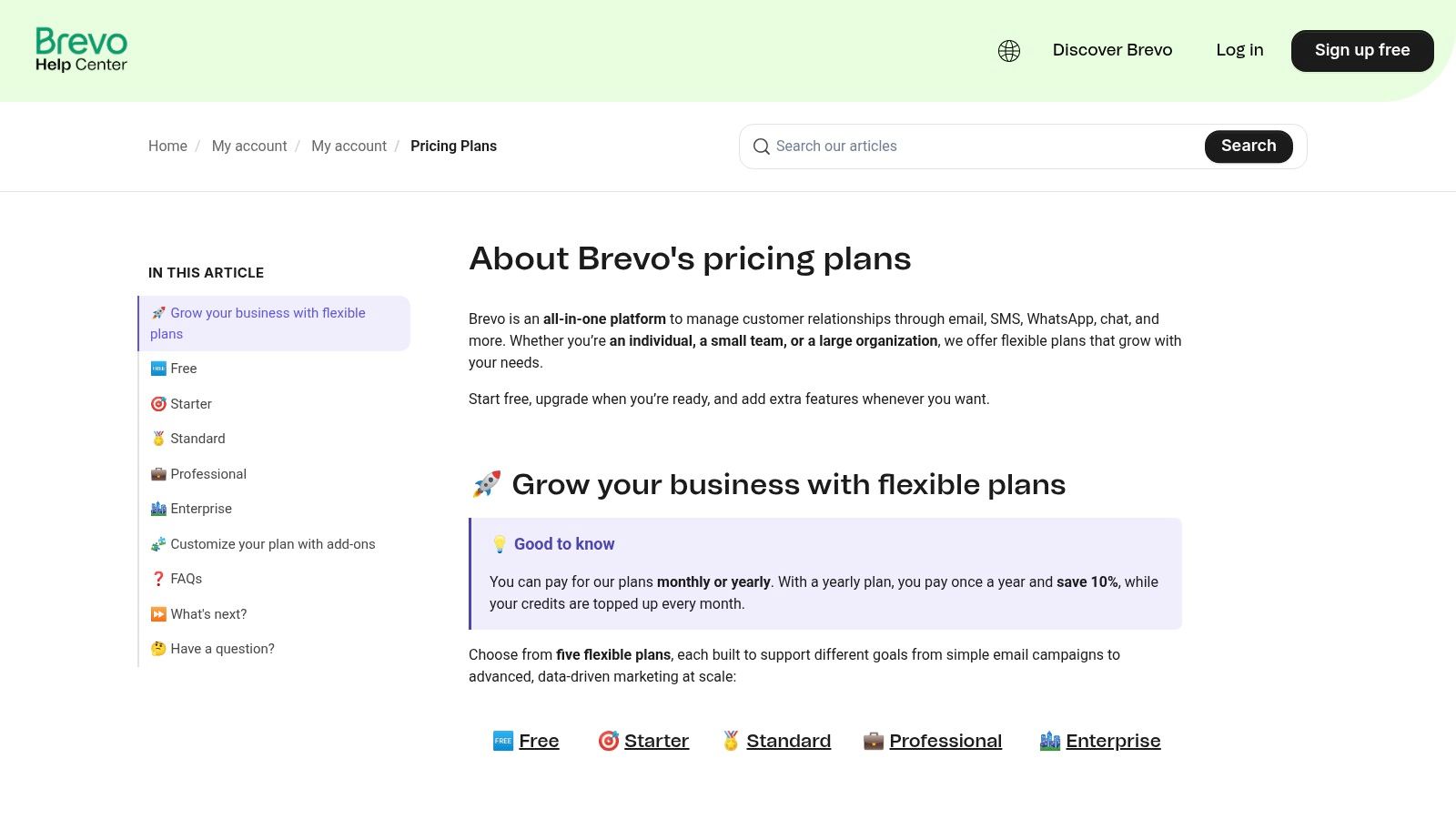
The platform’s standout feature is its cost-effective and flexible pricing model, which is particularly appealing to UK SMBs. Rather than being locked into expensive, contact-based subscriptions, Brevo offers a generous free plan and affordable paid tiers. Its marketing automation tools enable stores to set up crucial ecommerce workflows like abandoned cart recovery and welcome series, while the optional sales add-ons provide deal tracking capabilities for businesses with more complex sales cycles.
Key Details & Pricing
- Best For: UK-based small to medium-sized businesses needing an affordable, all-in-one marketing and sales platform.
- Pricing: A generous free plan is available with a 300 email/day limit. Paid plans (Starter, Business) start from £16.50/month, with optional sales add-ons and pay-as-you-go credits for SMS and WhatsApp.
- Pros: Excellent value for money with strong multi-channel communication tools. Flexible billing with pay-as-you-go options is a significant advantage.
- Cons: The core CRM functionality is less advanced than dedicated CRM systems. More sophisticated analytics and features are reserved for higher-priced plans.
- Website: help.brevo.com/hc/en-us/articles/208589409
10. Shopify App Store
While not a CRM itself, the Shopify App Store is an essential starting point for any Shopify merchant seeking the best CRM for ecommerce. It acts as a curated marketplace where you can discover, vet, and install a wide range of CRM and marketing automation apps that are built to integrate seamlessly with your store. This direct-install functionality from the Shopify admin dramatically simplifies deployment, removing technical barriers and allowing for rapid implementation.
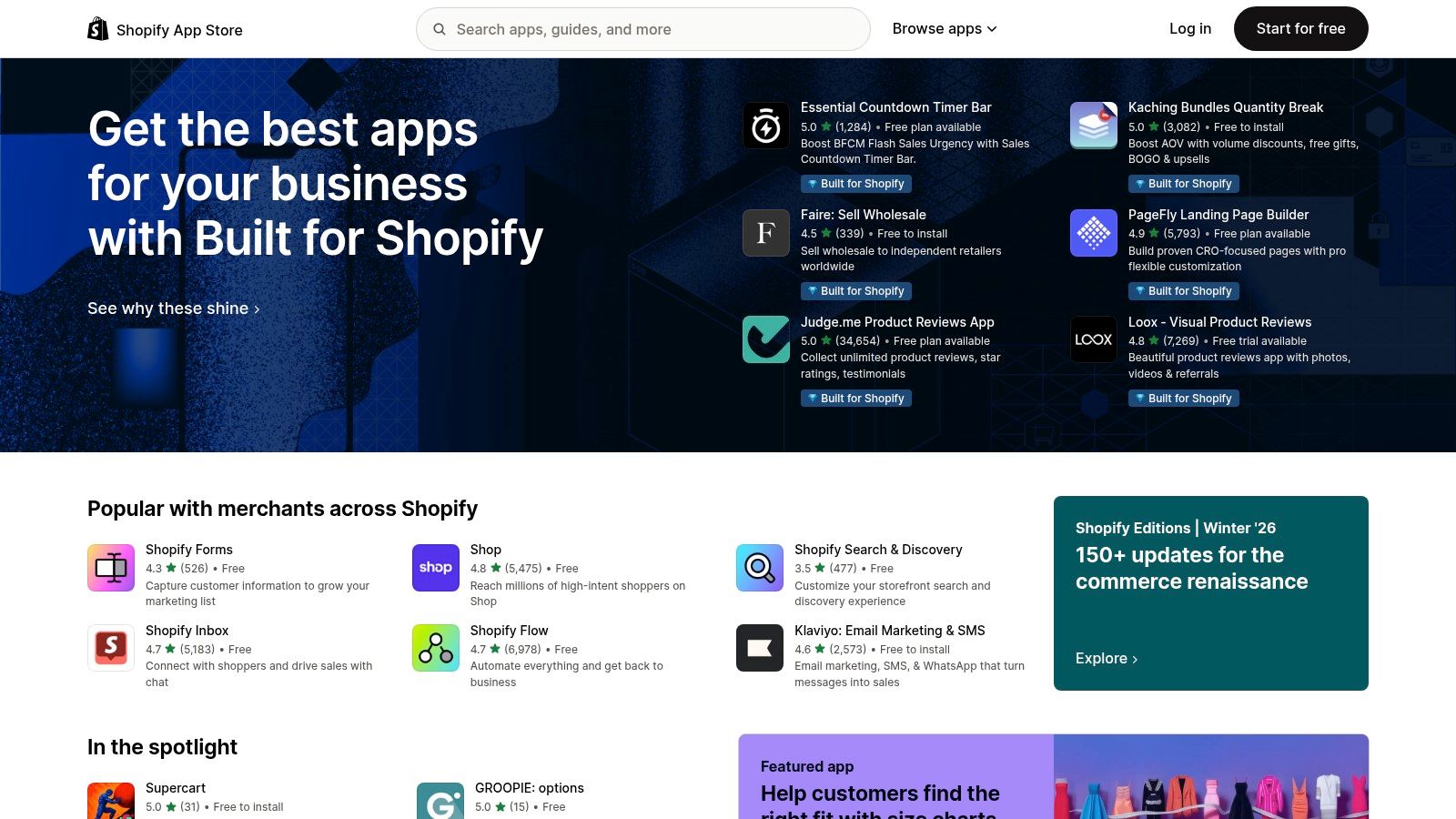
The platform’s real value lies in its transparency and community-driven insights. Each app listing includes clear pricing, feature breakdowns, and, most importantly, unfiltered merchant reviews. This allows you to assess the quality, support, and real-world performance of a tool before committing. By using filters like 'Built for Shopify', you can quickly identify solutions specifically optimised for the ecommerce environment, from powerful all-in-one platforms like Klaviyo to specialised clienteling apps.
Key Details & Pricing
- Best For: Shopify merchants who prioritise fast deployment and native integration with their ecommerce platform.
- Pricing: The App Store is free to browse. App pricing varies from free plans to thousands of pounds per month, with costs clearly displayed on each listing.
- Pros: Extremely fast and simple app installation. Merchant reviews provide valuable, real-world insights for vetting tools. Centralised app management within the Shopify admin.
- Cons: The sheer volume of over 8,000 apps can be overwhelming, making discovery a challenge. The quality and support can vary significantly between third-party developers.
- Website: apps.shopify.com
11. BigCommerce App Marketplace
While not a standalone CRM, the BigCommerce App Marketplace is a vital resource for merchants using the platform, acting as a central hub to connect their store with a leading CRM for ecommerce. It provides a curated and vetted selection of applications that enable direct integration with powerful systems like HubSpot, Zoho, and Salesforce. This approach allows businesses to choose a best-in-class CRM that fits their specific operational needs without sacrificing deep data synchronisation with their BigCommerce storefront.
The marketplace's strength lies in simplifying a complex decision. By offering quality signals like partner tiers and user reviews, it helps merchants gauge an app's reliability and compatibility. BigCommerce also highlights apps that support its Multi-Storefront feature, a crucial detail for businesses managing multiple brands from a single backend. This curated environment ensures that integrations are not only possible but optimised for the BigCommerce ecosystem, centralising customer data, order history, and marketing activities seamlessly.
Key Details & Pricing
- Best For: BigCommerce store owners who want to integrate a dedicated, powerful third-party CRM into their existing ecommerce operations.
- Pricing: The marketplace itself is free to browse. Pricing is determined by the individual CRM app you choose to install, which can range from free plans to thousands of pounds per month.
- Pros: Allows you to connect your BigCommerce store to established, feature-rich CRMs. App quality signals and filters simplify the selection process.
- Cons: The actual CRM functionality and its depth depend entirely on the third-party app selected. Some integrations may require additional setup and technical vetting.
- Website: www.bigcommerce.com/apps/
12. WooCommerce Marketplace (CRM Extensions)
For businesses built on WordPress, the WooCommerce Marketplace offers a uniquely integrated approach to CRM. Instead of a standalone platform, it provides a curated selection of CRM plugins and connectors that bring customer management directly into the WordPress dashboard. This is ideal for merchants who want to centralise operations and avoid juggling multiple systems. The marketplace features both native solutions, like the first-party Jetpack CRM, and connectors for popular external CRMs such as Keap and Microsoft Dynamics.
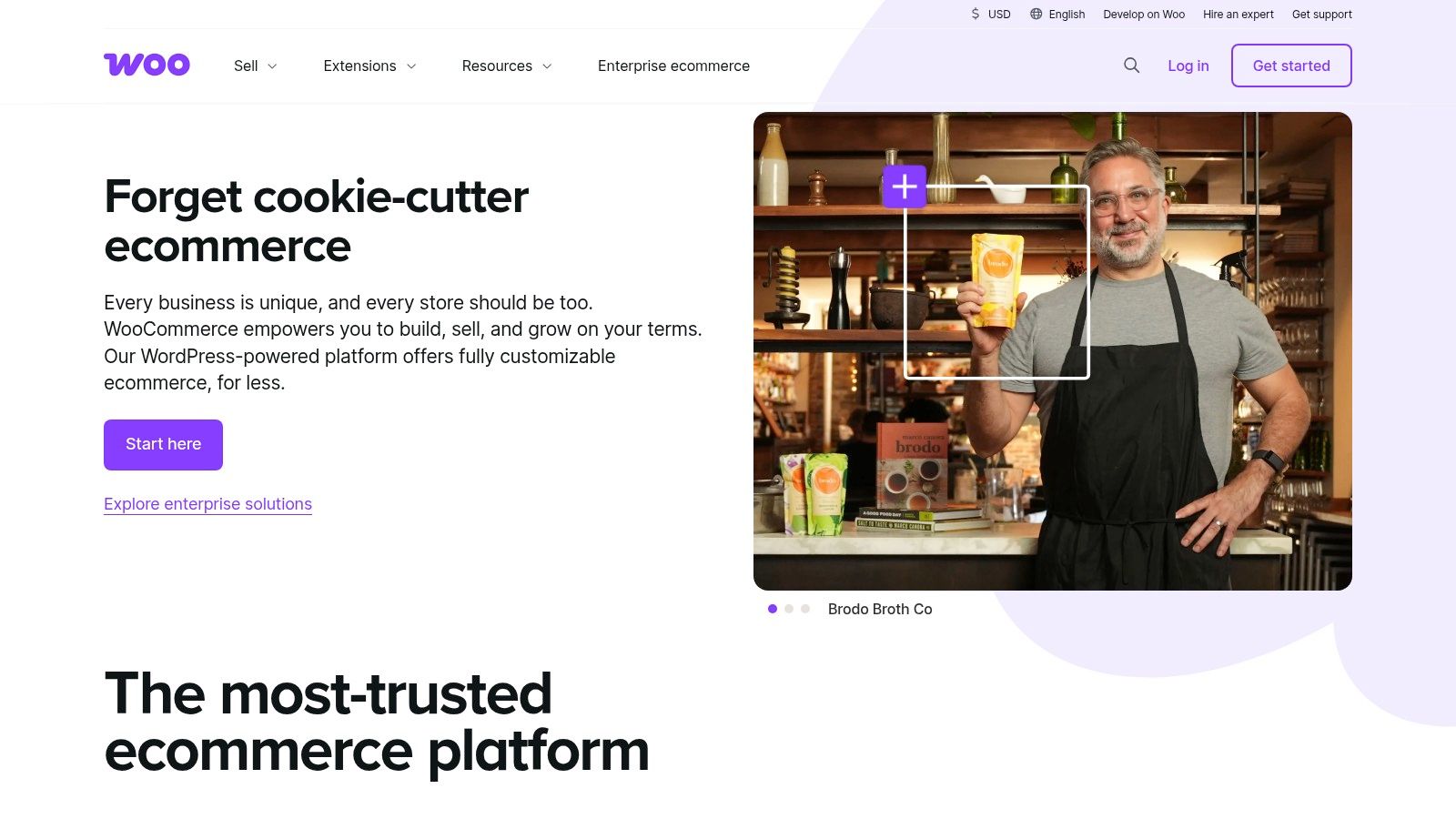
This approach ensures tight compatibility with your store's orders, customers, and product data. The primary benefit is having a CRM system that speaks the same language as your ecommerce platform from day one. You can sync customer data seamlessly, view order histories within contact profiles, and build segments based on purchasing behaviour without complex API configurations. The marketplace offers a mix of free and paid extensions, with all purchases backed by a 30-day money-back guarantee, making it a flexible and low-risk choice for finding the best CRM for ecommerce within the WordPress ecosystem.
Key Details & Pricing
- Best For: WooCommerce store owners who prioritise a WordPress-native experience and want to manage their CRM from within their existing site.
- Pricing: Varies significantly by extension. Some offer free versions, while premium plugins or connectors can range from one-off payments to annual subscriptions (£50 – £250+ per year).
- Pros: Unbeatable integration with WooCommerce and WordPress. A wide range of free and paid options available through a single, trusted support channel.
- Cons: Functionality is entirely dependent on the specific plugin chosen. Some connectors may require technical setup, and you are reliant on third-party developers for maintenance and updates.
- Website: woocommerce.com
Top 12 eCommerce CRM Comparison
| Product | Core features ✨ | UX / Quality ★ | Price & Value 💰 | Target audience 👥 | Strength / USP 🏆 |
|---|---|---|---|---|---|
| HubSpot CRM | ✨ Free core CRM, marketing/sales/service, Shopify sync, marketplace | ★★★★☆ — polished UI & docs | 💰 Free‑forever + paid tiers; can get complex | 👥 SMB → mid‑market & ecommerce | 🏆 Unified platform & large partner ecosystem |
| Salesforce | ✨ Data Cloud, CRM Analytics, Commerce Cloud, AppExchange | ★★★★★ — enterprise‑grade reliability | 💰 Premium; annual contracts & add‑ons | 👥 Mid‑market → enterprise brands | 🏆 Deep customisation, scale & compliance |
| Klaviyo | ✨ Email + SMS, advanced segmentation, predictive analytics, ecommerce templates | ★★★★☆ — ecommerce‑native UX & benchmarking | 💰 Profile‑based pricing; cost grows with list | 👥 DTC & ecommerce lifecycle marketers | 🏆 Revenue-focused segmentation & templates |
| ActiveCampaign | ✨ Visual automation builder, sales CRM, ecommerce integrations, AI on higher tiers | ★★★★ — mature automations & deliverability | 💰 Tiered pricing; key features on higher plans | 👥 SMBs scaling marketing automation | 🏆 Visual automation + CRM combo |
| Drip | ✨ Ecommerce CRM, revenue attribution, prebuilt flows, native cart integrations | ★★★★ — quick setup & revenue dashboards | 💰 Profile‑based; transparent pricing + 14‑day trial | 👥 DTC stores focused on revenue tracking | 🏆 Ecommerce-first attribution & workflows |
| Zoho CRM | ✨ Custom pipelines, automation, analytics, marketplace connectors | ★★★★ — flexible, less ecommerce‑native | 💰 Budget-friendly; free tier for small teams | 👥 Cost‑conscious SMBs | 🏆 Price-to-feature ratio & extensibility |
| Pipedrive | ✨ Visual sales pipelines, AI reporting, add‑ons, 500+ integrations | ★★★★ — very user‑friendly, fast onboarding | 💰 Mid-tier; modular add‑ons (Campaigns, LeadBooster) | 👥 Sales-led teams; B2B/ecommerce sellers | 🏆 Ease of use & visual pipeline clarity |
| Ometria | ✨ Retail CDXP, single customer view, predictive personalization, cross‑channel orchestration | ★★★★ — enterprise retail UX (demo model) | 💰 Quote-based enterprise pricing | 👥 Mid‑market & enterprise retail brands | 🏆 On-site personalization + CDP capabilities |
| Brevo (Sendinblue) | ✨ Email, SMS, WhatsApp, chat, automation, lightweight CRM | ★★★★ — solid channel coverage, lighter CRM | 💰 Competitive; free plan + pay‑as‑you‑go credits | 👥 UK SMBs & budget teams | 🏆 Multi‑channel at a low price point |
| Shopify App Store | ✨ 8,000+ Shopify‑native apps, direct installs, merchant reviews | ★★★★ — seamless install; discovery noisy | 💰 App pricing varies; many paid apps | 👥 Shopify merchants & app explorers | 🏆 Fast deployment & native Shopify integration |
| BigCommerce App Marketplace | ✨ CRM/ERP connectors, multi‑store badges, unified billing options | ★★★★ — vetted apps, multi‑store support | 💰 Varies by app; some unified billing available | 👥 BigCommerce merchants, multi‑store sellers | 🏆 Multi‑store compatibility & quality signals |
| WooCommerce Marketplace | ✨ Jetpack CRM, multiple CRM connectors, WP‑native plugins | ★★★ — flexible but plugin‑dependent UX | 💰 Mix of free/paid extensions; transparent pricing + refunds | 👥 WordPress/WooCommerce merchants | 🏆 WordPress‑native CRM options & flexibility |
Choosing the Right CRM to Scale Your Ecommerce Business
Navigating the landscape of ecommerce CRM platforms can feel overwhelming, but making an informed decision is one of the most impactful investments you can make in your business's future. Throughout this guide, we've explored a diverse range of powerful tools, from all-in-one giants like HubSpot and Salesforce to hyper-focused, ecommerce-native platforms like Klaviyo and Drip. The central takeaway is clear: there is no single "best" CRM for every ecommerce store. The right choice is deeply personal to your business model, scale, technical resources, and ultimate growth ambitions.
A Shopify startup might find Klaviyo’s deep integration and pre-built automation flows provide immediate value, allowing them to recapture abandoned carts and build loyalty from day one. In contrast, a more complex B2B ecommerce operation using Magento might require the robust, customisable architecture of Salesforce or Zoho CRM to manage intricate sales cycles and multifaceted customer relationships. The key is to look beyond flashy feature lists and focus on the core functionalities that solve your most pressing problems today while providing a runway for future growth.
A Practical Framework for Your Final Decision
Before committing to a platform, it's crucial to move from theoretical analysis to practical application. Your selection process should be a strategic exercise, not a quick-fire decision.
Here is a simple, actionable checklist to guide your final evaluation:
- Define Your Core Needs: Are you primarily focused on email marketing automation (like ActiveCampaign or Drip), managing a complex sales pipeline (like Pipedrive), or creating a single, unified customer view (like HubSpot)? Be honest about your top 1-3 priorities.
- Audit Your Tech Stack: The best CRM for ecommerce is one that seamlessly integrates with your existing tools. Confirm native, deep integrations with your ecommerce platform (Shopify, BigCommerce, WooCommerce), as well as your helpdesk, analytics, and logistics software. A poorly integrated CRM creates more work, not less.
- Evaluate Total Cost of Ownership: Look beyond the monthly subscription fee. Factor in potential implementation costs, costs for premium support, migration expenses if you're moving from another system, and the price of any necessary third-party connectors or add-ons.
- Leverage Free Trials: Never buy a CRM without testing it first. Use the trial period to connect your store, import a small segment of customer data, and build a test automation. This hands-on experience will reveal more about a platform's usability and true capabilities than any demo ever could.
- Consider Your Team's Skillset: A powerful platform like Salesforce is only effective if your team has the expertise to manage it. Be realistic about the technical proficiency within your company. Sometimes, a simpler, more intuitive tool like Brevo is a more practical and effective choice.
Final Thoughts: Your CRM as a Growth Engine
Ultimately, choosing a CRM is about more than just organising contacts; it's about building the operational backbone for scalable, customer-centric growth. The right platform will centralise your data, automate repetitive tasks, and provide the insights needed to create personalised experiences that turn one-time buyers into lifelong advocates. It empowers you to understand customer behaviour, segment audiences with precision, and communicate with the right message at the perfect moment.
This decision is a foundational step in transforming your business from being reactive to proactive. By investing the time now to thoroughly assess your needs and test the leading contenders, you are setting the stage for a more efficient, profitable, and resilient ecommerce operation for years to come.
Feeling ready to build your complete marketing tech stack? The The Digital Marketing Toolbox provides curated guides, templates, and exclusive discounts on top-tier software to help you integrate your new CRM with the best tools for SEO, analytics, and social media management. Explore The Digital Marketing Toolbox today and build a powerful, cohesive growth engine for your business.


