
Let's be honest, for years, "rank tracking" felt like a bit of a vanity metric. You’d check your position for a handful of keywords, feel good if it went up, and panic if it went down. But true Google SERP tracking is so much more than that. It’s about systematically monitoring your website’s visibility across Google's search results for the keywords that actually matter to your business.
This isn't just about your classic blue-link ranking. It’s about analysing the entire search landscape—SERP features like featured snippets and People Also Ask boxes, who your real competitors are on the page, and how all this affects your click-through rates. It’s the only way to get a genuine picture of your organic search performance.
Why Proper Google SERP Tracking Is a Game Changer

I've seen too many businesses dismiss SERP tracking as just a number to stick in a report. The reality is, it’s evolved into a powerful diagnostic tool. It provides the crucial business intelligence you need to make sense of a search environment that seems to change daily. For a UK-based e-commerce manager or a small business owner, it’s the difference between guessing and knowing.
Think of consistent tracking as your early warning system. It helps you spot subtle market shifts, identify new competitors creeping up on your turf, and measure the real impact of Google’s constant algorithm updates. Take the recent rollout of AI Overviews. Without precise tracking, how would you know if a traffic drop is because of this new feature muscling you out or a genuine decline in your core rankings?
Moving Beyond Rankings to Real Strategy
This is where the magic happens. Effective SERP monitoring gives you the data to make smarter strategic decisions. It’s no longer about whether you’re in position three or four. It’s about digging into why you’re there and what that position actually means for your bottom line.
This process uncovers the kind of insights that should shape your entire SEO approach:
- Competitor Intelligence: Pinpoint which rivals are gaining ground on your most valuable keywords. You can then analyse their content, backlink profile, or on-page tactics to figure out what’s working for them.
- Content Opportunities: Easily spot those "striking distance" keywords—the ones hovering at the bottom of page one or top of page two. A small optimisation push here can deliver a huge return.
- Impact Measurement: Finally, you can accurately gauge the success of your SEO campaigns. Whether it's a technical fix, a new content cluster, or a link-building push, you can see the direct impact on visibility.
When you start treating Google SERP tracking as a core diagnostic tool rather than just a scoreboard, you gain a massive competitive advantage. It's how you make sure your digital marketing is proactive, not just constantly reacting to changes.
Ultimately, this data-driven approach means you can put your time and money where they’ll have the biggest impact. Instead of creating content in the dark, you can focus on optimising pages that will deliver a significant return, protecting your organic traffic and building a foundation for long-term growth.
Getting Your Bearings: Goals and Tracking Methods
Before you even think about which tool to use, let's get one thing straight: tracking keywords without a clear goal is a waste of time. It’s like having a fancy dashboard in your car but no destination. You're just burning fuel.
So, where are you trying to go? Are you a local plumber in Manchester desperate to show up in the map pack when someone searches "emergency plumber M20"? Or maybe an e-commerce shop trying to elbow your way onto page one for "eco-friendly dog toys"? Your specific goal changes everything about how you track your progress.
The single most important thing you can do is define your Key Performance Indicators (KPIs) first. This turns SERP tracking from a passive, data-hoarding exercise into a focused strategy that actually moves the needle for your business.
What Does Success Actually Look Like?
Forget vague ideas like "get more traffic." We need to get specific and measurable. Think in terms of tangible results you can point to in a few months' time.
Here are a few examples of what a solid goal looks like:
- Boost Organic Visibility: Move our top 10 "buy now" keywords from page two into the top five spots by the end of Q3.
- Win the Local Battle: Own a top-three spot in the Google Business Profile listings for our five core service postcodes.
- Snag SERP Features: Capture the featured snippet for the question "how to choose the right running shoes."
- Keep an Eye on the Competition: Track our main competitor's rankings for our shared keywords to spot weaknesses we can exploit.
Once you know what you're aiming for, picking the right way to track your SERP performance becomes much clearer. The method you choose will really depend on your budget, the scale of your project, and how deep you need to go.
Weighing Up Your Tracking Options
You've really got three main ways to keep tabs on your rankings: doing it by hand, using Google Search Console, or investing in a dedicated tool.
Manually searching for your keywords is tempting because it’s quick and free, but it's a terrible idea for serious tracking. Your results are heavily personalised, so what you see isn't what your potential customers see. On the other end of the spectrum is Google Search Console. It's an incredible free resource that gives you data straight from the horse's mouth, but it only shows you averages and lacks the daily, competitor-focused insights you get from paid software.
This is where third-party rank trackers come in. They offer the works: daily updates, tracking by specific location (down to the postcode), and deep dives into what your competitors are up to. To get a feel for what's out there, it's worth exploring the best SERP tracking tools that are built for today's complex search results.
Here in the UK, the game has become incredibly local. I've seen e-commerce managers having to track visibility right down to the postcode level to stay competitive. For local businesses, those map pack impressions are everything. It all comes back to getting on that first page, especially when you consider that 89% of users implicitly trust what Google shows them there.
To help you figure out what's right for you, let’s break down the pros and cons of each method. And if you need to build out your keyword list first, our guide on the best keyword research tools is the perfect place to start.
Comparison of Google SERP Tracking Methods
Choosing the right tracking method is crucial. This table lays out the common options to help you match your needs and budget to the right solution.
| Method | Best For | Cost | Accuracy | Key Features |
|---|---|---|---|---|
| Manual Checks | Quick, occasional spot-checks for a handful of keywords. | Free | Low (Personalised) | Instant but unreliable for strategic decisions. |
| Google Search Console | Small businesses and anyone on a tight budget needing reliable data. | Free | High (Direct from Google) | Average position, CTR, impressions, performance data. |
| Third-Party Tools | Agencies, in-house SEOs, and businesses needing daily, granular data. | Paid | High (Unbiased) | Daily tracking, competitor analysis, SERP feature monitoring. |
Ultimately, while manual checks and GSC have their place, any serious SEO campaign will quickly outgrow them. For real-time insights and a competitive edge, a dedicated third-party tool is almost always a worthwhile investment.
Fine-Tuning Your Tracking for Maximum Insight
Once you've picked your tracking method, the real work begins. Proper Google SERP tracking isn’t about just chucking a few thousand keywords into a tool and hoping for the best. It’s about a thoughtful setup that delivers clean, actionable data. It all starts with your keyword list.
Your list needs to be a strategic mix. It's a common mistake to focus only on those high-volume, top-of-funnel terms. You need to blend broad, informational queries with the highly specific, commercial-intent keywords that signal someone is ready to pull out their wallet.
Think of a London-based bakery. They should be tracking "how to bake sourdough" just as closely as they track "vegan birthday cake delivery London". This balance gives you a complete picture of your visibility across the entire customer journey, not just a small slice of it.
But a solid keyword list is only the first piece of the puzzle. The real power comes from setting up granular tracking parameters that actually reflect your audience.
This flowchart shows a simple way to think about where to start.
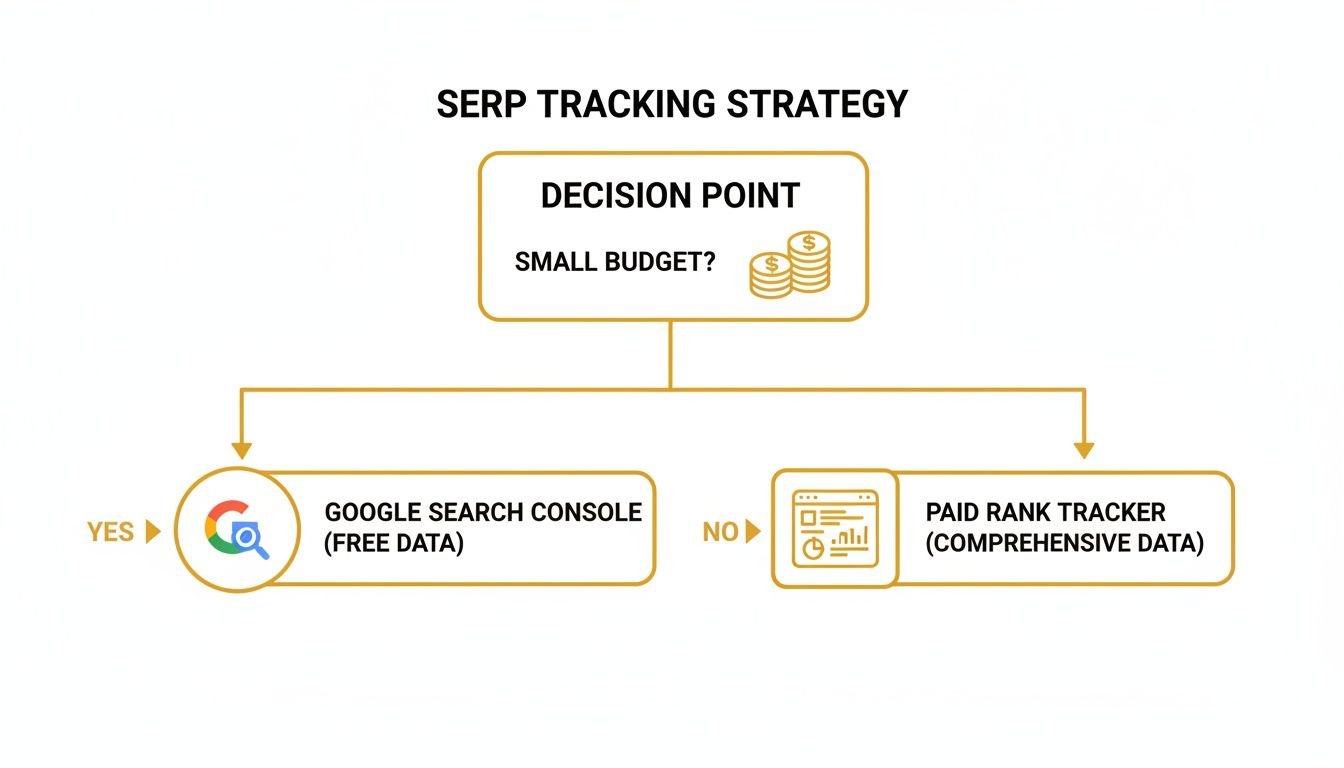
The main takeaway here is that you don't need a massive budget to get going. Google Search Console offers a surprisingly powerful, free foundation to build upon.
Drilling Down with Granular Targeting
If you want data you can actually trust, you have to align your tracking with how your customers search. It’s that simple. If your results are skewed because your settings are off, your entire strategy will be, too.
Here are the non-negotiables for an accurate setup:
- Geo-targeting: You need to specify the exact location you're tracking from. For UK businesses, this could be as broad as the "United Kingdom" or as specific as a postcode in Birmingham. This is absolutely vital for local service businesses or any company where location heavily influences the search results.
- Device Segmentation: Always track your mobile and desktop rankings separately. User behaviour and the SERP layouts themselves can differ dramatically between devices. With Google's mobile-first indexing, the mobile view is often the one that truly matters.
- Language and Locale: Make sure your tracking is set to
en-GBto reflect how your UK audience searches. Using the defaulten-USsetting is a rookie error that can produce misleading results and cause you to completely miss out on localised SERP features.
Accurate configuration transforms your tracking from a simple report card into a detailed diagnostic tool. It’s the difference between knowing your rank and understanding your true market visibility.
Tracking Beyond the Blue Links
These days, the SERPs are far more than just ten blue links. Real visibility means showing up in a variety of features that often sit well above the traditional organic results. Your tracking setup absolutely must account for these.
Be sure to monitor your presence in:
- Featured Snippets: The coveted "answer boxes" at the top of the SERP.
- People Also Ask (PAA) Boxes: Capturing these can massively boost your visibility for informational queries.
- Local Packs: Non-negotiable for any business with a physical location or service area.
- Image and Video Carousels: Crucial for any brand with visually-driven products or content.
Tracking these features shows you where the real opportunities for clicks actually are. Even better, when you connect this data with your analytics, you get a much deeper understanding of traffic quality.
For agencies and freelancers, integrating GA4 engagement metrics with click-through rate tracking often reveals serious traffic quality issues, especially when search intent is mismatched—a problem that affects over 50% of UK organic campaigns. On the flip side, local businesses tracking Google Business Profile clicks find that high-intent actions like direction requests can convert at an impressive 15-20%.
If you're just getting started with analytics, our guide on how to set up Google Analytics can help you build that solid foundation.
Turning SERP Data into Actionable SEO Strategy
Collecting data is one thing, but actually turning it into a real, tangible SEO strategy is where the magic happens. Your Google SERP tracking dashboard isn't just a report you glance at once a week. Think of it as an active diagnostic tool that should be dictating your very next move.
When you spot a change in your data, your first job is to play detective. You need to move from asking "what happened?" to understanding "why did it happen?" and, finally, deciding "what are we going to do about it?" This simple process is what separates reactive reporting from a proactive, winning strategy.
Let’s say your click-through rate (CTR) for a key commercial term suddenly plummets, but your average position has held steady at number three. A rookie might panic and start rewriting content, but a seasoned SEO pro knows to investigate the SERP itself first. Has a new image pack or a "People Also Ask" box suddenly appeared above your listing, stealing all those juicy clicks before users even get to you?
Your SERP data is a live map of the competitive landscape. Every shift, whether from Google or a competitor, is an opportunity or a threat. Your ability to interpret these signals and act fast is your primary competitive advantage.
From Diagnosis to Actionable Tactics
Once you’ve figured out what’s changed, the next step is to translate that insight into specific, actionable tasks for your team. A clear diagnosis always leads to a precise response.
Here are a few common scenarios I see all the time, and how you can react strategically:
-
Scenario 1: A Competitor Jumps You
A key rival suddenly outranks you for a high-value keyword.- Action: Don't just get annoyed—get analytical. Immediately dive into their page. Have they significantly updated their content, overhauled their on-page SEO, or landed some powerful new backlinks? Your SERP tracking has just handed you a high-priority competitor analysis task.
-
Scenario 2: You Enter the 'Striking Zone'
Your page has crept up from position 12 to position 8.- Action: This is a massive opportunity. That page should immediately become a priority. Give it a content refresh, find new internal linking opportunities from your stronger pages, and maybe even give it a little nudge with a targeted link-building push to get it into the top half of page one.
-
Scenario 3: A Wild SERP Feature Appears
A featured snippet or a video carousel now dominates the results for a query you rank for.- Action: Time to adapt your content strategy. Can you restructure your content with clear Q&A formatting to snatch that snippet? Or could you create a short, informative video to compete in the carousel? Don't fight the SERP; play its game.
Connecting SERP Data with Business Outcomes
Ultimately, the goal is to understand how SERP performance actually impacts your bottom line. This means connecting your tracking data with analytics platforms like GA4. After all, a high ranking is just a vanity metric if it doesn’t drive qualified traffic that converts.
By integrating these data sources, you can start answering the really important business questions. Does traffic from keywords where you rank in the top three engage more with your site? Do users who arrive from "informational" keywords eventually become customers? This complete picture is how you prove the real value of your SEO efforts.
Real-world data really brings this home. In one recent case, a London agency's tracking revealed a 25% CTR plunge for a client right after an AI Overview rollout. They responded by tweaking meta descriptions, which recovered 40% of the lost traffic within a few weeks. UK-wide stats consistently show that position one still captures a massive 39.8% of all clicks, so every single rank matters. You can discover more insights about these UK agency SEO metrics on whatsdash.com.
This level of analysis turns your Google SERP tracking from a simple monitoring task into the central nervous system of your entire marketing strategy, informing content, on-page SEO, and even wider commercial decisions.
Troubleshooting Common SERP Tracking Problems
Sooner or later, every well-oiled Google SERP tracking machine will throw up some data that makes you scratch your head. When your numbers don't seem to make sense or rankings are bouncing all over the place, the first rule is simple: don't panic. The trick is to methodically figure out what's really happening. This way, you can tell the difference between a real SEO issue and a simple quirk in your tools.
One of the most common things you'll run into is data not matching up across different platforms. For instance, your rank tracker might show your main keyword sitting pretty at position three, while Google Search Console (GSC) is reporting an average position of 4.2. This doesn't mean one of them is broken.
The key is to remember what each tool is measuring. GSC gives you averaged data over time, mixing together results from countless different users, devices, and locations. Your rank tracker, on the other hand, provides a clean, precise snapshot from a specific time, location, and device. They're both right; they just tell different parts of the story.
Decoding Unstable Rankings and Impression Shifts
Seeing your most important keyword leap from position two to nine and back in a single week is enough to give anyone a bit of a shock. But before you start tearing your page apart, take a breath and look at the bigger picture.
Has a Google algorithm update just rolled out? Sometimes, the entire search landscape gets a bit shaky for a while. It's also worth checking if powerful new competitors have suddenly appeared on page one.
Often, these wild swings are just short-term noise. My advice is always to zoom out and look at the trend over several weeks. A steady decline is a clear signal to act, but a few days of volatility might just be the SERP settling down after a tremor.
Here's another classic scenario: your impressions are down, but your average position is actually better. This usually means you've lost some visibility for broad, low-ranking keywords while simultaneously strengthening your grip on more targeted, valuable terms. It feels counter-intuitive, but it's often a sign that your SEO efforts are working exactly as intended.
The Impact of Technical SERP Changes
Sometimes, the weirdness in your data has nothing to do with your site or your tools, but with Google itself. Technical shifts in how the SERPs work can completely change the data that gets collected, making historical comparisons tricky if you're not in the loop.
A perfect example was back in September 2025 when Google removed the ‘&num=100’ parameter. This change meant tools could no longer easily grab 100 results per page, a popular method for deep SERP monitoring. For many marketers in the UK, this caused what looked like a massive drop in desktop impressions—up to 20-30% in some GSC reports. It wasn't a performance issue; the very way impressions were being measured had changed overnight.
The most crucial skill in troubleshooting is learning to distinguish between a tool limitation, an algorithm shift, and a genuine problem on your site. Always look at the SERP with your own eyes and compare a couple of data sources before making any big strategic moves.
By approaching these common issues with a clear head and a solid diagnostic process, you'll be able to trust your tracking and make decisions based on real insight, not a knee-jerk reaction. And if the confusing data is popping up in Google Analytics, it might be worth investigating the keyword not provided problem in our detailed guide.
Got Questions About Google SERP Tracking? We’ve Got Answers.
Even the most seasoned SEO pros run into questions when digging into SERP data. It's a complex beast. Let’s tackle some of the most common queries we hear from UK businesses, clearing up the confusion so you can get back to what matters.
How Often Should I Be Checking My Rankings?
There isn't a one-size-fits-all answer here; it's about prioritising. For your most critical, money-making keywords—the ones tied directly to sales or leads—daily tracking is your best bet. You need to know instantly if a valuable keyword takes a nosedive.
For the rest of your keyword set, like broader informational terms, weekly tracking is perfectly fine. It gives you a clear picture of your progress without getting lost in the minor daily wobbles that are a normal part of SEO. If you're an agency, however, daily tracking across all client keywords is often the standard, as it allows you to spot and react to issues before they become problems.
Why Do My Rankings Look Different When I Search for Them Myself?
This is the big one, and the culprit is personalisation. When you search on your own computer, Google is showing you results based on your location, your past search behaviour, the device you're on, and a dozen other signals. It's a SERP made just for you.
A proper SERP tracking tool cuts through all that noise. It requests data from a neutral, non-personalised server in the specific location you're targeting. This gives you a clean, objective look at how the average person in Manchester, for example, sees the results. That's the data you can actually trust to make strategic decisions.
The rankings you see in your own browser aren't a true reflection of your SEO performance. Always rely on the impartial data from a dedicated tracking tool or Google Search Console to guide your strategy.
Is There Any Point in Tracking Keywords Beyond Page One?
Yes, absolutely—this is where you find your hidden gems. While nearly all the action happens on page one, keeping an eye on your rankings in positions 11-50 is a smart strategic move. We call these your "striking distance" keywords.
Think of them as your low-hanging fruit. Your content is already on Google's radar for these terms, and it just needs a nudge to break into the top ten. By identifying these pages, you can prioritise simple wins. A quick content refresh, a few more internal links, or building a couple of fresh backlinks can often be enough to push these terms onto page one, delivering a fast and valuable boost to your traffic.
Ready to stop guessing and start making decisions based on solid data? At The Digital Marketing Toolbox, we’ve gathered the best resources to help you become an SEO master. Discover and compare top-tier tools for everything from rank tracking to analytics, all in one place.
Find the right SEO tools for your business at grow-your-biz.com


