

To work out your marketing ROI, the simplest formula to remember is: (Sales Growth – Marketing Cost) / Marketing Cost. This calculation turns all your complex campaign data into a straightforward percentage, showing you exactly how much revenue you've earned for every pound you've spent.
Why Mastering Marketing ROI Is No Longer Optional
Let's be honest—for many, the term "Return on Investment" (ROI) conjures up images of daunting spreadsheets and headache-inducing maths. But in the UK's fiercely competitive market, it’s the most critical language any business leader needs to speak. It’s how you translate your team’s hard work—the clever campaigns, the late nights, and the creative sparks—into tangible business growth.
Thinking about how to calculate marketing ROI isn’t just an accounting task; it’s a powerful storytelling tool. It gives you the concrete proof you need to justify your marketing spend and, more importantly, secure bigger budgets for your next big idea.
Frame ROI as a Strategic Advantage
Seeing ROI as just another metric is missing the bigger picture. It's really the key to making smarter, data-driven decisions that push your business forward. When you get a firm grip on your returns, you can:
- Allocate Budgets Wisely: You can finally see which channels are pulling their weight and which are just draining your funds. This lets you put your money where it will make the most impact.
- Build Your Credibility: When you can draw a straight line from a marketing campaign to a boost in revenue, you build trust with stakeholders and prove your department’s value beyond a shadow of a doubt.
- Sharpen Your Strategy: Constantly tracking ROI tells you what’s truly connecting with your audience. This insight allows you to fine-tune your campaigns for better performance over time. A great marketing strategy for a small business, for example, hinges on knowing which affordable tactics deliver the highest returns.
This simple shift in perspective transforms ROI from a backward-glancing metric into a forward-facing compass that guides your entire marketing plan. It’s about being strategic and accountable, not just busy.
To help you get started, here's a quick breakdown of the basic ROI formula.
Quick Guide to Calculating Basic Marketing ROI
| Component | What It Means | Example |
|---|---|---|
| Sales Growth | The increase in revenue directly attributable to your marketing campaign. | Your campaign generated £15,000 in new sales. |
| Marketing Cost | The total amount spent on the campaign (ad spend, tools, creative, etc.). | The campaign cost a total of £3,000. |
| ROI Formula | (Sales Growth - Marketing Cost) / Marketing Cost |
(£15,000 - £3,000) / £3,000 = 4, or 400% ROI. |
This table shows that for every £1 spent, the campaign generated £4 in return—a powerful piece of data to have.
Measuring marketing ROI is how you discover how effective and profitable your campaigns truly are. It’s the bridge between your day-to-day marketing activities and the company's bottom-line objectives, giving you the evidence needed to justify spending and optimise for the future.
The Real Cost of Ignoring ROI
In today's market, not measuring ROI is a huge gamble. Without the data, you’re essentially marketing with a blindfold on. You could be pouring money into a channel that feels busy but generates very little profit, all while a quieter, more effective channel is starved of the resources it needs to grow. This kind of guesswork simply isn't sustainable.
The benefits of tracking your numbers are crystal clear. In fact, research shows that UK marketers who consistently calculate their ROI are 1.6 times more likely to get their budget requests approved. This statistic really drives home how accountability is directly tied to investment and growth. Mastering ROI isn't just about proving your worth—it's about securing the resources you need to win.
Gathering the Right Data for Accurate ROI
Your marketing ROI calculation is only ever as good as the data you put into it. It’s a classic case of 'garbage in, garbage out'. If your inputs are flawed, you’ll get a distorted view of your performance, which is worse than having no view at all. To get this right, you need to be almost forensic in tracking down every relevant cost and every single pound of attributable revenue.
This means looking far beyond the obvious numbers, like your ad spend. The real cost of a marketing campaign is the sum of all its parts, and believe me, many of those parts are easy to overlook.
Uncovering Your Total Marketing Investment
For a true picture of your investment, you have to account for every related expense. Think of it as creating a complete financial snapshot of your campaign. The key costs to factor in are:
- Direct Campaign Spend: This is the easy one. It’s your budget for things like PPC ads, social media promotions, and other paid placements.
- Software and Tool Subscriptions: Don’t forget the monthly fees for your email marketing platform, SEO tools like Ahrefs, analytics software, or your CRM. These are all part of your marketing overhead.
- Agency and Freelancer Fees: If you’ve brought in outside help for content creation, design, or campaign management, those retainer or project fees are a core part of your investment.
- Internal Team Costs: This is the expense that almost everyone misses. You need to calculate the proportional salary cost for the team members who worked on the campaign. For example, if a marketer earning £40,000 a year spent 25% of their time on a project for one month, that’s roughly £833 to add to your cost pile.
The point here isn't just to track spending; it's to achieve total financial clarity. Every hidden cost you ignore slightly inflates your final ROI figure, making a campaign look more successful than it actually was.
Attributing Revenue with Confidence
Once you’ve got your costs tallied up, the next challenge is connecting revenue back to specific marketing activities with confidence. This is where vague assumptions can completely derail your calculations. You need solid tracking to follow a customer’s journey from their very first interaction right through to the final sale.
For instance, you can see in Google Analytics how different channels contribute to your goals.

This kind of dashboard helps you see which channels, like Organic Search or Direct traffic, are actually driving conversions, allowing you to attribute success where it’s due.
To get this kind of clarity, you have to put the right mechanisms in place. UTM parameters are absolutely non-negotiable here. They are simple tags you add to your URLs that tell your analytics tools exactly where a visitor came from. A lead generated from a specific LinkedIn post can be tagged and tracked all the way through to a closed deal in your CRM.
You also need to set up conversion goals in Google Analytics for important actions like a form submission or an e-book download. For an e-commerce business, this is more straightforward – you can directly track purchases. But for a B2B service, you might need to assign a value to a lead based on your historical conversion rates. If you know that 1 in 10 leads typically becomes a £2,000 client, then each new lead is effectively worth £200. This is how you complete the data story.
The Core ROI Formula and Its Smarter Variations

When it comes to calculating marketing ROI, the classic formula is beautifully simple. It's built to answer the one question every business owner asks: for every pound we put in, how many did we get back?
The formula you'll see time and again is: (Sales Growth – Marketing Cost) / Marketing Cost
Let’s put it into practice. Imagine a small UK e-commerce shop that sells handcrafted leather goods. They decide to run a targeted social media campaign for a new line of satchels.
- Total Marketing Cost: £2,000 (this covers their ad spend, plus any content creation).
- Sales Growth Attributed to Campaign: £10,000 in new sales directly from the campaign.
- Calculation: (£10,000 – £2,000) / £2,000 = 4
To get the percentage, just multiply by 100. So, their campaign delivered a 400% ROI. For every £1 they invested, they generated £4 in revenue. It’s a powerful, at-a-glance measure of profitability.
Beyond the Basic Formula
The standard formula is a fantastic starting point, but it has one major limitation: it’s all about the here and now. It tells you what happened in the short term but often misses the bigger picture of long-term value. This is where you need to get a bit more sophisticated to truly calculate marketing ROI for sustainable growth.
A much smarter approach brings Customer Lifetime Value (CLV) into the equation. CLV is the total revenue you can realistically expect from a single customer over their entire relationship with your brand. For any business that relies on repeat purchases or subscriptions, this metric is an absolute game-changer.
By shifting from immediate sales to Customer Lifetime Value, you start measuring the true long-term impact of your marketing. It proves that your campaigns aren't just making a quick sale; they're building a loyal customer base that delivers value for years.
Incorporating CLV Into Your ROI
Let's switch gears to a UK-based B2B tech firm. They invest £15,000 in a content marketing campaign, creating e-books and webinars over one quarter. The campaign works, bringing in 10 new clients.
Each of those new clients signs an initial contract worth £5,000, meaning the immediate sales growth is £50,000. If we use the basic formula, the ROI is (£50,000 – £15,000) / £15,000, which gives us a 233% return. A respectable result by any measure.
But here’s the thing. This firm knows from experience that the average client sticks around for three years, making their CLV a much healthier £15,000 per client.
So, let's run the numbers again with CLV in mind:
- Total Lifetime Value Generated: 10 clients x £15,000 CLV = £150,000
- CLV-Based ROI: (£150,000 – £15,000) / £15,000 = 900% ROI
This single adjustment completely reframes the campaign's success. It shows the investment didn't just produce a one-off return; it secured long-term, predictable revenue. This is the kind of insight that justifies spending on slower, brand-building activities that don't always pay off immediately.
This more holistic view is gaining traction across the UK. Current industry thinking suggests that for sustainable growth, around 50-60% of marketing budgets should go towards brand building, with the remaining 40-50% on performance marketing. Why? Because ignoring the brand-building side of things can undervalue a marketing programme’s total effectiveness by as much as 50%. A CLV-based ROI is what brings this hidden value into the light. You can find out more about unlocking this hidden marketing ROI on Think with Google.
Analysing ROI Across Your Marketing Channels
Once you've got a handle on the basic formula, it's time to stop thinking about your marketing as one big, monolithic expense. If you really want to know what's moving the needle, you have to calculate your marketing ROI for each individual channel.
Let's be honest: not all your marketing efforts are created equal. A blended, average ROI figure can be dangerously misleading. It often conceals your true star performers while masking the channels that are quietly draining your budget.
Think about it. The return from a fast and furious pay-per-click (PPC) campaign will naturally look worlds apart from the slow-burn success of a long-term search engine optimisation (SEO) strategy. By untangling them, you get the clarity needed to make sharp, data-backed decisions about where to invest your next pound. This is the leap from just "doing" marketing to strategically investing in it.
The chart below shows the essential relationship between what you spend on marketing and the revenue it generates—the very heart of any ROI calculation.
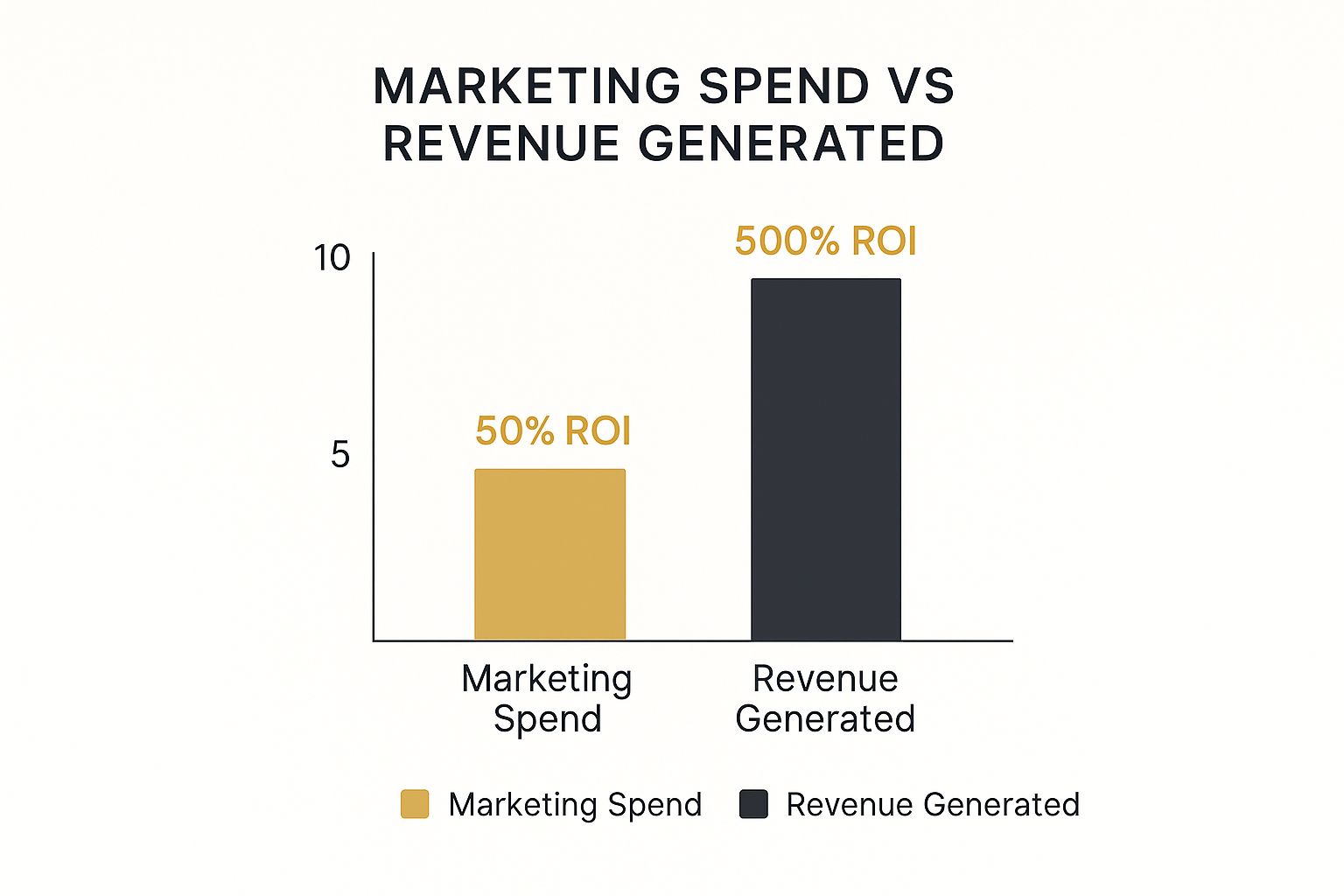
As you can see, a focused investment in the right place can bring back disproportionately large returns. It's a perfect illustration of how powerful a high-ROI channel can be.
Benchmarking Your Channel Performance
Every marketing channel has its own personality, its own rhythm, and its own typical return profile. Getting to know these benchmarks is crucial for setting realistic expectations. More importantly, it helps you spot when a campaign is performing exceptionally well or, conversely, when it's falling flat.
If you're just starting out, a good beginner's guide to digital marketing can give you a solid grounding in how these different channels play together.
But what does this look like in practice? Here’s a quick overview of what you might expect from some of the main channels.
To give you a clearer picture, let's look at some typical benchmarks for popular digital marketing channels in the UK. This table isn't gospel, but it's a great starting point for seeing how your own efforts stack up.
Typical Marketing Channel ROI Benchmarks in the UK
| Marketing Channel | Average ROI (Ratio) | Key Considerations |
|---|---|---|
| Email Marketing | 42:1 | Requires a quality list. Low cost per send, high potential for nurturing and repeat sales. |
| SEO | 22:1 | A long-term investment. ROI builds slowly but compounds over time for sustainable, organic traffic. |
| PPC Advertising | 2:1 | Fast results and highly measurable. Success depends on tight campaign management to control costs. |
| Social Media | Varies widely | Can be direct (ads) or indirect (brand building). Attribution is key but can be complex. |
These figures highlight just how different "good" looks from one channel to the next. Chasing a 42:1 return from PPC is unrealistic, while settling for a 2:1 return from your email list would be a massive missed opportunity.
The Enduring Power of Email
While flashy new channels often grab the headlines, don't ever underestimate email marketing. For UK businesses, it remains an absolute powerhouse. Its direct-to-inbox nature and the ability to segment your audience with precision make it incredibly efficient.
The numbers speak for themselves. According to the Data & Marketing Association (DMA), for every £1 a UK business invests in email marketing, the average return is an incredible £42.
That's an ROI of 4,200%.
It's a channel you simply cannot afford to get wrong.
Don’t just measure your overall marketing ROI. Break it down channel by channel. This granular view is where the most valuable insights live, allowing you to double down on what works and fix or cut what doesn’t.
By regularly performing this kind of channel-specific analysis, you build a detailed performance map of your entire marketing mix. It empowers you to shift your budget with confidence, ensuring every part of your strategy is pulling its weight and optimised for maximum profitability.
Putting Your ROI Insights Into Action

Getting that final number from your marketing ROI calculation feels good, but it’s really just the starting line. The real magic happens when you use that number to make smarter, more informed strategic decisions. On its own, the figure is just a number; what you do with it is what truly matters.
First things first, you need to understand what your ROI actually means in your world. There's no universal "good" ROI. A 5:1 return could be outstanding in one sector but just okay in another. Your job is to set benchmarks that make sense for your industry, your business model, and your specific goals.
Turning Data Into Decisions
With that context in place, you can start looking for the stories hiding in the data. Is your ROI trending upwards quarter after quarter? Did that one campaign you tried last month create a significant bump? Answering these kinds of questions is how you shift from simply reporting numbers to building a clear picture of what's working and what isn't.
This is also how you get buy-in from stakeholders. Presenting your findings effectively is key. Don't just flash a final percentage on a slide. Instead, walk them through the narrative. For instance, explain how a relatively small investment in email marketing nurtured existing leads into high-value customers. You can dig deeper into the advantages of email marketing to see exactly why it often punches so far above its weight.
An ROI figure is more than a metric; it's a diagnostic tool. Use it to check the health of your marketing engine, see what's fuelling growth, and find the parts that need a tune-up.
Building a Culture of Improvement
Armed with this knowledge, you can start fostering a culture of continuous improvement. The aim is simple: make every marketing pound work harder than the last. Here are a few practical ways I’ve seen this work brilliantly:
- Create Simple Dashboards: You don't need fancy, expensive software to get started. A straightforward spreadsheet dashboard that tracks ROI by channel gives you incredible clarity. It lets you see at a glance where your budget is best spent.
- Run Smarter A/B Tests: Let your ROI data guide your A/B testing. If a social media campaign is delivering a low return, don't just scrap it. Test a different creative, a new audience, or a stronger call to action to see if you can turn it around.
- Communicate Wins (and Lessons): Share what you find with the rest of the team. Celebrating a high-ROI campaign builds morale and momentum. Just as importantly, breaking down a campaign with a poor return offers valuable lessons for everyone and prevents repeating mistakes.
When you consistently apply these ideas, ROI stops being a one-off task you dread. It becomes the core of your marketing strategy—a constant feedback loop that leads to smarter spending, greater accountability, and ultimately, real, sustainable growth.
Common Questions About Marketing ROI
Even when you've got the formulas down and your data is lined up, real-world questions always pop up. It’s one thing to grasp the theory of marketing ROI, but it's another thing entirely to apply it when business complexities get in the way.
Think of this section as the practical advice you need after reading the textbook definitions. We're tackling the nuances that turn a confusing number into a genuinely useful insight.
How Often Should I Calculate Marketing ROI?
There’s no single right answer to this – the ideal timing really comes down to the rhythm of your business and the length of your sales cycle.
If you’re running a fast-moving e-commerce shop with constant promotions, checking in on campaign ROI weekly or even monthly makes a lot of sense. You need to be able to react quickly. On the flip side, if you're a B2B business with a six-month sales process, a quarterly or bi-annual review will give you a much clearer picture.
The key isn't to follow a rigid, universal schedule. It’s about maintaining a consistent one that makes sense for how your customers actually buy. This is how you spot real trends instead of just reacting to random blips in the data.
What Should I Do with a Negative ROI?
First off, don't panic. A negative ROI isn't a failure; it's a valuable piece of intel. It’s a bright, flashing sign telling you that some part of your strategy isn't connecting as planned.
A negative return is your cue to become a detective. Was the audience targeting off? Did the ad creative miss the mark? Was the channel cost simply too high for the revenue it could realistically generate?
Use that negative number as a diagnostic tool. Dig into every part of the campaign, figure out a hypothesis for what went wrong, then tweak your approach and test it again. This cycle of analysis and refinement is exactly how you build a resilient and truly profitable marketing machine.
How Do I Measure ROI for Content and SEO?
This is a classic challenge, mainly because the pay-off from long-term plays like content marketing and SEO is rarely immediate or direct. Pinning a specific sale on a blog post someone read six months ago is tough. The trick is to broaden your definition of "return."
Instead of hunting for direct sales, you need to track the metrics that are clear indicators of future revenue.
- Growth in organic traffic to your most important commercial pages.
- The number of leads generated from things like e-book downloads or webinar sign-ups.
- Assisted conversions in Google Analytics, which show you every time these channels played a part in a final sale.
By figuring out the value of a new lead or subscriber based on your own historical data, you can build a powerful, evidence-backed case for the financial impact of these foundational marketing efforts.
Ready to stop guessing and start measuring? The Digital Marketing Toolbox centralises the best analytics, SEO, and AI-driven tools to help you track performance and prove your impact. Find the right solutions to measure and improve your ROI today at https://grow-your-biz.com.


