

Think of a digital marketing strategy template as your blueprint. It’s a pre-built, structured guide that takes the guesswork out of your online marketing. Instead of just throwing things at the wall to see what sticks, this document gives you a repeatable framework to define your goals, pinpoint your audience, choose the right channels, and actually measure what’s working. It turns your vague ideas into a concrete, actionable roadmap.
Building Your Foundation for Digital Success

Before you can build a towering skyscraper, you’ve got to lay a solid foundation. The same logic applies directly to your digital marketing.
Jumping straight into tactics—firing off social media posts or email campaigns without a clear purpose—is like trying to build on sand. It's a surefire way to waste time, money, and a whole lot of effort. This foundational stage is all about defining what success actually looks like for your UK business.
Getting this initial work right transforms your marketing from a collection of hopeful guesses into a smart, strategic investment. If these concepts feel a bit new, our Beginner's Guide to Digital Marketing offers a great primer to get you up to speed.
First, Set Your Core Business Objectives
What are you really trying to accomplish? While "more sales" is the obvious answer, the most effective goals are specific, measurable, and tied directly to business outcomes. To help you frame your thinking, it's useful to see what other UK businesses are focused on.
Take a look at the top priorities for businesses across the country. This table gives you a clear snapshot of the most common goals, helping you align your efforts with proven industry benchmarks.
Core Digital Marketing Objectives for UK Businesses
| Marketing Goal | Percentage of UK Businesses Prioritising |
|---|---|
| Increase Sales Revenue | 54% |
| Enhance Brand Awareness | 42% |
| Boost Customer Engagement | 42% |
| Generate More Leads | 39% |
| Improve Customer Retention | 35% |
These figures show a clear picture: generating revenue is king, but building a known brand and an engaged community are just as vital for long-term growth. Use these common objectives as a starting point for your own strategy.
Use the SMART Framework to Sharpen Your Goals
Once you have a general idea, it’s time to make it real. The SMART framework is a classic for a reason—it forces you to create goals that are Specific, Measurable, Achievable, Relevant, and Time-bound. This is where vague wishes become actionable targets.
A goal like "get more leads" isn't very helpful. But applying the SMART framework transforms it into something powerful: "Increase marketing qualified leads (MQLs) from organic search by 15% in the next quarter by publishing four new optimised blog posts." Now you have absolute clarity and a direct way to track your success.
Get Your Bearings with a SWOT Analysis
Finally, before you charge ahead, you need to understand the terrain. A SWOT (Strengths, Weaknesses, Opportunities, Threats) analysis is a deceptively simple tool for assessing your position. It forces you to look inward at your capabilities and outward at the market environment.
For example, your strength might be a highly knowledgeable team, but a weakness could be a small marketing budget. An opportunity might be a new social media platform your competitors are ignoring, while a threat could be a major search engine algorithm update.
When you're mapping out specific channels, using a dedicated guide like a social media marketing strategy template can help you conduct a mini-SWOT for platforms like Instagram or LinkedIn. This foundational analysis ensures every part of your plan is grounded in reality, not just wishful thinking.
Defining Your Ideal UK Customer

Truly effective marketing should feel less like a megaphone announcement and more like a personal conversation. But to have that conversation, you first need to know exactly who you're talking to. This is where building detailed customer personas becomes one of the most crucial parts of your digital marketing strategy template.
Think of a persona as a character sketch of your perfect customer. It’s not just a list of statistics; it's a semi-fictional character, grounded in real data, that represents a key segment of your audience. Giving them a name, a personality, and real-world challenges makes your marketing so much sharper.
When you know who you're trying to reach, you stop guessing. Your messaging, the content you create, and the channels you choose all start to align with the people who actually want to buy from you.
Gathering Your Persona Data
You don't need a huge research budget to get started. Often, the most valuable information is already at your disposal – you just need to know where to look.
Begin by exploring your existing customer data and website analytics. These are absolute goldmines for understanding your UK audience.
- Google Analytics: Dive into the 'Demographics' and 'Interests' reports. This will give you a solid overview of the age, gender, and general interests of the people visiting your site.
- Social Media Insights: Your business pages on platforms like Facebook and Instagram offer rich data on your followers' demographics, where they live, and the times they’re most active.
- Customer Surveys: Don't underestimate the power of simply asking. A short survey sent to your email list can reveal so much. Ask about their biggest problems, what they truly value, and where they hang out online.
The aim here isn't to define one single "average" customer. You're looking for distinct groups. You’ll likely find you have two or three core customer types, and each one will need a slightly different approach.
Building Your Persona: A Real-World Example
Alright, let's put this into practice and turn that raw data into a living, breathing character. Let's say you run a financial advisory firm in the UK that helps young professionals. After digging through your data, you might develop a persona that looks something like this.
Persona Profile: "Manchester Millie"
- Background: Millie is a 29-year-old marketing manager living in Manchester. She's ambitious and earns a good salary, but she’s completely overwhelmed by the idea of financial planning.
- Goals: She’s focused on buying her first flat within the next two years and wants to start investing for her future. She’s looking for clear, jargon-free advice.
- Pain Points: Her biggest fear is that she isn't "making her money work for her." She finds the big, traditional financial websites stuffy and irrelevant to someone at her stage of life.
- Online Habits: She’s always listening to business podcasts during her commute, follows personal finance influencers on Instagram for tips, and uses budgeting apps on her phone.
Suddenly, with "Manchester Millie" in mind, your marketing strategy comes into focus. You know you should be creating content like "A First-Time Buyer's Guide for Northern Professionals" or running targeted ads on Instagram. This is how you transform a generic digital marketing strategy template into a specific, powerful plan for your business.
Choosing Your High-Impact Marketing Channels
Now that you have a crystal-clear picture of your ideal customer, it’s time to figure out where to actually find them online. This is where the template really starts to take shape.
The online world is noisy and crowded. It's tempting to think you need a presence on every platform, but that’s a classic mistake that burns through your budget and leaves you with a weak, diluted message. The secret is focus. Your job is to pinpoint the few channels where your customers are already hanging out and ready to listen.
A one-size-fits-all approach just doesn't work. The channels that are a goldmine for a fashion e-commerce brand will be a ghost town for a B2B software firm. Be honest with yourself and think back to your customer persona. Where do they really spend their time? That’s your starting point.
Matching Channels to Your Business Model
For most UK businesses, the best channels fall into a few key categories. The trick is to align your choices with how you operate. The distinction between selling to consumers versus other businesses is probably the biggest factor in this decision.
-
Business-to-Consumer (B2C): If you're selling directly to people, your game is all about building a brand they love, creating an emotional connection, and driving sales. Platforms like Instagram and TikTok are brilliant for visual products. At the same time, great SEO and targeted Google Ads are perfect for catching people who are actively searching for what you sell. Don't forget email – it’s fantastic for building loyalty and getting those repeat sales.
-
Business-to-Business (B2B): In the B2B world, it's about establishing trust, generating high-quality leads, and guiding them through a longer decision-making process. SEO is absolutely vital here, as professionals spend a lot of time researching solutions. LinkedIn is the undisputed champion for professional networking and sharing valuable content. From there, well-crafted email campaigns can nurture those leads effectively.
A common pitfall is jumping on a trending platform without thinking if your audience is even there. A local accountancy firm, for example, probably won’t get much from a TikTok dance challenge. But for a brand selling quirky phone cases? It could be a game-changer. Always start with your audience, not the platform.
Navigating the UK Social Media Scene
It’s no secret that social media advertising is a powerhouse in the UK, with projected revenues expected to hit £9.95 billion. While Facebook remains a giant in terms of user numbers, you have to look deeper.
Engagement, especially among younger audiences, is migrating. To connect with Gen Z and younger Millennials, you need to be where they are, which increasingly means platforms like Instagram and TikTok. Being aware of these shifts is key. You can explore detailed UK social media statistics to get a better sense of the current landscape.
Allocating a Starting Budget
Once you've shortlisted a few promising channels, the big question is: where do you put your money?
If you're new to this, my advice is to test the waters first. Don't go all-in on a single channel right away. A much smarter move is to set aside a small, experimental budget for two or three platforms that your research suggests are the best fit. This is especially true for smaller operations; our guide on creating a marketing strategy for a small business goes into more depth on budgeting.
Give it a few months and track everything. Keep a close eye on your cost-per-click (CPC), conversion rates, and, most importantly, your return on ad spend (ROAS). The numbers won't lie. They’ll quickly tell you which channels are delivering real value, so you can confidently invest more in what works and cut what doesn't.
Crafting a Content and Messaging Strategy That Converts

Now that you've pinned down who you're talking to and where you'll find them, it’s time to focus on what you're actually going to say. Your content is the lifeblood of your entire marketing plan. It’s the magnet that pulls people in, the conversation that builds trust, and the nudge that encourages them to act.
A solid content strategy isn't about just churning out blog posts. It’s about consistently creating genuinely useful and relevant material that addresses the real problems your customers face. This is where your customer personas—like "Manchester Millie"—truly shine, acting as your guide for every piece of content you create.
Aligning Content with the Customer Journey
Let's be realistic: not all content works for all people at all times. Someone just discovering your brand for the first time needs something very different from a person on the verge of buying. A brilliant, yet simple, way to get this right is by mapping your content to the different stages of the marketing funnel.
Think of it as starting a friendship. You don't jump into deep, personal stories right away. You build up to it. Your content should do the same.
-
Awareness Stage (Top of the Funnel): Your aim here is to grab the attention of a wide audience by making them aware of a problem or need. Your content should be educational and genuinely helpful. We're talking about blog posts, simple how-to guides, and videos that answer broad questions. For "Manchester Millie," a post like "5 Common Money Mistakes Young Professionals Make" would be perfect.
-
Consideration Stage (Middle of the Funnel): At this point, your audience knows they have a problem and are now actively researching solutions. This is your chance to showcase why your product or service is the best fit. Dive deeper with things like detailed case studies, product comparison guides, or insightful webinars.
-
Decision Stage (Bottom of the Funnel): They're almost there! They're ready to make a choice, and your job is to make it an easy one. Content here should seal the deal. Think free trials, no-obligation consultations, transparent pricing pages, and glowing customer testimonials to provide that final push of confidence.
Organising Your Content with a Calendar
Great ideas are one thing, but it’s consistency that truly builds an audience and drives results. A content calendar is a non-negotiable tool inside your digital marketing strategy template, and it doesn't need to be complex. A simple spreadsheet often does the trick beautifully.
Your calendar is there to track what you're publishing, on which channel, and on what date. This simple framework creates a reliable flow of valuable content for your audience, keeps your team on the same page, and eliminates that last-minute panic of having nothing to post.
A core part of your messaging is your unique brand voice. For a deep dive, check out this Ultimate Brand Voice Guide. Whether your voice is witty, professional, or super friendly, it needs to be the same everywhere. It’s the personality that makes your brand stick in people's minds.
When you create content that's deliberately designed for your customer's journey and organised for consistent delivery, you aren't just a business—you're the authority. This is how you build the trust that turns curious visitors into lifelong fans.
How to Measure and Optimise Your Strategy
Your digital marketing strategy shouldn't just be a document you create once and then file away. The best strategies are living, breathing things that grow and adapt right alongside your business. This is where the real value of your digital marketing strategy template shines—when you start measuring what you’re doing, learning from the data, and making smart changes.
Without measurement, you're essentially marketing in the dark. It’s all guesswork. But once you start tracking your performance, you gain the clarity to do more of what works and stop wasting time and money on what doesn't. This turns marketing from a cost into a genuine growth driver for your business.
The good news? You don't need a huge, complicated analytics setup to begin. Powerful and free tools like Google Analytics 4 are more than capable of giving you the insights you need to track your progress and make informed decisions.
Pinpoint Your Key Performance Indicators
Before you can measure success, you have to define what success looks like. This is where Key Performance Indicators, or KPIs, come in. These are the specific, measurable metrics that tell you if you're actually getting closer to your business goals. Your KPIs will naturally differ based on the marketing channels you've decided to focus on.
Here are a few of the most crucial KPIs I always recommend keeping an eye on for each channel:
- SEO: The big ones here are organic traffic (how many people find you through search engines), your keyword rankings for important terms, and the click-through rate (CTR) you’re getting from the search results pages.
- PPC/Paid Ads: For paid advertising, it all comes down to the money. Your main focus should be cost-per-acquisition (CPA) or return on ad spend (ROAS). These tell you exactly what it costs to land a new customer and how much revenue your ads are bringing in.
- Social Media: Don't get caught up in follower counts. Instead, measure your engagement rate (the likes, comments, and shares) and, more importantly, website clicks. Is your social media activity actually driving people to your site?
- Email Marketing: Always track your open rate and click-through rate, but the most critical metric is the conversion rate from your campaigns. If you want to dive deeper, there are many advantages of email marketing when it comes to nurturing a direct relationship with your audience.
Key Performance Indicators by Marketing Channel
Here is a quick summary of the essential metrics to track for each digital marketing channel. Watching these will help you effectively measure the success of your strategy.
| Channel | Primary KPI | Secondary KPI |
|---|---|---|
| SEO | Organic Traffic | Keyword Rankings, Click-Through Rate (CTR) |
| PPC/Paid Ads | Return on Ad Spend (ROAS) | Cost-Per-Acquisition (CPA), Conversion Rate |
| Social Media | Engagement Rate | Website Clicks, Follower Growth |
| Email Marketing | Conversion Rate | Open Rate, Click-Through Rate (CTR) |
Having this data at your fingertips makes it much easier to see which channels are pulling their weight and where you might need to adjust your approach.
Building Your Performance Dashboard
Your template should have a dedicated section for tracking performance over time. This doesn't need to be complex; a simple spreadsheet where you log your core KPIs every week or month can work wonders. Seeing your data visually makes it so much easier to spot patterns and trends.
For example, this simple chart shows a planned content output for a single week.
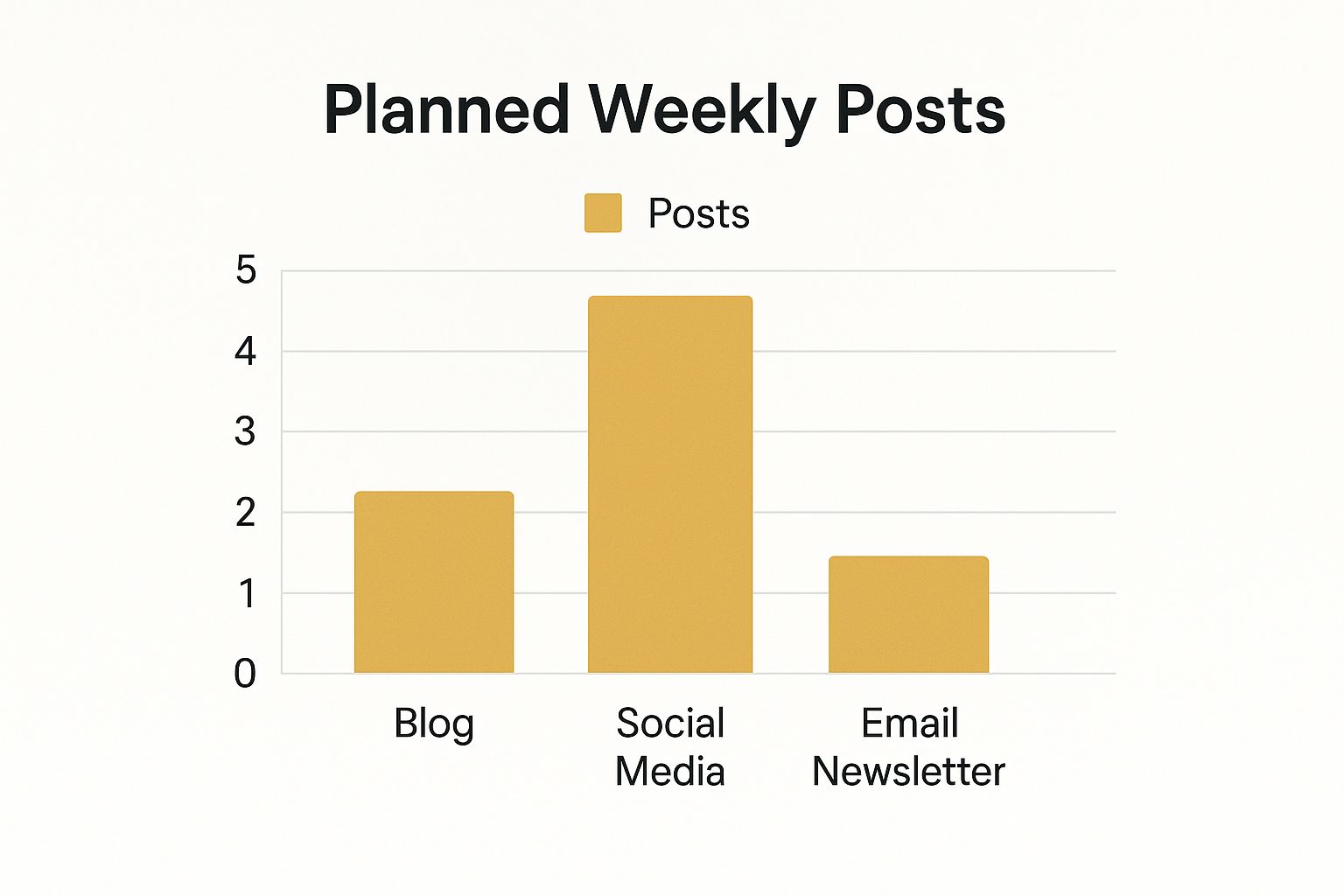
You can see at a glance that social media is the most active channel in this particular plan, with five posts scheduled.
The goal is to move from just gathering data to finding actionable insights. For instance, if your organic traffic is climbing but your sales are flat, that might point to a problem with your website's user experience, not your SEO.
This cycle of measuring, learning, and refining is what drives sustainable growth. In a market like the UK, where digital marketing spend is projected to hit USD 86.35 billion by 2034, a data-driven approach isn't just an option—it's a necessity. To get a better handle on these market dynamics, you can read the full research about these market trends and see what's powering this expansion.
When it comes to your paid ads, precise measurement is non-negotiable. Knowing how to correctly implement tracking is key to understanding your return on investment. For example, learning about setting up Google Ads conversion tracking is a practical step to ensure every pound you spend is accounted for. By regularly checking in on your KPIs, you can confidently steer your marketing strategy toward real, measurable results.
A Few Common Questions
As you start working with the template, you're bound to have some questions. It happens to everyone. So, I’ve put together answers to some of the most common queries I hear from businesses trying to get their digital marketing off the ground.
Think of this as a quick chat to clear up those nagging doubts that can stall your progress. Let's get them sorted.
How Often Should I Actually Update My Digital Marketing Plan?
Look, your strategy shouldn't be set in stone. The marketing world just moves too fast for that. I always recommend a deep, comprehensive review of your entire strategy at least once a year. This is when you step back, look at the big picture, and make sure your marketing is still pulling in the same direction as your overall business goals.
On the other hand, you need to be much more nimble with your day-to-day tactics. You should be checking in on your performance metrics monthly or, at the very least, quarterly. This regular pulse-check is what lets you react quickly.
Say a competitor launches a surprise product, or a social media algorithm suddenly changes overnight. A quarterly review gives you the space to pivot your tactics and capitalise on new opportunities without having to wait a whole year.
What’s the Biggest Mistake People Make With These Templates?
Hands down, the single biggest pitfall is treating the template like a paint-by-numbers worksheet. It's so tempting to just fill the boxes with generic phrases and move on, but that completely defeats the purpose. The template is a framework to guide your thinking, not a substitute for it.
A plan filled with vague wishes like "get more followers" or "increase website traffic" is pretty much doomed from the start. That's not a strategy; it's a wish list. A template is just a document of empty promises without specific, researched actions and clear ways to measure success.
To get real value, you have to do the legwork. For every section, take the time to dig into your specific audience, analyse what your competitors are doing, and properly understand your unique place in the UK market.
How Much Should a Small UK Business Really Budget for Digital Marketing?
There isn’t one magic number, I'm afraid. Your ideal budget really depends on your industry, your revenue, and how quickly you want to grow. That said, a solid rule of thumb for small businesses is to earmark somewhere between 5% and 15% of your total revenue for all your marketing efforts.
If you're a new business just starting out or you're pushing for aggressive growth to grab market share, you’ll want to aim for the higher end of that scale. An established business with a steady stream of customers might find that 5-10% is perfectly adequate.
Honestly, the starting number isn't the most critical part. What truly matters is your commitment to tracking your return on investment (ROI). Start with a budget you're comfortable with, measure absolutely everything, and then be smart about reinvesting what you earn into the channels that are actually delivering results.
Ready to stop guessing and start growing? The Digital Marketing Toolbox provides a curated catalogue of the best tools to bring your strategy to life. Discover, compare, and implement solutions for SEO, email, social media, and more. Find the perfect tools to power your success at https://grow-your-biz.com.


