
At its core, calculating your Customer Acquisition Cost (CAC) is pretty straightforward: you take your total sales and marketing spend and divide it by the number of new customers you've brought in over a set period. But don't let that simple formula fool you; it's one of the most powerful health checks for your business, telling you a story about your financial sustainability and marketing efficiency.
Why Calculating CAC Is a Non-Negotiable Business Skill

In today's tough economic climate, knowing your numbers isn't just a "nice to have"—it's a critical skill for survival. Think of CAC as the pulse of your marketing and sales engine. When you truly understand it, you can stop guessing and start making strategic decisions that directly boost your bottom line.
Getting a firm grasp on this figure is essential for a few key reasons:
- Budget Optimisation: It shines a light on exactly where your marketing pounds are working hardest, so you can double down on what’s effective and cut the dead weight.
- Proving ROI: It gives you concrete proof of your marketing team's value, turning campaign efforts into tangible financial results you can take to the bank.
- Sustainable Growth: It's the bedrock of a profitable business model, ensuring the lifetime value of a customer far outweighs what you spent to get them in the door.
For a clearer picture, let's break down the two main parts of the CAC formula.
Quick Overview of the CAC Formula Components
This table sums up the core elements you'll be working with.
| Component | What It Includes | Why It Matters |
|---|---|---|
| Total Sales & Marketing Costs | Salaries, ad spend, software tools, agency fees, commissions, and any other overheads related to marketing and sales. | This is the total investment you're making to attract customers. Being comprehensive here is key to getting an accurate picture. |
| New Customers Acquired | The total count of brand-new customers who made their first purchase within your specified time frame. | This is the direct result of your investment. It defines the "return" side of your acquisition efforts. |
Nailing both sides of this equation is what gives you a CAC figure you can actually trust and act upon.
The Rising Cost of Acquiring Customers
The pressure to master this calculation has never been greater. Right now, in 2025, the UK is experiencing a significant spike in customer acquisition costs. They've hit an all-time high, driven by a cocktail of economic pressures.
With the UK economy projected to grow by a sluggish 0.3% and consumer spending set to rise by just 1.3%, the battle for every new customer is more intense than ever. This climate makes it much harder—and more expensive—to win new business. You can read the full research on these economic pressures over on Tyviso.
"A high ratio implies attractive economics because your essential profit formula is a success, while a low ratio implies you may need to adjust your business model." – Christina Wallace, Harvard Business School Professor
Christina's point really hits home. A simple calculation isn't enough; you need to understand the story behind the numbers. This is especially true for online businesses, where the delicate balance between lifetime value (LTV) and acquisition cost is everything. If you're in this space, it's worth exploring the different e-commerce growth data analysis tools for LTV, CAC, and cohorts to gain a deeper understanding.
Without this clarity, you’re just pouring money into a leaking bucket—a mistake very few businesses can afford to make right now.
Gathering Your Data for an Accurate Calculation

Your CAC calculation is only as good as the data you feed it. It’s that simple. If you put garbage in, you'll get garbage out, and that can lead you to make some seriously misguided business decisions. To get this right, you need to dig deeper than the most obvious expenses and capture the full financial picture of what it takes to win a customer.
This means getting a bit obsessive about tracking every single cost related to marketing and sales, not just the big, flashy numbers. Everyone remembers to include their direct ad spend from Google Ads or Meta campaigns, but that’s barely half the story.
To truly understand how to calculate customer acquisition cost properly, you need to tally up every pound spent in the pursuit of new business.
Identifying Your Direct Costs
Let’s start with the easy stuff: direct costs. These are the expenses you can tie directly to a specific marketing or sales activity. They show up as clean line items on invoices or in your ad platform dashboards, representing the money you're actively spending to get in front of potential customers.
Think of these as the fuel for your acquisition engine. Your list here should definitely include:
- PPC Ad Spend: The total amount you're spending on platforms like Google Ads, Bing Ads, and LinkedIn Ads.
- Social Media Advertising: All your paid campaign costs from Facebook, Instagram, TikTok, and X. To get this right, you’ll need detailed figures, including estimates for your specific social media campaign costs.
- Affiliate and Influencer Payouts: Any commissions or flat fees paid to partners who bring you new customers.
Accounting for Indirect and Overlooked Costs
Now, this is where so many businesses fall down. Indirect costs, or overheads, are all the expenses that support your acquisition efforts but aren't tied to one specific campaign. If you ignore these, you’ll end up with a dangerously optimistic CAC that isn’t based in reality.
A common mistake is to only count ad spend, which can make a campaign look twice as profitable as it really is. Including salaries and software costs gives you the true, unvarnished picture of your acquisition efficiency.
These are the critical but often-forgotten costs you can't afford to miss:
- Salaries: The wages of your marketing and sales team. If they have other responsibilities, you'll need to allocate a fair percentage of their salary to acquisition activities.
- Software Subscriptions: All those monthly or annual fees for your CRM, email marketing platform, SEO tools, and analytics software add up.
- Content Creation: Costs for freelance writers, graphic designers, video producers, or any agency fees you pay.
- Sales Commissions and Bonuses: Any performance-based pay that goes to your sales team for closing deals.
Imagine a UK-based e-commerce brand selling artisan coffee. They might proudly report their £5,000 Meta ad spend. But if they forget the £3,500 monthly salary of their social media manager and the £500 for content creation tools, their CAC calculation will be completely skewed.
Getting a handle on these costs is a core principle of good marketing, something we explore further in our beginner's guide to digital marketing. By diligently gathering both your direct and indirect costs, you build a solid foundation for a CAC figure you can actually trust.
Putting the CAC Formula into Practice with Real-World Scenarios
Alright, let's move from theory to reality. The customer acquisition cost formula is simple on paper, but seeing it work with actual numbers is where the magic happens. This is how you start to understand the real pulse of your business. We'll walk through the calculation for two very different UK-based companies to see how it plays out.
This infographic lays out the basic steps for figuring out your CAC.
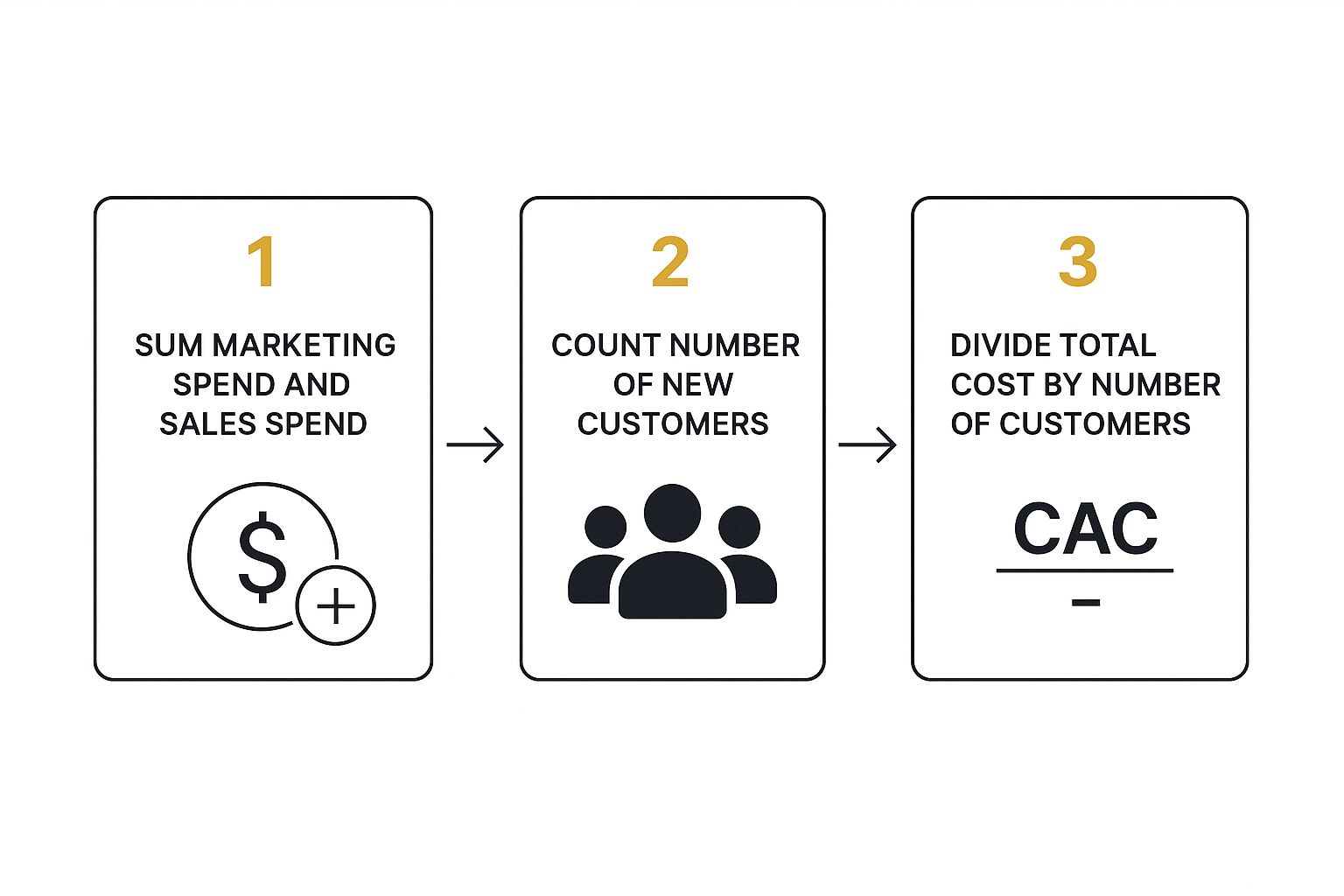
As you can see, it’s a straightforward process: add up your spending, count your new customers, and do the division. Simple, yet incredibly powerful.
Example One: A UK SaaS Startup
Let's imagine a SaaS company in London that sells project management software to small creative agencies. Their growth strategy is a mix of content marketing and highly targeted paid ads.
Here’s a look at their spending over the last quarter:
- Marketing & Sales Salaries: £15,000 (This is the portion of salaries directly tied to acquiring new business, not retaining existing clients).
- Google Ads Spend: £7,500
- LinkedIn Ads Spend: £5,000
- SEO & Content Agency Fees: £4,500
- CRM & Marketing Automation Tools: £1,200
In that same quarter, they onboarded 125 brand-new paying customers.
First, we need to tally up all those acquisition costs:
£15,000 + £7,500 + £5,000 + £4,500 + £1,200 = £33,200 total spend.
Now, we just divide that total by the number of new customers:
£33,200 / 125 = £265.60 CAC.
This tells the SaaS company it costs them £265.60 to get each new subscriber through the door. This single number is the linchpin for their entire business model—they can now directly compare it to their Customer Lifetime Value (LTV) to see if they're building a sustainable business.
Example Two: A UK Direct-to-Consumer Brand
Now for something completely different: a Manchester-based e-commerce brand selling sustainable activewear. Their playbook is all about social media advertising and collaborating with influencers. Because their sales cycle is much faster, calculating CAC monthly makes more sense.
Here’s their spending breakdown for last month:
- Meta Ads (Facebook & Instagram): £8,000
- TikTok Ads: £4,000
- Influencer Campaign Fees: £3,500
- Email Marketing Platform: £300
- Portion of Marketing Manager's Salary: £2,000
During that month, they welcomed 270 new customers.
Let's add it all up:
£8,000 + £4,000 + £3,500 + £300 + £2,000 = £17,800 total spend.
And now for the final calculation:
£17,800 / 270 = £65.93 CAC.
For an e-commerce brand, this figure is absolutely vital. The cost of acquiring customers in this space is skyrocketing—it's shot up by around 40% since 2023 for UK e-commerce businesses. With average acquisition costs hovering between $68 and $78, and many brands losing an average of $29 per new customer, knowing your exact CAC isn't just a "nice-to-have," it's a survival metric.
To give you a clearer picture of how these costs add up, here’s a sample calculation table.
Sample CAC Calculation for a UK E-commerce Business (Monthly)
| Expense Category | Cost (£) | Notes |
|---|---|---|
| Paid Advertising | ||
| Google Ads | £5,000 | Search and Shopping campaigns for specific product lines. |
| Meta Ads (Facebook/Instagram) | £8,000 | Retargeting and prospecting campaigns. |
| TikTok Ads | £4,000 | Top-of-funnel brand awareness campaigns. |
| Content & Outreach | ||
| Influencer Collaborations | £3,500 | Fees for three micro-influencers for a monthly campaign. |
| Salaries (Prorated) | ||
| Marketing Manager Salary | £2,000 | 50% of salary allocated to acquisition activities. |
| PPC Specialist Salary | £1,500 | 50% of salary allocated to acquisition campaigns. |
| Tools & Software | ||
| SEO Software (e.g., Ahrefs) | £150 | Monthly subscription for keyword research and tracking. |
| Email Marketing Platform (e.g., Klaviyo) | £300 | Costs associated with acquisition-focused email flows. |
| TOTAL ACQUISITION SPEND | £24,450 | |
| NEW CUSTOMERS ACQUIRED | 350 | |
| FINAL CAC | £69.86 | (£24,450 / 350) |
This table shows just how many different expenses feed into the final CAC. Every tool, salary, and ad campaign has a role to play.
Monthly vs. Quarterly Calculations: Which Is Right for You?
So, how often should you be running these numbers? It really comes down to your sales cycle.
For businesses like our e-commerce example where customers can see an ad and buy within hours, monthly calculations are perfect. They give you rapid feedback on what’s working, allowing you to quickly shift budget and tactics. This kind of agility is a key part of an effective marketing strategy for small businesses.
On the other hand, for businesses with a longer sales process, like our SaaS company, a quarterly calculation often provides a more reliable picture. A customer might see a blog post, sign up for a demo, take a 14-day trial, and only then become a paying customer. A monthly calculation could be skewed by these lags. A quarterly view smooths out those peaks and valleys, giving you a truer sense of what it really costs to turn a prospect into a paying client.
Making Sense of Your CAC: What Does 'Good' Actually Look Like?

So, you’ve calculated your customer acquisition cost. That's a great first step, but the number itself doesn't tell you much on its own. A £50 CAC might be fantastic for one business and completely unsustainable for another.
The real question isn't just "What is my CAC?" but rather, "Is my CAC actually working for my business?"
To figure that out, you need to bring another crucial metric into the picture: Customer Lifetime Value (LTV). Simply put, LTV is the total revenue you can expect to get from a customer over the entire time they do business with you. It’s the other side of the acquisition coin, and how these two figures relate is the true measure of your business's health.
This relationship is best understood through the LTV-to-CAC ratio. It's a straightforward comparison that shows you exactly how much value you're getting back for every pound you put into acquisition.
The LTV-to-CAC Ratio Explained
Think of the LTV-to-CAC ratio as a quick snapshot of your business model's profitability. It takes the conversation beyond just the cost of getting a customer and shines a light on long-term value. Without it, you’re essentially flying blind, unsure if your marketing spend is a solid investment or just money down the drain.
As a rule of thumb, a healthy LTV-to-CAC ratio is widely considered to be 3:1 or higher. This means that for every £1 you spend to bring in a new customer, you should expect to get at least £3 back over their lifetime.
Hitting that 3:1 sweet spot is a strong sign that you have a scalable and profitable business model. It proves you're not just acquiring any customers, but the right kind of customers, and you're doing it efficiently.
Here’s a quick breakdown of what different ratios mean:
- Below 1:1: This is a red flag. You're losing money on every single customer you acquire. A model like this can't last, and you need to make some strategic changes, fast.
- Exactly 1:1: You're just about breaking even on your acquisition efforts. You’re spending a pound to make a pound, which leaves zero room for profit or covering any of your other operational costs.
- Above 3:1 (e.g., 4:1 or 5:1): On the surface, this is great news! Your marketing is clearly very efficient. However, it could also be a sign that you're under-investing in growth and leaving potential customers on the table.
Why Context Is Everything
While 3:1 is a solid benchmark, a "good" CAC is deeply tied to your specific industry and business model. There's no one-size-fits-all answer.
For instance, a subscription software company with excellent customer retention can afford a much higher upfront CAC than a local retail shop that relies on smaller, more frequent purchases.
A startup in an aggressive growth phase might also choose to stomach a lower LTV-to-CAC ratio for a short period to grab market share. An established company, on the other hand, will need to keep a close eye on this ratio to ensure long-term stability.
The trick is to understand your own unique circumstances and use the ratio as a guide, not an unbreakable law. Boosting your LTV often comes down to building better customer relationships. Exploring the advantages of email marketing can be a cost-effective strategy to improve retention and encourage repeat business, which directly lifts your lifetime value.
Common Mistakes That Skew Your CAC Calculation
Calculating your customer acquisition cost seems simple enough on the surface, but it's surprisingly easy to get wrong. Tiny oversights can lead to huge errors in judgement, giving you a completely skewed view of your marketing performance.
An inaccurate CAC can either create a false sense of security or trigger unnecessary panic. Both scenarios lead to bad decisions about where to spend your budget and how to plan for growth. Getting this right means being brutally honest about every single penny you're spending to bring in new business.
Scarily, a lot of businesses are flying blind. A recent survey of UK retailers found that about a quarter of retailers don't know their true CAC, and over a third aren't even tracking customer retention. You simply can't gauge how efficient your acquisition efforts are without this visibility. You can find more insights from that survey on understanding customer acquisition costs at Novuna.
Let's walk through the most common tripwires I see and, more importantly, how you can sidestep them.
Forgetting Overheads and Indirect Costs
This is the number one offender, without a doubt. It’s easy to tally up your direct ad spend on Google or Meta, but what about the salaries of the people managing those campaigns? Or the subscription cost for the CRM they use to track all those leads?
These aren't optional extras; they are fundamental costs of winning a new customer.
- Salaries and Wages: You have to attribute a portion of your marketing and sales team salaries. If someone spends 50% of their time on acquisition activities, then 50% of their salary for that period belongs in your CAC calculation.
- Software and Tools: All those monthly subscriptions add up. Don't forget your SEO tools, email marketing platforms like Mailchimp, analytics software, and any other tech that supports your acquisition work.
- Creative and Agency Fees: The money you spend on freelance designers, copywriters, or your digital marketing agency is absolutely part of the equation.
Ignoring these costs will make your marketing channels seem far more profitable than they really are. A true CAC has to reflect the total investment, not just the obvious line items on an invoice.
Mixing New and Returning Customers
The "C" in CAC stands for "Customer," but what it really means is a new customer. Your calculation should only ever include the number of brand-new customers you won during the specific period you're measuring.
If you lump returning customers into the mix, you'll artificially lower your CAC. This makes it look cheaper to acquire customers than it actually is. Marketing to existing customers is crucial for boosting lifetime value (LTV), but those costs are part of your retention budget, not acquisition. Dig into your CRM or sales data to properly segment new buyers from repeat purchasers. This is non-negotiable for clean numbers.
Failing to Segment by Channel
Calculating a single, "blended" CAC for the whole business is a decent starting point for a high-level health check. The problem is, it gives you zero actionable insight.
Your blended CAC might look perfectly healthy, but it could be hiding an expensive, underperforming channel that's being propped up by a really efficient one. To make genuinely smart budget decisions, you have to break it down.
You need to understand how to calculate customer acquisition cost for each of your channels individually. Figure out your CAC for:
- Paid Search (Google Ads)
- Paid Social (Meta, LinkedIn, TikTok)
- Organic Search (SEO and content marketing)
- Email Marketing
This granular detail is where the magic happens. It shows you exactly where you should shift your budget for a better return, turning a simple metric into a powerful strategic tool.
Got More Questions About CAC?
Even after you’ve got the basics down for calculating your customer acquisition cost, a few common questions always seem to pop up. Nailing these details can be the difference between a metric that genuinely helps and one that just adds to the confusion. Let's clear up some of the most frequent sticking points.
Getting these answers right adds that final layer of context, turning your CAC from just another number into a serious strategic tool for your business.
How Often Should I Be Calculating My CAC?
For most UK businesses, running the numbers monthly is the sweet spot. This frequency gives you timely feedback on your campaigns without getting lost in the day-to-day fluctuations. If you're running an e-commerce brand with a quick path to purchase, this is definitely for you.
However, if you’re a B2B company where the sales journey is more of a marathon—we're talking multiple demos, proposals, and sign-offs—then a quarterly calculation will probably give you a more accurate and stable picture. It helps smooth out the natural delays between a first touchpoint and a closed deal. The real key here is consistency. Pick a timeframe that makes sense for your business and stick to it so you can spot genuine trends.
What’s the Real Difference Between CAC and CPA?
This is a classic point of confusion, but the distinction is incredibly important.
Think of Cost Per Acquisition (CPA) as a micro-metric. It’s focused on the cost of a specific action, which might not be a paying customer. This could be anything from a lead submitting a form, someone signing up for a free trial, or a user downloading your latest guide.
Customer Acquisition Cost (CAC), on the other hand, is the ultimate macro-metric. It tells you the total cost to bring a new, paying customer on board. You might have several different CPAs feeding into your marketing funnel, but you only have one final CAC for each new person who actually spends money with you.
CPA is brilliant for optimising specific campaigns and funnel stages. But CAC is the number that tells you if your entire business model is actually profitable and built to last.
Should I Use a Blended or a Channel-Specific CAC?
Honestly, you need both. They answer different questions, and both are vital.
Your blended CAC is your 30,000-foot view—the number you'd show in a board meeting. It gives you a quick snapshot of the overall health of your entire sales and marketing machine. It's the go-to figure for checking your LTV:CAC ratio and assessing your business's long-term viability.
But your channel-specific CAC is where the real action happens. This is where you roll up your sleeves and get tactical.
- It helps you figure out if your Google Ads are actually more efficient than your LinkedIn campaigns.
- It reveals the true cost of winning customers through content marketing compared to paid social media.
Without breaking it down by channel, you’re flying blind when it comes to optimising your budget. You could have a couple of highly profitable channels masking the poor performance of others, and you'd have no idea. By calculating both, you get the complete story, empowering you to make smarter decisions at every level.
Ready to build a smarter marketing stack? At The Digital Marketing Toolbox, we bring together the best tools for analytics, SEO, and campaign management in one place. Discover and compare top-rated software to lower your CAC and drive sustainable growth. Explore the toolbox and find your next game-changing solution today


