
Getting a Google review boils down to two things: giving your customers a brilliant experience and then making it dead simple for them to talk about it online. It's about creating a direct review link, picking the perfect moment to ask, and using tools like email, SMS, or even QR codes to make the process completely painless.
Why Google Reviews Matter for UK Businesses

Think of Google reviews as today's word-of-mouth. It’s the digital equivalent of a neighbour recommending a great local plumber over the garden fence. For any UK business, they're not just a 'nice to have'—they are a vital asset that has a real impact on your visibility, your credibility, and your bottom line.
When a potential customer is searching for a product or service, they’re actively seeking social proof to feel confident in their choice. Positive reviews build that trust in an instant, acting as genuine endorsements that even the cleverest advert can't buy.
The Power of Social Proof and Trust
Honest customer feedback is one of the most powerful marketing tools you have. It tells a story about your business from the perspective of real people, which is far more convincing than any slogan you can come up with. This library of experiences helps potential customers picture what it’s actually like to work with you.
A consistent flow of positive reviews shows people you are:
- Credible: It proves you're a real, active business that consistently delivers on its promises.
- Customer-Focused: It offers solid proof that you care about your customers and live up to their expectations.
- Transparent: Being open to all feedback, good and bad, signals honesty and builds a much deeper level of trust.
Boosting Your Local Search Ranking
Beyond just building trust, Google reviews are a massive factor in local search engine optimisation (SEO). Google's algorithm sees a high volume of positive reviews as a strong signal that a business is reputable and relevant to people searching nearby. This directly influences how high you rank in local search results, especially in the coveted "Local Pack" map listings.
Recent survey data really drives this home. In the UK, over 80% of consumers turn to Google to read reviews of local businesses, and almost a third won't even consider a business with a rating below four stars. What's more, 63% of UK consumers are more likely to use a business that has online reviews, proving the direct line between reviews and new customers. For a deeper understanding of how this all works, you can explore the digital marketing expertise at bare-digital.
The takeaway is clear: encouraging reviews isn't just about reputation management. It’s a core part of any smart local marketing strategy that drives visibility and brings more customers through the door.
To see how reviews fit into the bigger picture of your online strategy, check out our https://grow-your-biz.com/beginners-guide-to-digital-marketing/.
How to Create Your Google Review Link
If you want more Google reviews, the single best thing you can do is make it ridiculously easy for your customers. People are busy. Any friction, no matter how small, can be the difference between getting that glowing 5-star review and getting nothing at all.
That's where your direct Google review link comes into play. It’s a simple, shareable URL that whisks customers straight to the review pop-up for your business. No searching, no faffing about. Just click and review.
Think about it: sending a customer to Google’s homepage and just hoping they find your business profile isn’t a strategy—it’s a lottery ticket. A direct link is your most important tool for turning a happy customer's good intentions into a tangible, valuable review.
Finding Your Unique Review Link
Getting hold of this link is actually quite simple once you know where to look. It’s tucked away inside your Google Business Profile dashboard, which is your command centre for all things Google.
Here’s the quickest way to grab it:
- First, sign in to the Google account connected to your business.
- Next, just search for your business name on Google. This should bring up your management panel right in the search results.
- Look for a button labelled "Ask for reviews". It's usually quite prominent.
This screenshot shows you exactly what you're looking for inside the dashboard.
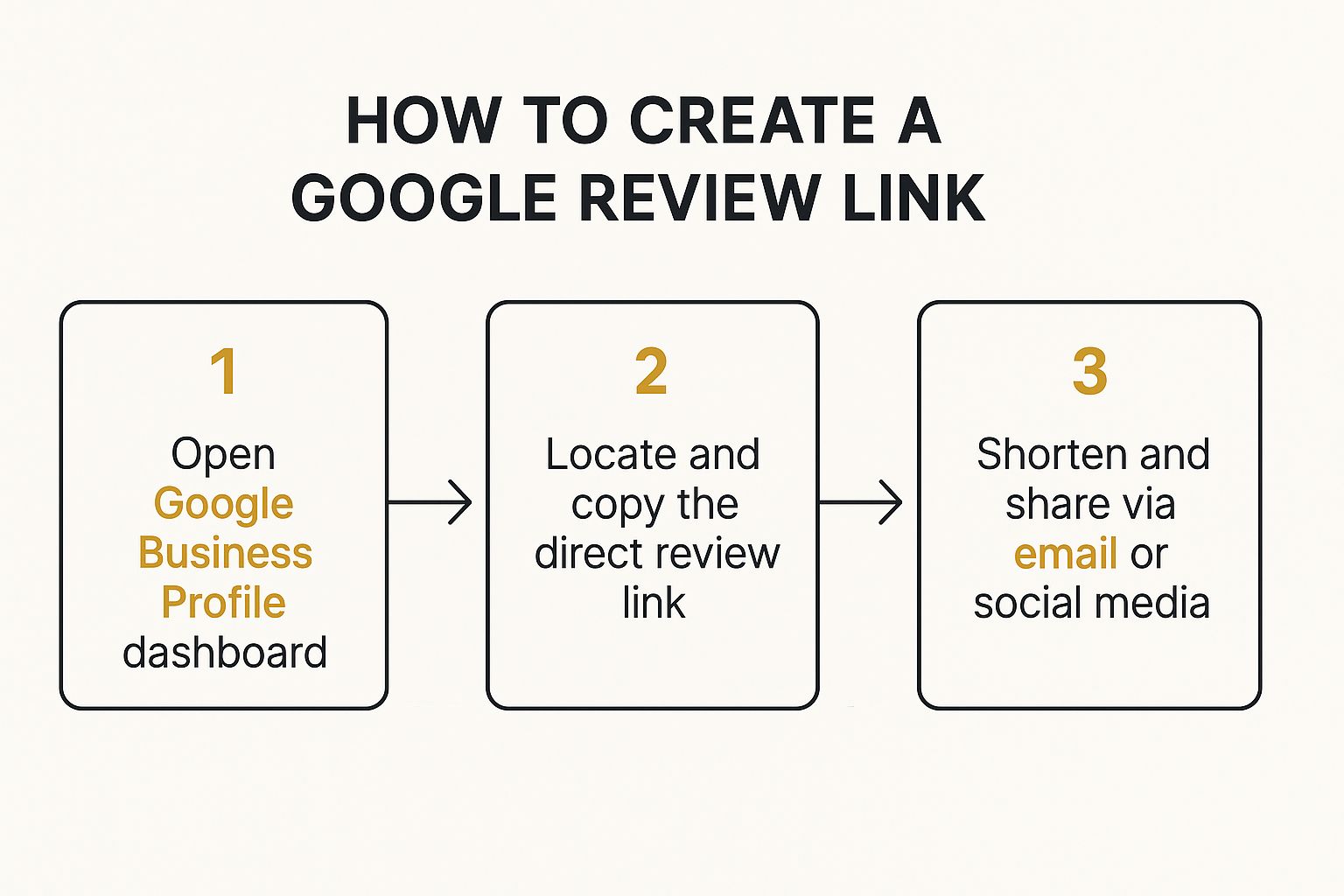
Once you click that, a little box will pop up containing your unique review link, ready to be copied and shared with the world.
For Best Results, Shorten and Brand Your Link
Let's be honest, the default link Google gives you is long, ugly, and forgettable. It works, but it doesn't exactly scream professionalism. A much smarter move is to use a link shortener to create a clean, memorable, and even branded URL.
A branded, shortened link isn't just about looking good; it's about building trust. A customer is far more likely to click on something like
review.yourcafe.co.ukthan a long jumble of random letters and numbers. It immediately looks more legitimate.
Tools like Bitly or TinyURL are great for creating a quick, tidy link.
But if you want to take it a step further, a service like Rebrandly lets you create custom-branded links using your own domain. This small detail can make a huge difference, reinforcing your brand and making your request look far more credible, especially on printed materials like receipts or business cards. It just makes the whole experience feel more polished.
10 Tried-and-Tested Ways to Ask Customers for Reviews
Knowing how to ask for a Google review is less about a hard sales pitch and more about perfect timing and a gentle nudge. The best requests feel like a natural part of a great experience, not some awkward afterthought. It all comes down to asking at the right moment, using the right channel, and making it ridiculously easy for the customer.
Your goal should be to frame your request as a genuine invitation for feedback. Show them you truly value their opinion. This simple shift in perspective turns a basic transaction into a meaningful interaction, making a thoughtful response far more likely.
Nail the Timing of Your Request
If there's one secret to getting more reviews, it's timing. You need to catch customers when their positive feelings about your business are at their absolute peak. This moment of delight is everything.
Look for these "peak happiness" moments:
- Right after a purchase they're clearly excited about.
- The moment they compliment your service unprompted, whether in person or online.
- After you've brilliantly solved a problem for them, turning a potential negative into a massive positive.
- A few days after they've received their product and had a chance to actually use it.
Asking too early can feel pushy, and if you wait too long, that initial buzz will have faded. Your job is to pinpoint that sweet spot where they feel most satisfied with their experience—that’s your golden window of opportunity.
The Power of the In-Person Ask
Honestly, nothing beats a direct, personal conversation. If you interact with customers face-to-face, a simple and friendly ask can be incredibly effective. It feels authentic and is pretty hard for someone to ignore.
Let’s say you run a local bookshop. A customer is gushing about a recommendation you gave them. As you’re ringing them up, you could say:
"I'm so glad you loved it! You know, it would mean the world to us if you could share that in a quick Google review. It really helps other book lovers find us."
See how that works? It’s genuine, appreciative, and gives a clear reason why their review matters. You're not just asking for a star rating; you're asking them to help a community. For service-based businesses like hairdressers or mechanics, this is hands-down the most powerful method.
Use Email and SMS to Your Advantage
For online businesses, or when an in-person ask just isn't practical, automated follow-ups via email or SMS are your best friend. They let you scale your review requests without losing that personal touch. A well-crafted email is a seriously powerful tool; you can learn more about the general advantages of email marketing in our detailed guide.
Whatever you send, keep it short, direct, and—most importantly—make sure you include your direct Google review link.
A Simple Email Template That Works:
Subject: How did we do, [Customer Name]?
Hi [Customer Name],
Thanks so much for your recent order! We really hope you're loving your new [Product Name].
If you have a spare moment, we'd be so grateful if you could share your experience by leaving us a review on Google. Your feedback helps us improve and lets others know what to expect.
[Your Direct Google Review Link]Thanks again for your support!
The team at [Your Business Name]
This template is simple, easy to customise, and gets straight to the point. To explore a wider range of tactics, check out these proven strategies to get Google reviews.
Get Creative with Low-Effort Methods
Think beyond just digital messages. You can cleverly build review "asks" right into your physical business materials. These methods are passive, but you’d be surprised how effective they can be.
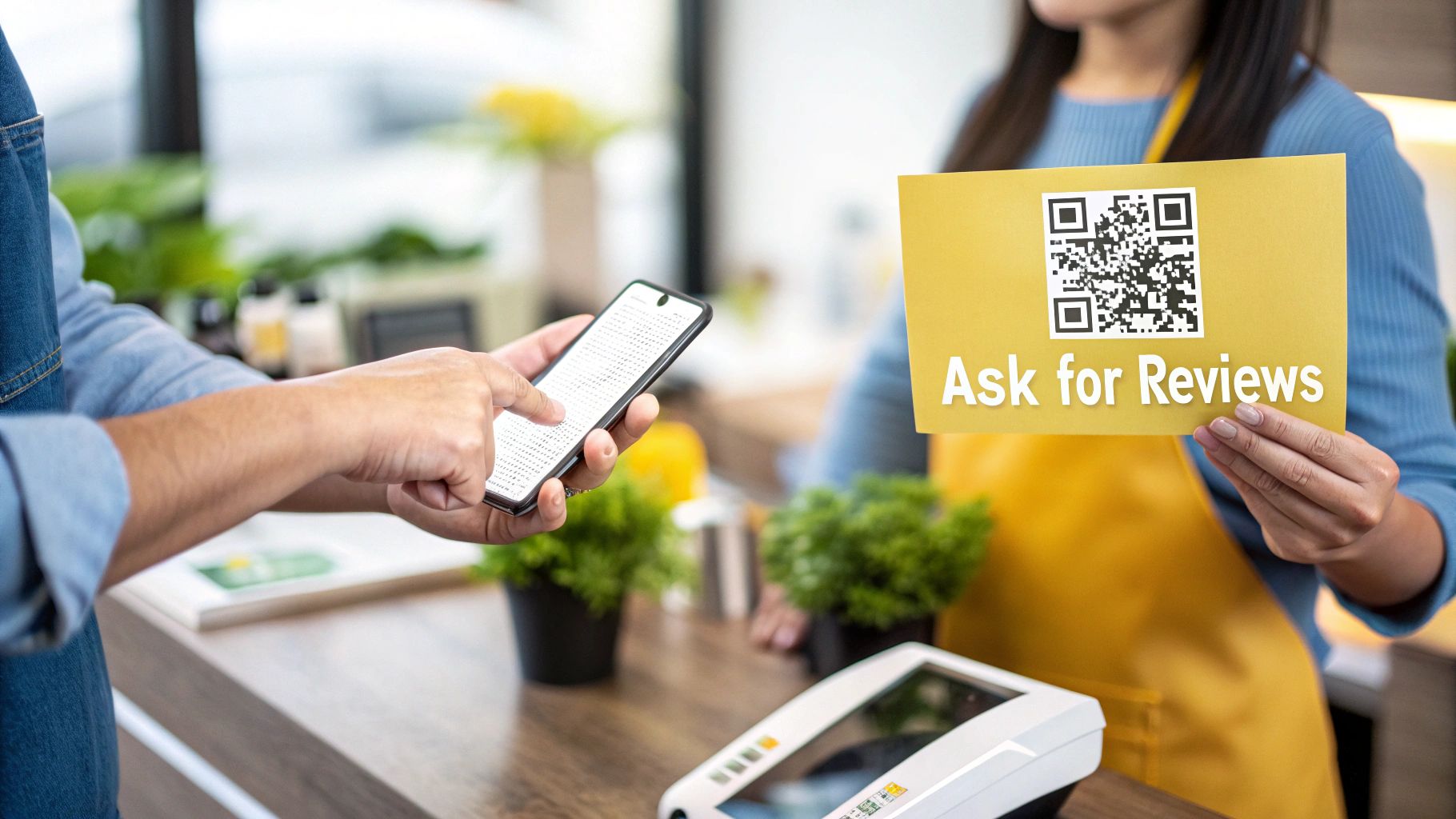
- QR Codes: Pop a QR code that links directly to your review page on receipts, business cards, product packaging, or even table tents in your café.
- Email Signatures: Add a simple line to your email signature, like "Happy with our service? Leave us a review on Google!" with a direct link.
- Website Banners: Include a non-intrusive banner or footer on your website inviting satisfied customers to leave their feedback.
Review Request Methods Comparison
Choosing the right way to ask for a review often depends on your business type and how you interact with your customers. What works for a bustling café might not be the best fit for an online software company. This table breaks down the most common methods to help you decide which approach is right for you.
| Method | Best For | Pros | Cons |
|---|---|---|---|
| In-Person | Service-based businesses (salons, garages), retail shops, restaurants. | Highly personal and effective. High conversion rate. | Not scalable. Relies on staff confidence and timing. |
| E-commerce, B2B services, businesses with a customer database. | Scalable, can be automated and personalised. Easy to track results. | Can be ignored or land in spam folders. Lower open rates. | |
| SMS/Text Message | Appointment-based services (dentists, tradespeople), local businesses. | Extremely high open rates (over 90%). Immediate and direct. | Can feel intrusive if not handled well. Character limits. |
| QR Codes | Cafés, restaurants, physical products, trade show stalls. | Very low effort for the customer. Modern and convenient. | Requires a physical presence. Customer needs a smartphone. |
| Website CTA | Any business with a website, especially with high traffic. | Captures happy customers while they're already engaged online. | Can be missed (banner blindness). Less personal. |
Ultimately, the best strategy often involves a mix of these methods. By diversifying your approach, you can create more opportunities to capture that valuable feedback without ever feeling like you're pestering your customers.
How Reviews Boost Your Local SEO Performance
https://www.youtube.com/embed/zrJ6qOWGPfk
If you think of Google reviews as just a reputation management task, you're missing a massive piece of the puzzle. Every single piece of feedback your customers leave is a direct, powerful signal to Google's search algorithm. Put simply, your reviews are a huge factor in how easily local customers can find you.
When someone searches for "best cafe near me," Google’s job is to show them the most relevant, trustworthy, and popular options. Your reviews give Google the evidence it needs to make that call. They're a fundamental part of how it gauges your authority and relevance in a specific area.
The Key to Winning the Local Pack
You know that little map with three business listings that pops up at the very top of local search results? That's the "Local Pack," and it's prime real estate. Getting your business featured there can make your phone ring off the hook and bring a steady stream of customers through the door.
And guess what? Reviews are one of the most important factors for securing a spot.
Google’s algorithm is smart. It looks at several key signals from your reviews to decide who makes the cut:
- Review Quantity: The raw number of reviews you've collected. More reviews suggest you're an established and well-regarded business.
- Review Velocity: This is all about how often you're getting new reviews. A consistent flow tells Google that you're active and relevant right now.
- Review Quality: Your average star rating. It's an obvious one, but higher ratings clearly signal a better customer experience, which Google wants to promote.
- Review Content: The actual words people use are gold. When customers mention specific services or your location (like "the best flat white in Bristol"), it reinforces your relevance for those exact search terms.
Think about it from Google's perspective. A business with 50 recent, glowing reviews sends a much stronger signal than another with 10 reviews from two years ago, even if they have the same star rating. It's a continuous effort, not a set-it-and-forget-it task.
The Numbers Don't Lie
The link between reviews and local SEO isn't just a hunch; it's backed by hard data. In fact, review signals are estimated to make up around 15% of the entire ranking criteria for the Google Local Pack.
The results are even more striking when you dig deeper. Businesses that manage to gather 100 or more reviews typically see an 82% increase in user actions—like calls and website clicks—compared to those with fewer than ten. A high star rating is just as vital; businesses with a 4.8+ rating enjoy a 52% boost in direction requests over those hovering below 4.0. You can see more compelling data on how reviews impact business performance at SQ Magazine.
Asking how to get a Google review is, at its core, the same as asking how to improve your local SEO. Each new review strengthens your business profile, telling Google that you are a trusted, relevant, and authoritative choice for local customers.
This focus on customer feedback is a non-negotiable part of any solid marketing strategy for small business aiming for real, long-term growth. You're not just chasing a temporary ranking boost; you're building a powerful online reputation that consistently brings new customers to your door.
Staying Compliant with UK Review Laws

As you build your strategy to get more Google reviews, it’s absolutely essential to keep everything above board and operate within UK law. Earning customer trust is a slow, hard-won battle, but breaking it by bending the rules can have devastating consequences for your reputation and your bottom line.
The rules around online reviews in the UK have tightened up considerably, largely thanks to the new Digital Markets, Competition and Consumers (DMCC) Act. This has given the Competition and Markets Authority (CMA) a lot more teeth to clamp down on businesses using dodgy or misleading tactics. Getting this right isn't just about ethics; it's about protecting your business from serious trouble.
What Is Strictly Forbidden
Under these updated regulations, a few practices are now explicitly illegal. The whole point is to ensure transparency, so customers can genuinely trust that the reviews they're reading are from real people with real experiences.
Make sure you avoid these pitfalls at all costs:
- Posting Fake Reviews: This might seem obvious, but it covers everything from writing your own glowing reviews to paying a third party to do it for you. It also means you can’t post fake negative reviews for your competitors.
- Offering Incentives: You can't offer money, a discount, or a free gift in exchange for someone leaving a review. The authorities see this as a bribe for positive feedback, and it's strictly off-limits.
- "Cherry-Picking" Reviews: Selectively showing off only your five-star reviews while hiding or deleting the negative ones is a big no-no. All genuine feedback, good or bad, has to be treated with the same transparency.
The new rules are all about levelling the playing field and protecting consumers from being misled. Essentially, any action that artificially boosts your reputation or unfairly damages a competitor's is now firmly against the law.
The Consequences of Non-Compliance
The penalties for breaking these rules are no joke and could genuinely alter the future of your business. The CMA now has the power to fine companies up to a staggering 10% of their global turnover for any breaches, and they don't even need a court order to do it. The CMA's guidance also highlights the importance of publishing all written feedback to maintain trust. You can learn more about the CMA's consumer law guidance at Birdeye.com to get the full picture.
It's not just about the money, either. Google itself might penalise your Business Profile, sometimes even adding a warning label telling customers that your reviews might not be trustworthy. Imagine the damage that could do. A label like that could destroy the very trust you’ve worked so hard to build.
At the end of the day, the best strategy is always an honest one. Focus on giving your customers a brilliant experience and simply make it easy for them to share their genuine thoughts.
Common Questions About Getting Google Reviews
Even with a solid plan, you're bound to hit a few snags when asking for Google reviews. Let's walk through some of the most common questions we hear from UK businesses, with straightforward answers to help you navigate those tricky spots.
How Should We Respond to Negative Reviews?
Let’s be honest, a negative review can feel like a personal blow. But how you handle it publicly is what really matters. It’s your chance to show everyone watching just how good your customer service is, even when things go wrong.
The trick is to respond quickly and professionally, right there on the review platform. You need to acknowledge their frustration and show some empathy – whatever you do, don't get defensive.
A solid response usually follows this path:
- Start by thanking them for taking the time to leave feedback.
- Offer a sincere apology that their experience wasn’t up to scratch.
- Take the conversation offline. Offer to make things right by providing a direct email or phone number to a specific person.
This simple act shows potential customers that you’re not just listening, but you’re committed to resolving problems. It can genuinely turn a bad situation into a powerful display of your company’s character.
How Many Reviews Should We Aim For?
There isn’t a magic number here. What works for a local cafe won't be the same for a national chain. Instead of fixating on a total, think about your review velocity – that’s the steady, consistent flow of new reviews coming in.
Think about it: a business with 50 fresh reviews from the last year seems far more relevant and trustworthy than a competitor with 100 reviews that are all three years old.
As a starting point, have a look at your top three local competitors. Your first goal should be to get more reviews than them. Once you’re ahead, focus on getting one or two new reviews every week. That’s enough to keep your profile looking active and trustworthy.
Is It Worth Paying for Review Management Software?
For most businesses juggling more than a few customers, the answer is a resounding yes. You absolutely can manage your reviews by hand, but dedicated software is a massive time-saver. These platforms can put your review requests on autopilot, sending them out via email or SMS, which is a game-changer if you’re serious about getting more Google reviews consistently.
They also come packed with other useful features:
- A single dashboard to see and reply to all your reviews in one place.
- Instant alerts when a new review comes in, so you can respond immediately.
- Tools to easily display your best reviews directly on your website.
If you’re getting more than a handful of reviews a month, or if you manage several locations, the time you save and the streamlined process easily justify the cost.
At The Digital Marketing Toolbox, we've brought together the best tools to help you manage your online reputation and make your marketing simpler. You can explore our handpicked solutions to find the right one for your business at https://grow-your-biz.com.


