

When you want to get more Google reviews, it really boils down to two things: asking at the right time and making it ridiculously easy for happy customers to say something nice. That's the core of it.
Why Google Reviews Are So Incredibly Important
Before we jump into the "how," let's spend a moment on the "why." It's easy to see reviews as just a nice-to-have, but for any local business in the UK, they're an absolute necessity.
Think of your Google Business Profile as your digital shopfront. Those stars and comments are the first thing most potential customers see—it’s today’s word-of-mouth, but amplified for the whole world to see.
For a local cafe in Manchester or a plumber in Bristol, a high star rating is what convinces someone browsing search results to click on your listing instead of the one right next to it. This has a direct impact on your visibility in that all-important Google Local Pack—the map and three businesses that pop up for local searches.
The Real Power of Social Proof
In a competitive local market, social proof isn't just a marketing buzzword; it's the decider. A flood of positive reviews sends a clear signal to both Google's algorithm and potential customers that you're a trustworthy, high-quality business.
A steady stream of good feedback does more than just make you look good. It delivers tangible results:
- Builds Instant Trust: A solid collection of recent, positive reviews makes you look reliable and established from the get-go.
- Boosts Your Local SEO: Google actively rewards businesses that have frequent, positive reviews, pushing them higher up in local search rankings.
- Drives More Clicks and Calls: People are far more likely to visit your website, call your number, or get directions when they see others have had a great experience.
Honestly, a consistent flow of genuine reviews is one of the most powerful tools you have. It creates a feedback loop that builds trust, boosts visibility, and brings more customers through your door. It’s that simple.
What UK Customers Expect to See
Let's be clear: people in the UK rely on Google. A 2024 survey showed that a staggering 81% of consumers turn to Google to check out local businesses, which just underscores its dominance.
This means that having a strong, well-maintained review profile isn't just a good idea—it's a fundamental part of meeting customer expectations and a crucial pillar of any modern marketing strategy for small business.
Before you dive in, it’s worth taking the time to get a solid understanding Google reputation for your business, because that knowledge is the foundation you’ll build everything else on.
Build a Foundation for Five-Star Feedback
Before you even think about asking for a single review, let's get one thing straight. The real secret to a steady stream of five-star feedback isn't just about asking. It's about earning it by delivering an experience so good that customers want to talk about it.
It all starts with laying the right groundwork. The first step? Treating your Google Business Profile like the powerful tool it is. A well-kept profile is like a clear signpost, making it dead simple for someone to find you, understand what you offer, and leave their thoughts. A neglected profile, on the other hand, just creates confusion and doubt.
Optimise Your Digital Front Door
Think of your Google Business Profile as your shop window on the world's biggest high street. If it’s messy or half-empty, people are going to walk right on by. A polished, complete profile doesn't just look professional; it makes the entire review process smoother for your happy customers.
Start by running a quick audit. Are these key areas fully up-to-date?
- Accurate NAP Information: Your Name, Address, and Phone number need to be spot-on and identical everywhere online. Consistency is key.
- Precise Business Category: Get specific. Don't just be a "Restaurant"; be an "Italian Restaurant" or a "Vegan Cafe".
- High-Quality Photos: Show you're an active, legitimate business. Add recent, well-lit photos of your space, your products, and your team in action.
- Service Areas: Clearly define the neighbourhoods or cities you serve. This helps local customers find you and know you're the right fit for them.
Getting this foundation right is non-negotiable. It tells both Google and your customers that you're a serious, active business that cares about its reputation. Without this, all your other efforts will fall short.
Embed a Review-Worthy Culture
Now for the bit you can’t automate: the actual customer experience. You can send all the links in the world, but a genuine five-star review is rarely just about the product. It’s about how you made the customer feel.
This means training your entire team to not only deliver brilliant service but also to spot the perfect moment to mention a review. It’s about creating a culture where going the extra mile is just what you do.
Think about it. The plumber who not only fixes the leak but also tidies up afterwards has created a review-worthy moment. The barista who remembers a regular's order and asks how their holiday was has definitely earned the right to ask for feedback.
The best strategy for getting more Google reviews is to make your service so memorable that customers feel an urge to share their experience. The review then becomes a natural, final step in their journey with you.
Create and Share Your Direct Review Link
Once your service is consistently great, your next job is to remove every single obstacle that might stop someone from leaving a review. The easiest way to do this is with a direct review link.
This isn't just a link to your profile; it's a special URL that takes customers straight to the review pop-up window. No searching, no scrolling, no extra clicks.
You can grab this link directly from your Google Business Profile dashboard. Just look for the "Get more reviews" card and click "Share review form."
Once you have that golden link, start placing it in all the right spots:
- On printed receipts or invoices
- In the footer of your email signature
- Within post-purchase "thank you" emails
- On business cards or flyers left after a service call
By building this solid foundation—a polished profile, exceptional service, and a frictionless review process—you’re setting the stage for success long before you make the first ask.
Smart Ways to Ask for Google Reviews
Alright, with a solid foundation in place, it’s time to get proactive and start asking for those all-important reviews. Simply hoping customers will leave feedback isn't a strategy. The real key is to make your request feel natural, timely, and incredibly simple for the customer to follow through on.
You don’t need a complicated, expensive system for this. It all comes down to understanding your customers and picking that perfect moment when they’re happiest with your service. Think about it: that's right after they’ve enjoyed a great meal, you've completed a project to their delight, or they’ve just unboxed a product they love. That’s your golden window.
Master the Art of the Digital Ask
For most businesses, email and SMS are your best friends when it comes to requesting reviews. They're direct, personal, and can be automated without feeling robotic. The secret is to craft a message that doesn’t sound like just another marketing email.
Personalisation is everything. A message that starts with "Hi Sarah" and mentions the specific service she received is a world away from a generic, one-size-fits-all email blast.
Here are a couple of tried-and-tested approaches:
- Email Requests: Pop an email over a day or two after a purchase or service. Keep it brief, thank them for their business, and explain how their feedback helps you and other customers. The most important part? Include your direct Google review link to make it a one-click job.
- SMS Requests: If your business has a more immediate relationship with customers (like a takeaway or a local tradesperson), a quick text can work wonders. A simple message like, "Thanks for choosing us, David! We'd love it if you could share your experience on Google," followed by the link, is often all it takes.
This visual shows just how straightforward an automated email flow can be in turning a happy customer into a 5-star review.
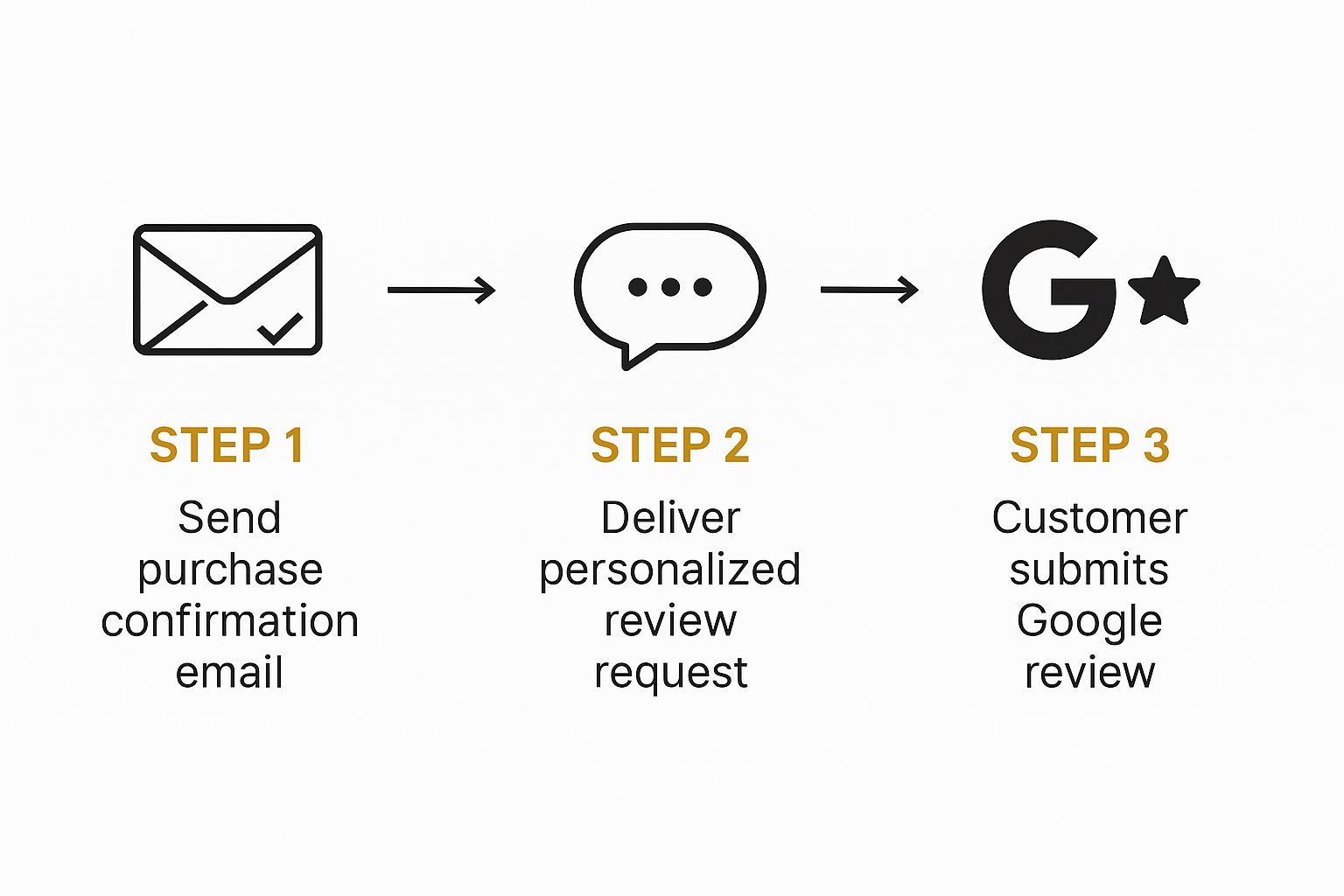
This kind of simple, automated process takes all the friction out of it. You’re catching people at the right time, making it easy, and seriously boosting your chances of getting that feedback.
Don't Forget About In-Person and Physical Prompts
Never underestimate the power of a well-placed physical reminder, especially if you have a brick-and-mortar business. When a customer is right there in front of you, buzzing from a great experience, the barrier to leaving a review is practically non-existent.
This is where QR codes really shine. A simple QR code that links directly to your Google review page can be strategically placed around your premises.
Think about these high-impact spots:
- At the till: A small sign or sticker right where customers pay.
- On cafe or restaurant tables: A small, tasteful table talker can do the trick.
- On printed invoices or receipts: A classic method that still works surprisingly well.
- On business cards or flyers: For service-based businesses, leaving a card with a QR code is a brilliant final touch.
The goal is to weave the 'ask' into the natural end of the customer's journey. When it feels like a seamless part of the experience, people are much more willing to take a moment to share their thoughts.
Perfecting Your Timing and Wording
How you ask is just as crucial as when you ask. You want to avoid sounding desperate or like you're just after another tick in a box. A much better approach is to frame it as them helping other people make good choices.
Here’s how you could word it for a few different businesses:
- For a Cafe: "Loved your flat white? Let others know! A quick review on Google helps fellow coffee lovers find their new favourite spot."
- For a Solicitor: "Thank you for trusting us. Your feedback is invaluable, and a Google review can help others in our community find the right legal support when they need it most."
- For an E-commerce Shop: "We hope you're loving your new gadget! If you have a moment, sharing your experience on Google would mean the world to our small team."
Choosing the right method often depends on your specific business and how you interact with your customers. The table below compares a few popular approaches to help you decide what's best for you.
Effective Methods for Requesting Google Reviews
| Method | Effectiveness | Customer Effort | Best For |
|---|---|---|---|
| Email Request | High | Low | E-commerce, service businesses, post-appointment follow-ups |
| SMS Request | Very High | Very Low | Takeaways, tradespeople, mobile services, immediate feedback |
| In-Person (QR Code) | Medium-High | Low | Cafes, shops, restaurants, salons, any physical location |
| On Receipts/Invoices | Medium | Medium | Retail, professional services where physical paperwork is used |
Ultimately, a mix-and-match approach is often the most effective. By testing different methods, you'll soon figure out what resonates best with your customers and brings in a steady stream of glowing reviews.
These tactics are a fantastic starting point. To see how reviews fit into the bigger picture, this beginner's guide to digital marketing offers great context. And if you want to expand your efforts beyond Google, exploring some general strategies for getting customer reviews will help you build trust across the board.
Why a Steady Stream of Reviews is Your Secret Weapon
A high star rating is great, but it’s only one piece of the puzzle. Let’s paint a picture. You're looking for a local tradesperson. Business A has a flawless 4.9-star rating… from 15 reviews that are all a couple of years old. Business B has a 4.7-star rating, but it’s from 150 reviews, with new ones popping up every single week.
Which one do you trust more?
For most of us, it’s Business B. Their reputation feels alive, current, and far more convincing. This gets to the heart of a crucial idea: when it comes to your online reputation, quantity and consistency are every bit as important as the quality of your ratings. Both Google and your potential customers are watching the volume and freshness of your feedback very closely.
More Reviews, More Trust, More Business
A healthy number of reviews acts as powerful social proof. When someone sees that hundreds of people have bothered to leave a comment, it instantly lowers the risk in their mind. It tells them you’re a legitimate, popular business that consistently gets the job done. A handful of glowing-but-ancient reviews just doesn't carry the same weight.
This isn't just about feelings; it directly impacts how people act and how visible you are. Early 2025 data shows that UK businesses with over 100 reviews get an 82% boost in user actions—we’re talking clicks, calls, and direction requests—compared to those with fewer than 10. Better yet, simply automating your review requests via email or text can increase your review count by 21% in just six months. It shows how a simple system can pay huge dividends. You can see more UK-specific stats in the full report.
Having a large volume of reviews also gives you a much-needed cushion. If you only have five reviews and one is negative, your average rating takes a massive dive. But with 200 positive reviews in the bank, one unhappy customer is just a small blip on the radar. It shows that the vast majority of your customers walk away happy.
The Power of "Review Velocity"
Beyond the sheer number, Google is obsessed with what we call review velocity—basically, how often new reviews are coming in. A steady, consistent trickle of feedback is one of the strongest signals you can send that your business is active, relevant, and still delighting customers.
Put yourself in Google's shoes for a moment. A business whose reviews all appeared in one burst a year ago looks stale. Maybe they’ve gone downhill since then? On the other hand, a business getting fresh feedback every week is clearly active and engaging with customers right now.
A consistent flow of new reviews tells Google's algorithm that your business is current and trustworthy. This is a huge factor in your local search ranking. The goal is to make review collection a normal, daily part of your business, not a one-off marketing push.
The data backs this up. We're seeing that business profiles with a consistent velocity—at least one new review a week—tend to rank around 25% higher in local search results. This momentum feeds itself, creating a fantastic upward spiral: a higher rank gets you more visibility, which brings in more customers, who then leave you more reviews.
How Your Customers Double as Your SEO Team
There’s another hidden benefit to a high volume of reviews that most people miss. When your customers describe their experience, they naturally use the exact keywords you want to rank for.
Think about a plumber in Manchester. Their customer reviews might look something like this:
- "Fantastic service for our boiler repair in Didsbury."
- "The best emergency plumber in Manchester we've ever used."
- "They fixed our leaky tap quickly and professionally."
When Google’s crawlers see these specific, user-generated phrases again and again, it reinforces what your business is all about and where you operate. This can directly help you show up for those valuable long-tail searches. In a way, your happy customers become a key part of your SEO strategy without even knowing it.
Responding to Reviews to Protect Your Reputation

Getting a customer to leave a review is a huge win, but your work isn't finished. What happens next is just as important. Your public response to that feedback—whether it’s glowing or critical—is where you truly define your brand's reputation for everyone else to see.
A timely, thoughtful response shows potential customers that there’s a real, caring human behind the business. It signals that you value feedback and are committed to making things right. This active engagement doesn't just look good; it actively encourages more people to share their own experiences.
For local businesses in the UK, a healthy number of Google reviews is essential for boosting visibility and credibility. Engaging with reviewers encourages more interaction and shows a real commitment to customer satisfaction. Over time, this can elevate a business’s star rating and drive more valuable actions, like calls or requests for directions. Find out more about why active review management is key for UK businesses.
Responding to Positive Reviews
It’s tempting to see a five-star review pop up, smile, and move on. But that’s a missed opportunity. Replying to positive feedback doesn't just show your appreciation; it can turn a happy customer into a loyal advocate for your brand.
Your replies don't need to be long essays, but they must be personal. Here’s a simple formula I always recommend:
- Thank them by name. Addressing the reviewer directly makes the interaction feel genuine and less like a canned response.
- Reference something specific. Mentioning the product they bought or the service they loved shows you’ve actually read their comment.
- Invite them back. Always end on a positive, forward-looking note that encourages them to return.
A simple, "Thanks so much for the kind words, Sarah! We're thrilled you enjoyed the new coffee blend. We look forward to seeing you again soon!" is far more impactful than a generic "Thanks for your review."
Turning Negative Feedback into a Positive
Sooner or later, it happens. A negative review lands, and it stings. But how you handle it in public is what truly matters. A defensive or ignored complaint can do serious damage, whereas a graceful, professional response can actually win you new customers by showcasing your excellent customer service.
When a bad review comes in, take a breath. Never, ever reply in anger.
Your public response to a negative review is not just for the unhappy customer; it's a demonstration for every future customer who reads it. Your goal is to show that you are reasonable, professional, and committed to making things right.
Here's a framework for responding effectively:
- Acknowledge and Apologise: Start by thanking them for their feedback and apologising that their experience didn't meet expectations. This simple act de-escalates the situation immediately.
- Take Ownership: Don't make excuses or, worse, blame the customer. A simple "We're sorry we fell short" shows accountability and maturity.
- Move the Conversation Offline: Provide a direct contact method, like an email address or phone number, to resolve the specific issue privately. This prevents a public back-and-forth and shows you're serious about fixing the problem.
For example: "Hi James, thank you for bringing this to our attention. We're truly sorry to hear that your delivery was delayed, and we apologise for the frustration this caused. That’s not the standard we aim for. Please could you email us at support@your-biz.co.uk so we can look into this and make it right for you?"
This approach is all about managing your reputation and customer relationships, a principle that applies to other areas of marketing too, as we discuss in our guide on the advantages of email marketing.
Dealing with Fake Reviews
Occasionally, you might get a review that is clearly fake or violates Google's policies (think spam, hate speech, or a clear conflict of interest). While you should still respond professionally, your main course of action here is to report it.
Find the review, click the three-dot menu next to it, and select 'Report review'. Google will then assess it against their policies. Be warned, though—removal is not guaranteed. A calm, factual public response like, "We have no record of a customer with this name or experience," can help signal to other readers that the review may not be genuine.
Common Questions About Getting Google Reviews
Navigating the world of Google reviews can throw a few curveballs. Let’s tackle some of the most common questions I hear from business owners, so you can manage your online reputation effectively and stay on the right side of the rules.
Can I Offer Incentives for Google Reviews in the UK?
This is a big one, and the answer is a hard no. It can be tempting to offer a discount or a freebie in exchange for a review, but this is a serious violation of Google's policies.
Google views this as manipulating your rating, and they can be quite strict about it. If you're caught, those reviews will likely be removed, and it could even lead to penalties against your Google Business Profile. The best strategy is always to focus on providing a brilliant experience that makes people want to leave a review, without any prodding.
Your goal should be earning genuine reviews that reflect real customer experiences. Incentives completely undermine that trust and are a risky shortcut that can seriously damage your credibility with both Google and your future customers.
How Do I Create a Direct Link for Customers to Leave a Review?
You have to make leaving a review as easy as humanly possible. The key is to generate a direct link that takes a customer straight to the review pop-up, removing any faffing about with searching or extra clicks.
Thankfully, getting this link is simple. Just head over to your Google Business Profile dashboard.
- Log in to your Google Business Profile.
- On the homepage, you’ll see a card that says "Get more reviews".
- Click the "Share review form" button.
This gives you a short, clean URL you can use everywhere. Pop it into your follow-up emails, text messages, or even on your receipts. I’ve seen businesses have great success turning it into a QR code for customers to scan in-store. It’s a small touch that makes a massive difference to your conversion rate.
What Is the Best Way to Handle a Fake Negative Review?
Dealing with a fake negative review is incredibly frustrating, but how you react is critical. First, take a deep breath and respond publicly and professionally. Yes, even if you know it's completely fabricated.
A calm, factual response shows potential customers you're on the ball. Something like, "We've checked our records and can't find a customer with this name or any details matching this experience. We take all feedback seriously, so please contact us directly if there's been a mix-up."
Once you've done that, report the review to Google. Find the review, click the three-dot menu next to it, and hit "Report review". Select the most appropriate reason, like "Spam" or "Conflict of interest". There's no guarantee Google will remove it, but it’s the official channel and always worth doing.
At The Digital Marketing Toolbox, we provide curated resources to help you master every aspect of your online presence, from SEO to reputation management. Discover the best tools to streamline your marketing and drive real growth.
Find your solution at https://grow-your-biz.com.


