

Unlocking Social Media Success on a Budget
Want impactful social media results without the hefty price tag? This listicle reveals seven proven low cost social media management techniques to boost your brand's online presence. Learn how to maximize your reach and engagement with strategies like content batching, user-generated content, repurposing existing content, and leveraging AI tools. Whether you're a small business, agency, or e-commerce manager, these practical tips will optimize your social media management and improve your bottom line.
1. Content Batching and Scheduling
One of the most effective ways to achieve low cost social media management is through content batching and scheduling. This strategy involves dedicating specific blocks of time to creating a large amount of social media content at once, rather than crafting individual posts daily. This “bulk creation” approach allows you to streamline your workflow and maximise your efficiency, freeing up valuable time throughout the week. You then use scheduling tools to automate the posting of this pre-prepared content across various platforms like Facebook, Instagram, Twitter, and LinkedIn, maintaining a consistent online presence without constant daily input. This proactive approach helps small businesses, e-commerce managers, and even busy content creators maintain a vibrant online presence without breaking the bank or sacrificing their valuable time.

Content batching and scheduling isn't just about saving time; it's about working smarter. By dedicating specific time blocks to content creation, you enter a focused creative flow, leading to higher quality content and a more cohesive brand message. Imagine dedicating a single afternoon to crafting all your social media graphics for the week, followed by another session for writing engaging captions. This focused approach allows you to fine-tune your messaging, maintain consistency across platforms, and ultimately, achieve better results.
Successful implementation of content batching relies on leveraging the right tools and establishing a clear process. Buffer, Hootsuite, and Later are excellent examples of scheduling platforms that enable automated posting and cross-platform distribution. Buffer, for instance, is known for its clean interface and user-friendly scheduling features, used even in their own social media strategy. Hootsuite, on the other hand, offers robust functionality for managing multiple client accounts, making it a popular choice for digital marketing agencies. Even smaller businesses can benefit, using platforms like Later to batch and schedule Instagram content a week in advance. These examples showcase how businesses of all sizes are leveraging these tools to streamline their social media efforts.
So, how can you integrate this method into your own low cost social media management strategy?
- Dedicate Time: Set aside 2-4 hours per week specifically for content batching. This focused time allows for deep work and efficient content creation. Treat it like an important meeting and stick to the schedule.
- Utilize Free Tools: Start with the free tiers offered by platforms like Buffer, Hootsuite, or Later. These provide ample functionality for most small businesses and individuals.
- Create Templates: Develop templates for different content types (e.g., graphics, captions, blog post teasers). This significantly speeds up the creation process and ensures brand consistency.
- Maintain Flexibility: While planning is key, leave 20-30% of your content calendar open for real-time posts and responses to trending topics. This keeps your content fresh and engaging while still enjoying the benefits of batching.
- Batch Similar Content: Group similar content types together during your batching sessions. For example, create all your graphics one day and then write all the accompanying captions in another session. This streamlines your thought process and improves efficiency.
While content batching and scheduling offer significant advantages for low cost social media management, it's important to be aware of potential drawbacks. The pre-planned nature of batched content can make it less responsive to real-time trends and events. There's also a risk of content feeling less authentic or timely if not carefully planned. However, by reserving space for spontaneous posts and remaining mindful of current events, you can mitigate these risks. The upfront time investment required for batching might seem daunting initially, but the long-term time savings and improved consistency make it a worthwhile investment for anyone seeking a low-cost and effective social media strategy.
The benefits of content batching and scheduling are undeniable. It significantly reduces the daily time investment required for social media, ensures a consistent posting schedule, and costs considerably less than hiring a daily social media manager. Moreover, it allows for better content planning, strategy development, and reduces the mental fatigue often associated with constant content creation. For those seeking low-cost social media management solutions in the UK, content batching and scheduling is a highly effective strategy, deserving of its top spot on this list. Learn more about Content Batching and Scheduling Pioneered by individuals like Joel Gascoigne (Buffer founder), Amy Porterfield (online marketing strategist), and Later's content marketing team, this method offers a proven path to efficient and affordable social media success.
2. User-Generated Content (UGC) Strategy
One of the most powerful yet underutilized strategies in low cost social media management is leveraging user-generated content (UGC). This approach flips the traditional content creation model on its head, utilizing content crafted by your customers, followers, and brand advocates rather than relying solely on in-house production. By encouraging your community to create and share authentic content related to your brand, you can significantly reduce content creation costs while simultaneously building stronger customer relationships and fostering invaluable social proof. It's a win-win for both your budget and your brand image.

A successful UGC strategy involves a multi-pronged approach. It starts with actively encouraging your audience to create content related to your brand. This can be achieved through branded hashtag campaigns, contests, giveaways, or simply by posing engaging questions and fostering a vibrant online community. Consider, for example, a local bakery in Bristol asking its followers to share photos of their homemade creations using a specific hashtag.
Next, effective content curation is essential. This means actively monitoring social media channels for relevant UGC, selecting high-quality content that aligns with your brand values, and obtaining permission from the original creators to reshare their work. Finally, a system for efficiently managing permissions and attributing content to the original creators is crucial for maintaining transparency and building trust. Features like customer-created photos, videos, reviews, testimonials, and community-driven content curation all contribute to a robust UGC strategy.
UGC's strength lies in its authenticity. Potential customers in the UK are more likely to trust recommendations and experiences from their peers than polished corporate messaging. This organic, word-of-mouth marketing builds genuine social proof, increases customer engagement and loyalty, and can even lead to higher conversion rates. Think about the impact of a satisfied customer sharing a photo of their new shoes from a UK-based online retailer on Instagram. That single post can reach hundreds, even thousands, of potential customers who are more likely to trust that authentic endorsement than a paid advertisement.
Several successful brands have demonstrated the power of UGC. Starbucks' #RedCupContest, for example, generates thousands of customer photos every holiday season, transforming a simple coffee cup into a viral marketing phenomenon. GoPro's entire social media strategy is built upon user-generated adventure videos, showcasing the versatility and durability of their cameras through the eyes of their customers. Closer to home, consider how Airbnb's #BelongAnywhere campaign effectively uses guest experiences to promote its brand, showcasing the unique and authentic travel experiences available through their platform.
While the benefits are clear, UGC does come with its challenges. One primary concern is the inherent lack of control over content quality and messaging. It requires active community management to ensure that the content aligns with your brand guidelines. It may also be difficult to generate sufficient UGC initially, especially for newer businesses. There’s also the risk of negative or inappropriate content being associated with your brand. Finally, a reliance on customer participation means the volume and quality of UGC can fluctuate.
To successfully implement a low cost social media management strategy utilising UGC, consider these actionable tips:
- Create unique, memorable hashtags: Develop a branded hashtag that encourages users to associate their content with your brand.
- Always ask permission before reposting: Respect your community by obtaining explicit permission to reshare their content.
- Offer incentives: Motivate users to create UGC by offering incentives like features, discounts, or prizes.
- Engage meaningfully: Respond to and interact with users who create content about your brand.
- Track brand mentions: Utilize tools like Mention or Brand24 to monitor online conversations and identify potential UGC.
- Establish clear guidelines: Create and communicate clear UGC guidelines and submission processes to maintain quality and consistency.
By carefully managing the potential downsides and implementing these best practices, businesses of all sizes, from independent shops in Brighton to established brands in London, can leverage the power of user-generated content to create engaging, cost-effective social media campaigns that resonate with their target audience. This makes UGC a truly invaluable tool in the arsenal of any business seeking low cost social media management solutions.
3. Repurposing Single Content Pieces: A Cornerstone of Low-Cost Social Media Management
In the competitive landscape of social media, consistency is key. But creating fresh, engaging content day in and day out can quickly drain resources, especially for small businesses and budget-conscious marketers. This is where the power of repurposing comes in. Repurposing single content pieces is a cornerstone of low-cost social media management, allowing you to maximize your content’s reach and impact without breaking the bank. It's a strategic approach that transforms one piece of high-quality original content into multiple formats tailored for various social media platforms, effectively multiplying your content output while minimizing creation time and costs. This method is invaluable for anyone looking to amplify their social media presence efficiently, making it a crucial element of any low-cost social media management strategy.
This method works by taking a substantial piece of content, such as a blog post, podcast episode, webinar recording, or even a comprehensive social media update, and breaking it down into smaller, digestible “micro-content” pieces. These smaller pieces are then optimized for different social media platforms, ensuring they resonate with the specific audience and format of each channel. For instance, a blog post about the benefits of organic dog food could be repurposed into Instagram carousels showcasing ingredients, short Twitter threads addressing common questions, Facebook posts linking to relevant research, and even engaging TikTok videos featuring happy pups enjoying their organic meals.
The benefits of this approach are numerous. Repurposing significantly increases your content volume without a proportional increase in time investment. It allows you to reach different audience segments across platforms, as each platform attracts unique user demographics and behaviours. Consistent repurposing reinforces key messages through repetition, strengthening brand recall and improving audience understanding. Moreover, it maximises the value derived from your high-quality original content, ensuring that the time and effort invested in its creation yields the greatest possible return. Finally, it combats creative burnout, a common challenge faced by content creators constantly pressured to produce fresh material.
Numerous successful examples demonstrate the effectiveness of content repurposing. Gary Vaynerchuk, CEO of VaynerMedia, is a prominent advocate of this strategy, famously demonstrating how a single keynote speech can be transformed into 64 pieces of content across different platforms. HubSpot, a leading marketing software company, routinely converts its insightful blog posts into infographics, social media posts, and short, engaging video snippets. Similarly, Tim Ferriss, author and host of The Tim Ferriss Show podcast, repurposes his long-form interviews into quotable images, audiograms, and concise blog excerpts, maximizing the reach of his valuable content. Even social media management platforms like Buffer practice what they preach, repurposing their blog content into Twitter threads, LinkedIn posts, and Instagram carousels. These examples highlight the versatility and effectiveness of repurposing across various industries and content formats.
Implementing this strategy successfully requires a considered approach. Start by identifying your best-performing long-form content. This ensures that the content you repurpose has already proven its value and resonance with your target audience. Create a repurposing template or checklist to streamline the process and ensure consistency. Crucially, adapt the tone and format of your repurposed content for each platform's unique audience; what works on LinkedIn might not resonate on TikTok. Leverage readily available tools like Canva to create eye-catching graphics quickly and efficiently. To avoid audience fatigue, space out your repurposed content strategically, ensuring a balanced mix of fresh and repurposed material. Finally, track the performance of different formats on each platform to refine your strategy and understand what resonates most effectively with your audience.
While repurposing offers significant advantages, it’s important to be mindful of potential drawbacks. Overusing this technique can lead to audience fatigue from repeated messaging. Therefore, it’s crucial to maintain a balance between repurposed and original content. Successful repurposing also requires a strong understanding of platform-specific best practices to ensure optimal engagement. Content that isn't tailored to the platform may appear less fresh or original, especially to followers who engage with your brand across multiple channels. Finally, adapting and optimizing content for different platforms requires a time investment, although this is significantly less than creating fresh content from scratch.
Repurposing single content pieces isn't just a cost-saving tactic; it's a smart strategy for maximizing your content's impact and achieving a strong return on investment in your low-cost social media management efforts. By implementing these tips and understanding the nuances of each platform, you can unlock the full potential of your content and establish a consistent, engaging presence across social media without overspending.
4. Community-Driven Management
Community-driven management offers a revolutionary approach to low cost social media management by leveraging the power of your brand's biggest fans. Instead of relying solely on paid staff, this strategy empowers brand advocates, loyal customers, or volunteer community members to help manage your social media presence. In return for their contribution, these individuals receive recognition, exclusive access, or small incentives. This method capitalises on the fact that engaged community members often become the best brand ambassadors, organically fostering authentic engagement while significantly reducing management costs – making it an ideal solution for businesses in the UK looking to maximise their social media impact on a budget.
This approach works by establishing a mutually beneficial relationship between the brand and its community. Features like volunteer brand ambassador programs, community moderator systems, peer-to-peer customer support, collaborative content creation, and gamified participation rewards all contribute to a thriving online ecosystem. Imagine a scenario where your most enthusiastic customers are answering product questions, sharing user-generated content, and even moderating discussions in your online forum – all because they genuinely love your brand. This not only reduces your workload but also infuses your social media presence with an unparalleled level of authenticity that resonates deeply with potential customers.
Several brands have successfully implemented community-driven management. Sephora's Beauty Insider Community, with its volunteer moderators, provides a platform for makeup enthusiasts to connect and share their expertise. Adobe's Creative Community leverages user-led tutorials and support, fostering a collaborative environment where creatives can learn from one another. Peloton's vibrant Facebook groups, managed by enthusiastic members, create a sense of belonging and shared passion for fitness. Lululemon's ambassador program empowers local fitness influencers to represent the brand within their communities. And Microsoft's MVP (Most Valuable Professional) program recognises and rewards technical experts who contribute to the Microsoft ecosystem. These examples demonstrate the diverse ways community-driven management can be implemented across different industries.
When considering this approach, it’s essential to weigh the pros and cons. On the plus side, community-driven management significantly reduces management costs, creates authentic peer-to-peer interactions, builds stronger community bonds, provides a near 24/7 community presence, generates valuable customer insights, and scales engagement without proportional cost increases. However, it also presents challenges, such as less direct control over brand messaging, the need for initial investment in community building, the risk of inconsistent customer service quality, the potential for community conflicts, and the necessity for clear guidelines and training.
To successfully implement community-driven management, start by identifying your most engaged followers. Create clear community guidelines and brand voice documentation to ensure consistency. Provide regular recognition and exclusive perks to community managers to keep them motivated. Implement approval processes for sensitive topics to maintain brand integrity. Regularly communicate with and train community volunteers to equip them with the necessary knowledge and skills. Finally, leverage community management platforms like Discord or Facebook Groups to streamline communication and facilitate collaboration.
The following infographic illustrates the three key steps involved in setting up community-driven social media management.
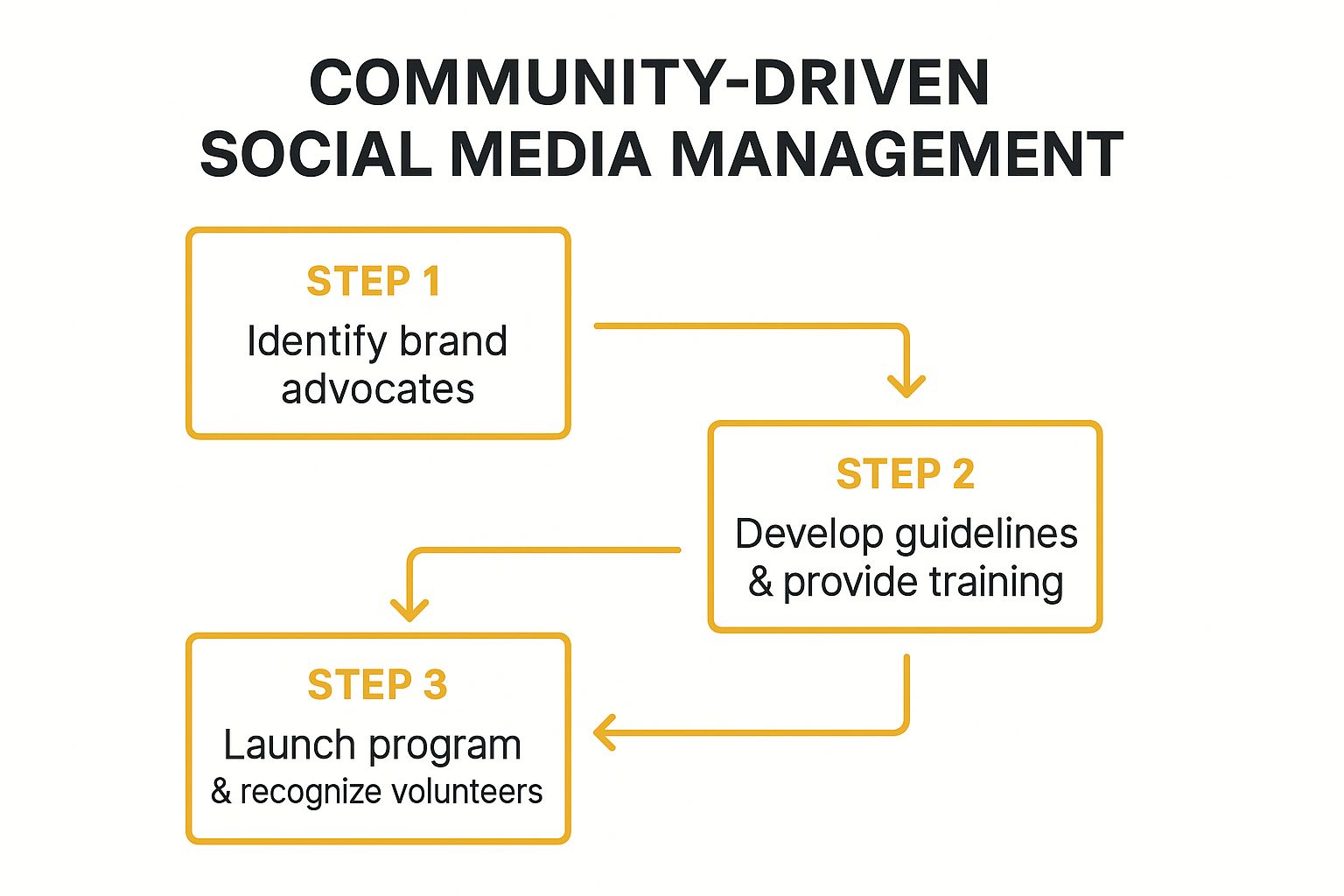
This simple three-step process highlights the importance of a structured approach, from identifying key advocates to providing ongoing support and recognition. By following these steps, businesses can effectively leverage the power of their communities to achieve low cost social media management while fostering authentic engagement.
Implementing community-driven management is particularly beneficial for businesses with a strong existing community or those looking to build one. It's an excellent strategy for small business owners seeking cost-effective marketing solutions, digital marketing agencies exploring innovative engagement tactics, and e-commerce managers aiming to boost conversions and cultivate brand loyalty. By tapping into the passion and expertise of your community, you can achieve sustainable growth and foster meaningful connections that translate to long-term success. Inspired by the community-focused models of Airbnb (Brian Chesky), LinkedIn (Reid Hoffman), and Zappos (Tony Hsieh), this approach proves that building a strong community can be a powerful driver of both brand loyalty and cost-effective growth.
5. AI-Powered Content Creation Tools
For UK businesses seeking low cost social media management, AI-powered content creation tools are a game-changer. These tools leverage artificial intelligence to automate and streamline many aspects of content creation, from generating captions and hashtags to creating graphics and scheduling posts. This allows businesses with limited resources to produce professional-quality social media content without needing extensive design skills or a large marketing budget. This approach significantly reduces the time and effort traditionally required for effective social media management, making it a valuable asset for businesses of all sizes.
AI-powered tools offer a range of features designed to simplify and enhance social media content creation. These include AI-generated captions and copywriting, automated hashtag research and suggestions, AI-powered image and graphic creation tools, content idea generation and trend analysis, and even automated posting and engagement optimization. Imagine crafting engaging captions in seconds, discovering the most relevant hashtags without laborious research, and designing eye-catching visuals even without graphic design expertise. This is the power of AI in social media management.
Several successful implementations highlight the efficacy of these tools. Jasper AI, for example, is being used by e-commerce brands in the UK and beyond to create compelling product descriptions and engaging social media posts. Canva's Magic Write feature is a boon for crafting quick and effective social media captions, while Copy.ai empowers small businesses to generate high-quality content for platforms like Instagram and Facebook. Even established social media management platforms like Hootsuite (with OwlyWriter) and Later are incorporating AI-powered caption generation features, demonstrating the growing importance of this technology.
To maximize the benefits of AI-powered content creation tools for low cost social media management, consider these actionable tips:
- Start with free tiers: Many AI tools offer free trials or free tiers, allowing you to test their effectiveness before committing to a paid subscription.
- Personalize AI-generated content: While AI can generate a great starting point, always review and personalize the content to reflect your unique brand voice and resonate with your target audience. Avoid sounding generic.
- Use AI for initial drafts: Leverage AI to overcome writer's block and generate initial drafts quickly, then refine the content with your own insights and creativity.
- Combine multiple AI tools: Don’t limit yourself to a single tool. Experiment with different platforms to discover the combination that best suits your specific needs and content creation workflow. For example, you might use one tool for image generation and another for caption writing.
- Track performance: Monitor the performance of your AI-generated content to identify what resonates most with your audience and refine your strategy accordingly. Data-driven insights are key to optimizing your social media presence.
- Maintain a content calendar: Even with the automation provided by AI, a well-structured content calendar is crucial for maintaining consistency and ensuring your social media strategy aligns with your overall marketing goals.
Choosing to incorporate AI-powered content creation tools is a smart move for several reasons. It dramatically reduces content creation time, ensuring consistent posting quality and frequency. It also provides access to professional-quality content even without in-house design skills, often proving more cost-effective than hiring external agencies or freelancers. The data-driven optimization suggestions offered by many of these tools can help you continually refine your strategy and improve your results. Finally, AI-driven content production is highly scalable, allowing you to easily increase your output as your business grows.
However, it's important to be aware of the potential drawbacks. AI-generated content can sometimes lack a personal touch or genuine brand personality. There's also a risk of the content becoming generic or repetitive if not carefully curated and personalized. There's often a learning curve associated with optimizing these tools for your specific needs, and ongoing subscription costs should be factored into your budget. Finally, while AI can automate many tasks, human oversight and strategy are still essential for successful social media management. Learn more about AI-Powered Content Creation Tools
Pioneered by individuals like Dave Rogenmoser (Jasper AI), Paul Yacoubian (Copy.ai), and Melanie Perkins (Canva), AI-powered content creation is transforming the landscape of social media management. By understanding the capabilities and limitations of these tools, businesses in the UK can leverage the power of AI to achieve significant cost savings and enhance their social media presence.
6. Cross-Platform Content Syndication
Cross-platform content syndication is a cornerstone of low cost social media management. This strategic approach allows you to maximise your content's reach without exponentially increasing your workload. Essentially, it involves adapting and distributing the same core message across multiple social media platforms. This doesn't mean simply copying and pasting the same post everywhere; it requires creating platform-optimized versions to resonate with each platform's unique audience and format requirements. By strategically repurposing your content, you can significantly increase efficiency and reach a wider audience without breaking the bank. This method is particularly valuable for small business owners, e-commerce managers, and content creators in the UK looking to stretch their marketing budget and amplify their online presence.
Imagine crafting a compelling blog post about the latest trends in your industry. With cross-platform content syndication, this single piece of content can become a Twitter thread highlighting key takeaways, an engaging Instagram carousel showcasing visual examples, a LinkedIn article targeting professionals, and even a short, snappy video for TikTok and Instagram Reels. This method ensures consistent brand messaging across various touchpoints while catering to the specific nuances of each platform.
Several successful individuals and businesses have demonstrated the power of cross-platform content syndication. Rand Fishkin, a prominent figure in the SEO world, effectively shares his insights across Twitter, LinkedIn, and Facebook, tailoring his message and format for each platform. BuzzFeed expertly adapts its video content for platforms like TikTok, Instagram Reels, and YouTube Shorts, capturing the attention of diverse audiences. Similarly, marketing guru Neil Patel syndicates his valuable tips across all major platforms, reaching a vast network of marketers and entrepreneurs. Shopify, a leading e-commerce platform, leverages LinkedIn, Twitter, Instagram, and even TikTok to share e-commerce advice, catering to a broad spectrum of businesses. These examples highlight the versatility and effectiveness of this approach for various industries and niches.
So, how can you implement cross-platform content syndication effectively? Here are some actionable tips:
- Create a master content calendar: Plan your content in advance, mapping out how each piece will be adapted for different platforms. This centralised planning ensures consistent messaging and helps streamline your workflow.
- Understand platform nuances: Each platform has its own optimal content formats, posting times, and audience expectations. Tailor your content accordingly to maximize engagement. For instance, visual content thrives on Instagram, while professional insights are best suited for LinkedIn.
- Use native platform features: Leverage platform-specific features like Stories, Reels, and live streams instead of simply cross-posting. This demonstrates a deeper understanding of the platform and enhances audience engagement.
- Tailor captions and hashtags: Craft platform-specific captions and use relevant hashtags to target the right audience on each platform. This helps your content gain visibility and reach a wider audience.
- Analyse and refine: Use analytics to track performance and identify which platforms perform best for different content types. This data-driven approach allows you to optimise your strategy and focus your efforts on the most effective channels.
- Stagger posting times: Consider slight timing delays between platforms to test performance and avoid appearing overly repetitive to cross-platform followers.
Learn more about Cross-Platform Content Syndication
While cross-platform content syndication offers numerous benefits for low cost social media management, it's crucial to be aware of the potential drawbacks. One key challenge is the risk of seeming repetitive to followers who follow you across multiple platforms. Addressing this requires careful adaptation and tailoring of your content for each platform. Additionally, each platform may demand significant adaptation, requiring time and resources. Different optimal posting times and frequencies can also add complexity to your social media management. Finally, focusing too heavily on syndication may dilute platform-specific audience building efforts and requires a thorough understanding of multiple platform algorithms.
Despite these challenges, the benefits of cross-platform content syndication often outweigh the drawbacks. It maximizes reach with minimal additional effort, reinforces brand messaging through multiple touchpoints, and allows for efficient use of content creation resources. By strategically implementing these tips and understanding the nuances of each platform, you can leverage the power of cross-platform content syndication to elevate your low cost social media management strategy and achieve significant results. This approach is especially beneficial in the UK market, where businesses are increasingly seeking cost-effective ways to enhance their online presence and reach a wider audience.
7. Employee Advocacy Programs: A Low-Cost Social Media Management Powerhouse
In the competitive landscape of social media marketing, finding low-cost social media management solutions that deliver impactful results is a top priority. Employee advocacy programs emerge as a potent strategy, transforming your team members into authentic brand ambassadors and significantly amplifying your social media presence without breaking the bank. This approach capitalises on the power of organic reach and genuine engagement, making it a valuable asset for businesses of all sizes, particularly small businesses and startups in the UK looking to maximize their marketing budget.
An employee advocacy program encourages and empowers employees to share company content and represent the brand on their personal social media accounts. Instead of relying solely on the company's official channels, this strategy leverages the combined networks of your employees, extending your brand's reach exponentially and tapping into a wider audience. It's a shift from a centralised, corporate voice to a distributed, human-centric approach, fostering trust and building deeper connections with potential customers.
How does it work?
Employee advocacy is built on a foundation of internal content sharing and employee engagement. Businesses create easily digestible content libraries, including blog posts, news articles, industry insights, and even behind-the-scenes glimpses of company culture. Employees are then encouraged, not mandated, to share this content with their networks. By empowering employees to share what resonates with them, the content feels more organic and less like a forced marketing message.
Real-World Success Stories:
Numerous global companies have successfully implemented employee advocacy programs, demonstrating the tangible benefits of this approach:
- IBM: With over 45,000 employee advocates, IBM showcases the scalability and potential of a well-structured program.
- Adobe: Adobe's social media advocacy program resulted in a staggering 2000% increase in reach, highlighting the potential for exponential growth.
- Dell: Dell attributes $6 million in additional revenue to its employee advocacy program, directly linking the strategy to tangible financial gains.
- Microsoft: Microsoft's employee advocates have generated millions of social impressions, solidifying the brand's online presence and reach.
- Starbucks: Starbucks partners (employees) frequently share company culture and values, humanising the brand and fostering a sense of community.
These examples demonstrate the effectiveness of employee advocacy across various industries, proving its relevance for businesses in the UK market as well.
Actionable Tips for Implementing an Employee Advocacy Program:
- Start Small and Organic: Begin with a pilot group of enthusiastic volunteers rather than mandating participation. This allows for a smoother rollout and fosters genuine engagement.
- Provide Clear Guidelines and Training: Offer comprehensive social media guidelines and brand voice training to ensure consistent brand representation and mitigate potential risks.
- Curate Easy-to-Share Content: Create readily available content libraries with diverse formats, including images, videos, and pre-written captions, simplifying the sharing process for employees.
- Recognize and Reward Participation: Implement a system to acknowledge and reward active employee advocates, fostering a culture of appreciation and encouraging continued participation.
- Leverage Technology: Explore dedicated employee advocacy platforms like Hootsuite Amplify or EveryoneSocial to streamline content distribution and track performance.
- Track and Measure Success: Monitor key metrics like reach, engagement, and website traffic to assess the program's effectiveness and make data-driven adjustments.
- Respect Personal Boundaries: Emphasise that participation is voluntary and respect individual comfort levels regarding sharing on personal social media accounts.
Pros and Cons:
While employee advocacy offers significant advantages for low-cost social media management, it's essential to be aware of potential challenges:
Pros:
- Significantly expands organic reach
- Creates authentic and trustworthy brand representation
- Reduces dependence on paid advertising
- Builds employee engagement and pride
- Cost-effective compared to influencer marketing
- Humanises brand presence
Cons:
- Less control over messaging and timing
- Requires employee buy-in and participation
- Risk of inconsistent brand representation
- Need for social media training and guidelines
- Potential for personal/professional boundary issues
Why Employee Advocacy Deserves Its Place in Your Low-Cost Social Media Management Strategy:
Employee advocacy provides a cost-effective way to amplify your brand's message, build trust, and reach a wider audience. By leveraging the authentic voices of your team, you can create a more engaging and human-centric social media presence, reducing reliance on expensive advertising campaigns and driving organic growth. For UK businesses navigating a competitive market, employee advocacy offers a powerful and affordable solution for achieving impactful social media results.
7 Low-Cost Social Media Strategies Compared
| Strategy | Implementation Complexity 🔄 | Resource Requirements ⚡ | Expected Outcomes 📊 | Ideal Use Cases 💡 | Key Advantages ⭐ |
|---|---|---|---|---|---|
| Content Batching and Scheduling | Medium – requires upfront planning and time blocking | Moderate – scheduling tools and dedicated batch time | High consistency and efficiency in posting | Small businesses, solopreneurs, startups with limited daily social management | Saves daily time, ensures schedule consistency, reduces mental fatigue |
| User-Generated Content (UGC) Strategy | Medium – needs active community management | Low to Moderate – incentives and curation effort | Strong engagement, authentic social proof | Brands with active communities wanting to build trust and loyalty | Cost-effective, builds community and peer trust |
| Repurposing Single Content Pieces | Medium – requires content adaptation skills | Moderate – templates and tool use | Increased content volume with minimal new creation | Businesses with quality long-form content aiming for cross-platform presence | Maximizes ROI on content, reaches diverse audiences |
| Community-Driven Management | High – needs community building, training, and moderation | Low to Moderate – training and volunteer support | Scalable engagement, authentic peer interactions | Brands aiming for strong community ties and cost-effective management | Reduces costs, 24/7 presence, deepens community bonds |
| AI-Powered Content Creation Tools | Low to Medium – learning curve on AI tools | Low to Moderate – subscription costs and oversight | Fast, consistent content generation | Businesses seeking to scale content with limited design skills | Saves time, professional quality, data-driven optimization |
| Cross-Platform Content Syndication | Medium – requires platform-specific adaptations | Moderate – content planning and optimization for multiple platforms | Broad reach and reinforced brand messaging | Brands wanting maximum exposure across multiple social channels | Efficient resource use, consistent messaging, wide reach |
| Employee Advocacy Programs | Medium – needs employee training and engagement | Low to Moderate – guidelines, tools, and incentives | Expanded organic reach, authentic brand voice | Companies wanting authentic representation and greater reach | Cost-effective, humanizes brand, increases employee pride |
Level Up Your Social Media Game
Mastering low cost social media management is no longer a luxury, but a necessity for businesses and individuals looking to thrive in today's digital landscape. Throughout this article, we've explored seven key strategies – from content batching and scheduling to leveraging AI-powered tools and employee advocacy – that empower you to maximize your social media impact without breaking the bank. By embracing user-generated content, repurposing existing materials, and fostering a strong online community, you can amplify your reach organically. Remember, effective cross-platform syndication and strategic use of AI can further streamline your workflow and boost your content's visibility.
The most important takeaway here is that low cost social media management isn't about cutting corners; it's about working smarter, not harder. These strategies free up your time and resources, allowing you to focus on what truly matters: connecting with your audience, building meaningful relationships, and ultimately driving business growth. Implementing even a few of these techniques can significantly enhance your brand presence and engagement across various platforms, leading to increased brand awareness, improved customer loyalty, and ultimately, a stronger bottom line.
Ready to take your low cost social media management to the next level? Explore The Digital Marketing Toolbox for a curated selection of resources and tools designed to streamline your social media efforts and help you achieve sustainable growth. This comprehensive toolbox provides valuable support for everything from content creation and scheduling to analytics and community engagement, making efficient and effective social media management within everyone's reach.


